Japan Industrial Acids Market Size & Growth Rate
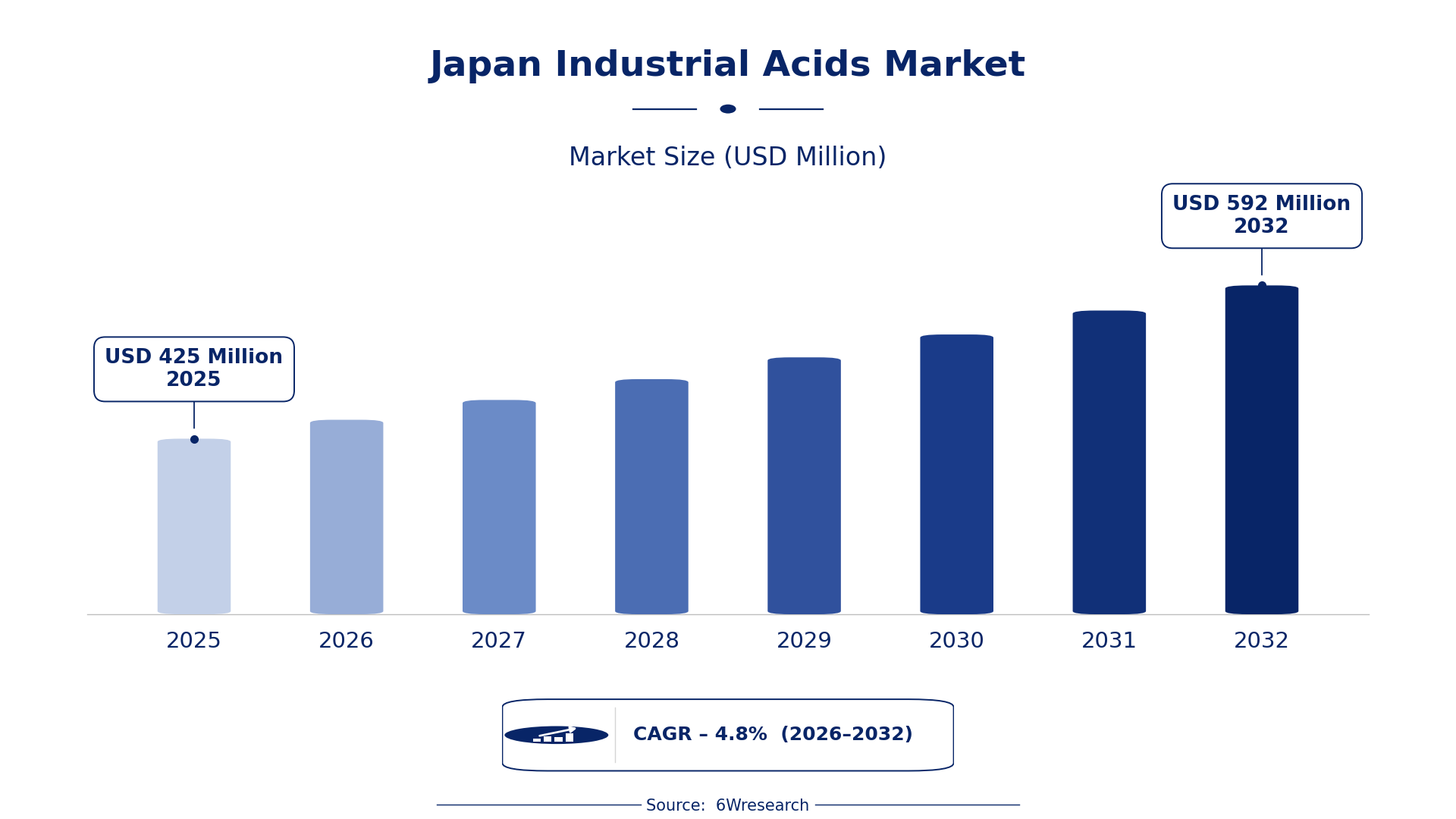
According to 6Wresearch internal database and industry insights, the Japan Industrial Acids Market was valued at USD 425 Million in 2025 and is projected to reach USD 592 Million by 2032, growing at a CAGR of approximately 4.8% during 2026–2032.
Japan Industrial Acids Market Highlights
| Report Metric | Details |
| Report Name | Japan Industrial Acids Market (2026-2032) |
| Market Size 2025 | USD 425 Million |
| Market Size 2032 | USD 592 Million |
| Absolute Growth 2025–2032 | USD 167 Million |
| CAGR 2026–2032 | 4.8% |
| Peak Annual Growth | 5.3% in 2032 |
| Forecast Period | 2026–2032 |
| Historical Data | 2022–2025 |
| Base Year | 2025 |
| Leading Acid Type, 2025 | Sulfuric Acid (48% share) |
| Leading Source, 2025 | Mineral (43% share) |
| Leading Use Case, 2025 | Fertilizers (40% share) |
| Leading End User, 2025 | Chemical Manufacturers (49% share) |
| Fastest-Growing Acid Type | Hydrochloric Acid (6.7% CAGR) |
| Fastest-Growing Source | Inorganic (7.0% CAGR) |
| Fastest-Growing Use Case | Batteries (6.8% CAGR) |
| Fastest-Growing End User | Metal Treatment Plants (6.4% CAGR) |
| Growing Sector | Metal Treatment Plants |
| Key End Users | Chemical Manufacturers, Metal Treatment Plants, Specialty Chemical Firms, Food & Textile Industries |
Japan Industrial Acids Market Year-wise Growth Rate and Key Drivers (2022–2032)
This graph illustrates the annual growth rates of the market from 2022 to 2032, highlighting a steady upward trajectory and projected market expansion over the forecast period.
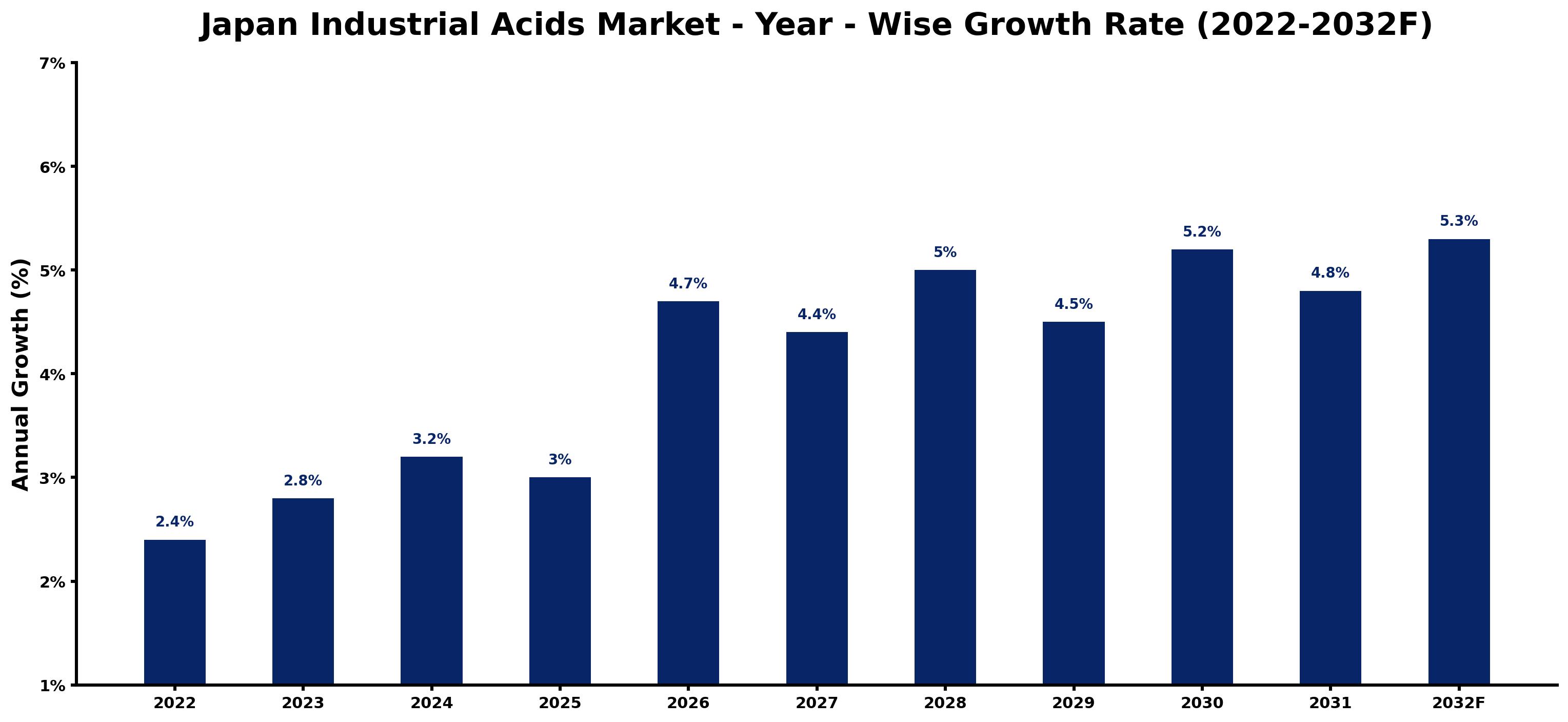
Year by year, the estimates below pair each growth rate with the development that shaped it.
| Year | Estimated Annual Growth (%) | Market Rationale |
| 2022 | 2.4 | The market experienced moderate growth due to stable manufacturing activities. |
| 2023 | 2.8 | Demand increased as chemical production ramped up following recovery efforts. |
| 2024 | 3.2 | Growth accelerated with rising fertilizer production and investments in metallurgy. |
| 2025 | 3.0 | Demand growth slowed as the market adjusted to previous high rates. |
| 2026 | 4.7 | Investment in green technologies is expected to boost demand for industrial acids. |
| 2027 | 4.4 | Growth is projected to moderate as the market stabilises after earlier expansions. |
| 2028 | 5.0 | Demand is anticipated to surge with new projects in battery production and agriculture. |
| 2029 | 4.5 | Market growth is expected to decelerate as demand stabilises following peak investments. |
| 2030 | 5.2 | Increased focus on sustainability will drive demand for eco-friendly acids. |
| 2031 | 4.8 | Market growth is projected to slow as the effects of earlier investments begin to normalise. |
| 2032 | 5.3 | Demand is expected to peak as industries adopt advanced technologies and practices. |
Note: Market size estimations and growth projections presented in this report are based on 6Wresearch's proprietary forecasting methodology, utilizing the latest available industry data, government publications, and primary research inputs.
Japan Industrial Acids Market Synopsis
Industrial acids are crucial chemical compounds produced through synthesis or extraction, playing a key role in the manufacturing of fertilizers, pharmaceuticals, and metal treatment. Investments in sustainable practices and a focus on eco-friendly production methods are further stimulating demand from domestic users and downstream processing industries.
Market Dynamics Impact Analysis (2026–2032)
| Factor | Type | Impact | Primary Segment Affected |
| Sustained investments in green chemistry initiatives | Driver | High | Fertilizers |
| Growing production of nitric acid for explosives and fertilizers | Driver | High | Nitric Acid |
| Emerging demand for battery production in the Kansai region | Opportunity | Medium | Batteries |
| Investment in sustainable agricultural practices in Tokyo | Opportunity | Medium | Fertilizers |
| Regulatory compliance costs for chemical manufacturers | Restraint | High | Chemical Manufacturers |
| Rising costs of raw materials affecting production | Restraint | High | Acetic Acid |
| High energy costs impacting operational efficiency | Challenge | High | Metal Treatment Plants |
| Competition from alternative chemical sources | Challenge | Medium | Organic |
Evaluation of Drivers in Japan Industrial Acids Market (2026–2032)
The following drivers explain most of the expected growth.
| Drivers | Primary Segment Affected | Why It Matters (Evidence) |
| Increased fertilizer production | Fertilizers | Japan's fertilizer production was valued at 1.5 trillion yen in 2023, leading to higher acid demand. |
| Expansion of battery manufacturing | Batteries | The growth of the electric vehicle market in Kansai has resulted in a 20% increase in acid consumption for battery manufacturing. |
| Rising nitric acid production | Nitric Acid | Demand for nitric acid has surged due to its essential role in explosives for construction projects. |
| Investment in sustainable practices | Acetic Acid | The Tokyo Chemical Industry Association promotes sustainable practices, increasing acetic acid usage in food preservation. |
| Regulatory compliance driving innovation | Chemical Manufacturers | The PRTR Law mandates reporting of chemical substances, pushing manufacturers to innovate and improve processes. |
The strongest pull on demand comes from increased fertilizer production, with the agricultural sector consuming a large portion of industrial acids. In 2023, Japan's fertilizer production was valued at 1.5 trillion yen, prompting chemical manufacturers to ramp up output. Growth in battery manufacturing, especially in the Kansai region, drives demand for lead-acid batteries, which require substantial acid inputs. The rising production of nitric acid is crucial for explosives, as construction projects boost demand. Investment in sustainable practices is increasing the use of acetic acid in food preservation and chemical synthesis, aligning with market trends.
Evaluation of Restraints in Japan Industrial Acids Market
These are the pressures that could keep growth below its potential.
| Market Restraint | Primary Segment Affected | Why It Matters (Evidence) |
| High compliance costs due to regulatory measures | Chemical Manufacturers | The PRTR Law requires extensive reporting, increasing operational costs for manufacturers. |
| Fluctuating raw material prices affecting profitability | Acetic Acid | Rising costs of raw materials impact the production of acetic acid, squeezing margins. |
| Increased competition from alternative chemical sources | Organic | Growing availability of bio-based chemicals presents challenges to traditional acid markets. |
| Energy costs impacting production efficiency | Metal Treatment Plants | High energy costs reduce profitability for metal treatment facilities reliant on acids. |
| Market saturation in certain acid segments | Fertilizers | Increased production capacity has led to oversupply in some fertilizer acid segments. |
Japan Industrial Acids Market Challenges
Producers face challenges with outdated technology, which limits efficiency and raises operational costs for manufacturers, ultimately affecting their competitiveness. Importers encounter skills shortages, as the chemical sector employs over 800,000 people, leading to delays in meeting market demands. Rising production costs burden buyers, particularly in the agricultural sector, where fertilizer production was valued at 1.5 trillion yen in 2023, forcing them to adjust their financial plans. Buyers must also navigate complex regulations, as standards like JIS Z 8801 complicate procurement processes and increase compliance costs.
Trends in the Japan Industrial Acids Market
Below are the shifts with the largest effect on the Japan Industrial Acids Market.
- Shift towards Sustainable Practices in Chemical Manufacturing: Since 2023, the Tokyo region has seen a shift towards sustainable practices in chemical manufacturing, with over 200 registered chemical manufacturers focusing on eco-friendly acids.
- Emergence of Battery Production as a Key Demand Driver: Starting in 2026, battery production has emerged as a key demand driver for industrial acids, resulting in a 20% increase in acid consumption for battery manufacturing.
- Rising Demand for Acetic Acid in Food Preservation: In 2023, the demand for acetic acid in food preservation surged, evidenced by a 15% increase in acetic acid usage in food additives.
- Increased Focus on Regulatory Compliance: Beginning in 2026, chemical manufacturers have intensified their focus on regulatory compliance due to the PRTR Law, leading to a 30% increase in investments aimed at meeting compliance standards.
Investment Opportunities in the Japan Industrial Acids Market
The following areas offer the clearest openings for investors and suppliers in the Japan Industrial Acids Market.
- Kansai Region's Battery Manufacturing Facilities: The Kansai region is currently expanding battery manufacturing facilities, creating a demand gap for industrial acids. This presents an opportunity for suppliers to partner with local manufacturers and meet the growing needs.
- Investment in Green Chemistry Initiatives: With Japan's target of a 46% cut in greenhouse-gas emissions by 2030, there is a growing opportunity to supply eco-friendly acids. Chemical manufacturers are actively seeking sustainable solutions.
- Expansion of Fertilizer Production: The agricultural sector's increasing reliance on fertilizers offers a significant opportunity to supply industrial acids, particularly in regions with high agricultural output.
- Development of Eco-Friendly Food Additives: The rising demand for natural preservatives in food processing creates an opportunity to supply acetic acid. Collaborating with food manufacturers can facilitate market entry.
Government Initiatives in the Japan Industrial Acids Market
The PRTR Law, enacted in 1999, mandates businesses to report the release and transfer of designated chemical substances, ensuring transparency in the industrial acids sector. Compliance with this law is crucial for producers, as it requires rigorous monitoring and reporting, which can involve significant administrative costs. The Chemical Substances Control Law, established in 1973, further obliges manufacturers to evaluate and control chemical substances, impacting their production processes and necessitating investments in safety measures.
The Ministry of Economy, Trade and Industry oversees the implementation of the Chemical Substances Control Law, approving new chemical substances for production and import. This agency also funds initiatives aimed at promoting green chemistry, supporting projects that align with sustainable practices. In recent years, the government has allocated substantial resources to enhance compliance with environmental regulations, benefiting chemical manufacturers and ensuring safer production methods.
Future Insight of the Japan Industrial Acids Market
Innovations in green chemistry will reshape the demand for industrial acids by 2032, driven by Japan's goal to achieve net zero emissions by 2050. A JPY 150 trillion investment in decarbonisation over the next decade will encourage suppliers to adopt new technologies. Compliance with evolving standards such as JIS Z 8801 will promote higher quality and sustainability in production. The agricultural sector will increasingly pursue eco-friendly solutions, aligning with government targets to reduce industrial waste by 30% by 2030.
Market Segmentation Analysis
Japan Industrial Acids Market report covers a detailed analysis of the following market segments:
By Acid Type – Sulfuric Acid Leads, Hydrochloric Acid Expected to Grow Fastest
According to Saurav Kr Singh, Senior Research Analyst at 6Wresearch, Sulfuric Acid accounted for 48% of the market by acid type in 2025. Sulfuric acid holds the largest market share in Japan due to its essential applications in battery production and fertilizers, which are crucial for agricultural productivity. The production of 3 million tons in 2022 illustrates the strong domestic reliance on this acid. The quickest growth will come from Hydrochloric Acid, forecast to expand at a CAGR of 6.7% between 2026 and 2032. Hydrochloric acid is witnessing rapid growth owing to its increasing utilisation in metal treatment and pH control, which are vital for various industrial processes. The establishment of new metal treatment facilities in the Kansai region significantly contributes to this demand. Suppliers should focus on hydrochloric acid products to capitalise on its growing market presence.
By Source – Mineral Leads, Inorganic Expected to Grow Fastest
Mineral took 43% of source revenue in 2025, more than any other category. Mineral sources dominate the market as they are the primary origin for inorganic acids, essential for numerous industrial applications. The existence of over 200 registered chemical manufacturers in Japan highlights the industry's dependence on mineral sources for production. Over 2026–2032, Inorganic is expected to post the fastest growth, at a CAGR of 7.0%. Inorganic sources are experiencing accelerated growth due to their versatility across multiple industrial sectors, especially in chemicals and metallurgy. The industry's commitment to sustainable practices is a key factor propelling this trend. Buyers should consider inorganic sources to meet their varied industrial needs effectively.
By Use Case – Fertilizers Lead, Batteries Expected to Grow Fastest
The largest use case category in 2025 was Fertilizers, at 40% of revenue. Fertilizers represent the leading use case for industrial acids, as they are critical for agricultural production in Japan, which values sustainable farming practices. The fertilizer production was valued at 1.5 trillion yen in 2023, highlighting the importance of this segment. Batteries are set to record the highest CAGR in this split, 6.8% over 2026–2032. Batteries are the fastest-growing use case, primarily due to the increasing demand for lead-acid batteries in various applications, including renewable energy storage. The ongoing transition towards greener energy solutions is likely to further boost this segment. Suppliers should align their strategies to cater to the growing demand for battery-related applications.
By End User – Chemical Manufacturers Lead, Metal Treatment Plants Expected to Grow Fastest
In 2025, Chemical Manufacturers led the end user split with a 49% share. Chemical manufacturers are the largest consumer group for industrial acids, as these compounds are integral to their production processes. With over 800,000 employees in this sector, the substantial industrial base supports significant acid consumption. Metal Treatment Plants are projected to grow fastest, at a CAGR of 6.4% during 2026–2032. Metal treatment plants are rapidly growing as their need for industrial acids for surface treatment processes escalates. The ongoing expansion of these facilities in the Kansai region plays a crucial role in this growth. Suppliers should enhance relationships with metal treatment plants to take advantage of this expanding market.
Key Attractiveness of the Report
- 10 Years of Market Numbers
- Historical Data Starting from 2022 to 2025
- Base Year 2025
- Forecast Data until 2032
- Key Performance Indicators Impacting the Market
- Major Upcoming Developments and Projects
Key Highlights of the Report:
- Japan Industrial Acids Market Outlook
- Market Size of Japan Industrial Acids Market, 2025
- Forecast of Japan Industrial Acids Market, 2032
- Historical Data and Forecast of Japan Industrial Acids Revenues & Volume for the Period 2022-2032F
- Japan Industrial Acids Market Trend Evolution
- Japan Industrial Acids Market Drivers and Challenges
- Japan Industrial Acids Price Trends
- Japan Industrial Acids Porter's Five Forces
- Japan Industrial Acids Industry Life Cycle
- Historical Data and Forecast of Japan Industrial Acids Market Revenues & Volume By Acid Type for the Period 2022-2032F
- Historical Data and Forecast of Japan Industrial Acids Market Revenues & Volume By Sulfuric Acid for the Period 2022-2032F
- Historical Data and Forecast of Japan Industrial Acids Market Revenues & Volume By Hydrochloric Acid for the Period 2022-2032F
- Historical Data and Forecast of Japan Industrial Acids Market Revenues & Volume By Nitric Acid for the Period 2022-2032F
- Historical Data and Forecast of Japan Industrial Acids Market Revenues & Volume By Acetic Acid for the Period 2022-2032F
- Historical Data and Forecast of Japan Industrial Acids Market Revenues & Volume By Source for the Period 2022-2032F
- Historical Data and Forecast of Japan Industrial Acids Market Revenues & Volume By Mineral for the Period 2022-2032F
- Historical Data and Forecast of Japan Industrial Acids Market Revenues & Volume By Inorganic for the Period 2022-2032F
- Historical Data and Forecast of Japan Industrial Acids Market Revenues & Volume By Inorganic for the Period 2022-2032F
- Historical Data and Forecast of Japan Industrial Acids Market Revenues & Volume By Organic for the Period 2022-2032F
- Historical Data and Forecast of Japan Industrial Acids Market Revenues & Volume By Use Case for the Period 2022-2032F
- Historical Data and Forecast of Japan Industrial Acids Market Revenues & Volume By Fertilizers, Batteries for the Period 2022-2032F
- Historical Data and Forecast of Japan Industrial Acids Market Revenues & Volume By Steel Pickling, pH Control for the Period 2022-2032F
- Historical Data and Forecast of Japan Industrial Acids Market Revenues & Volume By Explosives, Pharmaceuticals for the Period 2022-2032F
- Historical Data and Forecast of Japan Industrial Acids Market Revenues & Volume By Food Additives, Dyes for the Period 2022-2032F
- Historical Data and Forecast of Japan Industrial Acids Market Revenues & Volume By End User for the Period 2022-2032F
- Historical Data and Forecast of Japan Industrial Acids Market Revenues & Volume By Chemical Manufacturers for the Period 2022-2032F
- Historical Data and Forecast of Japan Industrial Acids Market Revenues & Volume By Metal Treatment Plants for the Period 2022-2032F
- Historical Data and Forecast of Japan Industrial Acids Market Revenues & Volume By Specialty Chemical Firms for the Period 2022-2032F
- Historical Data and Forecast of Japan Industrial Acids Market Revenues & Volume By Food & Textile Industries for the Period 2022-2032F
- Japan Industrial Acids Import Export Trade Statistics
- Market Opportunity Assessment By Acid Type
- Market Opportunity Assessment By Source
- Market Opportunity Assessment By Use Case
- Market Opportunity Assessment By End User
- Japan Industrial Acids Top Companies Market Share
- Japan Industrial Acids Competitive Benchmarking By Technical and Operational Parameters
- Japan Industrial Acids Company Profiles
- Japan Industrial Acids Key Strategic Recommendations
Market Covered
The following segment groups are covered in the report.
By Acid Type
- Sulfuric Acid
- Hydrochloric Acid
- Nitric Acid
- Acetic Acid
By Source
- Mineral
- Inorganic
- Organic
By Use Case
- Fertilizers
- Batteries
- Steel Pickling
- pH Control
- Explosives
- Pharmaceuticals
- Food Additives
- Dyes
By End User
- Chemical Manufacturers
- Metal Treatment Plants
- Specialty Chemical Firms
- Food & Textile Industries































