Japan Industrial Air Cleaner Market Size & Growth Rate
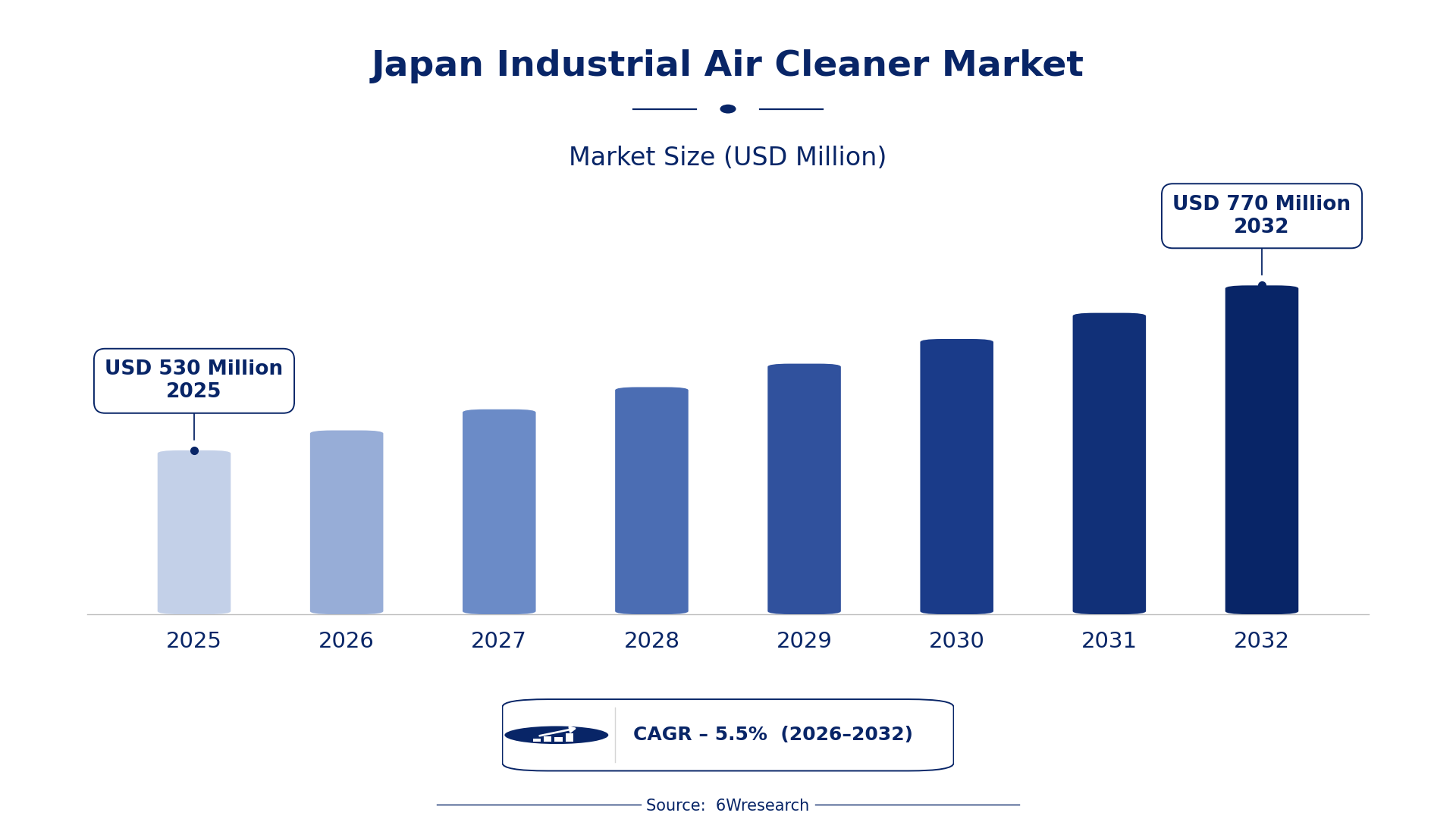
According to 6Wresearch internal database and industry insights, the Japan Industrial Air Cleaner Market was valued at USD 530 Million in 2025 and is projected to reach USD 770 Million by 2032, growing at a CAGR of approximately 5.5% during 2026–2032.
Japan Industrial Air Cleaner Market Highlights
| Report Metric | Details |
| Report Name | Japan Industrial Air Cleaner Market (2026-2032) |
| Market Size 2025 | USD 530 Million |
| Market Size 2032 | USD 770 Million |
| Absolute Growth 2025–2032 | USD 240 Million |
| CAGR 2026–2032 | 5.5% |
| Peak Annual Growth | 6.9% in 2032 |
| Forecast Period | 2026–2032 |
| Historical Data | 2022–2025 |
| Base Year | 2025 |
| Leading Cleaner Type, 2025 | HEPA Filter Systems (41% share) |
| Leading Filtration Technology, 2025 | Multi-Layer Filters (47% share) |
| Leading Target Contaminant, 2025 | Particulate Matter (47% share) |
| Leading End User, 2025 | Manufacturing Facilities (40% share) |
| Fastest-Growing Cleaner Type | Activated Carbon Units (7.8% CAGR) |
| Fastest-Growing Filtration Technology | Adsorption (7.9% CAGR) |
| Fastest-Growing Target Contaminant | VOCs & Odors (8.3% CAGR) |
| Fastest-Growing End User | Food Production Plants (7.2% CAGR) |
| Growing Sector | Manufacturing Facilities |
| Key End Users | Manufacturing Facilities, Pharmaceutical Plants, Food Production Plants, Chemical Processing Units |
Japan Industrial Air Cleaner Market Year-wise Growth Rate and Key Drivers (2022–2032)
This graph illustrates the annual growth rates of the market from 2022 to 2032, highlighting a steady upward trajectory and projected market expansion over the forecast period.
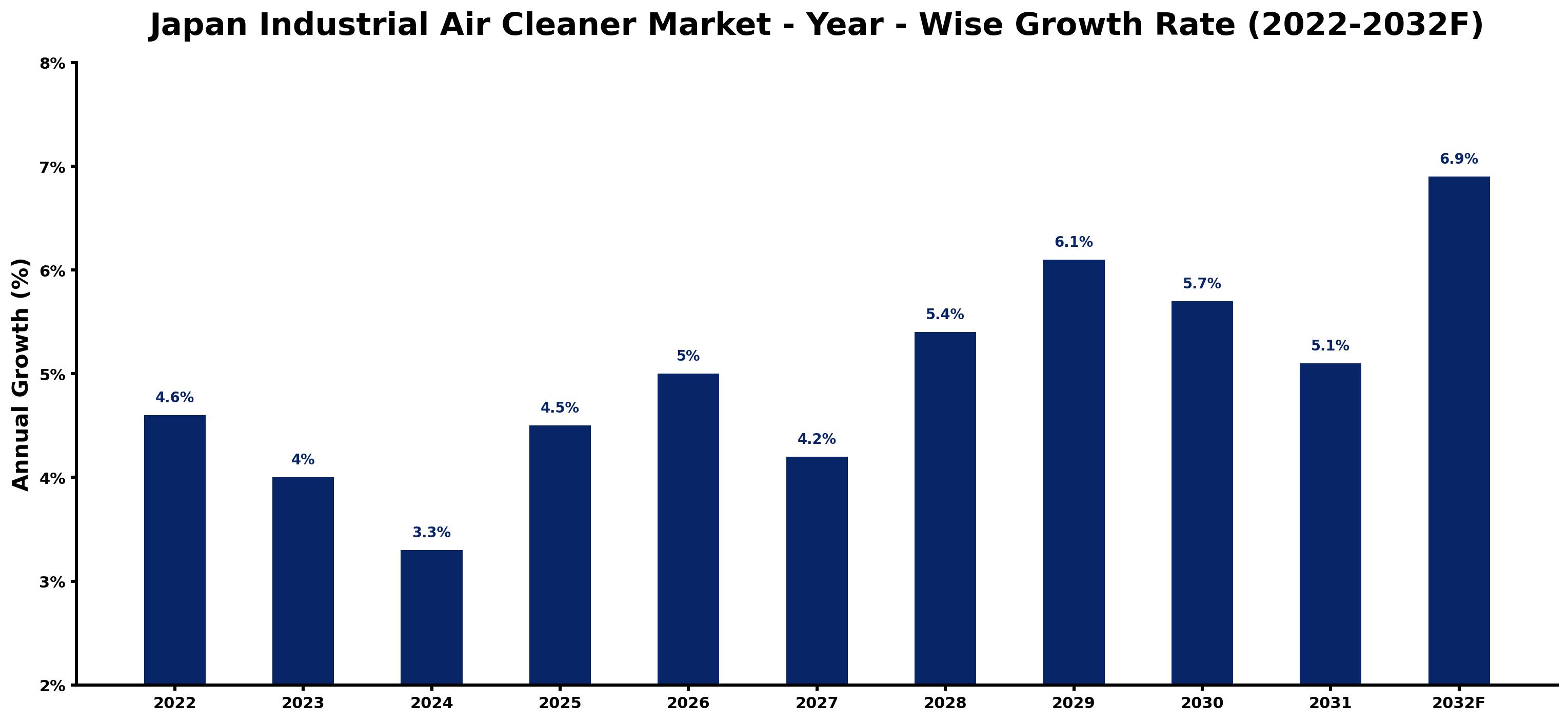
The yearly estimates that follow link every growth rate to its principal driver, so readers can see why the pace changed in each period.
| Year | Estimated Annual Growth (%) | Market Rationale |
| 2022 | 4.6 | The market experienced steady demand due to strong manufacturing activity. |
| 2023 | 4.0 | Growth slowed as manufacturers adjusted to supply chain challenges. |
| 2024 | 3.3 | Market expansion continued but at a reduced pace amid economic uncertainties. |
| 2025 | 4.5 | Demand increased as industries resumed full operations after disruptions. |
| 2026 | 5.0 | Growth accelerated with rising investments in air quality technologies. |
| 2027 | 4.2 | A slight slowdown occurred as market conditions stabilised. |
| 2028 | 5.4 | Demand surged as companies prioritised compliance with new standards. |
| 2029 | 6.1 | Growth continued as more facilities upgraded their air cleaning systems. |
| 2030 | 5.7 | A slowdown was noted as market saturation began in some areas. |
| 2031 | 5.1 | The market grew at a slower rate as competition intensified. |
| 2032 | 6.9 | Demand peaked with substantial investments in advanced air cleaning solutions. |
Note: Market size estimations and growth projections presented in this report are based on 6Wresearch's proprietary forecasting methodology, utilizing the latest available industry data, government publications, and primary research inputs.
Japan Industrial Air Cleaner Market Synopsis
Industrial air cleaners are devices designed to remove airborne contaminants in industrial environments, primarily utilising filtration technologies such as HEPA filters and activated carbon. The Japan Industrial Air Cleaner Market is growing, driven by the manufacturing sector, which employs over 30 million people and necessitates effective air quality management. The government's dedication to reducing greenhouse gas emissions and promoting air quality improvement programs further fuels demand, especially in regions like Tokyo and Kansai, where industrial activities are concentrated. This combination of elements is expected to sustain market growth in the coming years.
Market Dynamics Impact Analysis (2026–2032)
| Factor | Type | Impact | Primary Segment Affected |
| Rising investments in air quality technologies | Driver | High | HEPA Filter Systems |
| Increasing regulatory standards for air quality | Driver | High | Electrostatic Precipitators |
| Growing need for compliance in manufacturing facilities | Opportunity | High | Manufacturing Facilities |
| Expansion of food production facilities requiring air quality control | Opportunity | Medium | Food Production Plants |
| High initial costs of advanced air cleaning systems | Restraint | High | Activated Carbon Units |
| Limited awareness of air cleaning technologies among smaller manufacturers | Restraint | Medium | UV-Based Air Cleaners |
| Competition from low-cost alternatives in the market | Challenge | High | Multi-Layer Filters |
| Challenges in meeting stringent regulatory compliance | Challenge | Medium | Chemical Processing Units |
Evaluation of Drivers in Japan Industrial Air Cleaner Market (2026–2032)
The table below links each growth driver to the segment it affects and the evidence for it.
| Drivers | Primary Segment Affected | Why It Matters (Evidence) |
| Increased manufacturing output | Manufacturing Facilities | Japan's manufacturing sector employs over 30 million people, driving demand for air cleaning solutions. |
| Government regulations on air quality | Pharmaceutical Plants | The GX Basic Policy targets JPY 150 trillion in investments, boosting air quality technology adoption. |
| Investment in decarbonisation initiatives | Chemical Processing Units | Japan's GX Basic Policy aims for substantial investments, enhancing air quality measures. |
| Rising awareness of health impacts from poor air quality | Food Production Plants | Food production facilities are focusing on hygiene, increasing demand for effective air cleaning systems. |
| Technological advancements in filtration systems | HEPA Filter Systems | Over 50% of air cleaning systems in Japan are HEPA filter-based, improving filtration efficiency. |
The strongest pull on demand comes from increased manufacturing output, particularly in the Tokyo metropolitan area, which houses a high concentration of manufacturing facilities. With over 30 million people employed in this sector, the need for effective air cleaning solutions is paramount. Growing awareness of health impacts from poor air quality is prompting food production facilities to invest in better air quality management systems, further driving demand.
Evaluation of Restraints in Japan Industrial Air Cleaner Market
The key brakes on demand, and where they bite hardest, are shown below.
| Market Restraint | Primary Segment Affected | Why It Matters (Evidence) |
| High initial costs of advanced air cleaning systems | Activated Carbon Units | The upfront investment for advanced systems can deter smaller manufacturers from upgrading. |
| Limited awareness of air cleaning technologies among smaller manufacturers | UV-Based Air Cleaners | Many smaller facilities lack knowledge about available air cleaning solutions, hindering market growth. |
| Challenges in meeting stringent regulatory compliance | Chemical Processing Units | Compliance with evolving regulations can be costly and complex for chemical processors. |
| Competition from low-cost alternatives in the market | Multi-Layer Filters | Cheaper options may appeal to budget-conscious buyers, impacting premium product sales. |
| Supply chain disruptions affecting availability of components | HEPA Filter Systems | Global supply chain issues can delay production and increase costs for manufacturers. |
Japan Industrial Air Cleaner Market Challenges
Manufacturers are contending with rising costs due to supply chain disruptions, as many depend on imports for essential components like HEPA filters, potentially delaying production timelines by up to three months. A shortage of skilled technicians in the air cleaning sector results in longer installation times, affecting productivity for buyers. Compliance with regulations, particularly under the Food Sanitation Act, can increase operational costs by over 20% for food production facilities needing air quality upgrades. Slow technological advancements impede producers from adopting efficient air cleaning solutions, impacting their competitiveness in the market.
Trends in the Japan Industrial Air Cleaner Market
The following changes are redrawing the Japan Industrial Air Cleaner Market.
- Shift from Traditional to Advanced a leading supplier Technologies: Manufacturing facilities are increasingly embracing advanced filtration technologies, such as multi-layer filters, to enhance air quality. In 2022, over 50% of air cleaning systems in Japan were based on HEPA filters, reflecting this shift.
- Growing Focus on Environmental Compliance: The Kansai region is seeing a rise in air quality improvement initiatives, driven by regulatory pressures. The Japanese government aims for a 46% reduction in greenhouse gas emissions by 2030, prompting investments in cleaner technologies.
- Increased Demand for Odor Control Solutions: Food production plants are prioritising odour control, leading to a surge in the adoption of activated carbon units. This segment is projected to grow significantly, indicating strong market potential.
- Emergence of Smart Air Cleaning Systems: Smart air cleaning technologies are becoming more common, particularly in pharmaceutical plants. The integration of IoT in air cleaners is improving monitoring capabilities, aligning with Japan's push for innovation in industrial processes.
Investment Opportunities in the Japan Industrial Air Cleaner Market
The opportunities below stand out in the Japan Industrial Air Cleaner Market for new entrants and existing suppliers.
- Partnerships with Local Manufacturers: Now is an ideal time to enter the market through partnerships with local manufacturers, particularly in the Kansai region, which is key for chemical processing. This area has a high demand for air cleaning solutions.
- Investment in Advanced a leading supplier Technologies: With rising demand for air cleaning solutions, there is an opportunity to invest in advanced filtration technologies. Manufacturing facilities are seeking efficient solutions to meet compliance.
- Expansion into Food Production Sector: Food production plants are focusing on maintaining hygiene, creating opportunities for suppliers of air cleaning systems. The sector is projected to grow significantly, indicating strong market potential.
- Certification and Compliance Support Services: As regulations tighten, offering certification and compliance support services presents a lucrative opportunity. This is particularly relevant for pharmaceutical plants, which require stringent adherence to air quality standards.
Government Initiatives in the Japan Industrial Air Cleaner Market
The Industrial Safety and Health Act of 1972 mandates employer responsibilities for managing hazardous substances and machinery, ensuring safe working environments. This law has led to increased demand for air cleaning solutions across various industries, particularly in manufacturing and chemical processing sectors. The GX Promotion Act, introduced in 2023, further supports decarbonisation efforts, encouraging investments in technology that improve air quality.
The Ministry of the Environment implements air quality improvement programs in industrial zones, funding initiatives that support air cleaning capabilities. The government has allocated resources to ensure compliance with the GX Basic Policy, which regulates air quality standards in various facilities. These efforts aim to ensure that industries meet stringent regulations while promoting healthier work environments.
Future Insight of the Japan Industrial Air Cleaner Market
Japan's commitment to reducing greenhouse gas emissions will drive innovation in air cleaning technologies, prompting suppliers to develop advanced filtration systems. By 2032, anticipated investments in decarbonisation will create substantial demand for industrial air cleaners across various sectors. The adoption of standards like ISO 14644 will improve air quality management in cleanrooms. As the manufacturing sector expands, buyers can expect more efficient air cleaning solutions that enhance compliance and operational performance.
Market Segmentation Analysis
Japan Industrial Air Cleaner Market report covers a detailed analysis of the following market segments:
By Cleaner Type – HEPA Filter Systems Lead, Activated Carbon Units Expected to Grow Fastest
According to Saurav Kr Singh, Senior Research Analyst at 6Wresearch, in 2025, HEPA Filter Systems led the cleaner type split with a 41% share. HEPA filter systems dominate the market due to their critical role in capturing fine particles, especially in cleanrooms where air purity is paramount. Their widespread use is evidenced by the fact that they are essential in 90% of pharmaceutical cleanrooms in Japan. The quickest growth will come from Activated Carbon Units, forecast to expand at a CAGR of 7.8% between 2026 and 2032. Activated carbon units are experiencing rapid growth as they are increasingly utilised in food production facilities for effective odour control, driven by stringent hygiene regulations. The Food Sanitation Act reinforces the need for such solutions, contributing to their swift adoption. Suppliers must focus on enhancing HEPA and activated carbon technologies to meet the growing demands of key industries.
By Filtration Technology – Multi-Layer Filters Lead, Adsorption Expected to Grow Fastest
Multi-Layer Filters held 47% of the Japan Industrial Air Cleaner Market by filtration technology in 2025. Multi-layer filters lead the market because they provide superior filtration efficiency across various applications, making them vital in sectors such as manufacturing and food production. Their effectiveness in capturing diverse contaminants solidifies their strong market position. Over 2026–2032, Adsorption is expected to post the fastest growth, at a CAGR of 7.9%. Adsorption technology is rapidly gaining popularity as it effectively removes volatile organic compounds, particularly in industrial environments where air quality is crucial. This method's integration with existing filtration systems is driving its quick uptake. Buyers should prioritise investments in multi-layer and adsorption technologies to comply with stringent air quality regulations.
By Target Contaminant – Particulate Matter Leads, VOCs & Odors Expected to Grow Fastest
The largest target contaminant category in 2025 was Particulate Matter, at 47% of revenue. Particulate matter is the primary target for air cleaning technologies, especially in industrial settings where dust and fine particles can hinder operations. The focus on reducing particulate emissions aligns with Japan's environmental targets, solidifying its market share. VOCs & Odors are projected to grow fastest, at a CAGR of 8.3% during 2026–2032. VOCs and odours are becoming increasingly important, particularly in food and chemical processing, as regulations tighten around air quality. The rising awareness of health impacts associated with these contaminants is propelling their rapid growth. Suppliers must prioritise solutions that effectively address particulate matter and VOCs to align with market demands and regulatory requirements.
By End User – Manufacturing Facilities Lead, Food Production Plants Expected to Grow Fastest
Manufacturing Facilities took 40% of end user revenue in 2025, more than any other category. Manufacturing facilities are the primary users of industrial air cleaners, driven by the necessity to adhere to safety and air quality regulations. With over 30 million individuals employed in this sector, the demand for reliable air cleaning solutions remains strong. Food Production Plants are set to record the highest CAGR in this split, 7.2% over 2026–2032. Food production plants are seeing the fastest growth as they strive to uphold high hygiene standards and air quality to meet food safety regulations. The rising consumer demand for safe food products is propelling this trend forward. Suppliers need to customise their offerings to cater to the distinct requirements of manufacturing and food production sectors to seize market opportunities.
Key Attractiveness of the Report
- 10 Years of Market Numbers
- Historical Data Starting from 2022 to 2025
- Base Year 2025
- Forecast Data until 2032
- Key Performance Indicators Impacting the Market
- Major Upcoming Developments and Projects
Key Highlights of the Report:
- Japan Industrial Air Cleaner Market Outlook
- Market Size of Japan Industrial Air Cleaner Market, 2025
- Forecast of Japan Industrial Air Cleaner Market, 2032
- Historical Data and Forecast of Japan Industrial Air Cleaner Revenues & Volume for the Period 2022-2032F
- Japan Industrial Air Cleaner Market Trend Evolution
- Japan Industrial Air Cleaner Market Drivers and Challenges
- Japan Industrial Air Cleaner Price Trends
- Japan Industrial Air Cleaner Porter's Five Forces
- Japan Industrial Air Cleaner Industry Life Cycle
- Historical Data and Forecast of Japan Industrial Air Cleaner Market Revenues & Volume By Cleaner Type for the Period 2022-2032F
- Historical Data and Forecast of Japan Industrial Air Cleaner Market Revenues & Volume By Electrostatic Precipitators for the Period 2022-2032F
- Historical Data and Forecast of Japan Industrial Air Cleaner Market Revenues & Volume By HEPA Filter Systems for the Period 2022-2032F
- Historical Data and Forecast of Japan Industrial Air Cleaner Market Revenues & Volume By Activated Carbon Units for the Period 2022-2032F
- Historical Data and Forecast of Japan Industrial Air Cleaner Market Revenues & Volume By UV-Based Air Cleaners for the Period 2022-2032F
- Historical Data and Forecast of Japan Industrial Air Cleaner Market Revenues & Volume By Filtration Technology for the Period 2022-2032F
- Historical Data and Forecast of Japan Industrial Air Cleaner Market Revenues & Volume By High Voltage for the Period 2022-2032F
- Historical Data and Forecast of Japan Industrial Air Cleaner Market Revenues & Volume By Multi-Layer Filters for the Period 2022-2032F
- Historical Data and Forecast of Japan Industrial Air Cleaner Market Revenues & Volume By Adsorption for the Period 2022-2032F
- Historical Data and Forecast of Japan Industrial Air Cleaner Market Revenues & Volume By Germicidal for the Period 2022-2032F
- Historical Data and Forecast of Japan Industrial Air Cleaner Market Revenues & Volume By Target Contaminant for the Period 2022-2032F
- Historical Data and Forecast of Japan Industrial Air Cleaner Market Revenues & Volume By Smoke & Dust for the Period 2022-2032F
- Historical Data and Forecast of Japan Industrial Air Cleaner Market Revenues & Volume By Particulate Matter for the Period 2022-2032F
- Historical Data and Forecast of Japan Industrial Air Cleaner Market Revenues & Volume By VOCs & Odors for the Period 2022-2032F
- Historical Data and Forecast of Japan Industrial Air Cleaner Market Revenues & Volume By Biological Contaminants for the Period 2022-2032F
- Historical Data and Forecast of Japan Industrial Air Cleaner Market Revenues & Volume By End User for the Period 2022-2032F
- Historical Data and Forecast of Japan Industrial Air Cleaner Market Revenues & Volume By Manufacturing Facilities for the Period 2022-2032F
- Historical Data and Forecast of Japan Industrial Air Cleaner Market Revenues & Volume By Pharmaceutical Plants for the Period 2022-2032F
- Historical Data and Forecast of Japan Industrial Air Cleaner Market Revenues & Volume By Chemical Processing Units for the Period 2022-2032F
- Historical Data and Forecast of Japan Industrial Air Cleaner Market Revenues & Volume By Food Production Plants for the Period 2022-2032F
- Japan Industrial Air Cleaner Import Export Trade Statistics
- Market Opportunity Assessment By Cleaner Type
- Market Opportunity Assessment By Filtration Technology
- Market Opportunity Assessment By Target Contaminant
- Market Opportunity Assessment By End User
- Japan Industrial Air Cleaner Top Companies Market Share
- Japan Industrial Air Cleaner Competitive Benchmarking By Technical and Operational Parameters
- Japan Industrial Air Cleaner Company Profiles
- Japan Industrial Air Cleaner Key Strategic Recommendations
Market Covered
Segments analysed in this report are listed below.
By Cleaner Type
- Electrostatic Precipitators
- HEPA Filter Systems
- Activated Carbon Units
- UV-Based Air Cleaners
By Filtration Technology
- High Voltage
- Multi-Layer Filters
- Adsorption
- Germicidal
By Target Contaminant
- Smoke & Dust
- Particulate Matter
- VOCs & Odors
- Biological Contaminants
By End User
- Manufacturing Facilities
- Pharmaceutical Plants
- Chemical Processing Units
- Food Production Plants































