Japan Industrial Air Cleaning Equipment Market Size & Growth Rate
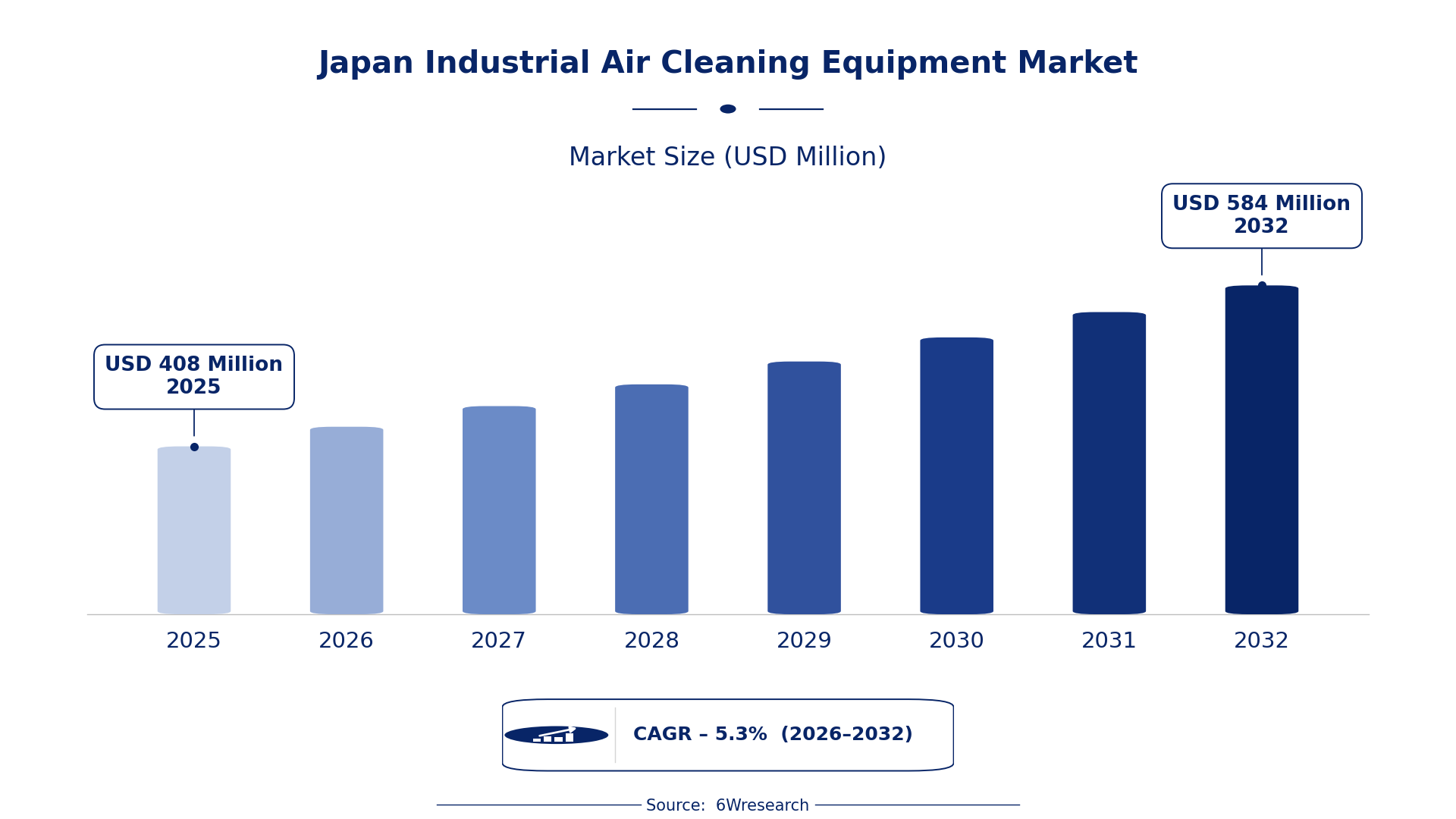
According to 6Wresearch internal database and industry insights, the Japan Industrial Air Cleaning Equipment Market was valued at USD 408 Million in 2025 and is projected to reach USD 584 Million by 2032, growing at a CAGR of approximately 5.3% during 2026–2032.
Japan Industrial Air Cleaning Equipment Market Highlights
| Report Metric | Details |
| Report Name | Japan Industrial Air Cleaning Equipment Market (2026-2032) |
| Market Size 2025 | USD 408 Million |
| Market Size 2032 | USD 584 Million |
| Absolute Growth 2025–2032 | USD 176 Million |
| CAGR 2026–2032 | 5.3% |
| Peak Annual Growth | 6.3% in 2030 |
| Forecast Period | 2026–2032 |
| Historical Data | 2022–2025 |
| Base Year | 2025 |
| Leading Equipment Type, 2025 | Dust Collectors (51% share) |
| Leading Cleaning Method, 2025 | Cyclone/Baghouse (50% share) |
| Leading Application Area, 2025 | Material Handling (45% share) |
| Leading End User, 2025 | Mining & Cement Plants (42% share) |
| Fastest-Growing Equipment Type | Fume Extractors (7.5% CAGR) |
| Fastest-Growing Cleaning Method | Carbon Filter (7.7% CAGR) |
| Fastest-Growing Application Area | Welding & Soldering (6.7% CAGR) |
| Fastest-Growing End User | Electronics Manufacturers (7.1% CAGR) |
| Growing Sector | Manufacturing |
| Key End Users | Manufacturers, Construction companies, Machine shops, Waste processing facilities |
Japan Industrial Air Cleaning Equipment Market Year-wise Growth Rate and Key Drivers (2022–2032)
This graph illustrates the annual growth rates of the market from 2022 to 2032, highlighting a steady upward trajectory and projected market expansion over the forecast period.
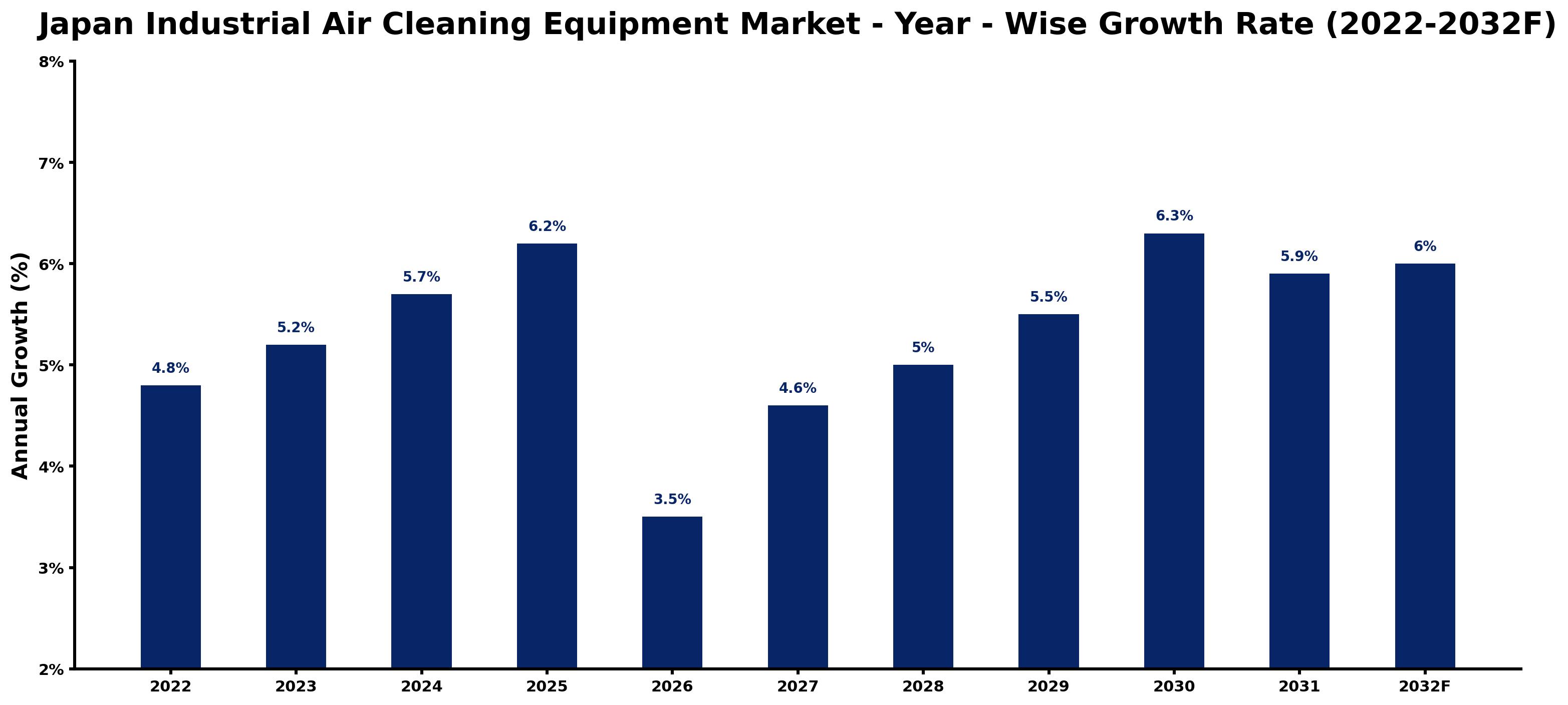
Below, each year's estimated growth is shown next to the factor that most influenced it.
| Year | Estimated Annual Growth (%) | Market Rationale |
| 2022 | 4.8 | The market experienced steady growth due to increasing awareness of air quality issues. |
| 2023 | 5.2 | Demand rose as industries sought to improve compliance with health regulations. |
| 2024 | 5.7 | Growth continued with investments in cleaner technologies across various sectors. |
| 2025 | 6.2 | The market peaked as manufacturers expanded their air cleaning capabilities. |
| 2026 | 3.5 | Growth is expected to slow as the market adjusts to previous high levels of demand. |
| 2027 | 4.6 | Demand will increase again as more facilities upgrade their air cleaning systems. |
| 2028 | 5.0 | The market is projected to see a rise in demand driven by stricter emission regulations. |
| 2029 | 5.5 | Growth is expected to continue as industries adopt advanced air cleaning solutions. |
| 2030 | 6.3 | The market is projected to reach its peak growth rate due to heightened environmental concerns. |
| 2031 | 5.9 | Growth will slow slightly as the market stabilises after rapid expansion. |
| 2032 | 6.0 | Demand is expected to rise again as more sectors invest in air quality improvements. |
Note: Market size estimations and growth projections presented in this report are based on 6Wresearch's proprietary forecasting methodology, utilizing the latest available industry data, government publications, and primary research inputs.
Japan Industrial Air Cleaning Equipment Market Synopsis
Industrial air cleaning equipment consists of systems that remove airborne contaminants from various environments, utilising advanced filtration technologies. The main applications involve maintaining air quality in manufacturing facilities and ensuring compliance with health regulations. The Japan Industrial Air Cleaning Equipment Market is expanding due to rising demand from the manufacturing and construction sectors, driven by investments in cleaner technologies and stricter environmental regulations. The installed base of over 500,000 units indicates ongoing demand for air quality solutions, with a target to reduce industrial emissions by 30% by 2030.
Market Dynamics Impact Analysis (2026–2032)
| Factor | Type | Impact | Primary Segment Affected |
| Increasing awareness of air quality standards | Driver | High | Dust Collectors |
| Technological advancements in filtration systems | Driver | High | Fume Extractors |
| Growing construction activities in urban areas | Opportunity | Medium | Material Handling |
| Rising investments in cleaner production technologies | Opportunity | Medium | Mist Collectors |
| High initial costs of advanced systems | Restraint | High | Odor Control Systems |
| Limited awareness among SMEs about available technologies | Restraint | Medium | Fume Extractors |
| Compliance with stringent regulations | Challenge | High | Dust Collectors |
| Fluctuating raw material prices | Challenge | Medium | Mist Collectors |
Evaluation of Drivers in Japan Industrial Air Cleaning Equipment Market (2026–2032)
Key forces behind demand, with the segment each one moves most, are listed below.
| Drivers | Primary Segment Affected | Why It Matters (Evidence) |
| Growing demand for compliance with air quality regulations | Fume Extractors | The implementation of the JIS B 9920 standard drives manufacturers to install fume extractors to meet safety standards. |
| Increased focus on worker health and safety | Mist Collectors | Machine shops are adopting mist collectors to ensure compliance with safety regulations and protect workers. |
| Expansion of manufacturing facilities in urban areas | Dust Collectors | The installed base of over 500,000 units indicates strong demand for dust collectors due to expanding electronics manufacturing. |
| Technological advancements in filtration technologies | Odor Control Systems | New technologies are enabling better performance in odor control, attracting more buyers in waste processing. |
| Government initiatives promoting cleaner production | Material Handling | The 2023 programme to promote cleaner production technologies is encouraging investment in air cleaning systems. |
What keeps demand rising is the increasing focus on compliance with air quality regulations, particularly in urban areas with high concentrations of manufacturing activity. In 2023, a programme promoting cleaner production technologies was launched, driving investments in advanced air cleaning systems. Facilities are increasingly adopting mist collectors to comply with safety regulations, reflecting a broader trend towards improving worker safety. Dust collectors are essential in cement plants located in Aichi and Osaka prefectures, highlighting the ongoing demand for industrial air cleaning equipment. These factors contribute to a strong market presence and an expanding installed base.
Evaluation of Restraints in Japan Industrial Air Cleaning Equipment Market
Below are the constraints most often cited by buyers and suppliers, with the segment each affects.
| Market Restraint | Primary Segment Affected | Why It Matters (Evidence) |
| High initial costs of advanced air cleaning systems | Odor Control Systems | The investment required for advanced systems deters some smaller manufacturers from upgrading. |
| Limited awareness among SMEs about available technologies | Fume Extractors | Many small and medium enterprises lack knowledge of the benefits of modern air cleaning technologies. |
| Challenges in meeting stringent compliance standards | Dust Collectors | Manufacturers face difficulties in adhering to evolving regulations, impacting purchasing decisions. |
| Fluctuating prices of raw materials for manufacturing equipment | Mist Collectors | Volatility in material costs affects the pricing and availability of air cleaning systems. |
| Long lead times for equipment delivery and installation | Odor Control Systems | Delays in procurement can hinder timely compliance with safety regulations. |
Japan Industrial Air Cleaning Equipment Market Challenges
In Japan, over 1,200 manufacturers struggle with a skills shortage, as experienced workers retire, leading to production delays and reduced output. Importers face supply chain disruptions due to strict adherence to the JIS B 9920 standard, which increases lead times and limits product availability for distributors. Buyers contend with rising costs as the government mandates a 30% reduction in industrial emissions by 2030, compelling them to invest in advanced air cleaning systems. SMEs experience financial strain from new safety regulations in machine shops, requiring substantial funds for system upgrades and employee training.
Trends in the Japan Industrial Air Cleaning Equipment Market
The shifts below are changing how Japan Industrial Air Cleaning Equipment Market products are bought and supplied.
- Shift towards Advanced Filtration Technologies: The trend towards advanced filtration technologies began in 2023, as manufacturers sought better air quality solutions. The JIS B 9920 standard is pushing manufacturers to adopt higher performance systems, leading to increased efficiency in air cleaning.
- Transition from Traditional to Automated Systems: In 2024, many facilities started transitioning to automated air cleaning systems, improving operational efficiency. The growing adoption of smart technologies is expected to improve monitoring and control of air quality.
- Increasing Adoption of Carbon Filters: The use of carbon filters has gained traction since 2023, particularly in electronics manufacturing. Approximately 20% of manufacturers are now implementing these filters to mitigate VOC emissions, reflecting a shift in air quality management.
- Growing Demand for Customised Air Solutions: In 2025, the demand for customised air cleaning solutions surged, particularly in waste processing facilities. This shift is evident as more companies seek tailored systems to meet specific operational needs.
Investment Opportunities in the Japan Industrial Air Cleaning Equipment Market
Investors looking at the Japan Industrial Air Cleaning Equipment Market should consider the following areas.
- Advanced Air Cleaning Systems: There is an opportunity to supply advanced air cleaning systems, especially as Japan aims for a 46% cut in greenhouse gas emissions by 2030. The construction sector is increasingly looking for efficient solutions to comply with regulations.
- Investment in Cleaner Production Technologies: The 2023 programme promoting cleaner production technologies presents an opportunity for suppliers to engage with manufacturing facilities. With JPY 150 trillion targeted for decarbonisation investments, there is a clear path for market entry.
- Customised Air Quality Solutions: The growing need for customised air quality solutions in sectors like waste processing creates a market gap. Suppliers can enter by partnering with local manufacturers to develop tailored systems.
- Expansion in Urban Manufacturing Hubs: Urban manufacturing hubs, particularly in the Tokyo area, are expanding rapidly, driving demand for air cleaning equipment. Suppliers can capitalise on this by establishing local partnerships for distribution.
Government Initiatives in the Japan Industrial Air Cleaning Equipment Market
The Industrial Safety and Health Act (1972) mandates employers to ensure safe working conditions, impacting air cleaning equipment producers. Compliance with this law requires manufacturers to invest in systems that meet safety standards, driving demand for advanced air cleaning technologies. In 2023, the government set a target to reduce industrial emissions by 30% by 2030, further influencing the market for air cleaning solutions.
The Japan Industrial Safety and Health Agency oversees the implementation of safety regulations, ensuring that manufacturers comply with air quality standards. This agency's initiatives support buyers in accessing funding for the installation of compliant air cleaning systems, facilitating their adoption in various industries.
Future Insight of the Japan Industrial Air Cleaning Equipment Market
Japan's ambitious decarbonisation targets will drive JPY 150 trillion in investments over the next decade, prompting suppliers to develop advanced air cleaning technologies. By 2032, compliance with new environmental standards will make advanced air cleaning systems commonplace in manufacturing, enhancing air quality and worker safety. The subsidy program for SMEs will encourage technology adoption, providing smaller buyers with access to improved systems. Stricter regulations will elevate performance expectations for air cleaning equipment, fostering a healthier industrial environment.
Market Segmentation Analysis
Japan Industrial Air Cleaning Equipment Market report covers a detailed analysis of the following market segments:
By Equipment Type – Dust Collectors Lead, Fume Extractors Expected to Grow Fastest
According to Saurav Kr Singh, Senior Research Analyst at 6Wresearch, the largest equipment type category in 2025 was Dust Collectors, at 51% of revenue. Dust collectors are essential for removing particulate matter from the air in industrial settings, particularly in cement plants where dust generation is prevalent. Their widespread use across various sectors reinforces their position as the leading equipment type in the market. The quickest growth will come from Fume Extractors, forecast to expand at a CAGR of 7.5% between 2026 and 2032. Fume extractors are crucial for capturing harmful fumes during welding and similar processes, especially in the electronics manufacturing sector in Tokyo. The increasing focus on workplace safety and compliance with regulations is expected to drive rapid growth in this segment. Suppliers should focus on enhancing fume extractor technologies to meet the growing regulatory requirements.
By Cleaning Method – Cyclone/Baghouse Leads, Carbon Filter Expected to Grow Fastest
In 2025, Cyclone/Baghouse led the cleaning method split with a 50% share. The cyclone/baghouse method is widely used for efficient dust collection in various industries, making it the preferred choice for many manufacturers. Its effectiveness in maintaining air quality contributes to its leading position in the market. Carbon Filter is set to record the highest CAGR in this split, 7.7% over 2026–2032. Carbon filters are increasingly used in specific applications for odour and VOC removal, particularly in electronics manufacturing where air quality is paramount. This targeted application is driving rapid growth in this segment. Buyers may benefit from investing in carbon filter technologies to address specific air quality challenges.
By Application Area – Material Handling Leads, Welding & Soldering Expected to Grow Fastest
Material Handling took 45% of application area revenue in 2025, more than any other category. Material handling is integral to maintaining air quality during material transport, which is critical in sectors such as mining and cement. This widespread application ensures it captures the largest market share. Over 2026–2032, Welding & Soldering is expected to post the fastest growth, at a CAGR of 6.7%. Welding and soldering are critical for worker safety in metalworking environments, with increasing adoption of air cleaning systems in response to safety regulations. This focus on safety is propelling rapid growth in this area. Suppliers should align their products with the safety requirements of welding and soldering applications to capture emerging opportunities.
By End User – Mining & Cement Plants Lead, Electronics Manufacturers Expected to Grow Fastest
Mining & Cement Plants accounted for 42% of the market by end user in 2025. Mining and cement plants play a vital role in controlling dust emissions in heavy industries, where air quality management is critical. Their large-scale operations and compliance with environmental regulations contribute to their dominant market share. Electronics Manufacturers are projected to grow fastest, at a CAGR of 7.1% during 2026–2032. Electronics manufacturers are key for maintaining clean air in sensitive manufacturing environments, which significantly boosts the demand for advanced air cleaning solutions. As technology progresses, this sector is likely to see considerable growth. Suppliers must tailor their products to meet the stringent air quality standards required by electronics manufacturers.
Key Attractiveness of the Report
- 10 Years of Market Numbers
- Historical Data Starting from 2022 to 2025
- Base Year 2025
- Forecast Data until 2032
- Key Performance Indicators Impacting the Market
- Major Upcoming Developments and Projects
Key Highlights of the Report:
- Japan Industrial Air Cleaning Equipment Market Outlook
- Market Size of Japan Industrial Air Cleaning Equipment Market, 2025
- Forecast of Japan Industrial Air Cleaning Equipment Market, 2032
- Historical Data and Forecast of Japan Industrial Air Cleaning Equipment Revenues & Volume for the Period 2022-2032F
- Japan Industrial Air Cleaning Equipment Market Trend Evolution
- Japan Industrial Air Cleaning Equipment Market Drivers and Challenges
- Japan Industrial Air Cleaning Equipment Price Trends
- Japan Industrial Air Cleaning Equipment Porter's Five Forces
- Japan Industrial Air Cleaning Equipment Industry Life Cycle
- Historical Data and Forecast of Japan Industrial Air Cleaning Equipment Market Revenues & Volume By Equipment Type for the Period 2022-2032F
- Historical Data and Forecast of Japan Industrial Air Cleaning Equipment Market Revenues & Volume By Dust Collectors for the Period 2022-2032F
- Historical Data and Forecast of Japan Industrial Air Cleaning Equipment Market Revenues & Volume By Fume Extractors for the Period 2022-2032F
- Historical Data and Forecast of Japan Industrial Air Cleaning Equipment Market Revenues & Volume By Mist Collectors for the Period 2022-2032F
- Historical Data and Forecast of Japan Industrial Air Cleaning Equipment Market Revenues & Volume By Odor Control Systems for the Period 2022-2032F
- Historical Data and Forecast of Japan Industrial Air Cleaning Equipment Market Revenues & Volume By Cleaning Method for the Period 2022-2032F
- Historical Data and Forecast of Japan Industrial Air Cleaning Equipment Market Revenues & Volume By Cyclone/Baghouse for the Period 2022-2032F
- Historical Data and Forecast of Japan Industrial Air Cleaning Equipment Market Revenues & Volume By Carbon Filter for the Period 2022-2032F
- Historical Data and Forecast of Japan Industrial Air Cleaning Equipment Market Revenues & Volume By Centrifugal Separation for the Period 2022-2032F
- Historical Data and Forecast of Japan Industrial Air Cleaning Equipment Market Revenues & Volume By Oxidation/Chemical for the Period 2022-2032F
- Historical Data and Forecast of Japan Industrial Air Cleaning Equipment Market Revenues & Volume By Application Area for the Period 2022-2032F
- Historical Data and Forecast of Japan Industrial Air Cleaning Equipment Market Revenues & Volume By Material Handling for the Period 2022-2032F
- Historical Data and Forecast of Japan Industrial Air Cleaning Equipment Market Revenues & Volume By Welding & Soldering for the Period 2022-2032F
- Historical Data and Forecast of Japan Industrial Air Cleaning Equipment Market Revenues & Volume By CNC/Metal Cutting for the Period 2022-2032F
- Historical Data and Forecast of Japan Industrial Air Cleaning Equipment Market Revenues & Volume By Waste Processing for the Period 2022-2032F
- Historical Data and Forecast of Japan Industrial Air Cleaning Equipment Market Revenues & Volume By End User for the Period 2022-2032F
- Historical Data and Forecast of Japan Industrial Air Cleaning Equipment Market Revenues & Volume By Mining & Cement Plants for the Period 2022-2032F
- Historical Data and Forecast of Japan Industrial Air Cleaning Equipment Market Revenues & Volume By Electronics Manufacturers for the Period 2022-2032F
- Historical Data and Forecast of Japan Industrial Air Cleaning Equipment Market Revenues & Volume By Machine Shops for the Period 2022-2032F
- Historical Data and Forecast of Japan Industrial Air Cleaning Equipment Market Revenues & Volume By Municipal/Industrial Sites for the Period 2022-2032F
- Japan Industrial Air Cleaning Equipment Import Export Trade Statistics
- Market Opportunity Assessment By Equipment Type
- Market Opportunity Assessment By Cleaning Method
- Market Opportunity Assessment By Application Area
- Market Opportunity Assessment By End User
- Japan Industrial Air Cleaning Equipment Top Companies Market Share
- Japan Industrial Air Cleaning Equipment Competitive Benchmarking By Technical and Operational Parameters
- Japan Industrial Air Cleaning Equipment Company Profiles
- Japan Industrial Air Cleaning Equipment Key Strategic Recommendations
Market Covered
This report examines the market across the segments below.
By Equipment Type
- Dust Collectors
- Fume Extractors
- Mist Collectors
- Odor Control Systems
By Cleaning Method
- Cyclone/Baghouse
- Carbon Filter
- Centrifugal Separation
- Oxidation/Chemical
By Application Area
- Material Handling
- Welding & Soldering
- CNC/Metal Cutting
- Waste Processing
By End User
- Mining & Cement Plants
- Electronics Manufacturers
- Machine Shops
- Municipal/Industrial Sites































