Japan Industrial Air Treatment Market Size & Growth Rate
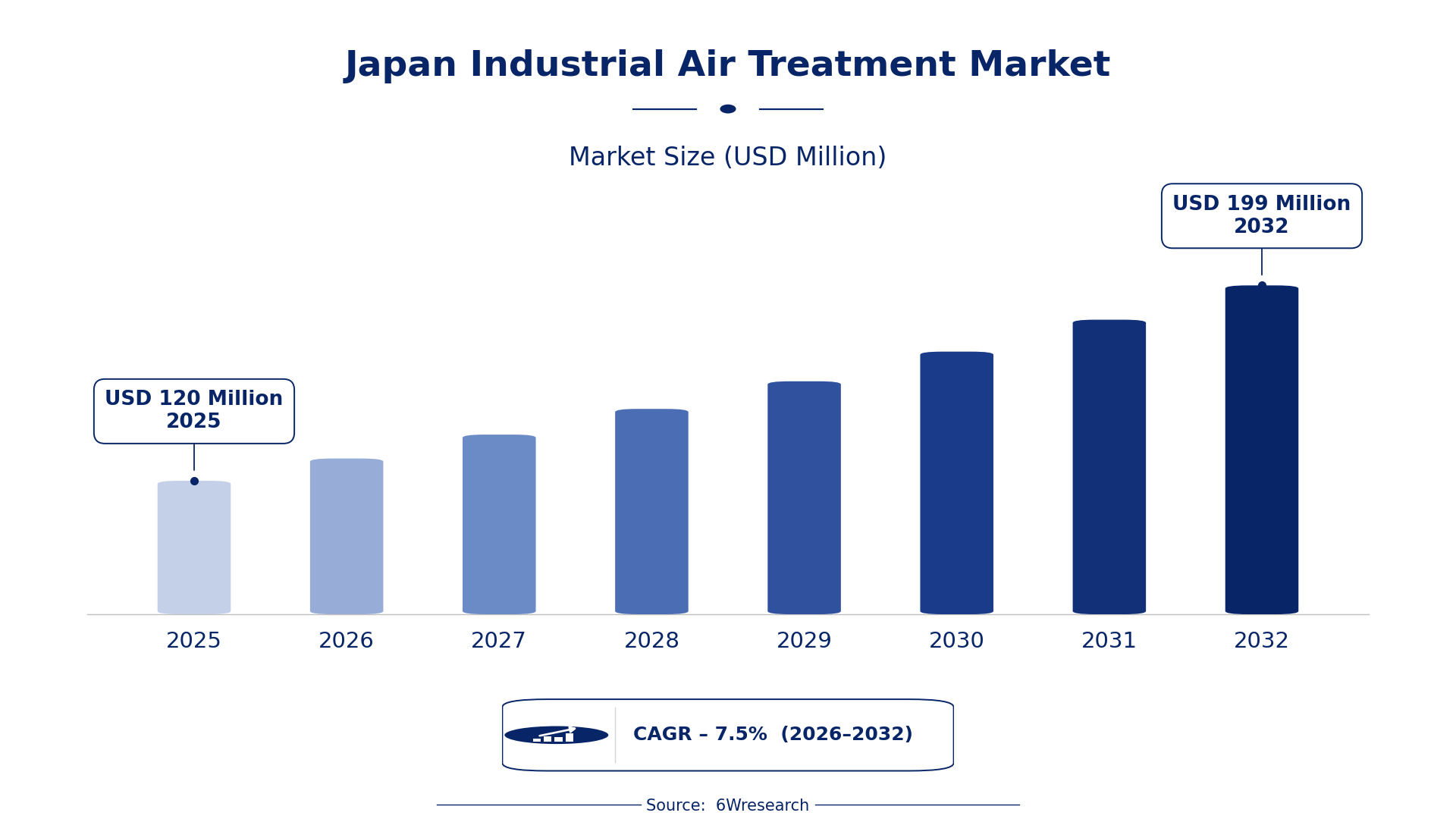
According to 6Wresearch internal database and industry insights, the Japan Industrial Air Treatment Market was valued at USD 120 Million in 2025 and is projected to reach USD 199 Million by 2032, growing at a CAGR of approximately 7.5% during 2026–2032.
Japan Industrial Air Treatment Market Highlights
| Report Metric | Details |
| Report Name | Japan Industrial Air Treatment Market (2026-2032) |
| Market Size 2025 | USD 120 Million |
| Market Size 2032 | USD 199 Million |
| Absolute Growth 2025–2032 | USD 79 Million |
| CAGR 2026–2032 | 7.5% |
| Peak Annual Growth | 8.6% in 2029 |
| Forecast Period | 2026–2032 |
| Historical Data | 2022–2025 |
| Base Year | 2025 |
| Leading Treatment Type, 2025 | Air Dryers (48% share) |
| Leading Purpose, 2025 | Moisture Removal (42% share) |
| Leading Integration, 2025 | With Compressor System (41% share) |
| Leading End User, 2025 | Food & Pharma Industries (29% share) |
| Fastest-Growing Treatment Type | Air Coolers (11.1% CAGR) |
| Fastest-Growing Purpose | Purity Enhancement (10.1% CAGR) |
| Fastest-Growing Integration | Inline Configuration (10.2% CAGR) |
| Growing Sector | Food and Pharma Industries |
| Key End Users | Manufacturers, Pharmaceutical Companies, Food Processors, Electronics Producers |
Japan Industrial Air Treatment Market Year-wise Growth Rate and Key Drivers (2022–2032)
This graph illustrates the annual growth rates of the market from 2022 to 2032, highlighting a steady upward trajectory and projected market expansion over the forecast period.
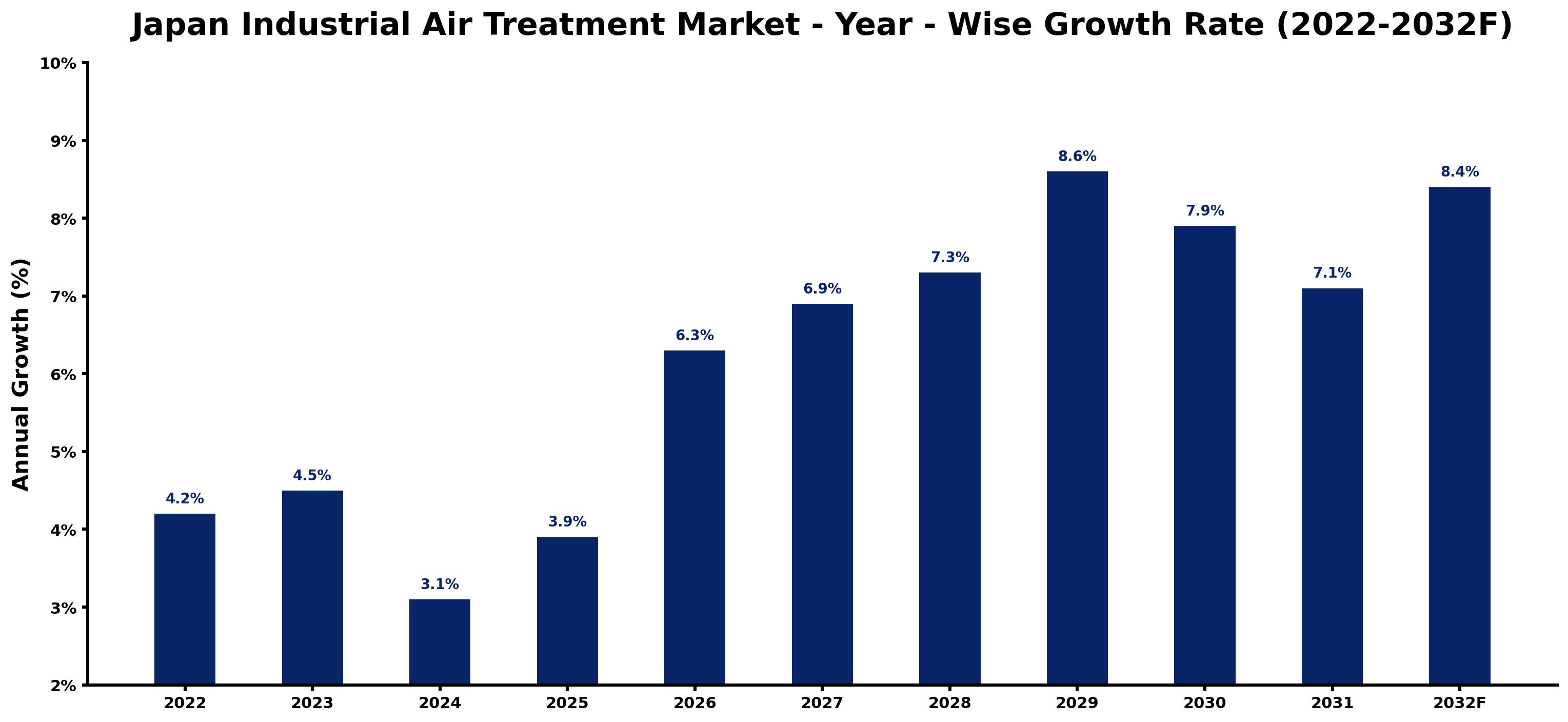
The table below sets out the estimated growth rate for each year and the main factor behind it.
| Year | Estimated Annual Growth (%) | Market Rationale |
| 2022 | 4.2 | The market experienced steady growth due to ongoing investments in air treatment technologies. |
| 2023 | 4.5 | Demand increased as manufacturers sought to improve air quality for compliance with health standards. |
| 2024 | 3.1 | Growth slowed as some sectors adjusted to new energy efficiency regulations. |
| 2025 | 3.9 | The market saw a rebound as industries ramped up production after previous disruptions. |
| 2026 | 6.3 | Investment in advanced air treatment systems is expected to drive demand significantly. |
| 2027 | 6.9 | Continued focus on energy efficiency will push manufacturers to upgrade their systems. |
| 2028 | 7.3 | Rising environmental awareness among businesses is expected to boost air treatment purchases. |
| 2029 | 8.6 | The peak growth year will be driven by substantial investments in decarbonisation initiatives. |
| 2030 | 7.9 | A slight slowdown is anticipated as the market adjusts to peak growth levels. |
| 2031 | 7.1 | Demand remains strong, although growth rates are expected to moderate slightly. |
| 2032 | 8.4 | The market is projected to grow as industries continue to adopt innovative air treatment solutions. |
Note: Market size estimations and growth projections presented in this report are based on 6Wresearch's proprietary forecasting methodology, utilizing the latest available industry data, government publications, and primary research inputs.
Japan Industrial Air Treatment Market Synopsis
Industrial air treatment technologies purify and condition air for various applications, produced through advanced filtration and drying processes. The Japan Industrial Air Treatment Market is experiencing growth driven by increasing demand from sectors like food and pharmaceuticals, which account for a large share of air treatment needs. With Japan targeting JPY 150 trillion in decarbonisation investments over ten years, the market is set to expand as industries seek compliance with health and environmental standards.
Market Dynamics Impact Analysis (2026–2032)
| Factor | Type | Impact | Primary Segment Affected |
| Growing focus on energy efficiency in manufacturing processes | Driver | High | Air Dryers |
| Increased investment in advanced filtration technologies | Driver | High | Oil Removal Filters |
| Rising demand for compliance with health standards | Opportunity | High | Moisture Removal |
| Expansion of manufacturing facilities in key regions | Opportunity | Medium | Food & Pharma Industries |
| High initial costs of advanced air treatment systems | Restraint | High | Air Coolers |
| Limited awareness of energy-efficient solutions among smaller manufacturers | Restraint | Medium | Nitrogen Generators |
| Challenges in meeting stringent environmental regulations | Challenge | High | Purity Enhancement |
| Competition from alternative air treatment technologies | Challenge | Medium | Gas Separation |
Evaluation of Drivers in Japan Industrial Air Treatment Market (2026–2032)
The main growth drivers and the segments they affect most are set out below.
| Drivers | Primary Segment Affected | Why It Matters (Evidence) |
| Increased production in food and pharmaceutical sectors | Moisture Removal | The food and pharma sectors accounted for a large share of air treatment demand, driving purchases of moisture removal systems. |
| Growing investments in energy-efficient technologies | Oil Removal Filters | Investment in air treatment technology is supported by government subsidies for energy efficiency improvements, encouraging manufacturers to upgrade their systems. |
| Rising environmental regulations | Air Dryers | Japan targets a 46% cut in greenhouse-gas emissions by 2030, pushing industries to adopt efficient air treatment solutions. |
| Expansion of cleanroom applications in electronics | Air Coolers | The electronics industry is a major user of air treatment solutions, increasing demand for air coolers in cleanroom environments. |
| Adoption of ISO 8573 standards | Purity Enhancement | The widespread adoption of ISO 8573 for air quality in industrial applications is driving demand for purity enhancement technologies. |
What keeps demand rising is the investment in energy-efficient technologies, particularly in the food and pharmaceutical sectors, which represent a substantial share of air treatment needs. The electronics industry is a major user of air treatment solutions, leading to increased demand for moisture removal systems. The push for compliance with ISO 8573 standards is driving purchases of purity improvement technologies. Consequently, manufacturers are upgrading their systems to meet these evolving requirements.
Evaluation of Restraints in Japan Industrial Air Treatment Market
Several factors work against faster growth; the main ones are summarised below.
| Market Restraint | Primary Segment Affected | Why It Matters (Evidence) |
| High initial costs of advanced air treatment systems | Air Coolers | The high costs associated with advanced air treatment systems deter smaller manufacturers from upgrading their equipment. |
| Limited awareness of energy-efficient solutions | Nitrogen Generators | Many smaller manufacturers lack knowledge about the benefits of energy-efficient air treatment technologies, limiting their adoption. |
| Challenges in meeting stringent environmental regulations | Purity Enhancement | Strict compliance with environmental regulations increases operational costs for manufacturers, impacting their purchasing decisions. |
| Competition from alternative air treatment technologies | Gas Separation | Alternative technologies may offer lower costs or simpler solutions, drawing potential customers away from traditional air treatment systems. |
| Dependence on specific industrial applications | Moisture Removal | Moisture removal systems are primarily used in specific industries, limiting broader market appeal and growth. |
Japan Industrial Air Treatment Market Challenges
Buyers face rising costs due to strict air quality standards, such as the JIS B 8350, which necessitate investment in advanced filtration systems. Competition among suppliers drives prices down, reducing profit margins by up to 20% for smaller firms. A skills gap in advanced air treatment technologies hampers suppliers' ability to innovate, causing product development delays that average six months. Many manufacturers remain reluctant to adopt new technologies, relying on outdated systems that can increase operational costs by 15%.
Trends in the Japan Industrial Air Treatment Market
The following changes are redrawing the Japan Industrial Air Treatment Market.
- Shift towards Energy-Efficient Air Treatment Solutions: Tokyo is experiencing a shift towards energy-efficient air treatment solutions, prompted by the government's push for decarbonisation. In 2023, a new programme was launched to promote these systems, encouraging manufacturers to adopt greener technologies.
- Transition from Traditional to Advanced Filtration Technologies: The introduction of advanced filtration technologies is transforming air treatment in Osaka. As industries upgrade, the installed base of air treatment systems is estimated at over 100,000 units, indicating a move towards improved air quality.
- Inline Configurations Gaining Popularity: Inline configurations for air coolers are becoming increasingly popular in manufacturing processes. This trend is evident in various industrial sectors, improving efficiency and space utilisation in production lines.
- Growing Demand for Compliance with Health Standards: Food and pharma industries are prioritising compliance with health standards, driving demand for moisture removal and purity improvement technologies. This trend is expected to grow as regulations tighten.
Investment Opportunities in the Japan Industrial Air Treatment Market
Below are the investment opportunities with the strongest case in the Japan Industrial Air Treatment Market.
- Investment in Energy-Efficient Air Treatment Systems: Now is the time to invest in energy-efficient air treatment systems, with Japan targeting a 46% reduction in greenhouse-gas emissions by 2030. Manufacturers in the food and pharma sectors are seeking compliant solutions.
- Supply of Advanced Filtration Technologies: The gap in advanced filtration technologies presents an opportunity for suppliers. With JPY 150 trillion earmarked for decarbonisation, manufacturers are eager to upgrade their systems.
- Expansion of Cleanroom Applications: The growing electronics sector is expanding cleanroom applications, creating demand for air treatment solutions. Suppliers can enter this market by partnering with local manufacturers for tailored solutions.
- Development of Inline Configuration Systems: The increasing preference for inline configurations in air treatment systems offers a valuable opportunity. Manufacturers in Tokyo are seeking solutions that optimise space and efficiency.
Government Initiatives in the Japan Industrial Air Treatment Market
The GX Promotion Act, introduced in 2023, establishes a legal framework for promoting energy-efficient technologies, complementing earlier laws that mandated energy efficiency improvements. This new measure encourages manufacturers to invest in advanced air treatment systems, aligning with Japan's decarbonisation goals. The Act aims to mobilise JPY 150 trillion in public and private investments over the next decade, driving innovation in the sector.
The Ministry of Economy, Trade and Industry (METI) funds initiatives for advanced air treatment technologies. METI supports projects that improve energy efficiency, approving subsidies that help manufacturers upgrade their systems to meet new standards. In 2023, METI allocated JPY 30 billion for energy efficiency projects, benefiting various industrial sectors.
Future Insight of the Japan Industrial Air Treatment Market
Investment in decarbonisation will generate strong demand for energy-efficient air treatment solutions, supported by public and private funding projected to reach JPY 150 trillion over the next decade. By 2032, the installed base of air treatment systems is expected to surpass 100,000 units, allowing suppliers to offer improved solutions. Enhanced government support for technology initiatives will drive innovation in air treatment processes. The adoption of standards like ISO 8573 will ensure compliance for buyers, promoting consistent air quality across various sectors.
Market Segmentation Analysis
Japan Industrial Air Treatment Market report covers a detailed analysis of the following market segments:
By Treatment Type – Air Dryers Lead, Air Coolers Expected to Grow Fastest
According to Saurav Kr Singh, Senior Research Analyst at 6Wresearch, the largest treatment type category in 2025 was Air Dryers, at 48% of revenue. Air dryers are essential for moisture removal in industrial processes, particularly within the food and pharmaceutical sectors. Their widespread use across Japan's manufacturing facilities solidifies their position as the leading sub-segment in the market. Air Coolers are projected to grow fastest, at a CAGR of 11.1% during 2026–2032. Air coolers are experiencing rapid growth due to their effectiveness in inline configurations, which enhance manufacturing efficiency by regulating temperatures. This trend is especially pronounced in Japan's electronics industry, where maintaining cleanroom environments is critical for operations. Suppliers should focus on advancing air cooler technologies to cater to the growing demand for efficient inline solutions.
By Purpose – Moisture Removal Leads, Purity Enhancement Expected to Grow Fastest
In 2025, Moisture Removal led the purpose split with a 42% share. Moisture removal is vital for preventing equipment damage and ensuring product quality, especially in the food and pharmaceutical industries. This critical need drives a substantial portion of the market towards moisture removal solutions, establishing it as the leading purpose segment. Purity Enhancement is set to record the highest CAGR in this split, 10.1% over 2026–2032. Purity enhancement is increasingly essential for meeting industry standards in sensitive applications, resulting in rapid growth for this segment. The stringent regulations prevalent in Japan's food and pharmaceutical sectors significantly fuel this demand. Buyers must prioritise purity enhancement technologies to comply with industry standards and safeguard product integrity.
By Integration – With Compressor System Leads, Inline Configuration Expected to Grow Fastest
With Compressor System took 41% of integration revenue in 2025, more than any other category. Integration with compressor systems is a common practice for achieving efficient air treatment, optimising performance across various industrial applications. This method is particularly widespread in Japan's manufacturing sector, where operational efficiency is paramount. Over 2026–2032, Inline Configuration is expected to post the fastest growth, at a CAGR of 10.2%. Inline configurations are gaining traction due to their space-saving advantages in production lines, allowing manufacturers to streamline workflows effectively. This preference is increasingly relevant as companies strive to maximise operational efficiency and reduce floor space usage. Suppliers should consider offering inline configuration options to meet the rising demand for efficient air treatment solutions.
By End User – Food & Pharma Industries Lead and Record the Fastest Growth
Food & Pharma Industries held 29% of the Japan Industrial Air Treatment Market by end user in 2025. The food and pharma industries are critical for compliance with health standards, driving a substantial share of air treatment demand in Japan. Their stringent regulations necessitate advanced air treatment solutions to ensure product safety. Food & Pharma Industries are also forecast to expand faster than any other category, at a CAGR of 10.4% over 2026–2032. The food and pharma industries are also the fastest-growing end user segment due to increasing health regulations and consumer demand for quality. This dual role reinforces their dominance in the market. Suppliers must focus on tailored solutions for the food and pharma sectors to meet their specific regulatory requirements and quality standards.
Key Attractiveness of the Report
- 10 Years of Market Numbers
- Historical Data Starting from 2022 to 2025
- Base Year 2025
- Forecast Data until 2032
- Key Performance Indicators Impacting the Market
- Major Upcoming Developments and Projects
Key Highlights of the Report:
- Japan Industrial Air Treatment Market Outlook
- Market Size of Japan Industrial Air Treatment Market, 2025
- Forecast of Japan Industrial Air Treatment Market, 2032
- Historical Data and Forecast of Japan Industrial Air Treatment Revenues & Volume for the Period 2022-2032F
- Japan Industrial Air Treatment Market Trend Evolution
- Japan Industrial Air Treatment Market Drivers and Challenges
- Japan Industrial Air Treatment Price Trends
- Japan Industrial Air Treatment Porter's Five Forces
- Japan Industrial Air Treatment Industry Life Cycle
- Historical Data and Forecast of Japan Industrial Air Treatment Market Revenues & Volume By Treatment Type for the Period 2022-2032F
- Historical Data and Forecast of Japan Industrial Air Treatment Market Revenues & Volume By Air Dryers for the Period 2022-2032F
- Historical Data and Forecast of Japan Industrial Air Treatment Market Revenues & Volume By Oil Removal Filters for the Period 2022-2032F
- Historical Data and Forecast of Japan Industrial Air Treatment Market Revenues & Volume By Air Coolers for the Period 2022-2032F
- Historical Data and Forecast of Japan Industrial Air Treatment Market Revenues & Volume By Nitrogen Generators for the Period 2022-2032F
- Historical Data and Forecast of Japan Industrial Air Treatment Market Revenues & Volume By Purpose for the Period 2022-2032F
- Historical Data and Forecast of Japan Industrial Air Treatment Market Revenues & Volume By Moisture Removal for the Period 2022-2032F
- Historical Data and Forecast of Japan Industrial Air Treatment Market Revenues & Volume By Purity Enhancement for the Period 2022-2032F
- Historical Data and Forecast of Japan Industrial Air Treatment Market Revenues & Volume By Heat Reduction for the Period 2022-2032F
- Historical Data and Forecast of Japan Industrial Air Treatment Market Revenues & Volume By Gas Separation for the Period 2022-2032F
- Historical Data and Forecast of Japan Industrial Air Treatment Market Revenues & Volume By Integration for the Period 2022-2032F
- Historical Data and Forecast of Japan Industrial Air Treatment Market Revenues & Volume By With Compressor System for the Period 2022-2032F
- Historical Data and Forecast of Japan Industrial Air Treatment Market Revenues & Volume By Inline Configuration for the Period 2022-2032F
- Historical Data and Forecast of Japan Industrial Air Treatment Market Revenues & Volume By Pre/Post Compression for the Period 2022-2032F
- Historical Data and Forecast of Japan Industrial Air Treatment Market Revenues & Volume By Standalone/Inline Units for the Period 2022-2032F
- Historical Data and Forecast of Japan Industrial Air Treatment Market Revenues & Volume By End User for the Period 2022-2032F
- Historical Data and Forecast of Japan Industrial Air Treatment Market Revenues & Volume By Paint Booths, Metal Shops for the Period 2022-2032F
- Historical Data and Forecast of Japan Industrial Air Treatment Market Revenues & Volume By Food & Pharma Industries for the Period 2022-2032F
- Historical Data and Forecast of Japan Industrial Air Treatment Market Revenues & Volume By Plastics and Chemical Plants for the Period 2022-2032F
- Historical Data and Forecast of Japan Industrial Air Treatment Market Revenues & Volume By Packaging & Electronics for the Period 2022-2032F
- Japan Industrial Air Treatment Import Export Trade Statistics
- Market Opportunity Assessment By Treatment Type
- Market Opportunity Assessment By Purpose
- Market Opportunity Assessment By Integration
- Market Opportunity Assessment By End User
- Japan Industrial Air Treatment Top Companies Market Share
- Japan Industrial Air Treatment Competitive Benchmarking By Technical and Operational Parameters
- Japan Industrial Air Treatment Company Profiles
- Japan Industrial Air Treatment Key Strategic Recommendations
Market Covered
Segments analysed in this report are listed below.
By Treatment Type
- Air Dryers
- Oil Removal Filters
- Air Coolers
- Nitrogen Generators
By Purpose
- Moisture Removal
- Purity Enhancement
- Heat Reduction
- Gas Separation
By Integration
- With Compressor System
- Inline Configuration
- Pre/Post Compression
- Standalone/Inline Units
By End User
- Paint Booths
- Metal Shops
- Food & Pharma Industries
- Plastics and Chemical Plants
- Packaging & Electronics































