Japan Industrial Amino Acid Market Size & Growth Rate
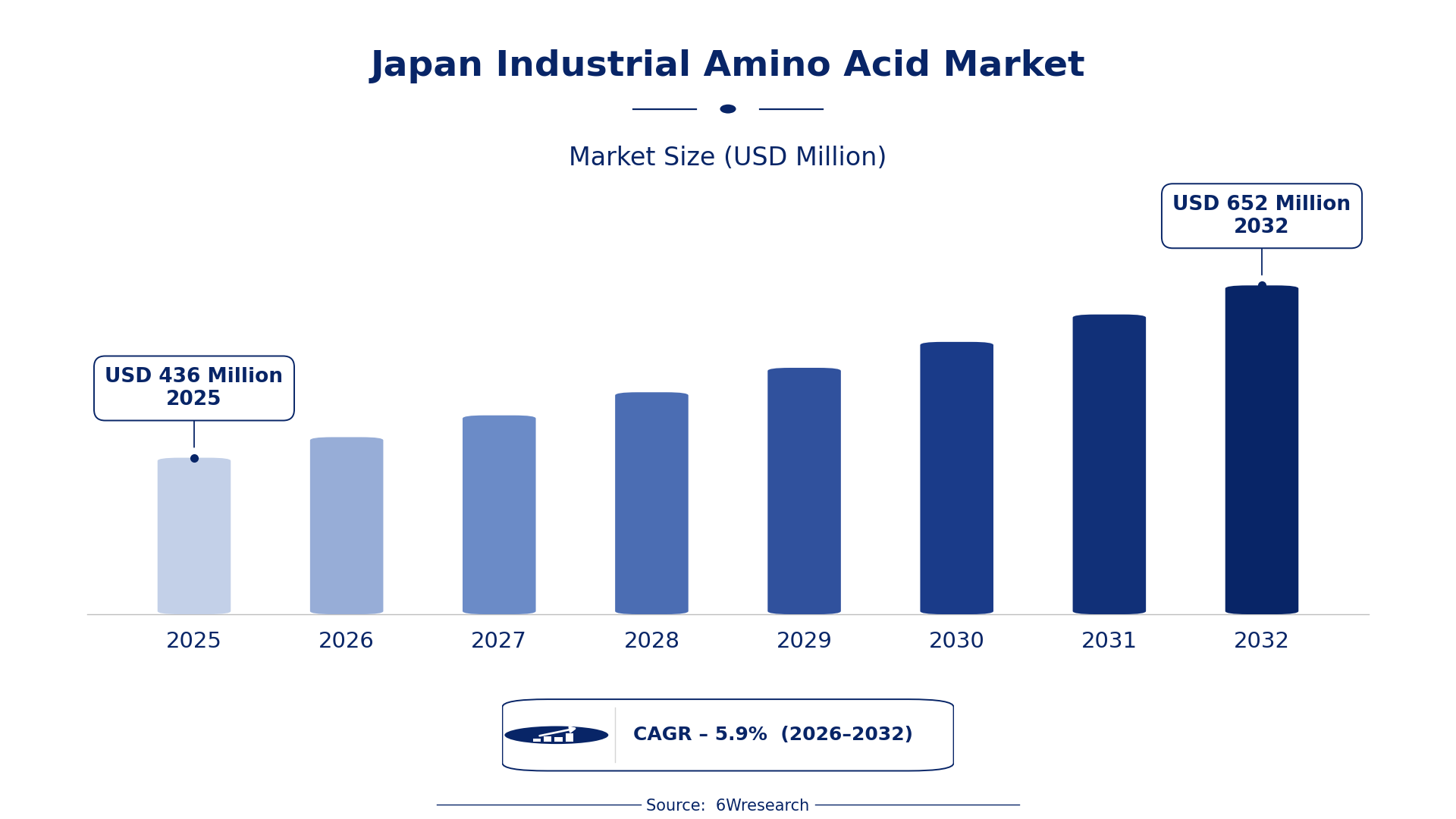
According to 6Wresearch internal database and industry insights, the Japan Industrial Amino Acid Market was valued at USD 436 Million in 2025 and is projected to reach USD 652 Million by 2032, growing at a CAGR of approximately 5.9% during 2026–2032.
Japan Industrial Amino Acid Market Highlights
| Report Metric | Details |
| Report Name | Japan Industrial Amino Acid Market (2026-2032) |
| Market Size 2025 | USD 436 Million |
| Market Size 2032 | USD 652 Million |
| Absolute Growth 2025–2032 | USD 216 Million |
| CAGR 2026–2032 | 5.9% |
| Peak Annual Growth | 6.8% in 2032 |
| Forecast Period | 2026–2032 |
| Historical Data | 2022–2025 |
| Base Year | 2025 |
| Leading Amino Acid Type, 2025 | Lysine (41% share) |
| Leading Source, 2025 | Fermentation (47% share) |
| Leading Application Area, 2025 | Animal Feed Supplements (42% share) |
| Leading End User, 2025 | Livestock Feed Producers (52% share) |
| Fastest-Growing Amino Acid Type | Glutamic Acid (8.3% CAGR) |
| Fastest-Growing Source | Corn/Beet Sugar (8.5% CAGR) |
| Fastest-Growing Application Area | Flavor Enhancers (MSG) (7.3% CAGR) |
| Fastest-Growing End User | Food Processors (7.7% CAGR) |
| Growing Sector | Animal Feed |
| Key End Users | Livestock Feed Producers, Food Processors, Agribusiness Companies |
Japan Industrial Amino Acid Market Year-wise Growth Rate and Key Drivers (2022–2032)
This graph illustrates the annual growth rates of the market from 2022 to 2032, highlighting a steady upward trajectory and projected market expansion over the forecast period.
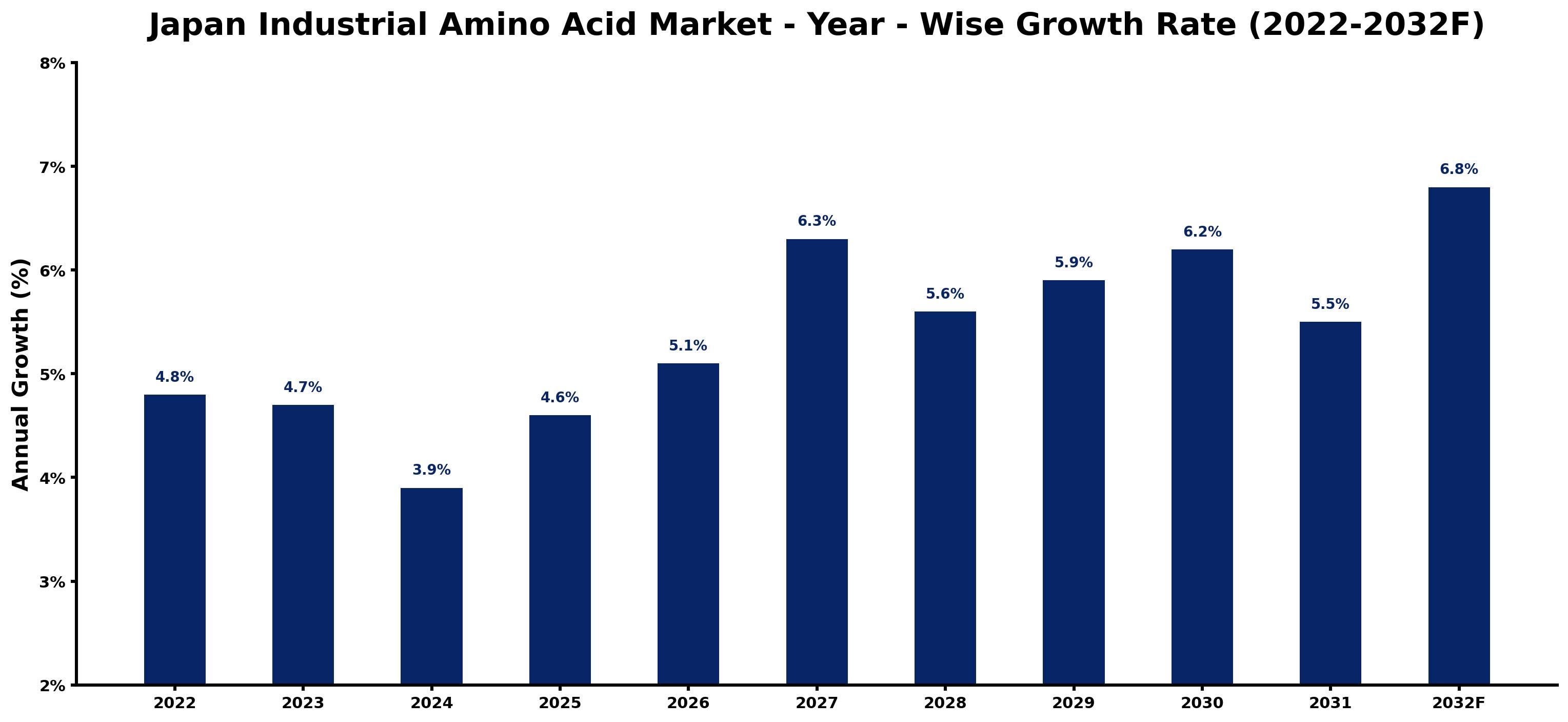
Year by year, the estimates below pair each growth rate with the development that shaped it.
| Year | Estimated Annual Growth (%) | Market Rationale |
| 2022 | 4.8 | The market experienced strong demand from livestock feed producers in Japan. |
| 2023 | 4.7 | Growth slowed due to market adjustments and increased competition among suppliers. |
| 2024 | 3.9 | The market continued to grow, albeit at a slower pace, influenced by changing dietary needs. |
| 2025 | 4.6 | Demand accelerated as livestock feed producers sought to improve nutrition levels. |
| 2026 | 5.1 | Growth is expected to pick up as investments in fermentation technologies increase production efficiency. |
| 2027 | 6.3 | The market is projected to expand further, driven by rising poultry feed requirements and production. |
| 2028 | 5.6 | Growth is anticipated to slow slightly as market saturation begins to set in for certain amino acids. |
| 2029 | 5.9 | Demand is expected to surge as the poultry industry adopts more amino acid supplements. |
| 2030 | 6.2 | Growth will continue as feed producers focus on quality and sustainability in sourcing. |
| 2031 | 5.5 | The market is projected to see a slowdown as competition intensifies and pricing pressures emerge. |
| 2032 | 6.8 | Demand is expected to peak with a focus on innovative production methods and sustainability. |
Note: Market size estimations and growth projections presented in this report are based on 6Wresearch's proprietary forecasting methodology, utilizing the latest available industry data, government publications, and primary research inputs.
Japan Industrial Amino Acid Market Synopsis
Industrial amino acids are organic compounds essential for animal feed and food processing. The Japan Industrial Amino Acid Market is driven by the livestock feed industry, which produces over 200,000 tons of lysine annually. The government's focus on sustainable practices supports this expansion, promoting efficiency and quality standards.
Market Dynamics Impact Analysis (2026–2032)
| Factor | Type | Impact | Primary Segment Affected |
| Rising investments in fermentation technologies | Driver | High | Fermentation |
| Increasing demand for high-quality livestock feed | Driver | High | Animal Feed Supplements |
| Growth in poultry industry requiring amino acids | Opportunity | High | Poultry Feed |
| Emerging trends in sustainable production methods | Opportunity | Medium | Microbial Production |
| Regulatory compliance costs for producers | Restraint | High | Lysine |
| Market saturation in certain amino acid segments | Restraint | Medium | Lysine |
| Intense competition among suppliers | Challenge | High | Lysine |
| Fluctuating raw material prices affecting production | Challenge | Medium | Lysine |
Evaluation of Drivers in Japan Industrial Amino Acid Market (2026–2032)
These are the developments adding the most demand over the forecast period.
| Drivers | Primary Segment Affected | Why It Matters (Evidence) |
| Increased investment in fermentation technologies | Fermentation | This investment improves production efficiency, which increases output and lowers costs for livestock feed producers, with 5 billion yen invested in 2023. |
| Growing demand for high-quality livestock feed | Animal Feed Supplements | As livestock producers seek to improve animal health, they are purchasing more amino acids to improve feed quality, reflecting a trend in the industry. |
| Expansion of the poultry industry | Poultry Feed | The poultry sector's growth drives demand for methionine, essential for poultry nutrition, valued at around 1 trillion yen. |
| Rising awareness of sustainable production methods | Microbial Production | Producers are adopting microbial methods to meet environmental standards and reduce waste, supported by government initiatives. |
| Increase in processed food products using glutamic acid | Flavor Enhancers (MSG) | The food processing industry is expanding, resulting in higher demand for flavor enhancers like glutamic acid, used in over 50% of processed foods. |
Most of the extra volume comes from heightened investment in fermentation technologies, which reached 5 billion yen in 2023, enhancing production efficiency. The poultry industry, valued at around 1 trillion yen, fuels demand for methionine, essential for livestock nutrition. The average consumption of amino acids in livestock feed is 3 kg per ton, highlighting a commitment to improving animal health. Fermentation methods account for 70% of amino acid production, reflecting a strong preference for this efficient approach. Growing awareness of sustainable practices is encouraging producers to adopt microbial production methods, indicating a shift in industry standards.
Evaluation of Restraints in Japan Industrial Amino Acid Market
The following restraints limit how fast demand can grow.
| Market Restraint | Primary Segment Affected | Why It Matters (Evidence) |
| Regulatory compliance costs for amino acid producers | Lysine | Producers face high costs to meet strict JIS standards for amino acid purity, impacting profitability by approximately 15%. |
| Market saturation in certain amino acid segments | Lysine | As the market matures, competition increases, resulting in price pressures in segments like lysine, affecting profitability. |
| Fluctuating raw material prices affecting production | Lysine | Volatility in prices for substrates like corn and beet sugar disrupts production costs, impacting overall expenses. |
| Limited consumer awareness of amino acid benefits | Livestock Feed Producers | Some livestock feed producers are slow to adopt new formulations due to a lack of information on benefits. |
| Intense competition among suppliers | Fermentation | The presence of numerous suppliers creates aggressive pricing strategies that squeeze margins, affecting profitability. |
Japan Industrial Amino Acid Market Challenges
High production costs for buyers arise from stringent regulations on amino acid purity, inflating expenses by 15% for livestock feed producers. Many producers depend on traditional fermentation methods, which restrict technological advancements and hinder efficiency improvements, affecting competitiveness in a sector where 70% of amino acids are produced this way. The average price of lysine at 200 yen per kg pressures buyers, impacting profit margins in the livestock feed industry. Increased competition from imports can disrupt local producers, compelling them to lower prices and potentially compromise quality to maintain market share.
Trends in the Japan Industrial Amino Acid Market
Buyers and suppliers in the Japan Industrial Amino Acid Market are adjusting to the following trends.
- Shift from Chemical Synthesis to Fermentation: Japan is moving towards fermentation methods for amino acid production, with 70% of production now utilising this technique. This transition improves sustainability and efficiency, as observed in the Tokyo region's food processing industries, which are increasingly adopting these methods.
- Rising Demand for Sustainable Production Methods: Investment in microbial production methods is on the rise, supported by government initiatives. In 2023, these methods accounted for a growing share of the market, reflecting a shift towards eco-friendly practices that resonate with consumers.
- Growth in Flavor Enhancers for Processed Foods: The demand for glutamic acid as a flavour enhancer is increasing, with over 50% of processed food products incorporating it. This trend is driven by evolving consumer preferences for taste and quality, resulting in heightened purchases by food processors.
- Expansion of Poultry Feed Requirements: The growth of the poultry industry is driving increased demand for amino acids, particularly methionine. The poultry feed market is projected to expand significantly, reflecting changing dietary needs and a focus on nutrition.
Investment Opportunities in the Japan Industrial Amino Acid Market
Where to invest in the Japan Industrial Amino Acid Market: the main openings are set out below.
- Supply of Microbial Production Technologies: With the government's support for sustainable production methods, there is a growing opportunity to supply microbial production technologies. Livestock feed producers are increasingly looking for efficient solutions to meet regulatory standards.
- Investment in Fermentation Facilities: Now is an ideal time to invest in fermentation facilities, as the market is expanding. Livestock feed producers are seeking partners to improve production capabilities and enhance efficiency.
- Development of High-Quality Feed Supplements: The increasing demand for high-quality livestock feed presents an opportunity to develop specialized feed supplements. Poultry feed producers are particularly interested in new formulations that meet evolving dietary requirements.
- Entry into Flavor Enhancer Market: The growing use of glutamic acid in processed foods offers a chance to enter the flavor enhancer market. Food processors are actively seeking suppliers of high-quality flavor enhancers to meet consumer demand.
Government Initiatives in the Japan Industrial Amino Acid Market
A new programme launched in 2023 aims to enhance amino acid production efficiency, building on existing regulations like the Chemical Substances Control Law (1973) and the PRTR Law (1999). This initiative seeks to streamline production processes and minimise environmental impact, encouraging producers to adopt more sustainable practices, with funding allocated to support these efforts.
Livestock feed producers benefit from the Ministry of Agriculture, Forestry and Fisheries' initiatives that promote sustainable feed practices. These programmes provide funding and support for adopting new technologies, ensuring compliance with regulations while improving production efficiency, with a target of increasing sustainable practices by 20% by 2025.
Future Insight of the Japan Industrial Amino Acid Market
Japan's commitment to a 46% reduction in greenhouse gas emissions by 2030 will drive changes in amino acid production methods, prompting suppliers to invest in cleaner technologies. A new programme launched in 2023 aims to improve production efficiency, which will likely increase supply reliability for buyers. By 2032, the poultry feed sector is expected to see a 5% annual rise in demand for methionine, reflecting changing dietary requirements in livestock. Investment in research and development reached 5 billion yen in 2023, supporting advancements in amino acid applications across various industries.
Market Segmentation Analysis
Japan Industrial Amino Acid Market report covers a detailed analysis of the following market segments:
By Amino Acid Type – Lysine Leads, Glutamic Acid Expected to Grow Fastest
According to Saurav Kr Singh, Senior Research Analyst at 6Wresearch, with 41% of amino acid type revenue in 2025, Lysine was the largest category. Lysine holds the largest share as it is essential for promoting growth in livestock, with Japan producing over 200,000 tons annually. This high production volume meets the substantial demand from livestock feed producers, reinforcing its dominant position. Over 2026–2032, Glutamic Acid is expected to post the fastest growth, at a CAGR of 8.3%. Glutamic acid is experiencing rapid growth due to its widespread use in over 50% of processed food products, reflecting a shift towards enhanced flavour profiles. As consumer preferences increasingly favour flavourful options, this trend is expected to continue. Suppliers should focus on producing high-quality lysine and glutamic acid to satisfy the increasing demand in both animal feed and food processing.
By Source – Fermentation Leads, Corn/Beet Sugar Expected to Grow Fastest
Fermentation took 47% of source revenue in 2025, more than any other category. Fermentation is the leading method for amino acid production, accounting for 70% of output in Japan, owing to its efficiency and established processes. This method is vital for producing various essential amino acids required by the industry. The quickest growth will come from Corn/Beet Sugar, forecast to expand at a CAGR of 8.5% between 2026 and 2032. Corn and beet sugar are gaining traction as substrates in fermentation processes, driven by government initiatives that promote sustainable production methods. This shift is anticipated to enhance the efficiency and sustainability of amino acid production. Suppliers should invest in fermentation technologies and sustainable substrates to align with market trends and regulatory requirements.
By Application Area – Animal Feed Supplements Lead, Flavor Enhancers (MSG) Expected to Grow Fastest
Animal Feed Supplements accounted for 42% of the market by application area in 2025. Animal feed supplements dominate the market as they are crucial for improving the nutritional value of livestock feed, reflecting the needs of Japan's approximately 25 million livestock population. This focus on animal nutrition drives consistent demand for amino acids. Flavor Enhancers (MSG) is set to record the highest CAGR in this split, 7.3% over 2026–2032. Flavor enhancers, especially monosodium glutamate, are rapidly growing due to their significant role in food processing, catering to changing consumer tastes. The increasing popularity of processed foods is likely to further stimulate this segment. Suppliers must diversify their product offerings to include both animal feed supplements and flavour enhancers to capitalise on growth opportunities in these key application areas.
By End User – Livestock Feed Producers Lead, Food Processors Expected to Grow Fastest
In 2025, Livestock Feed Producers led the end user split with a 52% share. Livestock feed producers are the primary end users of amino acids, highlighting the substantial investment in animal nutrition within Japan's 3 trillion yen animal feed market. Their ongoing demand for quality feed ingredients secures lysine's leading status. Food Processors are projected to grow fastest, at a CAGR of 7.7% during 2026–2032. Food processors are swiftly increasing their utilisation of flavour enhancers like glutamic acid, motivated by the growing consumer preference for enhanced flavours in food products. This trend is expected to accelerate as the food industry adapts to market demands. Suppliers should strengthen relationships with both livestock feed producers and food processors to maximise their market reach and respond to evolving consumer preferences.
Key Attractiveness of the Report
- 10 Years of Market Numbers
- Historical Data Starting from 2022 to 2025
- Base Year 2025
- Forecast Data until 2032
- Key Performance Indicators Impacting the Market
- Major Upcoming Developments and Projects
Key Highlights of the Report:
- Japan Industrial Amino Acid Market Outlook
- Market Size of Japan Industrial Amino Acid Market, 2025
- Forecast of Japan Industrial Amino Acid Market, 2032
- Historical Data and Forecast of Japan Industrial Amino Acid Revenues & Volume for the Period 2022-2032F
- Japan Industrial Amino Acid Market Trend Evolution
- Japan Industrial Amino Acid Market Drivers and Challenges
- Japan Industrial Amino Acid Price Trends
- Japan Industrial Amino Acid Porter's Five Forces
- Japan Industrial Amino Acid Industry Life Cycle
- Historical Data and Forecast of Japan Industrial Amino Acid Market Revenues & Volume By Amino Acid Type for the Period 2022-2032F
- Historical Data and Forecast of Japan Industrial Amino Acid Market Revenues & Volume By Lysine for the Period 2022-2032F
- Historical Data and Forecast of Japan Industrial Amino Acid Market Revenues & Volume By Glutamic Acid for the Period 2022-2032F
- Historical Data and Forecast of Japan Industrial Amino Acid Market Revenues & Volume By Methionine for the Period 2022-2032F
- Historical Data and Forecast of Japan Industrial Amino Acid Market Revenues & Volume By Tryptophan for the Period 2022-2032F
- Historical Data and Forecast of Japan Industrial Amino Acid Market Revenues & Volume By Source for the Period 2022-2032F
- Historical Data and Forecast of Japan Industrial Amino Acid Market Revenues & Volume By Fermentation for the Period 2022-2032F
- Historical Data and Forecast of Japan Industrial Amino Acid Market Revenues & Volume By Corn/Beet Sugar for the Period 2022-2032F
- Historical Data and Forecast of Japan Industrial Amino Acid Market Revenues & Volume By Chemical Synthesis for the Period 2022-2032F
- Historical Data and Forecast of Japan Industrial Amino Acid Market Revenues & Volume By Microbial Production for the Period 2022-2032F
- Historical Data and Forecast of Japan Industrial Amino Acid Market Revenues & Volume By Application Area for the Period 2022-2032F
- Historical Data and Forecast of Japan Industrial Amino Acid Market Revenues & Volume By Animal Feed Supplements for the Period 2022-2032F
- Historical Data and Forecast of Japan Industrial Amino Acid Market Revenues & Volume By Flavor Enhancers (MSG) for the Period 2022-2032F
- Historical Data and Forecast of Japan Industrial Amino Acid Market Revenues & Volume By Poultry Feed for the Period 2022-2032F
- Historical Data and Forecast of Japan Industrial Amino Acid Market Revenues & Volume By Nutrition & Pharma for the Period 2022-2032F
- Historical Data and Forecast of Japan Industrial Amino Acid Market Revenues & Volume By End User for the Period 2022-2032F
- Historical Data and Forecast of Japan Industrial Amino Acid Market Revenues & Volume By Livestock Feed Producers for the Period 2022-2032F
- Historical Data and Forecast of Japan Industrial Amino Acid Market Revenues & Volume By Food Processors for the Period 2022-2032F
- Historical Data and Forecast of Japan Industrial Amino Acid Market Revenues & Volume By Agribusiness Companies for the Period 2022-2032F
- Historical Data and Forecast of Japan Industrial Amino Acid Market Revenues & Volume By Health Supplement Firms for the Period 2022-2032F
- Japan Industrial Amino Acid Import Export Trade Statistics
- Market Opportunity Assessment By Amino Acid Type
- Market Opportunity Assessment By Source
- Market Opportunity Assessment By Application Area
- Market Opportunity Assessment By End User
- Japan Industrial Amino Acid Top Companies Market Share
- Japan Industrial Amino Acid Competitive Benchmarking By Technical and Operational Parameters
- Japan Industrial Amino Acid Company Profiles
- Japan Industrial Amino Acid Key Strategic Recommendations
Market Covered
This report examines the market across the segments below.
By Amino Acid Type
- Lysine
- Glutamic Acid
- Methionine
- Tryptophan
By Source
- Fermentation
- Corn/Beet Sugar
- Chemical Synthesis
- Microbial Production
By Application Area
- Animal Feed Supplements
- Flavor Enhancers (MSG)
- Poultry Feed
- Nutrition & Pharma
By End User
- Livestock Feed Producers
- Food Processors
- Agribusiness Companies
- Health Supplement Firms































