Japan Industrial Antimicrobial Coatings Market Size & Growth Rate
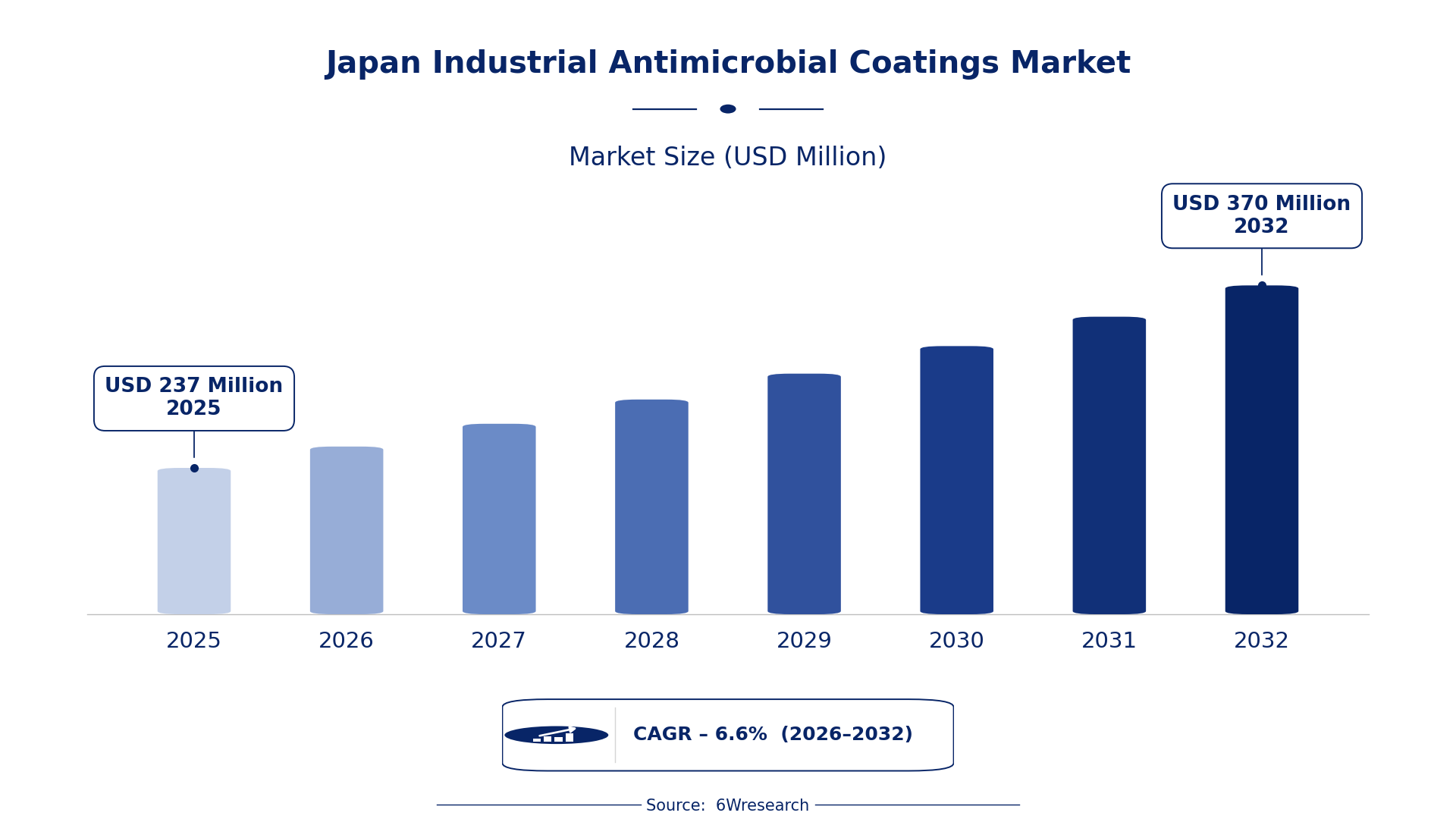
According to 6Wresearch internal database and industry insights, the Japan Industrial Antimicrobial Coatings Market was valued at USD 237 Million in 2025 and is projected to reach USD 370 Million by 2032, growing at a CAGR of approximately 6.6% during 2026–2032.
Japan Industrial Antimicrobial Coatings Market Highlights
| Report Metric | Details |
| Report Name | Japan Industrial Antimicrobial Coatings Market (2026-2032) |
| Market Size 2025 | USD 237 Million |
| Market Size 2032 | USD 370 Million |
| Absolute Growth 2025–2032 | USD 133 Million |
| CAGR 2026–2032 | 6.6% |
| Peak Annual Growth | 7.4% in 2028 |
| Forecast Period | 2026–2032 |
| Historical Data | 2022–2025 |
| Base Year | 2025 |
| Leading Coating Type, 2025 | Silver-Based Coatings (46% share) |
| Leading Active Agent, 2025 | Silver Ions (41% share) |
| Leading Substrate Compatibility, 2025 | Metals (39% share) |
| Leading End User, 2025 | Medical Device Makers (35% share) |
| Fastest-Growing Coating Type | Hybrid Coatings (9.4% CAGR) |
| Fastest-Growing Active Agent | Nanoparticle Infused (8.9% CAGR) |
| Fastest-Growing Substrate Compatibility | Multi-Surface (8.6% CAGR) |
| Fastest-Growing End User | Food Processing Units (8.3% CAGR) |
| Growing Sector | Healthcare |
| Key End Users | Medical Device Makers, Food Processing Units, Public Infrastructure |
Japan Industrial Antimicrobial Coatings Market Year-wise Growth Rate and Key Drivers (2022–2032)
This graph illustrates the annual growth rates of the market from 2022 to 2032, highlighting a steady upward trajectory and projected market expansion over the forecast period.
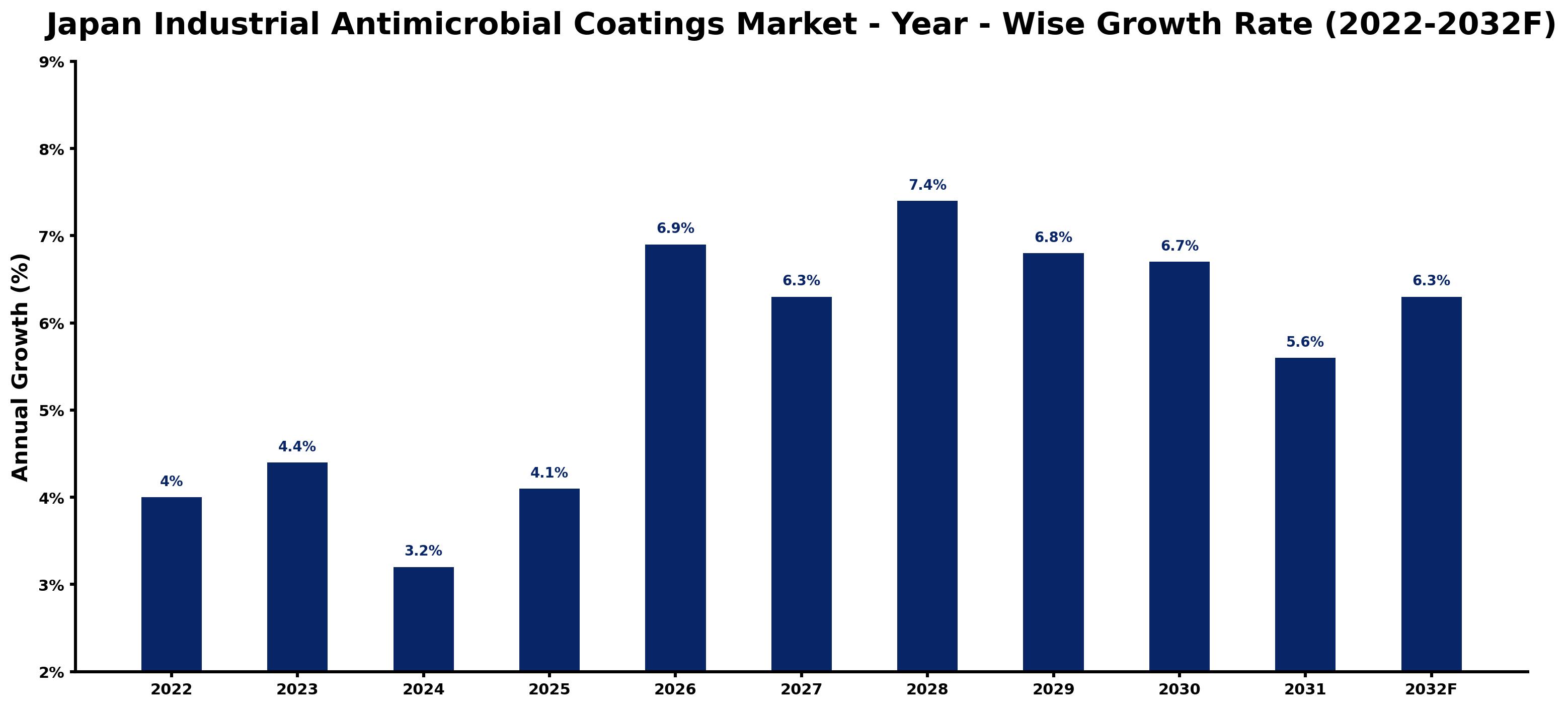
Below, each year's estimated growth is shown next to the factor that most influenced it.
| Year | Estimated Annual Growth (%) | Market Rationale |
| 2022 | 4.0 | The market maintained steady growth due to consistent demand from healthcare applications. |
| 2023 | 4.4 | Growth accelerated as the healthcare sector expanded, increasing the need for antimicrobial solutions. |
| 2024 | 3.2 | The growth rate slowed as market saturation in some segments began to occur. |
| 2025 | 4.1 | Demand rose again, driven by heightened hygiene awareness in food processing units. |
| 2026 | 6.9 | A surge in public infrastructure projects adopting antimicrobial coatings is anticipated. |
| 2027 | 6.3 | Growth is projected to moderate slightly as supply chain issues impact production timelines. |
| 2028 | 7.4 | Investments in healthcare and public safety initiatives will drive peak growth this year. |
| 2029 | 6.8 | Demand growth is expected to slow as the market stabilises after rapid expansion. |
| 2030 | 6.7 | The growth rate will decrease further as competition intensifies among coating manufacturers. |
| 2031 | 5.6 | A continued slowdown will reflect a more mature market with established players. |
| 2032 | 6.3 | Growth is projected to pick up again as new technologies in coatings gain traction. |
Note: Market size estimations and growth projections presented in this report are based on 6Wresearch's proprietary forecasting methodology, utilizing the latest available industry data, government publications, and primary research inputs.
Japan Industrial Antimicrobial Coatings Market Synopsis
Industrial antimicrobial coatings inhibit the growth of microorganisms, primarily using active agents like silver or copper. These coatings are essential in healthcare, food processing, and public infrastructure, improving hygiene and preventing contamination. The Japan Industrial Antimicrobial Coatings Market is expanding due to rising demand from medical device manufacturers and increasing hygiene standards in food processing.
Market Dynamics Impact Analysis (2026–2032)
| Factor | Type | Impact | Primary Segment Affected |
| Increasing healthcare investments | Driver | High | Medical Device Makers |
| Growing public awareness of hygiene | Driver | High | Public Infrastructure |
| Expansion of food safety regulations | Opportunity | High | Food Processing Units |
| Emerging technologies in coatings | Opportunity | Medium | Nanoparticle Infused |
| Regulatory compliance costs | Restraint | High | Copper-Based Coatings |
| Market saturation in established segments | Restraint | Medium | Silver-Based Coatings |
| Supply chain disruptions | Challenge | High | Silver-Based Coatings |
| Intense competition among manufacturers | Challenge | Medium | Silver-Based Coatings |
Evaluation of Drivers in Japan Industrial Antimicrobial Coatings Market (2026–2032)
The factors lifting demand, and the evidence behind each, are summarised below.
| Drivers | Primary Segment Affected | Why It Matters (Evidence) |
| Rising investments in healthcare infrastructure | Medical Device Makers | Japan's medical device market, valued at approximately ¥1.5 trillion, drives demand for antimicrobial coatings to ensure safety. |
| Increased hygiene awareness among consumers | Public Infrastructure | The Tokyo 2020 Olympics heightened the focus on hygiene, resulting in greater adoption of antimicrobial coatings in public transport systems. |
| Food safety regulations mandating hygiene standards | Food Processing Units | Japan's food processing industry, one of the largest in Asia, necessitates antimicrobial solutions to comply with safety regulations. |
| Technological advancements in coating formulations | Nanoparticle Infused | Emerging technologies are enhancing the performance of coatings, attracting interest from various sectors. |
| Government initiatives promoting hygiene standards | Public Infrastructure | The Tokyo Metropolitan Government's promotion of antimicrobial materials supports demand in public infrastructure projects. |
A wider customer base explains much of the growth, as rising investments in healthcare infrastructure valued at approximately ¥1.5 trillion drive demand for antimicrobial coatings. The focus on hygiene in public transport systems has increased following the Tokyo 2020 Olympics, leading to greater adoption of these coatings. Advancements in coating technologies, particularly nanoparticle-infused formulations, are attracting interest from multiple sectors, improving performance and effectiveness.
Evaluation of Restraints in Japan Industrial Antimicrobial Coatings Market
The table below lists the restraints and the evidence behind each.
| Market Restraint | Primary Segment Affected | Why It Matters (Evidence) |
| High compliance costs associated with regulations | Copper-Based Coatings | Regulatory requirements under the Food Sanitation Act increase production costs for manufacturers, impacting pricing strategies. |
| Market saturation in established segments | Silver-Based Coatings | The dominance of silver-based coatings limits growth opportunities as competition intensifies, resulting in price pressures. |
| Supply chain disruptions affecting production | Silver-Based Coatings | Global supply chain issues have delayed the availability of raw materials, causing production delays. |
| Limited innovation in traditional coatings | Copper-Based Coatings | Copper coatings face challenges in differentiation as new technologies emerge, affecting market competitiveness. |
| Intense competition among manufacturers | Silver-Based Coatings | Increased competition drives down prices, impacting profit margins for producers and limiting investment in R&D. |
Japan Industrial Antimicrobial Coatings Market Challenges
Healthcare buyers in Japan face challenges in finding skilled technicians for antimicrobial coating applications, which delays projects and raises costs by approximately 20%. Suppliers encounter difficulties sourcing raw materials due to stringent environmental regulations, extending lead times by several weeks and disrupting production schedules. Increased competition from international suppliers pressures local manufacturers to lower prices, diminishing profit margins and hampering investment in new technologies. Compliance with the Food Sanitation Act complicates product approvals, resulting in longer market entry timelines that can cost food processors valuable sales opportunities.
Trends in the Japan Industrial Antimicrobial Coatings Market
The shifts below are changing how Japan Industrial Antimicrobial Coatings Market products are bought and supplied.
- Shift towards Advanced Coating Technologies: Since 2020, Japan has experienced a shift towards advanced antimicrobial coatings, particularly nanoparticle-infused types. This change is driven by the need for improved performance in healthcare applications, with the market for these coatings projected to grow substantially.
- Increased Adoption in Public Transport: The Tokyo Metropolitan Government has promoted antimicrobial materials in public transport since 2021, resulting in a 30% increase in their use in new projects. This trend reflects a growing commitment to public hygiene.
- Focus on Food Safety Innovations: From 2022, food processing units have increasingly adopted antimicrobial coatings to comply with stringent safety regulations. This shift is evident as the demand for these coatings is projected to rise significantly in the coming years.
- Expansion of Antimicrobial Coatings in Healthcare: The healthcare sector has expanded its use of antimicrobial coatings since 2023, particularly in medical devices. This trend is supported by a growing installed base of over 1 million medical devices in Japan.
Investment Opportunities in the Japan Industrial Antimicrobial Coatings Market
Where to invest in the Japan Industrial Antimicrobial Coatings Market: the main openings are set out below.
- Gap in Advanced Coating Solutions: With a projected increase in demand for advanced coatings, suppliers can focus on nanoparticle-infused products. Medical device makers are seeking new solutions to improve safety and performance.
- Timing for Food Safety Innovations: As Japan's food processing industry continues to grow, now is the time to invest in antimicrobial coatings. Food processing units are looking for suppliers that can meet new safety regulations.
- Supply of Antimicrobial Coatings in Public Infrastructure: The Tokyo Metropolitan Government's initiatives create a demand for antimicrobial coatings in public infrastructure projects. Companies can enter this market through partnerships with local contractors.
- Investment in Healthcare Coatings: With healthcare spending projected to rise, there is a significant opportunity for suppliers of antimicrobial coatings. Medical device manufacturers are actively seeking to improve product safety.
Government Initiatives in the Japan Industrial Antimicrobial Coatings Market
The Food Sanitation Act amendment in 2018 established a positive list system for synthetic resins, impacting the use of antimicrobial coatings in food processing. This measure requires manufacturers to ensure compliance with safety standards, thus influencing production methods and costs. The regulation aims to improve food safety and hygiene across the industry.
The Japan Coatings Association oversees the implementation of guidelines for antimicrobial coatings, funding projects that promote innovation in this sector. The agency's initiatives aim to improve safety standards and ensure compliance with regulations, benefiting producers and buyers alike.
Future Insight of the Japan Industrial Antimicrobial Coatings Market
Japan's commitment to a 46% reduction in greenhouse-gas emissions by 2030 will drive innovation in antimicrobial coatings that meet environmental standards. By 2032, the adoption of ISO 22196 will assure buyers of product efficacy, fostering trust in the market. Initiatives from the Tokyo Metropolitan Government to promote antimicrobial materials in public infrastructure will create new business opportunities for suppliers. As the healthcare sector expands, the focus on reducing hospital-acquired infections will lead to increased demand for advanced antimicrobial solutions.
Market Segmentation Analysis
Japan Industrial Antimicrobial Coatings Market report covers a detailed analysis of the following market segments:
By Coating Type – Silver-Based Coatings Lead, Hybrid Coatings Expected to Grow Fastest
According to Saurav Kr Singh, Senior Research Analyst at 6Wresearch, the largest coating type category in 2025 was Silver-Based Coatings, at 46% of revenue. Silver-based coatings hold the largest share due to their effectiveness in medical applications, particularly in hospitals where hygiene is critical. The extensive use of these coatings in over 1 million medical devices in Japan underscores their dominant position. Hybrid Coatings are projected to grow fastest, at a CAGR of 9.4% during 2026–2032. The hybrid coatings segment is growing quickly as they integrate various active agents, appealing to multiple industries. This growth is driven by the rising demand for versatile solutions in sectors such as healthcare and food processing. Suppliers should prioritise the development of hybrid coating technologies to meet the increasing market demand.
By Active Agent – Silver Ions Lead, Nanoparticle Infused Expected to Grow Fastest
Silver Ions held 41% of the Japan Industrial Antimicrobial Coatings Market by active agent in 2025. Silver ions are integral to many antimicrobial coatings due to their proven efficacy in inhibiting microbial growth. Their widespread use in healthcare applications, such as in medical devices, reinforces their position as the leading active agent. The quickest growth will come from Nanoparticle Infused, forecast to expand at a CAGR of 8.9% between 2026 and 2032. Nanoparticle infused coatings are emerging rapidly, offering enhanced performance that meets the evolving demands of various industries. Their ability to provide superior antimicrobial properties will likely drive increased adoption across multiple sectors. Suppliers should focus on developing nanoparticle infused coatings to meet the rising demand for advanced antimicrobial solutions.
By Substrate Compatibility – Metals Lead, Multi-Surface Expected to Grow Fastest
In 2025, Metals led the substrate compatibility split with a 39% share. Metals are the primary substrate for many industrial antimicrobial coatings, offering durability and compatibility across various applications. Their widespread use in critical sectors like healthcare and food processing reinforces their leading market position. Multi-Surface is set to record the highest CAGR in this split, 8.6% over 2026–2032. Multi-surface compatibility is driving rapid growth as these coatings can be applied to a variety of materials, appealing to a broader range of industries. This adaptability is essential as businesses look to implement antimicrobial solutions in diverse environments. Suppliers should focus on developing multi-surface solutions to cater to the varied needs of end users.
By End User – Medical Device Makers Lead, Food Processing Units Expected to Grow Fastest
With 35% of end user revenue in 2025, Medical Device Makers was the largest category. Medical device makers are the primary users of antimicrobial coatings, driven by stringent safety regulations in the healthcare sector. Their significant investments in hygiene technologies underscore the importance of these coatings in preventing infections. Over 2026–2032, Food Processing Units are expected to post the fastest growth, at a CAGR of 8.3%. Food processing units are adopting antimicrobial coatings more rapidly to comply with strict hygiene standards, reflecting their commitment to food safety. This trend is expected to gain momentum as consumer awareness of hygiene increases. Suppliers should prioritise food processing units to capitalise on the growing need for effective antimicrobial solutions.
Key Attractiveness of the Report
- 10 Years of Market Numbers
- Historical Data Starting from 2022 to 2025
- Base Year 2025
- Forecast Data until 2032
- Key Performance Indicators Impacting the Market
- Major Upcoming Developments and Projects
Key Highlights of the Report:
- Japan Industrial Antimicrobial Coatings Market Outlook
- Market Size of Japan Industrial Antimicrobial Coatings Market, 2025
- Forecast of Japan Industrial Antimicrobial Coatings Market, 2032
- Historical Data and Forecast of Japan Industrial Antimicrobial Coatings Revenues & Volume for the Period 2022-2032F
- Japan Industrial Antimicrobial Coatings Market Trend Evolution
- Japan Industrial Antimicrobial Coatings Market Drivers and Challenges
- Japan Industrial Antimicrobial Coatings Price Trends
- Japan Industrial Antimicrobial Coatings Porter's Five Forces
- Japan Industrial Antimicrobial Coatings Industry Life Cycle
- Historical Data and Forecast of Japan Industrial Antimicrobial Coatings Market Revenues & Volume By Coating Type for the Period 2022-2032F
- Historical Data and Forecast of Japan Industrial Antimicrobial Coatings Market Revenues & Volume By Silver-Based Coatings for the Period 2022-2032F
- Historical Data and Forecast of Japan Industrial Antimicrobial Coatings Market Revenues & Volume By Copper-Based Coatings for the Period 2022-2032F
- Historical Data and Forecast of Japan Industrial Antimicrobial Coatings Market Revenues & Volume By Organic Antimicrobials for the Period 2022-2032F
- Historical Data and Forecast of Japan Industrial Antimicrobial Coatings Market Revenues & Volume By Hybrid Coatings for the Period 2022-2032F
- Historical Data and Forecast of Japan Industrial Antimicrobial Coatings Market Revenues & Volume By Active Agent for the Period 2022-2032F
- Historical Data and Forecast of Japan Industrial Antimicrobial Coatings Market Revenues & Volume By Silver Ions for the Period 2022-2032F
- Historical Data and Forecast of Japan Industrial Antimicrobial Coatings Market Revenues & Volume By Cuprous Oxide for the Period 2022-2032F
- Historical Data and Forecast of Japan Industrial Antimicrobial Coatings Market Revenues & Volume By Triclosan, QACs for the Period 2022-2032F
- Historical Data and Forecast of Japan Industrial Antimicrobial Coatings Market Revenues & Volume By Nanoparticle Infused for the Period 2022-2032F
- Historical Data and Forecast of Japan Industrial Antimicrobial Coatings Market Revenues & Volume By Substrate Compatibility for the Period 2022-2032F
- Historical Data and Forecast of Japan Industrial Antimicrobial Coatings Market Revenues & Volume By Metals, Plastics for the Period 2022-2032F
- Historical Data and Forecast of Japan Industrial Antimicrobial Coatings Market Revenues & Volume By HVAC Surfaces for the Period 2022-2032F
- Historical Data and Forecast of Japan Industrial Antimicrobial Coatings Market Revenues & Volume By Textiles, Wood for the Period 2022-2032F
- Historical Data and Forecast of Japan Industrial Antimicrobial Coatings Market Revenues & Volume By Multi-Surface for the Period 2022-2032F
- Historical Data and Forecast of Japan Industrial Antimicrobial Coatings Market Revenues & Volume By End User for the Period 2022-2032F
- Historical Data and Forecast of Japan Industrial Antimicrobial Coatings Market Revenues & Volume By Medical Device Makers for the Period 2022-2032F
- Historical Data and Forecast of Japan Industrial Antimicrobial Coatings Market Revenues & Volume By Public Infrastructure for the Period 2022-2032F
- Historical Data and Forecast of Japan Industrial Antimicrobial Coatings Market Revenues & Volume By Furniture & Interiors for the Period 2022-2032F
- Historical Data and Forecast of Japan Industrial Antimicrobial Coatings Market Revenues & Volume By Food Processing Units for the Period 2022-2032F
- Japan Industrial Antimicrobial Coatings Import Export Trade Statistics
- Market Opportunity Assessment By Coating Type
- Market Opportunity Assessment By Active Agent
- Market Opportunity Assessment By Substrate Compatibility
- Market Opportunity Assessment By End User
- Japan Industrial Antimicrobial Coatings Top Companies Market Share
- Japan Industrial Antimicrobial Coatings Competitive Benchmarking By Technical and Operational Parameters
- Japan Industrial Antimicrobial Coatings Company Profiles
- Japan Industrial Antimicrobial Coatings Key Strategic Recommendations
Market Covered
Segments analysed in this report are listed below.
By Coating Type
- Silver-Based Coatings
- Copper-Based Coatings
- Organic Antimicrobials
- Hybrid Coatings
By Active Agent
- Silver Ions
- Cuprous Oxide
- Triclosan
- QACs
- Nanoparticle Infused
By Substrate Compatibility
- Metals
- Plastics
- HVAC Surfaces
- Textiles
- Wood
- Multi-Surface
By End User
- Medical Device Makers
- Public Infrastructure
- Furniture & Interiors
- Food Processing Units































