Japan Industrial AR Market Size & Growth Rate
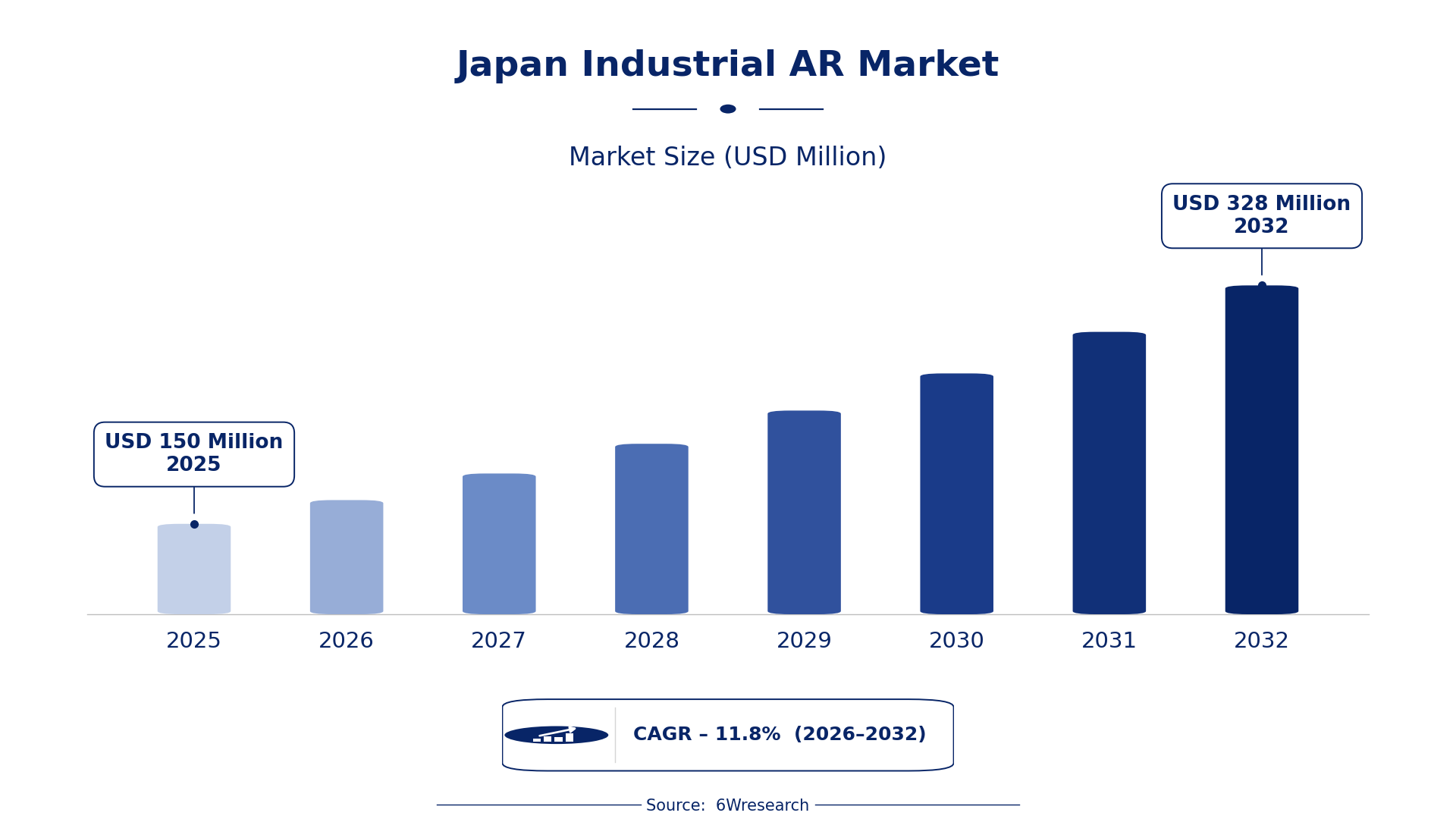
According to 6Wresearch internal database and industry insights, the Japan Industrial AR Market was valued at USD 150 Million in 2025 and is projected to reach USD 328 Million by 2032, growing at a CAGR of approximately 11.8% during 2026–2032.
Japan Industrial AR Market Highlights
| Report Metric | Details |
| Report Name | Japan Industrial AR Market (2026-2032) |
| Market Size 2025 | USD 150 Million |
| Market Size 2032 | USD 328 Million |
| Absolute Growth 2025–2032 | USD 178 Million |
| CAGR 2026–2032 | 11.8% |
| Peak Annual Growth | 14.5% in 2032 |
| Forecast Period | 2026–2032 |
| Historical Data | 2022–2025 |
| Base Year | 2025 |
| Leading AR Type, 2025 | Smart Glasses AR (45% share) |
| Leading Display Mode, 2025 | See-through Overlay (43% share) |
| Leading Functionality, 2025 | Real-Time Guidance (39% share) |
| Leading End User, 2025 | Assembly Line Workers (41% share) |
| Fastest-Growing AR Type | Tablet/Mobile AR (17.4% CAGR) |
| Fastest-Growing Functionality | Training Simulation (15.5% CAGR) |
| Fastest-Growing End User | Technical Training Centers (15.6% CAGR) |
| Growing Sector | Industrial training and efficiency |
| Key End Users | Assembly line workers, field technicians, technical training centers, industrial R&D teams |
Japan Industrial AR Market Year-wise Growth Rate and Key Drivers (2022–2032)
This graph illustrates the annual growth rates of the market from 2022 to 2032, highlighting a steady upward trajectory and projected market expansion over the forecast period.
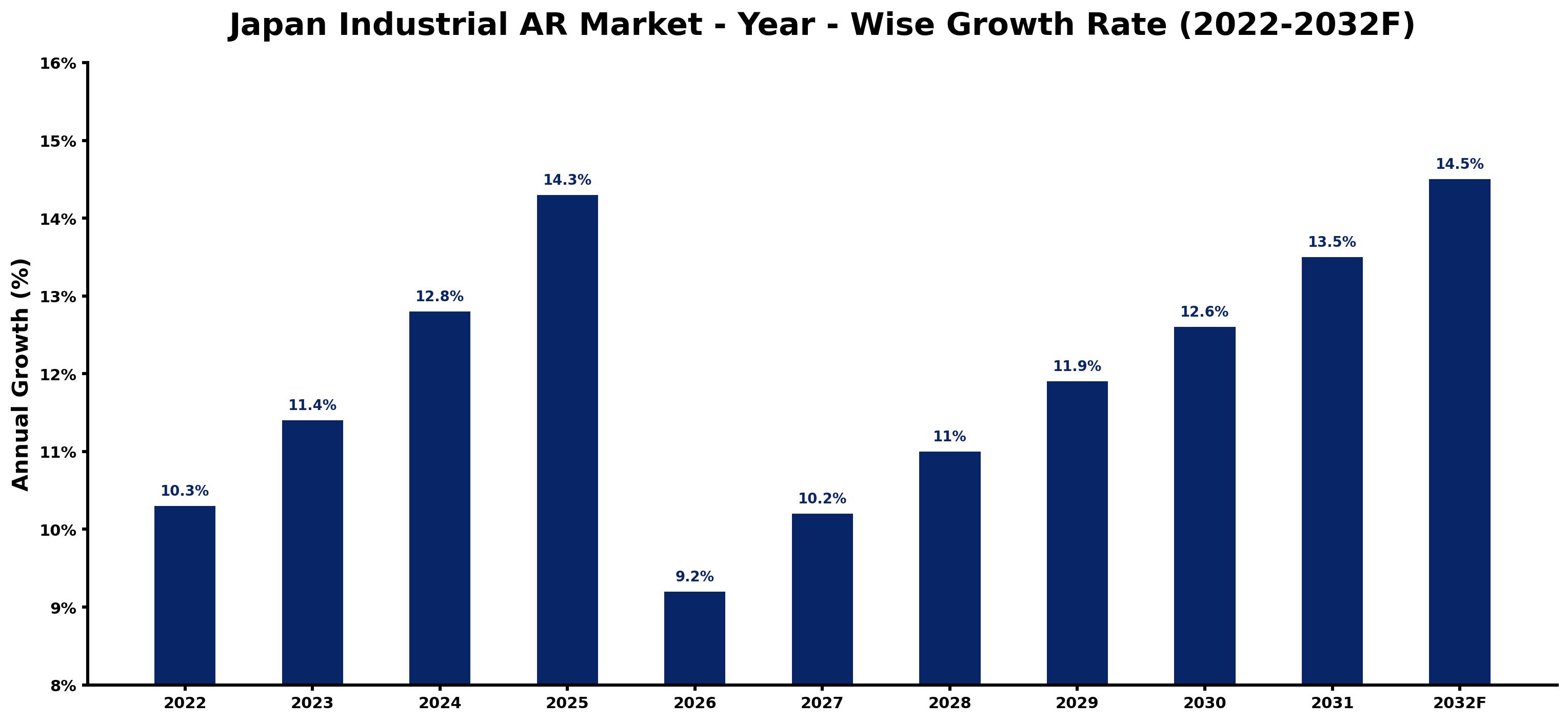
Each row of the following table gives one year's estimated growth and the event or demand shift that explains it.
| Year | Estimated Annual Growth (%) | Market Rationale |
| 2022 | 10.3 | The market showed solid growth due to increased interest in AR technologies. |
| 2023 | 11.4 | Demand rose as more companies adopted AR for training and maintenance. |
| 2024 | 12.8 | Growth accelerated as technological advancements improved AR usability. |
| 2025 | 14.3 | The market peaked this year, driven by substantial investments in AR applications. |
| 2026 | 9.2 | Growth is expected to slow as the market begins to stabilise after rapid expansion. |
| 2027 | 10.2 | Demand will increase again as more sectors recognise AR's benefits. |
| 2028 | 11.0 | The market is projected to continue growing as training tools become more essential. |
| 2029 | 11.9 | Growth will persist with ongoing investments in advanced manufacturing technologies. |
| 2030 | 12.6 | Demand is expected to rise as companies seek to improve operational efficiency. |
| 2031 | 13.5 | The market will expand further, driven by a focus on digital transformation. |
| 2032 | 14.5 | Growth is projected to peak again as AR applications become standard in many industries. |
Note: Market size estimations and growth projections presented in this report are based on 6Wresearch's proprietary forecasting methodology, utilizing the latest available industry data, government publications, and primary research inputs.
Japan Industrial AR Market Synopsis
Industrial AR technologies improve operational efficiency and training in various industrial applications. The Japan Industrial AR Market is expanding due to increased investments in advanced manufacturing technologies, with the Tokyo region representing 30% of all AR technology investments. The average age of assembly line workers is 45, creating a demand for effective training tools, while over 50% of field technicians report enhanced efficiency when using AR tools. In 2023, a government programme was launched to promote AR in manufacturing, which is expected to further stimulate market growth.
Market Dynamics Impact Analysis (2026–2032)
| Factor | Type | Impact | Primary Segment Affected |
| Increased adoption of AR for training and maintenance in manufacturing environments | Driver | High | Real-Time Guidance |
| Growing investments in advanced manufacturing technologies | Driver | High | Smart Glasses AR |
| Rising demand for effective training tools for older workers | Opportunity | High | Technical Training Centers |
| Significant public and private investment in decarbonisation technologies | Opportunity | Medium | Tablet/Mobile AR |
| High costs associated with implementing AR technologies | Restraint | High | Head-Mounted AR |
| Limited comfort and usability of certain AR devices | Restraint | Medium | Wearable HMD |
| Challenges in integrating AR with existing systems | Challenge | High | Screen-Based |
| Competition from other emerging technologies | Challenge | Medium | Projection-Based AR |
Evaluation of Drivers in Japan Industrial AR Market (2026–2032)
The following drivers explain most of the expected growth.
| Drivers | Primary Segment Affected | Why It Matters (Evidence) |
| Increased training efficiency through AR tools | Training Simulation | Over 200 industrial facilities in Japan use AR training simulations, enhancing onboarding processes. |
| Real-time guidance reduces errors in assembly lines | Real-Time Guidance | AR applications have improved efficiency by 20% in maintenance tasks. |
| Demand for hands-free operations in manufacturing | Smart Glasses AR | The Tokyo region accounts for 30% of AR technology investments, driving smart glasses adoption. |
| Need for effective maintenance instructions | Maintenance Instructions | Field technicians report over 50% efficiency improvements using AR tools. |
| Growing focus on operational efficiency | Tablet/Mobile AR | The average age of assembly line workers is 45, increasing the demand for accessible training. |
Several shifts outside the market lift sales. The average age of assembly line workers in Japan is 45, which increases the need for effective training tools. AR training simulations are used in over 200 industrial facilities, improving onboarding processes. The Tokyo region accounts for 30% of all AR technology investments, driving demand for smart glasses and mobile AR applications. Real-time guidance reduces errors in assembly lines, further boosting market growth. Technicians report over 50% efficiency improvements using AR tools, leading to higher adoption rates.
Evaluation of Restraints in Japan Industrial AR Market
These restraints slow adoption and weigh on supplier margins.
| Market Restraint | Primary Segment Affected | Why It Matters (Evidence) |
| High costs associated with implementing AR technologies | Head-Mounted AR | The average investment for AR systems can exceed ¥10 million, limiting adoption. |
| Limited comfort and usability of certain AR devices | Wearable HMD | Many users find head-mounted displays uncomfortable for extended use, hindering growth. |
| Integration challenges with existing systems | Screen-Based | Many companies face difficulties integrating AR into their current workflows, resulting in delays. |
| Competition from other emerging technologies | Projection-Based AR | Other technologies may offer more cost-effective solutions, diverting investment from AR. |
| Regulatory compliance costs for AR devices | Smart Glasses AR | Compliance with safety standards like JIS B 0126 can increase overall costs. |
Japan Industrial AR Market Challenges
Compliance with Japan's JIS B 0126 standard creates obstacles for buyers of AR technologies. This regulation requires rigorous safety checks, which can delay product availability for suppliers, limiting buyers' access to essential tools. Many suppliers struggle with outdated technology, which hampers their ability to innovate and can lead to a 20% increase in downtime for manufacturers. A skills gap exists as the average age of assembly line workers is 45, resulting in fewer younger, tech-savvy employees, which can reduce productivity for buyers. Supply chain inefficiencies emerge as over 50% of field technicians report challenges without AR tools, impacting operational effectiveness for manufacturers.
Trends in the Japan Industrial AR Market
The following changes are redrawing the Japan Industrial AR Market.
- Shift from Traditional Training to AR Simulations: Since 2023, many technical training centers have begun integrating AR simulations into their curricula, improving hands-on learning experiences. Over 100 centers now utilise AR, reflecting a shift towards more interactive training methods.
- Emergence of Real-Time Guidance in Manufacturing: In 2023, the adoption of real-time guidance systems has surged, with many assembly line workers relying on AR for improved efficiency. This shift has led to a 20% reduction in downtime in leading industries.
- Increased Focus on Decarbonisation Technologies: The GX Basic Policy adopted in 2023 targets JPY 150 trillion in decarbonisation investments, prompting manufacturers to adopt AR for energy efficiency. This focus is reshaping how companies approach operational efficiency.
- Growing Demand for Smart Glasses in Industrial Settings: The rise of smart glasses AR has been notable since 2023, with a 45% market share projected for 2025. This trend is driven by the need for hands-free operations in manufacturing environments.
Investment Opportunities in the Japan Industrial AR Market
Below are the investment opportunities with the strongest case in the Japan Industrial AR Market.
- Technical Training Centers Seeking Effective Solutions: With over 100 technical training centres nationwide, there is a clear demand for AR training tools. The average age of assembly line workers at 45 underscores the need for effective training solutions.
- Investment Gap in AR Technology: Japan's public and private sectors are targeting JPY 150 trillion for decarbonisation, creating opportunities for AR technology suppliers to fulfil this demand in manufacturing settings.
- Chubu Region's Automotive Sector: The Chubu region serves as a hub for automotive AR applications, with numerous manufacturers adopting AR technologies. Suppliers can penetrate this market through local partnerships or joint ventures.
- Approval Pathways for AR Devices: The JIS B 0126 standard governs AR device safety, establishing a pathway for compliance. Suppliers can invest in certification processes to access the industrial market.
Government Initiatives in the Japan Industrial AR Market
The GX Promotion Act of 2023 establishes a framework for promoting green technologies, updating previous regulations like the Industrial Safety and Health Act of 1972. This law mandates that employers ensure safe working conditions, which now includes AR technologies, pushing producers to comply with updated safety standards.
In 2023, the Japanese government allocated ¥1 billion for AR technology development, administered by the Ministry of Economy, Trade and Industry. This funding supports projects aimed at improving AR applications in manufacturing, benefiting both producers and users.
Future Insight of the Japan Industrial AR Market
Technological advancements will reshape demand for AR applications by 2032. The government initiative to promote AR in manufacturing will encourage widespread adoption, improving operational efficiency across various sectors. With Japan aiming for a 46% reduction in greenhouse gas emissions by 2030, AR solutions will play a crucial part in achieving these environmental targets. The installed base of AR devices is expected to reach around 20,000 units, providing buyers with improved tools for training and maintenance.
Market Segmentation Analysis
Japan Industrial AR Market report covers a detailed analysis of the following market segments:
By AR Type – Smart Glasses AR Leads, Tablet/Mobile AR Expected to Grow Fastest
According to Saurav Kr Singh, Senior Research Analyst at 6Wresearch, in 2025, Smart Glasses AR led the ar type split with a 45% share. Smart Glasses AR commands the largest share due to their hands-free functionality, which is essential for manufacturing tasks. With over 10,000 AR devices installed, these tools are extensively utilised for operational support in various facilities. Tablet/Mobile AR is projected to grow fastest, at a CAGR of 17.4% during 2026–2032. Tablet/Mobile AR is rapidly gaining traction as it provides on-the-go access to crucial information, with adoption rates significantly increasing across multiple sectors. This versatility is expected to further enhance its market presence. Suppliers should prioritise the development of tablet and mobile AR solutions to cater to the growing demand for flexible applications.
By Display Mode – See-through Overlay Leads and Records the Fastest Growth
See-through Overlay took 43% of display mode revenue in 2025, more than any other category. See-through Overlay is the leading display mode as it allows real-time data visualisation, which is critical for executing tasks in industrial environments. Its effectiveness in improving operational processes has made it the preferred option among users. See-through Overlay is also forecast to expand faster than any other category, at a CAGR of 13.8% over 2026–2032. The growth of See-through Overlay will persist as it remains the top choice for real-time applications, enabling users to access essential information seamlessly. Its established market presence is likely to drive further advancements. Buyers should invest in see-through overlay technologies to enhance operational efficiency and productivity.
By Functionality – Real-Time Guidance Leads, Training Simulation Expected to Grow Fastest
With 39% of functionality revenue in 2025, Real-Time Guidance was the largest category. Real-Time Guidance is the dominant functionality because it significantly boosts efficiency and minimises errors on assembly lines. This capability is crucial for industries focused on streamlining operations and increasing productivity. Over 2026–2032, Training Simulation is expected to post the fastest growth, at a CAGR of 15.5%. Training Simulation is experiencing rapid growth as businesses acknowledge the necessity of effective onboarding and skill enhancement for new employees. The rising average age of assembly line workers intensifies the demand for robust training solutions. Suppliers should focus on developing training simulation tools to meet the increasing need for effective employee training.
By End User – Assembly Line Workers Lead, Technical Training Centers Expected to Grow Fastest
Assembly Line Workers held 41% of the Japan Industrial AR Market by end user in 2025. Assembly Line Workers constitute the largest user group for AR applications, benefiting directly from improved operational support and efficiency gains. Their dependence on AR tools for daily activities highlights the segment's importance in the market. Technical Training Centers are set to record the highest CAGR in this split, 15.6% over 2026–2032. Technical Training Centers are seeing the fastest growth as they increasingly incorporate AR into their training programmes, enhancing practical learning experiences. This trend is anticipated to accelerate as educational institutions modernise their training approaches. Suppliers must engage with technical training centres to broaden their reach and impact within the educational sector.
Key Attractiveness of the Report
- 10 Years of Market Numbers
- Historical Data Starting from 2022 to 2025
- Base Year 2025
- Forecast Data until 2032
- Key Performance Indicators Impacting the Market
- Major Upcoming Developments and Projects
Key Highlights of the Report:
- Japan Industrial AR Market Outlook
- Market Size of Japan Industrial AR Market, 2025
- Forecast of Japan Industrial AR Market, 2032
- Historical Data and Forecast of Japan Industrial AR Revenues & Volume for the Period 2022-2032F
- Japan Industrial AR Market Trend Evolution
- Japan Industrial AR Market Drivers and Challenges
- Japan Industrial AR Price Trends
- Japan Industrial AR Porter's Five Forces
- Japan Industrial AR Industry Life Cycle
- Historical Data and Forecast of Japan Industrial AR Market Revenues & Volume By AR Type for the Period 2022-2032F
- Historical Data and Forecast of Japan Industrial AR Market Revenues & Volume By Smart Glasses AR for the Period 2022-2032F
- Historical Data and Forecast of Japan Industrial AR Market Revenues & Volume By Tablet/Mobile AR for the Period 2022-2032F
- Historical Data and Forecast of Japan Industrial AR Market Revenues & Volume By Head-Mounted AR for the Period 2022-2032F
- Historical Data and Forecast of Japan Industrial AR Market Revenues & Volume By Projection-Based AR for the Period 2022-2032F
- Historical Data and Forecast of Japan Industrial AR Market Revenues & Volume By Display Mode for the Period 2022-2032F
- Historical Data and Forecast of Japan Industrial AR Market Revenues & Volume By See-through Overlay for the Period 2022-2032F
- Historical Data and Forecast of Japan Industrial AR Market Revenues & Volume By Screen-Based for the Period 2022-2032F
- Historical Data and Forecast of Japan Industrial AR Market Revenues & Volume By Wearable HMD for the Period 2022-2032F
- Historical Data and Forecast of Japan Industrial AR Market Revenues & Volume By Surface Projection for the Period 2022-2032F
- Historical Data and Forecast of Japan Industrial AR Market Revenues & Volume By Functionality for the Period 2022-2032F
- Historical Data and Forecast of Japan Industrial AR Market Revenues & Volume By Real-Time Guidance for the Period 2022-2032F
- Historical Data and Forecast of Japan Industrial AR Market Revenues & Volume By Maintenance Instructions for the Period 2022-2032F
- Historical Data and Forecast of Japan Industrial AR Market Revenues & Volume By Training Simulation for the Period 2022-2032F
- Historical Data and Forecast of Japan Industrial AR Market Revenues & Volume By Object Tagging for the Period 2022-2032F
- Historical Data and Forecast of Japan Industrial AR Market Revenues & Volume By End User for the Period 2022-2032F
- Historical Data and Forecast of Japan Industrial AR Market Revenues & Volume By Assembly Line Workers for the Period 2022-2032F
- Historical Data and Forecast of Japan Industrial AR Market Revenues & Volume By Field Technicians for the Period 2022-2032F
- Historical Data and Forecast of Japan Industrial AR Market Revenues & Volume By Technical Training Centers for the Period 2022-2032F
- Historical Data and Forecast of Japan Industrial AR Market Revenues & Volume By Industrial R&D Teams for the Period 2022-2032F
- Japan Industrial AR Import Export Trade Statistics
- Market Opportunity Assessment By AR Type
- Market Opportunity Assessment By Display Mode
- Market Opportunity Assessment By Functionality
- Market Opportunity Assessment By End User
- Japan Industrial AR Top Companies Market Share
- Japan Industrial AR Competitive Benchmarking By Technical and Operational Parameters
- Japan Industrial AR Company Profiles
- Japan Industrial AR Key Strategic Recommendations
Market Covered
The following segment groups are covered in the report.
By AR Type
- Smart Glasses AR
- Tablet/Mobile AR
- Head-Mounted AR
- Projection-Based AR
By Display Mode
- See-through Overlay
- Screen-Based
- Wearable HMD
- Surface Projection
By Functionality
- Real-Time Guidance
- Maintenance Instructions
- Training Simulation
- Object Tagging
By End User
- Assembly Line Workers
- Field Technicians
- Technical Training Centers
- Industrial R&D Teams































