Japan Industrial AR/VR Solutions Market Size & Growth Rate
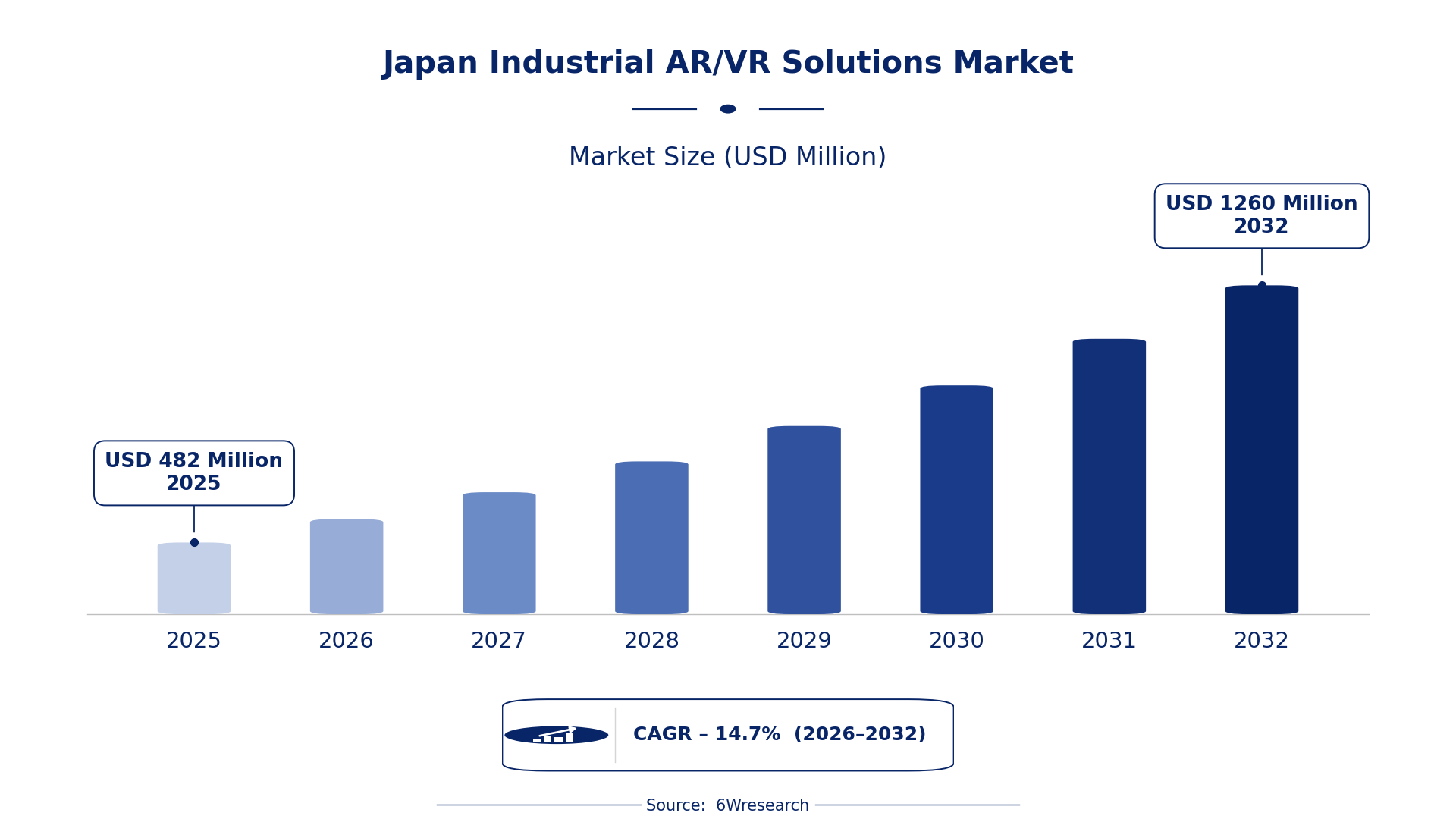
According to 6Wresearch internal database and industry insights, the Japan Industrial AR/VR Solutions Market was valued at USD 482 Million in 2025 and is projected to reach USD 1,260 Million by 2032, growing at a CAGR of approximately 14.7% during 2026–2032.
Japan Industrial AR/VR Solutions Market Highlights
| Report Metric | Details |
| Report Name | Japan Industrial AR/VR Solutions Market (2026-2032) |
| Market Size 2025 | USD 482 Million |
| Market Size 2032 | USD 1,260 Million |
| Absolute Growth 2025–2032 | USD 778 Million |
| CAGR 2026–2032 | 14.7% |
| Peak Annual Growth | 17.0% in 2026 |
| Forecast Period | 2026–2032 |
| Historical Data | 2022–2025 |
| Base Year | 2025 |
| Leading Solution Type, 2025 | AR for Assembly (41% share) |
| Leading Immersion Level, 2025 | Full Immersion (46% share) |
| Leading Use Case, 2025 | Visual Assembly Support (42% share) |
| Leading End User, 2025 | Automotive OEMs (42% share) |
| Fastest-Growing Solution Type | Mixed Reality Platforms (19.9% CAGR) |
| Fastest-Growing Immersion Level | Combined AR + VR (18.4% CAGR) |
| Fastest-Growing Use Case | Operator Skill Development (19.0% CAGR) |
| Fastest-Growing End User | Aerospace & Energy Firms (19.6% CAGR) |
| Growing Sector | automotive |
| Key End Users | automotive OEMs, aerospace firms, maintenance providers, training institutions |
Japan Industrial AR/VR Solutions Market Year-wise Growth Rate and Key Drivers (2022–2032)
This graph illustrates the annual growth rates of the market from 2022 to 2032, highlighting a steady upward trajectory and projected market expansion over the forecast period.
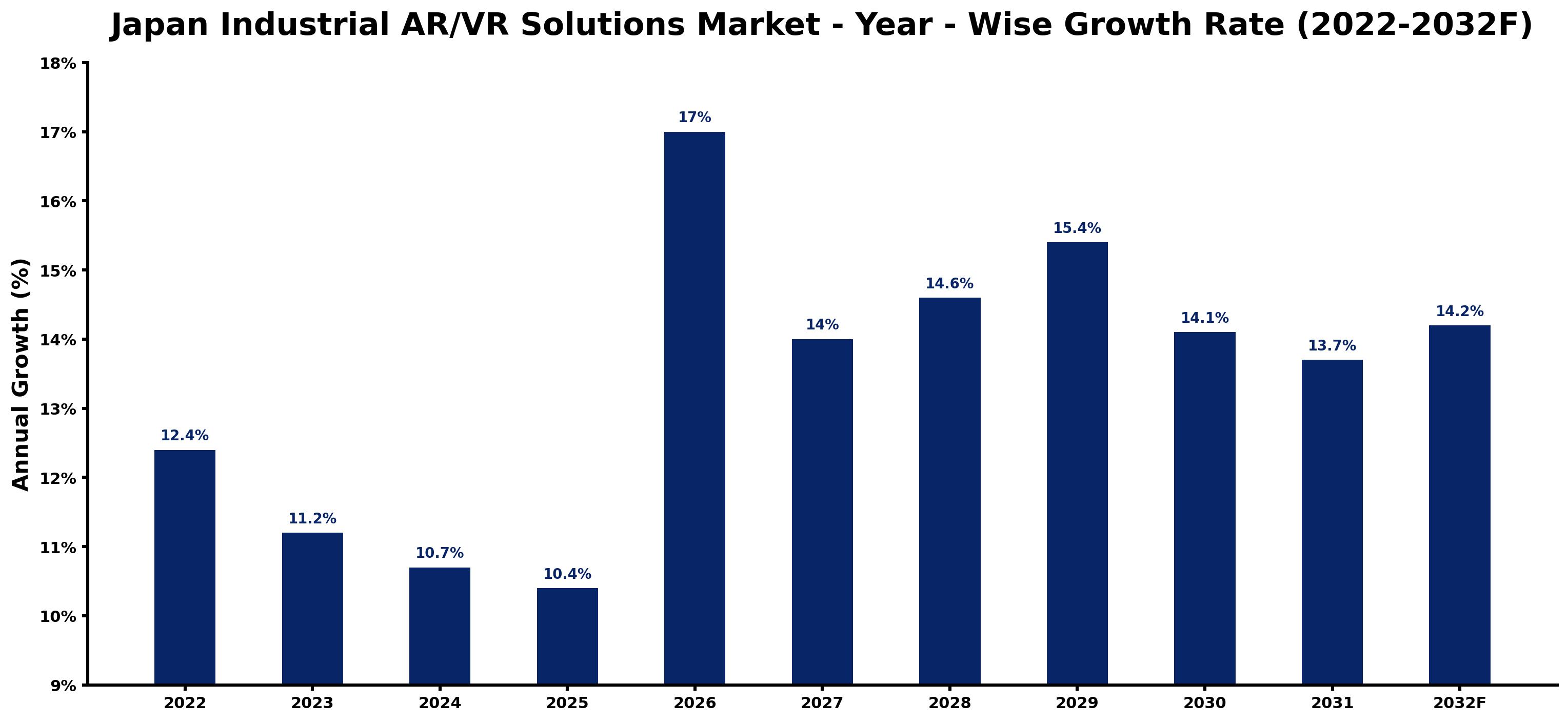
For each year, the table pairs the estimated growth rate with the leading influence on demand, showing how the drivers changed across the period.
| Year | Estimated Annual Growth (%) | Market Rationale |
| 2022 | 12.4 | The market experienced strong growth due to increased adoption of AR/VR technologies in various sectors. |
| 2023 | 11.2 | Demand growth slowed as companies adjusted to market saturation and focused on integration. |
| 2024 | 10.7 | Continued investment in training solutions contributed to a further slowdown in growth. |
| 2025 | 10.4 | Market growth slowed as companies consolidated their AR/VR investments and focused on efficiency. |
| 2026 | 17.0 | Demand is expected to surge as companies ramp up investments in advanced AR/VR solutions for operational efficiency. |
| 2027 | 14.0 | Growth will moderate as the market adjusts to the influx of new technologies and solutions. |
| 2028 | 14.6 | Increased adoption of mixed reality platforms will drive a resurgence in demand. |
| 2029 | 15.4 | Demand will continue to rise as industries embrace AR/VR for improved training and operational processes. |
| 2030 | 14.1 | Growth is projected to slow as the market matures and companies focus on refining existing solutions. |
| 2031 | 13.7 | A slight slowdown is expected as companies prioritise cost management in their AR/VR investments. |
| 2032 | 14.2 | Demand is expected to rise again as new applications and technologies emerge. |
Note: Market size estimations and growth projections presented in this report are based on 6Wresearch's proprietary forecasting methodology, utilizing the latest available industry data, government publications, and primary research inputs.
Japan Industrial AR/VR Solutions Market Synopsis
Industrial AR/VR solutions encompass augmented and virtual reality technologies tailored for industrial applications, improving operational efficiency and training personnel. In Japan, the automotive sector is a major user, employing over 5 million people who benefit from AR training. The market is expanding due to increased investments in technology, with approximately JPY 150 trillion allocated for decarbonisation initiatives over the next decade. The government's backing for AR/VR technologies in manufacturing further drives demand, creating opportunities for innovation and efficiency improvements across industries.
Market Dynamics Impact Analysis (2026–2032)
| Factor | Type | Impact | Primary Segment Affected |
| Increased investment in training solutions drives demand for immersive experiences. | Driver | High | VR for Training |
| Growing demand for operational efficiency in manufacturing creates opportunities for AR applications. | Driver | High | AR for Assembly |
| The rise in AR applications for quality checking presents significant market potential. | Opportunity | High | AR for Inspection |
| Aerospace companies are increasingly investing in VR training platforms to enhance skill development. | Opportunity | High | VR for Training |
| Market saturation in certain sectors may limit growth potential for new entrants. | Restraint | Medium | Mixed Reality Platforms |
| Integration challenges with existing systems can hinder AR/VR adoption rates. | Restraint | Medium | Combined AR + VR |
| Supply chain disruptions can delay the delivery of AR/VR hardware and software solutions. | Challenge | High | Full Immersion |
| The rapid pace of technological change can outstrip current training capabilities. | Challenge | High | Operator Skill Development |
Evaluation of Drivers in Japan Industrial AR/VR Solutions Market (2026–2032)
Demand rests on the following drivers, each shown with the segment it touches most.
| Drivers | Primary Segment Affected | Why It Matters (Evidence) |
| Increased focus on training efficiency drives demand for VR solutions. | VR for Training | The automotive sector employs over 5 million people, many of whom benefit from immersive training experiences. |
| Demand for real-time guidance in assembly processes boosts AR adoption. | AR for Assembly | The automotive industry seeks efficiency, driving the growth of AR applications in assembly processes. |
| The need for improved quality control processes fuels AR application growth. | AR for Inspection | AR applications in quality checking are expected to increase by 30% by 2025. |
| Investment in mixed reality platforms is rising as industries seek integrated solutions. | Mixed Reality Platforms | The installed base of AR devices in Japan reached 1 million units in 2023. |
| Government support for technology development encourages AR/VR adoption. | Combined AR + VR | In 2023, the government allocated 1 billion yen for AR/VR technology development in education. |
The strongest pull on demand comes from the automotive sector, where over 5 million employees benefit from VR training solutions that improve skill development. The installed base of AR devices reached 1 million units in 2023, driving demand for AR applications in assembly processes. AR applications in quality checking are expected to increase by 30% by 2025, as industries seek improved accuracy. Investment in mixed reality platforms is also increasing, reflecting a shift towards integrated solutions across sectors.
Evaluation of Restraints in Japan Industrial AR/VR Solutions Market
The main factors holding the market back are set out below.
| Market Restraint | Primary Segment Affected | Why It Matters (Evidence) |
| Market saturation in certain sectors limits growth potential. | Mixed Reality Platforms | As more companies adopt AR/VR, new entrants may struggle to differentiate their offerings. |
| Integration challenges with existing systems hinder adoption rates. | Combined AR + VR | Companies face difficulties in merging new technologies with established processes. |
| Supply chain disruptions delay delivery of AR/VR solutions. | Full Immersion | Global supply chain issues have affected the availability of necessary hardware. |
| Rapid technological changes can outpace training capabilities. | Operator Skill Development | Companies may find it challenging to keep training programs aligned with new technologies. |
| High initial investment costs deter smaller companies from adopting AR/VR solutions. | AR for Assembly | Smaller firms may lack the capital to invest in advanced AR technologies. |
Japan Industrial AR/VR Solutions Market Challenges
High costs impede the adoption of industrial AR/VR solutions, with initial investments often exceeding 100 million yen, limiting access for smaller firms. Integration challenges arise as many manufacturers struggle to connect AR/VR systems with existing machinery, causing project delays of up to six months for suppliers. Regulatory hurdles complicate implementation; compliance with ISO 9241 standards can consume considerable time and resources, impacting project timelines for clinics. Skills shortages in AR/VR programming restrict training centres from hiring qualified personnel, resulting in postponed operational efficiency improvements for buyers.
Trends in the Japan Industrial AR/VR Solutions Market
Buyers and suppliers in the Japan Industrial AR/VR Solutions Market are adjusting to the following trends.
- 30% Increase in AR Applications for Quality Checking: AR applications in quality checking are projected to grow by 30% by 2025, driven by the need for improved accuracy in manufacturing processes. This trend is particularly pronounced in the automotive sector, where precision is critical.
- Shift Towards Mixed Reality Platforms: The shift towards mixed reality platforms began in 2023, with industries seeking integrated AR/VR solutions. This change is particularly noticeable in the aerospace sector, which is increasingly adopting these technologies for training and operational efficiency.
- Growing Adoption of VR for Training: Aerospace companies are investing heavily in VR training platforms to enhance skill development. In 2023, the government allocated 1 billion yen for AR/VR technology development in education, supporting this trend.
- Full Immersion Technologies Gaining Traction: Full immersion technologies are gaining traction, especially in training scenarios. As of 2023, the installed base of AR devices in Japan reached 1 million units, indicating strong market interest.
Investment Opportunities in the Japan Industrial AR/VR Solutions Market
The openings below show where demand in the Japan Industrial AR/VR Solutions Market is visible and how suppliers can enter.
- Gap in AR for Assembly: With a projected increase in AR applications for assembly, there is a gap in the market. Automotive OEMs are seeking solutions to improve efficiency, creating opportunities for suppliers of AR technologies.
- Growing Need for VR Training Solutions: The demand for VR training solutions is on the rise, particularly in the aerospace sector. Investing in VR platforms can address the needs of training providers aiming to enhance skill development.
- Expansion of AR Applications in Quality Checking: The anticipated growth in AR applications for quality checking presents a valuable opportunity. Manufacturers in Tokyo and Aichi are seeking innovative solutions to improve accuracy.
- Investment in Mixed Reality Platforms: As industries embrace mixed reality, there is a growing need for integrated solutions. Collaborating with local partners in key regions can facilitate entry into this expanding market.
Government Initiatives in the Japan Industrial AR/VR Solutions Market
The GX Promotion Act (2023) provides a legal framework for promoting decarbonisation and supports the development of AR/VR technologies. This act aims for approximately JPY 150 trillion in public and private investment over ten years, strengthening the technological environment for AR/VR solutions in Japan. Additionally, the Act on the Rational Use of Energy (1979) requires large energy users to enhance efficiency, indirectly benefiting AR/VR applications by promoting energy-efficient technologies.
The Ministry of Economy, Trade and Industry (METI) oversees funding initiatives for AR/VR technology development. In 2023, METI allocated 1 billion yen specifically for AR/VR advancements in education, which supports the integration of these technologies in training environments, benefiting educational institutions and training providers.
Future Insight of the Japan Industrial AR/VR Solutions Market
Manufacturers will prioritise AR/VR technologies for training, driven by the government's 1 billion yen investment in educational technology. By 2032, the installed base of AR devices is projected to reach 1 million units, enhancing operational efficiency across sectors. The Ministry of Economy, Trade and Industry's 2023 initiative will accelerate AR/VR adoption in manufacturing, promoting technological progress. As AR applications in quality checking are expected to increase by 30% by 2025, suppliers must adapt to meet evolving client demands.
Market Segmentation Analysis
Japan Industrial AR/VR Solutions Market report covers a detailed analysis of the following market segments:
By Solution Type – AR for Assembly Leads, Mixed Reality Platforms Expected to Grow Fastest
According to Saurav Kr Singh, Senior Research Analyst at 6Wresearch, with 41% of solution type revenue in 2025, AR for Assembly was the largest category. AR for Assembly holds the largest share due to its direct application in enhancing operational efficiency during assembly processes, particularly in the automotive sector. The installed base of AR devices, reaching 1 million units in 2023, underscores its widespread adoption. Mixed Reality Platforms are set to record the highest CAGR in this split, 19.9% over 2026–2032. Mixed Reality Platforms are experiencing rapid growth as they integrate digital elements into physical workspaces, which is increasingly sought after in manufacturing. The government's 2023 programme to promote AR/VR technologies indicates a strong future demand for these solutions. Suppliers should focus on developing solutions that integrate AR and VR technologies to meet the growing needs of manufacturers.
By Immersion Level – Full Immersion Leads, Combined AR + VR Expected to Grow Fastest
Full Immersion held 46% of the Japan Industrial AR/VR Solutions Market by immersion level in 2025. Full Immersion leads the market as it offers complete engagement for training scenarios, making it essential for industries that require in-depth skill acquisition. This level of immersion is particularly valued in sectors like aerospace, where effective training is critical for operational success. Over 2026–2032, Combined AR + VR is expected to post the fastest growth, at a CAGR of 18.4%. Combined AR + VR is the fastest growing segment as it leverages both technologies for comprehensive solutions, appealing to firms seeking versatile training and operational tools. The increasing complexity of tasks in various industries fuels this demand for integrated solutions. Buyers will benefit from investing in combined solutions that enhance training and operational capabilities.
By Use Case – Visual Assembly Support Leads, Operator Skill Development Expected to Grow Fastest
Visual Assembly Support accounted for 42% of the market by use case in 2025. Visual Assembly Support is the leading use case as it aids in assembly with visual instructions, significantly improving efficiency in the automotive sector. This practical application is crucial for manufacturers aiming to streamline processes and reduce errors during production. The quickest growth will come from Operator Skill Development, forecast to expand at a CAGR of 19.0% between 2026 and 2032. Operator Skill Development is growing rapidly as it enhances operator skills through simulation, which is increasingly important in high-skill industries. The push for upskilling workers in advanced manufacturing environments drives this growth. Suppliers should prioritise developing simulation-based training tools to cater to the rising demand for skill enhancement.
By End User – Automotive OEMs Lead, Aerospace & Energy Firms Expected to Grow Fastest
In 2025, Automotive OEMs led the end user split with a 42% share. Automotive OEMs dominate the market as they are integral for manufacturing and assembly processes, heavily relying on AR/VR solutions to improve efficiency. The automotive sector's large workforce and investment in technology make it a key driver of market share. Aerospace & Energy Firms are projected to grow fastest, at a CAGR of 19.6% during 2026–2032. Aerospace & Energy Firms are the fastest growing end users, utilising AR/VR for training and operational efficiency, which is essential for maintaining safety and performance standards. The increasing complexity of operations in these sectors accelerates their adoption of advanced technologies. Suppliers should target aerospace and energy firms to capture the growing demand for AR/VR solutions in training and operations.
Key Attractiveness of the Report
- 10 Years of Market Numbers
- Historical Data Starting from 2022 to 2025
- Base Year 2025
- Forecast Data until 2032
- Key Performance Indicators Impacting the Market
- Major Upcoming Developments and Projects
Key Highlights of the Report:
- Japan Industrial AR/VR Solutions Market Outlook
- Market Size of Japan Industrial AR/VR Solutions Market, 2025
- Forecast of Japan Industrial AR/VR Solutions Market, 2032
- Historical Data and Forecast of Japan Industrial AR/VR Solutions Revenues & Volume for the Period 2022-2032F
- Japan Industrial AR/VR Solutions Market Trend Evolution
- Japan Industrial AR/VR Solutions Market Drivers and Challenges
- Japan Industrial AR/VR Solutions Price Trends
- Japan Industrial AR/VR Solutions Porter's Five Forces
- Japan Industrial AR/VR Solutions Industry Life Cycle
- Historical Data and Forecast of Japan Industrial AR/VR Solutions Market Revenues & Volume By Solution Type for the Period 2022-2032F
- Historical Data and Forecast of Japan Industrial AR/VR Solutions Market Revenues & Volume By AR for Assembly for the Period 2022-2032F
- Historical Data and Forecast of Japan Industrial AR/VR Solutions Market Revenues & Volume By VR for Training for the Period 2022-2032F
- Historical Data and Forecast of Japan Industrial AR/VR Solutions Market Revenues & Volume By Mixed Reality Platforms for the Period 2022-2032F
- Historical Data and Forecast of Japan Industrial AR/VR Solutions Market Revenues & Volume By AR for Inspection for the Period 2022-2032F
- Historical Data and Forecast of Japan Industrial AR/VR Solutions Market Revenues & Volume By Immersion Level for the Period 2022-2032F
- Historical Data and Forecast of Japan Industrial AR/VR Solutions Market Revenues & Volume By Partial Immersion for the Period 2022-2032F
- Historical Data and Forecast of Japan Industrial AR/VR Solutions Market Revenues & Volume By Full Immersion for the Period 2022-2032F
- Historical Data and Forecast of Japan Industrial AR/VR Solutions Market Revenues & Volume By Combined AR + VR for the Period 2022-2032F
- Historical Data and Forecast of Japan Industrial AR/VR Solutions Market Revenues & Volume By Overlay Visualization for the Period 2022-2032F
- Historical Data and Forecast of Japan Industrial AR/VR Solutions Market Revenues & Volume By Use Case for the Period 2022-2032F
- Historical Data and Forecast of Japan Industrial AR/VR Solutions Market Revenues & Volume By Visual Assembly Support for the Period 2022-2032F
- Historical Data and Forecast of Japan Industrial AR/VR Solutions Market Revenues & Volume By Operator Skill Development for the Period 2022-2032F
- Historical Data and Forecast of Japan Industrial AR/VR Solutions Market Revenues & Volume By Remote Collaboration for the Period 2022-2032F
- Historical Data and Forecast of Japan Industrial AR/VR Solutions Market Revenues & Volume By Quality Checking for the Period 2022-2032F
- Historical Data and Forecast of Japan Industrial AR/VR Solutions Market Revenues & Volume By End User for the Period 2022-2032F
- Historical Data and Forecast of Japan Industrial AR/VR Solutions Market Revenues & Volume By Automotive OEMs for the Period 2022-2032F
- Historical Data and Forecast of Japan Industrial AR/VR Solutions Market Revenues & Volume By Aerospace & Energy Firms for the Period 2022-2032F
- Historical Data and Forecast of Japan Industrial AR/VR Solutions Market Revenues & Volume By Maintenance Providers for the Period 2022-2032F
- Historical Data and Forecast of Japan Industrial AR/VR Solutions Market Revenues & Volume By Precision Manufacturing for the Period 2022-2032F
- Japan Industrial AR/VR Solutions Import Export Trade Statistics
- Market Opportunity Assessment By Solution Type
- Market Opportunity Assessment By Immersion Level
- Market Opportunity Assessment By Use Case
- Market Opportunity Assessment By End User
- Japan Industrial AR/VR Solutions Top Companies Market Share
- Japan Industrial AR/VR Solutions Competitive Benchmarking By Technical and Operational Parameters
- Japan Industrial AR/VR Solutions Company Profiles
- Japan Industrial AR/VR Solutions Key Strategic Recommendations
Market Covered
Coverage by segment is as follows.
By Solution Type
- AR for Assembly
- VR for Training
- Mixed Reality Platforms
- AR for Inspection
By Immersion Level
- Partial Immersion
- Full Immersion
- Combined AR + VR
- Overlay Visualization
By Use Case
- Visual Assembly Support
- Operator Skill Development
- Remote Collaboration
- Quality Checking
By End User
- Automotive OEMs
- Aerospace & Energy Firms
- Maintenance Providers
- Precision Manufacturing































