Japan Industrial Assembly Solutions Market Size & Growth Rate
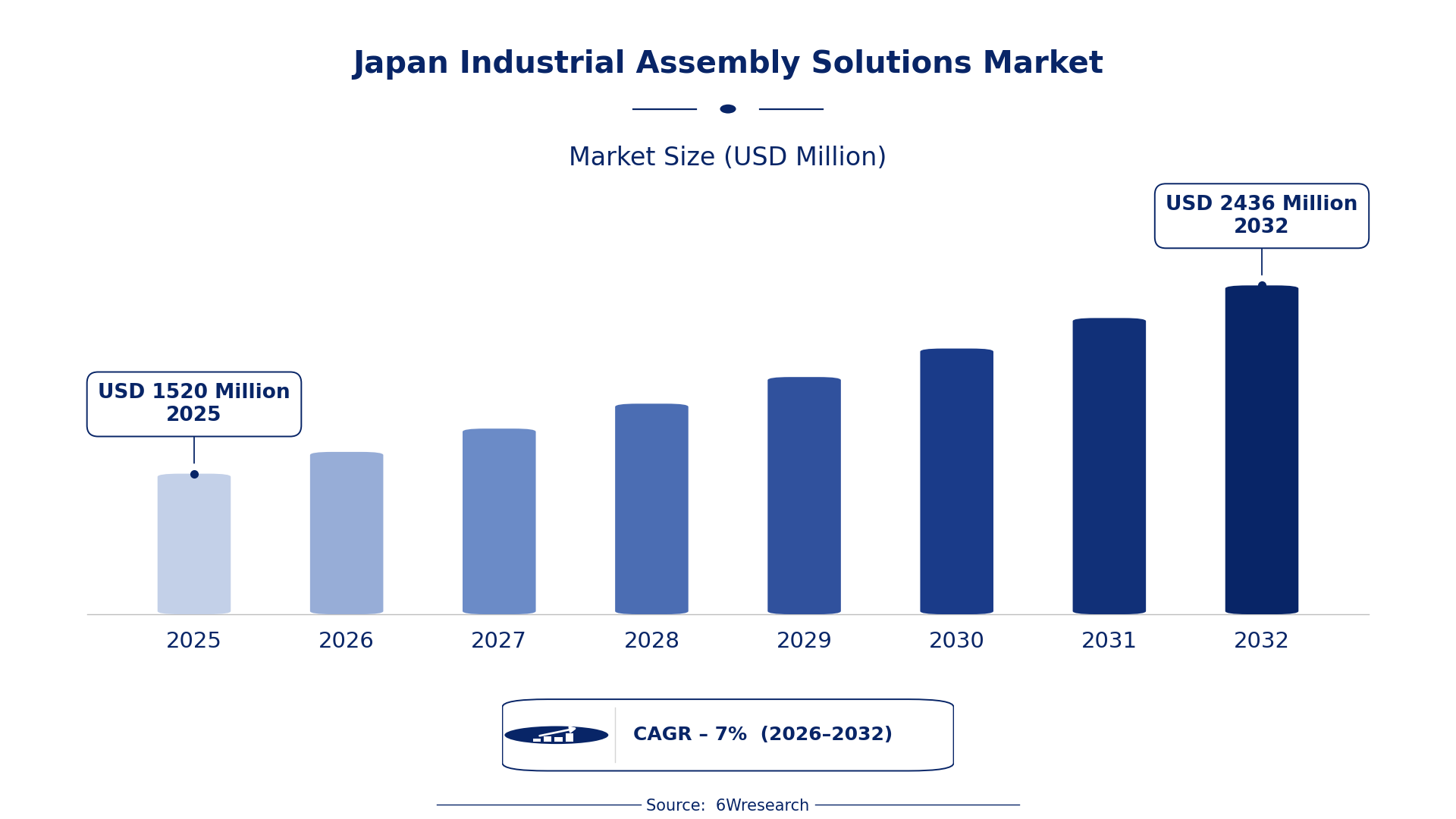
According to 6Wresearch internal database and industry insights, the Japan Industrial Assembly Solutions Market was valued at USD 1,520 Million in 2025 and is projected to reach USD 2,436 Million by 2032, growing at a CAGR of approximately 7% during 2026–2032.
Japan Industrial Assembly Solutions Market Highlights
| Report Metric | Details |
| Report Name | Japan Industrial Assembly Solutions Market (2026-2032) |
| Market Size 2025 | USD 1,520 Million |
| Market Size 2032 | USD 2,436 Million |
| Absolute Growth 2025–2032 | USD 916 Million |
| CAGR 2026–2032 | 7% |
| Peak Annual Growth | 7.8% in 2026 |
| Forecast Period | 2026–2032 |
| Historical Data | 2022–2025 |
| Base Year | 2025 |
| Leading Assembly Type, 2025 | Manual Assembly Tools (43% share) |
| Leading Automation Level, 2025 | Low Automation (41% share) |
| Leading Assembly Process, 2025 | Operator-Based (48% share) |
| Leading End User, 2025 | SME Workshops (36% share) |
| Fastest-Growing Assembly Type | Semi-Automated Systems (10.0% CAGR) |
| Fastest-Growing Automation Level | Partially Integrated (9.3% CAGR) |
| Fastest-Growing Assembly Process | Conveyor-Based (9.8% CAGR) |
| Fastest-Growing End User | Electronics Manufacturers (9.1% CAGR) |
| Growing Sector | Automotive Assembly |
| Key End Users | Automotive Assembly Plants, Electronics Manufacturers, Aerospace & Defense Firms, SME Workshops |
Japan Industrial Assembly Solutions Market Year-wise Growth Rate and Key Drivers (2022–2032)
This graph illustrates the annual growth rates of the market from 2022 to 2032, highlighting a steady upward trajectory and projected market expansion over the forecast period.
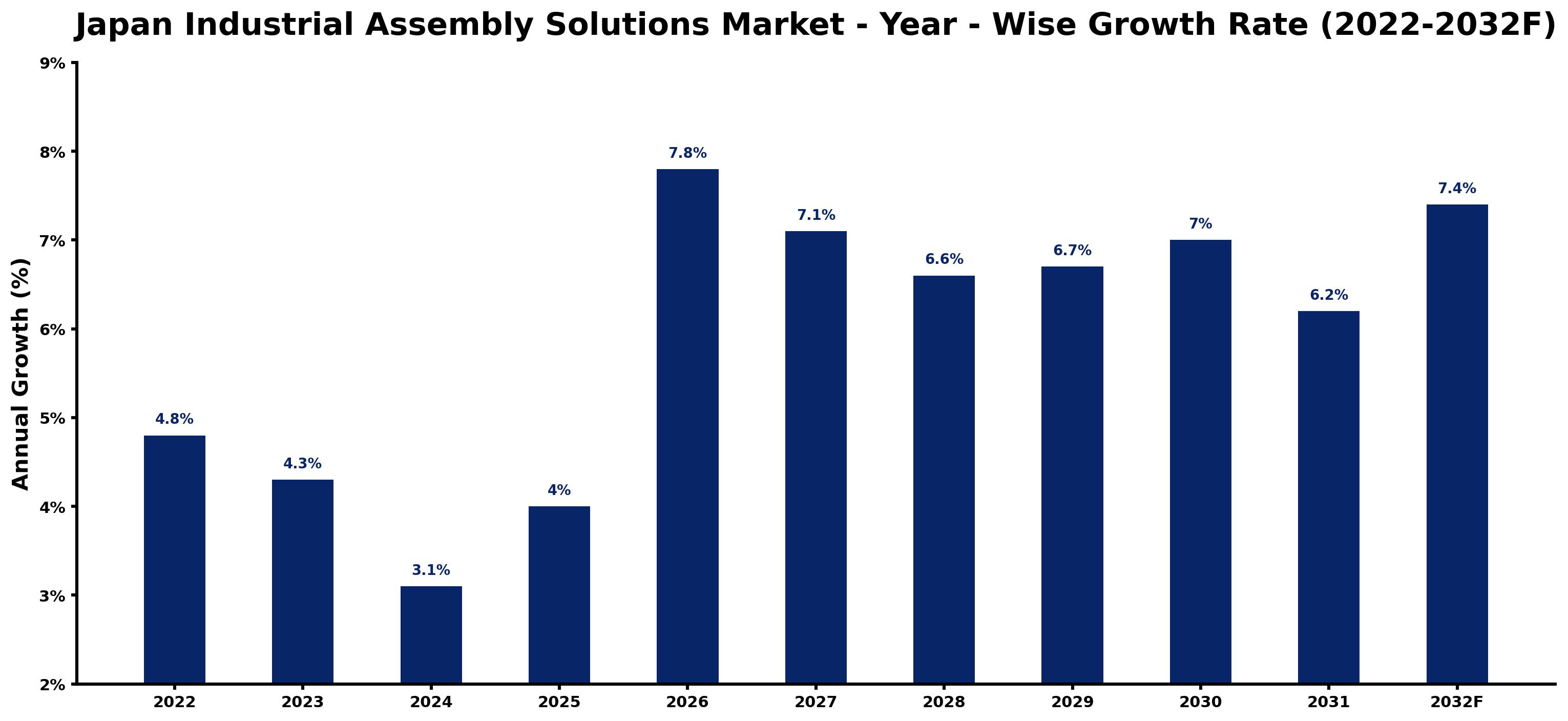
Year by year, the estimates below pair each growth rate with the development that shaped it.
| Year | Estimated Annual Growth (%) | Market Rationale |
| 2022 | 4.8 | The market experienced strong demand from the automotive sector, driving growth. |
| 2023 | 4.3 | Growth slowed as the electronics industry faced supply chain disruptions. |
| 2024 | 3.1 | Demand continued to decelerate due to rising material costs and inflation. |
| 2025 | 4.0 | Growth accelerated as manufacturers invested in automation technologies. |
| 2026 | 7.8 | The market is expected to peak with investments in robotics and automation. |
| 2027 | 7.1 | Growth is projected to slow slightly as the market stabilises after rapid expansion. |
| 2028 | 6.6 | Demand is expected to remain steady, supported by ongoing technological advancements. |
| 2029 | 6.7 | Growth is projected to pick up again as new assembly solutions gain traction. |
| 2030 | 7.0 | Manufacturers will continue to invest in advanced technologies, sustaining growth. |
| 2031 | 6.2 | Growth is expected to slow as the market adjusts to recent technological shifts. |
| 2032 | 7.4 | Demand is expected to rise again with new innovations in assembly solutions. |
Note: Market size estimations and growth projections presented in this report are based on 6Wresearch's proprietary forecasting methodology, utilizing the latest available industry data, government publications, and primary research inputs.
Japan Industrial Assembly Solutions Market Synopsis
Industrial Assembly Solutions in Japan encompass various technologies and tools used for assembling products across industries. The automotive industry produced 8.3 million vehicles in 2022, driving demand for assembly solutions. The market is expanding due to substantial investments in automation technologies, with $15 billion allocated in 2023, alongside the adoption of standards like JIS B 8801 that improve production quality.
Market Dynamics Impact Analysis (2026–2032)
| Factor | Type | Impact | Primary Segment Affected |
| Increased automation in manufacturing processes | Driver | High | Fully Automated Lines |
| Rising demand for high-quality assembly solutions | Driver | High | Semi-Automated Systems |
| Growing need for efficient production in SMEs | Opportunity | High | SME Workshops |
| Expansion of the automotive sector in key regions | Opportunity | High | Automotive Assembly Plants |
| High initial investment costs for automation technologies | Restraint | Medium | Fully Automated Lines |
| Limited skilled workforce for advanced assembly solutions | Restraint | Medium | Semi-Automated Systems |
| Competition from lower-cost assembly solutions | Challenge | High | Manual Assembly Tools |
| Supply chain disruptions affecting component availability | Challenge | Medium | Flexible Assembly Cells |
Evaluation of Drivers in Japan Industrial Assembly Solutions Market (2026–2032)
Key forces behind demand, with the segment each one moves most, are listed below.
| Drivers | Primary Segment Affected | Why It Matters (Evidence) |
| Growing automotive production levels | Automotive Assembly Plants | Japan's automotive industry produced 8.3 million vehicles in 2022, increasing demand for assembly solutions. |
| Investment in automation technologies | Fully Automated Lines | In 2023, Japan's manufacturing sector invested $15 billion in automation technologies, boosting demand for advanced assembly solutions. |
| Rising electronics sector value | Electronics Manufacturers | The electronics sector in Japan is valued at over $100 billion, driving the need for advanced assembly technologies. |
| Adoption of ISO 9001 standards | Operator-Based | ISO 9001 is widely adopted in assembly processes, improving quality and efficiency in production. |
| Government support for automation in SMEs | Semi-Automated Systems | The Ministry of Economy, Trade and Industry launched a program in 2023 to promote automation in SMEs, increasing demand. |
Buyers are adding capacity as the automotive industry thrives, producing millions of vehicles annually, which drives demand for assembly solutions. In 2023, the manufacturing sector invested heavily in automation technologies, boosting production efficiency. The electronics sector, valued at over $100 billion, relies on advanced assembly technologies, leading to increased purchases. The adoption of JIS B 8801 standards across industries improves quality assurance, prompting manufacturers to invest in better assembly solutions. Support for automation in SMEs encourages investments in semi-automated systems, further driving demand.
Evaluation of Restraints in Japan Industrial Assembly Solutions Market
Below are the constraints most often cited by buyers and suppliers, with the segment each affects.
| Market Restraint | Primary Segment Affected | Why It Matters (Evidence) |
| High initial costs of automation technologies | Fully Automated Lines | The average salary for assembly line workers in Japan is approximately $30,000 annually, raising operational costs. |
| Shortage of skilled workers for advanced assembly | Semi-Automated Systems | A limited skilled workforce in Japan hampers the implementation of advanced assembly technologies. |
| Competition from cheaper assembly alternatives | Manual Assembly Tools | Lower-cost assembly solutions appeal to budget-conscious manufacturers, impacting demand for higher-end products. |
| Supply chain disruptions affecting component availability | Flexible Assembly Cells | Recent global supply chain issues have led to delays in obtaining necessary components for assembly solutions. |
| Regulatory compliance costs for assembly standards | Operator-Based | Compliance with standards like JIS B 8801 increases operational costs for manufacturers. |
Japan Industrial Assembly Solutions Market Challenges
Buyers in the automotive sector face rising compliance costs due to regulations aimed at a 46% reduction in greenhouse-gas emissions by 2030, which can increase production expenses by 15%. Producers in the electronics industry struggle with outdated assembly technology, as 30% of assembly lines still rely on manual processes, causing delays that extend production timelines by 20%. Local manufacturers confront intense competition from global markets, forcing them to reduce prices, which can shrink profit margins by up to 10%. Buyers across various sectors encounter budget overruns from fluctuating costs for advanced assembly technologies, leading to project delays of up to six months.
Trends in the Japan Industrial Assembly Solutions Market
The trends below show where the Japan Industrial Assembly Solutions Market is heading.
- Shift from Manual to Automated Assembly: In 2023, manufacturers began transitioning from manual assembly tools to automated systems, driven by efficiency needs. The automotive sector is leading this shift, with a projected 20% increase in automation by 2026.
- Increased Adoption of Flexible Assembly Cells: Aerospace and defence firms are increasingly adopting flexible assembly cells to adapt to diverse production needs. This trend is reflected in the 200 aerospace firms in Japan, enhancing their operational flexibility.
- Growth of Semi-Automated Systems: The demand for semi-automated systems is rising, particularly in SME workshops, which are projected to grow at a CAGR of 10.0% by 2032. This reflects a broader trend towards balancing automation with manual input.
- Enhanced Focus on Quality Standards: The adoption of JIS B 8801 standards has surged, particularly among electronics manufacturers, improving assembly quality. This trend is supported by the Japan Electronics and Information Technology Industries Association promoting best practices.
Investment Opportunities in the Japan Industrial Assembly Solutions Market
Several openings in the Japan Industrial Assembly Solutions Market merit attention from investors.
- SME Workshops Seeking Automation Solutions: SME workshops are increasingly seeking automation solutions to improve productivity, with a growing need for semi-automated systems. This demand is supported by the Ministry of Economy, Trade and Industry's 2023 program to promote automation.
- Automotive Assembly Plants Investing in Robotics: The automotive sector is projected to adopt more robotics solutions by 2025, driven by the need for efficiency. This presents opportunities for suppliers of advanced robotics technologies.
- Electronics Manufacturers Expanding Production Capacity: Electronics manufacturers are expanding their production capacity, driven by a sector valued at over $100 billion. Suppliers can enter this market by offering advanced assembly technologies and automation solutions.
- Aerospace Firms Upgrading Assembly Technologies: Aerospace firms are projected to increase assembly automation by 20% by 2026, creating opportunities for suppliers of specialized assembly solutions. Collaborating with local partners can facilitate market entry.
Government Initiatives in the Japan Industrial Assembly Solutions Market
The GX Promotion Act (2023) provides a framework for decarbonisation investments in assembly technologies. This law aims for about JPY 150 trillion in public and private investment over ten years, encouraging manufacturers to adopt greener practices and improve production efficiency.
The Industrial Safety and Health Act (1972) mandates safety measures for assembly processes. The Ministry of Health, Labour and Welfare oversees compliance, ensuring safer working conditions in assembly plants and protecting workers during assembly operations.
Future Insight of the Japan Industrial Assembly Solutions Market
The introduction of advanced manufacturing facilities will transform production processes by 2032, allowing producers to improve efficiency. A government programme promoting a 30% increase in automation by 2030 will stimulate investments in cutting-edge technologies, benefiting both buyers and suppliers. The implementation of updated assembly tool specifications will improve quality assurance across production lines, fostering trust among buyers. By 2032, the aerospace sector will see a 20% rise in assembly automation, streamlining operations and reducing operational costs.
Market Segmentation Analysis
Japan Industrial Assembly Solutions Market report covers a detailed analysis of the following market segments:
By Assembly Type – Manual Assembly Tools Lead, Semi-Automated Systems Expected to Grow Fastest
According to Saurav Kr Singh, Senior Research Analyst at 6Wresearch, in 2025, Manual Assembly Tools led the assembly type split with a 43% share. Manual assembly tools are essential for hands-on assembly tasks, particularly in small workshops where precision is vital. The automotive sector frequently utilises these tools to maintain quality in their assembly processes. Over 2026–2032, Semi-Automated Systems are expected to post the fastest growth, at a CAGR of 10.0%. The growth of semi-automated systems is fuelled by the increasing need to boost productivity while retaining manual input, especially in the electronics sector. The rising adoption of these systems across various manufacturing environments illustrates this trend. Suppliers should develop adaptable solutions that address both manual and semi-automated assembly requirements.
By Automation Level – Low Automation Leads, Partially Integrated Expected to Grow Fastest
Low Automation took 41% of automation level revenue in 2025, more than any other category. Low automation is commonly found in low-tech environments and small-scale operations where advanced technologies are less accessible. This segment is crucial for workshops that prioritise flexibility without incurring high capital costs. The quickest growth will come from Partially Integrated, forecast to expand at a CAGR of 9.3% between 2026 and 2032. Partially integrated systems are gaining traction as they effectively combine manual and automated processes, catering to the increasing demand for production efficiency. The automotive sector's shift towards these systems illustrates this trend. Buyers may benefit from investing in partially integrated solutions to improve efficiency while managing expenses.
By Assembly Process – Operator-Based Leads, Conveyor-Based Expected to Grow Fastest
The largest assembly process category in 2025 was Operator-Based, at 48% of revenue. Operator-based assembly processes are essential in traditional practices, where skilled workers maintain quality and precision. This method is particularly important in sectors that require meticulous attention to detail, such as aerospace. Conveyor-Based is set to record the highest CAGR in this split, 9.8% over 2026–2032. Conveyor-based systems are rapidly gaining popularity due to their effectiveness in product movement, especially in high-volume production settings. The electronics industry is increasingly adopting these systems to streamline assembly operations. Suppliers should prioritise the development of conveyor-based solutions to address the rising demand for efficient assembly processes.
By End User – SME Workshops Lead, Electronics Manufacturers Expected to Grow Fastest
SME Workshops accounted for 36% of the market by end user in 2025. SME workshops constitute the largest segment as they employ basic assembly solutions for small-scale production, which is vital for local economies. These workshops typically rely on manual tools to meet their specific operational needs. Electronics Manufacturers are projected to grow fastest, at a CAGR of 9.1% during 2026–2032. Electronics manufacturers are witnessing rapid growth as they depend heavily on automation for precise assembly, driven by the sector's significant market value. The demand for advanced assembly technologies in this area is expected to rise sharply. Suppliers need to customise their offerings to align with the specific requirements of electronics manufacturers to capitalise on this expanding market.
Key Attractiveness of the Report
- 10 Years of Market Numbers
- Historical Data Starting from 2022 to 2025
- Base Year 2025
- Forecast Data until 2032
- Key Performance Indicators Impacting the Market
- Major Upcoming Developments and Projects
Key Highlights of the Report:
- Japan Industrial Assembly Solutions Market Outlook
- Market Size of Japan Industrial Assembly Solutions Market, 2025
- Forecast of Japan Industrial Assembly Solutions Market, 2032
- Historical Data and Forecast of Japan Industrial Assembly Solutions Revenues & Volume for the Period 2022-2032F
- Japan Industrial Assembly Solutions Market Trend Evolution
- Japan Industrial Assembly Solutions Market Drivers and Challenges
- Japan Industrial Assembly Solutions Price Trends
- Japan Industrial Assembly Solutions Porter's Five Forces
- Japan Industrial Assembly Solutions Industry Life Cycle
- Historical Data and Forecast of Japan Industrial Assembly Solutions Market Revenues & Volume By Assembly Type for the Period 2022-2032F
- Historical Data and Forecast of Japan Industrial Assembly Solutions Market Revenues & Volume By Manual Assembly Tools for the Period 2022-2032F
- Historical Data and Forecast of Japan Industrial Assembly Solutions Market Revenues & Volume By Semi-Automated Systems for the Period 2022-2032F
- Historical Data and Forecast of Japan Industrial Assembly Solutions Market Revenues & Volume By Fully Automated Lines for the Period 2022-2032F
- Historical Data and Forecast of Japan Industrial Assembly Solutions Market Revenues & Volume By Flexible Assembly Cells for the Period 2022-2032F
- Historical Data and Forecast of Japan Industrial Assembly Solutions Market Revenues & Volume By Automation Level for the Period 2022-2032F
- Historical Data and Forecast of Japan Industrial Assembly Solutions Market Revenues & Volume By Low Automation for the Period 2022-2032F
- Historical Data and Forecast of Japan Industrial Assembly Solutions Market Revenues & Volume By Partially Integrated for the Period 2022-2032F
- Historical Data and Forecast of Japan Industrial Assembly Solutions Market Revenues & Volume By PLC + Robotics for the Period 2022-2032F
- Historical Data and Forecast of Japan Industrial Assembly Solutions Market Revenues & Volume By Reconfigurable Systems for the Period 2022-2032F
- Historical Data and Forecast of Japan Industrial Assembly Solutions Market Revenues & Volume By Assembly Process for the Period 2022-2032F
- Historical Data and Forecast of Japan Industrial Assembly Solutions Market Revenues & Volume By Operator-Based for the Period 2022-2032F
- Historical Data and Forecast of Japan Industrial Assembly Solutions Market Revenues & Volume By Conveyor-Based for the Period 2022-2032F
- Historical Data and Forecast of Japan Industrial Assembly Solutions Market Revenues & Volume By Continuous Flow for the Period 2022-2032F
- Historical Data and Forecast of Japan Industrial Assembly Solutions Market Revenues & Volume By High-Mix, Low-Volume for the Period 2022-2032F
- Historical Data and Forecast of Japan Industrial Assembly Solutions Market Revenues & Volume By End User for the Period 2022-2032F
- Historical Data and Forecast of Japan Industrial Assembly Solutions Market Revenues & Volume By SME Workshops for the Period 2022-2032F
- Historical Data and Forecast of Japan Industrial Assembly Solutions Market Revenues & Volume By Electronics Manufacturers for the Period 2022-2032F
- Historical Data and Forecast of Japan Industrial Assembly Solutions Market Revenues & Volume By Automotive Assembly Plants for the Period 2022-2032F
- Historical Data and Forecast of Japan Industrial Assembly Solutions Market Revenues & Volume By Aerospace & Defense Firms for the Period 2022-2032F
- Japan Industrial Assembly Solutions Import Export Trade Statistics
- Market Opportunity Assessment By Assembly Type
- Market Opportunity Assessment By Automation Level
- Market Opportunity Assessment By Assembly Process
- Market Opportunity Assessment By End User
- Japan Industrial Assembly Solutions Top Companies Market Share
- Japan Industrial Assembly Solutions Competitive Benchmarking By Technical and Operational Parameters
- Japan Industrial Assembly Solutions Company Profiles
- Japan Industrial Assembly Solutions Key Strategic Recommendations
Market Covered
The report covers the following segments.
By Assembly Type
- Manual Assembly Tools
- Semi-Automated Systems
- Fully Automated Lines
- Flexible Assembly Cells
By Automation Level
- Low Automation
- Partially Integrated
- PLC + Robotics
- Reconfigurable Systems
By Assembly Process
- Operator-Based
- Conveyor-Based
- Continuous Flow
- High-Mix
- Low-Volume
By End User
- SME Workshops
- Electronics Manufacturers
- Automotive Assembly Plants
- Aerospace & Defense Firms































