Japan Industrial Automation Components Market Size & Growth Rate
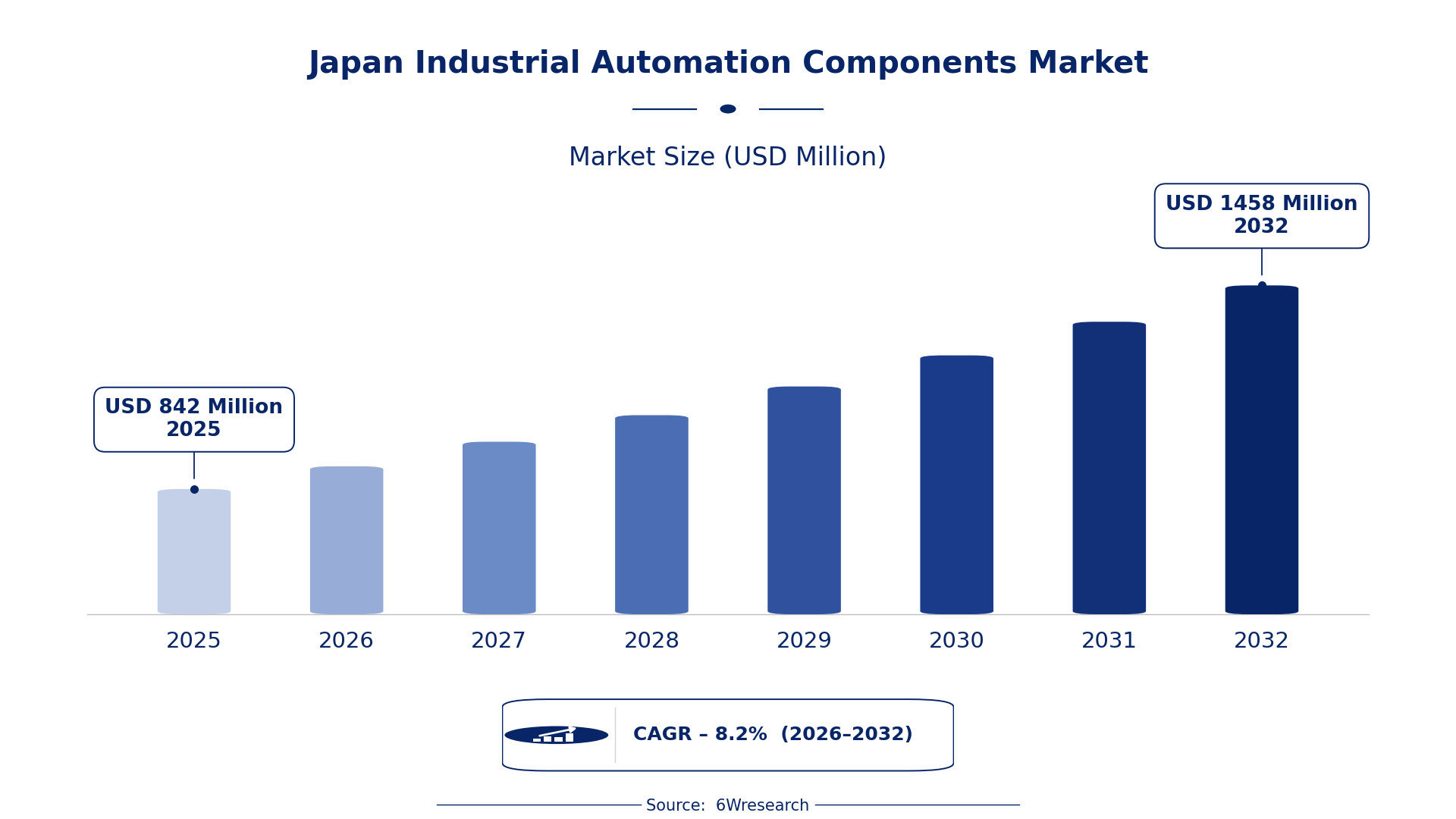
According to 6Wresearch internal database and industry insights, the Japan Industrial Automation Components Market was valued at USD 842 Million in 2025 and is projected to reach USD 1,458 Million by 2032, growing at a CAGR of approximately 8.2% during 2026–2032.
Japan Industrial Automation Components Market Highlights
| Report Metric | Details |
| Report Name | Japan Industrial Automation Components Market (2026-2032) |
| Market Size 2025 | USD 842 Million |
| Market Size 2032 | USD 1,458 Million |
| Absolute Growth 2025–2032 | USD 616 Million |
| CAGR 2026–2032 | 8.2% |
| Peak Annual Growth | 9.1% in 2032 |
| Forecast Period | 2026–2032 |
| Historical Data | 2022–2025 |
| Base Year | 2025 |
| Leading Component Type, 2025 | Sensors (47% share) |
| Leading Functionality, 2025 | Measurement (44% share) |
| Leading Integration Level, 2025 | Embedded/External (49% share) |
| Leading End User, 2025 | Machine Builders (41% share) |
| Fastest-Growing Component Type | Actuators (11.8% CAGR) |
| Fastest-Growing Functionality | Motion Control (10.8% CAGR) |
| Fastest-Growing Integration Level | PLC-Connected (11.3% CAGR) |
| Fastest-Growing End User | Robotics OEMs (11.0% CAGR) |
| Growing Sector | Manufacturing |
| Key End Users | Machine Builders, Robotics OEMs, Assembly Lines, Control Panel Makers |
Japan Industrial Automation Components Market Year-wise Growth Rate and Key Drivers (2022–2032)
This graph illustrates the annual growth rates of the market from 2022 to 2032, highlighting a steady upward trajectory and projected market expansion over the forecast period.
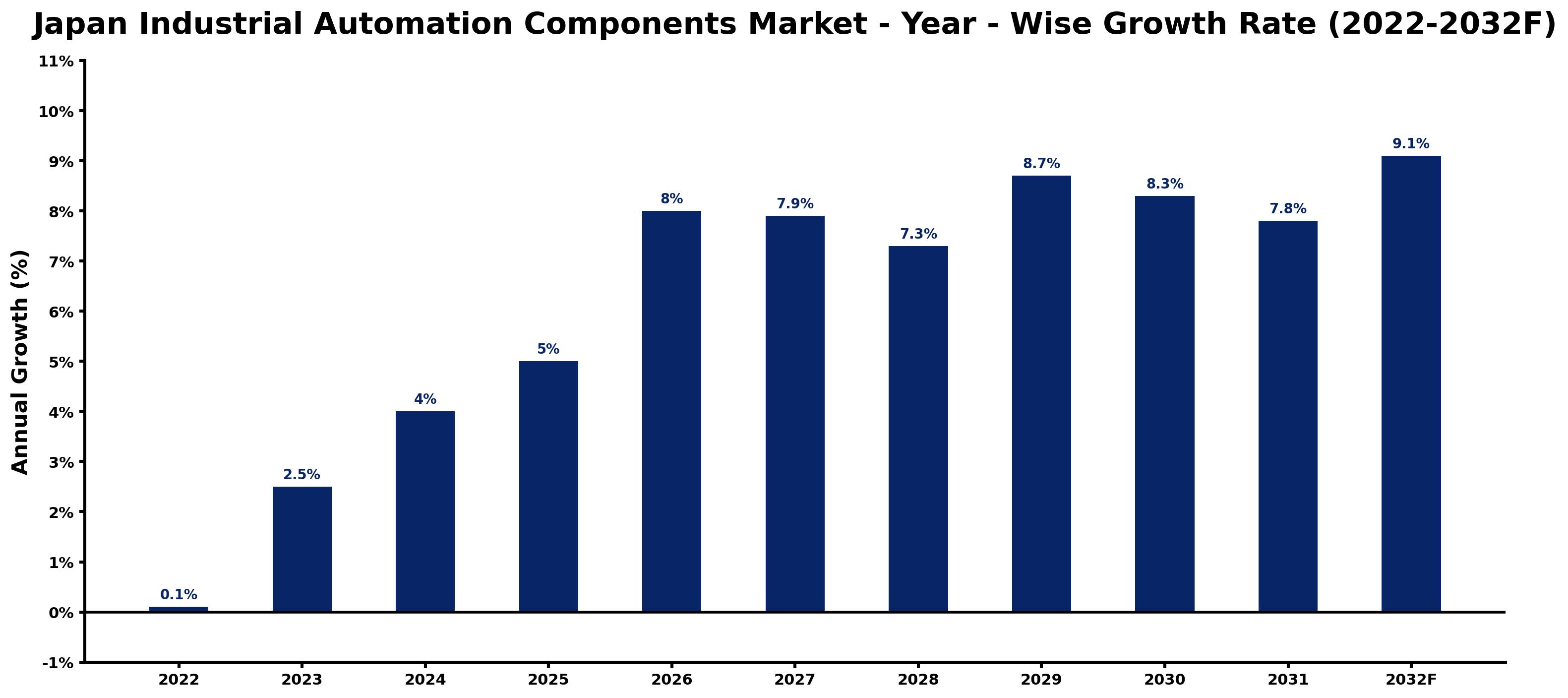
The table below sets out the estimated growth rate for each year and the main factor behind it.
| Year | Estimated Annual Growth (%) | Market Rationale |
| 2022 | 0.1 | The market showed minimal growth due to initial recovery from previous economic impacts. |
| 2023 | 2.5 | Increased investments in smart factories drove faster growth compared to the previous year. |
| 2024 | 4.0 | Demand rose further as manufacturers adopted more automation technologies. |
| 2025 | 5.0 | Growth accelerated as companies expanded their automation capabilities. |
| 2026 | 8.0 | A surge in robotics adoption is expected to contribute to a notable increase in demand. |
| 2027 | 7.9 | Growth will slow slightly as the market adjusts to previous high levels of investment. |
| 2028 | 7.3 | Continued interest in automation will keep the market growing, though at a slower pace. |
| 2029 | 8.7 | Demand rebounded as manufacturers sought to improve production efficiency. |
| 2030 | 8.3 | Growth will moderate as the market stabilises after a period of rapid expansion. |
| 2031 | 7.8 | A further slowdown will occur as the market begins to reach saturation in some areas. |
| 2032 | 9.1 | Demand will peak as advanced automation solutions become widely adopted. |
Note: Market size estimations and growth projections presented in this report are based on 6Wresearch's proprietary forecasting methodology, utilizing the latest available industry data, government publications, and primary research inputs.
Japan Industrial Automation Components Market Synopsis
Industrial automation components include devices such as sensors, actuators, and programmable logic controllers that improve productivity and efficiency in manufacturing processes. The Japan Industrial Automation Components Market is expanding due to investments in smart factory initiatives and the increasing adoption of robotics. With over 70% of manufacturers utilising these components, demand is driven by domestic manufacturers seeking to boost operational efficiency, supported by government initiatives like the 'Society 5.0' programme.
Market Dynamics Impact Analysis (2026–2032)
| Factor | Type | Impact | Primary Segment Affected |
| Growing investments in smart factories | Driver | High | Sensors |
| Rising demand for robotics in manufacturing | Driver | High | Actuators |
| Expansion of automation in automotive manufacturing | Opportunity | High | PLCs |
| Increasing adoption of Industry 4.0 technologies | Opportunity | High | Measurement |
| Shortage of skilled workforce | Restraint | Medium | Motion Control |
| High initial investment costs for automation systems | Restraint | Medium | Process Control |
| Rapid technological advancements leading to obsolescence | Challenge | High | Embedded/External |
| Intense competition among local manufacturers | Challenge | Medium | PLC-Connected |
Evaluation of Drivers in Japan Industrial Automation Components Market (2026–2032)
The main growth drivers and the segments they affect most are set out below.
| Drivers | Primary Segment Affected | Why It Matters (Evidence) |
| Investment in smart factories | Sensors | Over 70% of manufacturing firms in Japan utilize automation components, increasing sensor demand. |
| Growth in robotics adoption | Actuators | Japan's robotics market is expected to grow by 10% annually, driving actuator purchases. |
| Automotive sector expansion | PLCs | The automotive sector's reliance on automation boosts PLC demand among machine builders. |
| Focus on process accuracy | Measurement | Manufacturers pursuing ISO 9001 certification increase demand for measurement components. |
| Need for operational efficiency | Motion Control | The average lifespan of industrial automation components is around 10 years, prompting replacements. |
What keeps demand rising is the investment in smart factories, with over 70% of manufacturing firms in Japan utilising automation components. The robotics market is expected to grow by 10% annually, increasing actuator demand. Manufacturers pursuing ISO 9001 certification are focusing on process accuracy, driving measurement component demand. The average lifespan of automation components is around 10 years, necessitating replacements and upgrades. The automotive sector's expansion is boosting PLC purchases as manufacturers seek to optimise their operations.
Evaluation of Restraints in Japan Industrial Automation Components Market
The key brakes on demand, and where they bite hardest, are shown below.
| Market Restraint | Primary Segment Affected | Why It Matters (Evidence) |
| Shortage of skilled workforce | Motion Control | The manufacturing sector employs over 8 million people, but skills gaps hinder automation adoption. |
| High initial investment costs | Process Control | The annual investment in industrial automation technology is expected to reach 500 billion yen by 2025. |
| Technological obsolescence | Embedded/External | Rapid advancements in technology lead to shorter product lifespans, affecting buyer decisions. |
| Intense competition | PLC-Connected | Local manufacturers face pressure to innovate, impacting profitability and market share. |
| Regulatory compliance costs | Sensors | Compliance with the JIS B 8390 standard adds expenses for manufacturers. |
Japan Industrial Automation Components Market Challenges
In the Chubu region, manufacturers face fierce competition, which drives prices down and reduces profit margins, complicating financial sustainability for suppliers. A skills gap exists, as over 8 million employees in the manufacturing sector struggle with advanced automation technologies, resulting in project delays that can extend timelines by up to six months. High integration costs for new automation systems burden producers, costing around 500 billion yen annually in lost productivity. Supply chain disruptions arise from reliance on specific components, leading to increased lead times that can delay production schedules by weeks for buyers.
Trends in the Japan Industrial Automation Components Market
These developments are changing demand patterns in the Japan Industrial Automation Components Market.
- Shift towards Smart Manufacturing: Japan's manufacturing sector is increasingly adopting smart technologies, with investments projected to reach 500 billion yen by 2025. This initiative aims to improve productivity and efficiency across various industries.
- Rise of Robotics in Manufacturing: The automation sector is changing as robotics adoption increases, driven by the New Robot Strategy aiming for greater integration by 2025. This trend is expected to boost Japan's robotics market growth by 10% annually.
- Transition to Modular Automation Solutions: Manufacturers are shifting towards modular automation systems for flexibility and efficiency. The Chubu region is witnessing a rise in modular component production, aligning with the demand for adaptable manufacturing solutions.
- Increased Focus on Sustainability: With Japan targeting a 46% cut in greenhouse-gas emissions by 2030, manufacturers are investing in energy-efficient automation components. This commitment is driving demand for sustainable solutions across various sectors.
Investment Opportunities in the Japan Industrial Automation Components Market
The following areas offer the clearest openings for investors and suppliers in the Japan Industrial Automation Components Market.
- Supply of Advanced Sensors: The demand for advanced sensors is increasing, with over 70% of manufacturers seeking improved monitoring solutions. Investing in sensor technology can cater to machine builders in the Tokyo region, where automation is prevalent.
- Investment in Robotics Components: With Japan's robotics market expected to grow by 10% annually, there is a gap in robotics components supply. Robotics OEMs in the Nagoya region present opportunities for suppliers to enter the market.
- Development of Modular Automation Systems: The shift towards modular systems offers a timely opportunity for investment, with a projected increase in demand. Suppliers can target assembly lines in the Chubu region, where flexibility is essential.
- Focus on Energy-Efficient Solutions: As Japan aims for a 46% reduction in emissions by 2030, there is a growing need for energy-efficient automation components. Suppliers can engage with manufacturers pursuing sustainability initiatives.
Government Initiatives in the Japan Industrial Automation Components Market
The New Robot Strategy, established in 2015, aims to expand robot use across various sectors, including manufacturing and services. This policy encourages investment in automation technologies, targeting 150 trillion yen in decarbonisation investment over 10 years, promoting the adoption of advanced automation components.
The AI Promotion Act establishes a framework for AI research and development. This agency funds projects aimed at improving automation capabilities, with a focus on enhancing operational efficiency in manufacturing.
Future Insight of the Japan Industrial Automation Components Market
New smart factories will emerge by 2032, driven by the 'Smart Manufacturing Strategy' that focuses on productivity. Japan's decarbonisation investment is projected to reach JPY 150 trillion over the next decade, encouraging technological advancements that will benefit both buyers and suppliers. The annual investment in industrial automation technology is expected to hit 500 billion yen by 2025, facilitating greater adoption of automation solutions. With over 70% of manufacturing firms utilising automation components, operational efficiency will improve significantly.
Market Segmentation Analysis
Japan Industrial Automation Components Market report covers a detailed analysis of the following market segments:
By Component Type – Sensors Lead, Actuators Expected to Grow Fastest
According to Saurav Kr Singh, Senior Research Analyst at 6Wresearch, with 47% of component type revenue in 2025, Sensors was the largest category. Sensors are crucial for monitoring and control in automation systems, making them indispensable for manufacturers across various sectors. For instance, more than 70% of manufacturing firms in Japan rely on sensors to enhance their operational efficiency. The quickest growth will come from Actuators, forecast to expand at a CAGR of 11.8% between 2026 and 2032. Actuators are essential for converting control signals into physical motion, which drives their rapid adoption across multiple applications. With annual investments in industrial automation technology projected to hit 500 billion yen by 2025, actuator demand is expected to grow significantly. Suppliers should prioritise the development of sensor and actuator technologies to meet the increasing market demands.
By Functionality – Measurement Leads, Motion Control Expected to Grow Fastest
Measurement accounted for 44% of the market by functionality in 2025. Measurement functions are vital for ensuring process accuracy and quality control, which is essential for manufacturers. The implementation of standards like JIS B 8390 further underscores the importance of measurement in maintaining high-quality automation components. Motion Control is projected to grow fastest, at a CAGR of 10.8% during 2026–2032. Motion control is key for precise movement in automated systems, leading to its swift growth in the market. The ongoing 'Robot Revolution Initiative' aims to increase robot adoption, which will further boost the need for advanced motion control solutions. Buyers will benefit from investing in measurement and motion control technologies to improve their operational precision.
By Integration Level – Embedded/External Leads, PLC-Connected Expected to Grow Fastest
In 2025, Embedded/External led the integration level split with a 49% share. Embedded and external systems are integral to automation solutions, providing the necessary flexibility and adaptability for a range of applications. The Tokyo region serves as a major hub for the advancement of these integrated systems, highlighting their importance in the market. Over 2026–2032, PLC-Connected is expected to post the fastest growth, at a CAGR of 11.3%. PLC-connected systems are critical for integrated automation, facilitating effective communication between devices. The total installed base of over 1 million PLCs in Japan indicates a robust trend towards enhanced connectivity in automation solutions. Suppliers should focus on creating PLC-connected solutions to meet the rising demands for market integration.
By End User – Machine Builders Lead, Robotics OEMs Expected to Grow Fastest
Machine Builders took 41% of end user revenue in 2025, more than any other category. Machine builders are the primary users of automation components for equipment manufacture, creating substantial market demand. With over 8 million people employed in the manufacturing sector, their reliance on machine builders for automation solutions is significant. Robotics OEMs are set to record the highest CAGR in this split, 11.0% over 2026–2032. Robotics OEMs are experiencing increased demand for automation components as they advance robotics technology. The anticipated 10% annual growth in Japan's robotics market underscores the growing dependence on automation technologies by these manufacturers. Suppliers must tailor their offerings to meet the specific needs of machine builders and robotics OEMs to capitalise on market opportunities.
Key Attractiveness of the Report
- 10 Years of Market Numbers
- Historical Data Starting from 2022 to 2025
- Base Year 2025
- Forecast Data until 2032
- Key Performance Indicators Impacting the Market
- Major Upcoming Developments and Projects
Key Highlights of the Report:
- Japan Industrial Automation Components Market Outlook
- Market Size of Japan Industrial Automation Components Market, 2025
- Forecast of Japan Industrial Automation Components Market, 2032
- Historical Data and Forecast of Japan Industrial Automation Components Revenues & Volume for the Period 2022-2032F
- Japan Industrial Automation Components Market Trend Evolution
- Japan Industrial Automation Components Market Drivers and Challenges
- Japan Industrial Automation Components Price Trends
- Japan Industrial Automation Components Porter's Five Forces
- Japan Industrial Automation Components Industry Life Cycle
- Historical Data and Forecast of Japan Industrial Automation Components Market Revenues & Volume By Component Type for the Period 2022-2032F
- Historical Data and Forecast of Japan Industrial Automation Components Market Revenues & Volume By Sensors for the Period 2022-2032F
- Historical Data and Forecast of Japan Industrial Automation Components Market Revenues & Volume By Actuators for the Period 2022-2032F
- Historical Data and Forecast of Japan Industrial Automation Components Market Revenues & Volume By PLCs for the Period 2022-2032F
- Historical Data and Forecast of Japan Industrial Automation Components Market Revenues & Volume By Relays & Timers for the Period 2022-2032F
- Historical Data and Forecast of Japan Industrial Automation Components Market Revenues & Volume By Functionality for the Period 2022-2032F
- Historical Data and Forecast of Japan Industrial Automation Components Market Revenues & Volume By Measurement for the Period 2022-2032F
- Historical Data and Forecast of Japan Industrial Automation Components Market Revenues & Volume By Motion Control for the Period 2022-2032F
- Historical Data and Forecast of Japan Industrial Automation Components Market Revenues & Volume By Process Control for the Period 2022-2032F
- Historical Data and Forecast of Japan Industrial Automation Components Market Revenues & Volume By Switching Functions for the Period 2022-2032F
- Historical Data and Forecast of Japan Industrial Automation Components Market Revenues & Volume By Integration Level for the Period 2022-2032F
- Historical Data and Forecast of Japan Industrial Automation Components Market Revenues & Volume By Embedded/External for the Period 2022-2032F
- Historical Data and Forecast of Japan Industrial Automation Components Market Revenues & Volume By PLC-Connected for the Period 2022-2032F
- Historical Data and Forecast of Japan Industrial Automation Components Market Revenues & Volume By Modular/Compact for the Period 2022-2032F
- Historical Data and Forecast of Japan Industrial Automation Components Market Revenues & Volume By Panel-Mounted for the Period 2022-2032F
- Historical Data and Forecast of Japan Industrial Automation Components Market Revenues & Volume By End User for the Period 2022-2032F
- Historical Data and Forecast of Japan Industrial Automation Components Market Revenues & Volume By Machine Builders for the Period 2022-2032F
- Historical Data and Forecast of Japan Industrial Automation Components Market Revenues & Volume By Robotics OEMs for the Period 2022-2032F
- Historical Data and Forecast of Japan Industrial Automation Components Market Revenues & Volume By Assembly Lines for the Period 2022-2032F
- Historical Data and Forecast of Japan Industrial Automation Components Market Revenues & Volume By Control Panel Makers for the Period 2022-2032F
- Japan Industrial Automation Components Import Export Trade Statistics
- Market Opportunity Assessment By Component Type
- Market Opportunity Assessment By Functionality
- Market Opportunity Assessment By Integration Level
- Market Opportunity Assessment By End User
- Japan Industrial Automation Components Top Companies Market Share
- Japan Industrial Automation Components Competitive Benchmarking By Technical and Operational Parameters
- Japan Industrial Automation Components Company Profiles
- Japan Industrial Automation Components Key Strategic Recommendations
Market Covered
Coverage by segment is as follows.
By Component Type
- Sensors
- Actuators
- PLCs
- Relays & Timers
By Functionality
- Measurement
- Motion Control
- Process Control
- Switching Functions
By Integration Level
- Embedded/External
- PLC-Connected
- Modular/Compact
- Panel-Mounted
By End User
- Machine Builders
- Robotics OEMs
- Assembly Lines
- Control Panel Makers































