Japan industrial automation control equipment Market Size & Growth Rate
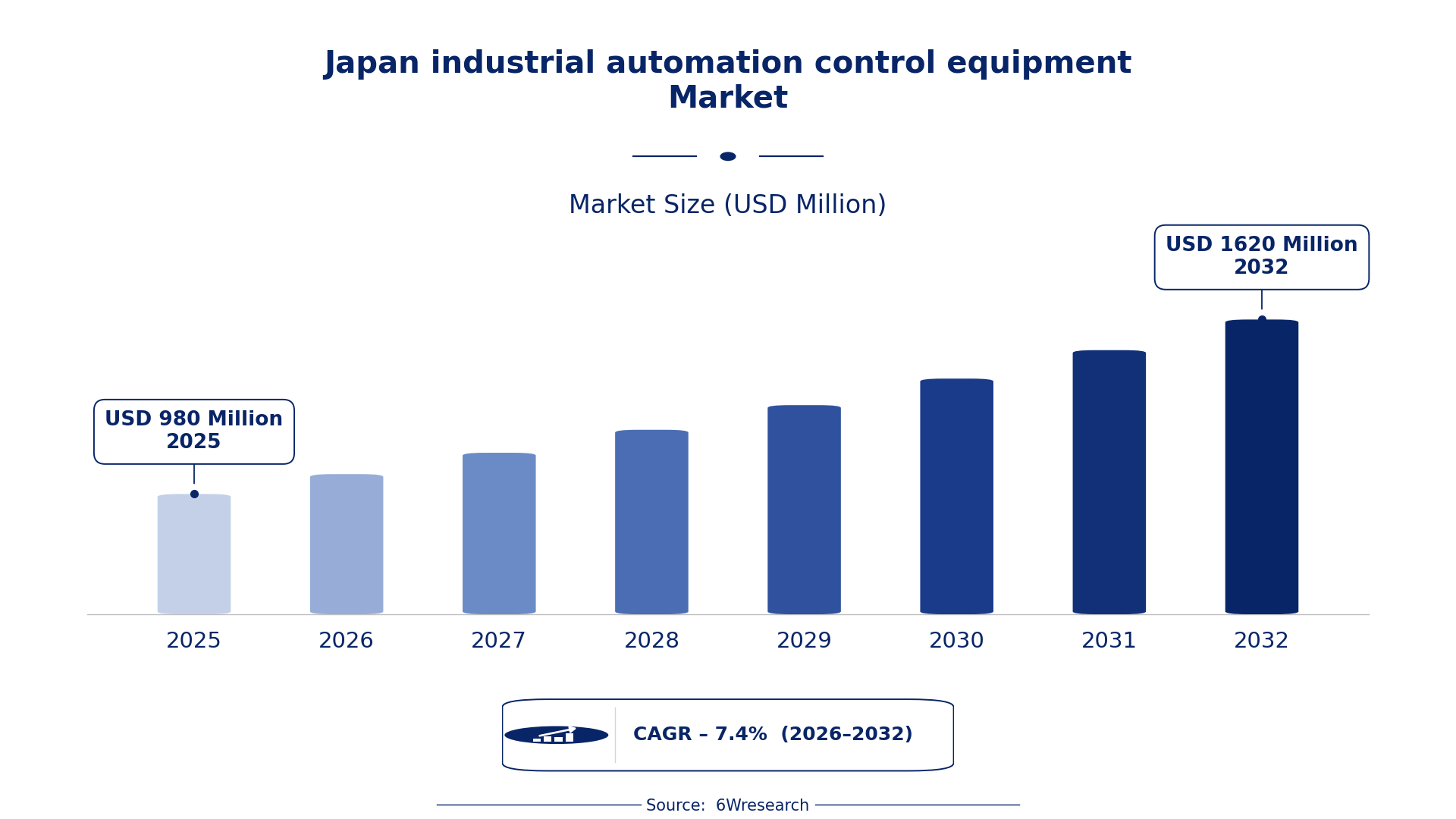
According to 6Wresearch internal database and industry insights, the Japan industrial automation control equipment Market was valued at USD 980 Million in 2025 and is projected to reach USD 1,620 Million by 2032, growing at a CAGR of approximately 7.4% during 2026–2032.
Japan industrial automation control equipment Market Highlights
| Report Metric | Details |
| Report Name | Japan industrial automation control equipment Market (2026-2032) |
| Market Size 2025 | USD 980 Million |
| Market Size 2032 | USD 1,620 Million |
| Absolute Growth 2025–2032 | USD 640 Million |
| CAGR 2026–2032 | 7.4% |
| Peak Annual Growth | 8.6% in 2028 |
| Forecast Period | 2026–2032 |
| Historical Data | 2022–2025 |
| Base Year | 2025 |
| Leading Equipment Type, 2025 | Distributed Control Systems (47% share) |
| Leading Control Mechanism, 2025 | Real-Time Automation (40% share) |
| Leading Operation Level, 2025 | Process Automation (39% share) |
| Leading End User, 2025 | Chemical Plants (49% share) |
| Fastest-Growing Equipment Type | SCADA Systems (10.0% CAGR) |
| Fastest-Growing Control Mechanism | Supervisory Control (9.5% CAGR) |
| Fastest-Growing Operation Level | Remote Monitoring (9.7% CAGR) |
| Fastest-Growing End User | Utility Networks (9.2% CAGR) |
| Growing Sector | automotive |
| Key End Users | automotive manufacturers, chemical plants, utility networks, packaging industry |
Japan industrial automation control equipment Market Year-wise Growth Rate and Key Drivers (2022–2032)
This graph illustrates the annual growth rates of the market from 2022 to 2032, highlighting a steady upward trajectory and projected market expansion over the forecast period.
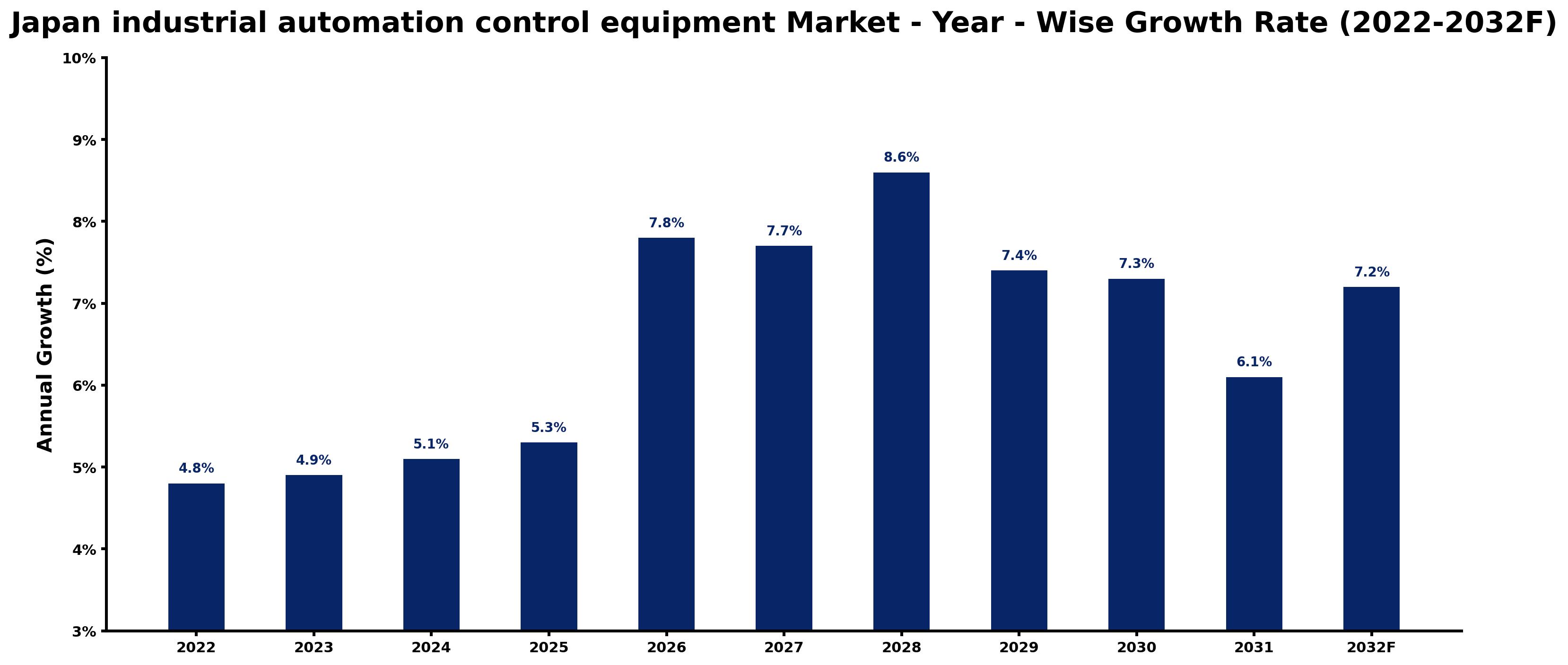
Each row of the following table gives one year's estimated growth and the event or demand shift that explains it.
| Year | Estimated Annual Growth (%) | Market Rationale |
| 2022 | 4.8 | The market showed steady growth amid increasing automation in manufacturing processes. |
| 2023 | 4.9 | Demand continued to rise as companies invested in efficiency improvements across sectors. |
| 2024 | 5.1 | Growth accelerated due to advancements in automation technologies and applications in various industries. |
| 2025 | 5.3 | The market reached a historical peak driven by strong demand from the automotive sector. |
| 2026 | 7.8 | Growth is expected to surge as investments in smart factory initiatives gain traction. |
| 2027 | 7.7 | The growth rate will slow slightly as companies adjust to integrating new technologies. |
| 2028 | 8.6 | The market is projected to peak due to heightened demand for real-time automation solutions. |
| 2029 | 7.4 | Growth is expected to decelerate as the market begins to stabilise after rapid expansion. |
| 2030 | 7.3 | The market will continue to grow, supported by ongoing investments in automation technologies. |
| 2031 | 6.1 | Growth is projected to slow further as the market matures and demand stabilises. |
| 2032 | 7.2 | Demand is expected to rise again as new technologies are adopted in various sectors. |
Note: Market size estimations and growth projections presented in this report are based on 6Wresearch's proprietary forecasting methodology, utilizing the latest available industry data, government publications, and primary research inputs.
Japan industrial automation control equipment Market Synopsis
Industrial automation control equipment encompasses systems that automate industrial processes, including sensors, controllers, and software for real-time monitoring. The Japan industrial automation control equipment Market is growing due to technological advancements and government initiatives that promote smart factories, with the automotive sector representing over 30% of demand. Key buyer groups consist of the automotive and chemical industries, which drive demand through investments aimed at improving efficiency and safety.
Market Dynamics Impact Analysis (2026–2032)
| Factor | Type | Impact | Primary Segment Affected |
| Increasing investments in smart factory initiatives | Driver | High | Real-Time Automation |
| Rising demand for efficiency in manufacturing processes | Driver | High | Programmable Controllers |
| Expansion of automation in utility networks | Opportunity | Medium | Utility Networks |
| Growing adoption of remote monitoring technologies | Opportunity | Medium | Remote Monitoring |
| High costs associated with automation technology | Restraint | High | Programmable Controllers |
| Challenges in integrating new technologies into existing systems | Restraint | Medium | Distributed Control Systems |
| Compliance with evolving industry standards and regulations | Challenge | High | SCADA Systems |
| Limited capacity for small and medium enterprises to invest | Challenge | Medium | Process Automation |
Evaluation of Drivers in Japan industrial automation control equipment Market (2026–2032)
Below are the drivers that matter most for revenue growth, with supporting evidence.
| Drivers | Primary Segment Affected | Why It Matters (Evidence) |
| Investment in smart factories | Real-Time Automation | Japan's GX Basic Policy targets JPY 150 trillion in decarbonisation investment, driving demand for automation solutions. |
| Demand for efficiency in manufacturing | Programmable Controllers | The automotive sector, accounting for over 30% of demand, pushes for automation to improve production efficiency and quality. |
| Technological advancements in automation | SCADA Systems | Rising demand for smart grids supports the expansion of the SCADA market in Japan, enhancing operational capabilities. |
| Increased focus on safety and efficiency | Chemical Plants | The chemical industry utilises advanced automation technologies to improve operational safety and efficiency across processes. |
| Growth in remote monitoring applications | Remote Monitoring | Remote monitoring technologies are projected to grow due to the need for off-site management in various sectors. |
Much of the new demand traces back to investments in smart factories, with Japan targeting JPY 150 trillion for decarbonisation over the next decade. The automotive sector, accounting for over 30% of industrial automation demand, drives efficiency improvements through advanced automation technologies. The chemical industry increasingly adopts automation for improved safety and operational efficiency, while remote monitoring technologies are gaining traction as companies seek effective off-site management solutions. These factors create strong demand for innovative industrial automation control equipment.
Evaluation of Restraints in Japan industrial automation control equipment Market
These are the pressures that could keep growth below its potential.
| Market Restraint | Primary Segment Affected | Why It Matters (Evidence) |
| High initial costs of automation technology | Programmable Controllers | The investment required for automation limits adoption among smaller firms, impacting their competitiveness. |
| Integration challenges with existing systems | Distributed Control Systems | Many companies face difficulties in incorporating new automation technologies into their legacy systems, delaying upgrades. |
| Evolving industry standards and regulations | SCADA Systems | Compliance with new regulations can delay implementation and increase costs for buyers, affecting project timelines. |
| Limited investment capacity among small businesses | Process Automation | Many small and medium enterprises struggle to allocate funds for automation upgrades, hindering their growth. |
| Shortage of skilled workforce for automation | Real-Time Automation | The lack of trained personnel can hinder the effective deployment of automation solutions, affecting operational efficiency. |
Japan industrial automation control equipment Market Challenges
Buyers in the industrial automation sector are contending with rising costs due to Japan's national minimum wage increase to JPY 1,055 per hour, which strains budgets for equipment upgrades. Technology limitations hinder suppliers, as many existing systems lack integration with IoT, delaying efficiency improvements for manufacturers by up to six months. Regulatory complexities arise from the Ministry of Economy, Trade and Industry enforcing strict standards, which can extend project timelines for producers by 20%. Competition is intensifying as the government promotes smart factories, compelling suppliers to innovate rapidly or risk losing market share and profitability.
Trends in the Japan industrial automation control equipment Market
Several trends are reshaping the Japan industrial automation control equipment Market; the most important are set out below.
- Shift towards Smart Factories: Japan is increasingly embracing smart factory concepts, with a government initiative launched in 2023 to promote automation technologies. This shift is expected to boost productivity and efficiency across various sectors, with investments projected to reach JPY 150 trillion.
- Rise of Remote Monitoring Solutions: Remote monitoring technologies are anticipated to grow, driven by the need for off-site management in manufacturing. The demand for these solutions is set to rise as industries pursue greater operational flexibility, thereby enhancing productivity.
- Adoption of Advanced SCADA Systems: The SCADA market is expanding due to growing demand for smart grids and efficient resource management. This trend highlights the need for improved supervisory control in utility networks, with projections indicating substantial growth in the coming years.
- Integration of IoT in Automation: Industrial panels are increasingly integrating IoT technologies, which improve functionality and connectivity. This trend is gaining momentum in regions like Tokyo, where manufacturers aim to boost operational efficiency and reduce costs.
Investment Opportunities in the Japan industrial automation control equipment Market
Below are the investment opportunities with the strongest case in the Japan industrial automation control equipment Market.
- Investment in Smart Factory Technologies: With Japan targeting JPY 150 trillion for decarbonisation, now is the time to invest in smart factory solutions. Utility networks are increasingly adopting automation to improve service reliability and operational efficiency.
- Growing Demand for Remote Monitoring: The demand for remote monitoring solutions is rising, with projections indicating significant market growth. Companies in the automotive sector are seeking these technologies to improve operational oversight and efficiency.
- Expansion of Automation in Chemical Plants: The chemical industry is heavily investing in automation for safety and efficiency improvements. This presents an opportunity for suppliers to offer advanced automation solutions to chemical plants, enhancing their operational capabilities.
- Focus on SCADA System Enhancements: The SCADA market is expanding as industries adopt smart grid technologies. Suppliers can enter this market by providing innovative SCADA solutions tailored to utility networks, improving overall efficiency.
Government Initiatives in the Japan industrial automation control equipment Market
The New Robot Strategy, established in 2015, aims to expand robot use across various sectors, including manufacturing and services. This initiative encourages investments in automation technologies, benefiting buyers by increasing access to advanced systems and improving productivity. The Green Growth Strategy targets carbon neutrality by 2050, promoting automation as a key component in achieving environmental goals and enhancing competitiveness in the market.
The Japan Automation Association oversees the implementation of the New Robot Strategy, funding projects that improve automation in manufacturing. Buyers in the automotive sector can utilise these initiatives to adopt advanced technologies, improving efficiency and competitiveness. The Ministry of Internal Affairs and Communications also supports industry standards, ensuring that buyers can access reliable and compliant automation solutions.
Future Insight of the Japan industrial automation control equipment Market
Investment in decarbonisation is projected to reach JPY 150 trillion over the next decade, generating substantial demand for advanced automation solutions. By 2032, the push for smart factories will drive automation adoption in small and medium enterprises, necessitating sophisticated control systems. The integration of IoT technologies will improve operational efficiency across various sectors. Growth in the SCADA market will support industries adapting to smart grid requirements, ensuring suppliers remain competitive while buyers benefit from enhanced capabilities.
Market Segmentation Analysis
Japan industrial automation control equipment Market report covers a detailed analysis of the following market segments:
By Equipment Type – Distributed Control Systems Lead, SCADA Systems Expected to Grow Fastest
According to Saurav Kr Singh, Senior Research Analyst at 6Wresearch, with 47% of equipment type revenue in 2025, Distributed Control Systems was the largest category. Distributed Control Systems are essential for managing complex industrial processes, particularly in the automotive and chemical sectors. Their widespread application in key regions like Tokyo and Aichi underscores their importance in Japan's industrial landscape. SCADA Systems are projected to grow fastest, at a CAGR of 10.0% during 2026–2032. The SCADA Systems segment is experiencing rapid growth due to the increasing demand for smart grids, which require advanced supervisory control and data acquisition capabilities. As industries prioritise operational efficiency, the need for SCADA Systems will continue to rise. Suppliers should focus on developing advanced SCADA solutions to capitalise on market growth trends.
By Control Mechanism – Real-Time Automation Leads, Supervisory Control Expected to Grow Fastest
Real-Time Automation held 40% of the Japan industrial automation control equipment Market by control mechanism in 2025. Real-Time Automation is vital for ensuring immediate responses in production environments, facilitating seamless operations. Its importance is especially pronounced in sectors where delays can lead to significant losses, such as chemical processing. The quickest growth will come from Supervisory Control, forecast to expand at a CAGR of 9.5% between 2026 and 2032. Supervisory Control is gaining traction as it allows for the management of multiple operations simultaneously, which is crucial as facilities become more complex. The increasing adoption of automation technologies will further boost this segment's growth. Buyers should invest in supervisory control solutions to improve their operational efficiency.
By Operation Level – Process Automation Leads, Remote Monitoring Expected to Grow Fastest
In 2025, Process Automation led the operation level split with a 39% share. Process Automation is fundamental for maintaining continuous production processes, ensuring operations run efficiently without interruptions. Its critical role in industries like chemical processing reinforces its leading position in the market. Remote Monitoring is set to record the highest CAGR in this split, 9.7% over 2026–2032. Remote Monitoring is becoming increasingly important for off-site management, allowing operators to oversee processes from various locations. The push for digital transformation in Japan is driving significant growth in this segment. Suppliers need to enhance their remote monitoring capabilities to meet the evolving demands of industrial operations.
By End User – Chemical Plants Lead, Utility Networks Expected to Grow Fastest
The largest end user category in 2025 was Chemical Plants, at 49% of revenue. Chemical Plants are significant users of automation technologies, prioritising safety and efficiency in their operations. Their high demand for industrial automation equipment solidifies their leading position in the market. Over 2026–2032, Utility Networks are expected to post the fastest growth, at a CAGR of 9.2%. Utility Networks require automation to ensure reliable service delivery, making this segment one of the fastest-growing within the industrial automation sector. The focus on improving infrastructure and service reliability will drive increased investments in this area. Suppliers should concentrate on automation solutions tailored for utility networks to capture emerging opportunities.
Key Attractiveness of the Report
- 10 Years of Market Numbers
- Historical Data Starting from 2022 to 2025
- Base Year 2025
- Forecast Data until 2032
- Key Performance Indicators Impacting the Market
- Major Upcoming Developments and Projects
Key Highlights of the Report:
- Japan industrial automation control equipment Market Outlook
- Market Size of Japan industrial automation control equipment Market, 2025
- Forecast of Japan industrial automation control equipment Market, 2032
- Historical Data and Forecast of Japan industrial automation control equipment Revenues & Volume for the Period 2022-2032F
- Japan industrial automation control equipment Market Trend Evolution
- Japan industrial automation control equipment Market Drivers and Challenges
- Japan industrial automation control equipment Price Trends
- Japan industrial automation control equipment Porter's Five Forces
- Japan industrial automation control equipment Industry Life Cycle
- Historical Data and Forecast of Japan industrial automation control equipment Market Revenues & Volume By Equipment Type for the Period 2022-2032F
- Historical Data and Forecast of Japan industrial automation control equipment Market Revenues & Volume By Distributed Control Systems for the Period 2022-2032F
- Historical Data and Forecast of Japan industrial automation control equipment Market Revenues & Volume By SCADA Systems for the Period 2022-2032F
- Historical Data and Forecast of Japan industrial automation control equipment Market Revenues & Volume By Programmable Controllers for the Period 2022-2032F
- Historical Data and Forecast of Japan industrial automation control equipment Market Revenues & Volume By Industrial Panels for the Period 2022-2032F
- Historical Data and Forecast of Japan industrial automation control equipment Market Revenues & Volume By Control Mechanism for the Period 2022-2032F
- Historical Data and Forecast of Japan industrial automation control equipment Market Revenues & Volume By Real-Time Automation for the Period 2022-2032F
- Historical Data and Forecast of Japan industrial automation control equipment Market Revenues & Volume By Supervisory Control for the Period 2022-2032F
- Historical Data and Forecast of Japan industrial automation control equipment Market Revenues & Volume By Logic-Based for the Period 2022-2032F
- Historical Data and Forecast of Japan industrial automation control equipment Market Revenues & Volume By Touch/Keypad for the Period 2022-2032F
- Historical Data and Forecast of Japan industrial automation control equipment Market Revenues & Volume By Operation Level for the Period 2022-2032F
- Historical Data and Forecast of Japan industrial automation control equipment Market Revenues & Volume By Process Automation for the Period 2022-2032F
- Historical Data and Forecast of Japan industrial automation control equipment Market Revenues & Volume By Remote Monitoring for the Period 2022-2032F
- Historical Data and Forecast of Japan industrial automation control equipment Market Revenues & Volume By Discrete Automation for the Period 2022-2032F
- Historical Data and Forecast of Japan industrial automation control equipment Market Revenues & Volume By Operator Interface for the Period 2022-2032F
- Historical Data and Forecast of Japan industrial automation control equipment Market Revenues & Volume By End User for the Period 2022-2032F
- Historical Data and Forecast of Japan industrial automation control equipment Market Revenues & Volume By Chemical Plants for the Period 2022-2032F
- Historical Data and Forecast of Japan industrial automation control equipment Market Revenues & Volume By Utility Networks for the Period 2022-2032F
- Historical Data and Forecast of Japan industrial automation control equipment Market Revenues & Volume By Packaging Industry for the Period 2022-2032F
- Historical Data and Forecast of Japan industrial automation control equipment Market Revenues & Volume By Automotive Plants for the Period 2022-2032F
- Japan industrial automation control equipment Import Export Trade Statistics
- Market Opportunity Assessment By Equipment Type
- Market Opportunity Assessment By Control Mechanism
- Market Opportunity Assessment By Operation Level
- Market Opportunity Assessment By End User
- Japan industrial automation control equipment Top Companies Market Share
- Japan industrial automation control equipment Competitive Benchmarking By Technical and Operational Parameters
- Japan industrial automation control equipment Company Profiles
- Japan industrial automation control equipment Key Strategic Recommendations
Market Covered
The study includes the following segmentation.
By Equipment Type
- Distributed Control Systems
- SCADA Systems
- Programmable Controllers
- Industrial Panels
By Control Mechanism
- Real-Time Automation
- Supervisory Control
- Logic-Based
- Touch/Keypad
By Operation Level
- Process Automation
- Remote Monitoring
- Discrete Automation
- Operator Interface
By End User
- Chemical Plants
- Utility Networks
- Packaging Industry
- Automotive Plants































