Japan Industrial Automation Drive Market Size & Growth Rate
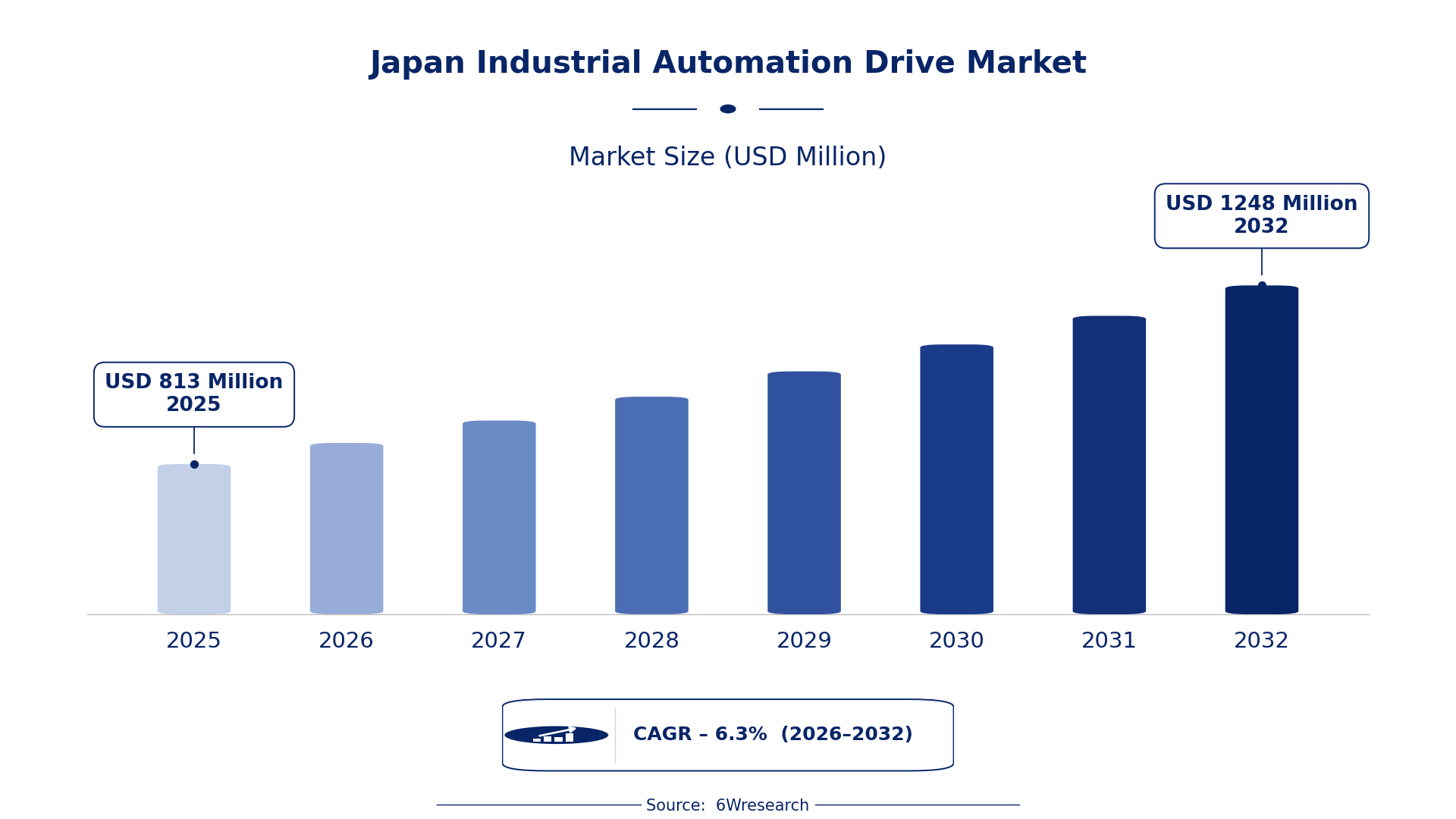
According to 6Wresearch internal database and industry insights, the Japan Industrial Automation Drive Market was valued at USD 813 Million in 2025 and is projected to reach USD 1,248 Million by 2032, growing at a CAGR of approximately 6.3% during 2026–2032.
Japan Industrial Automation Drive Market Highlights
| Report Metric | Details |
| Report Name | Japan Industrial Automation Drive Market (2026-2032) |
| Market Size 2025 | USD 813 Million |
| Market Size 2032 | USD 1,248 Million |
| Absolute Growth 2025–2032 | USD 435 Million |
| CAGR 2026–2032 | 6.3% |
| Peak Annual Growth | 7.5% in 2030 |
| Forecast Period | 2026–2032 |
| Historical Data | 2022–2025 |
| Base Year | 2025 |
| Leading Drive Type, 2025 | Variable Frequency Drives (36% share) |
| Leading Power Range, 2025 | Low to Medium Voltage (45% share) |
| Leading Control Feature, 2025 | Motor Speed Control (37% share) |
| Leading End User, 2025 | Conveyor Line Operators (48% share) |
| Fastest-Growing Drive Type | Servo Drives (8.6% CAGR) |
| Fastest-Growing Power Range | Precision Control (8.8% CAGR) |
| Fastest-Growing Control Feature | Closed-Loop Feedback (7.9% CAGR) |
| Fastest-Growing End User | Robotics Applications (8.2% CAGR) |
| Growing Sector | Manufacturing |
| Key End Users | Manufacturers, Automotive sector, Textile industry, HVAC contractors |
Japan Industrial Automation Drive Market Year-wise Growth Rate and Key Drivers (2022–2032)
This graph illustrates the annual growth rates of the market from 2022 to 2032, highlighting a steady upward trajectory and projected market expansion over the forecast period.
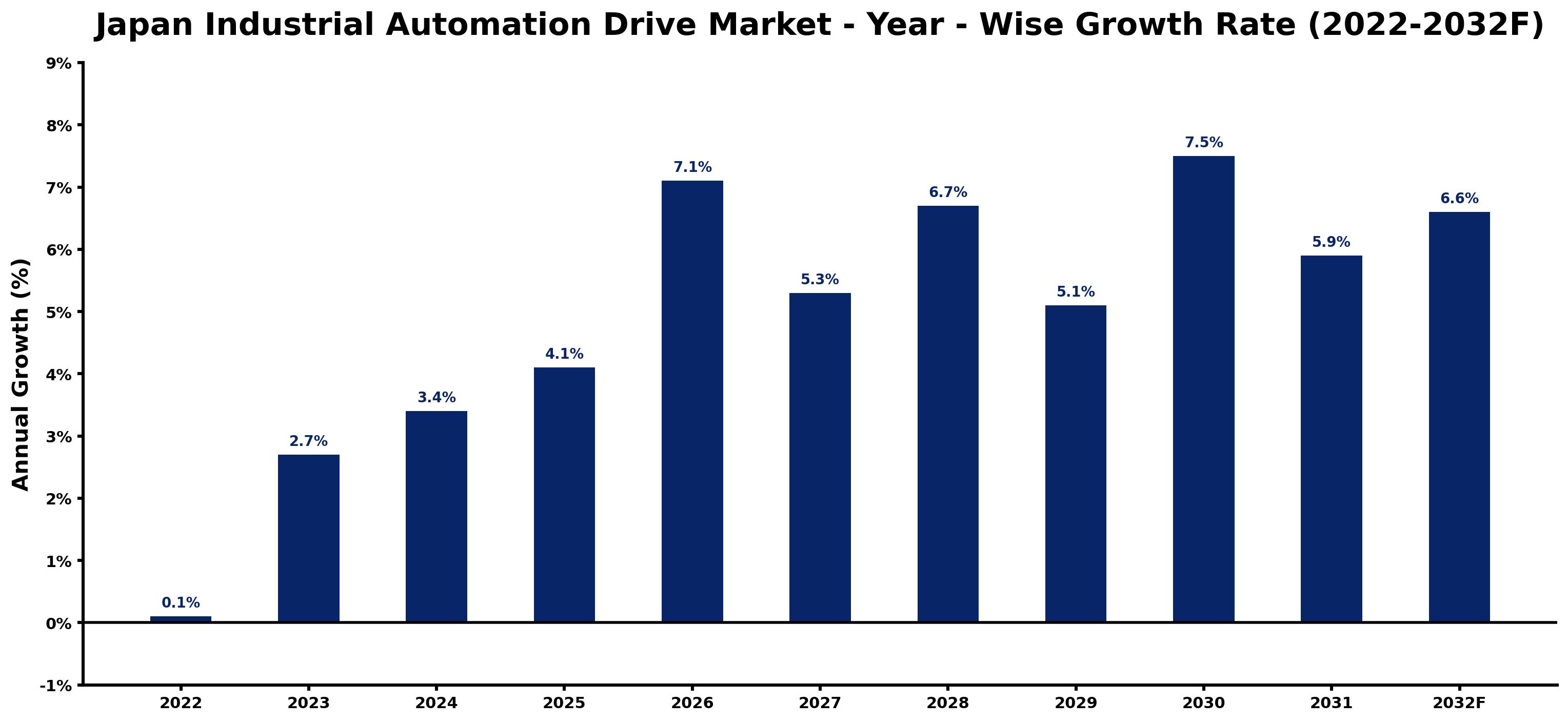
Year by year, the estimates below pair each growth rate with the development that shaped it.
| Year | Estimated Annual Growth (%) | Market Rationale |
| 2022 | 0.1 | The market exhibited minimal growth, reflecting ongoing adjustments in industrial operations. |
| 2023 | 2.7 | Growth accelerated due to increased automation in manufacturing sectors across Japan. |
| 2024 | 3.4 | Demand continued to rise as more industries adopted energy-efficient technologies. |
| 2025 | 4.1 | Expansion in the automotive sector contributed to a notable increase in drive usage. |
| 2026 | 7.1 | The market is expected to experience growth driven by advancements in robotics applications. |
| 2027 | 5.3 | Growth is projected to slow as the market adjusts to previous high demand levels. |
| 2028 | 6.7 | A resurgence in manufacturing activities will lead to a faster growth rate once again. |
| 2029 | 5.1 | Growth is expected to decelerate slightly as the market stabilises after previous peaks. |
| 2030 | 7.5 | The peak growth year will be driven by substantial investments in automation technologies. |
| 2031 | 5.9 | The market will see a slowdown as growth rates normalise after the peak. |
| 2032 | 6.6 | Growth is expected to remain strong, supported by ongoing technological advancements. |
Note: Market size estimations and growth projections presented in this report are based on 6Wresearch's proprietary forecasting methodology, utilizing the latest available industry data, government publications, and primary research inputs.
Japan Industrial Automation Drive Market Synopsis
Industrial Automation Drives control the speed and torque of electric motors, utilising advanced semiconductor technology. Their primary applications include improving energy efficiency and process control in sectors like manufacturing and automotive. The Japan Industrial Automation Drive Market is expanding due to rising demand from domestic users and exports, with a projected market value of approximately ¥1 trillion in 2023 and substantial investments in decarbonisation and automation technologies.
Market Dynamics Impact Analysis (2026–2032)
| Factor | Type | Impact | Primary Segment Affected |
| Increased adoption of Variable Frequency Drives in manufacturing processes | Driver | High | Variable Frequency Drives |
| Growing demand for Servo Drives in the automotive sector | Driver | High | Servo Drives |
| Expansion of the textile industry requiring automation solutions | Opportunity | Medium | Textile Machinery Users |
| Rising HVAC installations driving Soft Starter demand | Opportunity | Medium | Pumps & HVAC Systems |
| High initial investment costs for automation technologies | Restraint | High | Soft Starters |
| Limited awareness of energy-efficient technologies among small manufacturers | Restraint | Medium | Variable Frequency Drives |
| Skills shortage in automation technology implementation | Challenge | High | Servo Drives |
| Competition from low-cost alternatives in the market | Challenge | Medium | Variable Frequency Drives |
Evaluation of Drivers in Japan Industrial Automation Drive Market (2026–2032)
Key forces behind demand, with the segment each one moves most, are listed below.
| Drivers | Primary Segment Affected | Why It Matters (Evidence) |
| Increased energy efficiency in manufacturing processes | Variable Frequency Drives | Over 40% of the automation drive market is attributed to Variable Frequency Drives, enhancing operational efficiency. |
| Growing investments in textile automation | Textile Machinery Users | The textile market was valued at approximately ¥300 billion in 2023, driving demand for automation solutions. |
| Expansion of HVAC systems requiring Soft Starters | Pumps & HVAC Systems | Increased installations of HVAC systems are projected to boost Soft Starter demand. |
| Government incentives for energy-efficient technologies | Variable Frequency Drives | Japan's Green Growth Strategy aims for a 46% reduction in emissions by 2030, promoting automation adoption. |
| Rising demand for precision in robotics applications | Servo Drives | Servo Drives are essential for precise motion control, particularly in automotive manufacturing. |
In 2023, Variable Frequency Drives accounted for over 40% of the automation drive market, improving operational efficiency in various sectors. The textile industry, valued at approximately ¥300 billion, is driving demand for automation solutions. Investments in robotics applications are also contributing to the growth of Servo Drives, which are crucial for precise motion control. The push for energy-efficient technologies is encouraging adoption in HVAC systems, further increasing demand for Soft Starters.
Evaluation of Restraints in Japan Industrial Automation Drive Market
The following restraints limit how fast demand can grow.
| Market Restraint | Primary Segment Affected | Why It Matters (Evidence) |
| High initial investment costs for automation technologies | Soft Starters | The high upfront costs deter smaller manufacturers from adopting automation solutions. |
| Limited awareness of energy-efficient technologies among small manufacturers | Variable Frequency Drives | Many small manufacturers lack knowledge of available energy-efficient options, hindering market growth. |
| Regulatory compliance requirements for automation systems | Servo Drives | Complex compliance processes can delay implementation and increase costs for manufacturers. |
| Dependence on skilled labour for installation and maintenance | Variable Frequency Drives | A shortage of skilled workers affects the timely deployment of automation technologies. |
| Market saturation in certain segments leading to price competition | Soft Starters | Increased competition results in price pressures, affecting profitability for suppliers. |
Japan Industrial Automation Drive Market Challenges
Market pressures stem from local manufacturers facing stiff competition from international players, which reduces profit margins for producers. Limited investment in research and development leads to technological stagnation, leaving buyers in the automotive sector with outdated automation solutions. Rising raw material costs, driven by a national minimum wage increase to JPY 1,055 per hour, impose financial burdens on suppliers, limiting their capacity to invest in new technologies. Supply chain disruptions arise from reliance on specific components, causing delays in delivery timelines for manufacturers that require timely automation solutions.
Trends in the Japan Industrial Automation Drive Market
Below are the shifts with the largest effect on the Japan Industrial Automation Drive Market.
- Shift towards Energy-Efficient Technologies: The Green Growth Strategy promotes energy-efficient technologies in Japanese industries. This initiative aims for a 46% reduction in emissions by 2030, driving an increase in automation drive adoption.
- Transition from Traditional to Advanced Automation Solutions: The automotive sector is accelerating the adoption of advanced automation solutions. Servo Drives are increasingly integrated into manufacturing processes, with substantial growth driven by this sector.
- Expansion of Robotics Applications in Manufacturing: Robotics applications are gaining traction in Japan's manufacturing sector, with projections indicating continued growth. The total installed base of industrial automation drives exceeds 5 million units, reflecting this trend.
- Growth in Textile Machinery Automation: The textile industry in Japan is experiencing a resurgence, leading to increased demand for automation solutions. In 2023, the textile machinery market was valued at approximately ¥300 billion, indicating strong growth potential.
Investment Opportunities in the Japan Industrial Automation Drive Market
The following opportunities in the Japan Industrial Automation Drive Market pair current demand with a clear way in.
- Timing for Investment in Energy-Efficient Technologies: With Japan targeting a 46% reduction in greenhouse gas emissions by 2030, there is an opportunity for investment in energy-efficient automation solutions, particularly among manufacturers in the Tokyo metropolitan area.
- Supply of Automation Solutions for Textile Machinery: The resurgence of the textile industry presents an opportunity to supply automation drives. Manufacturers can enter this market by collaborating with textile machinery users in regions like Osaka, known for its textile production.
- Investment in Robotics Applications: The growing demand for robotics in manufacturing creates opportunities for suppliers of Servo Drives. Engaging with automotive manufacturers in Aichi Prefecture can facilitate market entry.
- Expansion of HVAC Systems: The increasing installation of HVAC systems offers a timely opportunity for Soft Starter suppliers. Collaborating with HVAC contractors in urban areas can help capture this growing market.
Government Initiatives in the Japan Industrial Automation Drive Market
The New Robot Strategy (2015) aims to expand robot use across various sectors, including manufacturing and services. This initiative has led to increased funding for automation projects, encouraging manufacturers to adopt advanced technologies. It supports the development of automation drives, which are important for improving operational efficiency. Japan's Green Growth Strategy aims for a 46% reduction in greenhouse gas emissions by 2030, further promoting energy-efficient technologies.
The Ministry of Economy, Trade and Industry (METI) oversees the approval and funding of various initiatives related to automation technologies. METI supports projects that improve energy efficiency and promote the use of advanced automation drives. The agency has allocated substantial funding for research and development in this area, ensuring that manufacturers have access to the latest technologies and standards, such as ISO 9001.
Future Insight of the Japan Industrial Automation Drive Market
A shift towards decarbonisation will transform the market by 2032, as the government aims for a 46% reduction in greenhouse gas emissions from 2013 levels. This policy will drive suppliers to innovate in energy-efficient automation technologies. Investment in automation is expected to increase, supported by public and private decarbonisation investments projected at JPY 150 trillion over ten years. Robotics applications will see significant growth, driven by rising demand in manufacturing, enhancing productivity across various sectors.
Market Segmentation Analysis
Japan Industrial Automation Drive Market report covers a detailed analysis of the following market segments:
By Drive Type – Variable Frequency Drives Lead, Servo Drives Expected to Grow Fastest
According to Saurav Kr Singh, Senior Research Analyst at 6Wresearch, Variable Frequency Drives accounted for 36% of the market by drive type in 2025. Variable Frequency Drives dominate the market due to their extensive use in controlling motor speed across various sectors, including manufacturing and HVAC. Their adaptability and established presence make them essential for numerous operational processes. Servo Drives are set to record the highest CAGR in this split, 8.6% over 2026–2032. Servo Drives are witnessing rapid growth as they are crucial for precise motion control in robotics, which is increasingly being integrated into automation solutions. This trend will likely drive further demand for Servo Drives as industries pursue enhanced efficiency through robotics. Suppliers should focus on expanding their Servo Drive offerings to meet the rising demand from the robotics sector.
By Power Range – Low to Medium Voltage Leads, Precision Control Expected to Grow Fastest
The largest power range category in 2025 was Low to Medium Voltage, at 45% of revenue. Low to Medium Voltage drives hold the largest share as they cater to the majority of operational needs across diverse industrial applications. Their widespread adoption ensures they remain the most common power range for industrial automation. Over 2026–2032, Precision Control is expected to post the fastest growth, at a CAGR of 8.8%. Precision Control is experiencing notable growth due to its critical role in applications requiring accurate speed and position management, particularly in high-tech industries. As these sectors advance, the demand for Precision Control solutions is expected to increase significantly. Buyers should consider investing in Precision Control technologies to fulfil the requirements of high-accuracy applications.
By Control Feature – Motor Speed Control Leads, Closed-Loop Feedback Expected to Grow Fastest
In 2025, Motor Speed Control led the control feature split with a 37% share. Motor Speed Control is a fundamental feature of automation drives, making it essential for users in various industries. Its importance in maintaining operational efficiency secures its position as the leading control feature in the market. Closed-Loop Feedback is projected to grow fastest, at a CAGR of 7.9% during 2026–2032. Closed-Loop Feedback is rapidly gaining popularity as it optimises motor performance by adjusting output based on real-time feedback. This feature is increasingly sought after in advanced automation systems, driving its fast growth. Suppliers need to enhance their Closed-Loop Feedback capabilities to address the growing demand for performance optimisation.
By End User – Conveyor Line Operators Lead, Robotics Applications Expected to Grow Fastest
With 48% of end user revenue in 2025, Conveyor Line Operators was the largest category. Conveyor Line Operators represent a significant market segment, relying heavily on automation drives to enhance operational efficiency in production lines. Their critical dependence on these drives solidifies their status as the largest end user group. The quickest growth will come from Robotics Applications, forecast to expand at a CAGR of 8.2% between 2026 and 2032. Robotics Applications are expanding rapidly as industries adopt automation technologies, making them essential to contemporary manufacturing processes. This trend is likely to accelerate the demand for automation drives designed for robotics. Suppliers should align their strategies to meet the increasing needs of robotics applications within the automation sector.
Key Attractiveness of the Report
- 10 Years of Market Numbers
- Historical Data Starting from 2022 to 2025
- Base Year 2025
- Forecast Data until 2032
- Key Performance Indicators Impacting the Market
- Major Upcoming Developments and Projects
Key Highlights of the Report:
- Japan Industrial Automation Drive Market Outlook
- Market Size of Japan Industrial Automation Drive Market, 2025
- Forecast of Japan Industrial Automation Drive Market, 2032
- Historical Data and Forecast of Japan Industrial Automation Drive Revenues & Volume for the Period 2022-2032F
- Japan Industrial Automation Drive Market Trend Evolution
- Japan Industrial Automation Drive Market Drivers and Challenges
- Japan Industrial Automation Drive Price Trends
- Japan Industrial Automation Drive Porter's Five Forces
- Japan Industrial Automation Drive Industry Life Cycle
- Historical Data and Forecast of Japan Industrial Automation Drive Market Revenues & Volume By Drive Type for the Period 2022-2032F
- Historical Data and Forecast of Japan Industrial Automation Drive Market Revenues & Volume By Variable Frequency Drives for the Period 2022-2032F
- Historical Data and Forecast of Japan Industrial Automation Drive Market Revenues & Volume By Servo Drives for the Period 2022-2032F
- Historical Data and Forecast of Japan Industrial Automation Drive Market Revenues & Volume By DC Drives for the Period 2022-2032F
- Historical Data and Forecast of Japan Industrial Automation Drive Market Revenues & Volume By Soft Starters for the Period 2022-2032F
- Historical Data and Forecast of Japan Industrial Automation Drive Market Revenues & Volume By Power Range for the Period 2022-2032F
- Historical Data and Forecast of Japan Industrial Automation Drive Market Revenues & Volume By Low to Medium Voltage for the Period 2022-2032F
- Historical Data and Forecast of Japan Industrial Automation Drive Market Revenues & Volume By Precision Control for the Period 2022-2032F
- Historical Data and Forecast of Japan Industrial Automation Drive Market Revenues & Volume By High Torque for the Period 2022-2032F
- Historical Data and Forecast of Japan Industrial Automation Drive Market Revenues & Volume By Gradual Acceleration for the Period 2022-2032F
- Historical Data and Forecast of Japan Industrial Automation Drive Market Revenues & Volume By Control Feature for the Period 2022-2032F
- Historical Data and Forecast of Japan Industrial Automation Drive Market Revenues & Volume By Motor Speed Control for the Period 2022-2032F
- Historical Data and Forecast of Japan Industrial Automation Drive Market Revenues & Volume By Closed-Loop Feedback for the Period 2022-2032F
- Historical Data and Forecast of Japan Industrial Automation Drive Market Revenues & Volume By Armature Control for the Period 2022-2032F
- Historical Data and Forecast of Japan Industrial Automation Drive Market Revenues & Volume By Voltage Regulation for the Period 2022-2032F
- Historical Data and Forecast of Japan Industrial Automation Drive Market Revenues & Volume By End User for the Period 2022-2032F
- Historical Data and Forecast of Japan Industrial Automation Drive Market Revenues & Volume By Conveyor Line Operators for the Period 2022-2032F
- Historical Data and Forecast of Japan Industrial Automation Drive Market Revenues & Volume By Robotics Applications for the Period 2022-2032F
- Historical Data and Forecast of Japan Industrial Automation Drive Market Revenues & Volume By Textile Machinery Users for the Period 2022-2032F
- Historical Data and Forecast of Japan Industrial Automation Drive Market Revenues & Volume By Pumps & HVAC Systems for the Period 2022-2032F
- Japan Industrial Automation Drive Import Export Trade Statistics
- Market Opportunity Assessment By Drive Type
- Market Opportunity Assessment By Power Range
- Market Opportunity Assessment By Control Feature
- Market Opportunity Assessment By End User
- Japan Industrial Automation Drive Top Companies Market Share
- Japan Industrial Automation Drive Competitive Benchmarking By Technical and Operational Parameters
- Japan Industrial Automation Drive Company Profiles
- Japan Industrial Automation Drive Key Strategic Recommendations
Market Covered
The study includes the following segmentation.
By Drive Type
- Variable Frequency Drives
- Servo Drives
- DC Drives
- Soft Starters
By Power Range
- Low to Medium Voltage
- Precision Control
- High Torque
- Gradual Acceleration
By Control Feature
- Motor Speed Control
- Closed-Loop Feedback
- Armature Control
- Voltage Regulation
By End User
- Conveyor Line Operators
- Robotics Applications
- Textile Machinery Users
- Pumps & HVAC Systems































