Japan Industrial Automation IC Market Size & Growth Rate
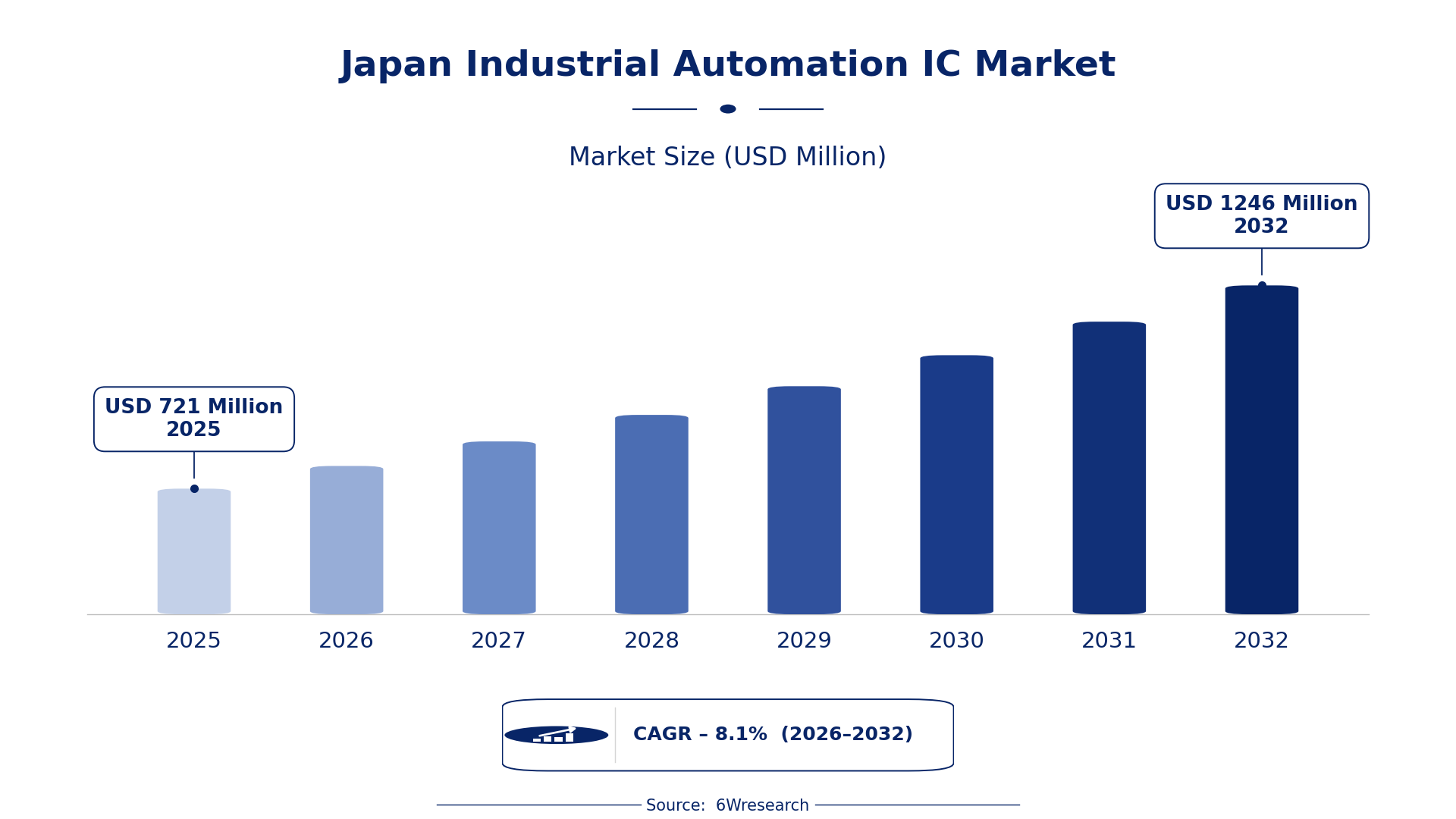
According to 6Wresearch internal database and industry insights, the Japan Industrial Automation IC Market was valued at USD 721 Million in 2025 and is projected to reach USD 1,246 Million by 2032, growing at a CAGR of approximately 8.1% during 2026–2032.
Japan Industrial Automation IC Market Highlights
| Report Metric | Details |
| Report Name | Japan Industrial Automation IC Market (2026-2032) |
| Market Size 2025 | USD 721 Million |
| Market Size 2032 | USD 1,246 Million |
| Absolute Growth 2025–2032 | USD 525 Million |
| CAGR 2026–2032 | 8.1% |
| Peak Annual Growth | 8.8% in 2026 |
| Forecast Period | 2026–2032 |
| Historical Data | 2022–2025 |
| Base Year | 2025 |
| Leading IC Type, 2025 | Power Management ICs (43% share) |
| Leading Application Segment, 2025 | Motor Drives (43% share) |
| Leading Packaging Type, 2025 | SMD/Through-Hole (42% share) |
| Leading End User, 2025 | Automation Hardware OEMs (38% share) |
| Fastest-Growing IC Type | Microcontrollers (MCUs) (11.7% CAGR) |
| Fastest-Growing Application Segment | Process Control (10.7% CAGR) |
| Fastest-Growing Packaging Type | QFP/BGA (11.9% CAGR) |
| Fastest-Growing End User | Industrial PC Makers (10.9% CAGR) |
| Growing Sector | Industrial Automation |
| Key End Users | Automation Hardware OEMs, PLC Manufacturers, Robotics Integrators |
Japan Industrial Automation IC Market Year-wise Growth Rate and Key Drivers (2022–2032)
This graph illustrates the annual growth rates of the market from 2022 to 2032, highlighting a steady upward trajectory and projected market expansion over the forecast period.
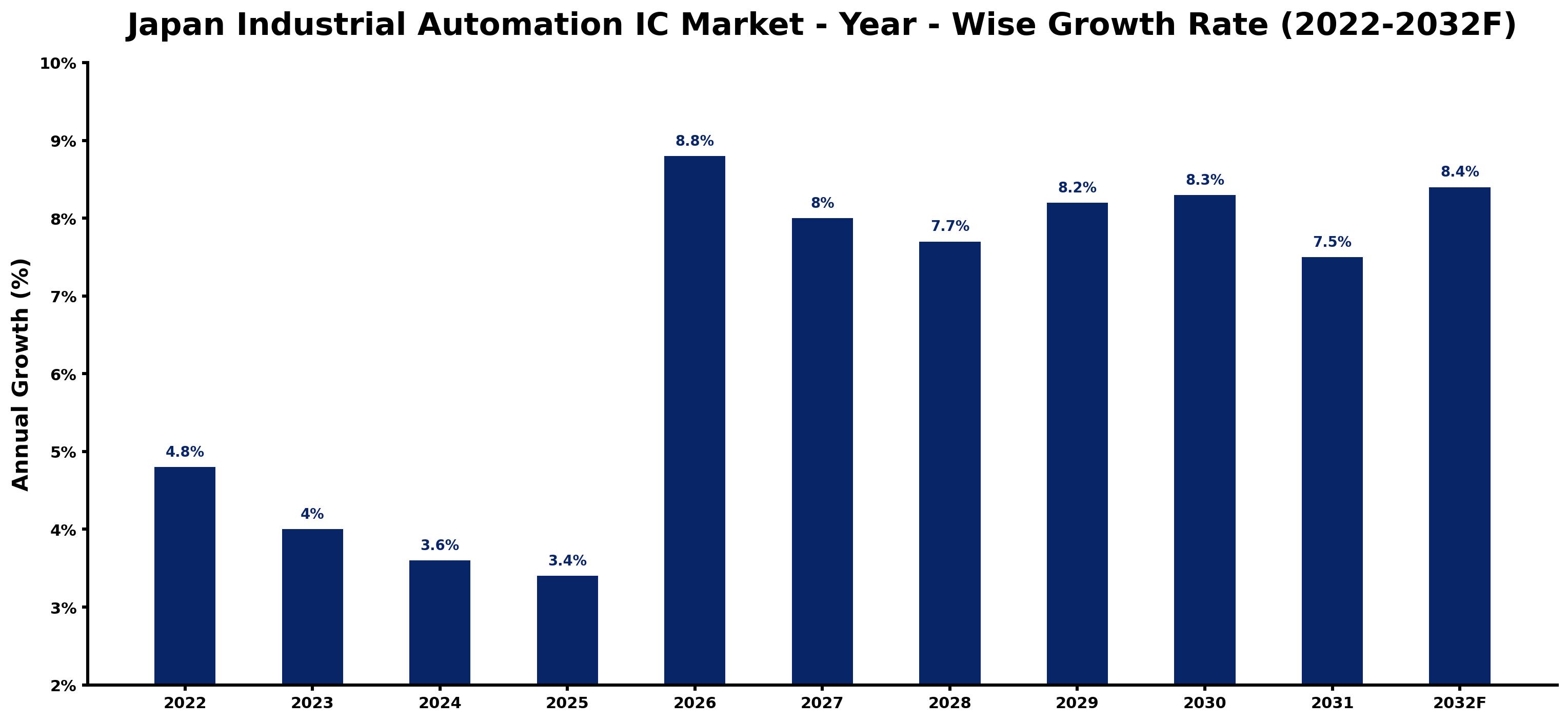
The yearly estimates that follow link every growth rate to its principal driver, so readers can see why the pace changed in each period.
| Year | Estimated Annual Growth (%) | Market Rationale |
| 2022 | 4.8 | The market experienced steady growth due to ongoing investments in automation technology. |
| 2023 | 4.0 | Demand growth slowed as manufacturers adjusted to market conditions and economic uncertainties. |
| 2024 | 3.6 | Continued investments in automation led to a further slowdown in growth as the market stabilised. |
| 2025 | 3.4 | Growth slowed as companies focused on optimising existing automation systems rather than new investments. |
| 2026 | 8.8 | Demand is expected to surge as companies accelerate automation initiatives to improve productivity and efficiency. |
| 2027 | 8.0 | Growth is projected to slow slightly as the market stabilises after the previous year's surge. |
| 2028 | 7.7 | Demand will continue to grow, albeit at a slower pace as market conditions normalise. |
| 2029 | 8.2 | A renewed interest in automation technology will drive demand higher as companies seek competitive advantages. |
| 2030 | 8.3 | Demand is expected to remain strong as businesses continue to invest in automation for operational efficiency. |
| 2031 | 7.5 | Growth will slow as the market reaches a more mature stage with stabilised demand patterns. |
| 2032 | 8.4 | Demand is projected to rise as new technologies and applications emerge in the automation sector. |
Note: Market size estimations and growth projections presented in this report are based on 6Wresearch's proprietary forecasting methodology, utilizing the latest available industry data, government publications, and primary research inputs.
Japan Industrial Automation IC Market Synopsis
Industrial Automation ICs are semiconductor devices essential for controlling and automating industrial processes, primarily used in motor control and process automation. The Japan Industrial Automation IC Market is expanding, driven by the increasing adoption of automation technologies across various sectors. In 2023, Japan's government allocated 5 billion JPY for automation technology research, reflecting a commitment to improving industrial efficiency. The rising demand for Microcontrollers, projected to be used in over 60% of automation applications, is a key driver of market growth.
Market Dynamics Impact Analysis (2026–2032)
| Factor | Type | Impact | Primary Segment Affected |
| Increasing adoption of automation technologies in manufacturing processes | Driver | High | Motor Drives |
| Growing demand for energy-efficient solutions in industrial applications | Driver | High | Power Management ICs |
| Expansion of automation in small and medium enterprises | Opportunity | High | Automation Hardware OEMs |
| Rising need for customised automation solutions in various sectors | Opportunity | Medium | Microcontrollers (MCUs) |
| High competition leading to price pressures on IC manufacturers | Restraint | High | ASICs for Automation |
| Fluctuations in global semiconductor supply chains affecting availability | Restraint | Medium | Logic ICs |
| Challenges in integrating new technologies into existing systems | Challenge | High | Process Control |
| Shortage of skilled workforce in automation technology | Challenge | Medium | Industrial PC Makers |
Evaluation of Drivers in Japan Industrial Automation IC Market (2026–2032)
Demand rests on the following drivers, each shown with the segment it touches most.
| Drivers | Primary Segment Affected | Why It Matters (Evidence) |
| Growing demand for industrial automation solutions | Motor Drives | Motor Drives are essential for controlling electric motors, with the installed base of industrial robots in Japan exceeding 300,000. |
| Focus on energy efficiency in industrial processes | Power Management ICs | Power Management ICs account for 35% of the total IC market, reflecting the push for energy-efficient solutions. |
| Increased investments in automation technology | Microcontrollers (MCUs) | Microcontrollers are used in over 60% of automation applications, highlighting their critical role in control tasks. |
| Rising interest in custom automation solutions | ASICs for Automation | The demand for ASICs is projected to grow due to increased customization needs in various industries. |
| Expansion of robotics in industrial applications | Process Control | The Japan Robotics Association promotes robotics, increasing the need for Process Control ICs in automation. |
The demand for industrial automation solutions is strong, highlighted by the installed base of industrial robots in Japan surpassing 300,000. The emphasis on energy efficiency in industrial processes is apparent, with Power Management ICs making up 35% of the total IC market. Investments in automation technology are on the rise, with Microcontrollers featured in over 60% of automation applications, underscoring their importance in control functions. Growing interest in custom automation solutions is driving demand for ASICs, which are designed for specific tasks. The growth of robotics in industrial applications is supported by the Japan Robotics Association, which promotes further advancements in Process Control ICs.
Evaluation of Restraints in Japan Industrial Automation IC Market
The main factors holding the market back are set out below.
| Market Restraint | Primary Segment Affected | Why It Matters (Evidence) |
| High competition leading to price pressures | ASICs for Automation | Price competition among manufacturers affects profit margins, making it challenging for suppliers to sustain operations. |
| Fluctuations in global semiconductor supply chains | Logic ICs | Supply chain disruptions can lead to delays in product availability, impacting manufacturers' production schedules. |
| Integration challenges with existing systems | Process Control | Difficulties in integrating new technologies into legacy systems can slow down adoption rates among users. |
| Limited availability of skilled workforce | Industrial PC Makers | A shortage of talent in automation technology hampers the ability to innovate and meet market demands. |
| Regulatory compliance costs for new products | Microcontrollers (MCUs) | Compliance with standards such as JIS C 61000 increases operational costs for manufacturers. |
Japan Industrial Automation IC Market Challenges
By 2022, over 300,000 industrial robots were installed in Japan, yet many producers face challenges due to outdated technology, which hampers production efficiency. This technology gap arises from high research and development costs, causing delays in product launches for manufacturers of up to six months. Rising operational costs, linked to a national minimum wage of JPY 1,055 per hour, pressure profit margins for producers, compelling them to raise prices for buyers. Supply chain disruptions, especially in semiconductor availability, can result in project delays of several weeks for buyers reliant on timely deliveries.
Trends in the Japan Industrial Automation IC Market
The trends below show where the Japan Industrial Automation IC Market is heading.
- New Robot Strategy Expanding Automation: The New Robot Strategy initiated in 2015 aims to broaden robot use across sectors. This strategy has led to increased investments, with Japan's government allocating 5 billion JPY for automation technology research in 2023, boosting market growth potential.
- Shift Towards Energy-Efficient Solutions: Since 2020, there has been a notable shift towards energy-efficient automation solutions. The Green Growth Strategy aims for a 46% reduction in greenhouse gas emissions by 2030, prompting manufacturers to adopt more efficient technologies.
- Increased Customisation in Automation: The demand for customised automation solutions has risen sharply, particularly in the automotive sector. This trend is evidenced by the growing need for ASICs, which are designed for specific applications in various industries.
- Focus on Robotics Integration: The Robotics and Automation Conference held in 2023 highlighted the increasing integration of robotics in industrial processes. This trend is driven by the installed base of industrial robots in Japan, which fosters further innovation.
Investment Opportunities in the Japan Industrial Automation IC Market
Where to invest in the Japan Industrial Automation IC Market: the main openings are set out below.
- Joint Ventures for Automation Technology: Forming joint ventures with local firms can help tap into existing market knowledge. Automation Hardware OEMs in the Tokyo metropolitan area are seeking solutions to improve productivity.
- Investment in Agricultural Automation: With the government allocating 5 billion JPY for automation in agriculture, there is a strong opportunity for suppliers. Collaborating with agricultural technology firms can facilitate market entry.
- Expansion in Automotive Automation: The Chubu region, known for its automotive manufacturing, presents a gap in advanced automation solutions. Suppliers can target this area by forming partnerships with local manufacturers.
- Focus on Energy Management Solutions: As Japan targets a 46% cut in greenhouse gas emissions, there is a growing need for energy management solutions. Power Management ICs are essential for meeting these sustainability goals.
Government Initiatives in the Japan Industrial Automation IC Market
The AI Promotion Act, set to take effect in 2025, establishes a national framework for AI research and development, enhancing the capabilities of automation technologies. This act complements the New Robot Strategy from 2015, which aims to expand robot use in various sectors, further driving innovation and investment in automation.
In 2023, the Ministry of Economy, Trade and Industry (METI) allocated 5 billion JPY for automation technology research. This funding is intended to support the development of advanced automation solutions, ensuring that Japan remains competitive in the global market.
Future Insight of the Japan Industrial Automation IC Market
Japan's commitment to a 46% reduction in greenhouse-gas emissions by fiscal 2030 will drive a transition towards cleaner automation technologies. By 2032, the government’s JPY 150 trillion decarbonisation investment will encourage suppliers to develop energy-efficient solutions. The implementation of the JIS C 61000 standard will enhance product reliability and interoperability, providing buyers with better system integration. As suppliers focus on advanced technologies, buyers will gain access to solutions that comply with stringent industry standards.
Market Segmentation Analysis
Japan Industrial Automation IC Market report covers a detailed analysis of the following market segments:
By IC Type – Power Management ICs Lead, Microcontrollers (MCUs) Expected to Grow Fastest
According to Saurav Kr Singh, Senior Research Analyst at 6Wresearch, Power Management ICs held 43% of the Japan Industrial Automation IC Market by ic type in 2025. Power Management ICs are vital for optimising energy consumption in automation systems, ensuring operational efficiency. Their extensive application across sectors such as manufacturing and robotics reinforces their leading market position. Microcontrollers (MCUs) is set to record the highest CAGR in this split, 11.7% over 2026–2032. Microcontrollers are increasingly sought after for their role in complex control tasks, with over 60% of automation applications employing them. This growing reliance indicates a trend that will likely continue as industries pursue advanced control capabilities. Suppliers should prioritise microcontroller advancements to cater to the rising demand in automation.
By Application Segment – Motor Drives Lead, Process Control Expected to Grow Fastest
The largest application segment category in 2025 was Motor Drives, at 43% of revenue. Motor Drives are crucial for controlling electric motors, which are integral to many automation applications across sectors like automotive and manufacturing. Their extensive use ensures a robust installed base, solidifying their position as the leading application segment. Process Control is projected to grow fastest, at a CAGR of 10.7% during 2026–2032. Process Control is experiencing rapid growth as industries focus on optimising efficiency and managing complex processes more effectively. The increasing adoption of advanced process management solutions in sectors such as food and beverage is a key factor in this growth. Suppliers should prioritise the development of solutions for process control to align with market demands.
By Packaging Type – SMD/Through-Hole Leads, QFP/BGA Expected to Grow Fastest
With 42% of packaging type revenue in 2025, SMD/Through-Hole was the largest category. SMD/Through-Hole packaging is widely adopted due to its compatibility with various automation applications, providing reliability and ease of integration. This packaging type is prevalent among manufacturers focusing on compact automation devices. The quickest growth will come from QFP/BGA, forecast to expand at a CAGR of 11.9% between 2026 and 2032. QFP/BGA packaging is becoming increasingly popular for high-density applications, driven by the need for more complex and compact automation solutions. As automation technology advances, the demand for these packaging types will likely rise. Suppliers should consider expanding their offerings in QFP/BGA packaging to cater to the evolving needs of automation.
By End User – Automation Hardware OEMs Lead, Industrial PC Makers Expected to Grow Fastest
Automation Hardware OEMs accounted for 38% of the market by end user in 2025. Automation Hardware OEMs are the primary users of automation ICs, incorporating these components into their systems to enhance functionality. Their dominant role in the market ensures a steady demand for various automation ICs, particularly in the manufacturing sector. Over 2026–2032, Industrial PC Makers are expected to post the fastest growth, at a CAGR of 10.9%. Industrial PC Makers are rapidly expanding due to the rising need for computing power in automation systems. The growth in the installed base of industrial PCs directly correlates with an increased demand for automation ICs. Buyers should engage with suppliers to ensure their specific needs are met in the evolving landscape of industrial computing.
Key Attractiveness of the Report
- 10 Years of Market Numbers
- Historical Data Starting from 2022 to 2025
- Base Year 2025
- Forecast Data until 2032
- Key Performance Indicators Impacting the Market
- Major Upcoming Developments and Projects
Key Highlights of the Report:
- Japan Industrial Automation IC Market Outlook
- Market Size of Japan Industrial Automation IC Market, 2025
- Forecast of Japan Industrial Automation IC Market, 2032
- Historical Data and Forecast of Japan Industrial Automation IC Revenues & Volume for the Period 2022-2032F
- Japan Industrial Automation IC Market Trend Evolution
- Japan Industrial Automation IC Market Drivers and Challenges
- Japan Industrial Automation IC Price Trends
- Japan Industrial Automation IC Porter's Five Forces
- Japan Industrial Automation IC Industry Life Cycle
- Historical Data and Forecast of Japan Industrial Automation IC Market Revenues & Volume By IC Type for the Period 2022-2032F
- Historical Data and Forecast of Japan Industrial Automation IC Market Revenues & Volume By Power Management ICs for the Period 2022-2032F
- Historical Data and Forecast of Japan Industrial Automation IC Market Revenues & Volume By Microcontrollers (MCUs) for the Period 2022-2032F
- Historical Data and Forecast of Japan Industrial Automation IC Market Revenues & Volume By Logic ICs for the Period 2022-2032F
- Historical Data and Forecast of Japan Industrial Automation IC Market Revenues & Volume By ASICs for Automation for the Period 2022-2032F
- Historical Data and Forecast of Japan Industrial Automation IC Market Revenues & Volume By Application Segment for the Period 2022-2032F
- Historical Data and Forecast of Japan Industrial Automation IC Market Revenues & Volume By Motor Drives for the Period 2022-2032F
- Historical Data and Forecast of Japan Industrial Automation IC Market Revenues & Volume By Process Control for the Period 2022-2032F
- Historical Data and Forecast of Japan Industrial Automation IC Market Revenues & Volume By Signal Processing for the Period 2022-2032F
- Historical Data and Forecast of Japan Industrial Automation IC Market Revenues & Volume By Custom Tasks for the Period 2022-2032F
- Historical Data and Forecast of Japan Industrial Automation IC Market Revenues & Volume By Packaging Type for the Period 2022-2032F
- Historical Data and Forecast of Japan Industrial Automation IC Market Revenues & Volume By SMD/Through-Hole for the Period 2022-2032F
- Historical Data and Forecast of Japan Industrial Automation IC Market Revenues & Volume By QFP/BGA for the Period 2022-2032F
- Historical Data and Forecast of Japan Industrial Automation IC Market Revenues & Volume By SOIC/DIP for the Period 2022-2032F
- Historical Data and Forecast of Japan Industrial Automation IC Market Revenues & Volume By Die-Level/SIP for the Period 2022-2032F
- Historical Data and Forecast of Japan Industrial Automation IC Market Revenues & Volume By End User for the Period 2022-2032F
- Historical Data and Forecast of Japan Industrial Automation IC Market Revenues & Volume By Automation Hardware OEMs for the Period 2022-2032F
- Historical Data and Forecast of Japan Industrial Automation IC Market Revenues & Volume By Industrial PC Makers for the Period 2022-2032F
- Historical Data and Forecast of Japan Industrial Automation IC Market Revenues & Volume By PLC Manufacturers for the Period 2022-2032F
- Historical Data and Forecast of Japan Industrial Automation IC Market Revenues & Volume By Robotics Integrators for the Period 2022-2032F
- Japan Industrial Automation IC Import Export Trade Statistics
- Market Opportunity Assessment By IC Type
- Market Opportunity Assessment By Application Segment
- Market Opportunity Assessment By Packaging Type
- Market Opportunity Assessment By End User
- Japan Industrial Automation IC Top Companies Market Share
- Japan Industrial Automation IC Competitive Benchmarking By Technical and Operational Parameters
- Japan Industrial Automation IC Company Profiles
- Japan Industrial Automation IC Key Strategic Recommendations
Market Covered
The report covers the following segments.
By IC Type
- Power Management ICs
- Microcontrollers (MCUs)
- Logic ICs
- ASICs for Automation
By Application Segment
- Motor Drives
- Process Control
- Signal Processing
- Custom Tasks
By Packaging Type
- SMD/Through-Hole
- QFP/BGA
- SOIC/DIP
- Die-Level/SIP
By End User
- Automation Hardware OEMs
- Industrial PC Makers
- PLC Manufacturers
- Robotics Integrators































