Japan Industrial Automation in Developing Countries Market Size & Growth Rate
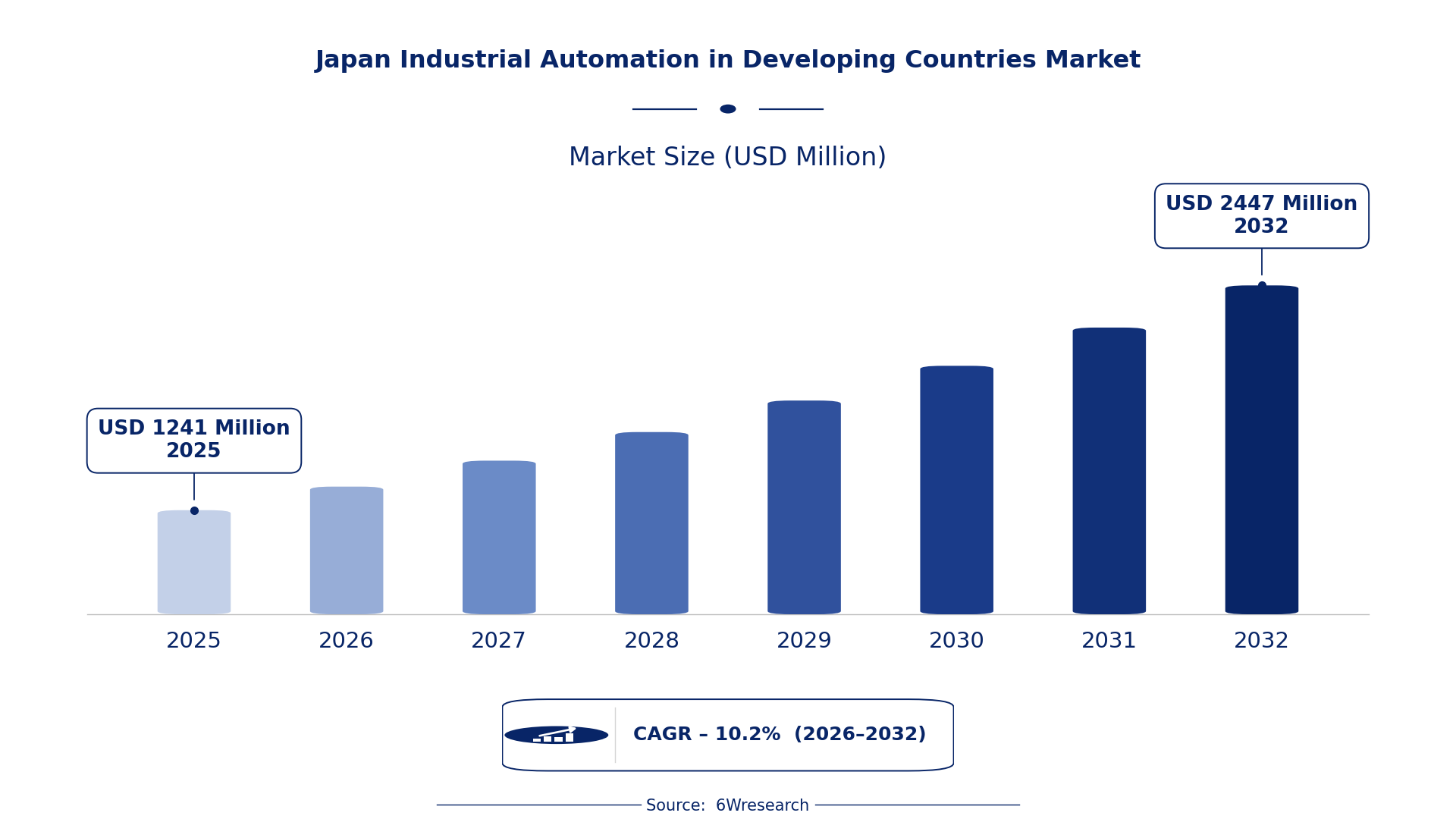
According to 6Wresearch internal database and industry insights, the Japan Industrial Automation in Developing Countries Market was valued at USD 1,241 Million in 2025 and is projected to reach USD 2,447 Million by 2032, growing at a CAGR of approximately 10.2% during 2026–2032.
Japan Industrial Automation in Developing Countries Market Highlights
| Report Metric | Details |
| Report Name | Japan Industrial Automation in Developing Countries Market (2026-2032) |
| Market Size 2025 | USD 1,241 Million |
| Market Size 2032 | USD 2,447 Million |
| Absolute Growth 2025–2032 | USD 1,206 Million |
| CAGR 2026–2032 | 10.2% |
| Peak Annual Growth | 11.1% in 2032 |
| Forecast Period | 2026–2032 |
| Historical Data | 2022–2025 |
| Base Year | 2025 |
| Leading Automation Type, 2025 | Basic PLC-based Automation (47% share) |
| Leading Adoption Barrier, 2025 | Cost & Skills Gap (41% share) |
| Leading Industry Focus, 2025 | FMCG Manufacturing (51% share) |
| Leading End User, 2025 | Small Industrial Units (48% share) |
| Fastest-Growing Automation Type | Robotics Integration (15.7% CAGR) |
| Fastest-Growing Adoption Barrier | High CapEx (13.5% CAGR) |
| Fastest-Growing Industry Focus | Auto Component Assembly (13.4% CAGR) |
| Fastest-Growing End User | Tier-2 Suppliers (13.1% CAGR) |
| Growing Sector | FMCG Manufacturing |
| Key End Users | Manufacturers, Industrial Units, Automotive Sector, Electronics Producers |
Japan Industrial Automation in Developing Countries Market Year-wise Growth Rate and Key Drivers (2022–2032)
This graph illustrates the annual growth rates of the market from 2022 to 2032, highlighting a steady upward trajectory and projected market expansion over the forecast period.
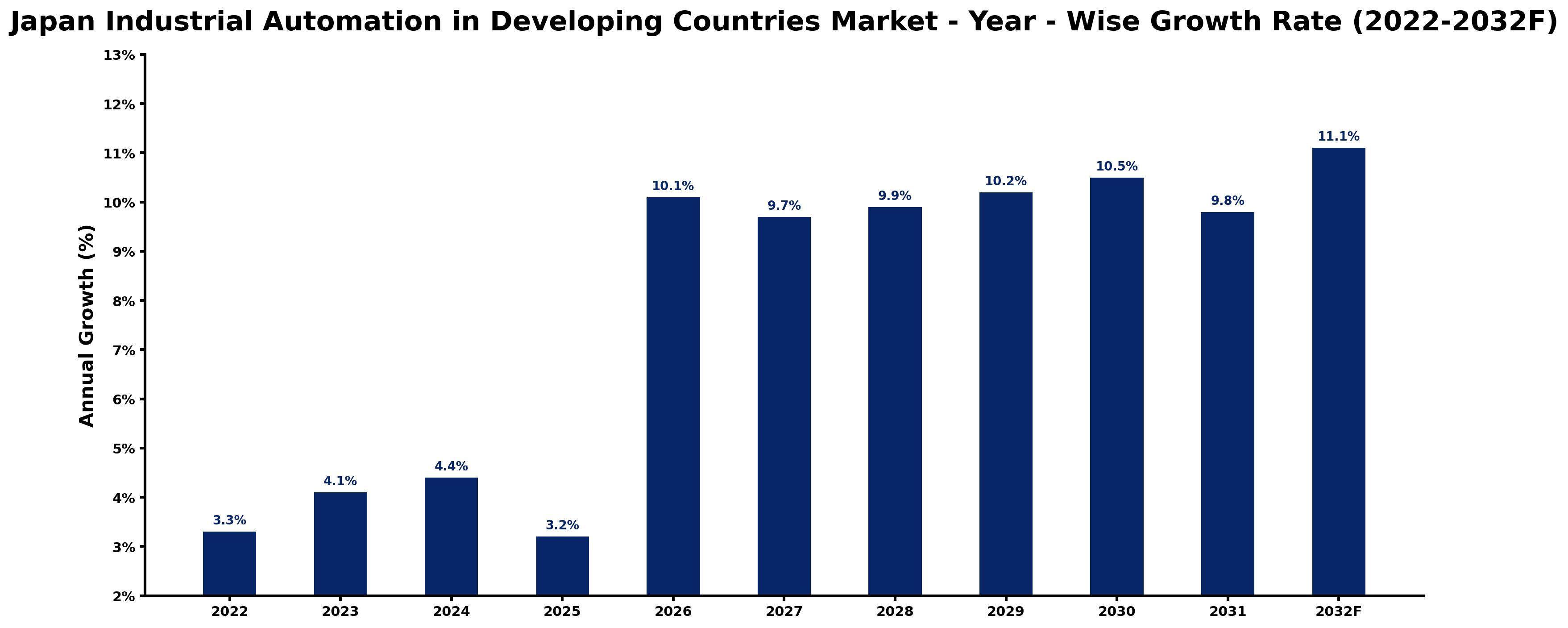
Annual growth estimates for each year appear below with the principal reason behind them, explaining the shifts that set the pace of the market.
| Year | Estimated Annual Growth (%) | Market Rationale |
| 2022 | 3.3 | The market showed steady growth, reflecting ongoing investments in automation technologies. |
| 2023 | 4.1 | Demand increased due to the rising adoption of robotics in manufacturing processes. |
| 2024 | 4.4 | Growth accelerated as manufacturers sought to improve production efficiency. |
| 2025 | 3.2 | Growth slowed as companies adjusted to market conditions and investment cycles. |
| 2026 | 10.1 | A surge in demand is expected as new automation projects are initiated across sectors. |
| 2027 | 9.7 | Growth is projected to decelerate slightly as some sectors face capacity constraints. |
| 2028 | 9.9 | Demand is anticipated to pick up again as technological advancements drive further automation. |
| 2029 | 10.2 | Increased activity is expected as companies expand their automation capabilities. |
| 2030 | 10.5 | Growth will continue as investments in automation become a priority for manufacturers. |
| 2031 | 9.8 | A slight slowdown is anticipated as market saturation begins to affect growth rates. |
| 2032 | 11.1 | The market is projected to peak as major investments in automation technologies reach fruition. |
Note: Market size estimations and growth projections presented in this report are based on 6Wresearch's proprietary forecasting methodology, utilizing the latest available industry data, government publications, and primary research inputs.
Japan Industrial Automation in Developing Countries Market Synopsis
Industrial automation in Japan utilises technology to improve manufacturing processes through robotics and control systems, increasing efficiency and production quality. The Japan Industrial Automation in Developing Countries Market is projected to reach 1.5 trillion yen by 2025, supported by strong demand from the automotive and electronics sectors. Initiatives like the 'Society 5.0' programme are stimulating investment in automation technologies, while the rising adoption of robotics integration is expected to significantly boost productivity.
Market Dynamics Impact Analysis (2026–2032)
| Factor | Type | Impact | Primary Segment Affected |
| Growing adoption of robotics in manufacturing processes | Driver | High | Robotics Integration |
| Increased investment in automation technologies | Driver | High | Basic PLC-based Automation |
| Rising demand for efficiency in manufacturing | Opportunity | High | FMCG Manufacturing |
| Technological advancements in automation tools | Opportunity | Medium | Cloud Automation Tools |
| High capital expenditure requirements | Restraint | High | Basic PLC-based Automation |
| Skills gap in the workforce | Restraint | Medium | Basic PLC-based Automation |
| Rising costs of automation technology | Challenge | High | Basic PLC-based Automation |
| Compliance with international standards | Challenge | Medium | Process Control Automation |
Evaluation of Drivers in Japan Industrial Automation in Developing Countries Market (2026–2032)
The factors lifting demand, and the evidence behind each, are summarised below.
| Drivers | Primary Segment Affected | Why It Matters (Evidence) |
| Increased productivity through robotics integration | Robotics Integration | Robotics integration has boosted productivity by up to 30% in manufacturing sectors. |
| Growing demand for automation in the automotive sector | FMCG Manufacturing | The automotive sector accounts for 20% of Japan's total industrial automation market. |
| Need for quality management standards | Process Control Automation | ISO 9001 is widely adopted by manufacturers to ensure quality management. |
| Expansion of the Tokyo automation technology hub | Cloud Automation Tools | The Tokyo region is a hub for automation technology development. |
| Government initiatives promoting automation | FMCG Manufacturing | Various initiatives support automation, improving productivity and operational efficiency. |
Orders keep climbing as demand from the automotive sector drives automation technologies, accounting for 20% of the market. Robotics integration has increased productivity by up to 30%, prompting manufacturers to invest in these systems. The adoption of ISO 9001 standards ensures quality management, further encouraging investments in advanced manufacturing solutions. The push for improved production quality fuels demand for advanced automation technologies.
Evaluation of Restraints in Japan Industrial Automation in Developing Countries Market
The table below lists the restraints and the evidence behind each.
| Market Restraint | Primary Segment Affected | Why It Matters (Evidence) |
| High capital expenditure requirements | High CapEx | High CapEx remains a barrier, with investments needed for advanced automation systems. |
| Skills gap in the workforce | Cost & Skills Gap | The Cost & Skills Gap limits adoption, as many companies struggle to find qualified personnel. |
| Rising costs of automation technology | Process Control Automation | Increasing costs can deter smaller manufacturers from investing in automation. |
| Compliance with international standards | Process Control Automation | Meeting compliance requirements can be costly and time-consuming for manufacturers. |
| Infrastructure deficits affecting deployment | Cloud Automation Tools | Infrastructure limitations can hinder the effective implementation of cloud automation solutions. |
Japan Industrial Automation in Developing Countries Market Challenges
Manufacturers incur inflated production costs due to supply chain disruptions, raising expenses by up to 15% for automotive producers. Environmental regulations impose delays, extending project timelines by an average of six months for many producers. Investment in technology is critical, as companies must allocate approximately JPY 100 million for necessary automation upgrades, straining smaller producers financially. Workforce shortages hinder operational efficiency, with nearly 30% of producers struggling to find qualified personnel, negatively impacting production quality and overall output.
Trends in the Japan Industrial Automation in Developing Countries Market
Buyers and suppliers in the Japan Industrial Automation in Developing Countries Market are adjusting to the following trends.
- Shift towards Robotics Integration: Manufacturers are increasingly adopting robotics to improve production efficiency, with productivity rising significantly. This trend is particularly strong in the automotive sector, which heavily relies on automation technologies.
- Transition to Cloud Automation Tools: Cloud automation tools are gaining traction for data management and analytics, reflecting a broader trend in manufacturing. In 2023, their adoption surged as companies sought to optimise operations.
- Emergence of Industry 5.0: The concept of Industry 5.0 is gaining momentum, focusing on human-robot collaboration. This shift began in 2022, aiming to improve productivity while prioritising worker well-being.
- Prioritisation of Sustainability in Automation: Sustainability is becoming a key focus, with Japan targeting a 46% cut in greenhouse-gas emissions by 2030. This initiative drives investment in energy-efficient automation technologies.
Investment Opportunities in the Japan Industrial Automation in Developing Countries Market
The openings below show where demand in the Japan Industrial Automation in Developing Countries Market is visible and how suppliers can enter.
- Gap in Automation Adoption: With Japan's industrial automation market projected to reach 1.5 trillion yen by 2025, there is a gap in automation adoption among smaller manufacturers. Partnering with local firms can facilitate entry into this market.
- Growing Demand from FMCG Sector: FMCG manufacturing, accounting for 51% of the market, presents an opportunity for automation suppliers. Investing in tailored solutions for this sector can yield substantial returns.
- Investment in Robotics Integration: The automotive sector's demand for robotics integration is set to grow, creating opportunities for suppliers. Establishing joint ventures with local manufacturers can enhance market presence.
- Expansion of Automation Initiatives: The government's initiatives, such as the 'Society 5.0' programme, are driving demand for automation technologies. Suppliers can enter this space by obtaining necessary certifications and approvals.
Government Initiatives in the Japan Industrial Automation in Developing Countries Market
The New Robot Strategy, launched in 2015, aims to expand robot use across various sectors, including manufacturing and services. This initiative encourages investments in automation technologies to improve productivity and sustainability in the industrial sector. The strategy is part of Japan's broader Green Growth Strategy, which targets 14 growth sectors, fostering a supportive environment for industrial automation.
The AI Promotion Act, established in 2025, creates a national framework for AI research and development. This act supports manufacturers in adopting advanced automation technologies while ensuring compliance with quality standards, ultimately improving operational efficiency. The Ministry of Economy, Trade and Industry oversees these efforts, promoting initiatives that enhance automation across the manufacturing landscape.
Future Insight of the Japan Industrial Automation in Developing Countries Market
The launch of new robotics facilities will transform production capabilities by 2032, allowing suppliers to meet rising demand efficiently. Advanced automation systems will streamline manufacturing processes, enabling buyers to achieve greater operational efficiency. The 'Society 5.0' initiative will facilitate collaboration between technology developers and manufacturers, driving sector innovation. By 2025, Japan's industrial automation market is projected to reach 1.5 trillion yen, signalling a shift towards more automated processes across various industries.
Market Segmentation Analysis
Japan Industrial Automation in Developing Countries Market report covers a detailed analysis of the following market segments:
By Automation Type – Basic PLC-based Automation Leads, Robotics Integration Expected to Grow Fastest
According to Saurav Kr Singh, Senior Research Analyst at 6Wresearch, in 2025, Basic PLC-based Automation led the automation type split with a 47% share. For instance, it is extensively used in the automotive sector, which significantly contributes to Japan's industrial landscape. The quickest growth will come from Robotics Integration, forecast to expand at a CAGR of 15.7% between 2026 and 2032. Robotics integration is witnessing rapid growth as it automates repetitive tasks, leading to productivity increases in manufacturing lines. This trend is particularly notable in the automotive sector, a major player in Japan's industrial automation market. Suppliers should focus on developing advanced robotics solutions to cater to the growing demand in manufacturing.
By Adoption Barrier – Cost & Skills Gap Leads, High CapEx Expected to Grow Fastest
With 41% of adoption barrier revenue in 2025, Cost & Skills Gap was the largest category. Cost and skills gap is the leading barrier to adoption, affecting many companies' ability to invest in advanced automation technologies. This issue is especially challenging for smaller firms that find it difficult to secure skilled workers and afford necessary training. High CapEx is projected to grow fastest, at a CAGR of 13.5% during 2026–2032. High capital expenditure is emerging as the fastest-growing barrier, as companies face escalating initial investment costs for automation technologies. This concern is particularly relevant in sectors requiring substantial upfront capital for equipment upgrades. Understanding these barriers can help suppliers tailor their offerings to effectively address customer challenges.
By Industry Focus – FMCG Manufacturing Leads, Auto Component Assembly Expected to Grow Fastest
FMCG Manufacturing took 51% of industry focus revenue in 2025, more than any other category. FMCG manufacturing leads the market due to its heavy reliance on automation for improving efficiency and meeting consumer demand. The sector's ongoing need for streamlined processes drives significant investments in automation technologies. Over 2026–2032, Auto Component Assembly is expected to post the fastest growth, at a CAGR of 13.4%. Auto component assembly is the fastest-growing focus area as manufacturers seek precision and speed in production. The automotive industry's demand for enhanced quality and efficiency fuels this growth, making it a priority for automation investments. Suppliers should target the automotive sector to leverage the increasing demand for automation solutions.
By End User – Small Industrial Units Lead, Tier-2 Suppliers Expected to Grow Fastest
The largest end user category in 2025 was Small Industrial Units, at 48% of revenue. Small industrial units account for the largest share as they often adopt basic automation to enhance operational efficiency. Despite their limited scale, these units play a crucial role in Japan's manufacturing ecosystem. Tier-2 Suppliers are set to record the highest CAGR in this split, 13.1% over 2026–2032. Tier-2 suppliers are the fastest-growing end user group as they increasingly implement automation to remain competitive in the market. This shift is driven by the need for improved productivity and quality in their production processes. Suppliers must develop tailored solutions that specifically address the requirements of Tier-2 suppliers to capture this expanding segment.
Key Attractiveness of the Report
- 10 Years of Market Numbers
- Historical Data Starting from 2022 to 2025
- Base Year 2025
- Forecast Data until 2032
- Key Performance Indicators Impacting the Market
- Major Upcoming Developments and Projects
Key Highlights of the Report:
- Japan Industrial Automation in Developing Countries Market Outlook
- Market Size of Japan Industrial Automation in Developing Countries Market, 2025
- Forecast of Japan Industrial Automation in Developing Countries Market, 2032
- Historical Data and Forecast of Japan Industrial Automation in Developing Countries Revenues & Volume for the Period 2022-2032F
- Japan Industrial Automation in Developing Countries Market Trend Evolution
- Japan Industrial Automation in Developing Countries Market Drivers and Challenges
- Japan Industrial Automation in Developing Countries Price Trends
- Japan Industrial Automation in Developing Countries Porter's Five Forces
- Japan Industrial Automation in Developing Countries Industry Life Cycle
- Historical Data and Forecast of Japan Industrial Automation in Developing Countries Market Revenues & Volume By Automation Type for the Period 2022-2032F
- Historical Data and Forecast of Japan Industrial Automation in Developing Countries Market Revenues & Volume By Basic PLC-based Automation for the Period 2022-2032F
- Historical Data and Forecast of Japan Industrial Automation in Developing Countries Market Revenues & Volume By Robotics Integration for the Period 2022-2032F
- Historical Data and Forecast of Japan Industrial Automation in Developing Countries Market Revenues & Volume By Process Control Automation for the Period 2022-2032F
- Historical Data and Forecast of Japan Industrial Automation in Developing Countries Market Revenues & Volume By Cloud Automation Tools for the Period 2022-2032F
- Historical Data and Forecast of Japan Industrial Automation in Developing Countries Market Revenues & Volume By Adoption Barrier for the Period 2022-2032F
- Historical Data and Forecast of Japan Industrial Automation in Developing Countries Market Revenues & Volume By Cost & Skills Gap for the Period 2022-2032F
- Historical Data and Forecast of Japan Industrial Automation in Developing Countries Market Revenues & Volume By High CapEx for the Period 2022-2032F
- Historical Data and Forecast of Japan Industrial Automation in Developing Countries Market Revenues & Volume By Infrastructure Deficit for the Period 2022-2032F
- Historical Data and Forecast of Japan Industrial Automation in Developing Countries Market Revenues & Volume By Connectivity Limitation for the Period 2022-2032F
- Historical Data and Forecast of Japan Industrial Automation in Developing Countries Market Revenues & Volume By Industry Focus for the Period 2022-2032F
- Historical Data and Forecast of Japan Industrial Automation in Developing Countries Market Revenues & Volume By FMCG Manufacturing for the Period 2022-2032F
- Historical Data and Forecast of Japan Industrial Automation in Developing Countries Market Revenues & Volume By Auto Component Assembly for the Period 2022-2032F
- Historical Data and Forecast of Japan Industrial Automation in Developing Countries Market Revenues & Volume By Oil Refining & Cement for the Period 2022-2032F
- Historical Data and Forecast of Japan Industrial Automation in Developing Countries Market Revenues & Volume By Food Processing for the Period 2022-2032F
- Historical Data and Forecast of Japan Industrial Automation in Developing Countries Market Revenues & Volume By End User for the Period 2022-2032F
- Historical Data and Forecast of Japan Industrial Automation in Developing Countries Market Revenues & Volume By Small Industrial Units for the Period 2022-2032F
- Historical Data and Forecast of Japan Industrial Automation in Developing Countries Market Revenues & Volume By Tier-2 Suppliers for the Period 2022-2032F
- Historical Data and Forecast of Japan Industrial Automation in Developing Countries Market Revenues & Volume By Local Plants for the Period 2022-2032F
- Historical Data and Forecast of Japan Industrial Automation in Developing Countries Market Revenues & Volume By Mid-Sized Factories for the Period 2022-2032F
- Japan Industrial Automation in Developing Countries Import Export Trade Statistics
- Market Opportunity Assessment By Automation Type
- Market Opportunity Assessment By Adoption Barrier
- Market Opportunity Assessment By Industry Focus
- Market Opportunity Assessment By End User
- Japan Industrial Automation in Developing Countries Top Companies Market Share
- Japan Industrial Automation in Developing Countries Competitive Benchmarking By Technical and Operational Parameters
- Japan Industrial Automation in Developing Countries Company Profiles
- Japan Industrial Automation in Developing Countries Key Strategic Recommendations
Market Covered
Coverage by segment is as follows.
By Automation Type
- Basic PLC-based Automation
- Robotics Integration
- Process Control Automation
- Cloud Automation Tools
By Adoption Barrier
- Cost & Skills Gap
- High CapEx
- Infrastructure Deficit
- Connectivity Limitation
By Industry Focus
- FMCG Manufacturing
- Auto Component Assembly
- Oil Refining & Cement
- Food Processing
By End User
- Small Industrial Units
- Tier-2 Suppliers
- Local Plants
- Mid-Sized Factories































