Japan Industrial Automation Robot Market Size & Growth Rate
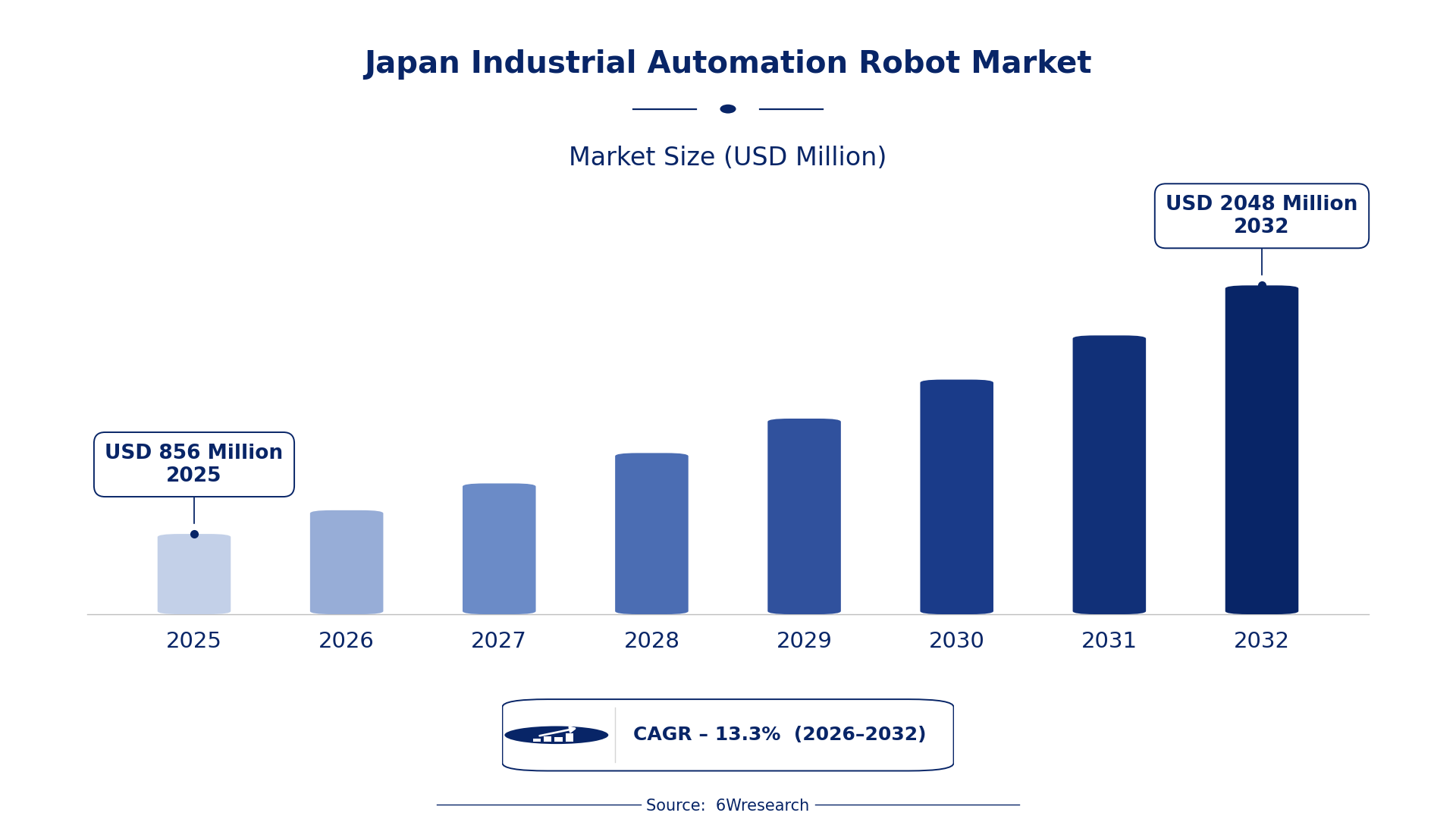
According to 6Wresearch internal database and industry insights, the Japan Industrial Automation Robot Market was valued at USD 856 Million in 2025 and is projected to reach USD 2,048 Million by 2032, growing at a CAGR of approximately 13.3% during 2026–2032.
Japan Industrial Automation Robot Market Highlights
| Report Metric | Details |
| Report Name | Japan Industrial Automation Robot Market (2026-2032) |
| Market Size 2025 | USD 856 Million |
| Market Size 2032 | USD 2,048 Million |
| Absolute Growth 2025–2032 | USD 1,192 Million |
| CAGR 2026–2032 | 13.3% |
| Peak Annual Growth | 19.1% in 2032 |
| Forecast Period | 2026–2032 |
| Historical Data | 2022–2025 |
| Base Year | 2025 |
| Leading Robot Type, 2025 | Articulated Robots (43% share) |
| Leading Axis Configuration, 2025 | 6-Axis (51% share) |
| Leading Application Area, 2025 | Welding (42% share) |
| Leading End User, 2025 | Automotive Industry (52% share) |
| Fastest-Growing Robot Type | Delta Robots (19.7% CAGR) |
| Fastest-Growing Application Area | High-Speed Sorting (17.8% CAGR) |
| Fastest-Growing End User | Food & Pharma Plants (17.6% CAGR) |
| Growing Sector | Automotive Industry |
| Key End Users | Automotive Industry, Electronics Assembly, Food & Pharma Plants |
Japan Industrial Automation Robot Market Year-wise Growth Rate and Key Drivers (2022–2032)
This graph illustrates the annual growth rates of the market from 2022 to 2032, highlighting a steady upward trajectory and projected market expansion over the forecast period.
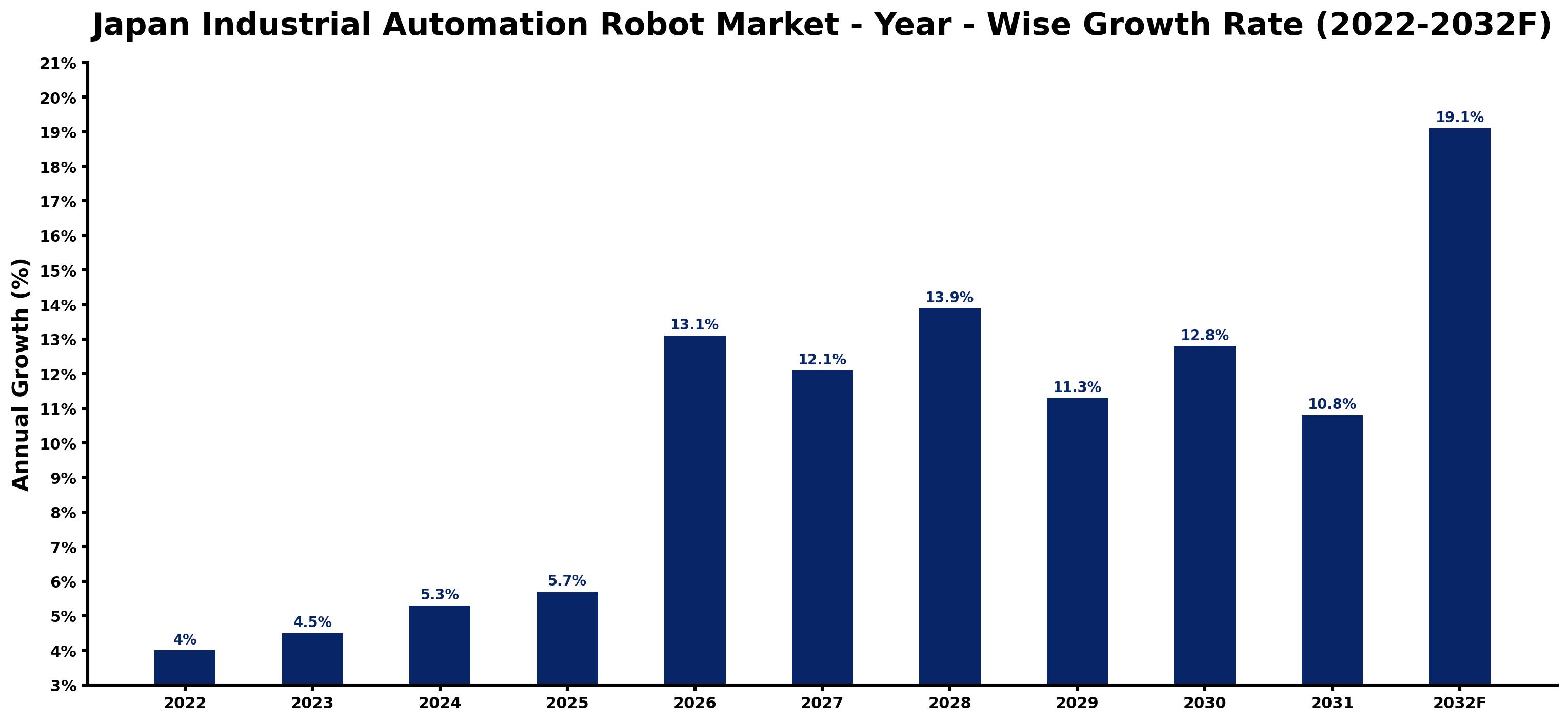
For each year, the table pairs the estimated growth rate with the leading influence on demand, showing how the drivers changed across the period.
| Year | Estimated Annual Growth (%) | Market Rationale |
| 2022 | 4.0 | The market experienced stable growth due to ongoing investments in automation technology. |
| 2023 | 4.5 | Demand increased as manufacturers sought to improve efficiency and reduce labour costs. |
| 2024 | 5.3 | The automotive sector expanded its automation efforts, driving higher robot adoption rates. |
| 2025 | 5.7 | Growth accelerated as companies focused on precision and productivity improvements. |
| 2026 | 13.1 | A surge in demand for advanced automation technologies is expected to lead to market expansion. |
| 2027 | 12.1 | Growth is projected to slow slightly as companies adjust to new automation standards and practices. |
| 2028 | 13.9 | Demand is expected to rebound with increased investments in high-speed sorting applications. |
| 2029 | 11.3 | The market will continue to grow, albeit at a slower pace due to market saturation. |
| 2030 | 12.8 | Technological advancements in robotics will spur renewed interest and investment. |
| 2031 | 10.8 | Growth is projected to decelerate as companies consolidate their automation strategies and investments. |
| 2032 | 19.1 | The market will peak as demand for automation robots surges in various sectors. |
Note: Market size estimations and growth projections presented in this report are based on 6Wresearch's proprietary forecasting methodology, utilizing the latest available industry data, government publications, and primary research inputs.
Japan Industrial Automation Robot Market Synopsis
Industrial Automation Robots are advanced machines designed to automate tasks in manufacturing processes. These robots improve efficiency, precision, and productivity across various industries, particularly in automotive and electronics. The Japan Industrial Automation Robot Market is growing due to increased investments in technology upgrades, a strong focus on efficiency, and a commitment to reducing greenhouse gas emissions. The automotive sector, which accounts for over 40% of robot usage, is a major driver of this growth, alongside the Electronics Industry, employing 25% of all robots in the country.
Market Dynamics Impact Analysis (2026–2032)
| Factor | Type | Impact | Primary Segment Affected |
| Rising demand for automation in manufacturing processes | Driver | High | Articulated Robots |
| Increased investments in high-speed sorting technologies | Driver | High | Delta Robots |
| Growing need for efficient production in food and pharmaceutical sectors | Opportunity | High | Food & Pharma Plants |
| Expansion of robotics applications in electronics assembly | Opportunity | High | Electronics Assembly |
| High initial investment costs for automation technologies | Restraint | Medium | SCARA Robots |
| Limited availability of skilled workforce for robot programming | Restraint | Medium | Cartesian Robots |
| Competition from low-cost automation solutions | Challenge | High | 6-Axis |
| Rapid technological advancements leading to obsolescence | Challenge | Medium | Welding |
Evaluation of Drivers in Japan Industrial Automation Robot Market (2026–2032)
Demand rests on the following drivers, each shown with the segment it touches most.
| Drivers | Primary Segment Affected | Why It Matters (Evidence) |
| Increased robot density in manufacturing | Articulated Robots | Japan's industrial robot density is 1,200 units per 10,000 workers, driving demand for articulated robots in various sectors. |
| Growing automotive production rates | Delta Robots | The automotive sector accounts for over 40% of industrial robot usage, increasing demand for delta robots in assembly lines. |
| Focus on reducing greenhouse gas emissions | SCARA Robots | Japan targets a 46% cut in emissions by 2030, prompting investment in SCARA robots for efficient assembly processes. |
| Rising demand for automation in logistics | High-Speed Sorting | The Food Industry is projected to adopt 15% more automation by 2026, boosting demand for high-speed sorting robots. |
| Technological advancements in robotics | Welding | The Ministry of Economy, Trade and Industry aims to increase automation by 30% by 2025, enhancing the role of welding robots. |
What keeps demand rising is the high density of industrial robots in Japan, with 1,200 units per 10,000 workers, prompting manufacturers to adopt articulated robots for greater efficiency. The automotive sector, accounting for over 40% of industrial robot usage, boosts demand for delta robots in assembly lines. Japan's commitment to reducing greenhouse gas emissions by 46% by 2030 propels investments in SCARA robots for assembly applications. The Food Industry's projected 15% increase in automation adoption by 2026 fuels demand for high-speed sorting robots. The goal to raise automation levels by 30% by 2025 underscores the importance of welding robots in production processes.
Evaluation of Restraints in Japan Industrial Automation Robot Market
Several factors work against faster growth; the main ones are summarised below.
| Market Restraint | Primary Segment Affected | Why It Matters (Evidence) |
| High initial costs of automation technologies | SCARA Robots | The investment required for SCARA robots can deter smaller manufacturers from adopting automation. |
| Shortage of skilled workforce for robot programming | Cartesian Robots | Limited availability of qualified personnel to program and maintain Cartesian robots restricts their adoption. |
| Competition from lower-cost automation solutions | 6-Axis | The presence of cheaper alternatives in the market pressures 6-axis robot manufacturers to reduce prices. |
| Rapid technological advancements leading to obsolescence | Welding | Frequent updates in technology can make existing welding robots outdated, affecting long-term investments. |
| Complex integration processes with existing systems | Delta Robots | Integrating delta robots into established production lines can be challenging and time-consuming. |
Japan Industrial Automation Robot Market Challenges
Regulatory standards for industrial robots in Japan are stringent, primarily due to safety concerns, which delays product approvals for manufacturers and raises costs by 20% for buyers seeking compliance. Intense competition among suppliers leads to price wars, resulting in reduced profit margins and forcing some to compromise on quality, which ultimately impacts production efficiency for manufacturers. Rising minimum wages, now at JPY 1,055 per hour, increase operational costs for manufacturers, compelling them to invest more in automation, which can delay return on investment for buyers. Skills shortages in robotics programming hinder suppliers from meeting demand, causing project delays that can extend timelines for buyers by up to six months.
Trends in the Japan Industrial Automation Robot Market
Below are the shifts with the largest effect on the Japan Industrial Automation Robot Market.
- Shift towards Advanced Automation in Automotive: Automotive manufacturers are increasingly adopting advanced automation technologies, with over 40% of industrial robots used in this sector. This shift improves production efficiency and precision, driving further investments in robotics.
- Increase in High-Speed Sorting Applications: The demand for high-speed sorting robots is rising, particularly in logistics and food industries. This sector is expected to adopt 15% more automation by 2026, reflecting a growing need for efficiency.
- Expansion of Robotics in Electronics Assembly: Electronics assembly is experiencing a surge in automation adoption, with 25% of all industrial robots employed in this sector. This trend highlights the importance of efficiency in production processes.
- Growth of Automation in Food Industry: The Food Industry is increasingly utilising automation to improve safety and efficiency. This sector is projected to adopt 15% more automation by 2026, indicating a notable trend.
Investment Opportunities in the Japan Industrial Automation Robot Market
The following opportunities in the Japan Industrial Automation Robot Market pair current demand with a clear way in.
- Gap in Automation for Food & Pharma: With a projected 15% increase in automation adoption in the Food Industry by 2026, there is an opportunity for suppliers of automation robots to meet this demand.
- Timing for Robotics in Electronics Assembly: As the Electronics Industry employs 25% of all industrial robots, now is an ideal time to invest in automation solutions tailored for this sector's needs.
- Investment in High-Speed Sorting Technologies: The logistics sector is rapidly adopting high-speed sorting robots, presenting an opportunity for suppliers to provide advanced solutions to meet growing demand.
- Expansion of Automation in Automotive Production: With over 40% of industrial robots used in automotive production, suppliers can capitalise on this opportunity by offering practical automation technologies.
Government Initiatives in the Japan Industrial Automation Robot Market
The New Robot Strategy, launched in 2015, aims to expand robot use across various sectors, including manufacturing and agriculture. This initiative complements existing regulations by promoting innovation and investment in robotics, with a target of increasing automation levels by 30% by 2025. The strategy aligns with Japan's broader goals of improving productivity and reducing greenhouse gas emissions.
The Ministry of Economy, Trade and Industry oversees the implementation of the New Robot Strategy, providing funding and support for robotics projects. In 2023, the government allocated ¥10 billion for automation research, benefiting manufacturers seeking to adopt advanced robotics solutions. This funding facilitates the development of new technologies and improves the competitiveness of Japan's industrial sector.
Future Insight of the Japan Industrial Automation Robot Market
Japan's commitment to decarbonisation will drive investments in automation technologies, prompting suppliers to innovate and improve robot efficiency. By 2025, the government aims to increase manufacturing automation, which will lead to greater adoption of advanced robotics across various sectors. The projected rise in automation within the food industry will create new opportunities for suppliers to expand their offerings. With the installed base of over 400,000 industrial robots, advancements in robotics standards will likely improve safety and performance.
Market Segmentation Analysis
Japan Industrial Automation Robot Market report covers a detailed analysis of the following market segments:
By Robot Type – Articulated Robots Lead, Delta Robots Expected to Grow Fastest
According to Saurav Kr Singh, Senior Research Analyst at 6Wresearch, Articulated Robots held 43% of the Japan Industrial Automation Robot Market by robot type in 2025. Articulated Robots hold the largest share in Japan's market as they are widely utilised for complex tasks across various industries, particularly in automotive production. Their established presence, especially in welding applications, reinforces their dominant position. Delta Robots are projected to grow fastest, at a CAGR of 19.7% during 2026–2032. Delta Robots are experiencing rapid growth due to their efficiency in high-speed sorting and packaging tasks, which are essential in logistics operations. The increasing focus on operational efficiency is propelling their adoption in these areas. Suppliers should consider expanding their product offerings to include Delta Robots to meet the rising demand in logistics.
By Axis Configuration – 6-Axis Leads and Records the Fastest Growth
6-Axis took 51% of axis configuration revenue in 2025, more than any other category. 6-Axis robots are the leading configuration as they provide the necessary flexibility for executing complex movements in automation tasks. Their adaptability across various industries ensures their continued dominance in the market. 6-Axis is also forecast to expand faster than any other category, at a CAGR of 14.4% over 2026–2032. The 6-Axis configuration is also the fastest growing segment, efficiently managing intricate operations that are vital in modern manufacturing. This growth reinforces its leadership position as demand for versatile automation solutions continues to rise. Buyers should focus on investing in 6-Axis robots to stay competitive in an evolving industrial landscape.
By Application Area – Welding Leads, High-Speed Sorting Expected to Grow Fastest
Welding accounted for 42% of the market by application area in 2025. Welding is the leading application area as it is critical for the automotive and manufacturing industries, where precision and efficiency are paramount. The high volume of welding tasks in these sectors drives substantial demand for automation. The quickest growth will come from High-Speed Sorting, forecast to expand at a CAGR of 17.8% between 2026 and 2032. High-Speed Sorting is the fastest growing application area, driven by the increasing need for efficiency in logistics and packaging operations. As e-commerce expands, the demand for rapid sorting solutions accelerates. Suppliers should develop specialised solutions for High-Speed Sorting to meet the rising demand in logistics.
By End User – Automotive Industry Leads, Food & Pharma Plants Expected to Grow Fastest
In 2025, Automotive Industry led the end user split with a 52% share. The Automotive Industry is the leading end user of industrial robots, driving significant demand for automation due to its large scale and complex production processes. This sector's reliance on robotics for precision and efficiency solidifies its top position. Food & Pharma Plants are set to record the highest CAGR in this split, 17.6% over 2026–2032. Food & Pharma Plants are the fastest growing end user segment as these industries increasingly adopt automation to enhance safety and operational efficiency. The heightened emphasis on quality control is a key factor behind this growth. Suppliers need to tailor their solutions to meet the specific demands of Food & Pharma Plants to capitalise on this growth opportunity.
Key Attractiveness of the Report
- 10 Years of Market Numbers
- Historical Data Starting from 2022 to 2025
- Base Year 2025
- Forecast Data until 2032
- Key Performance Indicators Impacting the Market
- Major Upcoming Developments and Projects
Key Highlights of the Report:
- Japan Industrial Automation Robot Market Outlook
- Market Size of Japan Industrial Automation Robot Market, 2025
- Forecast of Japan Industrial Automation Robot Market, 2032
- Historical Data and Forecast of Japan Industrial Automation Robot Revenues & Volume for the Period 2022-2032F
- Japan Industrial Automation Robot Market Trend Evolution
- Japan Industrial Automation Robot Market Drivers and Challenges
- Japan Industrial Automation Robot Price Trends
- Japan Industrial Automation Robot Porter's Five Forces
- Japan Industrial Automation Robot Industry Life Cycle
- Historical Data and Forecast of Japan Industrial Automation Robot Market Revenues & Volume By Robot Type for the Period 2022-2032F
- Historical Data and Forecast of Japan Industrial Automation Robot Market Revenues & Volume By Articulated Robots for the Period 2022-2032F
- Historical Data and Forecast of Japan Industrial Automation Robot Market Revenues & Volume By SCARA Robots for the Period 2022-2032F
- Historical Data and Forecast of Japan Industrial Automation Robot Market Revenues & Volume By Delta Robots for the Period 2022-2032F
- Historical Data and Forecast of Japan Industrial Automation Robot Market Revenues & Volume By Cartesian Robots for the Period 2022-2032F
- Historical Data and Forecast of Japan Industrial Automation Robot Market Revenues & Volume By Axis Configuration for the Period 2022-2032F
- Historical Data and Forecast of Japan Industrial Automation Robot Market Revenues & Volume By 6-Axis for the Period 2022-2032F
- Historical Data and Forecast of Japan Industrial Automation Robot Market Revenues & Volume By 4-Axis for the Period 2022-2032F
- Historical Data and Forecast of Japan Industrial Automation Robot Market Revenues & Volume By Parallel-Arm for the Period 2022-2032F
- Historical Data and Forecast of Japan Industrial Automation Robot Market Revenues & Volume By Linear Movement for the Period 2022-2032F
- Historical Data and Forecast of Japan Industrial Automation Robot Market Revenues & Volume By Application Area for the Period 2022-2032F
- Historical Data and Forecast of Japan Industrial Automation Robot Market Revenues & Volume By Welding, Assembly for the Period 2022-2032F
- Historical Data and Forecast of Japan Industrial Automation Robot Market Revenues & Volume By Pick & Place for the Period 2022-2032F
- Historical Data and Forecast of Japan Industrial Automation Robot Market Revenues & Volume By High-Speed Sorting for the Period 2022-2032F
- Historical Data and Forecast of Japan Industrial Automation Robot Market Revenues & Volume By 3D Printing & Packaging for the Period 2022-2032F
- Historical Data and Forecast of Japan Industrial Automation Robot Market Revenues & Volume By End User for the Period 2022-2032F
- Historical Data and Forecast of Japan Industrial Automation Robot Market Revenues & Volume By Automotive Industry for the Period 2022-2032F
- Historical Data and Forecast of Japan Industrial Automation Robot Market Revenues & Volume By Electronics Assembly for the Period 2022-2032F
- Historical Data and Forecast of Japan Industrial Automation Robot Market Revenues & Volume By Food & Pharma Plants for the Period 2022-2032F
- Historical Data and Forecast of Japan Industrial Automation Robot Market Revenues & Volume By Custom Machinery OEMs for the Period 2022-2032F
- Japan Industrial Automation Robot Import Export Trade Statistics
- Market Opportunity Assessment By Robot Type
- Market Opportunity Assessment By Axis Configuration
- Market Opportunity Assessment By Application Area
- Market Opportunity Assessment By End User
- Japan Industrial Automation Robot Top Companies Market Share
- Japan Industrial Automation Robot Competitive Benchmarking By Technical and Operational Parameters
- Japan Industrial Automation Robot Company Profiles
- Japan Industrial Automation Robot Key Strategic Recommendations
Market Covered
Segments analysed in this report are listed below.
By Robot Type
- Articulated Robots
- SCARA Robots
- Delta Robots
- Cartesian Robots
By Axis Configuration
- 6-Axis
- 4-Axis
- Parallel-Arm
- Linear Movement
By Application Area
- Welding
- Assembly
- Pick & Place
- High-Speed Sorting
- 3D Printing & Packaging
By End User
- Automotive Industry
- Electronics Assembly
- Food & Pharma Plants
- Custom Machinery OEMs































