Japan industrial automation support services Market Size & Growth Rate
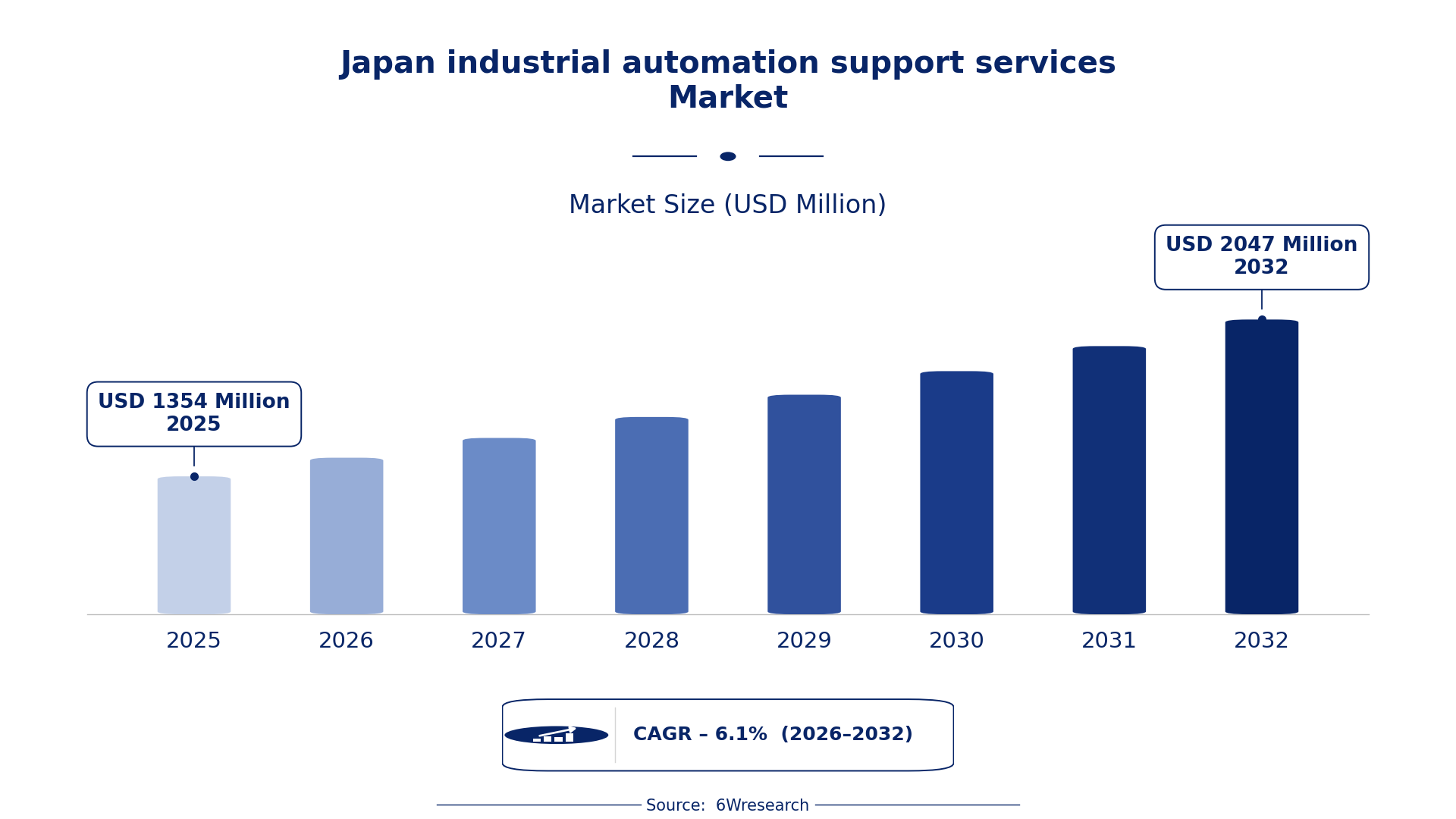
According to 6Wresearch internal database and industry insights, the Japan industrial automation support services Market was valued at USD 1,354 Million in 2025 and is projected to reach USD 2,047 Million by 2032, growing at a CAGR of approximately 6.1% during 2026–2032.
Japan industrial automation support services Market Highlights
| Report Metric | Details |
| Report Name | Japan industrial automation support services Market (2026-2032) |
| Market Size 2025 | USD 1,354 Million |
| Market Size 2032 | USD 2,047 Million |
| Absolute Growth 2025–2032 | USD 693 Million |
| CAGR 2026–2032 | 6.1% |
| Peak Annual Growth | 7.4% in 2026 |
| Forecast Period | 2026–2032 |
| Historical Data | 2022–2025 |
| Base Year | 2025 |
| Leading Service Type, 2025 | Technical Training Services (41% share) |
| Leading Support Format, 2025 | Cloud-Enabled (44% share) |
| Leading Target System, 2025 | PLCs (36% share) |
| Leading End User, 2025 | Smart Manufacturing Plants (41% share) |
| Fastest-Growing Service Type | Predictive Maintenance (8.1% CAGR) |
| Fastest-Growing Target System | Robots (9.0% CAGR) |
| Fastest-Growing End User | Process Industries (7.9% CAGR) |
| Growing Sector | Process Industries |
| Key End Users | Smart Manufacturing Plants, Process Industries, Industrial Operators, Equipment OEMs |
Japan industrial automation support services Market Year-wise Growth Rate and Key Drivers (2022–2032)
This graph illustrates the annual growth rates of the market from 2022 to 2032, highlighting a steady upward trajectory and projected market expansion over the forecast period.
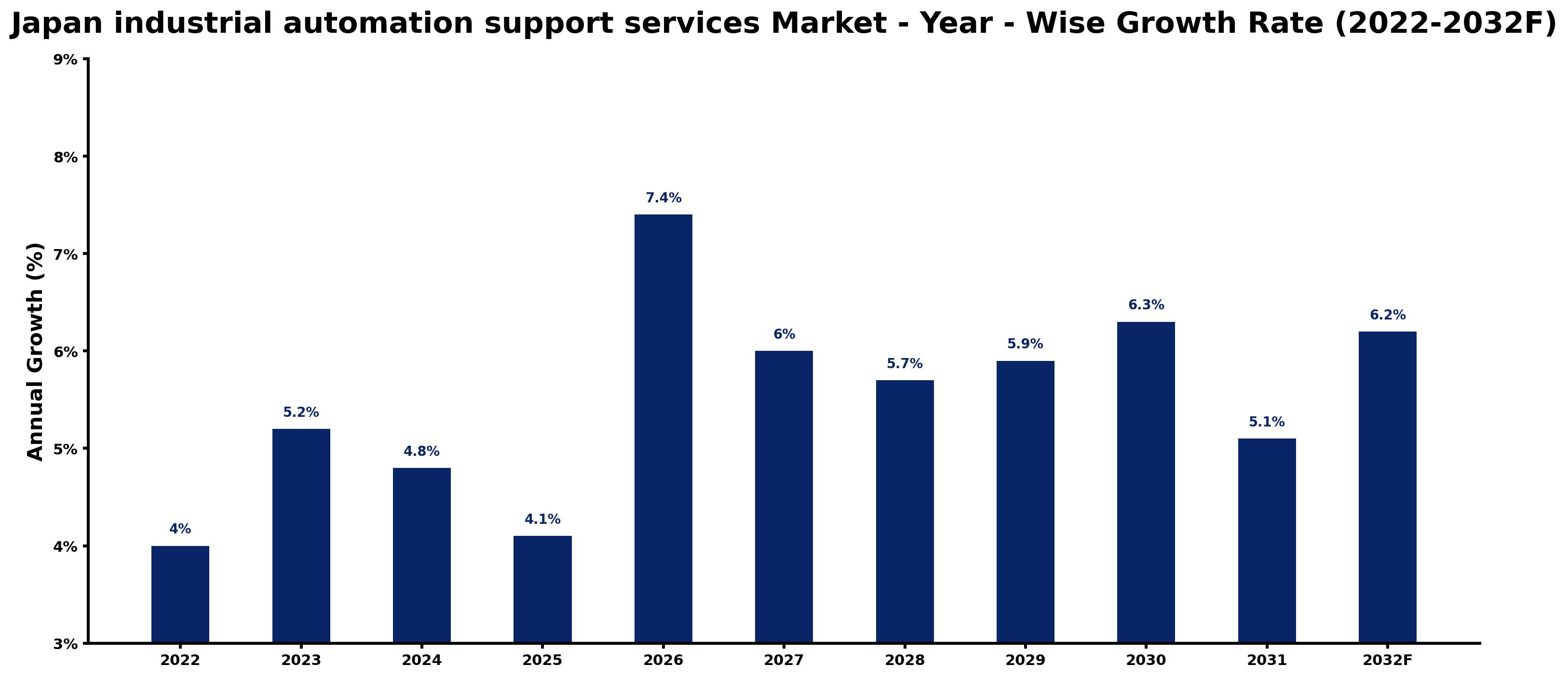
Year by year, the estimates below pair each growth rate with the development that shaped it.
| Year | Estimated Annual Growth (%) | Market Rationale |
| 2022 | 4.0 | The market showed steady growth as manufacturers focused on modernising operations. |
| 2023 | 5.2 | Growth accelerated as more companies adopted predictive maintenance technologies. |
| 2024 | 4.8 | The market experienced a slowdown as investment levels stabilised after previous growth. |
| 2025 | 4.1 | Demand continued to grow, albeit at a slower pace as market maturity set in. |
| 2026 | 7.4 | The market peaked with investments in AI integration and automation. |
| 2027 | 6.0 | Growth slowed slightly as the focus shifted to optimising existing systems. |
| 2028 | 5.7 | The market maintained a steady pace as companies continued to invest in automation. |
| 2029 | 5.9 | Demand increased again as manufacturers sought advanced automation solutions. |
| 2030 | 6.3 | Growth continued as the adoption of IoT technologies gained traction. |
| 2031 | 5.1 | The market slowed as companies focused on consolidating their automation strategies. |
| 2032 | 6.2 | Demand rose again as technological advancements drove new investments. |
Note: Market size estimations and growth projections presented in this report are based on 6Wresearch's proprietary forecasting methodology, utilizing the latest available industry data, government publications, and primary research inputs.
Japan industrial automation support services Market Synopsis
Japan industrial automation support services encompass technical services that improve the efficiency and reliability of automated systems through remote diagnostics, predictive maintenance, and technical training. In 2023, over 70% of Japanese manufacturers invested in predictive maintenance technologies, reflecting a strong shift towards modernisation. Factors such as substantial public and private decarbonisation investments of JPY 150 trillion over ten years are driving this growth, creating opportunities for service providers in the sector.
Market Dynamics Impact Analysis (2026–2032)
| Factor | Type | Impact | Primary Segment Affected |
| Increasing adoption of predictive maintenance technologies | Driver | High | Predictive Maintenance |
| Growing demand for technical training services | Driver | High | Technical Training Services |
| Expansion of smart manufacturing facilities | Opportunity | High | Smart Manufacturing Plants |
| Investment in AI integration in manufacturing | Opportunity | High | Integration & Retrofitting |
| Challenges in workforce upskilling | Restraint | Medium | Technical Training Services |
| Aging industrial robots requiring consistent support | Restraint | Medium | Robots |
| High costs of implementing advanced automation | Challenge | High | Automation Hardware |
| Slow integration of legacy systems into modern frameworks | Challenge | Medium | Legacy to IoT Systems |
Evaluation of Drivers in Japan industrial automation support services Market (2026–2032)
These are the developments adding the most demand over the forecast period.
| Drivers | Primary Segment Affected | Why It Matters (Evidence) |
| Investment in predictive maintenance technologies | Predictive Maintenance | Over 70% of Japanese manufacturers are investing in these technologies to prevent equipment failures. |
| Demand for technical training services | Technical Training Services | Over 300,000 workers require training to effectively manage advanced automation technologies. |
| Growth of smart manufacturing initiatives | Smart Manufacturing Plants | The Smart Factory Initiative aims to increase IoT adoption by 2025. |
| Integration of AI in manufacturing processes | Integration & Retrofitting | In 2023, a program was launched to promote AI integration in manufacturing. |
| Aging industrial robots necessitating support | Robots | The average age of industrial robots in Japan is around five years, creating a need for ongoing support. |
A significant portion of Japanese manufacturers are investing in predictive maintenance technologies to prevent equipment failures and reduce downtime. The average age of industrial robots in Japan is around five years, necessitating ongoing support to maintain these systems. Technical training is critical for workers in the automation sector to manage advanced technologies effectively. The integration of IoT technologies into manufacturing processes further drives demand for support services as companies seek to modernise their operations.
Evaluation of Restraints in Japan industrial automation support services Market
The key brakes on demand, and where they bite hardest, are shown below.
| Market Restraint | Primary Segment Affected | Why It Matters (Evidence) |
| A shortage of skilled workers hinders growth in predictive maintenance services. | Predictive Maintenance | Over 300,000 workers require technical training to meet evolving demands. |
| Supply chain disruptions impact the availability of critical components. | Integration & Retrofitting | Delays in projects increase costs for manufacturers. |
| Rising costs associated with aging industrial robots necessitate more frequent support services. | Robots | The average age of industrial robots in Japan is around five years. |
| Intense competition among service providers leads to price wars. | Technical Training Services | This reduces profit margins and makes it difficult for smaller firms to sustain operations. |
| Limited awareness of the benefits of automation support services. | Field Deployment | This affects adoption rates among potential users. |
Japan industrial automation support services Market Challenges
A shortage of skilled workers hinders progress, with over 300,000 workers needing technical training, resulting in delays in project implementation for manufacturers. Supply chain disruptions restrict the availability of essential components, driving up costs and extending timelines for industrial operators. Rising expenses associated with the average age of industrial robots, which is around five years, require more frequent support services, impacting budgets for producers. Intense competition among service providers leads to price wars, squeezing profit margins and threatening the viability of smaller firms in the market.
Trends in the Japan industrial automation support services Market
Four trends stand out in the Japan industrial automation support services Market.
- Shift from Traditional to Predictive Maintenance: In 2023, Japanese manufacturers increasingly adopted predictive maintenance strategies, with over 70% investing in these technologies. This shift reduces downtime and improves operational efficiency, benefiting sectors such as automotive and electronics.
- Transition from Manual to Automated Training: The demand for technical training services has evolved, focusing on automated training methods. In 2023, over 300,000 workers required upskilling to manage advanced automation technologies, driving service demand.
- Emergence of Cloud-Enabled Solutions: Cloud-enabled solutions are gaining traction, with 60% of manufacturing firms in Japan using them for data storage and access. This trend supports operational efficiency and flexibility in service delivery.
- Integration of AI in Manufacturing: The AI Promotion Act, set to be implemented by 2025, is expected to improve the integration of AI technologies in manufacturing. This will drive demand for automation support services as firms modernise operations.
Investment Opportunities in the Japan industrial automation support services Market
The following areas offer the clearest openings for investors and suppliers in the Japan industrial automation support services Market.
- Investment in Smart Manufacturing Plants: Smart Manufacturing Plants are increasingly investing in automation support services, with a projected budget of 200 billion JPY for technology development. Service providers can enter this market through local partnerships.
- Supply of Predictive Maintenance Technologies: With over 70% of manufacturers investing in predictive maintenance, a gap in service provision exists. Targeting industrial operators can yield substantial returns.
- Expansion of Technical Training Services: The need for technical training services for over 300,000 workers presents an opportunity for training providers. Collaborating with educational institutions can facilitate market entry.
- Support for Cloud-Enabled Solutions: As 60% of firms adopt cloud-enabled solutions, demand for support services is growing. Suppliers can establish joint ventures with local firms to enhance service offerings.
Government Initiatives in the Japan industrial automation support services Market
The AI Promotion Act, established in 2025, creates a national framework for AI research and development, improving the capabilities of automation support services. This law builds on the New Robot Strategy from 2015, which aimed to expand robot use across various sectors, including manufacturing and services.
The Ministry of Economy, Trade and Industry approves funding for automation technology development, with an annual budget estimated at 200 billion JPY. This funding supports initiatives that enhance the adoption of advanced automation technologies in manufacturing.
Future Insight of the Japan industrial automation support services Market
The integration of advanced IoT technologies will considerably alter demand for automation support services as manufacturers seek to improve operational efficiency. By 2032, Japan's public and private decarbonisation investment is expected to reach JPY 150 trillion, stimulating growth in the sector. A national initiative to promote AI in manufacturing will drive technological advancements. As firms increasingly adopt cloud-enabled solutions, suppliers will need to adjust their offerings to better meet the requirements of manufacturers.
Market Segmentation Analysis
Japan industrial automation support services Market report covers a detailed analysis of the following market segments:
By Service Type – Technical Training Services Lead, Predictive Maintenance Expected to Grow Fastest
According to Saurav Kr Singh, Senior Research Analyst at 6Wresearch, Technical Training Services accounted for 41% of the market by service type in 2025. Technical training services dominate this segment due to their critical role in upskilling over 300,000 workers in the automation sector. As automation technologies become increasingly complex, the demand for specialised training to manage these systems intensifies. Over 2026–2032, Predictive Maintenance is expected to post the fastest growth, at a CAGR of 8.1%. Predictive maintenance is experiencing rapid growth as over 70% of Japanese manufacturers are investing in these technologies to prevent equipment failures. This trend reflects a strong commitment to improving operational efficiency through advanced maintenance strategies. Suppliers should focus on developing comprehensive training programmes and predictive maintenance offerings to meet the evolving needs of manufacturers.
By Support Format – Cloud-Enabled Leads and Records the Fastest Growth
Cloud-Enabled held 44% of the Japan industrial automation support services Market by support format in 2025. Cloud-enabled solutions lead this segment as they are utilised by 60% of manufacturing firms in Japan for data storage and access. This widespread adoption highlights the importance of cloud technology in facilitating effective automation support services. Cloud-Enabled is also forecast to expand faster than any other category, at a CAGR of 8.7% over 2026–2032. The growth of cloud-enabled solutions is accelerating as they become integral to automation support, allowing for scalable and flexible service delivery. This trend indicates that the lead in this segment will likely continue to widen as more firms adopt cloud technologies. Buyers should prioritise the integration of cloud-enabled solutions to enhance their automation support capabilities and improve operational performance.
By Target System – PLCs Lead, Robots Expected to Grow Fastest
In 2025, PLCs led the target system split with a 36% share. PLCs are the leading target system due to their fundamental role in automation systems, with approximately 1.5 million units in operation across various industries. Their critical function necessitates ongoing support services to ensure optimal performance. The quickest growth will come from Robots, forecast to expand at a CAGR of 9.0% between 2026 and 2032. Robots are growing rapidly in demand as they are widely used in manufacturing, creating a need for specialised support services to maintain their efficiency. This increasing reliance on robotic systems will further drive the need for targeted support solutions. Suppliers should tailor their services to address the specific needs of PLCs and robots to capture market opportunities effectively.
By End User – Smart Manufacturing Plants Lead, Process Industries Expected to Grow Fastest
With 41% of end user revenue in 2025, Smart Manufacturing Plants was the largest category. Smart manufacturing plants represent the largest end user group as they heavily rely on automation support to optimise production efficiency. Their advanced operations necessitate a high level of technical support to maintain competitive advantage. Process Industries are set to record the highest CAGR in this split, 7.9% over 2026–2032. Process industries are experiencing the fastest growth in demand for automation support, particularly in chemicals and food sectors that require reliable and efficient operations. This trend indicates a shift towards more automated processes in traditional industries. Suppliers must develop customised solutions for both smart manufacturing plants and process industries to effectively cater to their unique automation support requirements.
Key Attractiveness of the Report
- 10 Years of Market Numbers
- Historical Data Starting from 2022 to 2025
- Base Year 2025
- Forecast Data until 2032
- Key Performance Indicators Impacting the Market
- Major Upcoming Developments and Projects
Key Highlights of the Report:
- Japan industrial automation support services Market Outlook
- Market Size of Japan industrial automation support services Market, 2025
- Forecast of Japan industrial automation support services Market, 2032
- Historical Data and Forecast of Japan industrial automation support services Revenues & Volume for the Period 2022-2032F
- Japan industrial automation support services Market Trend Evolution
- Japan industrial automation support services Market Drivers and Challenges
- Japan industrial automation support services Price Trends
- Japan industrial automation support services Porter's Five Forces
- Japan industrial automation support services Industry Life Cycle
- Historical Data and Forecast of Japan industrial automation support services Market Revenues & Volume By Service Type for the Period 2022-2032F
- Historical Data and Forecast of Japan industrial automation support services Market Revenues & Volume By Remote Diagnostics for the Period 2022-2032F
- Historical Data and Forecast of Japan industrial automation support services Market Revenues & Volume By Predictive Maintenance for the Period 2022-2032F
- Historical Data and Forecast of Japan industrial automation support services Market Revenues & Volume By Integration & Retrofitting for the Period 2022-2032F
- Historical Data and Forecast of Japan industrial automation support services Market Revenues & Volume By Technical Training Services for the Period 2022-2032F
- Historical Data and Forecast of Japan industrial automation support services Market Revenues & Volume By Support Format for the Period 2022-2032F
- Historical Data and Forecast of Japan industrial automation support services Market Revenues & Volume By Cloud-Enabled for the Period 2022-2032F
- Historical Data and Forecast of Japan industrial automation support services Market Revenues & Volume By AI/ML Integrated for the Period 2022-2032F
- Historical Data and Forecast of Japan industrial automation support services Market Revenues & Volume By Field Deployment for the Period 2022-2032F
- Historical Data and Forecast of Japan industrial automation support services Market Revenues & Volume By On-Site & Virtual for the Period 2022-2032F
- Historical Data and Forecast of Japan industrial automation support services Market Revenues & Volume By Target System for the Period 2022-2032F
- Historical Data and Forecast of Japan industrial automation support services Market Revenues & Volume By PLCs, Robots for the Period 2022-2032F
- Historical Data and Forecast of Japan industrial automation support services Market Revenues & Volume By Drives, Motors for the Period 2022-2032F
- Historical Data and Forecast of Japan industrial automation support services Market Revenues & Volume By Legacy to IoT Systems for the Period 2022-2032F
- Historical Data and Forecast of Japan industrial automation support services Market Revenues & Volume By Automation Hardware for the Period 2022-2032F
- Historical Data and Forecast of Japan industrial automation support services Market Revenues & Volume By End User for the Period 2022-2032F
- Historical Data and Forecast of Japan industrial automation support services Market Revenues & Volume By Equipment OEMs for the Period 2022-2032F
- Historical Data and Forecast of Japan industrial automation support services Market Revenues & Volume By Smart Manufacturing Plants for the Period 2022-2032F
- Historical Data and Forecast of Japan industrial automation support services Market Revenues & Volume By Process Industries for the Period 2022-2032F
- Historical Data and Forecast of Japan industrial automation support services Market Revenues & Volume By Industrial Operators for the Period 2022-2032F
- Japan industrial automation support services Import Export Trade Statistics
- Market Opportunity Assessment By Service Type
- Market Opportunity Assessment By Support Format
- Market Opportunity Assessment By Target System
- Market Opportunity Assessment By End User
- Japan industrial automation support services Top Companies Market Share
- Japan industrial automation support services Competitive Benchmarking By Technical and Operational Parameters
- Japan industrial automation support services Company Profiles
- Japan industrial automation support services Key Strategic Recommendations
Market Covered
The report covers the following segments.
By Service Type
- Remote Diagnostics
- Predictive Maintenance
- Integration & Retrofitting
- Technical Training Services
By Support Format
- Cloud-Enabled
- AI/ML Integrated
- Field Deployment
- On-Site & Virtual
By Target System
- PLCs
- Robots
- Drives
- Motors
- Legacy to IoT Systems
- Automation Hardware
By End User
- Equipment OEMs
- Smart Manufacturing Plants
- Process Industries
- Industrial Operators































