Japan Industrial Automation Systems Market Size & Growth Rate
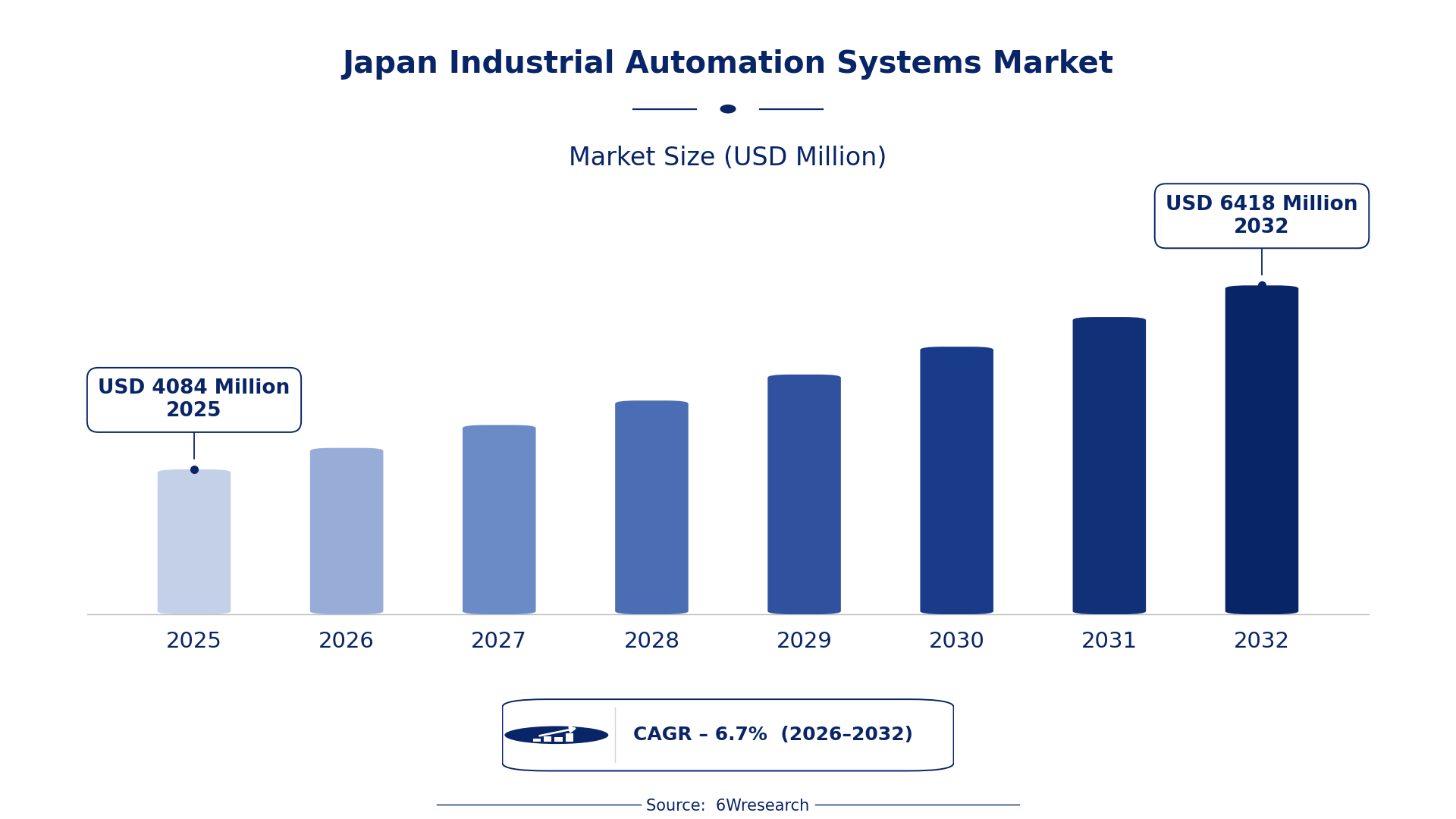
According to 6Wresearch internal database and industry insights, the Japan Industrial Automation Systems Market was valued at USD 4,084 Million in 2025 and is projected to reach USD 6,418 Million by 2032, growing at a CAGR of approximately 6.7% during 2026–2032.
Japan Industrial Automation Systems Market Highlights
| Report Metric | Details |
| Report Name | Japan Industrial Automation Systems Market (2026-2032) |
| Market Size 2025 | USD 4,084 Million |
| Market Size 2032 | USD 6,418 Million |
| Absolute Growth 2025–2032 | USD 2,334 Million |
| CAGR 2026–2032 | 6.7% |
| Peak Annual Growth | 7.2% in 2027 |
| Forecast Period | 2026–2032 |
| Historical Data | 2022–2025 |
| Base Year | 2025 |
| Leading System Type, 2025 | Process Automation Systems (47% share) |
| Leading Integration Level, 2025 | Centralized (40% share) |
| Leading Control Scope, 2025 | Continuous Control (37% share) |
| Leading End User, 2025 | Automotive Assembly Lines (40% share) |
| Fastest-Growing System Type | Hybrid Automation Systems (10.1% CAGR) |
| Fastest-Growing Integration Level | Modular (8.6% CAGR) |
| Fastest-Growing Control Scope | Custom Workflow (8.8% CAGR) |
| Fastest-Growing End User | Pharmaceuticals (8.5% CAGR) |
| Growing Sector | Pharmaceuticals |
| Key End Users | Automotive Assembly Lines, Pharmaceuticals, Petrochemical Plants, Water Treatment Facilities |
Japan Industrial Automation Systems Market Year-wise Growth Rate and Key Drivers (2022–2032)
This graph illustrates the annual growth rates of the market from 2022 to 2032, highlighting a steady upward trajectory and projected market expansion over the forecast period.
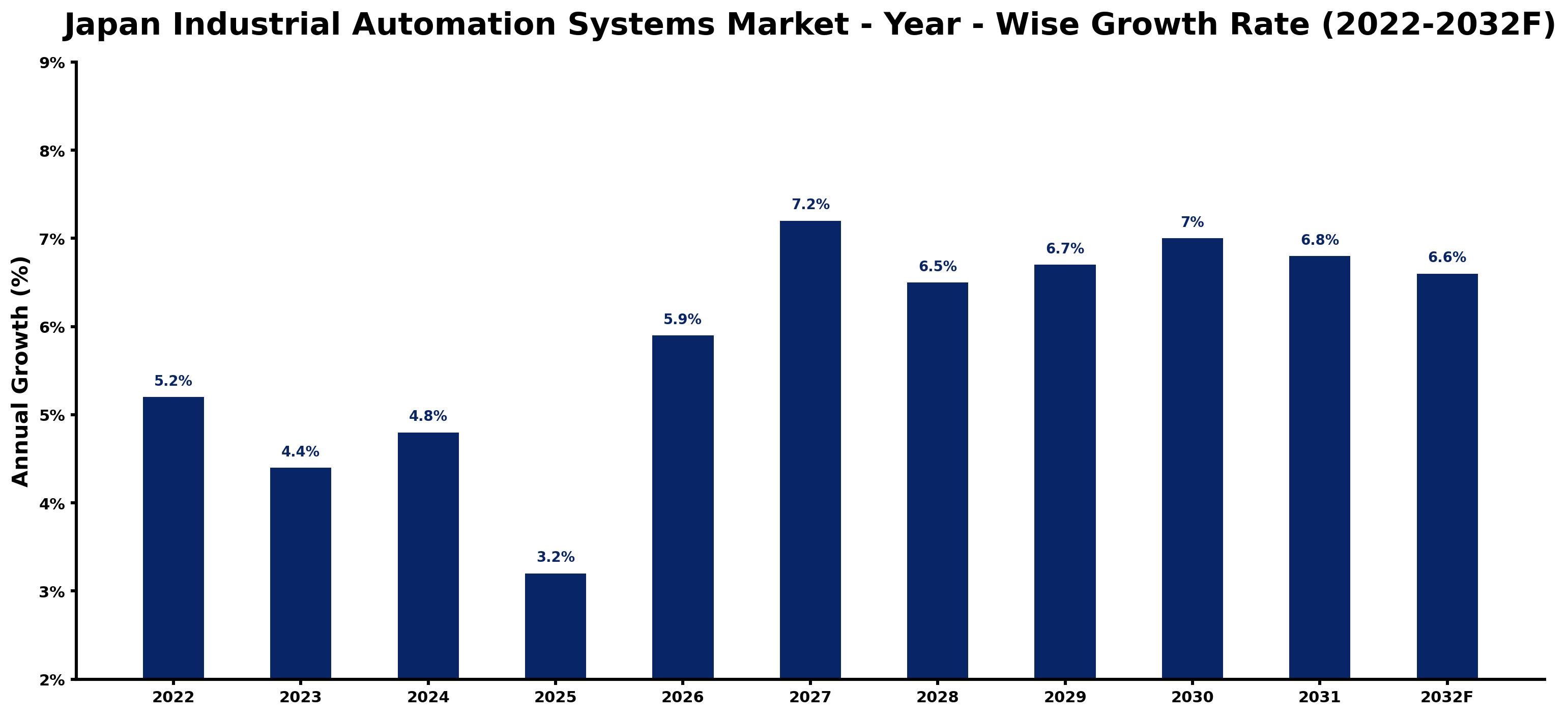
The yearly estimates that follow link every growth rate to its principal driver, so readers can see why the pace changed in each period.
| Year | Estimated Annual Growth (%) | Market Rationale |
| 2022 | 5.2 | Demand remained strong, particularly from the automotive sector, which drove automation adoption. |
| 2023 | 4.4 | Growth slowed as manufacturers faced supply chain challenges impacting production schedules. |
| 2024 | 4.8 | Increased investments in automation technologies led to a recovery in growth rates. |
| 2025 | 3.2 | Demand growth slowed due to market saturation in certain automation segments. |
| 2026 | 5.9 | Rising interest in Industry 4.0 technologies is expected to spur renewed demand for automation systems. |
| 2027 | 7.2 | Peak growth will be driven by substantial investments in robotics and process automation. |
| 2028 | 6.5 | Growth is projected to slow as companies focus on optimising existing automation systems. |
| 2029 | 6.7 | Demand will increase due to the expansion of the pharmaceutical sector requiring precise automation. |
| 2030 | 7.0 | Continued investments in smart manufacturing technologies will drive higher demand for automation. |
| 2031 | 6.8 | Growth is expected to slow as the market matures and competition intensifies among suppliers. |
| 2032 | 6.6 | Demand will remain strong as companies seek to improve operational efficiency through automation. |
Note: Market size estimations and growth projections presented in this report are based on 6Wresearch's proprietary forecasting methodology, utilizing the latest available industry data, government publications, and primary research inputs.
Japan Industrial Automation Systems Market Synopsis
Industrial Automation Systems optimise manufacturing processes through the integration of software and hardware. The Japan Industrial Automation Systems Market is growing due to increased investments in automation technologies, particularly in the automotive and pharmaceutical sectors. Japan's GX Basic Policy targets JPY 150 trillion in decarbonisation investments over the next decade, further supporting demand for advanced automation solutions, while the New Robot Strategy encourages broader robot use across various industries.
Market Dynamics Impact Analysis (2026–2032)
| Factor | Type | Impact | Primary Segment Affected |
| Increased investments in Industry 4.0 technologies | Driver | High | Process Automation Systems |
| Growing demand for precision in manufacturing | Driver | High | Pharmaceuticals |
| Expansion of automation in emerging sectors | Opportunity | High | Hybrid Automation Systems |
| Rising need for efficient manufacturing solutions | Opportunity | High | Discrete Automation Systems |
| High initial investment costs for automation systems | Restraint | Medium | SCADA + HMI Systems |
| Regulatory compliance requirements increase complexity | Restraint | Medium | Process Automation Systems |
| Supply chain disruptions affecting component availability | Challenge | High | Discrete Automation Systems |
| Intense competition among automation providers | Challenge | Medium | Hybrid Automation Systems |
Evaluation of Drivers in Japan Industrial Automation Systems Market (2026–2032)
Key forces behind demand, with the segment each one moves most, are listed below.
| Drivers | Primary Segment Affected | Why It Matters (Evidence) |
| Rising adoption of Industry 4.0 technologies | Process Automation Systems | This trend leads manufacturers to invest in advanced automation solutions, enhancing productivity across over 1,000 petrochemical plants utilizing these systems. |
| Increased demand for precision in pharmaceutical manufacturing | Pharmaceuticals | The sector's regulatory requirements drive the need for precise automation systems, ensuring compliance and quality control in production processes. |
| Growing public and private investments in decarbonisation | Discrete Automation Systems | Japan's GX Basic Policy targets JPY 150 trillion in decarbonisation investments, boosting demand for efficient automation solutions. |
| Expansion of automotive assembly lines | Automotive Assembly Lines | The automotive sector employs advanced robotics, focusing on efficiency and productivity improvements, which increases demand for automation systems. |
| Government initiatives promoting automation technologies | SCADA + HMI Systems | The Ministry of Economy, Trade and Industry (METI) supports automation advancements, increasing system adoption across multiple industries. |
Behind the steady rise in orders sits Japan's population of approximately 126 million, driving demand for efficient manufacturing solutions, particularly in the automotive sector, which employs advanced robotics. Automation is increasingly adopted in over 1,000 petrochemical plants to optimise processes.
Evaluation of Restraints in Japan Industrial Automation Systems Market
These are the pressures that could keep growth below its potential.
| Market Restraint | Primary Segment Affected | Why It Matters (Evidence) |
| High initial investment costs for automation systems | SCADA + HMI Systems | Upfront costs deter smaller manufacturers from adopting advanced automation technologies, limiting market growth. |
| Regulatory compliance requirements increase complexity | Process Automation Systems | Manufacturers must navigate complex regulations, which can delay automation system implementation and increase costs. |
| Supply chain disruptions affecting component availability | Discrete Automation Systems | Global supply chain issues have led to shortages of critical components, impacting production timelines for automation systems. |
| Limited skilled workforce for advanced automation | Hybrid Automation Systems | A shortage of skilled workers capable of operating and maintaining advanced automation systems hampers market potential. |
| Market saturation in certain automation segments | Process Automation Systems | As many manufacturers have implemented automation, new sales opportunities are becoming increasingly limited. |
Japan Industrial Automation Systems Market Challenges
High costs for advanced automation systems can burden producers, particularly in the automotive sector, where investments often exceed JPY 1 billion. Buyers in the pharmaceutical sector experience delays due to stringent regulatory requirements, extending project timelines by up to 12 months. Increased competition from countries with lower labour costs compels Japanese manufacturers to adopt automation swiftly, risking market share losses. Compliance with ISO 9001 standards complicates operations for producers, as maintaining certification requires ongoing investments in system upgrades and staff training, straining budgets.
Trends in the Japan Industrial Automation Systems Market
Several trends are reshaping the Japan Industrial Automation Systems Market; the most important are set out below.
- Smart Manufacturing Strategy Driving Automation Adoption: The Smart Manufacturing Strategy, launched in 2022, is driving increased automation in Japan's manufacturing sector. This initiative aims to modernise production processes, with an expected investment of ¥50 billion in automation technology research and development.
- Shift Towards Modular Automation Systems: Modular automation systems are gaining traction as manufacturers seek flexibility in their operations. This shift is evident in the automotive sector, which is increasingly adopting modular solutions to improve production efficiency.
- Increased Focus on Industry 4.0 Technologies: Industry 4.0 technologies are transforming manufacturing processes across Japan. The adoption of IoT and AI in automation systems is expected to rise significantly, with manufacturers investing heavily in these technologies.
- Growing Demand for SCADA Systems in Water Treatment: Water treatment facilities are increasingly implementing SCADA systems for real-time monitoring and control. This trend is reflected in the rising number of facilities adopting these systems to improve operational efficiency.
Investment Opportunities in the Japan Industrial Automation Systems Market
The openings below show where demand in the Japan Industrial Automation Systems Market is visible and how suppliers can enter.
- Gap in Automation Solutions for Small Manufacturers: With a growing need for affordable automation solutions, small manufacturers are seeking cost-effective options. Collaborating with local technology providers can help bridge this gap and facilitate entry into the market.
- Investment in Custom Automation Solutions: The demand for tailored automation solutions is rising, particularly in niche markets. Targeting pharmaceutical companies can yield opportunities for suppliers offering bespoke systems that meet specific regulatory needs.
- Expansion of Automation in Water Treatment Facilities: Water treatment facilities are increasingly investing in automation technologies. Suppliers can enter this market by partnering with local authorities and demonstrating compliance with environmental regulations.
- Growing Need for Modular Automation Systems: As manufacturers seek flexibility, the demand for modular automation systems is rising. Suppliers can capitalise on this trend by forming joint ventures with local firms to develop adaptable solutions.
Government Initiatives in the Japan Industrial Automation Systems Market
The New Robot Strategy, launched in 2015, promotes the integration of robots in manufacturing, services, agriculture, and care. This initiative encourages investment in automation technologies, supporting the growth of the industrial automation sector and enhancing productivity across various industries. The AI Promotion Act, established in 2025, creates a national framework for AI research and development, further improving automation capabilities across sectors.
In 2023, the government allocated ¥50 billion for automation technology research and development through the Ministry of Economy, Trade and Industry (METI). This funding supports projects aimed at advancing automation technologies, promoting their adoption in various sectors, and enhancing Japan's competitiveness in the global market.
Future Insight of the Japan Industrial Automation Systems Market
The integration of Industry 4.0 technologies will reshape demand for automation systems by 2032, driven by the government's emphasis on advanced manufacturing. Investment in decarbonisation initiatives, estimated at JPY 150 trillion over the next decade, will create new opportunities for suppliers of eco-friendly automation solutions. Robotics and AI advancements will enable manufacturers to streamline processes and improve efficiency. As Japan's population continues to drive the need for effective manufacturing practices, the adoption of automation in sectors like pharmaceuticals will significantly increase.
Market Segmentation Analysis
Japan Industrial Automation Systems Market report covers a detailed analysis of the following market segments:
By System Type – Process Automation Systems Lead, Hybrid Automation Systems Expected to Grow Fastest
According to Saurav Kr Singh, Senior Research Analyst at 6Wresearch, the largest system type category in 2025 was Process Automation Systems, at 47% of revenue. Process Automation Systems command the largest share because they are essential for continuous manufacturing processes, particularly in sectors like petrochemicals. Their critical role is evident in over 1,000 plants that rely on these systems to maintain operational efficiency. The quickest growth will come from Hybrid Automation Systems, forecast to expand at a CAGR of 10.1% between 2026 and 2032. Hybrid Automation Systems are rapidly expanding as they effectively merge process and discrete automation, catering to specific applications. This adaptability is vital as industries increasingly pursue tailored solutions to meet diverse operational requirements. Suppliers should focus on developing flexible solutions to meet the growing demand for hybrid automation.
By Integration Level – Centralized Leads, Modular Expected to Grow Fastest
Centralized accounted for 40% of the market by integration level in 2025. Centralized systems lead the market due to their prevalent use in large-scale operations, providing robust control and oversight. Their widespread adoption in key manufacturing regions like Tokyo and Aichi underscores their importance in industrial automation. Modular is projected to grow fastest, at a CAGR of 8.6% during 2026–2032. Modular systems are experiencing rapid growth because they offer flexibility, allowing manufacturers to adapt to various applications without extensive reconfiguration. This trend reflects the increasing demand for customised solutions across different industrial environments. Buyers will benefit from suppliers that offer modular solutions capable of adapting to changing operational needs.
By Control Scope – Continuous Control Leads, Custom Workflow Expected to Grow Fastest
With 37% of control scope revenue in 2025, Continuous Control was the largest category. Continuous Control systems hold the largest share as they are necessary for processes requiring constant monitoring, particularly in industries like automotive and pharmaceuticals. Their critical role in ensuring operational efficiency makes them indispensable. Over 2026–2032, Custom Workflow is expected to post the fastest growth, at a CAGR of 8.8%. Custom Workflow solutions are rapidly gaining traction as they provide tailored automation for unique processes, allowing companies to optimise their operations. This trend reflects the industry's shift towards more personalised automation strategies. Suppliers should prioritise the development of customisable solutions to cater to the unique needs of various industries.
By End User – Automotive Assembly Lines Lead, Pharmaceuticals Expected to Grow Fastest
Automotive Assembly Lines held 40% of the Japan Industrial Automation Systems Market by end user in 2025. Automotive Assembly Lines dominate the market as they are crucial for production efficiency in Japan's robust automotive sector. The integration of advanced robotics in these lines highlights their significance in maintaining competitiveness within the industry. Pharmaceuticals are set to record the highest CAGR in this split, 8.5% over 2026–2032. The Pharmaceuticals sector is witnessing the fastest growth due to stringent regulatory requirements that demand precise automation systems for compliance and quality control. This heightened focus on accuracy is driving investments in advanced automation technologies. Suppliers must address the specific compliance needs of the pharmaceutical industry to capitalise on this growth opportunity.
Key Attractiveness of the Report
- 10 Years of Market Numbers
- Historical Data Starting from 2022 to 2025
- Base Year 2025
- Forecast Data until 2032
- Key Performance Indicators Impacting the Market
- Major Upcoming Developments and Projects
Key Highlights of the Report:
- Japan Industrial Automation Systems Market Outlook
- Market Size of Japan Industrial Automation Systems Market, 2025
- Forecast of Japan Industrial Automation Systems Market, 2032
- Historical Data and Forecast of Japan Industrial Automation Systems Revenues & Volume for the Period 2022-2032F
- Japan Industrial Automation Systems Market Trend Evolution
- Japan Industrial Automation Systems Market Drivers and Challenges
- Japan Industrial Automation Systems Price Trends
- Japan Industrial Automation Systems Porter's Five Forces
- Japan Industrial Automation Systems Industry Life Cycle
- Historical Data and Forecast of Japan Industrial Automation Systems Market Revenues & Volume By System Type for the Period 2022-2032F
- Historical Data and Forecast of Japan Industrial Automation Systems Market Revenues & Volume By Process Automation Systems for the Period 2022-2032F
- Historical Data and Forecast of Japan Industrial Automation Systems Market Revenues & Volume By Discrete Automation Systems for the Period 2022-2032F
- Historical Data and Forecast of Japan Industrial Automation Systems Market Revenues & Volume By Hybrid Automation Systems for the Period 2022-2032F
- Historical Data and Forecast of Japan Industrial Automation Systems Market Revenues & Volume By SCADA + HMI Systems for the Period 2022-2032F
- Historical Data and Forecast of Japan Industrial Automation Systems Market Revenues & Volume By Integration Level for the Period 2022-2032F
- Historical Data and Forecast of Japan Industrial Automation Systems Market Revenues & Volume By Centralized for the Period 2022-2032F
- Historical Data and Forecast of Japan Industrial Automation Systems Market Revenues & Volume By Modular for the Period 2022-2032F
- Historical Data and Forecast of Japan Industrial Automation Systems Market Revenues & Volume By Combined (Batch + Discrete) for the Period 2022-2032F
- Historical Data and Forecast of Japan Industrial Automation Systems Market Revenues & Volume By Supervisory + Interface for the Period 2022-2032F
- Historical Data and Forecast of Japan Industrial Automation Systems Market Revenues & Volume By Control Scope for the Period 2022-2032F
- Historical Data and Forecast of Japan Industrial Automation Systems Market Revenues & Volume By Continuous Control for the Period 2022-2032F
- Historical Data and Forecast of Japan Industrial Automation Systems Market Revenues & Volume By Event-Based Control for the Period 2022-2032F
- Historical Data and Forecast of Japan Industrial Automation Systems Market Revenues & Volume By Custom Workflow for the Period 2022-2032F
- Historical Data and Forecast of Japan Industrial Automation Systems Market Revenues & Volume By Remote/Real-Time for the Period 2022-2032F
- Historical Data and Forecast of Japan Industrial Automation Systems Market Revenues & Volume By End User for the Period 2022-2032F
- Historical Data and Forecast of Japan Industrial Automation Systems Market Revenues & Volume By Petrochemical Plants for the Period 2022-2032F
- Historical Data and Forecast of Japan Industrial Automation Systems Market Revenues & Volume By Automotive Assembly Lines for the Period 2022-2032F
- Historical Data and Forecast of Japan Industrial Automation Systems Market Revenues & Volume By Pharmaceuticals for the Period 2022-2032F
- Historical Data and Forecast of Japan Industrial Automation Systems Market Revenues & Volume By Water Treatment Facilities for the Period 2022-2032F
- Japan Industrial Automation Systems Import Export Trade Statistics
- Market Opportunity Assessment By System Type
- Market Opportunity Assessment By Integration Level
- Market Opportunity Assessment By Control Scope
- Market Opportunity Assessment By End User
- Japan Industrial Automation Systems Top Companies Market Share
- Japan Industrial Automation Systems Competitive Benchmarking By Technical and Operational Parameters
- Japan Industrial Automation Systems Company Profiles
- Japan Industrial Automation Systems Key Strategic Recommendations
Market Covered
The study includes the following segmentation.
By System Type
- Process Automation Systems
- Discrete Automation Systems
- Hybrid Automation Systems
- SCADA + HMI Systems
By Integration Level
- Centralized
- Modular
- Combined (Batch + Discrete)
- Supervisory + Interface
By Control Scope
- Continuous Control
- Event-Based Control
- Custom Workflow
- Remote/Real-Time
By End User
- Petrochemical Plants
- Automotive Assembly Lines
- Pharmaceuticals
- Water Treatment Facilities































