Japan Industrial Autonomous Systems Market Size & Growth Rate
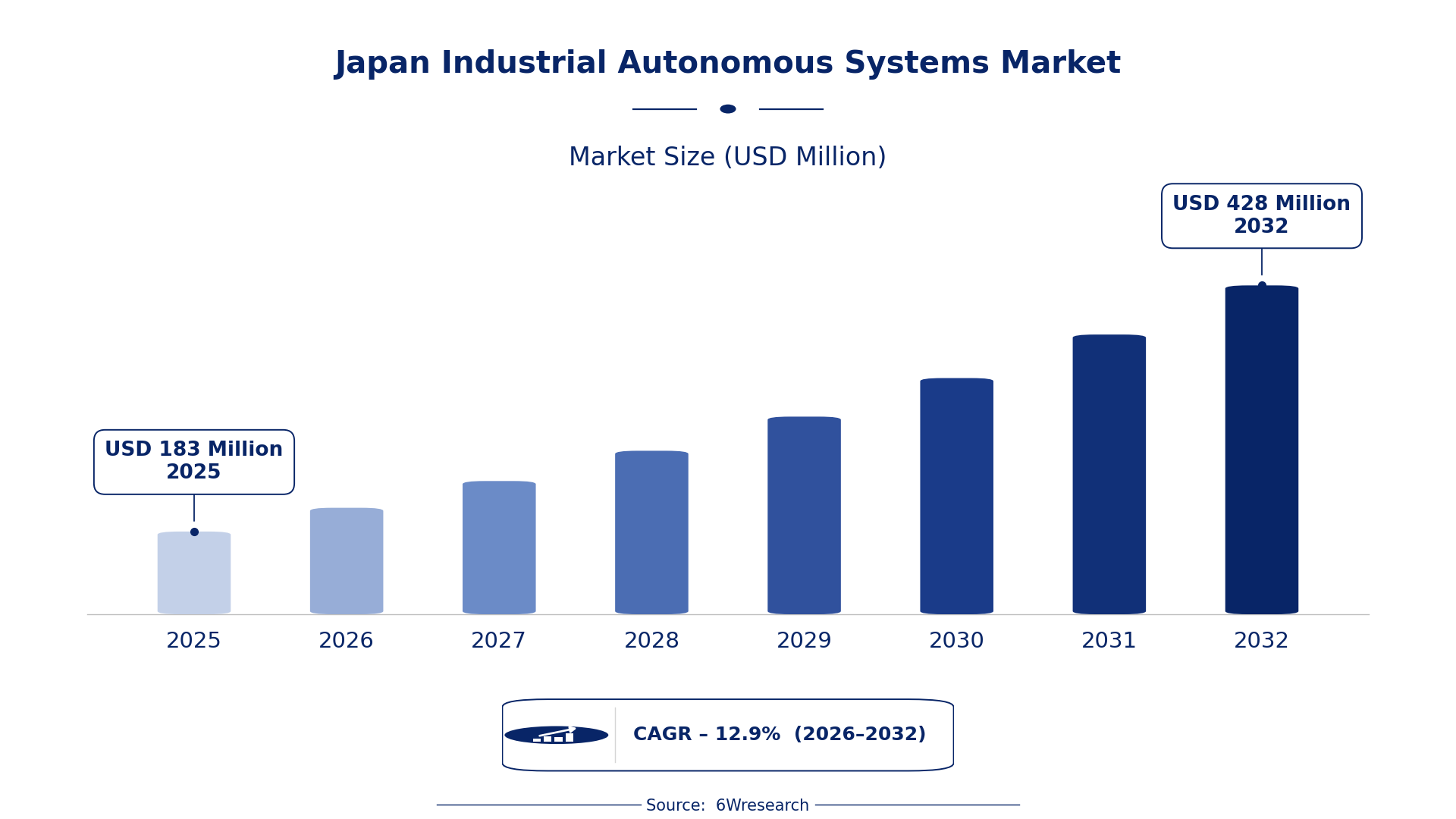
According to 6Wresearch internal database and industry insights, the Japan Industrial Autonomous Systems Market was valued at USD 183 Million in 2025 and is projected to reach USD 428 Million by 2032, growing at a CAGR of approximately 12.9% during 2026–2032.
Japan Industrial Autonomous Systems Market Highlights
| Report Metric | Details |
| Report Name | Japan Industrial Autonomous Systems Market (2026-2032) |
| Market Size 2025 | USD 183 Million |
| Market Size 2032 | USD 428 Million |
| Absolute Growth 2025–2032 | USD 245 Million |
| CAGR 2026–2032 | 12.9% |
| Peak Annual Growth | 14.5% in 2027 |
| Forecast Period | 2026–2032 |
| Historical Data | 2022–2025 |
| Base Year | 2025 |
| Leading System Type, 2025 | AI-Driven Robots (42% share) |
| Leading Autonomy Level, 2025 | Fully Autonomous (36% share) |
| Leading Sensor Integration, 2025 | LIDAR + Proximity Sensors (47% share) |
| Leading End User, 2025 | Logistics Centers (52% share) |
| Fastest-Growing System Type | Autonomous Guided Vehicles (AGVs) (14.0% CAGR) |
| Fastest-Growing Autonomy Level | Adaptive Control (17.3% CAGR) |
| Fastest-Growing End User | Assembly Lines (16.2% CAGR) |
| Growing Sector | Logistics |
| Key End Users | Manufacturers, Logistics Centres, Assembly Lines, Metalworking Facilities |
Japan Industrial Autonomous Systems Market Year-wise Growth Rate and Key Drivers (2022–2032)
This graph illustrates the annual growth rates of the market from 2022 to 2032, highlighting a steady upward trajectory and projected market expansion over the forecast period.
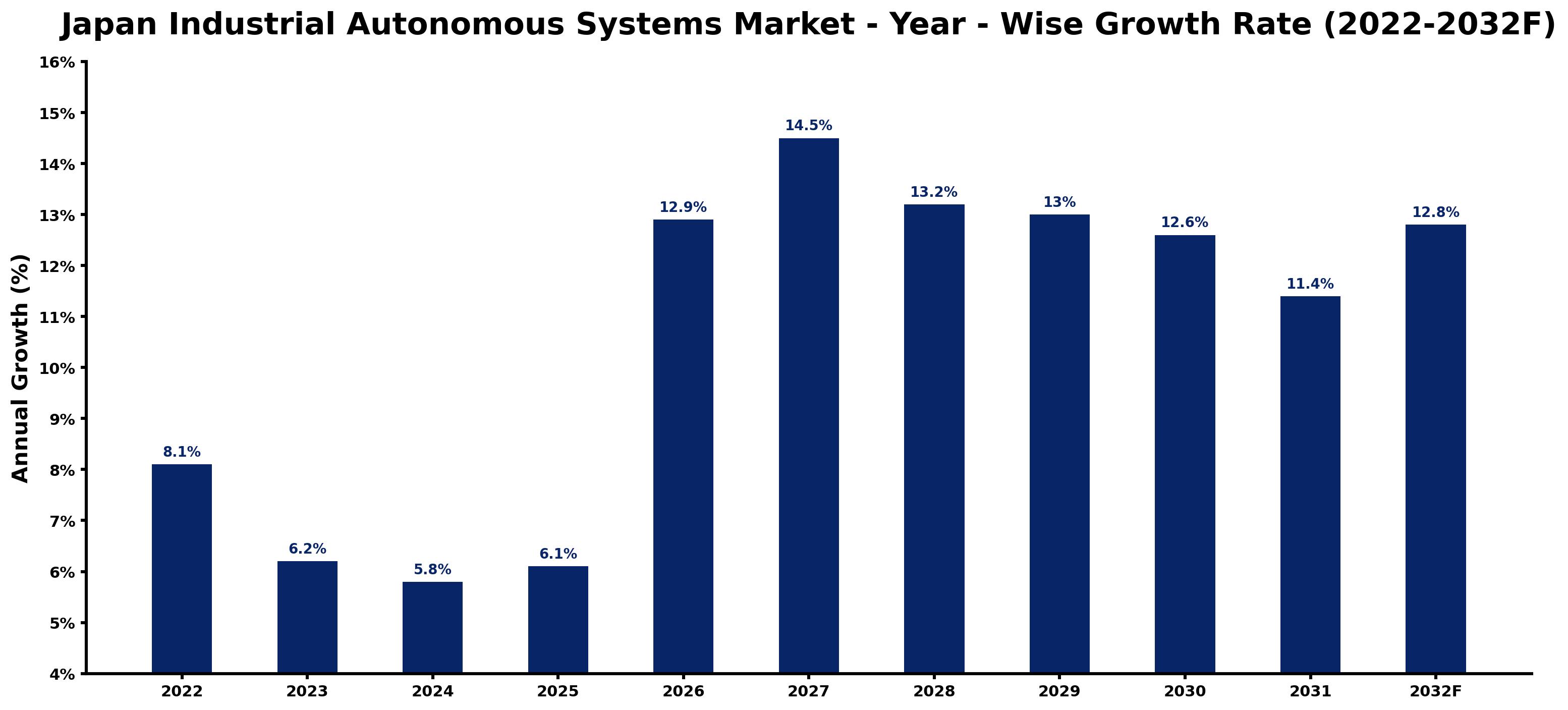
The following figures match every annual growth estimate with the main market development of that year, giving the reasoning behind each rise or slowdown.
| Year | Estimated Annual Growth (%) | Market Rationale |
| 2022 | 8.1 | The market experienced strong growth due to increasing automation in manufacturing. |
| 2023 | 6.2 | Growth slowed as companies adjusted to new technologies and economic conditions. |
| 2024 | 5.8 | Demand continued to rise, albeit at a slower pace, as firms embraced automation. |
| 2025 | 6.1 | Growth accelerated as investments in AI-driven systems gained traction. |
| 2026 | 12.9 | Demand is expected to surge sharply as companies seek to improve operational efficiency. |
| 2027 | 14.5 | The peak growth will be driven by advancements in autonomous technologies. |
| 2028 | 13.2 | Growth is projected to slow slightly as the market begins to stabilise after rapid expansion. |
| 2029 | 13.0 | Demand will remain strong, although growth rates are expected to normalise from previous highs. |
| 2030 | 12.6 | The market is projected to continue growing as automation becomes essential in various sectors. |
| 2031 | 11.4 | Growth will moderate as the market matures and competition intensifies. |
| 2032 | 12.8 | Demand is expected to rise again as new technologies are adopted. |
Note: Market size estimations and growth projections presented in this report are based on 6Wresearch's proprietary forecasting methodology, utilizing the latest available industry data, government publications, and primary research inputs.
Japan Industrial Autonomous Systems Market Synopsis
Industrial Autonomous Systems encompass technologies such as autonomous guided vehicles and AI-driven robots, which improve operational efficiency in logistics and manufacturing. The Japan Industrial Autonomous Systems Market is growing due to increased automation demands from logistics centres and manufacturing facilities. Factors such as Japan's GX Basic Policy and rising investments in decarbonisation are propelling this growth, along with a manufacturing workforce and a target to reduce greenhouse-gas emissions by 46% by fiscal 2030.
Market Dynamics Impact Analysis (2026–2032)
| Factor | Type | Impact | Primary Segment Affected |
| Increasing automation in logistics and manufacturing sectors | Driver | High | AI-Driven Robots |
| Growing investments in decarbonisation initiatives | Driver | High | Autonomous Guided Vehicles (AGVs) |
| Expansion of logistics centres requiring advanced automation | Opportunity | High | Logistics Centers |
| Rising demand for precision in manufacturing processes | Opportunity | Medium | Autonomous CNC Machines |
| High initial investment costs for advanced systems | Restraint | High | Self-Diagnosing Systems |
| Limited awareness of autonomous technologies among SMEs | Restraint | Medium | AI-Driven Robots |
| Challenges in integrating new technologies with existing systems | Challenge | High | Autonomous CNC Machines |
| Shortage of skilled workforce to operate advanced systems | Challenge | Medium | AI-Driven Robots |
Evaluation of Drivers in Japan Industrial Autonomous Systems Market (2026–2032)
The main growth drivers and the segments they affect most are set out below.
| Drivers | Primary Segment Affected | Why It Matters (Evidence) |
| Increased demand for automation in logistics | Autonomous Guided Vehicles (AGVs) | Logistics centres are adopting AGVs for efficient material handling, with the logistics sector expected to grow by 5% annually through 2025. |
| Rising investments in AI technologies | AI-Driven Robots | The annual investment in automation technologies in Japan is estimated at ¥300 billion, leading to higher adoption rates. |
| Government support for automation initiatives | Self-Diagnosing Systems | The 'Smart Manufacturing' program encourages technology adoption in SMEs, driving demand for predictive maintenance solutions. |
| Technological advancements in robotics | Autonomous CNC Machines | The installed base of industrial robots in Japan exceeds 400,000 units, driving demand for precision machining. |
| Aging workforce in manufacturing | AI-Driven Robots | The average age of workers in manufacturing is increasing, necessitating automation solutions to maintain productivity. |
Most of the extra volume comes from the increasing demand for automation in logistics, where autonomous guided vehicles are widely adopted. The logistics sector is projected to grow by 5% annually through 2025, prompting investment in advanced systems. In 2023, Japan's annual investment in automation technologies reached approximately ¥300 billion, driving higher adoption rates. The aging workforce in manufacturing necessitates the integration of AI-driven robots to sustain productivity levels.
Evaluation of Restraints in Japan Industrial Autonomous Systems Market
Below are the constraints most often cited by buyers and suppliers, with the segment each affects.
| Market Restraint | Primary Segment Affected | Why It Matters (Evidence) |
| High initial investment costs for advanced systems | Self-Diagnosing Systems | The costs associated with implementing self-diagnosing systems can deter smaller firms from adoption, limiting market growth. |
| Limited awareness of autonomous technologies among SMEs | AI-Driven Robots | Many small and medium enterprises lack knowledge about the benefits of AI-driven automation, hindering their investment decisions. |
| Challenges in integrating new technologies with existing systems | Autonomous CNC Machines | Integration issues can lead to increased downtime and costs, affecting the willingness of firms to adopt new solutions. |
| Concerns regarding data security in automation | AI-Driven Robots | Firms are hesitant to adopt AI-driven solutions due to fears of data breaches and cyber threats. |
| Regulatory compliance costs for new technologies | Autonomous Guided Vehicles (AGVs) | Compliance with safety standards can increase operational costs, impacting the adoption of AGVs. |
Japan Industrial Autonomous Systems Market Challenges
Over 400,000 industrial robots are installed in Japan, yet many producers struggle with outdated technology, which diminishes efficiency and can delay production timelines by as much as 20%. Price wars driven by fierce competition among manufacturers compel buyers to compromise on quality, adversely affecting their operational effectiveness. Supply chain disruptions, intensified by global events, can postpone critical components, impacting production schedules and potentially resulting in a 15% loss in output. Rising costs of automation technologies, estimated at ¥300 billion annually, put pressure on buyers' budgets, restricting their capacity to invest in new systems and uphold operational efficiency.
Trends in the Japan Industrial Autonomous Systems Market
The following changes are redrawing the Japan Industrial Autonomous Systems Market.
- Shift from Manual to Automated Processes: In 2023, Japan's manufacturing sector experienced a shift towards automation, with a reported 10% increase in robot adoption. This transition is motivated by the need for efficiency and productivity, particularly in logistics and assembly lines.
- Growing Integration of AI in Manufacturing: The year 2023 saw a marked increase in AI integration within manufacturing processes. As companies strive to enhance operational efficiency, the adoption of AI-driven robots has surged, with annual investments in automation technologies estimated at ¥300 billion.
- Rise of Predictive Maintenance Solutions: The demand for self-diagnosing systems has risen as industries prioritise predictive maintenance. In 2023, the emphasis on productivity sparked interest in these advanced solutions.
- Expansion of Logistics Automation: The logistics sector is progressively automating operations, with logistics centres extensively adopting autonomous guided vehicles. This trend is supported by a projected 5% annual growth in the sector through 2025.
Investment Opportunities in the Japan Industrial Autonomous Systems Market
Investors looking at the Japan Industrial Autonomous Systems Market should consider the following areas.
- Gap in Automation Solutions for SMEs: With Japan's annual investment in automation technologies estimated at ¥300 billion, there exists a gap in affordable solutions for SMEs. Targeting small manufacturers could lead to substantial market penetration.
- Demand for Advanced Robotics in Logistics: The logistics sector is anticipated to grow by 5% annually, creating a demand for advanced robotics. Supplying autonomous guided vehicles to logistics centres can capture this expanding market.
- Investment in AI-Driven Automation: Japan's push towards AI integration in manufacturing offers an opportunity to supply AI-driven robots. Engaging with manufacturing facilities can facilitate market entry.
- Support for Smart Factory Initiatives: The Tokyo Metropolitan Government's backing for smart factories presents opportunities for automation suppliers. Investing in smart technologies can yield substantial returns in this growing market.
Government Initiatives in the Japan Industrial Autonomous Systems Market
The Industrial Safety and Health Act establishes strict employer duties regarding hazardous substances and machinery, ensuring that producers of industrial autonomous systems adhere to safety standards. Compliance with this law is essential for manufacturers to avoid penalties and ensure safe operations in workplaces.
The Ministry of Economy, Trade and Industry promotes automation through various initiatives, including the 'Connected Industries' initiative. This program funds projects aimed at improving productivity and competitiveness in industries, focusing on supporting the integration of advanced technologies.
Future Insight of the Japan Industrial Autonomous Systems Market
Japan's planned JPY 150 trillion investment in decarbonisation over the next decade will generate substantial demand for advanced automation technologies. By 2032, the integration of AI in manufacturing will streamline processes, improving productivity and operational efficiency. The 'Smart Manufacturing' programme will encourage small and medium enterprises to adopt new technologies, creating a competitive environment. As the workforce ages, automation will become increasingly necessary, with productivity targets set to double by 2030, ensuring that buyers and suppliers remain responsive in a rapidly evolving market.
Market Segmentation Analysis
Japan Industrial Autonomous Systems Market report covers a detailed analysis of the following market segments:
By System Type – AI-Driven Robots Lead, Autonomous Guided Vehicles (AGVs) Expected to Grow Fastest
According to Saurav Kr Singh, Senior Research Analyst at 6Wresearch, AI-Driven Robots accounted for 42% of the market by system type in 2025. AI-Driven Robots dominate the market due to their extensive application in manufacturing and logistics, where they significantly enhance operational efficiency. Their widespread use is highlighted by the installed base of over 400,000 units in Japan, reflecting strong demand from various sectors. The quickest growth will come from Autonomous Guided Vehicles (AGVs), forecast to expand at a CAGR of 14.0% between 2026 and 2032. The growth of Autonomous Guided Vehicles is propelled by the increasing need for efficient material handling solutions in logistics and warehousing. This segment is expected to thrive as Japan's logistics sector is forecasted to grow by 5% annually through 2025, indicating a robust market opportunity. Suppliers should focus on developing advanced features for AI-Driven Robots to maintain their leading position in the market.
By Autonomy Level – Fully Autonomous Leads, Adaptive Control Expected to Grow Fastest
With 36% of autonomy level revenue in 2025, Fully Autonomous was the largest category. Fully Autonomous systems lead the market as they represent the future of industrial automation, requiring minimal human intervention and aligning with Japan's productivity goals. Their adoption is crucial for industries aiming to enhance efficiency and reduce operational costs. Adaptive Control is projected to grow fastest, at a CAGR of 17.3% during 2026–2032. Adaptive Control is gaining traction due to its ability to improve system responsiveness in dynamic environments, which is vital for modern industrial applications. As industries evolve, this capability will be essential for maintaining a competitive edge in automation. Buyers should consider investing in Fully Autonomous systems to secure their operational future and improve productivity.
By Sensor Integration – LIDAR + Proximity Sensors Lead and Record the Fastest Growth
LIDAR + Proximity Sensors held 47% of the Japan Industrial Autonomous Systems Market by sensor integration in 2025. LIDAR + Proximity Sensors hold the largest market share as they significantly enhance navigation and safety in autonomous systems, making them essential for effective operation. Their critical role in meeting safety standards is particularly relevant in Japan's industrial environment. LIDAR + Proximity Sensors are also forecast to expand faster than any other category, at a CAGR of 14.5% over 2026–2032. LIDAR + Proximity Sensors are also the fastest-growing segment due to their increasing necessity for ensuring safe and efficient navigation in complex operational settings. Their dual role in leading and fastest growth highlights their importance in the market. Suppliers must prioritise the advancement of LIDAR + Proximity Sensors to meet the rising demand in the industry.
By End User – Logistics Centers Lead, Assembly Lines Expected to Grow Fastest
The largest end user category in 2025 was Logistics Centers, at 52% of revenue. Logistics Centers are the primary users of autonomous systems, utilising them to improve operational efficiency and reduce costs. Their significant investments in automation technologies are a key driver for the demand in this market. Assembly Lines are set to record the highest CAGR in this split, 16.2% over 2026–2032. Assembly Lines are experiencing rapid growth as manufacturers seek to modernise their processes and increase productivity. This growth is further supported by government initiatives aimed at enhancing competitiveness within the manufacturing sector. Buyers in the manufacturing sector should explore tailored automation solutions for Assembly Lines to maintain their competitive advantage.
Key Attractiveness of the Report
- 10 Years of Market Numbers
- Historical Data Starting from 2022 to 2025
- Base Year 2025
- Forecast Data until 2032
- Key Performance Indicators Impacting the Market
- Major Upcoming Developments and Projects
Key Highlights of the Report:
- Japan Industrial Autonomous Systems Market Outlook
- Market Size of Japan Industrial Autonomous Systems Market, 2025
- Forecast of Japan Industrial Autonomous Systems Market, 2032
- Historical Data and Forecast of Japan Industrial Autonomous Systems Revenues & Volume for the Period 2022-2032F
- Japan Industrial Autonomous Systems Market Trend Evolution
- Japan Industrial Autonomous Systems Market Drivers and Challenges
- Japan Industrial Autonomous Systems Price Trends
- Japan Industrial Autonomous Systems Porter's Five Forces
- Japan Industrial Autonomous Systems Industry Life Cycle
- Historical Data and Forecast of Japan Industrial Autonomous Systems Market Revenues & Volume By System Type for the Period 2022-2032F
- Historical Data and Forecast of Japan Industrial Autonomous Systems Market Revenues & Volume By Autonomous Guided Vehicles (AGVs) for the Period 2022-2032F
- Historical Data and Forecast of Japan Industrial Autonomous Systems Market Revenues & Volume By Autonomous CNC Machines for the Period 2022-2032F
- Historical Data and Forecast of Japan Industrial Autonomous Systems Market Revenues & Volume By AI-Driven Robots for the Period 2022-2032F
- Historical Data and Forecast of Japan Industrial Autonomous Systems Market Revenues & Volume By Self-Diagnosing Systems for the Period 2022-2032F
- Historical Data and Forecast of Japan Industrial Autonomous Systems Market Revenues & Volume By Autonomy Level for the Period 2022-2032F
- Historical Data and Forecast of Japan Industrial Autonomous Systems Market Revenues & Volume By Partial/Predefined for the Period 2022-2032F
- Historical Data and Forecast of Japan Industrial Autonomous Systems Market Revenues & Volume By Adaptive Control for the Period 2022-2032F
- Historical Data and Forecast of Japan Industrial Autonomous Systems Market Revenues & Volume By Fully Autonomous for the Period 2022-2032F
- Historical Data and Forecast of Japan Industrial Autonomous Systems Market Revenues & Volume By Predictive Failure for the Period 2022-2032F
- Historical Data and Forecast of Japan Industrial Autonomous Systems Market Revenues & Volume By Sensor Integration for the Period 2022-2032F
- Historical Data and Forecast of Japan Industrial Autonomous Systems Market Revenues & Volume By RFID + Vision Systems for the Period 2022-2032F
- Historical Data and Forecast of Japan Industrial Autonomous Systems Market Revenues & Volume By Load + Thermal Sensors for the Period 2022-2032F
- Historical Data and Forecast of Japan Industrial Autonomous Systems Market Revenues & Volume By LIDAR + Proximity Sensors for the Period 2022-2032F
- Historical Data and Forecast of Japan Industrial Autonomous Systems Market Revenues & Volume By Embedded Health Sensors for the Period 2022-2032F
- Historical Data and Forecast of Japan Industrial Autonomous Systems Market Revenues & Volume By End User for the Period 2022-2032F
- Historical Data and Forecast of Japan Industrial Autonomous Systems Market Revenues & Volume By Logistics Centers for the Period 2022-2032F
- Historical Data and Forecast of Japan Industrial Autonomous Systems Market Revenues & Volume By Metalworking Facilities for the Period 2022-2032F
- Historical Data and Forecast of Japan Industrial Autonomous Systems Market Revenues & Volume By Assembly Lines for the Period 2022-2032F
- Historical Data and Forecast of Japan Industrial Autonomous Systems Market Revenues & Volume By Power Equipment OEMs for the Period 2022-2032F
- Japan Industrial Autonomous Systems Import Export Trade Statistics
- Market Opportunity Assessment By System Type
- Market Opportunity Assessment By Autonomy Level
- Market Opportunity Assessment By Sensor Integration
- Market Opportunity Assessment By End User
- Japan Industrial Autonomous Systems Top Companies Market Share
- Japan Industrial Autonomous Systems Competitive Benchmarking By Technical and Operational Parameters
- Japan Industrial Autonomous Systems Company Profiles
- Japan Industrial Autonomous Systems Key Strategic Recommendations
Market Covered
The following segment groups are covered in the report.
By System Type
- Autonomous Guided Vehicles (AGVs)
- Autonomous CNC Machines
- AI-Driven Robots
- Self-Diagnosing Systems
By Autonomy Level
- Partial/Predefined
- Adaptive Control
- Fully Autonomous
- Predictive Failure
By Sensor Integration
- RFID + Vision Systems
- Load + Thermal Sensors
- LIDAR + Proximity Sensors
- Embedded Health Sensors
By End User
- Logistics Centers
- Metalworking Facilities
- Assembly Lines
- Power Equipment OEMs































