Japan Industrial Backwash Filters Market Size & Growth Rate
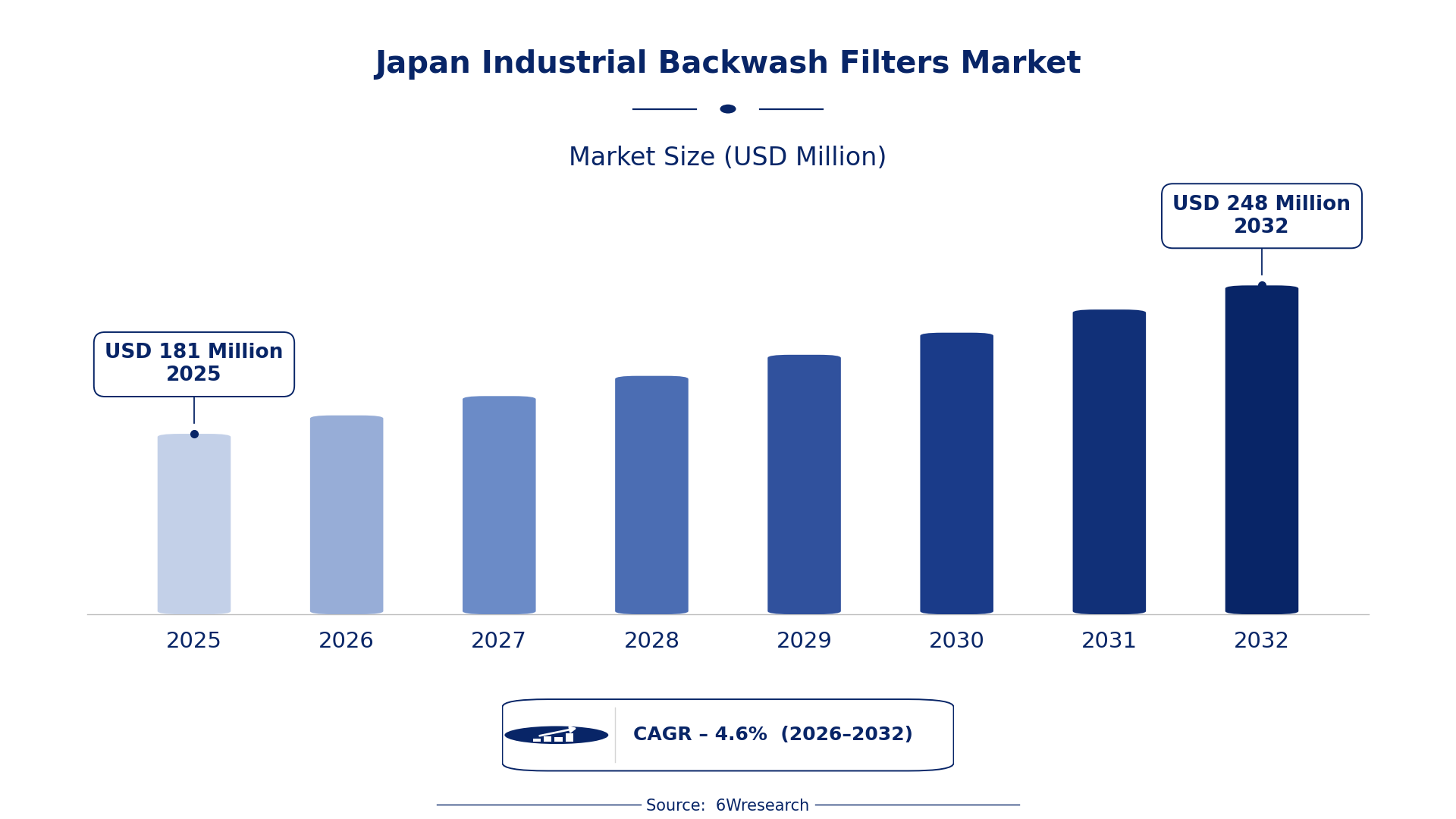
According to 6Wresearch internal database and industry insights, the Japan Industrial Backwash Filters Market was valued at USD 181 Million in 2025 and is projected to reach USD 248 Million by 2032, growing at a CAGR of approximately 4.6% during 2026–2032.
Japan Industrial Backwash Filters Market Highlights
| Report Metric | Details |
| Report Name | Japan Industrial Backwash Filters Market (2026-2032) |
| Market Size 2025 | USD 181 Million |
| Market Size 2032 | USD 248 Million |
| Absolute Growth 2025–2032 | USD 67 Million |
| CAGR 2026–2032 | 4.6% |
| Peak Annual Growth | 5.3% in 2028 |
| Forecast Period | 2026–2032 |
| Historical Data | 2022–2025 |
| Base Year | 2025 |
| Leading Filter Type, 2025 | Automatic Backwash Filters (40% share) |
| Leading Cleaning Mechanism, 2025 | Programmable (45% share) |
| Leading Media Type, 2025 | Sand/Cartridge (37% share) |
| Leading End User, 2025 | Cooling Tower Operators (49% share) |
| Fastest-Growing Filter Type | Manual Backwash Filters (6.4% CAGR) |
| Fastest-Growing Cleaning Mechanism | Manual Trigger (6.1% CAGR) |
| Fastest-Growing Media Type | Stainless Mesh (6.9% CAGR) |
| Fastest-Growing End User | Water Treatment Plants (5.8% CAGR) |
| Growing Sector | Water Treatment |
| Key End Users | Cooling Tower Operators, Water Treatment Plants, Chemical Process Units |
Japan Industrial Backwash Filters Market Year-wise Growth Rate and Key Drivers (2022–2032)
This graph illustrates the annual growth rates of the market from 2022 to 2032, highlighting a steady upward trajectory and projected market expansion over the forecast period.
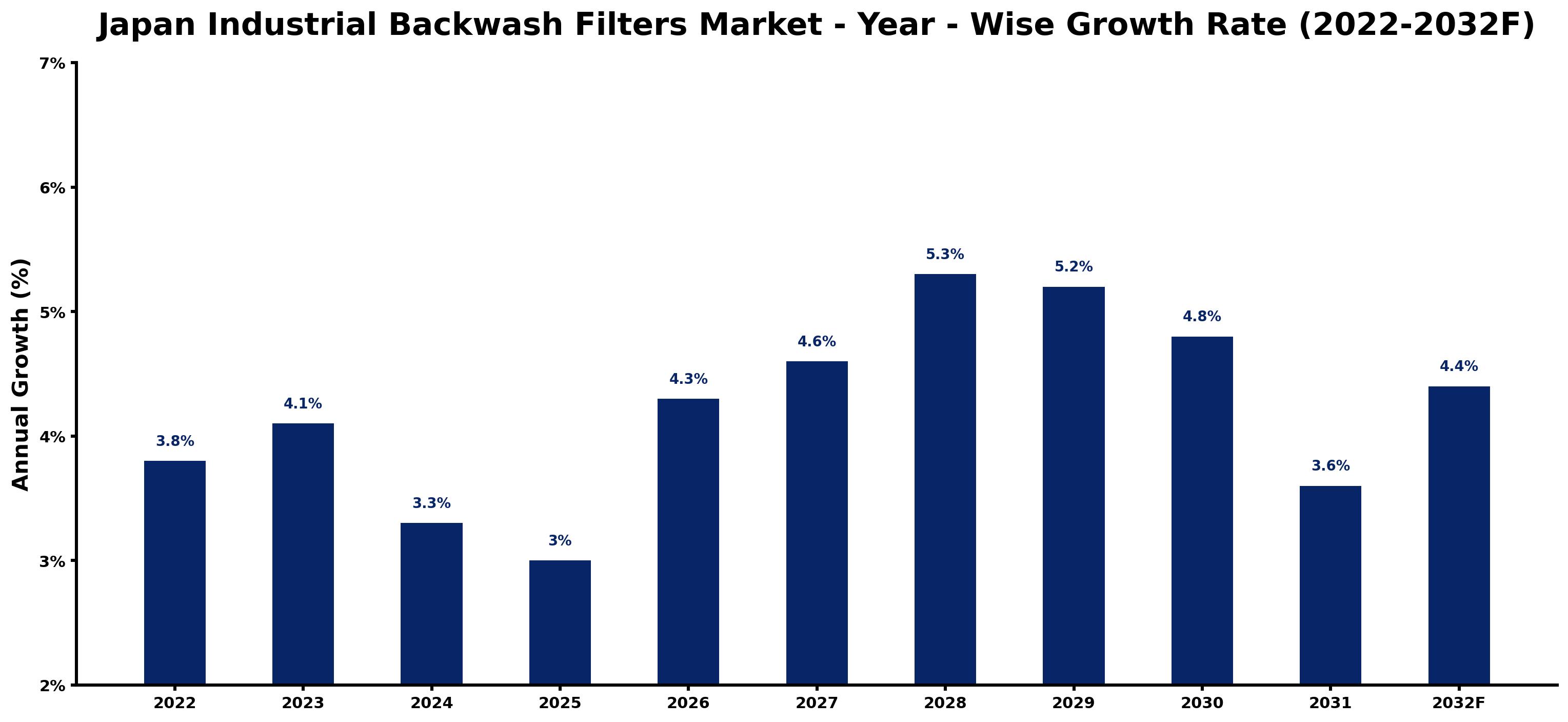
Each row of the following table gives one year's estimated growth and the event or demand shift that explains it.
| Year | Estimated Annual Growth (%) | Market Rationale |
| 2022 | 3.8 | The market showed steady growth, driven by ongoing investments in water treatment technologies. |
| 2023 | 4.1 | Growth accelerated as demand from water treatment plants increased. |
| 2024 | 3.3 | The rate slowed as some sectors adjusted to new environmental regulations. |
| 2025 | 3.0 | A further slowdown occurred due to market saturation in certain industrial applications. |
| 2026 | 4.3 | Growth is expected to pick up again as investments in sustainable technologies gain traction. |
| 2027 | 4.6 | Demand is projected to continue rising, particularly in chemical processing units. |
| 2028 | 5.3 | The market is expected to peak with heightened focus on environmental compliance and efficiency. |
| 2029 | 5.2 | Growth is anticipated to slow slightly as capacity expansions reach maturity in some areas. |
| 2030 | 4.8 | A further slowdown is expected as competition intensifies among suppliers. |
| 2031 | 3.6 | The market is projected to grow at a slower rate as operational efficiencies become a priority. |
| 2032 | 4.4 | Demand is expected to rise again as new water treatment facilities come online. |
Note: Market size estimations and growth projections presented in this report are based on 6Wresearch's proprietary forecasting methodology, utilizing the latest available industry data, government publications, and primary research inputs.
Japan Industrial Backwash Filters Market Synopsis
Industrial backwash filters remove contaminants from water in industrial applications by reversing the flow to clean filter media. The Japan Industrial Backwash Filters Market is growing due to rising investments in water treatment technologies and stricter environmental regulations. The average annual investment in water treatment technologies is about 200 billion yen, while the GX Basic Policy aims for approximately JPY 150 trillion in decarbonisation investment over the next decade, boosting demand from sectors such as water treatment plants and industrial manufacturing.
Market Dynamics Impact Analysis (2026–2032)
| Factor | Type | Impact | Primary Segment Affected |
| Increasing investments in water treatment technologies | Driver | High | Automatic Backwash Filters |
| Rising environmental regulations mandating cleaner operations | Driver | High | Dual Media Filters |
| Growing demand for efficient water filtration solutions | Opportunity | High | Cooling Tower Operators |
| Expansion of water treatment infrastructure in urban areas | Opportunity | Medium | Water Treatment Plants |
| High initial investment costs for advanced filtration systems | Restraint | High | Cartridge Backwash Systems |
| Limited awareness of new technologies among smaller operators | Restraint | Medium | Manual Backwash Filters |
| Competition from alternative filtration technologies | Challenge | High | Self-Cleaning |
| Supply chain disruptions affecting equipment availability | Challenge | Medium | Programmable |
Evaluation of Drivers in Japan Industrial Backwash Filters Market (2026–2032)
These are the developments adding the most demand over the forecast period.
| Drivers | Primary Segment Affected | Why It Matters (Evidence) |
| Increased focus on environmental compliance | Automatic Backwash Filters | This drives demand as industries seek to meet stricter regulations, with average annual investments in water treatment technologies at about 200 billion yen. |
| Technological advancements in filtration efficiency | Dual Media Filters | These advancements lead to higher adoption rates, particularly in water treatment plants, which serve an average population of around 300,000. |
| Rising operational costs prompting efficiency upgrades | Cooling Tower Operators | Operators are investing in more efficient systems to reduce long-term costs, contributing to the market's growth. |
| Growing industrial activity in regions like Kyushu | Chemical Process Units | This region's industrial boiler operations drive demand for advanced filtration solutions. |
| Increased public and private investment in decarbonisation | Self-Cleaning | The GX Basic Policy aims for JPY 150 trillion in investments, boosting the market for efficient filtration. |
The average annual investment in water treatment technologies is about 200 billion yen, prompting industries to upgrade their systems. Rising industrial activity in chemical processing units is boosting demand for filtration solutions. Operators in cooling tower applications are increasingly adopting self-cleaning filters to improve efficiency and reduce operational costs.
Evaluation of Restraints in Japan Industrial Backwash Filters Market
The following restraints limit how fast demand can grow.
| Market Restraint | Primary Segment Affected | Why It Matters (Evidence) |
| High initial investment costs for advanced filtration systems | Cartridge Backwash Systems | These costs deter smaller operators from upgrading, limiting market growth in certain segments. |
| Limited awareness of new technologies among smaller operators | Manual Backwash Filters | This lack of knowledge restricts adoption rates, particularly in less urbanised areas. |
| Regulatory complexities in compliance reporting | Automatic Backwash Filters | Navigating these regulations can be challenging for smaller operators, hindering their investment decisions. |
| Competition from alternative filtration technologies | Self-Cleaning | Emerging technologies may divert investment away from traditional filtration systems. |
| Supply chain disruptions affecting equipment availability | Programmable | These disruptions can lead to delays in project timelines, impacting overall market growth. |
Japan Industrial Backwash Filters Market Challenges
Water treatment producers face challenges in complying with the JIS B 8361 standard, which requires high filter performance. This regulation arises from Japan's strict environmental policies, raising production costs by approximately 15% and extending delivery timelines for manufacturers. Distributors often lack expertise in advanced filtration technologies, leading to inefficiencies that can delay project completions by up to six months. Buyers are encountering rising costs as the average annual investment in water treatment technologies reaches about 200 billion yen, compelling them to allocate larger budgets for necessary upgrades. Stricter dual media filter regulations can also impose higher initial expenses on buyers, straining their operational budgets.
Trends in the Japan Industrial Backwash Filters Market
Four trends stand out in the Japan Industrial Backwash Filters Market.
- Shift towards Automated Filtration Systems: The Tokyo metropolitan area is increasingly adopting automated filtration systems, with a reported 30% rise in installations since 2022. This trend boosts operational efficiency and reduces manual intervention.
- Transition from Manual to Programmable Filters: Since 2023, there has been a notable shift towards programmable filters in industrial applications, driven by a growing demand for automated cleaning schedules that improve efficiency.
- Emergence of Dual Media Filters: The use of dual media filters has surged due to stricter environmental regulations, with a 40% increase in installations in water treatment plants since 2022, ensuring compliance.
- Cooling Tower Operators Prioritising Self-Cleaning Solutions: Cooling tower operators are increasingly prioritising self-cleaning filters, with adoption rates rising by 20% in 2023, resulting in reduced maintenance costs.
Investment Opportunities in the Japan Industrial Backwash Filters Market
The openings below show where demand in the Japan Industrial Backwash Filters Market is visible and how suppliers can enter.
- Kyushu Region's Industrial Expansion: The Kyushu region is experiencing growth in industrial activities, creating a demand for advanced filtration solutions. Investing in automatic backwash filters here could yield substantial returns, given the region's industrial boiler operations.
- Collaboration for Decarbonisation Initiatives: Partnerships with local water treatment facilities can facilitate market entry, especially as public-private investments target JPY 150 trillion in decarbonisation over the next decade.
- Growing Demand from Water Treatment Plants: Water treatment plants are increasingly seeking efficient filtration solutions, with an average investment of 200 billion yen annually. Suppliers can enter this market through partnerships with local operators.
- Investment in Compact Filtration Solutions: The rising demand for cartridge backwash systems in compact industrial setups presents an opportunity for suppliers to provide tailored solutions, particularly in urban areas.
Government Initiatives in the Japan Industrial Backwash Filters Market
The GX Promotion Act, enacted in 2023, establishes the legal foundation for Japan's decarbonisation strategy. This act aims for a 46% reduction in greenhouse gas emissions by fiscal 2030, driving investments in water treatment technologies. The Industrial Safety and Health Act of 1972 mandates safety measures for hazardous substances, influencing operational standards for filtration systems in industrial settings.
The Japan Water Works Association oversees programs to improve water quality in industrial sectors, promoting compliance with environmental standards. The Ministry of the Environment supports best practices in water treatment, ensuring that facilities adhere to the JIS B 8361 standard for backwash filter performance.
Future Insight of the Japan Industrial Backwash Filters Market
New water treatment facilities will emerge by 2032, driven by the government's commitment to decarbonisation and water quality improvement initiatives. This shift will enable suppliers to deliver advanced filtration technologies that comply with evolving standards. The average lifespan of industrial backwash filters is projected to extend, allowing for better long-term investments. As the Japan Water Works Association promotes best practices, buyers will benefit from enhanced filtration solutions that support their operational efficiency and environmental compliance.
Market Segmentation Analysis
Japan Industrial Backwash Filters Market report covers a detailed analysis of the following market segments:
By Filter Type – Automatic Backwash Filters Lead, Manual Backwash Filters Expected to Grow Fastest
According to Prakhar Dixit, Senior Research Analyst at 6Wresearch, Automatic Backwash Filters accounted for 40% of the market by filter type in 2025. Automatic backwash filters maintain the largest share due to their ability to clean themselves, ensuring uninterrupted operation in extensive water treatment facilities. The reliance on these filters is particularly evident in regions like Tokyo, where numerous facilities depend on them for efficiency. Manual Backwash Filters are set to record the highest CAGR in this split, 6.4% over 2026–2032. Manual backwash filters are experiencing rapid growth as they become increasingly popular in smaller industrial setups where automation may not be feasible. This growth is fuelled by the need for cost-effective solutions in environments with limited space. Suppliers should focus on developing manual backwash filters to meet the rising demand in compact industrial applications.
By Cleaning Mechanism – Programmable Leads, Manual Trigger Expected to Grow Fastest
The largest cleaning mechanism category in 2025 was Programmable, at 45% of revenue. Programmable cleaning mechanisms hold the largest share as they allow for automated cleaning schedules, which improves operational efficiency in various industrial applications. Facilities adhering to the JIS B 8361 standard benefit from this technology, ensuring compliance with performance regulations. Manual Trigger is projected to grow fastest, at a CAGR of 6.1% during 2026–2032. Manual trigger mechanisms are gaining traction in scenarios where automation is impractical, particularly in smaller facilities. This growth reflects a shift towards flexibility in cleaning processes to accommodate diverse operational needs. Buyers may seek suppliers who offer both programmable and manual options to cater to varying operational requirements.
By Media Type – Sand/Cartridge Leads, Stainless Mesh Expected to Grow Fastest
In 2025, Sand/Cartridge led the media type split with a 37% share. Sand/cartridge media types are prevalent in the market as they are the standard choice for filtration in numerous industrial settings. Their widespread use in water treatment plants underscores their reliability and effectiveness in contaminant removal. The quickest growth will come from Stainless Mesh, forecast to expand at a CAGR of 6.9% between 2026 and 2032. Stainless mesh media is seeing the fastest growth due to its durability and reusability, appealing to industries focused on sustainability. The increasing emphasis on long-lasting materials aligns with environmental regulations and cost-saving measures. Suppliers should consider expanding their product lines to include more durable media options to attract environmentally conscious buyers.
By End User – Cooling Tower Operators Lead, Water Treatment Plants Expected to Grow Fastest
Cooling Tower Operators held 49% of the Japan Industrial Backwash Filters Market by end user in 2025. Cooling tower operators lead the market as they play a vital role in maintaining water quality in cooling systems, essential for various industrial operations. The average population served by these cooling systems highlights their importance in urban water management. Over 2026–2032, Water Treatment Plants are expected to post the fastest growth, at a CAGR of 5.8%. Water treatment plants represent the fastest-growing end user segment, driven by increased investments in initiatives aimed at improving water quality. The government's focus on enhancing water treatment infrastructure post-2023 is a significant factor in this trend. Suppliers must align their offerings with the needs of water treatment plants to capitalise on this growing market opportunity.
Key Attractiveness of the Report
- 10 Years of Market Numbers
- Historical Data Starting from 2022 to 2025
- Base Year 2025
- Forecast Data until 2032
- Key Performance Indicators Impacting the Market
- Major Upcoming Developments and Projects
Key Highlights of the Report:
- Japan Industrial Backwash Filters Market Outlook
- Market Size of Japan Industrial Backwash Filters Market, 2025
- Forecast of Japan Industrial Backwash Filters Market, 2032
- Historical Data and Forecast of Japan Industrial Backwash Filters Revenues & Volume for the Period 2022-2032F
- Japan Industrial Backwash Filters Market Trend Evolution
- Japan Industrial Backwash Filters Market Drivers and Challenges
- Japan Industrial Backwash Filters Price Trends
- Japan Industrial Backwash Filters Porter's Five Forces
- Japan Industrial Backwash Filters Industry Life Cycle
- Historical Data and Forecast of Japan Industrial Backwash Filters Market Revenues & Volume By Filter Type for the Period 2022-2032F
- Historical Data and Forecast of Japan Industrial Backwash Filters Market Revenues & Volume By Automatic Backwash Filters for the Period 2022-2032F
- Historical Data and Forecast of Japan Industrial Backwash Filters Market Revenues & Volume By Manual Backwash Filters for the Period 2022-2032F
- Historical Data and Forecast of Japan Industrial Backwash Filters Market Revenues & Volume By Dual Media Filters for the Period 2022-2032F
- Historical Data and Forecast of Japan Industrial Backwash Filters Market Revenues & Volume By Cartridge Backwash Systems for the Period 2022-2032F
- Historical Data and Forecast of Japan Industrial Backwash Filters Market Revenues & Volume By Cleaning Mechanism for the Period 2022-2032F
- Historical Data and Forecast of Japan Industrial Backwash Filters Market Revenues & Volume By Programmable for the Period 2022-2032F
- Historical Data and Forecast of Japan Industrial Backwash Filters Market Revenues & Volume By Manual Trigger for the Period 2022-2032F
- Historical Data and Forecast of Japan Industrial Backwash Filters Market Revenues & Volume By Automatic/Manual for the Period 2022-2032F
- Historical Data and Forecast of Japan Industrial Backwash Filters Market Revenues & Volume By Self-Cleaning for the Period 2022-2032F
- Historical Data and Forecast of Japan Industrial Backwash Filters Market Revenues & Volume By Media Type for the Period 2022-2032F
- Historical Data and Forecast of Japan Industrial Backwash Filters Market Revenues & Volume By Sand/Cartridge for the Period 2022-2032F
- Historical Data and Forecast of Japan Industrial Backwash Filters Market Revenues & Volume By Stainless Mesh for the Period 2022-2032F
- Historical Data and Forecast of Japan Industrial Backwash Filters Market Revenues & Volume By Sand + Gravel for the Period 2022-2032F
- Historical Data and Forecast of Japan Industrial Backwash Filters Market Revenues & Volume By Polypropylene for the Period 2022-2032F
- Historical Data and Forecast of Japan Industrial Backwash Filters Market Revenues & Volume By End User for the Period 2022-2032F
- Historical Data and Forecast of Japan Industrial Backwash Filters Market Revenues & Volume By Cooling Tower Operators for the Period 2022-2032F
- Historical Data and Forecast of Japan Industrial Backwash Filters Market Revenues & Volume By Water Treatment Plants for the Period 2022-2032F
- Historical Data and Forecast of Japan Industrial Backwash Filters Market Revenues & Volume By Industrial Boilers for the Period 2022-2032F
- Historical Data and Forecast of Japan Industrial Backwash Filters Market Revenues & Volume By Chemical Process Units for the Period 2022-2032F
- Japan Industrial Backwash Filters Import Export Trade Statistics
- Market Opportunity Assessment By Filter Type
- Market Opportunity Assessment By Cleaning Mechanism
- Market Opportunity Assessment By Media Type
- Market Opportunity Assessment By End User
- Japan Industrial Backwash Filters Top Companies Market Share
- Japan Industrial Backwash Filters Competitive Benchmarking By Technical and Operational Parameters
- Japan Industrial Backwash Filters Company Profiles
- Japan Industrial Backwash Filters Key Strategic Recommendations
Market Covered
Coverage by segment is as follows.
By Filter Type
- Automatic Backwash Filters
- Manual Backwash Filters
- Dual Media Filters
- Cartridge Backwash Systems
By Cleaning Mechanism
- Programmable
- Manual Trigger
- Automatic/Manual
- Self-Cleaning
By Media Type
- Sand/Cartridge
- Stainless Mesh
- Sand + Gravel
- Polypropylene
By End User
- Cooling Tower Operators
- Water Treatment Plants
- Industrial Boilers
- Chemical Process Units































