Japan Industrial Bagging Equipment Market Size & Growth Rate
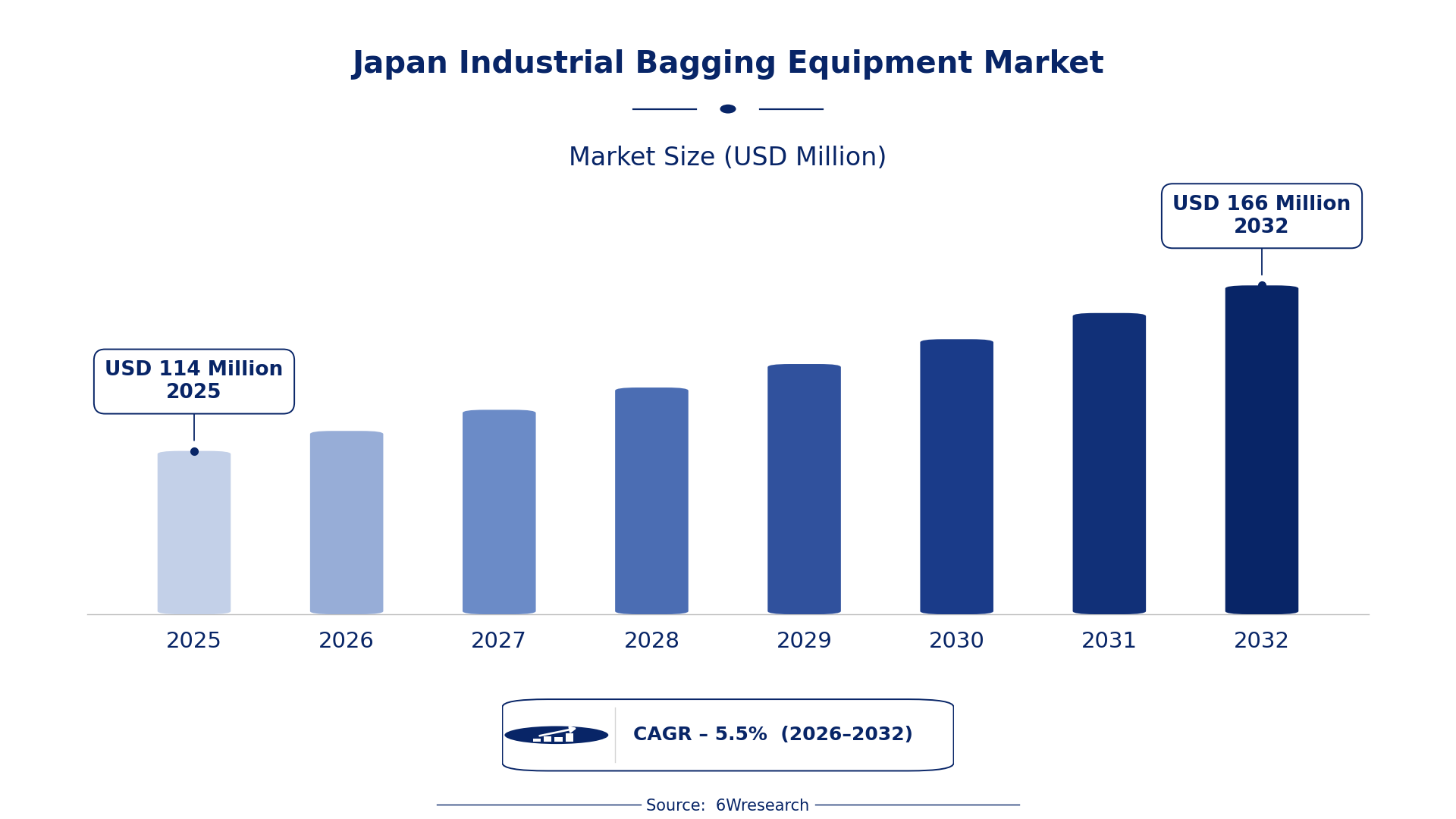
According to 6Wresearch internal database and industry insights, the Japan Industrial Bagging Equipment Market was valued at USD 114 Million in 2025 and is projected to reach USD 166 Million by 2032, growing at a CAGR of approximately 5.5% during 2026–2032.
Japan Industrial Bagging Equipment Market Highlights
| Report Metric | Details |
| Report Name | Japan Industrial Bagging Equipment Market (2026-2032) |
| Market Size 2025 | USD 114 Million |
| Market Size 2032 | USD 166 Million |
| Absolute Growth 2025–2032 | USD 52 Million |
| CAGR 2026–2032 | 5.5% |
| Peak Annual Growth | 6.7% in 2032 |
| Forecast Period | 2026–2032 |
| Historical Data | 2022–2025 |
| Base Year | 2025 |
| Leading Equipment Type, 2025 | FFS Bagging Machines (45% share) |
| Leading Bag Type, 2025 | Pre-formed Bags (44% share) |
| Leading Automation Level, 2025 | Fully Automated (49% share) |
| Leading End User, 2025 | Agriculture Industry (47% share) |
| Fastest-Growing Equipment Type | Valve Bag Packers (7.7% CAGR) |
| Fastest-Growing Bag Type | FIBCs (7.8% CAGR) |
| Fastest-Growing Automation Level | Semi-Automated (8.0% CAGR) |
| Fastest-Growing End User | Chemical Manufacturers (7.3% CAGR) |
| Growing Sector | Agriculture |
| Key End Users | Agriculture Industry, Cement & Building Materials, Chemical Manufacturers, Fertilizer Plants |
Japan Industrial Bagging Equipment Market Year-wise Growth Rate and Key Drivers (2022–2032)
This graph illustrates the annual growth rates of the market from 2022 to 2032, highlighting a steady upward trajectory and projected market expansion over the forecast period.
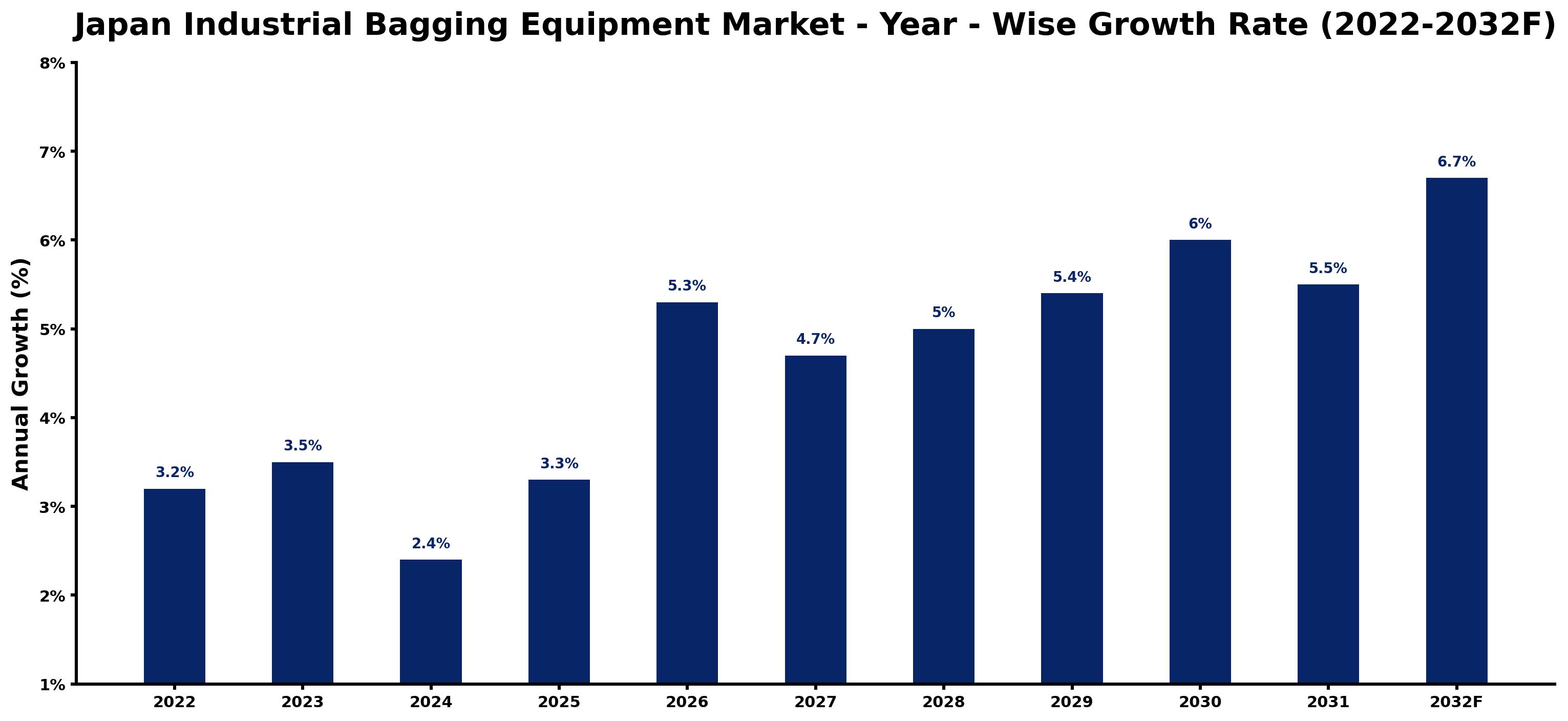
The following figures match every annual growth estimate with the main market development of that year, giving the reasoning behind each rise or slowdown.
| Year | Estimated Annual Growth (%) | Market Rationale |
| 2022 | 3.2 | The market showed steady growth, reflecting ongoing demand from various sectors. |
| 2023 | 3.5 | Growth accelerated due to increased investments in agriculture and construction. |
| 2024 | 2.4 | Growth slowed as some sectors faced temporary challenges in demand. |
| 2025 | 3.3 | A rebound occurred as agricultural activities picked up, boosting equipment needs. |
| 2026 | 5.3 | Demand is expected to surge as more facilities adopt fully automated systems for efficiency. |
| 2027 | 4.7 | A slight slowdown is projected as market adjustments take place. |
| 2028 | 5.0 | Growth is expected to resume as technological advancements in bagging equipment emerge. |
| 2029 | 5.4 | Demand will continue to rise, driven by the construction industry's expansion. |
| 2030 | 6.0 | Increased investments in sustainability practices will further boost market growth. |
| 2031 | 5.5 | A minor slowdown is projected as the market stabilises after rapid growth. |
| 2032 | 6.7 | The market will peak, driven by high demand for efficient packaging solutions. |
Note: Market size estimations and growth projections presented in this report are based on 6Wresearch's proprietary forecasting methodology, utilizing the latest available industry data, government publications, and primary research inputs.
Japan Industrial Bagging Equipment Market Synopsis
Industrial bagging equipment is essential for packaging bulk materials across various industries, including agriculture and construction. The Japan Industrial Bagging Equipment Market is expanding, primarily due to the agriculture sector, which accounts for 30% of total demand. Investments in automation and efficiency improvements, alongside a growing focus on sustainability, are driving this growth. For instance, Japan's agricultural sector, with approximately 2 million farmers, is increasingly adopting advanced bagging technologies to improve productivity and meet regulatory standards.
Market Dynamics Impact Analysis (2026–2032)
| Factor | Type | Impact | Primary Segment Affected |
| Growing demand from the agriculture sector for efficient packaging solutions | Driver | High | Open Mouth Baggers |
| Increased investments in fully automated systems for productivity | Driver | High | Fully Automated |
| Rising need for sustainable packaging solutions in construction | Opportunity | Medium | Bulk Bag Fillers |
| Expansion of chemical manufacturing requiring precise bagging equipment | Opportunity | Medium | Valve Bag Packers |
| High initial investment costs for advanced bagging technologies | Restraint | High | FFS Bagging Machines |
| Limited availability of skilled workforce for operating advanced systems | Restraint | Medium | Semi-Automated |
| Regulatory compliance costs affecting small-scale producers | Challenge | High | Pre-formed Bags |
| Technological advancements outpacing existing equipment capabilities | Challenge | Medium | FIBCs |
Evaluation of Drivers in Japan Industrial Bagging Equipment Market (2026–2032)
The factors lifting demand, and the evidence behind each, are summarised below.
| Drivers | Primary Segment Affected | Why It Matters (Evidence) |
| Increased agricultural output requiring efficient packaging | Open Mouth Baggers | The agriculture sector, representing 30% of demand, drives the need for bulk packaging solutions, especially for grains and seeds. |
| Adoption of fully automated systems for efficiency | Fully Automated | Fertilizer plants are investing in fully automated systems, which are projected to increase productivity and drive demand. |
| Growing construction activities necessitating bulk material packaging | Bulk Bag Fillers | The cement and building materials industry in the Kanto region is a major user of bagging equipment for packaging aggregates. |
| Need for safe handling of hazardous materials in chemicals | Valve Bag Packers | Chemical manufacturers require precise filling solutions to ensure safe handling of bulk chemicals. |
| Demand for high-speed packaging solutions in food and agriculture | FFS Bagging Machines | The FFS bagging machine segment is projected to grow due to increasing efficiency needs in packaging processes. |
Several shifts outside the market lift sales. The agriculture sector, accounting for 30% of total demand, is driving increased agricultural output that requires efficient packaging solutions like open mouth baggers. Fertilizer plants are investing in fully automated systems, which are expected to improve productivity and drive demand for fully automated bagging equipment. The construction industry's expansion in the Kanto region necessitates bulk bag fillers for packaging aggregates. Chemical manufacturers require valve bag packers for the safe handling of hazardous materials, further boosting demand. The FFS bagging machine segment is projected to grow due to rising efficiency needs in packaging processes.
Evaluation of Restraints in Japan Industrial Bagging Equipment Market
The main factors holding the market back are set out below.
| Market Restraint | Primary Segment Affected | Why It Matters (Evidence) |
| High initial investment costs for advanced bagging technologies | FFS Bagging Machines | Producers face high upfront costs, limiting adoption among smaller operations in the market. |
| Limited availability of skilled workforce for operating advanced systems | Semi-Automated | The shortage of skilled workers hampers the efficient operation of semi-automated bagging systems. |
| Regulatory compliance costs affecting small-scale producers | Pre-formed Bags | Compliance costs restrict small producers' ability to invest in new technologies, affecting their competitiveness. |
| Technological advancements outpacing existing equipment capabilities | FIBCs | Rapid technological changes create challenges for producers trying to keep pace with market demands. |
| Market saturation in certain segments limiting growth potential | Valve Bag Packers | Increased competition and market saturation can restrict growth opportunities for existing players. |
Japan Industrial Bagging Equipment Market Challenges
Producers face stringent regulations aimed at reducing greenhouse gas emissions, compelling them to invest in costly compliance technologies. Japan's goal of a 46% reduction by 2030 requires substantial investments, impacting budgets in the agriculture and construction sectors. Buyers are experiencing rising prices as minimum wages increase to JPY 1,055 per hour, inflating operational costs for producers and ultimately affecting equipment pricing. Importers are encountering supply chain disruptions due to reliance on specific regions, particularly the Kanto area, which delays deliveries and raises costs for buyers across various industries.
Trends in the Japan Industrial Bagging Equipment Market
These developments are changing demand patterns in the Japan Industrial Bagging Equipment Market.
- Shift towards Fully Automated Systems: In 2023, the trend towards fully automated bagging systems gained traction, with fertilizer plants investing in these technologies to improve productivity. Approximately 30% of new installations are now fully automated.
- Increased Adoption of Sustainable Packaging Solutions: The Japan Packaging Institute has promoted standards for sustainable packaging, resulting in a notable rise in demand for eco-friendly bagging options among manufacturers in 2023.
- Expansion of Chemical Manufacturing: The Tokyo region is witnessing a surge in chemical manufacturing, leading to a significant increase in demand for valve bag packers to ensure safe handling of hazardous materials in 2023.
- Rising Demand for Bulk Bag Fillers in Construction: Construction activities have surged in the Kanto region, resulting in a notable rise in the use of bulk bag fillers for packaging materials like sand and gravel.
Investment Opportunities in the Japan Industrial Bagging Equipment Market
Several openings in the Japan Industrial Bagging Equipment Market merit attention from investors.
- Growing Need for Automation in Agriculture: With Japan's agricultural sector requiring efficient packaging solutions, there is a strong opportunity for investment in fully automated bagging systems, particularly in rural areas where modernization is essential.
- Expansion in the Cement Industry: The growth of the construction sector presents an opportunity for suppliers of bulk bag fillers, especially in the Kanto region, where demand is rising due to ongoing infrastructure projects.
- Investment in Sustainable Packaging Technologies: As sustainability becomes a priority, companies have the chance to invest in eco-friendly bagging solutions, particularly for the agriculture sector, which faces pressure to reduce its carbon footprint.
- Emerging Demand from Chemical Manufacturers: The chemical industry is expanding, creating a need for advanced bagging equipment like valve bag packers, which ensure safe handling of materials, particularly in urban manufacturing hubs.
Government Initiatives in the Japan Industrial Bagging Equipment Market
The Act on the Rational Use of Energy requires large energy users to adopt energy-efficient technologies, impacting producers of industrial bagging equipment by necessitating upgrades to reduce energy consumption and greenhouse gas emissions. This measure aligns with Japan's environmental goals and encourages innovation in equipment design, aiming for a 46% reduction in emissions by 2030. Additionally, the national minimum wage increase to JPY 1,055 per hour in 2024 affects operational costs for producers, pushing them towards more efficient solutions.
The GX Promotion Act provides a framework for decarbonisation investments, including funding for modernising equipment in various industries. The Ministry of Agriculture, Forestry and Fisheries supports farmers in adopting these technologies, improving their productivity and compliance with environmental standards, with a target of JPY 150 trillion in investments over the next decade.
Future Insight of the Japan Industrial Bagging Equipment Market
Investment in decarbonisation will create a surge in demand for advanced bagging technologies, with JPY 150 trillion allocated over the next decade. By 2032, the agricultural sector is likely to transition towards modernised packaging solutions, driven by government support for innovation. The implementation of ISO 9001 standards will improve manufacturing quality across the industry. Increased automation in bagging systems will enhance productivity, especially in sectors like construction, where efficient packaging is crucial for materials such as sand and gravel.
Market Segmentation Analysis
Japan Industrial Bagging Equipment Market report covers a detailed analysis of the following market segments:
By Equipment Type – FFS Bagging Machines Lead, Valve Bag Packers Expected to Grow Fastest
According to Saurav Kr Singh, Senior Research Analyst at 6Wresearch, in 2025, FFS Bagging Machines led the equipment type split with a 45% share. FFS bagging machines lead the market owing to their extensive use in high-speed packaging, particularly for agricultural products. Their capability to efficiently handle grains and seeds is vital in Japan's agriculture sector, which represents 30% of total demand. Valve Bag Packers are projected to grow fastest, at a CAGR of 7.7% during 2026–2032. Valve bag packers are experiencing rapid growth as they are critical for the precise filling of powders and granules, especially in the chemical industry. This segment's expansion is fuelled by heightened safety regulations and the necessity for accurate packaging of hazardous materials. Suppliers should prioritise advancements in valve bag packers to align with the increasing safety and efficiency requirements of the chemical sector.
By Bag Type – Pre-formed Bags Lead, FIBCs Expected to Grow Fastest
With 44% of bag type revenue in 2025, Pre-formed Bags was the largest category. Pre-formed bags hold the largest share as they are designed for specific products, providing convenience and efficiency in packaging. Their extensive application in agriculture demonstrates their necessity, particularly for farmers who need ready-to-fill solutions for seeds and fertilizers. Over 2026–2032, FIBCs are expected to post the fastest growth, at a CAGR of 7.8%. FIBCs are witnessing rapid growth due to their essential function in the secure transport of bulk materials across various sectors. The increasing need for efficient and safe packaging solutions, especially in construction and agriculture, is propelling this segment's expansion. Suppliers must prioritise the development of FIBCs that meet safety standards and address the transportation demands of bulk material handlers.
By Automation Level – Fully Automated Leads, Semi-Automated Expected to Grow Fastest
The largest automation level category in 2025 was Fully Automated, at 49% of revenue. Fully automated systems lead the market as they are increasingly adopted for their efficiency in high-volume operations, particularly in the agriculture sector. Their ability to streamline processes and reduce labour costs makes them a preferred choice among large-scale producers. The quickest growth will come from Semi-Automated, forecast to expand at a CAGR of 8.0% between 2026 and 2032. Semi-automated systems are growing rapidly as they allow facilities to optimise labour costs while still improving productivity. This segment appeals to businesses looking for a balance between automation and manual intervention, especially in smaller operations. Vendors should consider offering flexible automation solutions that cater to both fully automated and semi-automated preferences of various end users.
By End User – Agriculture Industry Leads, Chemical Manufacturers Expected to Grow Fastest
Agriculture Industry accounted for 47% of the market by end user in 2025. The agriculture industry is the leading user of bagging equipment, heavily relying on these solutions for the efficient packaging of seeds and fertilizers. With approximately 2 million farmers in Japan, the demand for effective packaging solutions remains robust. Chemical Manufacturers are set to record the highest CAGR in this split, 7.3% over 2026–2032. Chemical manufacturers represent the fastest-growing segment as they require precise packaging solutions for hazardous materials. The heightened regulatory focus on safety and efficiency in chemical handling is driving this growth. Suppliers should tailor their products to meet the specific needs of chemical manufacturers, ensuring compliance with safety regulations.
Key Attractiveness of the Report
- 10 Years of Market Numbers
- Historical Data Starting from 2022 to 2025
- Base Year 2025
- Forecast Data until 2032
- Key Performance Indicators Impacting the Market
- Major Upcoming Developments and Projects
Key Highlights of the Report:
- Japan Industrial Bagging Equipment Market Outlook
- Market Size of Japan Industrial Bagging Equipment Market, 2025
- Forecast of Japan Industrial Bagging Equipment Market, 2032
- Historical Data and Forecast of Japan Industrial Bagging Equipment Revenues & Volume for the Period 2022-2032F
- Japan Industrial Bagging Equipment Market Trend Evolution
- Japan Industrial Bagging Equipment Market Drivers and Challenges
- Japan Industrial Bagging Equipment Price Trends
- Japan Industrial Bagging Equipment Porter's Five Forces
- Japan Industrial Bagging Equipment Industry Life Cycle
- Historical Data and Forecast of Japan Industrial Bagging Equipment Market Revenues & Volume By Equipment Type for the Period 2022-2032F
- Historical Data and Forecast of Japan Industrial Bagging Equipment Market Revenues & Volume By Open Mouth Baggers for the Period 2022-2032F
- Historical Data and Forecast of Japan Industrial Bagging Equipment Market Revenues & Volume By Valve Bag Packers for the Period 2022-2032F
- Historical Data and Forecast of Japan Industrial Bagging Equipment Market Revenues & Volume By FFS Bagging Machines for the Period 2022-2032F
- Historical Data and Forecast of Japan Industrial Bagging Equipment Market Revenues & Volume By Bulk Bag Fillers for the Period 2022-2032F
- Historical Data and Forecast of Japan Industrial Bagging Equipment Market Revenues & Volume By Bag Type for the Period 2022-2032F
- Historical Data and Forecast of Japan Industrial Bagging Equipment Market Revenues & Volume By Pre-formed Bags for the Period 2022-2032F
- Historical Data and Forecast of Japan Industrial Bagging Equipment Market Revenues & Volume By Powdered Products for the Period 2022-2032F
- Historical Data and Forecast of Japan Industrial Bagging Equipment Market Revenues & Volume By Film Roll to Bag for the Period 2022-2032F
- Historical Data and Forecast of Japan Industrial Bagging Equipment Market Revenues & Volume By FIBCs for the Period 2022-2032F
- Historical Data and Forecast of Japan Industrial Bagging Equipment Market Revenues & Volume By Automation Level for the Period 2022-2032F
- Historical Data and Forecast of Japan Industrial Bagging Equipment Market Revenues & Volume By Semi-Automated for the Period 2022-2032F
- Historical Data and Forecast of Japan Industrial Bagging Equipment Market Revenues & Volume By Fully Automated for the Period 2022-2032F
- Historical Data and Forecast of Japan Industrial Bagging Equipment Market Revenues & Volume By Fully Integrated for the Period 2022-2032F
- Historical Data and Forecast of Japan Industrial Bagging Equipment Market Revenues & Volume By Manual/Automated for the Period 2022-2032F
- Historical Data and Forecast of Japan Industrial Bagging Equipment Market Revenues & Volume By End User for the Period 2022-2032F
- Historical Data and Forecast of Japan Industrial Bagging Equipment Market Revenues & Volume By Agriculture Industry for the Period 2022-2032F
- Historical Data and Forecast of Japan Industrial Bagging Equipment Market Revenues & Volume By Cement & Building Materials for the Period 2022-2032F
- Historical Data and Forecast of Japan Industrial Bagging Equipment Market Revenues & Volume By Chemical Manufacturers for the Period 2022-2032F
- Historical Data and Forecast of Japan Industrial Bagging Equipment Market Revenues & Volume By Fertilizer Plants for the Period 2022-2032F
- Japan Industrial Bagging Equipment Import Export Trade Statistics
- Market Opportunity Assessment By Equipment Type
- Market Opportunity Assessment By Bag Type
- Market Opportunity Assessment By Automation Level
- Market Opportunity Assessment By End User
- Japan Industrial Bagging Equipment Top Companies Market Share
- Japan Industrial Bagging Equipment Competitive Benchmarking By Technical and Operational Parameters
- Japan Industrial Bagging Equipment Company Profiles
- Japan Industrial Bagging Equipment Key Strategic Recommendations
Market Covered
The following segment groups are covered in the report.
By Equipment Type
- Open Mouth Baggers
- Valve Bag Packers
- FFS Bagging Machines
- Bulk Bag Fillers
By Bag Type
- Pre-formed Bags
- Powdered Products
- Film Roll to Bag
- FIBCs
By Automation Level
- Semi-Automated
- Fully Automated
- Fully Integrated
- Manual/Automated
By End User
- Agriculture Industry
- Cement & Building Materials
- Chemical Manufacturers
- Fertilizer Plants































