Japan Industrial Belt Systems Market Size & Growth Rate
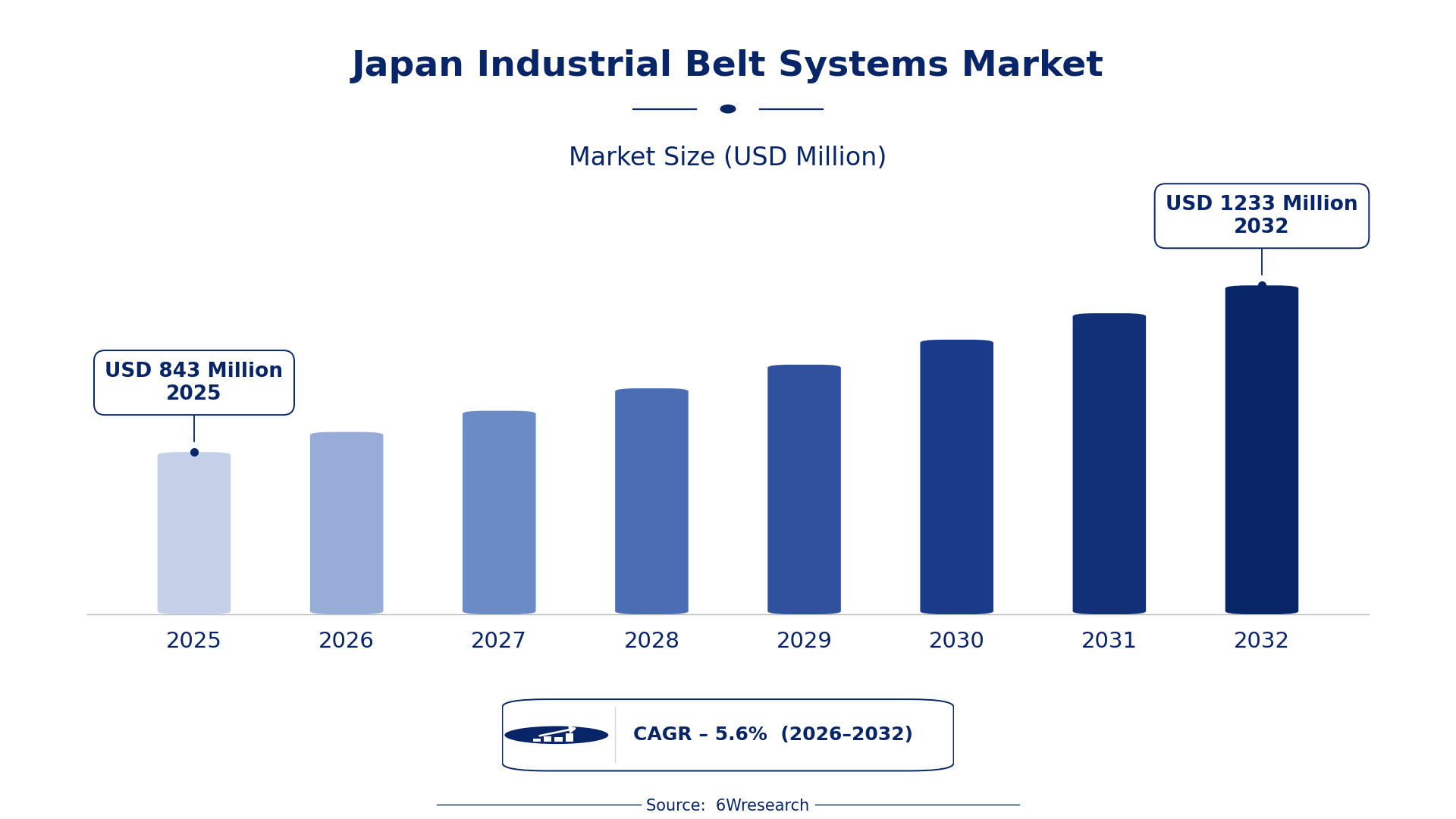
According to 6Wresearch internal database and industry insights, the Japan Industrial Belt Systems Market was valued at USD 843 Million in 2025 and is projected to reach USD 1,233 Million by 2032, growing at a CAGR of approximately 5.6% during 2026–2032.
Japan Industrial Belt Systems Market Highlights
| Report Metric | Details |
| Report Name | Japan Industrial Belt Systems Market (2026-2032) |
| Market Size 2025 | USD 843 Million |
| Market Size 2032 | USD 1,233 Million |
| Absolute Growth 2025–2032 | USD 390 Million |
| CAGR 2026–2032 | 5.6% |
| Peak Annual Growth | 7.1% in 2032 |
| Forecast Period | 2026–2032 |
| Historical Data | 2022–2025 |
| Base Year | 2025 |
| Leading Belt Type, 2025 | Conveyor Belts (49% share) |
| Leading Material Type, 2025 | Rubber (41% share) |
| Leading Usage Mode, 2025 | Continuous Motion (50% share) |
| Leading End User, 2025 | Automotive Industry (52% share) |
| Fastest-Growing Belt Type | Timing Belts (7.9% CAGR) |
| Fastest-Growing Material Type | Polyurethane + Steel Cord (8.3% CAGR) |
| Fastest-Growing Usage Mode | Synchronous Transmission (7.6% CAGR) |
| Fastest-Growing End User | Mining & Quarry Plants (7.5% CAGR) |
| Growing Sector | Automotive Industry |
| Key End Users | Automotive Industry, Mining & Quarry Plants, Agricultural Equipment, Textile & Packaging Units |
Japan Industrial Belt Systems Market Year-wise Growth Rate and Key Drivers (2022–2032)
This graph illustrates the annual growth rates of the market from 2022 to 2032, highlighting a steady upward trajectory and projected market expansion over the forecast period.
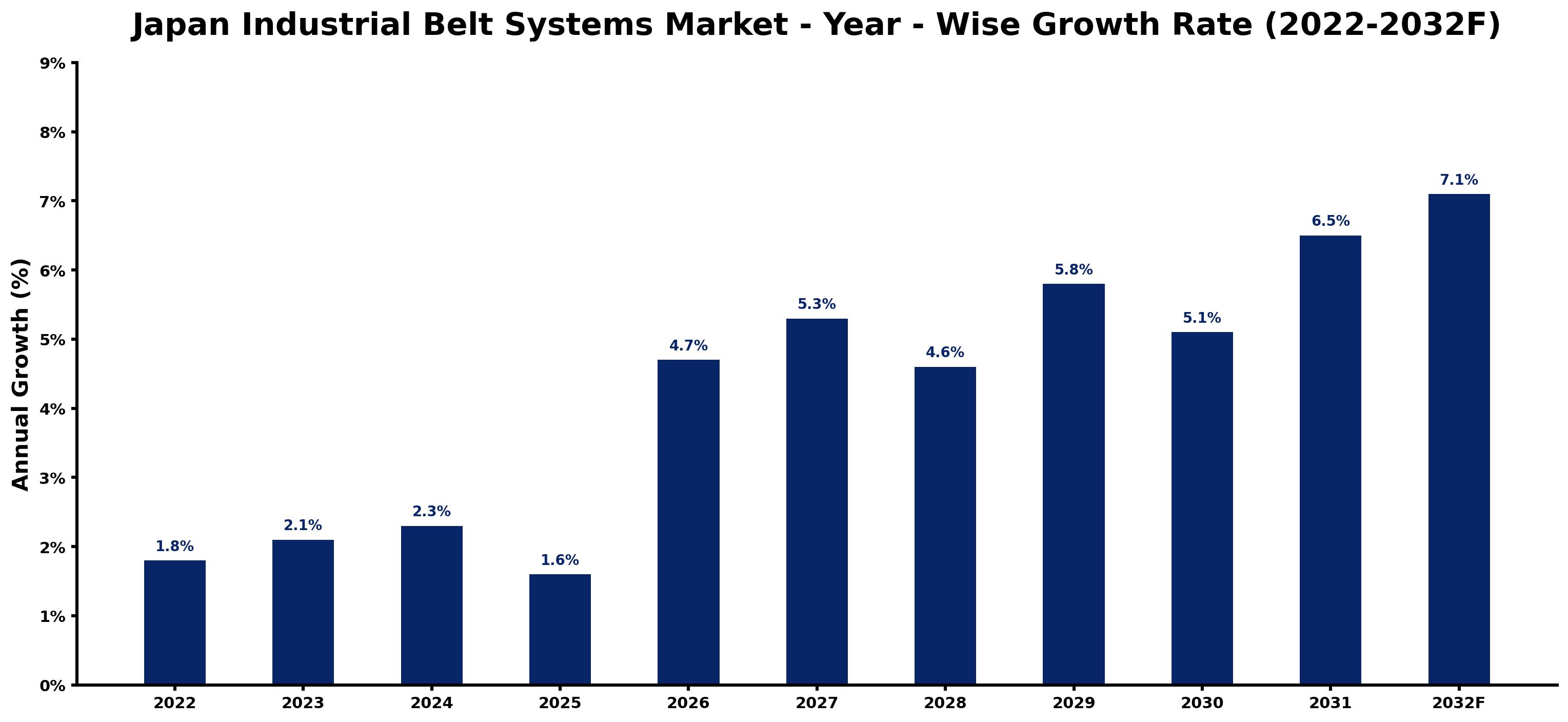
Annual growth estimates for each year appear below with the principal reason behind them, explaining the shifts that set the pace of the market.
| Year | Estimated Annual Growth (%) | Market Rationale |
| 2022 | 1.8 | The market experienced steady growth due to ongoing industrial activities. |
| 2023 | 2.1 | Demand increased as the automotive sector continued to recover. |
| 2024 | 2.3 | Growth accelerated with rising production levels in manufacturing industries. |
| 2025 | 1.6 | Growth slowed as market adjustments occurred after previous peaks in demand. |
| 2026 | 4.7 | Demand is expected to surge as manufacturers adopt advanced technologies for efficiency. |
| 2027 | 5.3 | The market is projected to expand further with increased investments in automation. |
| 2028 | 4.6 | Growth is expected to moderate as the market stabilises after rapid expansions. |
| 2029 | 5.8 | Demand will rise again as mining activities in Hokkaido pick up. |
| 2030 | 5.1 | Growth is projected to decelerate slightly as market conditions normalise. |
| 2031 | 6.5 | Demand will increase due to rising automotive production and exports. |
| 2032 | 7.1 | The market is expected to peak with investments in green technologies. |
Note: Market size estimations and growth projections presented in this report are based on 6Wresearch's proprietary forecasting methodology, utilizing the latest available industry data, government publications, and primary research inputs.
Japan Industrial Belt Systems Market Synopsis
Industrial Belt Systems are mechanical devices crucial for transporting materials and power across various industries. They primarily consist of rubber, PVC, and polyurethane, with applications spanning manufacturing, automotive, and heavy machinery. The Japan Industrial Belt Systems Market is expanding due to demand from the automotive sector, which produced 8.3 million vehicles in 2022, alongside investments in advanced manufacturing technologies projected at JPY 150 trillion over the next decade. This expansion is fuelled by the need for efficient transportation solutions in key sectors such as mining and agriculture, further broadening market potential.
Market Dynamics Impact Analysis (2026–2032)
| Factor | Type | Impact | Primary Segment Affected |
| Rising automotive production drives demand for timing belts and V-belts. | Driver | High | Timing Belts |
| Increased investment in advanced manufacturing technologies creates demand for conveyor belts. | Driver | High | Conveyor Belts |
| Growing agricultural sector opens opportunities for agricultural equipment belts. | Opportunity | Medium | Agricultural Equipment |
| Expansion of mining activities in Hokkaido boosts demand for conveyor systems. | Opportunity | Medium | Mining & Quarry Plants |
| High production costs limit profit margins for manufacturers. | Restraint | High | Rubber |
| Regulatory compliance requires significant investment in safety and quality standards. | Restraint | Medium | Conveyor Belts |
| Supply chain disruptions can delay production and increase costs. | Challenge | High | Conveyor Belts |
| Intense competition among manufacturers pressures pricing strategies. | Challenge | Medium | Conveyor Belts |
Evaluation of Drivers in Japan Industrial Belt Systems Market (2026–2032)
Demand rests on the following drivers, each shown with the segment it touches most.
| Drivers | Primary Segment Affected | Why It Matters (Evidence) |
| Increased automotive production leads to higher demand for timing belts. | Timing Belts | Japan's automotive industry produced 8.3 million vehicles in 2022, driving higher purchases. |
| Investment in advanced manufacturing technologies boosts demand for conveyor belts. | Conveyor Belts | The Ministry of Economy, Trade and Industry launched a program in 2023 to promote these technologies. |
| Growing agricultural sector increases demand for agricultural equipment belts. | Agricultural Equipment | The agricultural sector in Japan is valued at approximately 9 trillion yen, driving purchases. |
| Mining activities in Hokkaido create demand for conveyor systems. | Mining & Quarry Plants | Japan's mining sector relies heavily on conveyor systems for material transport. |
| Rising industrial automation leads to increased demand for synchronous transmission belts. | Synchronous Transmission | The trend towards automation in factories is driving the need for precise timing solutions. |
The strongest pull on demand comes from the automotive sector, which produced 8.3 million vehicles in 2022, leading to increased purchases of timing belts. Investments in advanced manufacturing technologies, projected at JPY 150 trillion over the next decade, are boosting demand for conveyor belts. The agricultural sector, valued at approximately 9 trillion yen, is also driving demand for agricultural equipment belts. The trend towards industrial automation is increasing the need for synchronous transmission belts, as factories seek precise timing solutions. Mining activities in Hokkaido further contribute to the demand for conveyor systems, reflecting the sector's reliance on efficient material transport.
Evaluation of Restraints in Japan Industrial Belt Systems Market
The following restraints limit how fast demand can grow.
| Market Restraint | Primary Segment Affected | Why It Matters (Evidence) |
| High production costs limit profit margins for manufacturers. | Rubber | The rubber industry in Japan is valued at 1.5 trillion yen, impacting pricing. |
| Regulatory compliance requires investment in safety and quality standards. | Conveyor Belts | ISO 9001 certification is common, necessitating investment in quality management. |
| Supply chain disruptions can delay production and increase costs. | Conveyor Belts | The average lifespan of a conveyor belt is about 5-10 years, affecting replacement cycles. |
| Market saturation in certain segments can limit growth opportunities. | Conveyor Belts | New entrants are intensifying competition in the market. |
| Technological advancements require continuous investment to remain competitive. | Conveyor Belts | Manufacturers must keep up with innovations to meet evolving customer demands. |
Japan Industrial Belt Systems Market Challenges
In Japan, producers face a skills shortage, which limits their ability to meet production demands and raises hiring costs for new employees. Many distributors encounter supply chain disruptions due to reliance on specific materials, resulting in longer lead times and increased prices for buyers. Rising costs in the rubber industry, valued at 1.5 trillion yen, directly impact pricing for buyers, constraining their purchasing power. The average lifespan of a conveyor belt is about 5-10 years, necessitating frequent replacements that disrupt operational efficiency.
Trends in the Japan Industrial Belt Systems Market
The shifts below are changing how Japan Industrial Belt Systems Market products are bought and supplied.
- Shift from Traditional to Advanced Manufacturing: Since 2023, Japan has experienced a shift towards advanced manufacturing technologies, driven by the GX Basic Policy. This change is reflected in the JPY 150 trillion investment target, which aims to improve efficiency and competitiveness.
- Transition from Rubber to Polyurethane Belts: In recent years, there has been a noticeable transition towards polyurethane and steel cord belts. With an 8.3% CAGR projected for this material type, manufacturers are adapting to meet higher strength requirements.
- Emergence of Synchronous Transmission as a Key Focus: The automotive industry is increasingly prioritising synchronous transmission systems. This shift is underscored by a projected CAGR of 7.6% for this segment, as manufacturers seek precision in timing.
- Growing Demand for Conveyor Systems in Mining: Since 2022, the mining sector has increasingly relied on conveyor systems for material transport. This trend is highlighted by a 7.5% CAGR for mining and quarry plants, reflecting rising operational needs.
Investment Opportunities in the Japan Industrial Belt Systems Market
The following opportunities in the Japan Industrial Belt Systems Market pair current demand with a clear way in.
- Partnerships with Local Manufacturers: Now is an opportune time to invest in partnerships with local manufacturers in the automotive sector, which produced 8.3 million vehicles in 2022, to tap into demand for timing belts.
- Focus on Agricultural Equipment Supply: With the agricultural sector valued at approximately 9 trillion yen, there is an opportunity to supply agricultural equipment belts. Engaging with local agricultural cooperatives can facilitate market entry.
- Investment in Mining Conveyor Systems: Investing in conveyor systems for mining operations in Hokkaido is timely, given the sector's reliance on these systems for efficiency. Collaborating with local mining companies can facilitate entry.
- Certification for Advanced Manufacturing Technologies: Now is the time to invest in certification for advanced manufacturing technologies, as the Ministry of Economy, Trade and Industry promotes these initiatives. This can open doors to new buyer groups.
Government Initiatives in the Japan Industrial Belt Systems Market
The Industrial Safety and Health Act of 1972 mandates employer responsibilities regarding hazardous substances and machinery, ensuring safety standards for industrial belt systems. Compliance with this law requires manufacturers to implement rigorous safety protocols and regular inspections, which ensures product reliability and protects workers. Additionally, the Act has led to a substantial reduction in workplace accidents over the years, benefiting both employees and manufacturers.
The GX Promotion Act, enacted in 2023, supports the GX strategy by promoting decarbonisation efforts. The Japan Climate Transition Bonds, first auctioned in February 2024, fund projects aimed at reducing greenhouse gas emissions, benefitting producers and buyers of industrial belt systems by aligning with sustainability goals. This initiative aims to mobilise approximately JPY 150 trillion over the next decade, encouraging investments in eco-friendly technologies.
Future Insight of the Japan Industrial Belt Systems Market
Buyers in the automotive sector will experience increased availability of advanced belt solutions as manufacturers adopt new technologies. Investments in decarbonisation, targeting 150 trillion yen over the next decade, will stimulate innovation among suppliers. As standards like JIS B 8810 evolve, they will improve quality assurance in industrial belts, enhancing supplier competitiveness. The textile industry, employing around 300,000 people, will also benefit from improved conveyor systems, reflecting a shift towards more efficient manufacturing processes.
Market Segmentation Analysis
Japan Industrial Belt Systems Market report covers a detailed analysis of the following market segments:
By Belt Type – Conveyor Belts Lead, Timing Belts Expected to Grow Fastest
According to Saurav Kr Singh, Senior Research Analyst at 6Wresearch, with 49% of belt type revenue in 2025, Conveyor Belts was the largest category. Conveyor belts dominate the market as they are extensively used for transporting materials in factories and mines across Japan. The Kanto region exemplifies this reliance, hosting numerous facilities that depend on conveyor systems for efficient operations. Timing Belts are projected to grow fastest, at a CAGR of 7.9% during 2026–2032. Timing belts are experiencing rapid growth, driven by the automotive industry's production of 8.3 million vehicles in 2022, which necessitates precise synchronous motion. As automotive technologies advance, the demand for timing belts is set to increase, further widening their market lead. Suppliers should focus on developing timing belts to meet the escalating needs of the automotive sector.
By Material Type – Rubber Leads, Polyurethane + Steel Cord Expected to Grow Fastest
Rubber accounted for 41% of the market by material type in 2025. Rubber is the leading material type for industrial belts, prized for its durability and flexibility, which are critical for various applications. The rubber industry, valued at 1.5 trillion yen, highlights its essential role in the production of industrial belts. Over 2026–2032, Polyurethane + Steel Cord is expected to post the fastest growth, at a CAGR of 8.3%. Polyurethane combined with steel cord is rapidly gaining traction due to its suitability for high-strength applications in demanding environments. This trend is expected to continue as industries seek more robust solutions for their operational needs. Buyers should consider investing in belts made from polyurethane and steel cord for enhanced performance in high-stress applications.
By Usage Mode – Continuous Motion Leads, Synchronous Transmission Expected to Grow Fastest
Continuous Motion took 50% of usage mode revenue in 2025, more than any other category. Continuous motion is the primary usage mode, vital for assembly lines and conveyor systems in manufacturing. Its critical role is evident in various industries throughout Japan, ensuring smooth operational flow. Synchronous Transmission is set to record the highest CAGR in this split, 7.6% over 2026–2032. Synchronous transmission is witnessing swift growth, particularly due to its importance in ensuring precise timing in machinery, especially in the automotive sector where timing belts are crucial. As technology evolves, the demand for these systems is projected to rise further. Suppliers must enhance synchronous transmission solutions to cater to the increasing demand for precision in machinery.
By End User – Automotive Industry Leads, Mining & Quarry Plants Expected to Grow Fastest
The largest end user category in 2025 was Automotive Industry, at 52% of revenue. The automotive industry is the largest end user of industrial belts, heavily relying on timing belts for vehicle production. The ongoing activity in this sector guarantees a steady demand for high-quality belts to ensure operational efficiency. The quickest growth will come from Mining & Quarry Plants, forecast to expand at a CAGR of 7.5% between 2026 and 2032. Mining and quarry plants are the fastest-growing end users, relying on conveyor systems for effective material handling in resource extraction. With the expansion of mining activities, the demand for industrial belts in this sector is expected to rise significantly. Suppliers should focus on the mining sector to capitalise on the increasing demand for conveyor systems.
Key Attractiveness of the Report
- 10 Years of Market Numbers
- Historical Data Starting from 2022 to 2025
- Base Year 2025
- Forecast Data until 2032
- Key Performance Indicators Impacting the Market
- Major Upcoming Developments and Projects
Key Highlights of the Report:
- Japan Industrial Belt Systems Market Outlook
- Market Size of Japan Industrial Belt Systems Market, 2025
- Forecast of Japan Industrial Belt Systems Market, 2032
- Historical Data and Forecast of Japan Industrial Belt Systems Revenues & Volume for the Period 2022-2032F
- Japan Industrial Belt Systems Market Trend Evolution
- Japan Industrial Belt Systems Market Drivers and Challenges
- Japan Industrial Belt Systems Price Trends
- Japan Industrial Belt Systems Porter's Five Forces
- Japan Industrial Belt Systems Industry Life Cycle
- Historical Data and Forecast of Japan Industrial Belt Systems Market Revenues & Volume By Belt Type for the Period 2022-2032F
- Historical Data and Forecast of Japan Industrial Belt Systems Market Revenues & Volume By Conveyor Belts for the Period 2022-2032F
- Historical Data and Forecast of Japan Industrial Belt Systems Market Revenues & Volume By Timing Belts for the Period 2022-2032F
- Historical Data and Forecast of Japan Industrial Belt Systems Market Revenues & Volume By V-Belts for the Period 2022-2032F
- Historical Data and Forecast of Japan Industrial Belt Systems Market Revenues & Volume By Flat Belts for the Period 2022-2032F
- Historical Data and Forecast of Japan Industrial Belt Systems Market Revenues & Volume By Material Type for the Period 2022-2032F
- Historical Data and Forecast of Japan Industrial Belt Systems Market Revenues & Volume By Rubber, PVC for the Period 2022-2032F
- Historical Data and Forecast of Japan Industrial Belt Systems Market Revenues & Volume By Polyurethane + Steel Cord for the Period 2022-2032F
- Historical Data and Forecast of Japan Industrial Belt Systems Market Revenues & Volume By Neoprene/Fabric for the Period 2022-2032F
- Historical Data and Forecast of Japan Industrial Belt Systems Market Revenues & Volume By Leather, Fabric for the Period 2022-2032F
- Historical Data and Forecast of Japan Industrial Belt Systems Market Revenues & Volume By Usage Mode for the Period 2022-2032F
- Historical Data and Forecast of Japan Industrial Belt Systems Market Revenues & Volume By Continuous Motion for the Period 2022-2032F
- Historical Data and Forecast of Japan Industrial Belt Systems Market Revenues & Volume By Synchronous Transmission for the Period 2022-2032F
- Historical Data and Forecast of Japan Industrial Belt Systems Market Revenues & Volume By Power Transmission for the Period 2022-2032F
- Historical Data and Forecast of Japan Industrial Belt Systems Market Revenues & Volume By Low-Torque Drives for the Period 2022-2032F
- Historical Data and Forecast of Japan Industrial Belt Systems Market Revenues & Volume By End User for the Period 2022-2032F
- Historical Data and Forecast of Japan Industrial Belt Systems Market Revenues & Volume By Mining & Quarry Plants for the Period 2022-2032F
- Historical Data and Forecast of Japan Industrial Belt Systems Market Revenues & Volume By Automotive Industry for the Period 2022-2032F
- Historical Data and Forecast of Japan Industrial Belt Systems Market Revenues & Volume By Agricultural Equipment for the Period 2022-2032F
- Historical Data and Forecast of Japan Industrial Belt Systems Market Revenues & Volume By Textile & Packaging Units for the Period 2022-2032F
- Japan Industrial Belt Systems Import Export Trade Statistics
- Market Opportunity Assessment By Belt Type
- Market Opportunity Assessment By Material Type
- Market Opportunity Assessment By Usage Mode
- Market Opportunity Assessment By End User
- Japan Industrial Belt Systems Top Companies Market Share
- Japan Industrial Belt Systems Competitive Benchmarking By Technical and Operational Parameters
- Japan Industrial Belt Systems Company Profiles
- Japan Industrial Belt Systems Key Strategic Recommendations
Market Covered
The report covers the following segments.
By Belt Type
- Conveyor Belts
- Timing Belts
- V-Belts
- Flat Belts
By Material Type
- Rubber
- PVC
- Polyurethane + Steel Cord
- Neoprene/Fabric
- Leather
- Fabric
By Usage Mode
- Continuous Motion
- Synchronous Transmission
- Power Transmission
- Low-Torque Drives
By End User
- Mining & Quarry Plants
- Automotive Industry
- Agricultural Equipment
- Textile & Packaging Units































