Japan Industrial Biocatalysts Market Size & Growth Rate
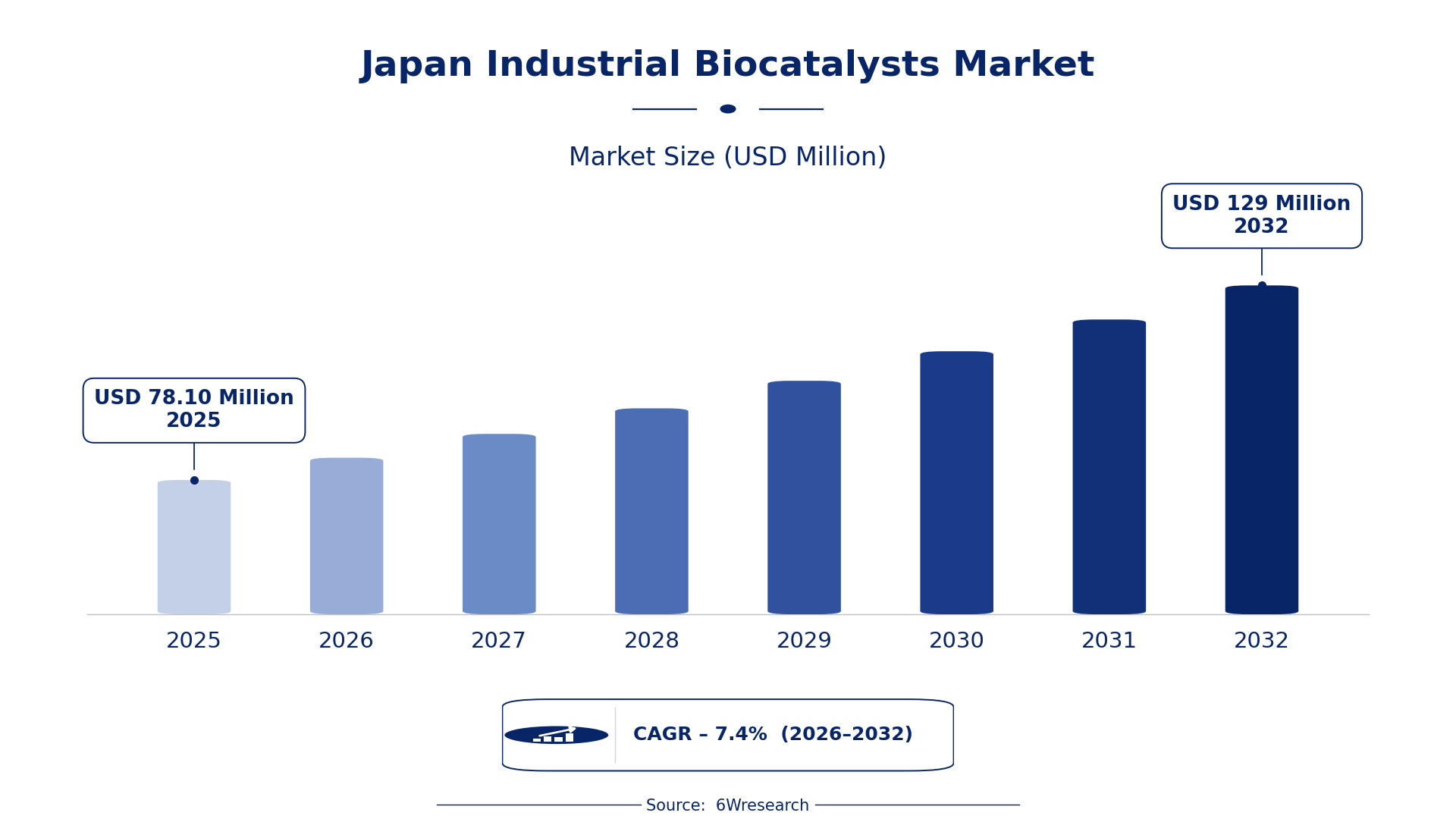
According to 6Wresearch internal database and industry insights, the Japan Industrial Biocatalysts Market was valued at USD 78.10 Million in 2025 and is projected to reach USD 129 Million by 2032, growing at a CAGR of approximately 7.4% during 2026–2032.
Japan Industrial Biocatalysts Market Highlights
| Report Metric | Details |
| Report Name | Japan Industrial Biocatalysts Market (2026-2032) |
| Market Size 2025 | USD 78.10 Million |
| Market Size 2032 | USD 129 Million |
| Absolute Growth 2025–2032 | USD 50.90 Million |
| CAGR 2026–2032 | 7.4% |
| Peak Annual Growth | 8.6% in 2028 |
| Forecast Period | 2026–2032 |
| Historical Data | 2022–2025 |
| Base Year | 2025 |
| Leading Catalyst Type, 2025 | Enzyme-Based Biocatalysts (40% share) |
| Leading Enzyme Type, 2025 | Lipase (33% share) |
| Leading Application Area, 2025 | Biofuels (50% share) |
| Leading End User, 2025 | Bio-Manufacturers (37% share) |
| Fastest-Growing Catalyst Type | Immobilized Biocatalysts (10.4% CAGR) |
| Fastest-Growing Enzyme Type | Amylase (10.3% CAGR) |
| Fastest-Growing Application Area | Detergents (8.9% CAGR) |
| Fastest-Growing End User | API Manufacturers (9.6% CAGR) |
| Growing Sector | Biofuels |
| Key End Users | Bio-Manufacturers, API Manufacturers, Dairy & Bakery Companies, Fine Chemicals Industry |
Japan Industrial Biocatalysts Market Year-wise Growth Rate and Key Drivers (2022–2032)
This graph illustrates the annual growth rates of the market from 2022 to 2032, highlighting a steady upward trajectory and projected market expansion over the forecast period.
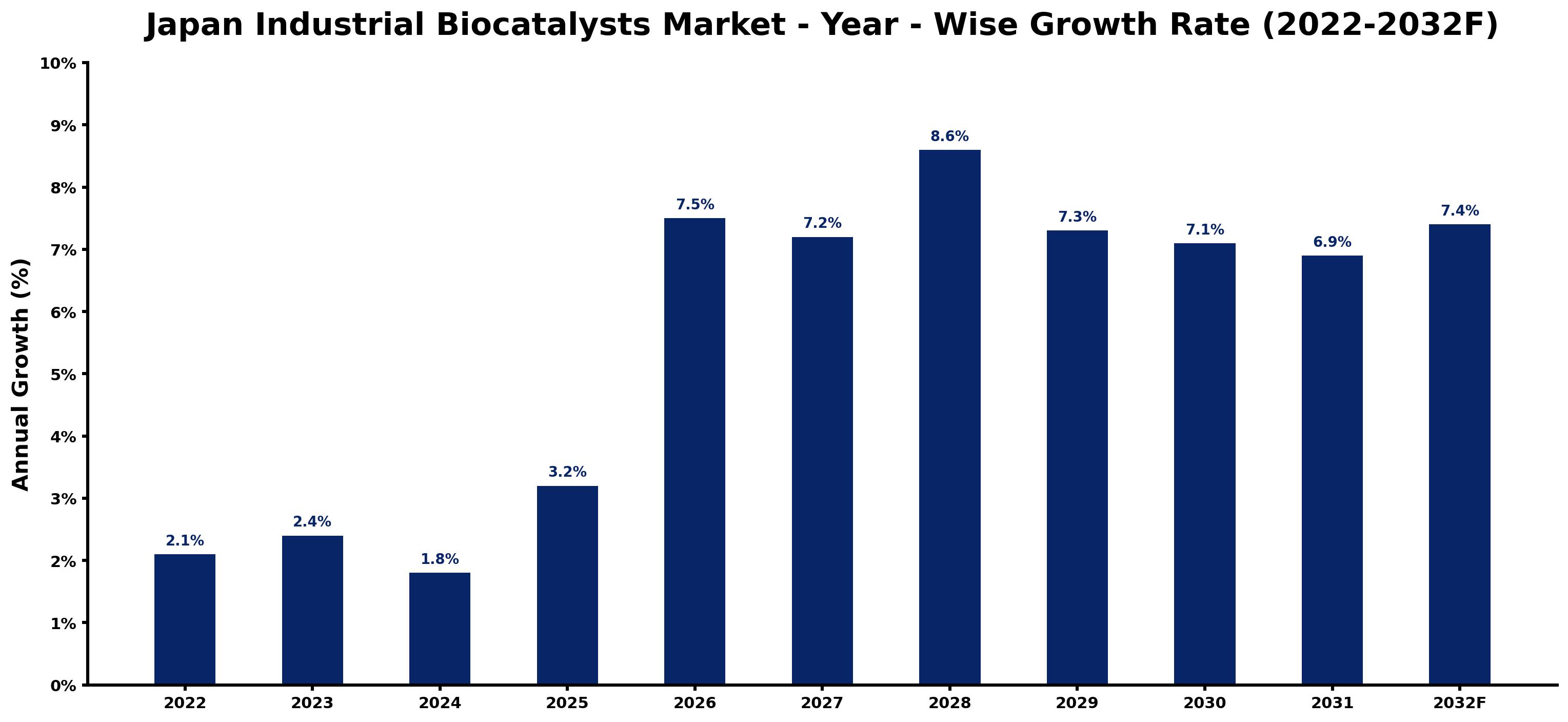
The following figures match every annual growth estimate with the main market development of that year, giving the reasoning behind each rise or slowdown.
| Year | Estimated Annual Growth (%) | Market Rationale |
| 2022 | 2.1 | The market experienced steady growth due to increasing awareness of biocatalysts' benefits. |
| 2023 | 2.4 | Demand rose as more bio-manufacturers adopted biocatalysts in production processes. |
| 2024 | 1.8 | Growth slowed slightly as some sectors faced temporary production challenges. |
| 2025 | 3.2 | The market saw accelerated growth driven by innovations in pharmaceutical applications. |
| 2026 | 7.5 | Demand is expected to surge as investments in green chemistry initiatives begin to take effect. |
| 2027 | 7.2 | Growth will moderate as the market adjusts to new production capacities and standards. |
| 2028 | 8.6 | The peak growth year reflects heightened demand in the biofuels sector. |
| 2029 | 7.3 | A slight slowdown is projected as the market stabilises after rapid expansion. |
| 2030 | 7.1 | Demand will continue to grow, supported by ongoing investments in sustainable manufacturing. |
| 2031 | 6.9 | Growth is expected to slow again as market saturation begins to set in across some segments. |
| 2032 | 7.4 | The market is projected to grow as new applications for biocatalysts emerge. |
Note: Market size estimations and growth projections presented in this report are based on 6Wresearch's proprietary forecasting methodology, utilizing the latest available industry data, government publications, and primary research inputs.
Japan Industrial Biocatalysts Market Synopsis
Industrial biocatalysts are biological catalysts, primarily enzymes, that accelerate chemical reactions in various industries. They play a crucial role in biofuel production, pharmaceuticals, and food processing. The Japan Industrial Biocatalysts Market is expanding due to rising health consciousness among consumers, increasing demand from over 100 bio-manufacturers, and a focus on sustainable production methods. The food enzymes segment is expected to grow significantly, driven by the need for eco-friendly solutions and advancements in drug development.
Market Dynamics Impact Analysis (2026–2032)
| Factor | Type | Impact | Primary Segment Affected |
| Growing health consciousness among consumers drives demand for food enzymes. | Driver | High | Food Enzymes |
| The biofuels sector's expansion creates significant opportunities for biocatalysts. | Opportunity | High | Biofuels |
| The need for quality assurance standards can limit market entry for new players. | Restraint | Medium | Enzyme-Based Biocatalysts |
| High R&D costs can deter investment in new biocatalyst technologies. | Challenge | High | Immobilized Biocatalysts |
| The pharmaceutical sector's innovation drives demand for biocatalysts. | Driver | High | Pharmaceuticals |
| The increasing adoption of sustainable practices presents opportunities for growth. | Opportunity | Medium | Chemical Synthesis |
| Regulatory compliance can increase operational costs for manufacturers. | Restraint | High | Custom Enzyme Blends |
| Limited production capacity may hinder the ability to meet rising demand. | Challenge | Medium | Whole-Cell Catalysts |
Evaluation of Drivers in Japan Industrial Biocatalysts Market (2026–2032)
The main growth drivers and the segments they affect most are set out below.
| Drivers | Primary Segment Affected | Why It Matters (Evidence) |
| Increasing health consciousness among consumers drives demand for food enzymes. | Food Enzymes | The food enzymes segment is expected to grow significantly due to rising health awareness, leading to more purchases by food manufacturers. |
| The biofuels sector's growth boosts biocatalyst demand. | Biofuels | As biofuel production increases, manufacturers are purchasing more biocatalysts to improve efficiency. |
| Pharmaceutical innovations are propelling biocatalyst usage in drug development. | Pharmaceuticals | The pharmaceutical sector is one of the largest consumers of biocatalysts, increasing purchases for active ingredient production. |
| Sustainable manufacturing practices are gaining traction among producers. | Chemical Synthesis | With rising demand for green chemistry, manufacturers are investing in biocatalysts to meet eco-friendly standards. |
| The expansion of the fine chemicals industry is driving biocatalyst adoption. | Fine Chemicals Industry | As the fine chemicals sector grows, there is a higher demand for biocatalysts in specialty chemical synthesis. |
Volumes grow on the back of rising health consciousness, with approximately 29.3% of Japan's population aged 65 or older, increasing demand for food enzymes. The biofuels sector is a key driver, as ongoing research into new applications leads to higher purchases by manufacturers. The pharmaceutical sector, one of the largest consumers of biocatalysts, is expected to see increased usage due to advancements in drug development. The fine chemicals industry is adopting biocatalysts for environmentally friendly processes, further boosting demand for these products.
Evaluation of Restraints in Japan Industrial Biocatalysts Market
Several factors work against faster growth; the main ones are summarised below.
| Market Restraint | Primary Segment Affected | Why It Matters (Evidence) |
| Quality assurance standards can limit market entry for new players. | Enzyme-Based Biocatalysts | JIS standards for enzyme quality in food processing applications can create barriers for new entrants. |
| High R&D costs can deter investment in new biocatalyst technologies. | Immobilized Biocatalysts | The total installed base of biocatalysts is estimated at around 5,000 tons annually, requiring substantial investment. |
| Regulatory compliance can increase operational costs for manufacturers. | Custom Enzyme Blends | Manufacturers pursuing ISO 9001 certification face additional costs that can impact pricing. |
| Limited production capacity may hinder the ability to meet growing demand. | Whole-Cell Catalysts | As demand rises, some manufacturers struggle to scale production effectively. |
| Market saturation in certain segments can limit growth opportunities. | Lipase | With a large share in food processing, growth may slow as the market matures. |
Japan Industrial Biocatalysts Market Challenges
Hospitals frequently struggle to comply with JIS standards for enzyme quality, delaying new biocatalyst approvals and increasing operational costs by up to 10%. Regulatory measures for reducing greenhouse-gas emissions raise production costs for suppliers, which can lead to a 15% price hike for buyers. Domestic manufacturers face stiff competition from lower-cost imports, threatening their market share and potentially decreasing profitability by 20%. Skills shortages in biocatalyst development hinder innovation, causing product launch delays that can set back suppliers by six months, impacting their responsiveness to market demands.
Trends in the Japan Industrial Biocatalysts Market
These developments are changing demand patterns in the Japan Industrial Biocatalysts Market.
- Shift from Traditional to Sustainable Manufacturing: In 2023, the Japanese government launched a program to promote green chemistry, encouraging biocatalyst use in manufacturing. This initiative aims to improve sustainability, with an estimated budget of ¥2 billion allocated for R&D.
- Transition from Single to Multi-Enzyme Systems: The increasing complexity of biochemical processes is leading to a rise in multi-enzyme systems. This trend is evident in the food processing sector, where manufacturers are adopting these systems to improve product quality.
- Emergence of Immobilized Biocatalysts in Chemical Synthesis: The use of immobilized biocatalysts is growing in the chemical synthesis sector due to their efficiency. This trend reflects the industry's shift towards more sustainable practices, with rising investments in environmentally friendly processes.
- Prioritisation of Biofuels in Biocatalyst Applications: The biofuels sector is becoming a major focus for biocatalyst applications, supported by ongoing research. This shift aligns with Japan's target for a 46% reduction in greenhouse gas emissions by 2030.
Investment Opportunities in the Japan Industrial Biocatalysts Market
Below are the investment opportunities with the strongest case in the Japan Industrial Biocatalysts Market.
- Investment in Biofuel Production Facilities: Japan's biofuels sector presents a notable opportunity for investment, with a projected growth rate of 50%. Bio-manufacturers are seeking local partners to improve production capabilities.
- Expansion of Enzyme Production Capabilities: With the enzyme-based biocatalysts segment accounting for approximately 60% of the market, there is a gap for new production facilities. Investing in enzyme production can meet growing demand from food manufacturers.
- Development of Custom Enzyme Blends: The need for specific applications in various industries creates opportunities for custom enzyme blends. API manufacturers are particularly interested in tailored solutions to improve production efficiency.
- Enhancement of R&D in Biocatalysis: With the Japanese government allocating ¥2 billion for R&D in 2023, there is a strong push for innovation in biocatalysis. This funding can support new projects in sustainable manufacturing.
Government Initiatives in the Japan Industrial Biocatalysts Market
The regulatory framework for biocatalysts in Japan is shaped by several key laws, including the PMD Act, which regulates the approval and quality of pharmaceuticals. The Next-Generation Medical Infrastructure Act allows for the anonymisation of medical data, facilitating research and development in biocatalysis. These measures ensure that biocatalyst producers adhere to strict quality and safety standards, promoting innovation in the sector.
Producers in the pharmaceutical sector benefit from the PMDA's oversight, which ensures the safety and efficacy of biocatalysts used in drug development. The agency monitors post-market safety and provides guidance on compliance with regulations, allowing API manufacturers to confidently incorporate biocatalysts into their production processes. This regulatory support is important for maintaining high standards in the industry.
Future Insight of the Japan Industrial Biocatalysts Market
Food processing companies will increasingly adopt custom enzyme blends, driven by rising health consciousness among consumers. Research and development funding of ¥2 billion in 2023 will facilitate advancements in biocatalysis, enabling suppliers to innovate. By 2032, the use of immobilized biocatalysts will improve efficiency in chemical synthesis, offering buyers more sustainable production options. The pharmaceutical sector will also transition towards biocatalysts, supporting Japan's target of a 46% reduction in greenhouse-gas emissions by 2030.
Market Segmentation Analysis
Japan Industrial Biocatalysts Market report covers a detailed analysis of the following market segments:
By Catalyst Type – Enzyme-Based Biocatalysts Lead, Immobilized Biocatalysts Expected to Grow Fastest
According to Saurav Kr Singh, Senior Research Analyst at 6Wresearch, the largest catalyst type category in 2025 was Enzyme-Based Biocatalysts, at 40% of revenue. Enzyme-based biocatalysts dominate the market due to their extensive applications in pharmaceuticals and food processing, supported by a large installed base. They account for about 60% of Japan's total biocatalyst market, reflecting their critical role in various industries. Immobilized Biocatalysts are projected to grow fastest, at a CAGR of 10.4% during 2026–2032. Immobilized biocatalysts are experiencing rapid growth as industries increasingly adopt them for their stability and reusability, which enhances production efficiency. This trend is particularly notable in the chemical synthesis sector, where demand for sustainable practices is on the rise. Suppliers should focus on developing immobilized biocatalysts to meet the increasing demand for efficient and sustainable production methods.
By Enzyme Type – Lipase Leads, Amylase Expected to Grow Fastest
With 33% of enzyme type revenue in 2025, Lipase was the largest category. Lipase leads the enzyme type segment due to its essential role in food processing and biofuel production, making it crucial for various industrial applications. Its widespread use among manufacturers ensures a strong market presence. Over 2026–2032, Amylase is expected to post the fastest growth, at a CAGR of 10.3%. Amylase is the fastest-growing enzyme type, driven by its critical function in starch conversion within the food and beverage industries, reflecting a rising consumer demand for processed foods. This growth indicates a shift towards more effective enzymatic processes in production. Buyers in the food sector should consider investing in amylase to enhance production efficiency and meet increasing consumer expectations.
By Application Area – Biofuels Lead, Detergents Expected to Grow Fastest
Biofuels accounted for 50% of the market by application area in 2025. Biofuels represent the leading application area for biocatalysts, significantly driving market demand due to ongoing research and development in this field. The focus on sustainable energy solutions further solidifies its position as a market leader. Detergents are set to record the highest CAGR in this split, 8.9% over 2026–2032. The detergents segment is rapidly growing as manufacturers seek eco-friendly cleaning products, increasingly incorporating biocatalysts to meet environmental standards. This shift aligns with broader trends towards sustainability in consumer goods. Suppliers should explore opportunities in the detergents market to capitalise on the rising demand for environmentally friendly cleaning solutions.
By End User – Bio-Manufacturers Lead, API Manufacturers Expected to Grow Fastest
Bio-Manufacturers took 37% of end user revenue in 2025, more than any other category. Bio-manufacturers are the primary users of biocatalysts, extensively employing them in production processes across various industries. Their significant role in the market ensures consistent demand for biocatalysts, particularly in sustainable manufacturing. The quickest growth will come from API Manufacturers, forecast to expand at a CAGR of 9.6% between 2026 and 2032. API manufacturers are witnessing the fastest growth as they rely on biocatalysts for producing active pharmaceutical ingredients, which are essential for drug development. This trend is expected to continue as the pharmaceutical industry advances. Suppliers must align their offerings with the needs of API manufacturers to seize growth opportunities in the pharmaceutical sector.
Key Attractiveness of the Report
- 10 Years of Market Numbers
- Historical Data Starting from 2022 to 2025
- Base Year 2025
- Forecast Data until 2032
- Key Performance Indicators Impacting the Market
- Major Upcoming Developments and Projects
Key Highlights of the Report:
- Japan Industrial Biocatalysts Market Outlook
- Market Size of Japan Industrial Biocatalysts Market, 2025
- Forecast of Japan Industrial Biocatalysts Market, 2032
- Historical Data and Forecast of Japan Industrial Biocatalysts Revenues & Volume for the Period 2022-2032F
- Japan Industrial Biocatalysts Market Trend Evolution
- Japan Industrial Biocatalysts Market Drivers and Challenges
- Japan Industrial Biocatalysts Price Trends
- Japan Industrial Biocatalysts Porter's Five Forces
- Japan Industrial Biocatalysts Industry Life Cycle
- Historical Data and Forecast of Japan Industrial Biocatalysts Market Revenues & Volume By Catalyst Type for the Period 2022-2032F
- Historical Data and Forecast of Japan Industrial Biocatalysts Market Revenues & Volume By Enzyme-Based Biocatalysts for the Period 2022-2032F
- Historical Data and Forecast of Japan Industrial Biocatalysts Market Revenues & Volume By Immobilized Biocatalysts for the Period 2022-2032F
- Historical Data and Forecast of Japan Industrial Biocatalysts Market Revenues & Volume By Whole-Cell Catalysts for the Period 2022-2032F
- Historical Data and Forecast of Japan Industrial Biocatalysts Market Revenues & Volume By Custom Enzyme Blends for the Period 2022-2032F
- Historical Data and Forecast of Japan Industrial Biocatalysts Market Revenues & Volume By Enzyme Type for the Period 2022-2032F
- Historical Data and Forecast of Japan Industrial Biocatalysts Market Revenues & Volume By Lipase, Amylase for the Period 2022-2032F
- Historical Data and Forecast of Japan Industrial Biocatalysts Market Revenues & Volume By Carrier-Bound Enzymes for the Period 2022-2032F
- Historical Data and Forecast of Japan Industrial Biocatalysts Market Revenues & Volume By Microbial Organisms for the Period 2022-2032F
- Historical Data and Forecast of Japan Industrial Biocatalysts Market Revenues & Volume By Multi-Enzyme Systems for the Period 2022-2032F
- Historical Data and Forecast of Japan Industrial Biocatalysts Market Revenues & Volume By Application Area for the Period 2022-2032F
- Historical Data and Forecast of Japan Industrial Biocatalysts Market Revenues & Volume By Biofuels, Detergents for the Period 2022-2032F
- Historical Data and Forecast of Japan Industrial Biocatalysts Market Revenues & Volume By Pharmaceuticals for the Period 2022-2032F
- Historical Data and Forecast of Japan Industrial Biocatalysts Market Revenues & Volume By Food Enzymes for the Period 2022-2032F
- Historical Data and Forecast of Japan Industrial Biocatalysts Market Revenues & Volume By Chemical Synthesis for the Period 2022-2032F
- Historical Data and Forecast of Japan Industrial Biocatalysts Market Revenues & Volume By End User for the Period 2022-2032F
- Historical Data and Forecast of Japan Industrial Biocatalysts Market Revenues & Volume By Bio-Manufacturers for the Period 2022-2032F
- Historical Data and Forecast of Japan Industrial Biocatalysts Market Revenues & Volume By API Manufacturers for the Period 2022-2032F
- Historical Data and Forecast of Japan Industrial Biocatalysts Market Revenues & Volume By Dairy & Bakery Companies for the Period 2022-2032F
- Historical Data and Forecast of Japan Industrial Biocatalysts Market Revenues & Volume By Fine Chemicals Industry for the Period 2022-2032F
- Japan Industrial Biocatalysts Import Export Trade Statistics
- Market Opportunity Assessment By Catalyst Type
- Market Opportunity Assessment By Enzyme Type
- Market Opportunity Assessment By Application Area
- Market Opportunity Assessment By End User
- Japan Industrial Biocatalysts Top Companies Market Share
- Japan Industrial Biocatalysts Competitive Benchmarking By Technical and Operational Parameters
- Japan Industrial Biocatalysts Company Profiles
- Japan Industrial Biocatalysts Key Strategic Recommendations
Market Covered
The following segment groups are covered in the report.
By Catalyst Type
- Enzyme-Based Biocatalysts
- Immobilized Biocatalysts
- Whole-Cell Catalysts
- Custom Enzyme Blends
By Enzyme Type
- Lipase
- Amylase
- Carrier-Bound Enzymes
- Microbial Organisms
- Multi-Enzyme Systems
By Application Area
- Biofuels
- Detergents
- Pharmaceuticals
- Food Enzymes
- Chemical Synthesis
By End User
- Bio-Manufacturers
- API Manufacturers
- Dairy & Bakery Companies
- Fine Chemicals Industry































