Japan Industrial Biocides Market Size & Growth Rate
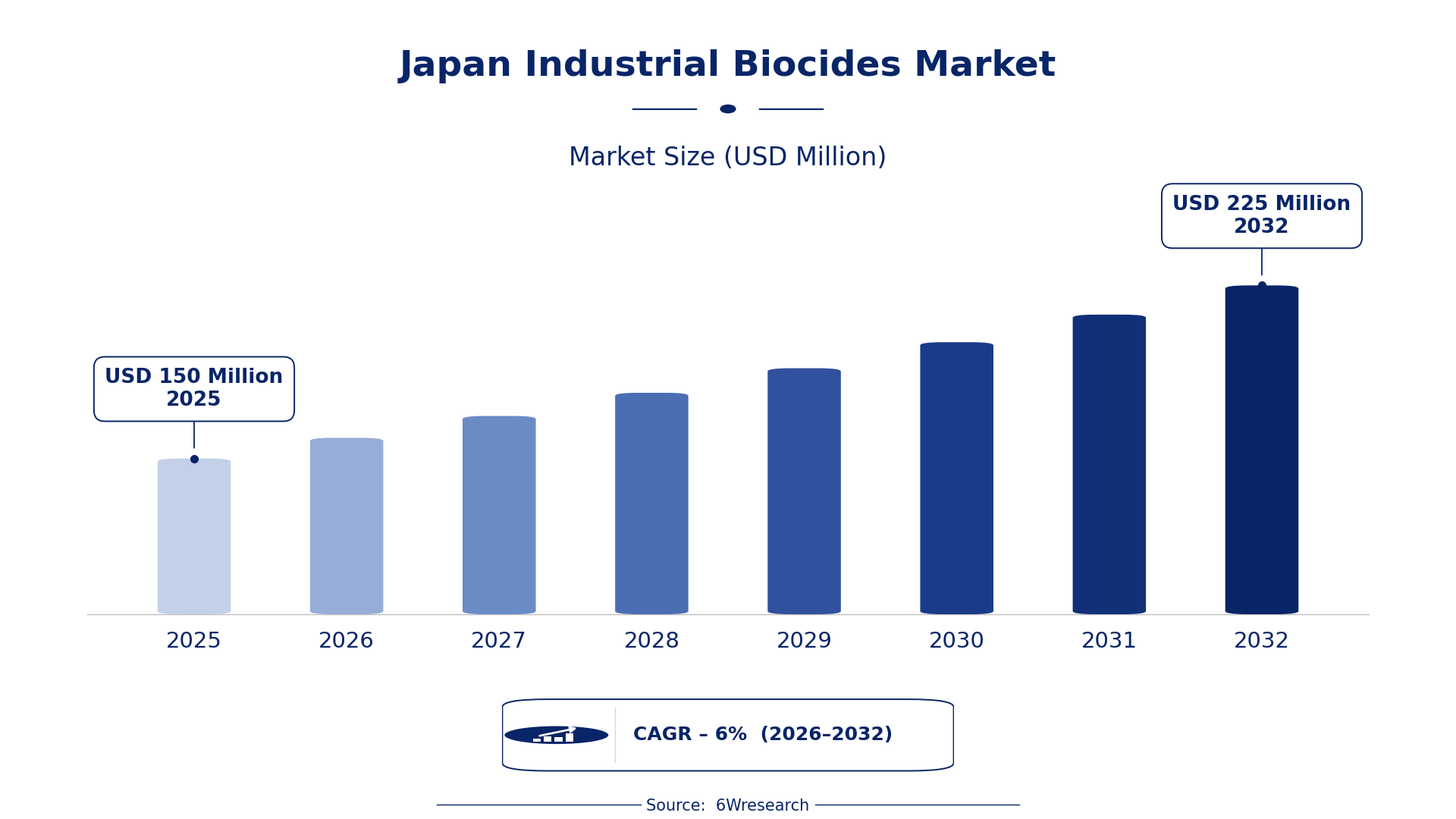
According to 6Wresearch internal database and industry insights, the Japan Industrial Biocides Market was valued at USD 150 Million in 2025 and is projected to reach USD 225 Million by 2032, growing at a CAGR of approximately 6% during 2026–2032.
Japan Industrial Biocides Market Highlights
| Report Metric | Details |
| Report Name | Japan Industrial Biocides Market (2026-2032) |
| Market Size 2025 | USD 150 Million |
| Market Size 2032 | USD 225 Million |
| Absolute Growth 2025–2032 | USD 75 Million |
| CAGR 2026–2032 | 6% |
| Peak Annual Growth | 6.8% in 2026 |
| Forecast Period | 2026–2032 |
| Historical Data | 2022–2025 |
| Base Year | 2025 |
| Leading Biocide Type, 2025 | Oxidizing Biocides (36% share) |
| Leading Formulation Type, 2025 | Chlorine (32% share) |
| Leading Application Use Case, 2025 | Water Treatment (31% share) |
| Leading End User, 2025 | Cooling Towers (41% share) |
| Fastest-Growing Biocide Type | Non-Oxidizing Biocides (8.7% CAGR) |
| Fastest-Growing Formulation Type | Hydrogen Peroxide (8.8% CAGR) |
| Fastest-Growing Application Use Case | Paints (8.0% CAGR) |
| Fastest-Growing End User | Boilers (8.1% CAGR) |
| Growing Sector | Water Treatment |
| Key End Users | Water treatment facilities, hospitals, industrial cleaning companies |
Japan Industrial Biocides Market Year-wise Growth Rate and Key Drivers (2022–2032)
This graph illustrates the annual growth rates of the market from 2022 to 2032, highlighting a steady upward trajectory and projected market expansion over the forecast period.
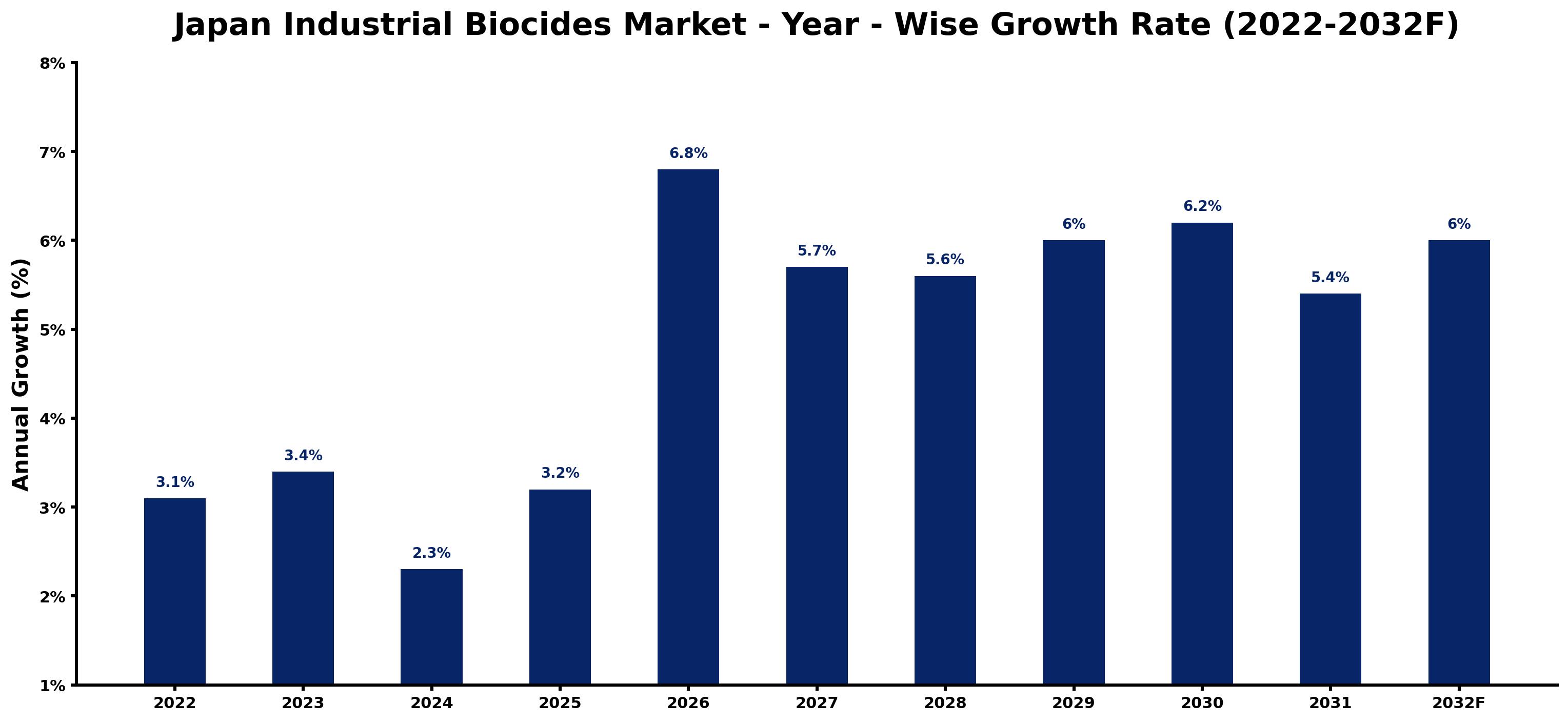
Below, each year's estimated growth is shown next to the factor that most influenced it.
| Year | Estimated Annual Growth (%) | Market Rationale |
| 2022 | 3.1 | The market experienced steady growth due to consistent demand from water treatment sectors. |
| 2023 | 3.4 | Growth accelerated as the water treatment industry expanded its biocide usage. |
| 2024 | 2.3 | The market saw a slowdown as demand stabilised after rapid growth in previous years. |
| 2025 | 3.2 | Demand increased again as industrial cleaning applications expanded their biocide requirements. |
| 2026 | 6.8 | Growth is expected to peak due to heightened investments in water treatment technologies. |
| 2027 | 5.7 | A slight slowdown will occur as the market adjusts to the previous year's peak. |
| 2028 | 5.6 | The market will continue to grow, albeit at a slower pace than the previous year. |
| 2029 | 6.0 | Demand is projected to rise again as new applications for biocides emerge in various sectors. |
| 2030 | 6.2 | Growth will remain strong as investments in biocide R&D increase. |
| 2031 | 5.4 | A slowdown is anticipated as market growth begins to stabilise after several years of expansion. |
| 2032 | 6.0 | Demand is expected to rise again as new regulations drive biocide usage. |
Note: Market size estimations and growth projections presented in this report are based on 6Wresearch's proprietary forecasting methodology, utilizing the latest available industry data, government publications, and primary research inputs.
Japan Industrial Biocides Market Synopsis
Chemical agents known as industrial biocides are employed to control harmful organisms in applications like water treatment and industrial cleaning. These products are synthesized through chemical reactions or derived from natural sources. The Japan Industrial Biocides Market is expanding, driven by increasing demand from sectors such as water treatment, valued at approximately 1 trillion JPY, and industrial cleaning, where annual demand is estimated at 500 million litres. The Tokyo metropolitan area, with its large population, further fuels this growth.
Market Dynamics Impact Analysis (2026–2032)
| Factor | Type | Impact | Primary Segment Affected |
| Growing investments in water treatment technologies | Driver | High | Water Treatment |
| Increasing demand for disinfectants in healthcare settings | Driver | High | Surface Disinfectant Biocides |
| Expansion of industrial cleaning applications requiring biocides | Opportunity | High | Industrial Cleaning |
| Rising awareness of hygiene standards in food processing | Opportunity | Medium | Food Packaging |
| Regulatory challenges surrounding biocide formulations | Restraint | High | Non-Oxidizing Biocides |
| Limited efficacy of natural biocides compared to synthetic options | Restraint | Medium | Natural Biocides |
| Cost pressures from raw material sourcing | Challenge | High | Oxidizing Biocides |
| Compliance with stringent health and safety regulations | Challenge | Medium | Surface Disinfectant Biocides |
Evaluation of Drivers in Japan Industrial Biocides Market (2026–2032)
These are the developments adding the most demand over the forecast period.
| Drivers | Primary Segment Affected | Why It Matters (Evidence) |
| Increased investment in water treatment infrastructure | Water Treatment | This investment has led to a higher demand for effective biocides, with the sector valued at approximately 1 trillion JPY. |
| Growing healthcare expenditure | Surface Disinfectant Biocides | Japan's national medical care expenditure was about JPY 46.7 trillion in fiscal 2022, driving disinfectant demand. |
| Rising industrial cleaning standards | Industrial Cleaning | The annual demand for industrial cleaning biocides is estimated at 500 million liters, reflecting increased hygiene requirements. |
| Technological advancements in biocide formulations | Non-Oxidizing Biocides | Innovations in formulation improve effectiveness, attracting more buyers in industrial applications. |
| Increasing population density in urban areas | Food Packaging | The Tokyo metropolitan area, with over 14 million residents, drives demand for biocides in food packaging. |
Spending rises because of increased investments in water treatment infrastructure, which has led to a demand for effective biocides. Japan's national medical care expenditure was about JPY 46.7 trillion in fiscal 2022, contributing to the rising need for disinfectants in healthcare settings. Annual demand for industrial cleaning biocides is estimated at 500 million liters, reflecting heightened hygiene standards across various industries. Technological advancements in biocide formulations improve their effectiveness, attracting more buyers in industrial applications. The Tokyo metropolitan area's high population density drives demand for biocides in food packaging.
Evaluation of Restraints in Japan Industrial Biocides Market
The table below lists the restraints and the evidence behind each.
| Market Restraint | Primary Segment Affected | Why It Matters (Evidence) |
| Regulatory challenges related to biocide formulations | Non-Oxidizing Biocides | Compliance with stringent regulations can delay product approvals, affecting market entry. |
| Limited efficacy of natural biocides | Natural Biocides | Natural biocides face competition from more effective synthetic options, limiting their market share. |
| Rising raw material costs | Oxidizing Biocides | Increased costs can squeeze margins for manufacturers, impacting pricing strategies. |
| Stringent health and safety compliance requirements | Surface Disinfectant Biocides | These requirements complicate production processes and slow down market responsiveness. |
| Market saturation in certain biocide applications | Industrial Cleaning | High competition in established segments limits growth opportunities for new entrants. |
Japan Industrial Biocides Market Challenges
Producers face fierce competition, leading to price reductions that erode profit margins for domestic manufacturers. Buyers in the industrial cleaning sector encounter fluctuating demand, causing seasonal inventory surpluses and increasing holding costs, which can reach up to 15% of total inventory value. Rising raw material prices for biocidal additives delay production timelines, resulting in supply shortages that affect end-users, particularly in water treatment. New disinfectant standards from the Ministry of Health, Labour and Welfare require hospitals to quickly adapt, increasing compliance costs and risking service disruptions for healthcare providers.
Trends in the Japan Industrial Biocides Market
Buyers and suppliers in the Japan Industrial Biocides Market are adjusting to the following trends.
- Launch of Eco-Friendly Biocides Initiative: In 2023, the Japanese government initiated a programme to promote eco-friendly biocides in industrial applications. This shift reflects growing environmental awareness, with a push towards sustainable practices in the chemical industry.
- Transition from Synthetic to Natural Biocides: A noticeable shift is occurring towards incorporating essential oils in biocide formulations. This change is driven by consumer demand for safer alternatives, with essential oils increasingly featured in natural biocide products.
- Emergence of Advanced Disinfection Standards: The Ministry of Health, Labour and Welfare set new standards for disinfectants in hospitals in 2023. These standards are influencing the types of biocides used in healthcare settings, ensuring higher efficacy and safety.
- Growth in Marine Coatings Demand: The Tokyo Bay area is experiencing a rise in demand for marine coatings, essential for antifouling applications. This trend is driven by increased shipping activity and environmental regulations, enhancing the need for effective biocides.
Investment Opportunities in the Japan Industrial Biocides Market
The openings below show where demand in the Japan Industrial Biocides Market is visible and how suppliers can enter.
- Timing for Investment in Eco-Friendly Biocides: With the government's push for eco-friendly biocides in 2023, there is a unique opportunity to invest in sustainable formulations. This trend appeals to environmentally conscious buyers in various sectors.
- Expansion in the Tokyo Bay Area: The Tokyo Bay area is a key region for marine coatings, presenting opportunities for biocide suppliers. Collaborating with local manufacturers can facilitate market entry and growth.
- Entry into the Food Packaging Sector: The increasing focus on hygiene in food packaging creates a demand for effective biocides. Partnering with food safety authorities can help navigate regulatory requirements and ensure compliance.
- Investment in R&D for Safer Alternatives: With Japan's biocide industry expected to invest in R&D for safer alternatives, there is a chance to develop innovative products. Collaborating with research institutions can enhance product offerings.
Government Initiatives in the Japan Industrial Biocides Market
Japan's regulatory framework for biocides is shaped by key laws, including the PMD Act, which oversees the approval and quality of pharmaceuticals and medical devices. Established in 2004, the PMDA monitors post-market safety, while the Clinical Trials Act, enacted in 2017, sets rules for clinical research. These regulations ensure that biocides meet safety and efficacy standards, impacting manufacturers and buyers alike.
The oversight by the PMDA ensures that disinfectants meet stringent safety requirements. The Ministry of Health, Labour and Welfare also influences the types of biocides used in medical facilities by setting standards for disinfectants. This regulatory environment supports the demand for effective and compliant biocidal products.
Future Insight of the Japan Industrial Biocides Market
By 2032, Japan's investment pipeline will significantly impact the biocides market, with approximately JPY 150 trillion earmarked for decarbonisation initiatives over the next decade. This investment will create demand for eco-friendly formulations, benefiting suppliers who focus on sustainable practices. The aging population will push hospitals to implement advanced disinfectants that meet stringent hygiene standards. As the annual demand for industrial cleaning biocides continues to grow, suppliers must scale production to satisfy the rising needs across multiple industries.
Market Segmentation Analysis
Japan Industrial Biocides Market report covers a detailed analysis of the following market segments:
By Biocide Type – Oxidizing Biocides Lead, Non-Oxidizing Biocides Expected to Grow Fastest
According to Saurav Kr Singh, Senior Research Analyst at 6Wresearch, with 36% of biocide type revenue in 2025, Oxidizing Biocides was the largest category. Oxidizing biocides hold a substantial share in the market due to their critical function in water treatment processes, especially in urban centres like Tokyo where water quality is paramount. Their effectiveness in eliminating harmful microorganisms ensures consistent demand from both municipal and industrial sectors. The quickest growth will come from Non-Oxidizing Biocides, forecast to expand at a CAGR of 8.7% between 2026 and 2032. Non-oxidizing biocides are rapidly gaining traction as they are increasingly preferred in industrial cleaning applications, where maintaining hygiene is essential. The annual demand for these biocides is estimated at 500 million litres, indicating robust growth in this area. Suppliers should focus on developing non-oxidizing biocides to meet the rising hygiene standards in industrial settings.
By Formulation Type – Chlorine Leads, Hydrogen Peroxide Expected to Grow Fastest
Chlorine took 32% of formulation type revenue in 2025, more than any other category. Chlorine is the leading formulation type as it is essential for water treatment and disinfection processes, ensuring safe drinking water. Its critical role in maintaining hygiene standards across various sectors solidifies its dominance in the market. Over 2026–2032, Hydrogen Peroxide is expected to post the fastest growth, at a CAGR of 8.8%. Hydrogen peroxide is experiencing the fastest growth due to its versatility in various cleaning and sterilisation applications, reflecting a shift towards safer alternatives. This trend is further supported by ongoing investments in R&D for safer biocide options. Buyers may benefit from exploring hydrogen peroxide as a more eco-friendly alternative in their cleaning processes.
By Application Use Case – Water Treatment Leads, Paints Expected to Grow Fastest
In 2025, Water Treatment led the application use case split with a 31% share. Water treatment is the leading application use case as it is essential for ensuring safe drinking water, a critical public health issue in Japan. The water treatment industry, valued at approximately 1 trillion JPY, underscores its importance in the biocides market. Paints are projected to grow fastest, at a CAGR of 8.0% during 2026–2032. The paints segment is experiencing the fastest growth due to the increasing need for biocides that prevent microbial growth, spurred by heightened industrial activity. The production of over 1 million tons of paints requiring biocidal additives in 2022 highlights this trend. Suppliers should consider opportunities in the paints segment to capitalise on the growing demand for effective biocidal solutions.
By End User – Cooling Towers Lead, Boilers Expected to Grow Fastest
The largest end user category in 2025 was Cooling Towers, at 41% of revenue. Cooling towers represent the largest end user as they are crucial for controlling microbial growth in cooling systems across various industries. The stringent operational standards in these systems necessitate reliable biocide solutions to ensure both efficiency and safety. Boilers are set to record the highest CAGR in this split, 8.1% over 2026–2032. Boilers are the fastest growing end user because they require biocides to prevent corrosion and biofouling, which are vital for optimal performance. The increasing focus on maintaining boiler efficiency is driving this segment's growth. Suppliers should enhance their product offerings for boiler applications to address the rising demand for effective biocide solutions.
Key Attractiveness of the Report
- 10 Years of Market Numbers
- Historical Data Starting from 2022 to 2025
- Base Year 2025
- Forecast Data until 2032
- Key Performance Indicators Impacting the Market
- Major Upcoming Developments and Projects
Key Highlights of the Report:
- Japan Industrial Biocides Market Outlook
- Market Size of Japan Industrial Biocides Market, 2025
- Forecast of Japan Industrial Biocides Market, 2032
- Historical Data and Forecast of Japan Industrial Biocides Revenues & Volume for the Period 2022-2032F
- Japan Industrial Biocides Market Trend Evolution
- Japan Industrial Biocides Market Drivers and Challenges
- Japan Industrial Biocides Price Trends
- Japan Industrial Biocides Porter's Five Forces
- Japan Industrial Biocides Industry Life Cycle
- Historical Data and Forecast of Japan Industrial Biocides Market Revenues & Volume By Biocide Type for the Period 2022-2032F
- Historical Data and Forecast of Japan Industrial Biocides Market Revenues & Volume By Oxidizing Biocides for the Period 2022-2032F
- Historical Data and Forecast of Japan Industrial Biocides Market Revenues & Volume By Non-Oxidizing Biocides for the Period 2022-2032F
- Historical Data and Forecast of Japan Industrial Biocides Market Revenues & Volume By Natural Biocides for the Period 2022-2032F
- Historical Data and Forecast of Japan Industrial Biocides Market Revenues & Volume By Surface Disinfectant Biocides for the Period 2022-2032F
- Historical Data and Forecast of Japan Industrial Biocides Market Revenues & Volume By Formulation Type for the Period 2022-2032F
- Historical Data and Forecast of Japan Industrial Biocides Market Revenues & Volume By Chlorine, Hydrogen Peroxide for the Period 2022-2032F
- Historical Data and Forecast of Japan Industrial Biocides Market Revenues & Volume By Isothiazolinones, Glutaraldehyde for the Period 2022-2032F
- Historical Data and Forecast of Japan Industrial Biocides Market Revenues & Volume By Essential Oils, Plant Extracts for the Period 2022-2032F
- Historical Data and Forecast of Japan Industrial Biocides Market Revenues & Volume By Spray/Gel for the Period 2022-2032F
- Historical Data and Forecast of Japan Industrial Biocides Market Revenues & Volume By Application Use Case for the Period 2022-2032F
- Historical Data and Forecast of Japan Industrial Biocides Market Revenues & Volume By Water Treatment for the Period 2022-2032F
- Historical Data and Forecast of Japan Industrial Biocides Market Revenues & Volume By Paints, Coatings for the Period 2022-2032F
- Historical Data and Forecast of Japan Industrial Biocides Market Revenues & Volume By Food Packaging for the Period 2022-2032F
- Historical Data and Forecast of Japan Industrial Biocides Market Revenues & Volume By Industrial Cleaning for the Period 2022-2032F
- Historical Data and Forecast of Japan Industrial Biocides Market Revenues & Volume By End User for the Period 2022-2032F
- Historical Data and Forecast of Japan Industrial Biocides Market Revenues & Volume By Cooling Towers, Boilers for the Period 2022-2032F
- Historical Data and Forecast of Japan Industrial Biocides Market Revenues & Volume By Marine Coating Firms for the Period 2022-2032F
- Historical Data and Forecast of Japan Industrial Biocides Market Revenues & Volume By Biodegradable Packaging for the Period 2022-2032F
- Historical Data and Forecast of Japan Industrial Biocides Market Revenues & Volume By Hospitals, Factories for the Period 2022-2032F
- Japan Industrial Biocides Import Export Trade Statistics
- Market Opportunity Assessment By Biocide Type
- Market Opportunity Assessment By Formulation Type
- Market Opportunity Assessment By Application Use Case
- Market Opportunity Assessment By End User
- Japan Industrial Biocides Top Companies Market Share
- Japan Industrial Biocides Competitive Benchmarking By Technical and Operational Parameters
- Japan Industrial Biocides Company Profiles
- Japan Industrial Biocides Key Strategic Recommendations
Market Covered
Coverage by segment is as follows.
By Biocide Type
- Oxidizing Biocides
- Non-Oxidizing Biocides
- Natural Biocides
- Surface Disinfectant Biocides
By Formulation Type
- Chlorine
- Hydrogen Peroxide
- Isothiazolinones
- Glutaraldehyde
- Essential Oils
- Plant Extracts
- Spray/Gel
By Application Use Case
- Water Treatment
- Paints
- Coatings
- Food Packaging
- Industrial Cleaning
By End User
- Cooling Towers
- Boilers
- Marine Coating Firms
- Biodegradable Packaging
- Hospitals
- Factories































