Japan Industrial Biopolymers Market Size & Growth Rate

According to 6Wresearch internal database and industry insights, the Japan Industrial Biopolymers Market was valued at USD 635 Million in 2025 and is projected to reach USD 1,120 Million by 2032, growing at a CAGR of approximately 8.4% during 2026–2032.
Japan Industrial Biopolymers Market Highlights
| Report Metric | Details |
| Report Name | Japan Industrial Biopolymers Market (2026-2032) |
| Market Size 2025 | USD 635 Million |
| Market Size 2032 | USD 1,120 Million |
| Absolute Growth 2025–2032 | USD 485 Million |
| CAGR 2026–2032 | 8.4% |
| Peak Annual Growth | 11.1% in 2032 |
| Forecast Period | 2026–2032 |
| Historical Data | 2022–2025 |
| Base Year | 2025 |
| Leading Polymer Type, 2025 | PLA (Polylactic Acid) (37% share) |
| Leading Source Material, 2025 | Corn Starch (37% share) |
| Leading Product Application, 2025 | Packaging (43% share) |
| Leading End User, 2025 | Food & Beverage Industry (53% share) |
| Fastest-Growing Polymer Type | PHAs (Polyhydroxyalkanoates) (12.3% CAGR) |
| Fastest-Growing Source Material | Bacterial Fermentation (12.2% CAGR) |
| Fastest-Growing Product Application | Agricultural Mulch Films (11.7% CAGR) |
| Fastest-Growing End User | Sustainable Agriculture (11.8% CAGR) |
| Growing Sector | Sustainable Packaging |
| Key End Users | Food & Beverage Industry, Compostable Plastics Firms, Sustainable Agriculture |
Japan Industrial Biopolymers Market Year-wise Growth Rate and Key Drivers (2022–2032)
This graph illustrates the annual growth rates of the market from 2022 to 2032, highlighting a steady upward trajectory and projected market expansion over the forecast period.
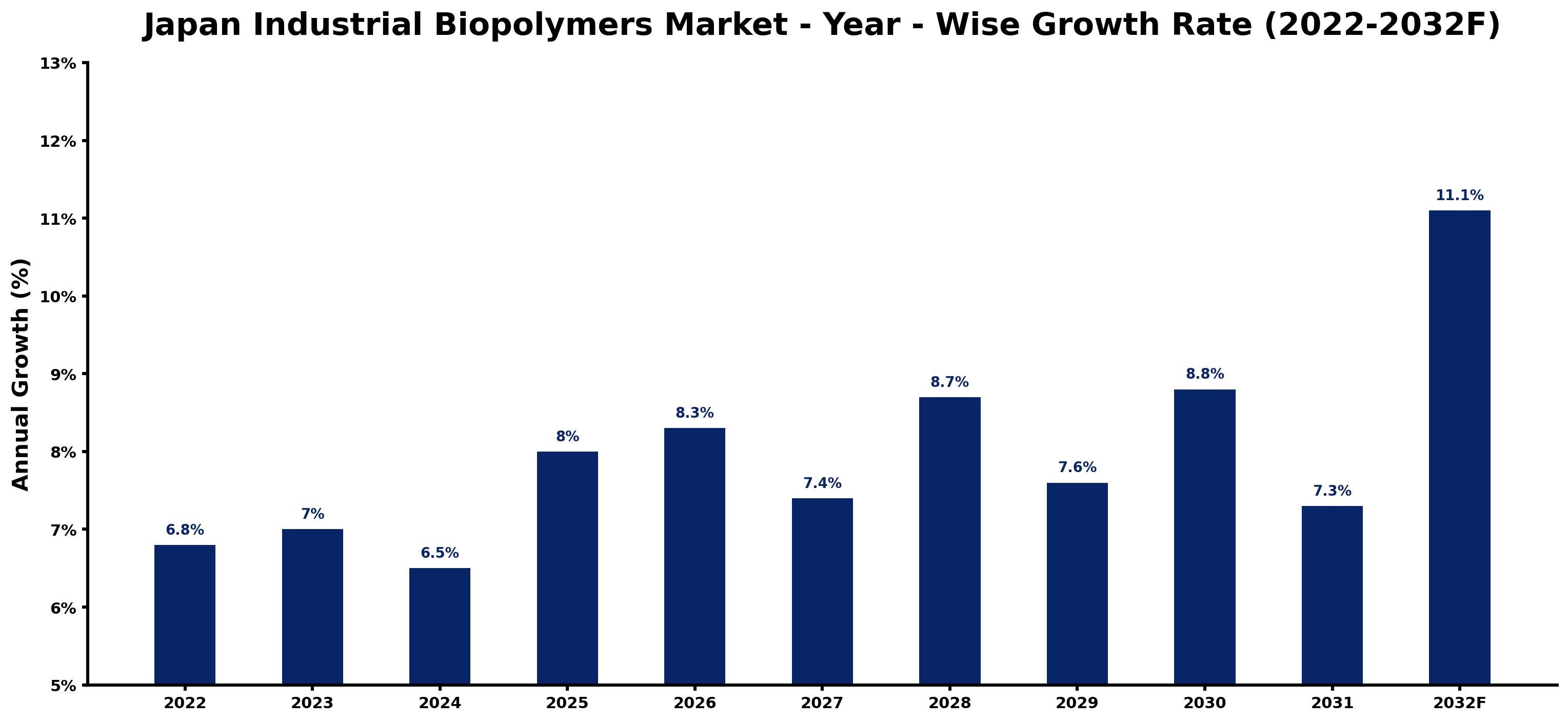
Each row of the following table gives one year's estimated growth and the event or demand shift that explains it.
| Year | Estimated Annual Growth (%) | Market Rationale |
| 2022 | 6.8 | Demand was driven by increased focus on sustainability in packaging. |
| 2023 | 7.0 | Growth was supported by rising consumer interest in biodegradable products. |
| 2024 | 6.5 | Market expansion slowed as competition intensified among biopolymer producers. |
| 2025 | 8.0 | Demand surged with new agricultural applications for biopolymers. |
| 2026 | 8.3 | Continued investment in sustainable practices boosted market growth. |
| 2027 | 7.4 | Market growth slowed due to supply chain disruptions affecting production. |
| 2028 | 8.7 | Rising environmental awareness led to increased biopolymer adoption. |
| 2029 | 7.6 | Growth decelerated as market saturation began in key segments. |
| 2030 | 8.8 | Demand accelerated with new regulations promoting biodegradable materials. |
| 2031 | 7.3 | Market growth slowed as producers adjusted to changing consumer preferences. |
| 2032 | 11.1 | Surge in orders was driven by heightened environmental policies. |
Note: Market size estimations and growth projections presented in this report are based on 6Wresearch's proprietary forecasting methodology, utilizing the latest available industry data, government publications, and primary research inputs.
Japan Industrial Biopolymers Market Synopsis
Industrial biopolymers are biodegradable polymers derived from renewable resources, primarily used in packaging, agricultural films, and disposable items. The Japan Industrial Biopolymers Market is experiencing growth driven by factors such as the rising demand from the food and beverage industry, which accounts for 20% of total demand, and the government's commitment to reducing plastic waste by 50% by 2030. The launch of a ¥1 billion program to support biopolymer innovation further fuels market expansion.
Market Dynamics Impact Analysis (2026–2032)
| Factor | Type | Impact | Primary Segment Affected |
| Growing demand for sustainable packaging solutions | Driver | High | Packaging |
| Increased agricultural applications of biopolymers | Driver | High | Agricultural Mulch Films |
| Rising consumer preference for eco-friendly products | Opportunity | High | Food & Beverage Industry |
| Government incentives for biopolymer research and development | Opportunity | High | Compostable Plastics Firms |
| Competition from traditional plastics | Restraint | Medium | Packaging |
| Limited awareness of biopolymer benefits among consumers | Restraint | Medium | Food Packaging Firms |
| High production costs compared to conventional plastics | Challenge | High | Starch-Based Biopolymers |
| Supply chain disruptions affecting raw material availability | Challenge | Medium | PHAs (Polyhydroxyalkanoates) |
Evaluation of Drivers in Japan Industrial Biopolymers Market (2026–2032)
Below are the drivers that matter most for revenue growth, with supporting evidence.
| Drivers | Primary Segment Affected | Why It Matters (Evidence) |
| Increased production of PLA | PLA (Polylactic Acid) | Japan produced 30,000 tons of PLA in 2022, meeting demand for sustainable packaging. |
| Expansion of agricultural biopolymer usage | Agricultural Mulch Films | Agricultural mulch films made from biopolymers are increasingly used in Hokkaido, supporting sustainable farming practices. |
| Government support for biopolymer adoption | Compostable Plastics Firms | Subsidies from the Ministry of the Environment encourage firms to switch to sustainable materials. |
| Growing consumer demand for eco-friendly products | Food Packaging Firms | The Food and Beverage industry in Japan is a major consumer of biopolymers, estimated at 20% of total demand. |
| Technological advancements in biopolymer production | PHAs (Polyhydroxyalkanoates) | Advancements in production processes are improving efficiency and lowering costs. |
Behind the steady rise in orders sits the growing consumer demand for eco-friendly products, particularly in the food packaging sector, which accounted for 20% of total biopolymer demand. In 2022, Japan produced 30,000 tons of PLA, reflecting the shift towards sustainable packaging solutions. Support for biopolymer adoption is also driving market growth, as firms transition to biopolymers. The agricultural sector is increasingly using mulch films in Hokkaido, which supports eco-friendly farming practices. Technological advancements are improving efficiency for PHAs, further boosting market growth.
Evaluation of Restraints in Japan Industrial Biopolymers Market
These are the pressures that could keep growth below its potential.
| Market Restraint | Primary Segment Affected | Why It Matters (Evidence) |
| High production costs compared to traditional plastics | Starch-Based Biopolymers | Production costs for starch-based biopolymers remain high, limiting widespread adoption in competitive markets. |
| Limited consumer awareness of biopolymer benefits | Food Packaging Firms | Approximately 40% of consumers are unaware of the advantages of biopolymers, hindering market expansion. |
| Competition from established plastic manufacturers | Packaging | Traditional plastic manufacturers dominate the market, making it challenging for biopolymers to gain market share. |
| Supply chain disruptions affecting raw material availability | PHAs (Polyhydroxyalkanoates) | Supply chain issues have led to inconsistent availability of raw materials for biopolymer production. |
| Regulatory hurdles in biopolymer certification | Compostable Plastics Firms | The certification process for biopolymers can be lengthy and complex, delaying product launches. |
Japan Industrial Biopolymers Market Challenges
Japan's biopolymer market faces fierce competition from low-cost traditional plastics, pressuring producers to lower prices and limiting their market share. Many buyers remain unaware of the benefits of biopolymers, resulting in a slower transition to these sustainable options and delaying revenue growth for suppliers. Supply chain disruptions, particularly in acquiring raw materials, can lead to production delays, costing producers up to three months in lost output. Rising production costs, influenced by the need for advanced technology and compliance with standards like ISO 17088:2012, can compel suppliers to increase prices, straining buyers' budgets.
Trends in the Japan Industrial Biopolymers Market
Buyers and suppliers in the Japan Industrial Biopolymers Market are adjusting to the following trends.
- Food & Beverage Industry Adopting Sustainable Packaging: The food and beverage industry is increasingly adopting biopolymers for packaging solutions, with 20% of total demand coming from this sector. In 2023, Japan's biopolymer market was valued at ¥50 billion, reflecting this shift towards sustainability.
- Growing Use of Agricultural Biopolymers: Agricultural applications of biopolymers are gaining traction, particularly in Hokkaido, where mulch films are being adopted for eco-friendly farming. This trend supports sustainable practices and reflects a growing awareness of environmental issues.
- Rise of Biopolymer Disposable Tableware: Disposable tableware made from biopolymers is gaining popularity in the food service industry, driven by consumer demand for eco-friendly options. The market for these products is expanding as municipalities mandate biodegradable alternatives.
- Increased Government Support for Biopolymer Innovation: Japan launched a program in 2023 to support biopolymer innovation with a budget of ¥1 billion. This funding aims to advance research and development in biopolymer technologies.
Investment Opportunities in the Japan Industrial Biopolymers Market
Several openings in the Japan Industrial Biopolymers Market merit attention from investors.
- Timing for Eco-Friendly Packaging Solutions: With Japan's population increasingly prioritising sustainability, there is an opportunity to supply biopolymers for packaging. The Food & Beverage Industry is actively seeking sustainable alternatives, making this a prime area for investment.
- Investment in Agricultural Biopolymers: The agricultural sector is rapidly adopting biopolymers, particularly for mulch films. Investing in production capabilities for these materials can cater to the Sustainable Agriculture buyer group, especially in regions like Hokkaido.
- Expansion of Biopolymer Disposable Tableware: The rising trend of eco-friendly disposable tableware presents an opportunity for suppliers. Municipalities mandating biodegradable products create a strong market for compostable tableware.
- Partnerships for Biopolymer Development: Now is the time to form partnerships with local firms focused on biopolymer innovation. Collaborating with compostable plastics firms can facilitate market entry and product development.
Government Initiatives in the Japan Industrial Biopolymers Market
The Chemical Substances Control Law, enacted in 1973, mandates the thorough evaluation and control of chemical substances used in manufacturing biopolymers. This law ensures that producers comply with safety standards, promoting responsible production practices. In 2023, the government allocated ¥1 billion to support biopolymer innovation, funding projects that improve production efficiency and environmental benefits. This funding is essential for advancing the biopolymer market and ensuring compliance with regulations.
The Ministry of the Environment oversees the implementation of subsidies for biopolymer usage, encouraging firms to adopt sustainable practices. This funding is vital for advancing the biopolymer market and ensuring compliance with regulations.
Future Insight of the Japan Industrial Biopolymers Market
Government initiatives will drive a substantial shift towards biopolymers, prompting suppliers to innovate in response. By 2032, the commitment to a 50% reduction in plastic waste will create robust demand for biopolymers, supported by JPY 150 trillion in public and private investments. Standards such as JIS K 6950 will ensure higher quality and safety for biodegradable products, benefiting both buyers and suppliers. The agricultural sector's growing adoption of biopolymers will also lead to new job opportunities in sustainable manufacturing.
Market Segmentation Analysis
Japan Industrial Biopolymers Market report covers a detailed analysis of the following market segments:
By Polymer Type – PLA (Polylactic Acid) Leads, PHAs (Polyhydroxyalkanoates) Expected to Grow Fastest
According to Saurav Kr Singh, Senior Research Analyst at 6Wresearch, the largest polymer type category in 2025 was PLA (Polylactic Acid), at 37% of revenue. PLA holds the largest share due to its extensive use in packaging and disposable items, which are essential for various industries. The demand for PLA is particularly strong in urban areas like Tokyo, where sustainable packaging solutions are prioritised. The quickest growth will come from PHAs (Polyhydroxyalkanoates), forecast to expand at a CAGR of 12.3% between 2026 and 2032. PHAs are experiencing rapid growth as they find increasing applications in medical and packaging sectors, reflecting a broader shift towards sustainable materials. Government initiatives aimed at fostering biopolymer innovation will likely accelerate this segment's expansion. Suppliers should consider scaling up production of PHAs to take advantage of the growing demand in the market.
By Source Material – Corn Starch Leads, Bacterial Fermentation Expected to Grow Fastest
In 2025, Corn Starch led the source material split with a 37% share. Corn Starch is the predominant source material for biopolymers, largely due to its accessibility and versatility in various applications. It serves as the primary raw material for many biopolymer products, reinforcing its market position. Bacterial Fermentation is projected to grow fastest, at a CAGR of 12.2% during 2026–2032. Bacterial Fermentation is witnessing the fastest growth as it is crucial for producing PHAs, which are increasingly preferred in sustainable applications. The heightened focus on eco-friendly materials is driving this segment's rapid development. Buyers should prioritise sourcing biopolymers derived from bacterial fermentation to align with sustainability goals.
By Product Application – Packaging Leads, Agricultural Mulch Films Expected to Grow Fastest
Packaging took 43% of product application revenue in 2025, more than any other category. Packaging is the leading application area for biopolymers, driven by the rising demand for sustainable solutions across multiple sectors. The influence of the Food and Beverage industry is particularly notable, as it integrates biopolymers into its packaging strategies. Agricultural Mulch Films are set to record the highest CAGR in this split, 11.7% over 2026–2032. Agricultural Mulch Films are rapidly gaining traction, becoming essential for sustainable farming practices, especially in regions like Hokkaido. This growth reflects the agricultural sector's commitment to adopting more environmentally friendly solutions. Suppliers should focus on developing agricultural mulch films to capitalise on this growing market segment.
By End User – Food & Beverage Industry Leads, Sustainable Agriculture Expected to Grow Fastest
Food & Beverage Industry held 53% of the Japan Industrial Biopolymers Market by end user in 2025. The Food & Beverage industry is the largest end user of biopolymers, significantly incorporating them into various sustainable packaging applications. This sector's scale and dedication to sustainability strongly influence the overall demand for biopolymers. Over 2026–2032, Sustainable Agriculture is expected to post the fastest growth, at a CAGR of 11.8%. Sustainable Agriculture is emerging as the fastest-growing end user, promoting the use of biopolymers in farming practices. This trend aligns with national sustainability targets, enhancing this segment's growth potential. Buyers in the agricultural sector should explore biopolymer options to meet evolving sustainability initiatives and regulations.
Key Attractiveness of the Report
- 10 Years of Market Numbers
- Historical Data Starting from 2022 to 2025
- Base Year 2025
- Forecast Data until 2032
- Key Performance Indicators Impacting the Market
- Major Upcoming Developments and Projects
Key Highlights of the Report:
- Japan Industrial Biopolymers Market Outlook
- Market Size of Japan Industrial Biopolymers Market, 2025
- Forecast of Japan Industrial Biopolymers Market, 2032
- Historical Data and Forecast of Japan Industrial Biopolymers Revenues & Volume for the Period 2022-2032F
- Japan Industrial Biopolymers Market Trend Evolution
- Japan Industrial Biopolymers Market Drivers and Challenges
- Japan Industrial Biopolymers Price Trends
- Japan Industrial Biopolymers Porter's Five Forces
- Japan Industrial Biopolymers Industry Life Cycle
- Historical Data and Forecast of Japan Industrial Biopolymers Market Revenues & Volume By Polymer Type for the Period 2022-2032F
- Historical Data and Forecast of Japan Industrial Biopolymers Market Revenues & Volume By PLA (Polylactic Acid) for the Period 2022-2032F
- Historical Data and Forecast of Japan Industrial Biopolymers Market Revenues & Volume By PHAs (Polyhydroxyalkanoates) for the Period 2022-2032F
- Historical Data and Forecast of Japan Industrial Biopolymers Market Revenues & Volume By Starch-Based Biopolymers for the Period 2022-2032F
- Historical Data and Forecast of Japan Industrial Biopolymers Market Revenues & Volume By Protein-Based Polymers for the Period 2022-2032F
- Historical Data and Forecast of Japan Industrial Biopolymers Market Revenues & Volume By Source Material for the Period 2022-2032F
- Historical Data and Forecast of Japan Industrial Biopolymers Market Revenues & Volume By Corn Starch for the Period 2022-2032F
- Historical Data and Forecast of Japan Industrial Biopolymers Market Revenues & Volume By Bacterial Fermentation for the Period 2022-2032F
- Historical Data and Forecast of Japan Industrial Biopolymers Market Revenues & Volume By Potato/Corn Starch for the Period 2022-2032F
- Historical Data and Forecast of Japan Industrial Biopolymers Market Revenues & Volume By Soy, Casein for the Period 2022-2032F
- Historical Data and Forecast of Japan Industrial Biopolymers Market Revenues & Volume By Product Application for the Period 2022-2032F
- Historical Data and Forecast of Japan Industrial Biopolymers Market Revenues & Volume By Packaging, Bottles for the Period 2022-2032F
- Historical Data and Forecast of Japan Industrial Biopolymers Market Revenues & Volume By Films, Bags for the Period 2022-2032F
- Historical Data and Forecast of Japan Industrial Biopolymers Market Revenues & Volume By Disposable Tableware for the Period 2022-2032F
- Historical Data and Forecast of Japan Industrial Biopolymers Market Revenues & Volume By Agricultural Mulch Films for the Period 2022-2032F
- Historical Data and Forecast of Japan Industrial Biopolymers Market Revenues & Volume By End User for the Period 2022-2032F
- Historical Data and Forecast of Japan Industrial Biopolymers Market Revenues & Volume By Food & Beverage Industry for the Period 2022-2032F
- Historical Data and Forecast of Japan Industrial Biopolymers Market Revenues & Volume By Compostable Plastics Firms for the Period 2022-2032F
- Historical Data and Forecast of Japan Industrial Biopolymers Market Revenues & Volume By Food Packaging Firms for the Period 2022-2032F
- Historical Data and Forecast of Japan Industrial Biopolymers Market Revenues & Volume By Sustainable Agriculture for the Period 2022-2032F
- Japan Industrial Biopolymers Import Export Trade Statistics
- Market Opportunity Assessment By Polymer Type
- Market Opportunity Assessment By Source Material
- Market Opportunity Assessment By Product Application
- Market Opportunity Assessment By End User
- Japan Industrial Biopolymers Top Companies Market Share
- Japan Industrial Biopolymers Competitive Benchmarking By Technical and Operational Parameters
- Japan Industrial Biopolymers Company Profiles
- Japan Industrial Biopolymers Key Strategic Recommendations
Market Covered
This report examines the market across the segments below.
By Polymer Type
- PLA (Polylactic Acid)
- PHAs (Polyhydroxyalkanoates)
- Starch-Based Biopolymers
- Protein-Based Polymers
By Source Material
- Corn Starch
- Bacterial Fermentation
- Potato/Corn Starch
- Soy
- Casein
By Product Application
- Packaging
- Bottles
- Films
- Bags
- Disposable Tableware
- Agricultural Mulch Films
By End User
- Food & Beverage Industry
- Compostable Plastics Firms
- Food Packaging Firms
- Sustainable Agriculture































