Japan Industrial Biotechnology Market Size & Growth Rate
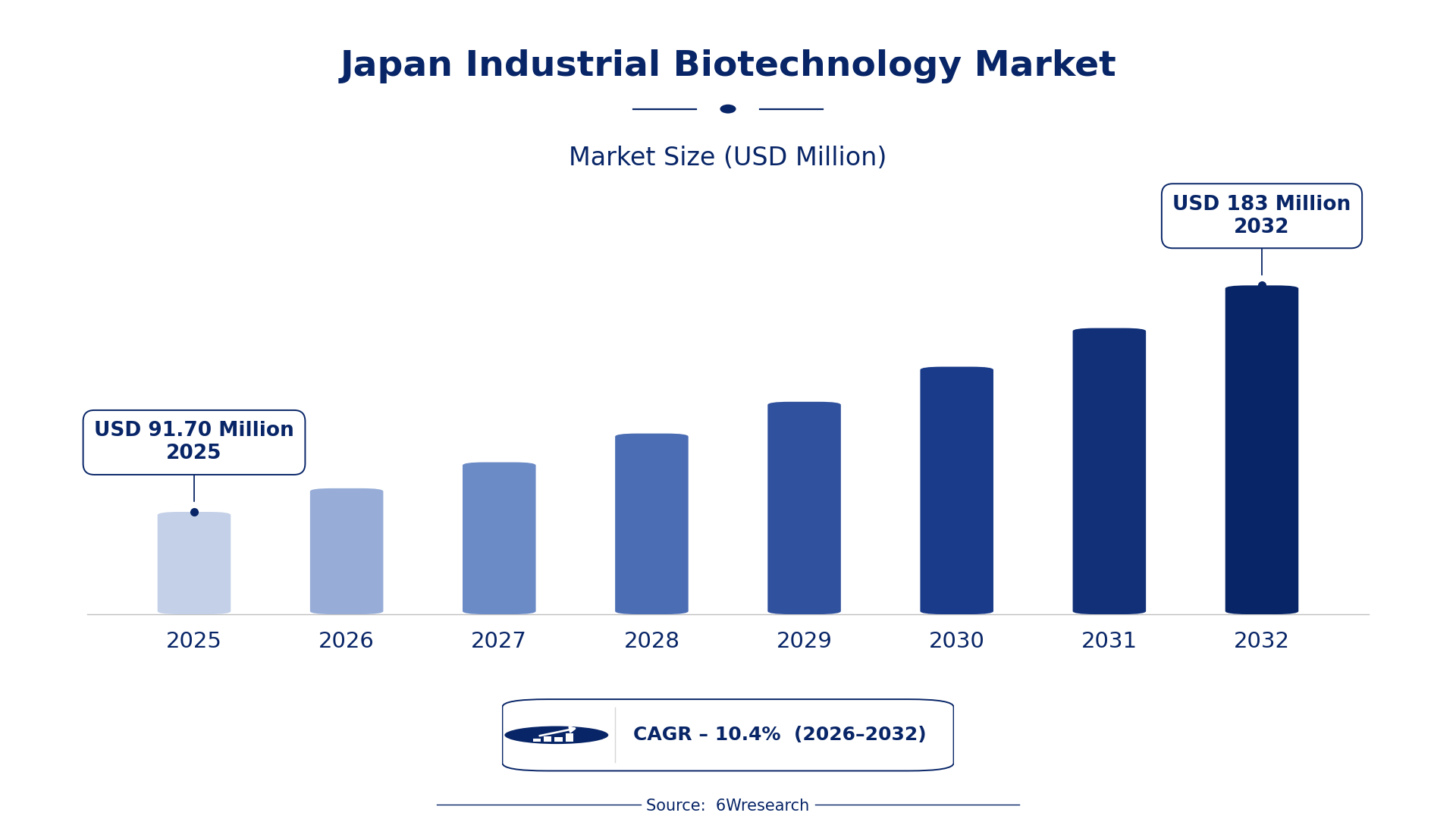
According to 6Wresearch internal database and industry insights, the Japan Industrial Biotechnology Market was valued at USD 91.70 Million in 2025 and is projected to reach USD 183 Million by 2032, growing at a CAGR of approximately 10.4% during 2026–2032.
Japan Industrial Biotechnology Market Highlights
| Report Metric | Details |
| Report Name | Japan Industrial Biotechnology Market (2026-2032) |
| Market Size 2025 | USD 91.70 Million |
| Market Size 2032 | USD 183 Million |
| Absolute Growth 2025–2032 | USD 91.30 Million |
| CAGR 2026–2032 | 10.4% |
| Peak Annual Growth | 12.8% in 2028 |
| Forecast Period | 2026–2032 |
| Historical Data | 2022–2025 |
| Base Year | 2025 |
| Leading Biotech Process, 2025 | Fermentation Engineering (41% share) |
| Leading Application Segment, 2025 | Enzyme Production (45% share) |
| Leading Technology Used, 2025 | Bioreactors (40% share) |
| Leading End User, 2025 | Pharmaceutical Companies (40% share) |
| Fastest-Growing Biotech Process | Bioconversion (15.7% CAGR) |
| Fastest-Growing Application Segment | Biofuel & Ethanol (14.2% CAGR) |
| Fastest-Growing Technology Used | Chromatography Systems (14.6% CAGR) |
| Fastest-Growing End User | Renewable Energy Sector (13.5% CAGR) |
| Growing Sector | Biofuel & Ethanol |
| Key End Users | Enzyme Production, Biofuel & Ethanol, Drug Purification, Environmental Monitoring |
Japan Industrial Biotechnology Market Year-wise Growth Rate and Key Drivers (2022–2032)
This graph illustrates the annual growth rates of the market from 2022 to 2032, highlighting a steady upward trajectory and projected market expansion over the forecast period.
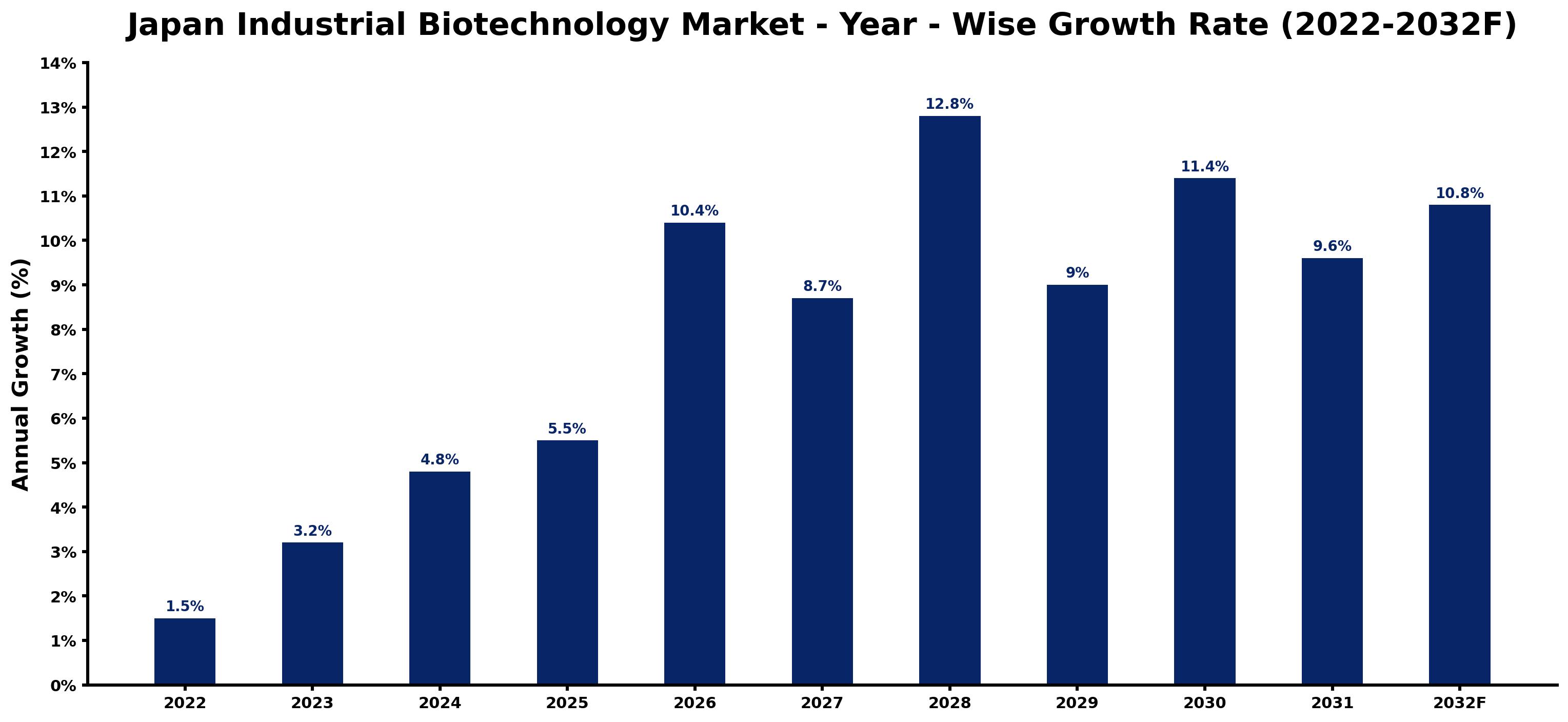
For each year, the table pairs the estimated growth rate with the leading influence on demand, showing how the drivers changed across the period.
| Year | Estimated Annual Growth (%) | Market Rationale |
| 2022 | 1.5 | The market exhibited modest growth as industries began to explore biotechnological applications. |
| 2023 | 3.2 | Demand for biotechnological solutions accelerated due to increased investment in research and development. |
| 2024 | 4.8 | Growth continued as more companies adopted biotechnological processes for efficiency. |
| 2025 | 5.5 | The market peaked historically as enzyme production surged in the food sector. |
| 2026 | 10.4 | Rapid growth is anticipated as bioconversion processes gain traction in waste management. |
| 2027 | 8.7 | The market will experience a slowdown as growth stabilises following earlier peaks. |
| 2028 | 12.8 | A new peak is expected as biofuel demand surges amid renewable energy initiatives. |
| 2029 | 9.0 | Growth will slow again as the market adjusts to increased competition and capacity. |
| 2030 | 11.4 | Demand is likely to rise as pharmaceutical companies expand their biotechnological capabilities. |
| 2031 | 9.6 | A slowdown will be noted as market growth stabilises after several years of rapid expansion. |
| 2032 | 10.8 | Growth is projected to accelerate again as innovations in bioprocessing attract new investments. |
Note: Market size estimations and growth projections presented in this report are based on 6Wresearch's proprietary forecasting methodology, utilizing the latest available industry data, government publications, and primary research inputs.
Japan Industrial Biotechnology Market Synopsis
Industrial biotechnology utilises biological systems to develop products and processes, primarily through fermentation and bioconversion techniques. Key applications include enzyme production, biofuels, and drug purification. The Japan Industrial Biotechnology Market is projected to reach 1 trillion yen by 2025, driven by demand from pharmaceutical companies and the renewable energy sector, alongside public and private investments in biotechnology research and development.
Market Dynamics Impact Analysis (2026–2032)
| Factor | Type | Impact | Primary Segment Affected |
| Increased focus on renewable energy sources drives demand for biofuels. | Driver | High | Biofuel & Ethanol |
| The pharmaceutical sector's reliance on biotechnological processes boosts enzyme production. | Driver | High | Enzyme Production |
| Growing interest in sustainable practices creates opportunities in bioconversion. | Opportunity | High | Bioconversion |
| Rising investments in biotechnology research open new avenues for innovation. | Opportunity | High | Fermentation Engineering |
| High operational costs can limit the adoption of advanced biotechnological methods. | Restraint | High | Bioreactors |
| Limited awareness of biotechnology benefits among smaller firms restricts market growth. | Restraint | Medium | Environmental Labs |
| Competition from traditional methods can hinder the market's expansion. | Challenge | High | Chemical Manufacturers |
| Technological integration challenges may slow down the adoption of biotechnological solutions. | Challenge | Medium | Pharmaceutical Companies |
Evaluation of Drivers in Japan Industrial Biotechnology Market (2026–2032)
These are the developments adding the most demand over the forecast period.
| Drivers | Primary Segment Affected | Why It Matters (Evidence) |
| The pharmaceutical industry's expansion drives the need for enzyme production. | Enzyme Production | With Japan's pharmaceutical market projected to grow, demand for enzymes for drug purification is increasing. |
| The push for sustainability fuels investments in biofuel production. | Biofuel & Ethanol | Japan targets a 46% reduction in greenhouse gas emissions by 2030, boosting biofuel initiatives. |
| Technological advancements in bioprocessing improve production efficiency. | Bioreactors | Over 1,000 bioreactors are operational in Japan, facilitating efficient fermentation processes. |
| Growing public and private investment in biotechnology research supports innovation. | Fermentation Engineering | Japan's GX Basic Policy aims for JPY 150 trillion in decarbonisation investments over the next decade. |
| Increasing demand for biofuels in transportation fuels growth in bioconversion processes. | Bioconversion | The push for renewable energy encourages biofuel production, leading to increased investments in bioconversion technologies. |
What keeps demand rising is the expansion of the pharmaceutical sector, which drives the need for enzyme production. The push for sustainability fuels investments in biofuel production, as Japan targets a 46% reduction in greenhouse gas emissions by 2030. Public and private investment in biotechnology research supports innovation, with substantial funding aimed at promoting advancements in biotechnological processes. The operational efficiency of over 1,000 bioreactors in Japan enhances production capabilities, allowing firms to meet growing market needs.
Evaluation of Restraints in Japan Industrial Biotechnology Market
Several factors work against faster growth; the main ones are summarised below.
| Market Restraint | Primary Segment Affected | Why It Matters (Evidence) |
| High operational costs can limit the adoption of advanced biotechnological methods. | Bioreactors | The initial investment required for bioreactors can deter smaller firms from adopting these technologies. |
| Limited awareness of biotechnology benefits among smaller firms restricts market growth. | Environmental Labs | Smaller environmental labs may not fully understand the advantages of biotechnological methods, hindering adoption. |
| Regulatory hurdles may slow down the approval process for new biotechnological products. | Pharmaceutical Companies | Stringent regulations can delay the introduction of biopharmaceuticals, affecting market activities. |
| Technological integration challenges may slow down the adoption of biotechnological solutions. | Pharmaceutical Companies | Integrating new biotechnological processes with existing systems can be complex and resource-intensive. |
| Competition from traditional methods can hinder the market's expansion. | Chemical Manufacturers | Chemical manufacturers often rely on conventional processes, limiting the shift towards biotechnological solutions. |
Japan Industrial Biotechnology Market Challenges
Enzyme manufacturers face inflated production expenses due to limited domestic sources for raw materials, increasing costs by 20% for producers. Technological limitations hinder the adoption of advanced bioprocessing techniques, delaying product development timelines by six months for pharmaceutical firms. A shortage of skilled biotechnology professionals persists, with over 60% of firms struggling to recruit qualified talent, causing project delays and operational inefficiencies. Regulatory compliance remains complex, with stringent guidelines imposing additional costs of 15% for firms navigating approval processes.
Trends in the Japan Industrial Biotechnology Market
Several trends are reshaping the Japan Industrial Biotechnology Market; the most important are set out below.
- Surge in Biofuel Production: Biofuel production in Japan is gaining momentum, with output increasing by 20% in 2023. This shift reflects a growing commitment to renewable energy, driven by national targets for emissions reduction.
- Adoption of Bioconversion Technologies: Bioconversion technologies are becoming more prevalent, especially in waste management. With over 300 biotechnology firms in Japan, the sector is set for growth as companies seek efficient waste solutions.
- Increased Funding for Biotechnology Research: Investment in biotechnology research is rising, particularly in the Tokyo region. The government allocated 50 billion yen for research initiatives in 2023, promoting innovation across various sectors.
- Demand for Advanced Enzyme Production: The food and beverage industry increasingly relies on enzyme production for processing. In 2025, enzyme production is projected to account for 45% of the market, underscoring its significance.
Investment Opportunities in the Japan Industrial Biotechnology Market
The following opportunities in the Japan Industrial Biotechnology Market pair current demand with a clear way in.
- Tokyo as a Biotechnology Hub: Tokyo is emerging as a biotechnology hub, attracting substantial investments. With the market projected to reach 1 trillion yen by 2025, firms can establish partnerships with local research institutions.
- Supply of Advanced Bioprocessing Solutions: There is a growing need for advanced bioprocessing solutions in Japan's biotechnology sector. Companies can supply bioreactors to pharmaceutical firms, enhancing production efficiency.
- Investment in Biofuel Production: The push for renewable energy presents a notable investment opportunity in biofuel production. With Japan targeting a 46% reduction in emissions by 2030, firms can enter through local partnerships.
- Support for Drug Purification Technologies: Pharmaceutical companies are increasingly seeking advanced drug purification technologies. Suppliers can meet this demand by providing chromatography systems, essential for biopharmaceutical manufacturing.
Government Initiatives in the Japan Industrial Biotechnology Market
The Next-Generation Medical Infrastructure Act (2017) allows certified bodies to anonymise medical data for research purposes, supporting biotechnology firms in developing new medical products while ensuring compliance with privacy regulations. This measure complements existing laws by enhancing the framework for medical research and product development.
In 2023, the government allocated 50 billion yen to support biotechnology research initiatives, overseen by the Japan Agency for Medical Research and Development (AMED). This funding aims to promote advancements in biotechnological processes and improve Japan's competitiveness in the global market.
Future Insight of the Japan Industrial Biotechnology Market
A policy-driven shift towards decarbonisation will catalyse advancements in biotechnology, supported by a JPY 150 trillion investment in decarbonisation over the next decade. By 2032, improvements in bioprocessing technologies will streamline production processes, enabling suppliers to reduce costs and accelerate product launches. The growth of biotechnology research institutions will help build a skilled workforce, addressing current talent shortages. Enhanced collaboration between government and private sectors will stimulate innovation, positioning Japan as a leader in the biopharmaceutical market.
Market Segmentation Analysis
Japan Industrial Biotechnology Market report covers a detailed analysis of the following market segments:
By Biotech Process – Fermentation Engineering Leads, Bioconversion Expected to Grow Fastest
According to Saurav Kr Singh, Senior Research Analyst at 6Wresearch, Fermentation Engineering held 41% of the Japan Industrial Biotechnology Market by biotech process in 2025. Fermentation Engineering holds the largest share because it is integral to producing biofuels and enzymes, which are essential in various sectors. The presence of over 1,000 bioreactors in operation reinforces the strong infrastructure supporting this process in Japan. Over 2026–2032, Bioconversion is expected to post the fastest growth, at a CAGR of 15.7%. Bioconversion is experiencing rapid growth as it effectively transforms biomass into valuable products, aligning with Japan's decarbonisation goals. The government's investment of 50 billion yen in biotechnology research initiatives in 2023 will further accelerate this segment's development. Suppliers should prioritise advancements in bioconversion technologies to cater to the increasing demand for sustainable solutions.
By Application Segment – Enzyme Production Leads, Biofuel & Ethanol Expected to Grow Fastest
The largest application segment category in 2025 was Enzyme Production, at 45% of revenue. Enzyme Production leads the market as it is vital for numerous industrial processes, especially in the food and beverage sector. The large population in Japan drives significant demand for processed food products that require enzyme applications. Biofuel & Ethanol is set to record the highest CAGR in this split, 14.2% over 2026–2032. Biofuel & Ethanol is the fastest-growing segment, propelled by the Renewable Energy Law which encourages biofuels in transportation. This regulatory support is crucial as Japan aims for a 46% reduction in greenhouse-gas emissions by fiscal 2030. Buyers should enhance their enzyme production capabilities to capitalise on the rising demand for efficient industrial processes.
By Technology Used – Bioreactors Lead, Chromatography Systems Expected to Grow Fastest
With 40% of technology used revenue in 2025, Bioreactors was the largest category. Bioreactors dominate the market as they are essential for fermentation processes widely used in producing biofuels and enzymes. The existence of over 300 biotechnology firms in Japan indicates a robust market for this technology. The quickest growth will come from Chromatography Systems, forecast to expand at a CAGR of 14.6% between 2026 and 2032. Chromatography Systems are experiencing rapid growth due to their critical role in separating compounds during bioprocessing, which is vital for quality control. The expansion of the pharmaceutical sector will further increase the need for advanced separation technologies. Suppliers must innovate in chromatography systems to meet the growing demand from the expanding biopharmaceutical market.
By End User – Pharmaceutical Companies Lead, Renewable Energy Sector Expected to Grow Fastest
In 2025, Pharmaceutical Companies led the end user split with a 40% share. Pharmaceutical Companies represent the largest end user, heavily relying on biotechnology for drug development, supported by Japan's substantial healthcare expenditure. With approximately 8,100 hospitals in 2023, the demand for biotechnological solutions in pharmaceuticals is significant. Renewable Energy Sector is projected to grow fastest, at a CAGR of 13.5% during 2026–2032. The Renewable Energy Sector is the fastest-growing end user, concentrating on sustainable energy solutions that align with national decarbonisation objectives. The government's commitment to investing in renewable energy infrastructure will further accelerate this growth. Suppliers should focus on the renewable energy sector to leverage the increasing emphasis on sustainable energy solutions.
Key Attractiveness of the Report
- 10 Years of Market Numbers
- Historical Data Starting from 2022 to 2025
- Base Year 2025
- Forecast Data until 2032
- Key Performance Indicators Impacting the Market
- Major Upcoming Developments and Projects
Key Highlights of the Report:
- Japan Industrial Biotechnology Market Outlook
- Market Size of Japan Industrial Biotechnology Market, 2025
- Forecast of Japan Industrial Biotechnology Market, 2032
- Historical Data and Forecast of Japan Industrial Biotechnology Revenues & Volume for the Period 2022-2032F
- Japan Industrial Biotechnology Market Trend Evolution
- Japan Industrial Biotechnology Market Drivers and Challenges
- Japan Industrial Biotechnology Price Trends
- Japan Industrial Biotechnology Porter's Five Forces
- Japan Industrial Biotechnology Industry Life Cycle
- Historical Data and Forecast of Japan Industrial Biotechnology Market Revenues & Volume By Biotech Process for the Period 2022-2032F
- Historical Data and Forecast of Japan Industrial Biotechnology Market Revenues & Volume By Fermentation Engineering for the Period 2022-2032F
- Historical Data and Forecast of Japan Industrial Biotechnology Market Revenues & Volume By Bioconversion for the Period 2022-2032F
- Historical Data and Forecast of Japan Industrial Biotechnology Market Revenues & Volume By Bioseparation for the Period 2022-2032F
- Historical Data and Forecast of Japan Industrial Biotechnology Market Revenues & Volume By Biosensors for the Period 2022-2032F
- Historical Data and Forecast of Japan Industrial Biotechnology Market Revenues & Volume By Application Segment for the Period 2022-2032F
- Historical Data and Forecast of Japan Industrial Biotechnology Market Revenues & Volume By Enzyme Production for the Period 2022-2032F
- Historical Data and Forecast of Japan Industrial Biotechnology Market Revenues & Volume By Biofuel & Ethanol for the Period 2022-2032F
- Historical Data and Forecast of Japan Industrial Biotechnology Market Revenues & Volume By Drug Purification for the Period 2022-2032F
- Historical Data and Forecast of Japan Industrial Biotechnology Market Revenues & Volume By Environmental Monitoring for the Period 2022-2032F
- Historical Data and Forecast of Japan Industrial Biotechnology Market Revenues & Volume By Technology Used for the Period 2022-2032F
- Historical Data and Forecast of Japan Industrial Biotechnology Market Revenues & Volume By Bioreactors for the Period 2022-2032F
- Historical Data and Forecast of Japan Industrial Biotechnology Market Revenues & Volume By Metabolic Pathway Design for the Period 2022-2032F
- Historical Data and Forecast of Japan Industrial Biotechnology Market Revenues & Volume By Chromatography Systems for the Period 2022-2032F
- Historical Data and Forecast of Japan Industrial Biotechnology Market Revenues & Volume By DNA/Protein Assays for the Period 2022-2032F
- Historical Data and Forecast of Japan Industrial Biotechnology Market Revenues & Volume By End User for the Period 2022-2032F
- Historical Data and Forecast of Japan Industrial Biotechnology Market Revenues & Volume By Chemical Manufacturers for the Period 2022-2032F
- Historical Data and Forecast of Japan Industrial Biotechnology Market Revenues & Volume By Renewable Energy Sector for the Period 2022-2032F
- Historical Data and Forecast of Japan Industrial Biotechnology Market Revenues & Volume By Pharmaceutical Companies for the Period 2022-2032F
- Historical Data and Forecast of Japan Industrial Biotechnology Market Revenues & Volume By Environmental Labs for the Period 2022-2032F
- Japan Industrial Biotechnology Import Export Trade Statistics
- Market Opportunity Assessment By Biotech Process
- Market Opportunity Assessment By Application Segment
- Market Opportunity Assessment By Technology Used
- Market Opportunity Assessment By End User
- Japan Industrial Biotechnology Top Companies Market Share
- Japan Industrial Biotechnology Competitive Benchmarking By Technical and Operational Parameters
- Japan Industrial Biotechnology Company Profiles
- Japan Industrial Biotechnology Key Strategic Recommendations
Market Covered
The study includes the following segmentation.
By Biotech Process
- Fermentation Engineering
- Bioconversion
- Bioseparation
- Biosensors
By Application Segment
- Enzyme Production
- Biofuel & Ethanol
- Drug Purification
- Environmental Monitoring
By Technology Used
- Bioreactors
- Metabolic Pathway Design
- Chromatography Systems
- DNA/Protein Assays
By End User
- Chemical Manufacturers
- Renewable Energy Sector
- Pharmaceutical Companies
- Environmental Labs































