Japan Industrial Bleaching Agents Market Size & Growth Rate
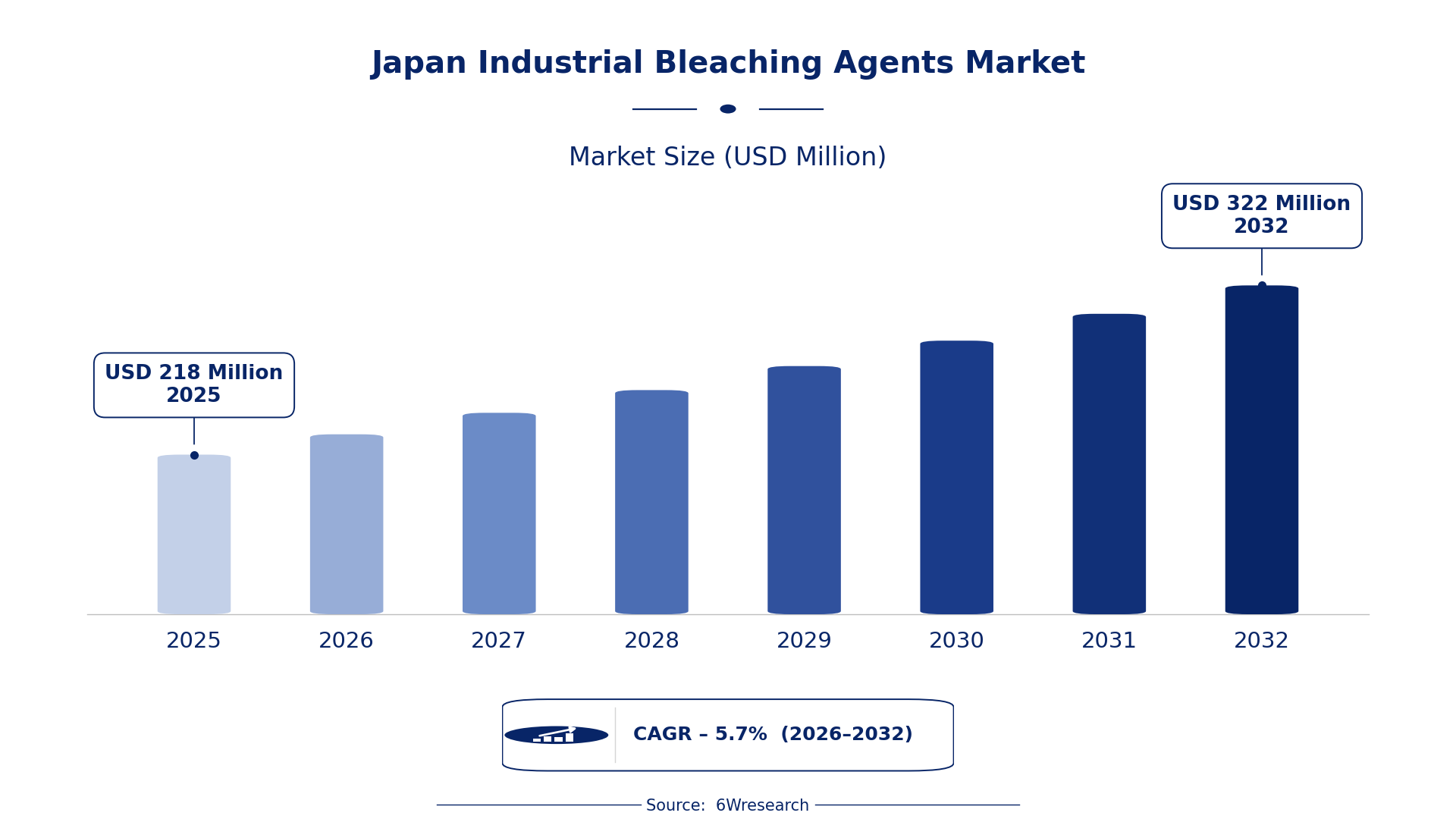
According to 6Wresearch internal database and industry insights, the Japan Industrial Bleaching Agents Market was valued at USD 218 Million in 2025 and is projected to reach USD 322 Million by 2032, growing at a CAGR of approximately 5.7% during 2026–2032.
Japan Industrial Bleaching Agents Market Highlights
| Report Metric | Details |
| Report Name | Japan Industrial Bleaching Agents Market (2026-2032) |
| Market Size 2025 | USD 218 Million |
| Market Size 2032 | USD 322 Million |
| Absolute Growth 2025–2032 | USD 104 Million |
| CAGR 2026–2032 | 5.7% |
| Peak Annual Growth | 6.6% in 2032 |
| Forecast Period | 2026–2032 |
| Historical Data | 2022–2025 |
| Base Year | 2025 |
| Leading Bleaching Agent Type, 2025 | Hydrogen Peroxide (39% share) |
| Leading Base Compound, 2025 | Oxygen-Based (42% share) |
| Leading Industry Application, 2025 | Pulp & Paper (40% share) |
| Leading End User, 2025 | Paper Manufacturers (41% share) |
| Fastest-Growing Bleaching Agent Type | Chlorine-Based Agents (8.1% CAGR) |
| Fastest-Growing Base Compound | Sodium Hypochlorite (7.6% CAGR) |
| Fastest-Growing Industry Application | Textile Whitening (7.9% CAGR) |
| Fastest-Growing End User | Fabric Processing Plants (7.8% CAGR) |
| Growing Sector | Pulp and Paper |
| Key End Users | Paper Manufacturers, Fabric Processing Plants, Sugar Mills |
Japan Industrial Bleaching Agents Market Year-wise Growth Rate and Key Drivers (2022–2032)
This graph illustrates the annual growth rates of the market from 2022 to 2032, highlighting a steady upward trajectory and projected market expansion over the forecast period.
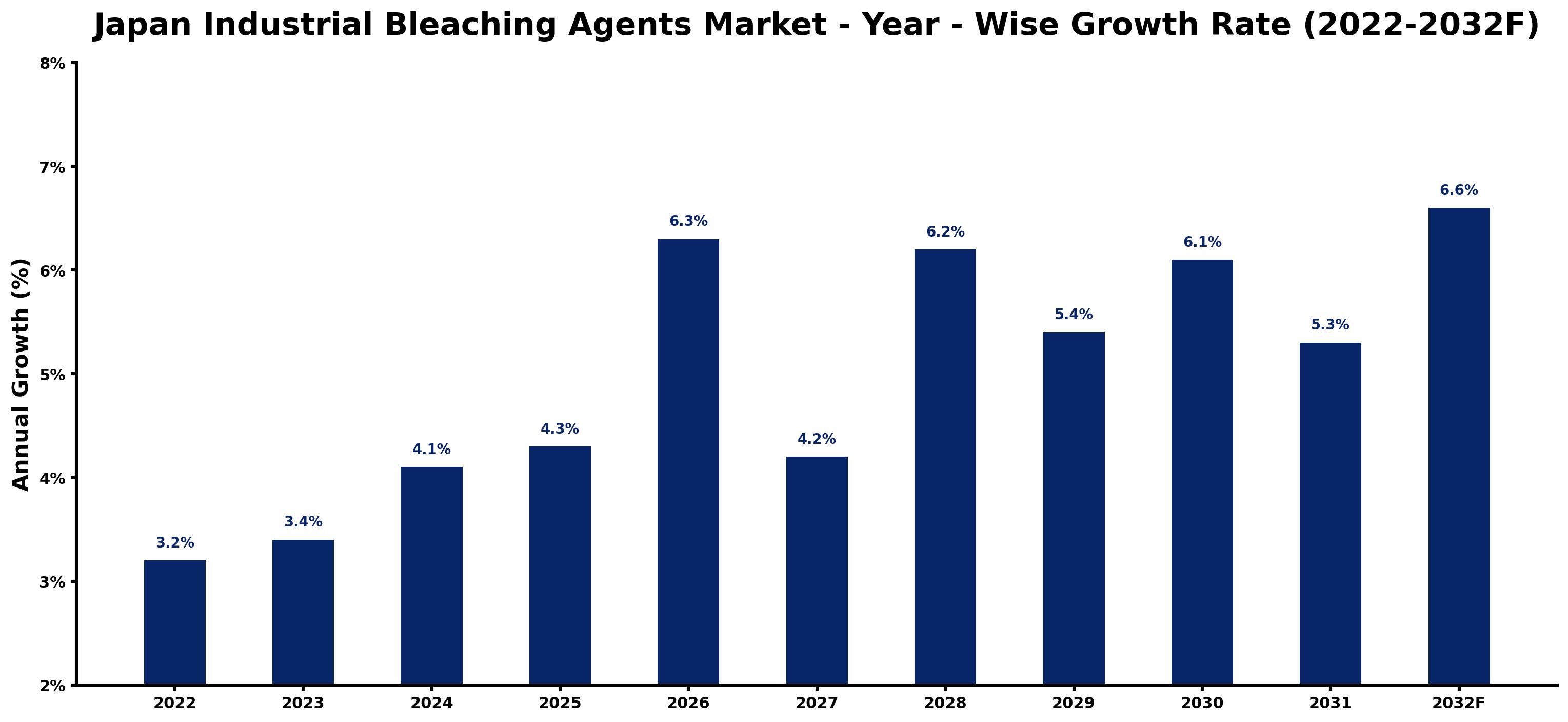
Year by year, the estimates below pair each growth rate with the development that shaped it.
| Year | Estimated Annual Growth (%) | Market Rationale |
| 2022 | 3.2 | The market showed steady growth, reflecting consistent demand from the pulp and paper sector. |
| 2023 | 3.4 | Growth accelerated due to increased production in the textile industry and rising environmental awareness. |
| 2024 | 4.1 | Demand surged as manufacturers adopted more efficient bleaching processes in response to sustainability trends. |
| 2025 | 4.3 | The market peaked as paper production reached 8 million tons, driving higher consumption of bleaching agents. |
| 2026 | 6.3 | Growth is expected to rise sharply as eco-friendly practices gain traction in various industries. |
| 2027 | 4.2 | A slowdown in growth occurs as market conditions stabilise after rapid expansion in the previous year. |
| 2028 | 6.2 | Demand is projected to increase again as manufacturers shift towards sustainable bleaching solutions. |
| 2029 | 5.4 | Growth slows slightly, reflecting market adjustments to new environmental regulations and standards. |
| 2030 | 6.1 | An uptick in growth is anticipated as investments in green technologies continue to rise. |
| 2031 | 5.3 | Growth is expected to moderate as the market reaches a more stable phase of development. |
| 2032 | 6.6 | The market is forecasted to peak, driven by heightened demand for eco-friendly bleaching agents. |
Note: Market size estimations and growth projections presented in this report are based on 6Wresearch's proprietary forecasting methodology, utilizing the latest available industry data, government publications, and primary research inputs.
Japan Industrial Bleaching Agents Market Synopsis
Industrial bleaching agents are chemical compounds used primarily in the pulp and paper, textile, and food industries to whiten or lighten materials. The Japan Industrial Bleaching Agents Market is growing due to rising demand from the pulp and paper sector, which produced 8 million tons in 2022, alongside increasing investments in eco-friendly practices. The GX Basic Policy aims for substantial decarbonisation investments over the next decade, further propelling the market as manufacturers embrace sustainable bleaching solutions.
Market Dynamics Impact Analysis (2026–2032)
| Factor | Type | Impact | Primary Segment Affected |
| Rising demand from the pulp and paper industry due to increased production levels | Driver | High | Pulp & Paper |
| Growing adoption of eco-friendly bleaching agents in textiles | Driver | High | Textile Whitening |
| Investment in sustainable practices by paper manufacturers | Opportunity | Medium | Paper Manufacturers |
| Expansion of bio-based textiles in the textile sector | Opportunity | Medium | Fabric Processing Plants |
| Regulatory pressures on chlorine-based agents due to environmental concerns | Restraint | High | Chlorine-Based Agents |
| Limited awareness of enzymatic bleaching agents among manufacturers | Restraint | Medium | Enzymatic Bleaching Agents |
| High operational costs for sustainable production methods | Challenge | High | Textile Whitening |
| Competition from alternative bleaching technologies | Challenge | Medium | Oxygen-Based |
Evaluation of Drivers in Japan Industrial Bleaching Agents Market (2026–2032)
The main growth drivers and the segments they affect most are set out below.
| Drivers | Primary Segment Affected | Why It Matters (Evidence) |
| Increased production in the pulp and paper industry | Pulp & Paper | Japan's pulp and paper industry produced 8 million tons in 2022, driving demand for bleaching agents. |
| Growing focus on sustainable practices in textiles | Textile Whitening | The textile industry is projected to grow with eco-friendly practices by 2025, increasing demand for eco-friendly bleaching agents. |
| Investment in decarbonisation initiatives | Sugar & Food Processing | Japan's GX Basic Policy targets about JPY 150 trillion of investment over 10 years, promoting sustainable practices. |
| Rising consumer demand for eco-friendly products | Eco-Friendly Alternatives | The Japan Chemical Industry Association supports sustainable practices in bleaching, influencing buyer preferences. |
| Technological advancements in bleaching processes | Hydrogen Peroxide | Hydrogen peroxide remains a leading bleaching agent in the pulp sector, improving production efficiency. |
Much of the new demand originates from the pulp and paper industry, which produced 8 million tons in 2022, resulting in heightened consumption of bleaching agents. The textile sector is expected to grow with eco-friendly practices by 2025, driving the need for sustainable bleaching solutions. Investment in decarbonisation efforts, targeting about JPY 150 trillion over the next decade, promotes the adoption of eco-friendly products. Consumer preferences are shifting towards sustainable practices, further shaping purchasing decisions across various industries.
Evaluation of Restraints in Japan Industrial Bleaching Agents Market
Below are the constraints most often cited by buyers and suppliers, with the segment each affects.
| Market Restraint | Primary Segment Affected | Why It Matters (Evidence) |
| Regulatory pressures on chlorine-based agents due to environmental concerns | Chlorine-Based Agents | Chlorine-based agents are regulated under strict environmental laws, limiting their usage in certain applications. |
| Limited awareness of enzymatic bleaching agents among manufacturers | Enzymatic Bleaching Agents | Many manufacturers are not fully aware of the benefits of enzymatic agents, hindering their adoption. |
| High operational costs for sustainable production methods | Textile Whitening | Implementing eco-friendly practices often requires substantial investment, impacting profitability for manufacturers. |
| Competition from alternative bleaching technologies | Oxygen-Based | Emerging technologies may offer more cost-effective solutions, challenging traditional bleaching methods. |
| Dependence on imports for certain bleaching agents | Sulfur Dioxide | Some bleaching agents are sourced from overseas, creating supply chain vulnerabilities. |
Japan Industrial Bleaching Agents Market Challenges
Japan's pulp and paper producers face strict environmental regulations, causing production delays of up to three months as they comply with new standards. Importers of bleaching agents contend with outdated technology, which raises operational costs by approximately 15%, squeezing profit margins. Buyers in the textile sector are experiencing rising expenses, with costs increasing by 20% as they transition towards eco-friendly practices and sustainable bleaching agents. A shortage of skilled workers in the chemical industry hampers innovation, risking a potential loss of market competitiveness for producers in the long term.
Trends in the Japan Industrial Bleaching Agents Market
Four trends stand out in the Japan Industrial Bleaching Agents Market.
- Shift towards Eco-Friendly Bleaching Solutions: Paper manufacturers are increasingly adopting eco-friendly bleaching agents in response to consumer demand for sustainability. In 2023, the government launched a program to reduce chemical use in industries, promoting greener alternatives.
- Transition from Chlorine-Based to Enzymatic Agents: Textile manufacturers are gradually moving away from chlorine-based agents towards enzymatic alternatives. This shift is driven by growing environmental regulations and consumer preferences for sustainable products.
- Emergence of Bio-Based Textiles: The textile sector is focusing on bio-based textiles to meet consumer demand. In 2023, the textile industry employed over 300,000 workers, indicating a shift towards sustainable practices.
- Increase in Decarbonisation Investments: Japan's GX Basic Policy aims for about JPY 150 trillion of public and private decarbonisation investment over 10 years. This investment is expected to support the adoption of eco-friendly bleaching agents across industries.
Investment Opportunities in the Japan Industrial Bleaching Agents Market
Investors looking at the Japan Industrial Bleaching Agents Market should consider the following areas.
- Investment in Eco-Friendly Bleaching Agents: Manufacturers can supply eco-friendly bleaching agents to meet growing demand. Paper manufacturers are increasingly seeking sustainable solutions, creating opportunities for suppliers.
- Expansion into Bio-Based Textiles: The growing interest in bio-based textiles presents an opportunity for investment. Fabric processing plants are looking for sustainable materials, offering a pathway for new entrants.
- Development of Enzymatic Bleaching Solutions: Investing in enzymatic bleaching agents can cater to the textile industry's shift towards sustainability. This market is expanding as manufacturers adopt greener practices.
- Partnerships for Sustainable Practices: Collaborating with local manufacturers can improve market entry for eco-friendly solutions. The textile sector's focus on sustainability creates avenues for joint ventures.
Government Initiatives in the Japan Industrial Bleaching Agents Market
The Industrial Safety and Health Act (1972; MHLW) sets employer duties regarding hazardous substances, ensuring safe practices in industries using bleaching agents. This law mandates compliance with safety standards, impacting manufacturers' operations and product formulations. The GX Promotion Act (2023) serves as a legal framework for promoting decarbonisation strategies, encouraging investments in sustainable technologies.
The Ministry of the Environment oversees the implementation of the GX Basic Policy, which aims for substantial decarbonisation investments. This policy encourages buyers to adopt eco-friendly bleaching agents, as they can benefit from incentives for sustainable practices and compliance with environmental regulations.
Future Insight of the Japan Industrial Bleaching Agents Market
Buyers in the textile sector will increasingly demand eco-friendly bleaching agents as consumer preferences shift towards sustainability. Producers will adopt advanced technologies to improve efficiency and reduce costs, creating a more competitive environment. By 2032, Japan's pulp and paper industry is expected to produce 9 million tons, reflecting a growing need for industrial bleaching agents. The government's decarbonisation investment programme will facilitate the transition to greener practices, benefiting both buyers and suppliers.
Market Segmentation Analysis
Japan Industrial Bleaching Agents Market report covers a detailed analysis of the following market segments:
By Bleaching Agent Type – Hydrogen Peroxide Leads, Chlorine-Based Agents Expected to Grow Fastest
According to Saurav Kr Singh, Senior Research Analyst at 6Wresearch, in 2025, Hydrogen Peroxide led the bleaching agent type split with a 39% share. Hydrogen peroxide holds the largest share as it is extensively utilised in the pulp and paper sector, crucial for achieving desired whiteness in products. Its application is reinforced by Japan's extensive network of over 1,000 paper manufacturing facilities, ensuring a continuous demand. Chlorine-Based Agents are set to record the highest CAGR in this split, 8.1% over 2026–2032. Chlorine-based agents are experiencing rapid growth, especially in textile applications, as manufacturers increasingly adopt sustainable practices. The textile industry's anticipated expansion by 2025 will further boost the demand for these agents, solidifying their market position. Suppliers should focus on developing chlorine-based agents to capitalise on the growing opportunities within the textile sector.
By Base Compound – Oxygen-Based Leads, Sodium Hypochlorite Expected to Grow Fastest
Oxygen-Based accounted for 42% of the market by base compound in 2025. Oxygen-based compounds dominate the market due to their broad applicability in various bleaching processes, making them vital across multiple industries. Their extensive use in sectors like pulp and paper, textiles, and water treatment guarantees consistent demand. Sodium Hypochlorite is projected to grow fastest, at a CAGR of 7.6% during 2026–2032. Sodium hypochlorite is seeing notable growth, particularly in water treatment and bleaching applications, as industries turn to more efficient solutions. This trend is likely to persist as environmental regulations increasingly favour its use. Suppliers need to prioritise the production of sodium hypochlorite to address the increasing demand in water treatment and bleaching applications.
By Industry Application – Pulp & Paper Leads, Textile Whitening Expected to Grow Fastest
Pulp & Paper held 40% of the Japan Industrial Bleaching Agents Market by industry application in 2025. The pulp and paper industry is the largest application area for bleaching agents, driven by Japan's substantial production of paper products, which reached 8 million tons in 2022. This sector's reliance on effective bleaching solutions ensures a dominant market share. Over 2026–2032, Textile Whitening is expected to post the fastest growth, at a CAGR of 7.9%. Textile whitening is experiencing rapid expansion as the industry embraces eco-friendly practices, responding to consumer demand for sustainable products. The projected growth of the textile sector by 2025 will further accelerate this trend. Suppliers should align their offerings with the textile industry's shift towards sustainable whitening solutions to capture emerging market opportunities.
By End User – Paper Manufacturers Lead, Fabric Processing Plants Expected to Grow Fastest
With 41% of end user revenue in 2025, Paper Manufacturers was the largest category. Paper manufacturers are the primary users of bleaching agents, as they require effective solutions to achieve desired product quality in their extensive production processes. This strong reliance on bleaching agents ensures their leading position in the market. The quickest growth will come from Fabric Processing Plants, forecast to expand at a CAGR of 7.8% between 2026 and 2032. Fabric processing plants are rapidly increasing their consumption of bleaching agents, driven by the textile industry's focus on improving product quality and sustainability. This growth is expected to continue as demand for high-quality textiles rises. Suppliers should target fabric processing plants to maximise their market reach and benefit from the growing demand in the textile industry.
Key Attractiveness of the Report
- 10 Years of Market Numbers
- Historical Data Starting from 2022 to 2025
- Base Year 2025
- Forecast Data until 2032
- Key Performance Indicators Impacting the Market
- Major Upcoming Developments and Projects
Key Highlights of the Report:
- Japan Industrial Bleaching Agents Market Outlook
- Market Size of Japan Industrial Bleaching Agents Market, 2025
- Forecast of Japan Industrial Bleaching Agents Market, 2032
- Historical Data and Forecast of Japan Industrial Bleaching Agents Revenues & Volume for the Period 2022-2032F
- Japan Industrial Bleaching Agents Market Trend Evolution
- Japan Industrial Bleaching Agents Market Drivers and Challenges
- Japan Industrial Bleaching Agents Price Trends
- Japan Industrial Bleaching Agents Porter's Five Forces
- Japan Industrial Bleaching Agents Industry Life Cycle
- Historical Data and Forecast of Japan Industrial Bleaching Agents Market Revenues & Volume By Bleaching Agent Type for the Period 2022-2032F
- Historical Data and Forecast of Japan Industrial Bleaching Agents Market Revenues & Volume By Hydrogen Peroxide for the Period 2022-2032F
- Historical Data and Forecast of Japan Industrial Bleaching Agents Market Revenues & Volume By Chlorine-Based Agents for the Period 2022-2032F
- Historical Data and Forecast of Japan Industrial Bleaching Agents Market Revenues & Volume By Sulfur Dioxide for the Period 2022-2032F
- Historical Data and Forecast of Japan Industrial Bleaching Agents Market Revenues & Volume By Enzymatic Bleaching Agents for the Period 2022-2032F
- Historical Data and Forecast of Japan Industrial Bleaching Agents Market Revenues & Volume By Base Compound for the Period 2022-2032F
- Historical Data and Forecast of Japan Industrial Bleaching Agents Market Revenues & Volume By Oxygen-Based for the Period 2022-2032F
- Historical Data and Forecast of Japan Industrial Bleaching Agents Market Revenues & Volume By Sodium Hypochlorite for the Period 2022-2032F
- Historical Data and Forecast of Japan Industrial Bleaching Agents Market Revenues & Volume By Gas Phase for the Period 2022-2032F
- Historical Data and Forecast of Japan Industrial Bleaching Agents Market Revenues & Volume By Laccases, Peroxidases for the Period 2022-2032F
- Historical Data and Forecast of Japan Industrial Bleaching Agents Market Revenues & Volume By Industry Application for the Period 2022-2032F
- Historical Data and Forecast of Japan Industrial Bleaching Agents Market Revenues & Volume By Pulp & Paper for the Period 2022-2032F
- Historical Data and Forecast of Japan Industrial Bleaching Agents Market Revenues & Volume By Textile Whitening for the Period 2022-2032F
- Historical Data and Forecast of Japan Industrial Bleaching Agents Market Revenues & Volume By Sugar & Food Processing for the Period 2022-2032F
- Historical Data and Forecast of Japan Industrial Bleaching Agents Market Revenues & Volume By Eco-Friendly Alternatives for the Period 2022-2032F
- Historical Data and Forecast of Japan Industrial Bleaching Agents Market Revenues & Volume By End User for the Period 2022-2032F
- Historical Data and Forecast of Japan Industrial Bleaching Agents Market Revenues & Volume By Paper Manufacturers for the Period 2022-2032F
- Historical Data and Forecast of Japan Industrial Bleaching Agents Market Revenues & Volume By Fabric Processing Plants for the Period 2022-2032F
- Historical Data and Forecast of Japan Industrial Bleaching Agents Market Revenues & Volume By Sugar Mills for the Period 2022-2032F
- Historical Data and Forecast of Japan Industrial Bleaching Agents Market Revenues & Volume By Bio-based Textiles for the Period 2022-2032F
- Japan Industrial Bleaching Agents Import Export Trade Statistics
- Market Opportunity Assessment By Bleaching Agent Type
- Market Opportunity Assessment By Base Compound
- Market Opportunity Assessment By Industry Application
- Market Opportunity Assessment By End User
- Japan Industrial Bleaching Agents Top Companies Market Share
- Japan Industrial Bleaching Agents Competitive Benchmarking By Technical and Operational Parameters
- Japan Industrial Bleaching Agents Company Profiles
- Japan Industrial Bleaching Agents Key Strategic Recommendations
Market Covered
The following segment groups are covered in the report.
By Bleaching Agent Type
- Hydrogen Peroxide
- Chlorine-Based Agents
- Sulfur Dioxide
- Enzymatic Bleaching Agents
By Base Compound
- Oxygen-Based
- Sodium Hypochlorite
- Gas Phase
- Laccases
- Peroxidases
By Industry Application
- Pulp & Paper
- Textile Whitening
- Sugar & Food Processing
- Eco-Friendly Alternatives
By End User
- Paper Manufacturers
- Fabric Processing Plants
- Sugar Mills
- Bio-based Textiles































