Japan Industrial Case Erectors Market Size & Growth Rate
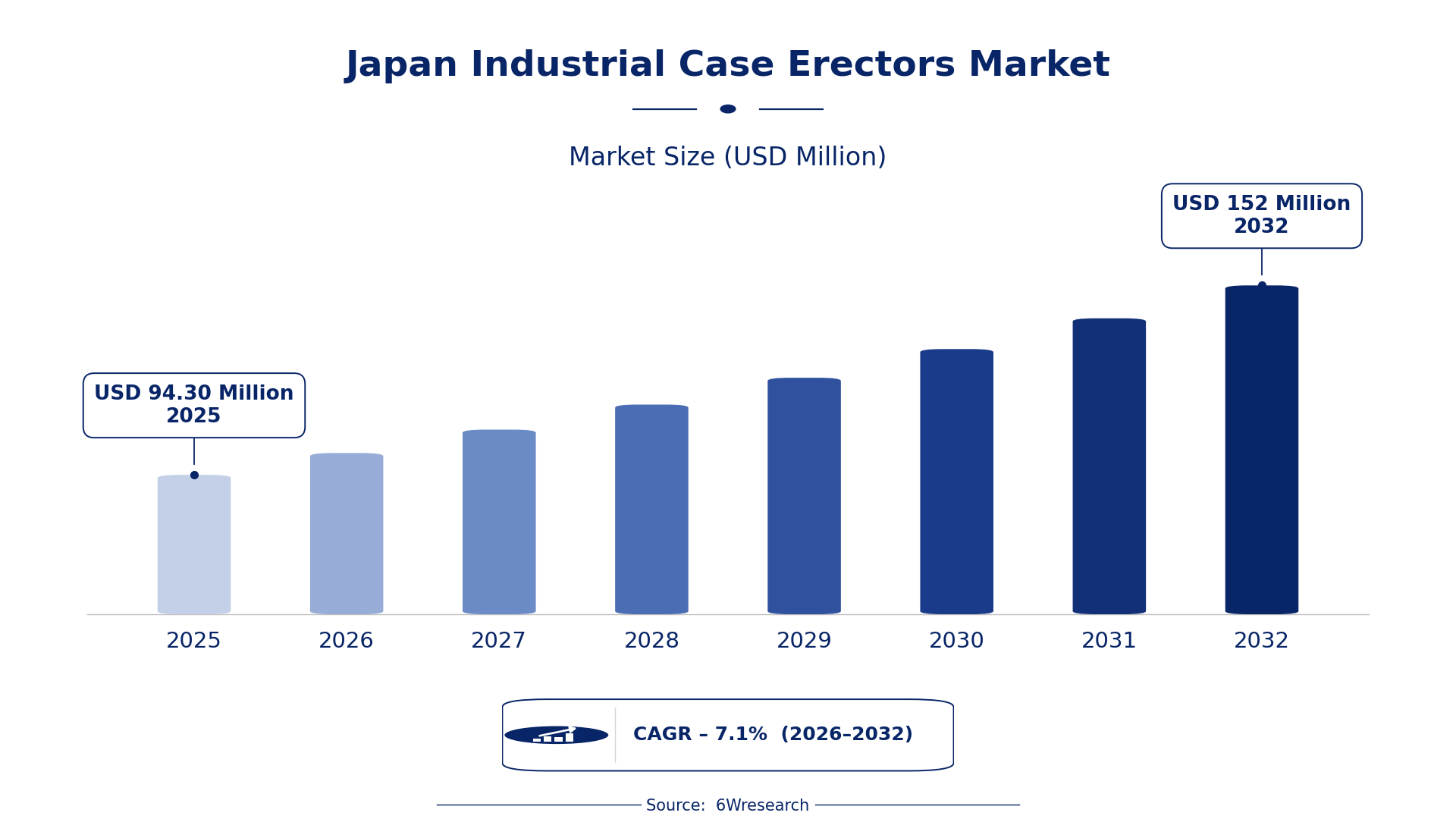
According to 6Wresearch internal database and industry insights, the Japan Industrial Case Erectors Market was valued at USD 94.30 Million in 2025 and is projected to reach USD 152 Million by 2032, growing at a CAGR of approximately 7.1% during 2026–2032.
Japan Industrial Case Erectors Market Highlights
| Report Metric | Details |
| Report Name | Japan Industrial Case Erectors Market (2026-2032) |
| Market Size 2025 | USD 94.30 Million |
| Market Size 2032 | USD 152 Million |
| Absolute Growth 2025–2032 | USD 57.70 Million |
| CAGR 2026–2032 | 7.1% |
| Peak Annual Growth | 8.3% in 2032 |
| Forecast Period | 2026–2032 |
| Historical Data | 2022–2025 |
| Base Year | 2025 |
| Leading Machine Type, 2025 | Semi-Automatic Erectors (39% share) |
| Leading Automation Level, 2025 | Low Automation (42% share) |
| Leading Box Type Supported, 2025 | RSC Cartons (36% share) |
| Leading End User, 2025 | Small-Scale Packagers (48% share) |
| Fastest-Growing Machine Type | Fully Automatic Erectors (10.3% CAGR) |
| Fastest-Growing Automation Level | High Speed (9.8% CAGR) |
| Fastest-Growing Box Type Supported | Die-Cut Boxes (10.0% CAGR) |
| Fastest-Growing End User | Food & Beverage Industry (9.9% CAGR) |
| Growing Sector | Food & Beverage Industry |
| Key End Users | Small-Scale Packagers, Food & Beverage Industry, E-Commerce Warehouses, Retail Packaging Centers |
Japan Industrial Case Erectors Market Year-wise Growth Rate and Key Drivers (2022–2032)
This graph illustrates the annual growth rates of the market from 2022 to 2032, highlighting a steady upward trajectory and projected market expansion over the forecast period.
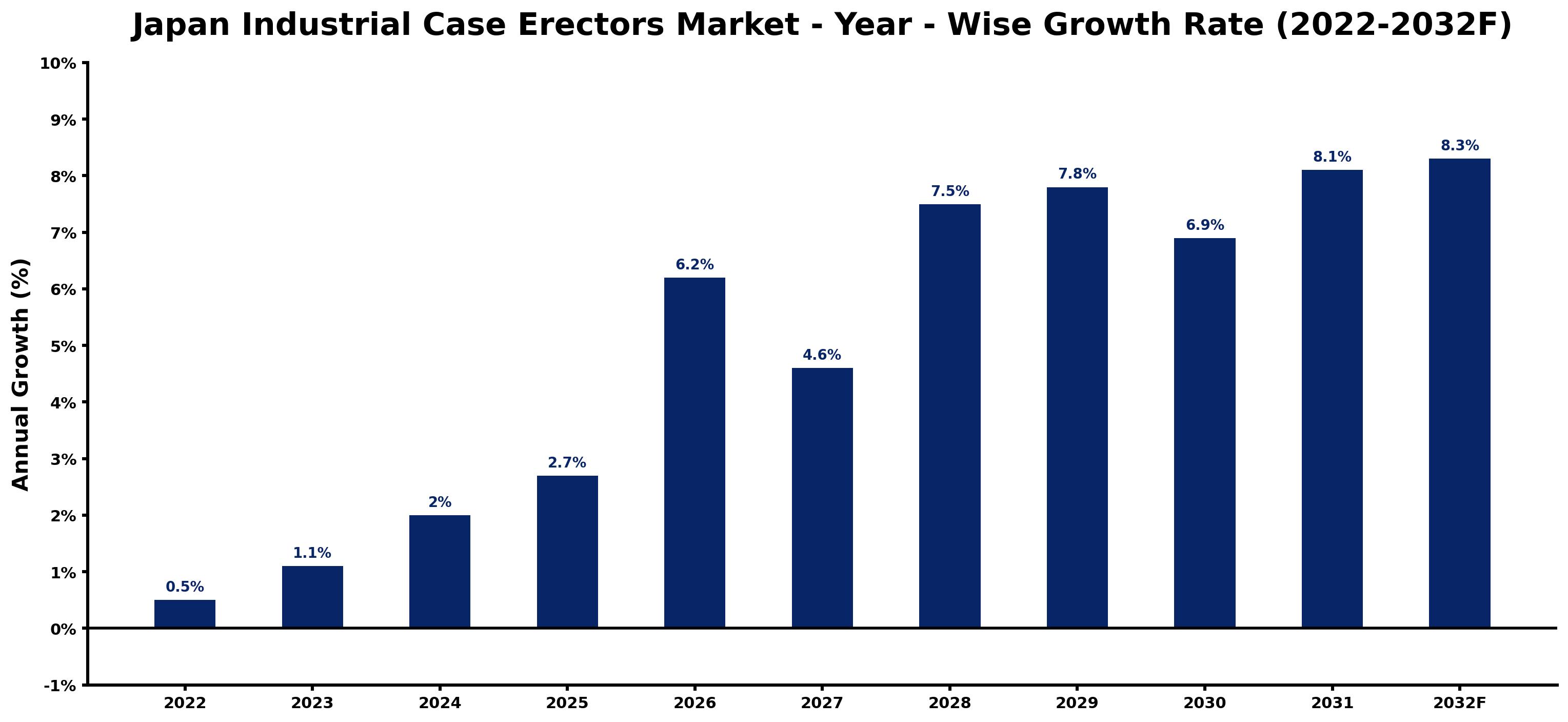
The table below sets out the estimated growth rate for each year and the main factor behind it.
| Year | Estimated Annual Growth (%) | Market Rationale |
| 2022 | 0.5 | The market showed modest growth due to steady demand from food and beverage packaging. |
| 2023 | 1.1 | Increased automation in packaging operations contributed to faster growth compared to the previous year. |
| 2024 | 2.0 | Rising e-commerce activity further boosted demand for efficient packaging solutions in the market. |
| 2025 | 2.7 | The market reached its historical peak growth as manufacturers invested in advanced machinery. |
| 2026 | 6.2 | A surge in demand for fully automatic erectors is expected to drive growth in the market. |
| 2027 | 4.6 | Growth is projected to slow slightly as the market adjusts to previous high investment levels. |
| 2028 | 7.5 | Demand for high-speed erectors is expected to increase, leading to a rebound in growth rates. |
| 2029 | 7.8 | The market will continue to expand as the food and beverage sector adopts more automation. |
| 2030 | 6.9 | Growth is anticipated to slow again as manufacturers focus on optimising existing operations. |
| 2031 | 8.1 | The market is expected to experience a resurgence in growth as new technologies gain traction. |
| 2032 | 8.3 | The introduction of new packaging solutions is projected to lead to peak annual growth in the market. |
Note: Market size estimations and growth projections presented in this report are based on 6Wresearch's proprietary forecasting methodology, utilizing the latest available industry data, government publications, and primary research inputs.
Japan Industrial Case Erectors Market Synopsis
Industrial case erectors automate the formation and sealing of boxes for packaging, primarily used in the food and beverage, e-commerce, and retail sectors. The Japan Industrial Case Erectors Market is growing due to increased automation investments and a commitment to sustainability, with Japan targeting a 46% reduction in greenhouse gas emissions by 2030. The food and beverage industry, valued at approximately 20 trillion JPY, drives demand, alongside the expanding e-commerce sector, projected to reach 20 trillion JPY by 2025.
Market Dynamics Impact Analysis (2026–2032)
| Factor | Type | Impact | Primary Segment Affected |
| Growing demand for automation in packaging processes | Driver | High | Fully Automatic Erectors |
| Increase in e-commerce activities requiring efficient packaging solutions | Driver | High | Servo-Driven Systems |
| Rising investments in packaging machinery for SMEs | Opportunity | High | Semi-Automatic Erectors |
| Demand for customized packaging solutions in e-commerce | Opportunity | High | Die-Cut Boxes |
| High initial investment costs for advanced machinery | Restraint | Medium | High Speed |
| Limited awareness of automation benefits among small-scale packagers | Restraint | Medium | Low Automation |
| Challenges in sourcing skilled labour for advanced operations | Challenge | High | Fully Automatic Erectors |
| Competition from low-cost manual packaging solutions | Challenge | Medium | Semi-Automatic Erectors |
Evaluation of Drivers in Japan Industrial Case Erectors Market (2026–2032)
Key forces behind demand, with the segment each one moves most, are listed below.
| Drivers | Primary Segment Affected | Why It Matters (Evidence) |
| Increased automation investments in manufacturing | Fully Automatic Erectors | Japan targets about JPY 150 trillion in decarbonisation investments over the next decade. |
| Surge in e-commerce activities | Servo-Driven Systems | The e-commerce sector in Japan is projected to reach 20 trillion JPY by 2025. |
| Demand for efficient packaging in food and beverage | Semi-Automatic Erectors | Japan's food and beverage industry is valued at approximately 20 trillion JPY. |
| Rising need for customized packaging solutions | Die-Cut Boxes | Die-cut boxes are increasingly used in the e-commerce sector for tailored packaging solutions. |
| Focus on sustainability in packaging solutions | High Speed | Japan aims for a 46% cut in greenhouse-gas emissions from fiscal 2013 levels by fiscal 2030. |
Orders keep climbing as manufacturers increasingly invest in automation technologies, with the food and beverage industry valued at approximately 20 trillion JPY continuing to adopt advanced machinery. The e-commerce sector is expanding rapidly, driving demand for efficient packaging solutions. Rising adoption of servo-driven systems improves precision in operations, while the focus on sustainability pushes manufacturers to seek high-speed solutions. Increasing demand for customized packaging, particularly die-cut boxes, shapes purchasing behaviour, leading to higher orders for semi-automatic erectors.
Evaluation of Restraints in Japan Industrial Case Erectors Market
These are the pressures that could keep growth below its potential.
| Market Restraint | Primary Segment Affected | Why It Matters (Evidence) |
| High initial costs of advanced machinery | High Speed | The average installed base of case erectors in Japan is estimated at over 5,000 units, making upgrades costly. |
| Limited awareness of automation benefits | Low Automation | Many small-scale packagers lack knowledge about the efficiency gains from automation, which hinders adoption. |
| Shortage of skilled labour for advanced operations | Fully Automatic Erectors | The need for skilled technicians increases operational costs and delays implementation, affecting productivity. |
| Competition from manual packaging solutions | Semi-Automatic Erectors | Lower-cost manual options appeal to budget-conscious small-scale packagers, impacting market growth. |
| Regulatory compliance costs for machinery safety | High Speed | Compliance with the Industrial Safety and Health Act increases operational expenses for manufacturers. |
Japan Industrial Case Erectors Market Challenges
In Japan, rising steel prices inflate machinery costs by up to 15% for producers in the food and beverage sector. Many producers depend on outdated automation technology, causing production delays of several weeks that disrupt delivery schedules for suppliers. Stricter environmental regulations necessitate costly adjustments, diverting resources and extending project timelines for manufacturers. A shortage of skilled workers in advanced automation hampers clinics and smaller manufacturers from upgrading their equipment, resulting in a loss of competitive edge and potential revenue declines.
Trends in the Japan Industrial Case Erectors Market
These developments are changing demand patterns in the Japan Industrial Case Erectors Market.
- Transition to Fully Automatic Erectors: More manufacturers are adopting fully automatic erectors to improve efficiency, particularly in Tokyo and Osaka, where installations are on the rise. This trend aligns with the annual demand for packaging machinery in Japan, estimated at around 300 billion JPY.
- Growing use of Die-Cut Boxes in E-Commerce: The e-commerce sector is increasingly utilising die-cut boxes for custom packaging solutions, reflecting a shift in consumer preferences. This trend coincides with the projected growth of the e-commerce sector to 20 trillion JPY by 2025.
- Increased Adoption of Servo-Driven Systems: Servo-driven systems are gaining traction in Japan due to their precision and efficiency in packaging operations. The average installed base of case erectors is estimated at over 5,000 units, highlighting the shift towards advanced technology.
- Expansion of Automation in Small-Scale Packaging: Small-scale packagers are increasingly adopting automation technologies to boost productivity and efficiency. The Japanese government launched a programme in 2023 to support automation in SMEs, facilitating this transition.
Investment Opportunities in the Japan Industrial Case Erectors Market
The following areas offer the clearest openings for investors and suppliers in the Japan Industrial Case Erectors Market.
- Food & Beverage Industry: The food and beverage industry requires efficient packaging solutions now, with an estimated value of 20 trillion JPY. Investing in fully automatic erectors can streamline operations in this sector, particularly in major regions like Tokyo.
- E-Commerce Warehouses: With the e-commerce sector growing rapidly, there is a pressing need for advanced packaging solutions. Suppliers can enter this market by forming partnerships with logistics providers.
- Retail Packaging Centers: Retail packaging centres are increasingly adopting automation technologies to improve efficiency. Investing in high-speed erectors can meet the growing demand for quick and reliable packaging solutions.
- Small-Scale Packagers: Small-scale packagers require flexible packaging solutions now, driven by rising consumer demand for customisation. Collaborating with local partners can facilitate entry into this niche market.
Government Initiatives in the Japan Industrial Case Erectors Market
The Industrial Safety and Health Act (1972) sets employer duties for hazardous substances and machinery, ensuring safety standards for industrial case erectors. Compliance with this law requires manufacturers to invest in safety measures and training, impacting operational costs and processes.
The GX Promotion Act (2023) supports Japan's decarbonisation efforts, encouraging manufacturers to adopt sustainable practices. This act promotes investments in green technologies, benefiting buyers who seek environmentally friendly packaging solutions.
Future Insight of the Japan Industrial Case Erectors Market
Japan's shift towards automation will accelerate due to government policies promoting decarbonisation, with a focus on green technologies. By 2032, the adoption of servo-driven systems will improve precision in packaging processes, benefiting both suppliers and buyers. Fully automatic erectors will become standard in retail packaging, improving operational efficiency. The growth of the e-commerce sector will increase the demand for customised packaging solutions, driving innovation and creating new market opportunities.
Market Segmentation Analysis
Japan Industrial Case Erectors Market report covers a detailed analysis of the following market segments:
By Machine Type – Semi-Automatic Erectors Lead, Fully Automatic Erectors Expected to Grow Fastest
According to Saurav Kr Singh, Senior Research Analyst at 6Wresearch, the largest machine type category in 2025 was Semi-Automatic Erectors, at 39% of revenue. Semi-automatic erectors hold the largest share as they are widely utilised in small-scale packaging operations, catering to businesses that require lower volume production. For instance, local food producers often depend on these machines for their adaptable packaging solutions. Over 2026–2032, Fully Automatic Erectors are expected to post the fastest growth, at a CAGR of 10.3%. Fully automatic erectors are experiencing rapid growth due to their necessity for high-volume packaging operations, especially in large manufacturing settings. As the e-commerce sector is set to reach 20 trillion JPY by 2025, the demand for these efficient systems is on the rise. Suppliers should focus on enhancing fully automatic erectors to meet the increasing needs of high-volume producers.
By Automation Level – Low Automation Leads, High Speed Expected to Grow Fastest
In 2025, Low Automation led the automation level split with a 42% share. Low automation systems lead the market as they are frequently utilised in less demanding packaging environments, enabling smaller operations to maintain efficiency without substantial investment. This trend is particularly noticeable in regions where small-scale packaging is common. High Speed is projected to grow fastest, at a CAGR of 9.8% during 2026–2032. High-speed systems are rapidly advancing due to their critical role in fast-paced production lines, especially in sectors that require quick turnaround times. The annual demand for packaging machinery in Japan, estimated at around 300 billion JPY, supports this growth. Buyers are likely to increasingly seek high-speed solutions to improve their production efficiency and meet market demands.
By Box Type Supported – RSC Cartons Lead, Die-Cut Boxes Expected to Grow Fastest
RSC Cartons accounted for 36% of the market by box type supported in 2025. RSC cartons are the most widely used box type in Japan, catering to various packaging applications across multiple industries. Their versatility makes them a preferred choice for many manufacturers looking for reliable packaging solutions. Die-Cut Boxes are set to record the highest CAGR in this split, 10.0% over 2026–2032. Die-cut boxes are gaining popularity due to their customisable nature, particularly in the e-commerce sector where tailored packaging solutions are increasingly demanded. The rise of online shopping has led to a surge in the need for unique packaging options. Suppliers should consider expanding their offerings to include die-cut boxes to capitalise on the growing e-commerce market.
By End User – Small-Scale Packagers Lead, Food & Beverage Industry Expected to Grow Fastest
Small-Scale Packagers held 48% of the Japan Industrial Case Erectors Market by end user in 2025. Small-scale packagers represent the largest segment as they frequently require flexible packaging solutions that can adapt to varying production demands. This segment is crucial for local businesses that focus on niche markets and artisanal products. The quickest growth will come from Food & Beverage Industry, forecast to expand at a CAGR of 9.9% between 2026 and 2032. The food and beverage industry is the fastest-growing end user, remaining a key consumer of case erecting technology due to its significant market value of approximately 20 trillion JPY. This trend is likely to continue as consumer demand for packaged food rises. Suppliers need to customise their products to align with the specific requirements of the food and beverage industry to capitalise on this growth.
Key Attractiveness of the Report
- 10 Years of Market Numbers
- Historical Data Starting from 2022 to 2025
- Base Year 2025
- Forecast Data until 2032
- Key Performance Indicators Impacting the Market
- Major Upcoming Developments and Projects
Key Highlights of the Report:
- Japan Industrial Case Erectors Market Outlook
- Market Size of Japan Industrial Case Erectors Market, 2025
- Forecast of Japan Industrial Case Erectors Market, 2032
- Historical Data and Forecast of Japan Industrial Case Erectors Revenues & Volume for the Period 2022-2032F
- Japan Industrial Case Erectors Market Trend Evolution
- Japan Industrial Case Erectors Market Drivers and Challenges
- Japan Industrial Case Erectors Price Trends
- Japan Industrial Case Erectors Porter's Five Forces
- Japan Industrial Case Erectors Industry Life Cycle
- Historical Data and Forecast of Japan Industrial Case Erectors Market Revenues & Volume By Machine Type for the Period 2022-2032F
- Historical Data and Forecast of Japan Industrial Case Erectors Market Revenues & Volume By Semi-Automatic Erectors for the Period 2022-2032F
- Historical Data and Forecast of Japan Industrial Case Erectors Market Revenues & Volume By Fully Automatic Erectors for the Period 2022-2032F
- Historical Data and Forecast of Japan Industrial Case Erectors Market Revenues & Volume By Servo-Driven Systems for the Period 2022-2032F
- Historical Data and Forecast of Japan Industrial Case Erectors Market Revenues & Volume By Bottom Sealer Erectors for the Period 2022-2032F
- Historical Data and Forecast of Japan Industrial Case Erectors Market Revenues & Volume By Automation Level for the Period 2022-2032F
- Historical Data and Forecast of Japan Industrial Case Erectors Market Revenues & Volume By Low Automation for the Period 2022-2032F
- Historical Data and Forecast of Japan Industrial Case Erectors Market Revenues & Volume By High Speed for the Period 2022-2032F
- Historical Data and Forecast of Japan Industrial Case Erectors Market Revenues & Volume By Precision Control for the Period 2022-2032F
- Historical Data and Forecast of Japan Industrial Case Erectors Market Revenues & Volume By Tape/Glue-Based Sealing for the Period 2022-2032F
- Historical Data and Forecast of Japan Industrial Case Erectors Market Revenues & Volume By Box Type Supported for the Period 2022-2032F
- Historical Data and Forecast of Japan Industrial Case Erectors Market Revenues & Volume By RSC Cartons for the Period 2022-2032F
- Historical Data and Forecast of Japan Industrial Case Erectors Market Revenues & Volume By Die-Cut Boxes for the Period 2022-2032F
- Historical Data and Forecast of Japan Industrial Case Erectors Market Revenues & Volume By Custom Sizes for the Period 2022-2032F
- Historical Data and Forecast of Japan Industrial Case Erectors Market Revenues & Volume By Corrugated Cartons for the Period 2022-2032F
- Historical Data and Forecast of Japan Industrial Case Erectors Market Revenues & Volume By End User for the Period 2022-2032F
- Historical Data and Forecast of Japan Industrial Case Erectors Market Revenues & Volume By Small-Scale Packagers for the Period 2022-2032F
- Historical Data and Forecast of Japan Industrial Case Erectors Market Revenues & Volume By Food & Beverage Industry for the Period 2022-2032F
- Historical Data and Forecast of Japan Industrial Case Erectors Market Revenues & Volume By E-Commerce Warehouses for the Period 2022-2032F
- Historical Data and Forecast of Japan Industrial Case Erectors Market Revenues & Volume By Retail Packaging Centers for the Period 2022-2032F
- Japan Industrial Case Erectors Import Export Trade Statistics
- Market Opportunity Assessment By Machine Type
- Market Opportunity Assessment By Automation Level
- Market Opportunity Assessment By Box Type Supported
- Market Opportunity Assessment By End User
- Japan Industrial Case Erectors Top Companies Market Share
- Japan Industrial Case Erectors Competitive Benchmarking By Technical and Operational Parameters
- Japan Industrial Case Erectors Company Profiles
- Japan Industrial Case Erectors Key Strategic Recommendations
Market Covered
Coverage by segment is as follows.
By Machine Type
- Semi-Automatic Erectors
- Fully Automatic Erectors
- Servo-Driven Systems
- Bottom Sealer Erectors
By Automation Level
- Low Automation
- High Speed
- Precision Control
- Tape/Glue-Based Sealing
By Box Type Supported
- RSC Cartons
- Die-Cut Boxes
- Custom Sizes
- Corrugated Cartons
By End User
- Small-Scale Packagers
- Food & Beverage Industry
- E-Commerce Warehouses
- Retail Packaging Centers































