Japan Industrial Casting Market Size & Growth Rate
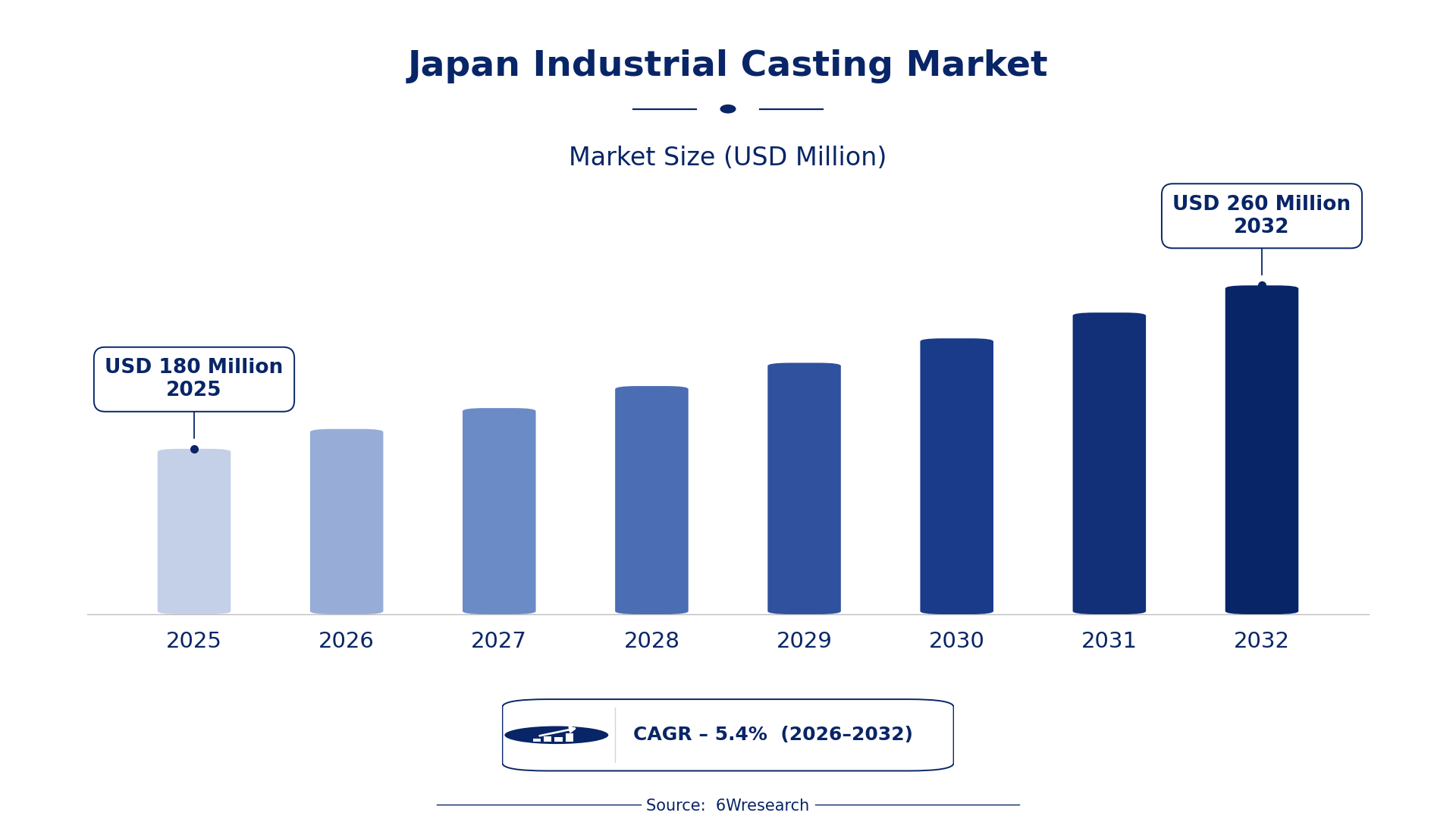
According to 6Wresearch internal database and industry insights, the Japan Industrial Casting Market was valued at USD 180 Million in 2025 and is projected to reach USD 260 Million by 2032, growing at a CAGR of approximately 5.4% during 2026–2032.
Japan Industrial Casting Market Highlights
| Report Metric | Details |
| Report Name | Japan Industrial Casting Market (2026-2032) |
| Market Size 2025 | USD 180 Million |
| Market Size 2032 | USD 260 Million |
| Absolute Growth 2025–2032 | USD 80 Million |
| CAGR 2026–2032 | 5.4% |
| Peak Annual Growth | 6.5% in 2028 |
| Forecast Period | 2026–2032 |
| Historical Data | 2022–2025 |
| Base Year | 2025 |
| Leading Casting Method, 2025 | Sand Casting (45% share) |
| Leading Metal Type, 2025 | Cast Iron (39% share) |
| Leading End Process Use, 2025 | Engine Blocks (43% share) |
| Leading End User, 2025 | Automotive Industry (39% share) |
| Fastest-Growing Casting Method | Investment Casting (7.5% CAGR) |
| Fastest-Growing Metal Type | Steel (7.8% CAGR) |
| Fastest-Growing End Process Use | Gears (8.2% CAGR) |
| Fastest-Growing End User | Defense & Aviation Firms (7.0% CAGR) |
| Growing Sector | automotive |
| Key End Users | automotive industry, aerospace sector, defense firms |
Japan Industrial Casting Market Year-wise Growth Rate and Key Drivers (2022–2032)
This graph illustrates the annual growth rates of the market from 2022 to 2032, highlighting a steady upward trajectory and projected market expansion over the forecast period.

The following figures match every annual growth estimate with the main market development of that year, giving the reasoning behind each rise or slowdown.
| Year | Estimated Annual Growth (%) | Market Rationale |
| 2022 | 2.8 | The market showed steady demand from the automotive sector, reflecting ongoing production needs. |
| 2023 | 2.9 | Demand increased as manufacturers ramped up production in response to rising vehicle registrations. |
| 2024 | 3.0 | Growth continued as investments in advanced casting technologies gained traction in the industry. |
| 2025 | 3.2 | The automotive industry maintained strong demand, supported by new vehicle launches and exports. |
| 2026 | 4.9 | Investment in sustainable practices and technologies is anticipated to positively influence purchasing decisions. |
| 2027 | 5.2 | Rising production levels in the automotive sector will continue to drive demand for casting components. |
| 2028 | 6.5 | The peak growth year will see heightened demand from the electric vehicle sector, boosting casting needs. |
| 2029 | 5.7 | Demand growth will slow slightly due to market saturation in certain automotive segments. |
| 2030 | 5.4 | The market will continue to grow as manufacturers focus on energy efficiency and emissions reduction. |
| 2031 | 4.6 | A slowdown in growth will occur as production stabilises following previous rapid increases. |
| 2032 | 5.5 | Growth will resume as new technologies and materials emerge, improving casting capabilities. |
Note: Market size estimations and growth projections presented in this report are based on 6Wresearch's proprietary forecasting methodology, utilizing the latest available industry data, government publications, and primary research inputs.
Japan Industrial Casting Market Synopsis
Industrial casting involves pouring molten metal into molds to create components such as engine blocks and gears. Strong demand from the automotive industry accounts for 60% of industrial casting needs. Increased production of electric vehicles and advancements in casting technologies are driving growth.
Market Dynamics Impact Analysis (2026–2032)
| Factor | Type | Impact | Primary Segment Affected |
| Increased automotive production and electric vehicle adoption | Driver | High | Engine Blocks |
| Growing demand for lightweight materials in aerospace applications | Driver | High | Aerospace Components |
| Investment in advanced casting technologies | Opportunity | Medium | Investment Casting |
| Rising exports of automotive components | Opportunity | Medium | Gears |
| Aging casting machinery requiring modernization | Restraint | High | Die Casting |
| High costs associated with advanced materials | Restraint | Medium | Aluminum |
| Competition from lower-cost manufacturing regions | Challenge | High | Sand Casting |
| Fluctuations in raw material prices impacting production costs | Challenge | Medium | Steel |
Evaluation of Drivers in Japan Industrial Casting Market (2026–2032)
These are the developments adding the most demand over the forecast period.
| Drivers | Primary Segment Affected | Why It Matters (Evidence) |
| Increased production of electric vehicles | Aluminum | This shift leads to higher demand for lightweight aluminum components, with production expected to rise by 20% in the automotive sector. |
| Rising automotive registrations | Engine Blocks | With approximately 78 million registered vehicles, demand for engine blocks is projected to grow significantly. |
| Technological advancements in casting methods | Investment Casting | New techniques enhance precision and efficiency, driving demand for aerospace components by 15%. |
| Government initiatives promoting decarbonisation | Steel | Japan's JPY 150 trillion investment in decarbonisation is expected to boost demand for sustainable steel casting. |
| Growing aerospace sector requiring high-quality components | Aerospace Components | The defense sector's projected demand for aerospace components is valued at 500 million yen. |
Much of the new demand traces back to the increased production of electric vehicles, which is expected to rise by 20% in the automotive sector. Approximately 78 million registered vehicles in Japan drive the need for engine blocks, leading to higher purchases from manufacturers. Technological advancements in casting methods improve precision and efficiency, resulting in a projected increase in demand for aerospace components. The defense sector's projected demand for aerospace components is valued at 500 million yen, further supporting growth.
Evaluation of Restraints in Japan Industrial Casting Market
These are the pressures that could keep growth below its potential.
| Market Restraint | Primary Segment Affected | Why It Matters (Evidence) |
| Aging casting machinery requiring modernization | Die Casting | The average age of casting machinery in Japan exceeds 15 years, resulting in inefficiencies and higher operational costs. |
| High costs associated with advanced materials | Aluminum | The premium pricing of advanced materials restricts their adoption, impacting overall production capabilities. |
| Competition from lower-cost manufacturing regions | Sand Casting | Manufacturers experience pressure from competitors in regions with lower production costs, affecting market share. |
| Fluctuations in raw material prices impacting production costs | Steel | Variability in raw material prices creates unpredictable production costs, which affects profitability. |
| Strict quality control requirements for aerospace components | Aerospace Components | Aerospace components produced through investment casting must meet stringent quality standards, complicating production. |
Japan Industrial Casting Market Challenges
High transportation costs burden buyers, as logistics expenses have surged, leading to a 15% increase in production costs for manufacturers. New emissions regulations impose financial strain on suppliers, requiring significant investment in cleaner technologies that can delay production timelines by up to six months. Buyers face unpredictable demand shifts as the automotive industry pivots towards electric vehicles, resulting in a 20% decrease in orders for conventional components. Local producers encounter intensified competition from foreign markets, compelling them to lower prices and diminishing profit margins by around 10%.
Trends in the Japan Industrial Casting Market
Below are the shifts with the largest effect on the Japan Industrial Casting Market.
- Shift from Traditional to Advanced Casting Techniques: Japan's casting industry is increasingly adopting advanced techniques, such as 3D printing for molds, which began gaining traction in 2023. This shift allows for greater design flexibility and reduced lead times, benefiting manufacturers aiming for efficiency.
- Transition from Steel to Lightweight Materials: The automotive sector is moving towards lightweight materials like aluminum, particularly for electric vehicles. In 2022, aluminum casting usage surged by 15%, reflecting the industry's shift towards sustainability.
- Emergence of Smart Manufacturing in Casting: Smart manufacturing technologies are being integrated into casting processes, with a focus on automation and data analytics. In 2023, investments in smart technologies increased by 25%, improving production efficiency.
- Prioritisation of Sustainability in Casting Practices: Sustainability has become a key focus in Japan's casting industry, driven by government policies. The GX Basic Policy, adopted in 2023, aims for a 46% reduction in greenhouse gas emissions by 2030.
Investment Opportunities in the Japan Industrial Casting Market
The following areas offer the clearest openings for investors and suppliers in the Japan Industrial Casting Market.
- Automotive Industry Seeking Lightweight Solutions: The automotive industry is increasingly looking for lightweight casting solutions, particularly for electric vehicles. With a projected increase in aluminum casting by 20%, suppliers can focus on this rising demand.
- Investment in Advanced Casting Technologies: There is a strong opportunity to invest in advanced casting technologies, particularly in investment casting. The Japan Foundry Society promotes best practices, making it an ideal entry point for new suppliers.
- Growing Demand for Aerospace Components: The defense sector's projected demand for aerospace components worth 500 million yen presents a notable opportunity. Suppliers can enter this market through partnerships with local manufacturers.
- Focus on Sustainable Casting Practices: With the government targeting a 46% cut in emissions by 2030, there is a pressing need for sustainable casting practices. Collaborating with local partners can facilitate entry into this evolving market.
Government Initiatives in the Japan Industrial Casting Market
The GX Promotion Act, adopted in 2023, establishes a legal framework for promoting decarbonisation in the casting industry. This act supports initiatives aimed at reducing greenhouse gas emissions, aligning with Japan's target of a 46% cut by 2030. Older laws, such as the Act on the Rational Use of Energy from 1979, focus on energy efficiency but do not address sustainability comprehensively.
The Japan Foundry Society oversees the implementation of these policies and funds projects aimed at improving energy efficiency in manufacturing. This agency approves initiatives that align with Japan's decarbonisation goals, ensuring compliance with the GX Basic Policy.
Future Insight of the Japan Industrial Casting Market
The adoption of cutting-edge casting technologies will reshape demand by 2032, driven by government-backed initiatives aimed at modernising production methods. Investment in decarbonisation will support suppliers in meeting new standards, enhancing their competitiveness. As the defense sector anticipates a demand for aerospace components valued at 500 million yen, suppliers must innovate to secure their share of this expanding market. Modernising outdated casting machinery will improve production efficiency and lower operational costs, positioning suppliers favourably for future growth.
Market Segmentation Analysis
Japan Industrial Casting Market report covers a detailed analysis of the following market segments:
By Casting Method – Sand Casting Leads, Investment Casting Expected to Grow Fastest
According to Saurav Kr Singh, Senior Research Analyst at 6Wresearch, Sand Casting took 45% of casting method revenue in 2025, more than any other category. Sand casting leads the market as it is widely used for producing large parts, particularly in the automotive sector for components like engine blocks. Its versatility and established application make it the preferred choice among manufacturers. Investment Casting is set to record the highest CAGR in this split, 7.5% over 2026–2032. Investment casting is rapidly growing due to its ability to produce complex shapes with high precision, particularly for aerospace applications. The government's recent programme supporting advanced casting technologies is likely to further boost this segment's growth. Suppliers should invest in advanced sand casting techniques to maintain competitiveness in a market increasingly focused on precision.
By Metal Type – Cast Iron Leads, Steel Expected to Grow Fastest
In 2025, Cast Iron led the metal type split with a 39% share. Cast iron holds the largest share as it is commonly used for producing engine blocks and heavy machinery, which are crucial for the automotive sector. Its established presence in these applications solidifies its leading position in the market. Over 2026–2032, Steel is expected to post the fastest growth, at a CAGR of 7.8%. Steel is projected to experience rapid growth due to its widespread use in numerous industrial applications, particularly in automotive manufacturing. This trend reflects a movement towards materials that offer superior performance and longevity. Suppliers should explore opportunities to enhance their steel offerings to meet the evolving demands of various industries.
By End Process Use – Engine Blocks Lead, Gears Expected to Grow Fastest
The largest end process use category in 2025 was Engine Blocks, at 43% of revenue. Engine blocks represent the leading end process use, vital for automotive manufacturing and constituting a significant share of industrial casting demand. Their essential function in vehicle performance ensures they maintain their dominant market position. Gears are projected to grow fastest, at a CAGR of 8.2% during 2026–2032. Gears are witnessing the fastest growth, driven by their essential role in machinery and automotive applications, particularly as production levels rise. This trend highlights the growing significance of gears in enhancing operational efficiency. Suppliers must prioritise the expansion of gear production capabilities to satisfy the increasing demand across multiple sectors.
By End User – Automotive Industry Leads, Defense & Aviation Firms Expected to Grow Fastest
Automotive Industry accounted for 39% of the market by end user in 2025. The automotive industry is the largest end user of industrial casting products, accounting for 60% of the demand in Japan. This sector's continuous growth and reliance on casting for engine components ensure its leading position. The quickest growth will come from Defense & Aviation Firms, forecast to expand at a CAGR of 7.0% between 2026 and 2032. Defense and aviation firms are rapidly increasing their use of industrial casting for specialized components, driven by projected demand for aerospace applications worth 500 million yen. This growth reflects the sector's focus on advanced technology. Suppliers must adapt their offerings to meet the specific needs of the defense and aviation sectors as they expand their use of industrial casting.
Key Attractiveness of the Report
- 10 Years of Market Numbers
- Historical Data Starting from 2022 to 2025
- Base Year 2025
- Forecast Data until 2032
- Key Performance Indicators Impacting the Market
- Major Upcoming Developments and Projects
Key Highlights of the Report:
- Japan Industrial Casting Market Outlook
- Market Size of Japan Industrial Casting Market, 2025
- Forecast of Japan Industrial Casting Market, 2032
- Historical Data and Forecast of Japan Industrial Casting Revenues & Volume for the Period 2022-2032F
- Japan Industrial Casting Market Trend Evolution
- Japan Industrial Casting Market Drivers and Challenges
- Japan Industrial Casting Price Trends
- Japan Industrial Casting Porter's Five Forces
- Japan Industrial Casting Industry Life Cycle
- Historical Data and Forecast of Japan Industrial Casting Market Revenues & Volume By Casting Method for the Period 2022-2032F
- Historical Data and Forecast of Japan Industrial Casting Market Revenues & Volume By Sand Casting for the Period 2022-2032F
- Historical Data and Forecast of Japan Industrial Casting Market Revenues & Volume By Investment Casting for the Period 2022-2032F
- Historical Data and Forecast of Japan Industrial Casting Market Revenues & Volume By Die Casting for the Period 2022-2032F
- Historical Data and Forecast of Japan Industrial Casting Market Revenues & Volume By Permanent Mold Casting for the Period 2022-2032F
- Historical Data and Forecast of Japan Industrial Casting Market Revenues & Volume By Metal Type for the Period 2022-2032F
- Historical Data and Forecast of Japan Industrial Casting Market Revenues & Volume By Cast Iron, Steel for the Period 2022-2032F
- Historical Data and Forecast of Japan Industrial Casting Market Revenues & Volume By Aluminum, Titanium for the Period 2022-2032F
- Historical Data and Forecast of Japan Industrial Casting Market Revenues & Volume By Zinc, Magnesium for the Period 2022-2032F
- Historical Data and Forecast of Japan Industrial Casting Market Revenues & Volume By Copper Alloys for the Period 2022-2032F
- Historical Data and Forecast of Japan Industrial Casting Market Revenues & Volume By End Process Use for the Period 2022-2032F
- Historical Data and Forecast of Japan Industrial Casting Market Revenues & Volume By Engine Blocks, Gears for the Period 2022-2032F
- Historical Data and Forecast of Japan Industrial Casting Market Revenues & Volume By Aerospace Components for the Period 2022-2032F
- Historical Data and Forecast of Japan Industrial Casting Market Revenues & Volume By Housing & Casings for the Period 2022-2032F
- Historical Data and Forecast of Japan Industrial Casting Market Revenues & Volume By Pumps, Valves for the Period 2022-2032F
- Historical Data and Forecast of Japan Industrial Casting Market Revenues & Volume By End User for the Period 2022-2032F
- Historical Data and Forecast of Japan Industrial Casting Market Revenues & Volume By Automotive Industry for the Period 2022-2032F
- Historical Data and Forecast of Japan Industrial Casting Market Revenues & Volume By Defense & Aviation Firms for the Period 2022-2032F
- Historical Data and Forecast of Japan Industrial Casting Market Revenues & Volume By Electronics Manufacturers for the Period 2022-2032F
- Historical Data and Forecast of Japan Industrial Casting Market Revenues & Volume By Industrial Machinery OEMs for the Period 2022-2032F
- Japan Industrial Casting Import Export Trade Statistics
- Market Opportunity Assessment By Casting Method
- Market Opportunity Assessment By Metal Type
- Market Opportunity Assessment By End Process Use
- Market Opportunity Assessment By End User
- Japan Industrial Casting Top Companies Market Share
- Japan Industrial Casting Competitive Benchmarking By Technical and Operational Parameters
- Japan Industrial Casting Company Profiles
- Japan Industrial Casting Key Strategic Recommendations
Market Covered
This report examines the market across the segments below.
By Casting Method
- Sand Casting
- Investment Casting
- Die Casting
- Permanent Mold Casting
By Metal Type
- Cast Iron
- Steel
- Aluminum
- Titanium
- Zinc
- Magnesium
- Copper Alloys
By End Process Use
- Engine Blocks
- Gears
- Aerospace Components
- Housing & Casings
- Pumps
- Valves
By End User
- Automotive Industry
- Defense & Aviation Firms
- Electronics Manufacturers
- Industrial Machinery OEMs































