Japan Industrial Chemical Market Size & Growth Rate
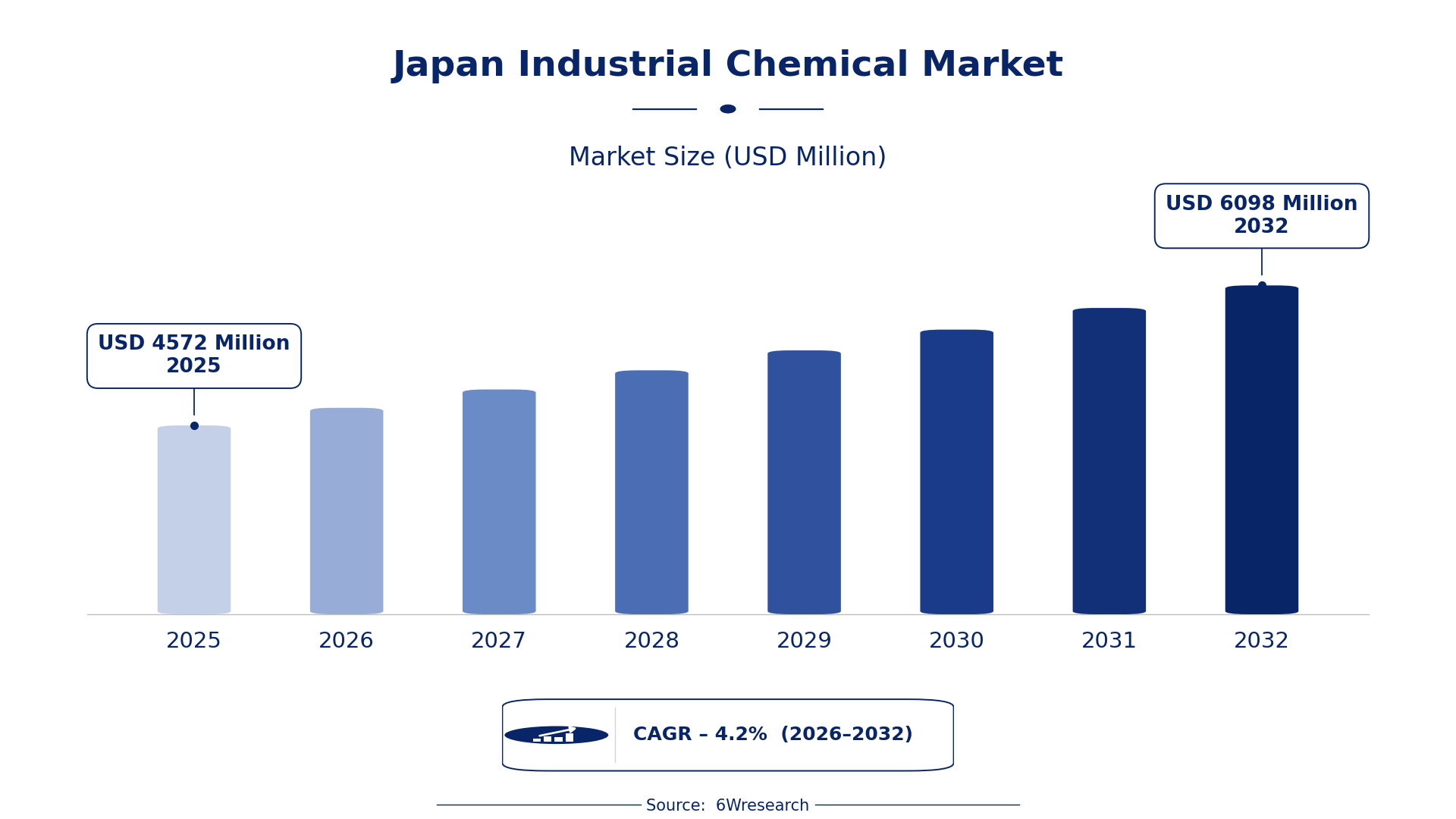
According to 6Wresearch internal database and industry insights, the Japan Industrial Chemical Market was valued at USD 4,572 Million in 2025 and is projected to reach USD 6,098 Million by 2032, growing at a CAGR of approximately 4.2% during 2026–2032.
Japan Industrial Chemical Market Highlights
| Report Metric | Details |
| Report Name | Japan Industrial Chemical Market (2026-2032) |
| Market Size 2025 | USD 4,572 Million |
| Market Size 2032 | USD 6,098 Million |
| Absolute Growth 2025–2032 | USD 1,526 Million |
| CAGR 2026–2032 | 4.2% |
| Peak Annual Growth | 5.1% in 2026 |
| Forecast Period | 2026–2032 |
| Historical Data | 2022–2025 |
| Base Year | 2025 |
| Leading Chemical Type, 2025 | Acids (HCl, Sulfuric) (34% share) |
| Leading State, 2025 | Liquid (38% share) |
| Leading Functionality, 2025 | pH Regulation (39% share) |
| Leading End User, 2025 | Metal Processing Firms (44% share) |
| Fastest-Growing Chemical Type | Solvents (6.0% CAGR) |
| Fastest-Growing Functionality | Cleaning (6.3% CAGR) |
| Fastest-Growing End User | Soap & Detergent Industry (5.6% CAGR) |
| Growing Sector | Soap & Detergent Industry |
| Key End Users | Metal Processing Firms, Soap & Detergent Industry, Paints & Coatings Sector, Chemical Synthesis Plants |
Japan Industrial Chemical Market Year-wise Growth Rate and Key Drivers (2022–2032)
This graph illustrates the annual growth rates of the market from 2022 to 2032, highlighting a steady upward trajectory and projected market expansion over the forecast period.
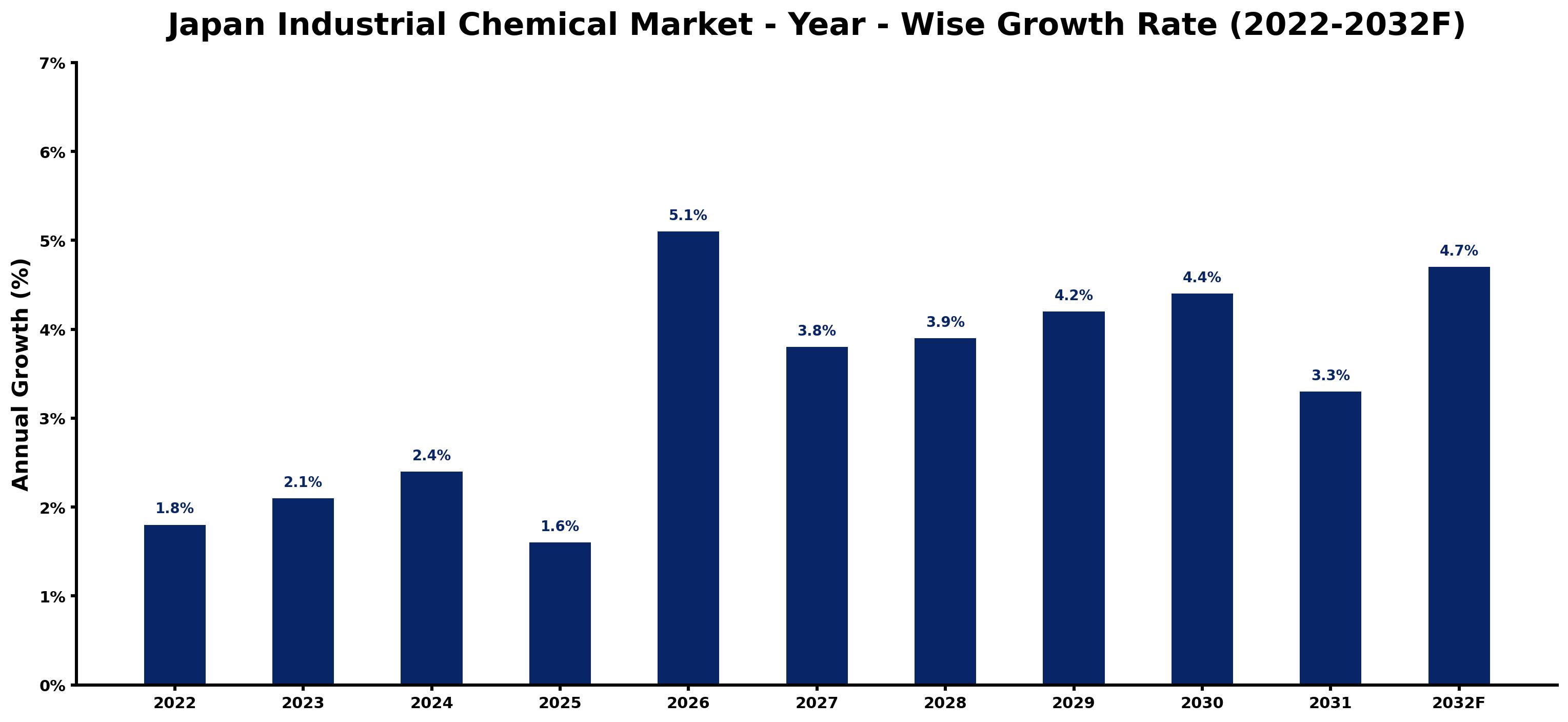
The following figures match every annual growth estimate with the main market development of that year, giving the reasoning behind each rise or slowdown.
| Year | Estimated Annual Growth (%) | Market Rationale |
| 2022 | 1.8 | The market exhibited steady growth, reflecting ongoing industrial activities. |
| 2023 | 2.1 | Growth accelerated due to increased domestic demand for industrial chemicals. |
| 2024 | 2.4 | The market continued to expand as production capacities improved. |
| 2025 | 1.6 | Growth slowed slightly as manufacturers adjusted to market conditions. |
| 2026 | 5.1 | The market is expected to surge as investments in green chemistry initiatives increase. |
| 2027 | 3.8 | Growth is projected to decelerate as companies face challenges in sourcing raw materials. |
| 2028 | 3.9 | Demand is expected to rise again as sustainability efforts gain traction in industries. |
| 2029 | 4.2 | The market is projected to expand further due to rising exports of specialty chemicals. |
| 2030 | 4.4 | Growth will continue as companies adopt more sustainable practices. |
| 2031 | 3.3 | The market growth is expected to slow as competition intensifies among suppliers. |
| 2032 | 4.7 | Demand will increase as the focus on decarbonisation leads to new investments. |
Note: Market size estimations and growth projections presented in this report are based on 6Wresearch's proprietary forecasting methodology, utilizing the latest available industry data, government publications, and primary research inputs.
Japan Industrial Chemical Market Synopsis
Industrial chemicals in Japan are essential compounds used in various manufacturing processes, produced through chemical reactions involving raw materials like petroleum and natural gas. The Japan Industrial Chemical Market is growing, driven by increased investments in decarbonisation, with approximately JPY 150 trillion targeted for public and private initiatives over the next decade. The soap and detergent industry, generating around 500 billion yen annually, contributes to this demand, alongside metal processing and chemical synthesis sectors.
Market Dynamics Impact Analysis (2026–2032)
| Factor | Type | Impact | Primary Segment Affected |
| Increased investment in decarbonisation initiatives | Driver | High | Chemical Synthesis Plants |
| Growing domestic demand for industrial chemicals | Driver | High | Metal Processing Firms |
| Emerging opportunities in green chemistry | Opportunity | Medium | Soap & Detergent Industry |
| Investments in chemical processing facilities in Kansai | Opportunity | Medium | Chemical Synthesis Plants |
| Stringent regulations on hazardous chemicals | Restraint | High | Acids (HCl, Sulfuric) |
| Market volatility due to fluctuating raw material prices | Restraint | Medium | Solvents |
| Competition from imported specialty chemicals | Challenge | High | Liquid |
| Technological advancements requiring continuous investment | Challenge | Medium | pH Regulation |
Evaluation of Drivers in Japan Industrial Chemical Market (2026–2032)
Key forces behind demand, with the segment each one moves most, are listed below.
| Drivers | Primary Segment Affected | Why It Matters (Evidence) |
| Increased public and private investment in decarbonisation | Chemical Synthesis Plants | Japan's GX Basic Policy targets JPY 150 trillion for decarbonisation, boosting demand for sustainable chemicals. |
| Rising domestic consumption of industrial chemicals | Metal Processing Firms | Japan's population of approximately 125 million drives demand for industrial chemicals. |
| Growing focus on sustainable practices in chemical manufacturing | Soap & Detergent Industry | The soap and detergent industry generates around 500 billion yen annually, increasing demand for eco-friendly chemicals. |
| Expansion of chemical processing facilities in the Tokyo Bay area | Solvents | The Tokyo Bay area is a major hub for chemical manufacturing, enhancing production capabilities. |
| Adoption of ISO 14001 environmental management standards | Acids (HCl, Sulfuric) | Widespread adoption of ISO 14001 encourages manufacturers to improve environmental performance. |
Behind the steady rise in orders sits increased public and private investment in decarbonisation, with Japan targeting JPY 150 trillion over ten years. This investment boosts demand for sustainable chemicals, particularly in the chemical synthesis sector, which employs over 200,000 workers. Domestic consumption, driven by Japan's population of approximately 125 million, also fuels demand among metal processing firms. The focus on sustainable practices increases the soap and detergent industry's need for eco-friendly chemicals, generating around 500 billion yen annually. The expansion of chemical processing facilities in the Tokyo Bay area supports production capabilities, while the adoption of ISO 14001 standards encourages improvements in environmental performance.
Evaluation of Restraints in Japan Industrial Chemical Market
Below are the constraints most often cited by buyers and suppliers, with the segment each affects.
| Market Restraint | Primary Segment Affected | Why It Matters (Evidence) |
| Rising costs due to stringent regulations on hazardous chemical use | Chemical Synthesis Plants | Compliance expenses can increase by up to 20% annually, impacting profitability. |
| Delays in receiving essential chemicals due to new environmental standards | Metal Processing Firms | New regulations can extend lead times by an average of three weeks, affecting production schedules. |
| Supply chain disruptions in the Tokyo Bay area | Solvents | Infrastructure challenges lead to a 15% reduction in output for local manufacturers. |
| Intensifying competition from international firms | Soap & Detergent Industry | Heavy investments in green chemistry force domestic suppliers to innovate or risk losing market share. |
| Limited availability of skilled workforce in chemical manufacturing | Acids (HCl, Sulfuric) | A shortage of trained personnel can hinder production efficiency and growth. |
Japan Industrial Chemical Market Challenges
Producers encounter rising costs as Japan's stringent regulations on hazardous chemical use increase compliance expenses by 20% each year. Buyers face delays due to the implementation of new environmental standards, which can extend lead times by an average of three weeks. Supply disruptions impact manufacturers in the Tokyo Bay area, where infrastructure challenges result in a 15% reduction in output. Competition escalates as international firms invest in green chemistry, compelling domestic suppliers to innovate or risk losing market share, ultimately affecting their profitability.
Trends in the Japan Industrial Chemical Market
These developments are changing demand patterns in the Japan Industrial Chemical Market.
- Shift towards Sustainable Chemical Practices: Japan's chemical industry is increasingly adopting sustainable practices, supported by government initiatives. In 2023, a program aimed at reducing VOC emissions was launched, promoting eco-friendly production methods.
- Transition from Traditional to Green Chemistry: The industry is moving towards green chemistry, with investments in sustainable technologies. In 2023, Japan allocated 300 billion yen to green chemistry initiatives, promoting environmental performance.
- Emergence of Advanced Chemical Processing Facilities: New chemical processing facilities are being established in regions like the Tokyo Bay area. This expansion is expected to increase production capacity by 15% over the next five years.
- Increased Focus on Environmental Management Standards: There is a growing emphasis on adopting ISO 14001 standards among manufacturers. Approximately 60% of chemical firms are expected to comply with these standards by 2025.
Investment Opportunities in the Japan Industrial Chemical Market
The openings below show where demand in the Japan Industrial Chemical Market is visible and how suppliers can enter.
- Investment in Green Chemistry Initiatives: The opportunity exists now due to Japan's commitment to sustainability, with 300 billion yen allocated for green chemistry. Chemical Synthesis Plants can utilise this funding to innovate and improve production processes.
- Supply of Eco-Friendly Chemicals: With the soap and detergent industry generating around 500 billion yen annually, there is a demand for eco-friendly chemicals. Suppliers can enter this market by partnering with local manufacturers in the Kansai region.
- Expansion of Chemical Processing Facilities: The Tokyo Bay area is a key location for new chemical processing facilities. Investing in this region can tap into the growing demand for industrial chemicals, supported by local infrastructure.
- Development of pH Regulation Solutions: There is a growing need for pH regulation solutions in various industries. Suppliers can target metal processing firms, which account for 44% of the market share, by offering innovative products.
Government Initiatives in the Japan Industrial Chemical Market
The Green Growth Strategy Through Achieving Carbon Neutrality in 2050, updated in 2021, aims to promote sustainable practices in the chemical sector. This strategy complements existing laws like the Chemical Substances Control Law, which regulates hazardous substances to improve safety and environmental standards for industrial chemicals.
In 2023, Japan allocated 300 billion yen towards initiatives that promote green chemistry. The Ministry of Economy, Trade and Industry oversees this funding, supporting projects that aim to reduce emissions and improve chemical processes.
Future Insight of the Japan Industrial Chemical Market
Buyers in the chemical sector will gain from advanced technologies by 2032, as the government allocates around JPY 300 billion for green chemistry initiatives. The focus on sustainability will drive innovation in chemical processes, leading to improved product offerings. Suppliers will boost operational efficiency as facilities upgrade to meet new environmental standards. The ongoing investment in decarbonisation will create a more competitive environment for all market participants.
Market Segmentation Analysis
Japan Industrial Chemical Market report covers a detailed analysis of the following market segments:
By Chemical Type – Acids (HCl, Sulfuric) Leads, Solvents Expected to Grow Fastest
According to Saurav Kr Singh, Senior Research Analyst at 6Wresearch, Acids (HCl, Sulfuric) took 34% of chemical type revenue in 2025, more than any other category. Acids, particularly sulfuric acid, dominate the market due to their essential role in metal processing and chemical synthesis. In 2022, Japan produced 1.5 million tons of sulfuric acid, reflecting the strong demand from various industrial applications. Solvents are projected to grow fastest, at a CAGR of 6.0% during 2026–2032. The solvent segment is rapidly expanding, primarily due to its importance in paints and coatings applications, which are growing alongside the construction and automotive sectors. This growth is further supported by a 300 billion yen investment in green chemistry initiatives in 2023. Suppliers should focus on enhancing their solvent product lines to leverage the increasing market demand.
By State – Liquid Leads and Records the Fastest Growth
Liquid accounted for 38% of the market by state in 2025. Liquid chemicals hold the largest share due to their commonality in industrial applications, making them a preferred choice for various manufacturing processes. The liquid state is essential for many industrial chemicals, facilitating easier handling and application. Liquid is also forecast to expand faster than any other category, at a CAGR of 5.8% over 2026–2032. The liquid segment is also the fastest-growing, as its versatility continues to meet the diverse needs of the chemical industry. The ongoing focus on sustainability and innovation ensures that liquid chemicals will remain in demand. Suppliers must ensure a steady supply of liquid chemicals to meet the increasing market demands.
By Functionality – pH Regulation Leads, Cleaning Expected to Grow Fastest
The largest functionality category in 2025 was pH Regulation, at 39% of revenue. pH regulation is the leading functionality as it is vital for maintaining optimal conditions in various chemical processes across multiple industries. This functionality is crucial for ensuring consistent product quality, particularly in manufacturing and pharmaceuticals. The quickest growth will come from Cleaning, forecast to expand at a CAGR of 6.3% between 2026 and 2032. The cleaning functionality is growing at the fastest rate, driven by its widespread application in sectors such as manufacturing and consumer goods. Increasing hygiene standards and consumer awareness are expected to significantly elevate the demand for cleaning chemicals. Suppliers should prioritise the development of cleaning products to meet the rising demand across diverse sectors.
By End User – Metal Processing Firms Lead, Soap & Detergent Industry Expected to Grow Fastest
In 2025, Metal Processing Firms led the end user split with a 44% share. Metal processing firms constitute the largest end-user segment for industrial chemicals, relying heavily on these products for their operations. Their substantial consumption highlights the critical importance of industrial chemicals within Japan's manufacturing landscape. Soap & Detergent Industry is set to record the highest CAGR in this split, 5.6% over 2026–2032. The soap and detergent industry is the fastest-growing end-user segment, driven by rising consumer demand for cleaning products. This growth is further bolstered by government initiatives aimed at promoting sustainability in chemical production. Suppliers should strategically focus on the soap and detergent industry to capitalise on its rapid growth opportunities.
Key Attractiveness of the Report
- 10 Years of Market Numbers
- Historical Data Starting from 2022 to 2025
- Base Year 2025
- Forecast Data until 2032
- Key Performance Indicators Impacting the Market
- Major Upcoming Developments and Projects
Key Highlights of the Report:
- Japan Industrial Chemical Market Outlook
- Market Size of Japan Industrial Chemical Market, 2025
- Forecast of Japan Industrial Chemical Market, 2032
- Historical Data and Forecast of Japan Industrial Chemical Revenues & Volume for the Period 2022-2032F
- Japan Industrial Chemical Market Trend Evolution
- Japan Industrial Chemical Market Drivers and Challenges
- Japan Industrial Chemical Price Trends
- Japan Industrial Chemical Porter's Five Forces
- Japan Industrial Chemical Industry Life Cycle
- Historical Data and Forecast of Japan Industrial Chemical Market Revenues & Volume By Chemical Type for the Period 2022-2032F
- Historical Data and Forecast of Japan Industrial Chemical Market Revenues & Volume By Acids (HCl, Sulfuric) for the Period 2022-2032F
- Historical Data and Forecast of Japan Industrial Chemical Market Revenues & Volume By Alkalis (NaOH, KOH) for the Period 2022-2032F
- Historical Data and Forecast of Japan Industrial Chemical Market Revenues & Volume By Solvents for the Period 2022-2032F
- Historical Data and Forecast of Japan Industrial Chemical Market Revenues & Volume By Oxidizers for the Period 2022-2032F
- Historical Data and Forecast of Japan Industrial Chemical Market Revenues & Volume By State for the Period 2022-2032F
- Historical Data and Forecast of Japan Industrial Chemical Market Revenues & Volume By Liquid for the Period 2022-2032F
- Historical Data and Forecast of Japan Industrial Chemical Market Revenues & Volume By Solid/Liquid for the Period 2022-2032F
- Historical Data and Forecast of Japan Industrial Chemical Market Revenues & Volume By Volatile Organic for the Period 2022-2032F
- Historical Data and Forecast of Japan Industrial Chemical Market Revenues & Volume By Liquid/Gas for the Period 2022-2032F
- Historical Data and Forecast of Japan Industrial Chemical Market Revenues & Volume By Functionality for the Period 2022-2032F
- Historical Data and Forecast of Japan Industrial Chemical Market Revenues & Volume By pH Regulation, Etching for the Period 2022-2032F
- Historical Data and Forecast of Japan Industrial Chemical Market Revenues & Volume By Cleaning, Saponification for the Period 2022-2032F
- Historical Data and Forecast of Japan Industrial Chemical Market Revenues & Volume By Dissolution, Cleaning for the Period 2022-2032F
- Historical Data and Forecast of Japan Industrial Chemical Market Revenues & Volume By Disinfection, Synthesis for the Period 2022-2032F
- Historical Data and Forecast of Japan Industrial Chemical Market Revenues & Volume By End User for the Period 2022-2032F
- Historical Data and Forecast of Japan Industrial Chemical Market Revenues & Volume By Metal Processing Firms for the Period 2022-2032F
- Historical Data and Forecast of Japan Industrial Chemical Market Revenues & Volume By Soap & Detergent Industry for the Period 2022-2032F
- Historical Data and Forecast of Japan Industrial Chemical Market Revenues & Volume By Paints & Coatings Sector for the Period 2022-2032F
- Historical Data and Forecast of Japan Industrial Chemical Market Revenues & Volume By Chemical Synthesis Plants for the Period 2022-2032F
- Japan Industrial Chemical Import Export Trade Statistics
- Market Opportunity Assessment By Chemical Type
- Market Opportunity Assessment By State
- Market Opportunity Assessment By Functionality
- Market Opportunity Assessment By End User
- Japan Industrial Chemical Top Companies Market Share
- Japan Industrial Chemical Competitive Benchmarking By Technical and Operational Parameters
- Japan Industrial Chemical Company Profiles
- Japan Industrial Chemical Key Strategic Recommendations
Market Covered
This report examines the market across the segments below.
By Chemical Type
- Acids (HCl, Sulfuric)
- Alkalis (NaOH, KOH)
- Solvents
- Oxidizers
By State
- Liquid
- Solid/Liquid
- Volatile Organic
- Liquid/Gas
By Functionality
- pH Regulation
- Etching
- Cleaning
- Saponification
- Dissolution
- Disinfection
- Synthesis
By End User
- Metal Processing Firms
- Soap & Detergent Industry
- Paints & Coatings Sector
- Chemical Synthesis Plants































