Japan Industrial Chemical Processing Market Size & Growth Rate
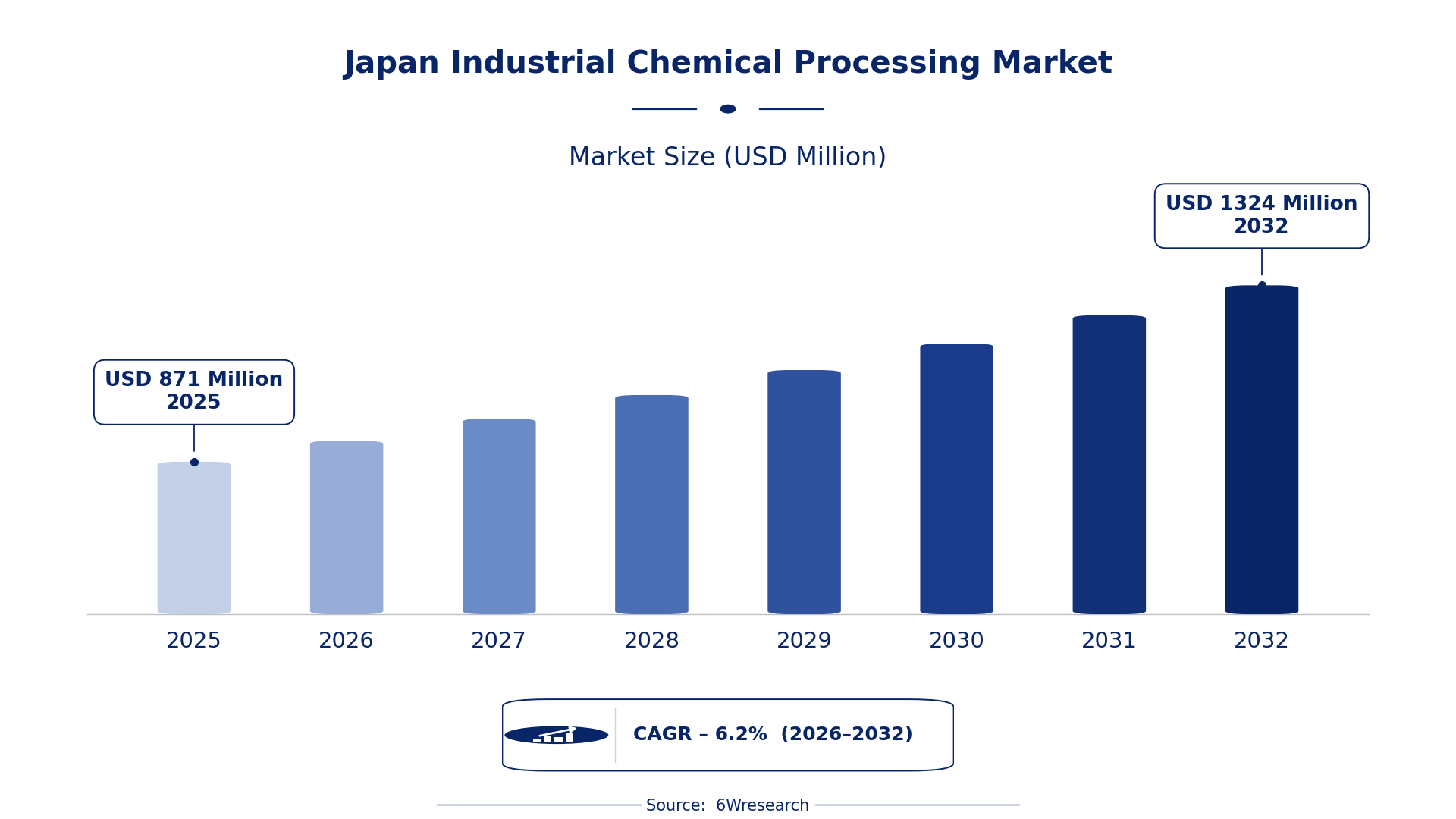
According to 6Wresearch internal database and industry insights, the Japan Industrial Chemical Processing Market was valued at USD 871 Million in 2025 and is projected to reach USD 1,324 Million by 2032, growing at a CAGR of approximately 6.2% during 2026–2032.
Japan Industrial Chemical Processing Market Highlights
| Report Metric | Details |
| Report Name | Japan Industrial Chemical Processing Market (2026-2032) |
| Market Size 2025 | USD 871 Million |
| Market Size 2032 | USD 1,324 Million |
| Absolute Growth 2025–2032 | USD 453 Million |
| CAGR 2026–2032 | 6.2% |
| Peak Annual Growth | 7.0% in 2028 |
| Forecast Period | 2026–2032 |
| Historical Data | 2022–2025 |
| Base Year | 2025 |
| Leading Process Type, 2025 | Continuous Processing (46% share) |
| Leading Operation Scale, 2025 | High Volume (44% share) |
| Leading Output Type, 2025 | Commodity Chemicals (53% share) |
| Leading End User, 2025 | Large Chemical Manufacturers (41% share) |
| Fastest-Growing Process Type | Hybrid Processing (9.0% CAGR) |
| Fastest-Growing Operation Scale | Flexible Batch + Cont. (8.2% CAGR) |
| Fastest-Growing Output Type | Specialty Chemicals (8.9% CAGR) |
| Fastest-Growing End User | R&D & Fine Chemical Makers (8.3% CAGR) |
| Growing Sector | Specialty Chemicals |
| Key End Users | Large Chemical Manufacturers, Automotive Industry, Electronics Sector, Petrochemical Plants |
Japan Industrial Chemical Processing Market Year-wise Growth Rate and Key Drivers (2022–2032)
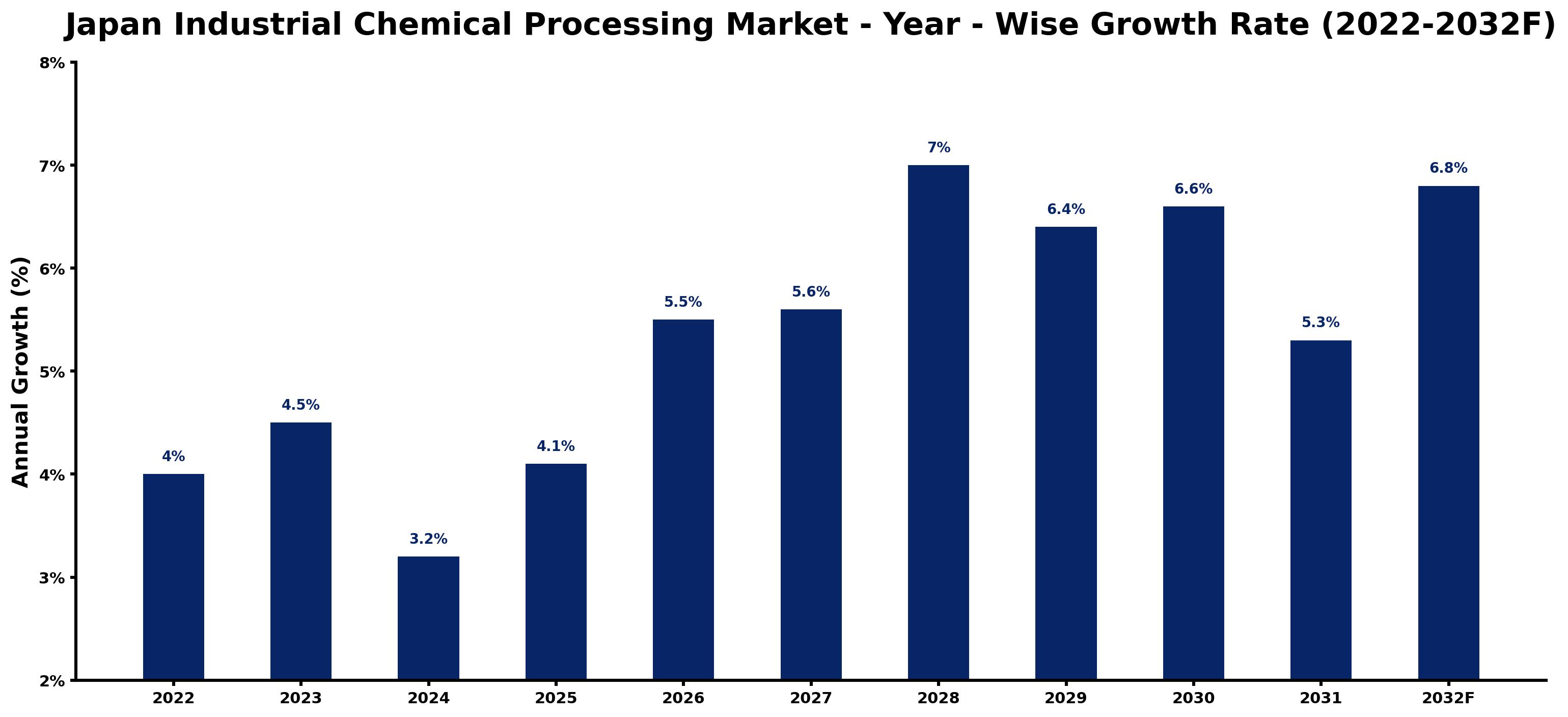
This graph illustrates the annual growth rates of the market from 2022 to 2032, highlighting a steady upward trajectory and projected market expansion over the forecast period.
Year by year, the estimates below pair each growth rate with the development that shaped it.
| Year | Estimated Annual Growth (%) | Market Rationale |
| 2022 | 4.0 | The market showed steady growth due to consistent domestic demand from large chemical manufacturers. |
| 2023 | 4.5 | Growth accelerated as production increased to meet rising needs in the automotive and electronics sectors. |
| 2024 | 3.2 | Growth slowed as manufacturers adjusted to market saturation and changing consumer preferences. |
| 2025 | 4.1 | Demand picked up again as investments in sustainable practices began to take effect. |
| 2026 | 5.5 | Growth is expected to strengthen as new technologies in chemical processing are adopted across various sectors. |
| 2027 | 5.6 | Demand will continue to rise, supported by increased production capacities in key regions like Kanto. |
| 2028 | 7.0 | The market is projected to peak as major investments in green technologies boost production efficiency. |
| 2029 | 6.4 | Growth is expected to decelerate slightly as the market begins to stabilise after rapid expansion in previous years. |
| 2030 | 6.6 | Demand will rise again as companies focus on meeting carbon reduction targets and improving sustainability. |
| 2031 | 5.3 | Growth is projected to slow as the market adjusts to new regulations and competitive pressures from global players. |
| 2032 | 6.8 | Demand is expected to increase as investments in innovative processing methods gain traction. |
Note: Market size estimations and growth projections presented in this report are based on 6Wresearch's proprietary forecasting methodology, utilizing the latest available industry data, government publications, and primary research inputs.
Japan Industrial Chemical Processing Market Synopsis
Industrial chemical processing involves transforming raw materials into valuable chemical products through batch, continuous, and catalytic methods. The Japan Industrial Chemical Processing Market is seeing growth driven by domestic demand, particularly from large chemical manufacturers and the automotive and electronics sectors. In 2022, the chemical industry produced over 30 million tons of chemicals, with a strong focus on sustainability and decarbonisation initiatives. Japan's GX Basic Policy targets approximately JPY 150 trillion in decarbonisation investments over the next decade, stimulating further market expansion.
Market Dynamics Impact Analysis (2026–2032)
| Factor | Type | Impact | Primary Segment Affected |
| Growing emphasis on sustainability in chemical production | Driver | High | Continuous Processing |
| Increased investment in advanced processing technologies | Driver | High | Batch Processing |
| Rising demand for specialty chemicals in niche markets | Opportunity | High | Specialty Chemicals |
| Expansion of petrochemical complexes in the Chubu region | Opportunity | Medium | Petrochemical Plants |
| Challenges in meeting stringent environmental regulations | Restraint | High | Commodity Chemicals |
| Limited availability of skilled workforce in chemical manufacturing | Restraint | Medium | Large Chemical Manufacturers |
| High operational costs impacting profitability | Challenge | High | Catalytic Processing |
| Increasing competition from international chemical producers | Challenge | Medium | Flexible Batch + Cont. |
Evaluation of Drivers in Japan Industrial Chemical Processing Market (2026–2032)
The following drivers explain most of the expected growth.
| Drivers | Primary Segment Affected | Why It Matters (Evidence) |
| Sustainability initiatives driving investment in cleaner technologies | Continuous Processing | Japan's GX Basic Policy aims for a 46% reduction in greenhouse gas emissions by 2030, prompting manufacturers to adopt sustainable practices. |
| Technological advancements improving production efficiency | Batch Processing | The chemical industry produced over 30 million tons of chemicals in 2022, reflecting increased efficiency and capacity. |
| Demand for high-quality specialty chemicals from various industries | Specialty Chemicals | Specialty chemicals accounted for 25% of Japan's total chemical output, indicating strong market interest. |
| Growth in the automotive and electronics sectors | Commodity Chemicals | The automotive industry in Japan is a major consumer of commodity chemicals, significantly boosting demand. |
| Investment in petrochemical complexes in key regions | Petrochemical Plants | The Chubu region is known for its large petrochemical complexes, driving local production capacity. |
What keeps demand rising is the increased focus on sustainability, pushing manufacturers to adopt cleaner technologies. In 2022, Japan's chemical industry produced over 30 million tons of chemicals, reflecting improved production efficiency. The automotive and electronics sectors are major consumers, with specialty chemicals accounting for 25% of total output. Investments in advanced processing technologies are expected to rise as companies pursue higher quality. The Kanto region's chemical production further supports this growth, supplying essential materials for various applications.
Evaluation of Restraints in Japan Industrial Chemical Processing Market
These are the pressures that could keep growth below its potential.
| Market Restraint | Primary Segment Affected | Why It Matters (Evidence) |
| Stringent environmental regulations increasing compliance costs | Commodity Chemicals | The Chemical Substances Control Law mandates rigorous evaluation of chemicals, raising operational costs for manufacturers. |
| Shortage of skilled workforce impacting production capabilities | Large Chemical Manufacturers | With approximately 300,000 people in the chemical manufacturing workforce, expansion opportunities are limited. |
| Volatility in raw material prices affecting profitability | Catalytic Processing | Fluctuations in global oil prices directly impact the cost of inputs for catalytic processes. |
| Competition from international producers offering lower prices | Flexible Batch + Cont. | Lower production costs abroad challenge local manufacturers' pricing strategies. |
| Challenges in adopting new technologies due to high initial costs | Specialty Chemicals | Investments in new processing methods require substantial capital, deterring some manufacturers. |
Japan Industrial Chemical Processing Market Challenges
Producers encounter a skills shortage in Japan's chemical sector, as the workforce of approximately 300,000 struggles to meet evolving industry demands. Regulatory hurdles arise from the Ministry of Economy, Trade and Industry's stringent compliance requirements, causing project delays of up to six months for producers. Technology adoption lags, with inefficiencies leading to a 15% increase in production costs for buyers. Competition intensifies from international markets, forcing local producers to lower prices, which can shrink profit margins by 10% for smaller firms.
Trends in the Japan Industrial Chemical Processing Market
Four trends stand out in the Japan Industrial Chemical Processing Market.
- Shift towards Sustainable Chemical Processes: Japan is increasingly adopting sustainable chemical processing methods, as seen with the GX Promotion Act of 2023, which aims to reduce carbon emissions in the chemical sector by 30% by 2030.
- Increase in Specialty Chemical Production: Specialty chemicals are gaining traction, with an expected growth rate of 8.9% through 2032. This growth is supported by rising demand in niche applications, particularly in the automotive and electronics sectors.
- Expansion of Petrochemical Complexes in Chubu Region: The Chubu region is experiencing growth in petrochemical complexes, which are crucial for local production. This area accounts for a substantial portion of Japan's chemical output, improving supply chain efficiency.
- Growing Investment in R&D for Fine Chemicals: Investment in research and development for fine chemicals is increasing, driven by government grants. This trend supports innovation and the development of specialised products, important for maintaining competitiveness.
Investment Opportunities in the Japan Industrial Chemical Processing Market
Below are the investment opportunities with the strongest case in the Japan Industrial Chemical Processing Market.
- Current Demand for Sustainable Solutions: With Japan targeting a 46% reduction in greenhouse gas emissions by 2030, there is a strong opportunity for suppliers of sustainable chemical technologies. Large Chemical Manufacturers are actively seeking partners to innovate and implement greener processes.
- Investment in Advanced Processing Technologies: The chemical industry is set for growth with JPY 150 trillion earmarked for decarbonisation investments over the next decade. Collaborating with local partners can facilitate entry into this expanding market.
- Specialty Chemicals Market Gap: The rising demand for specialty chemicals presents a notable opportunity, with an expected growth rate of 8.9%. Suppliers should focus on niche applications in automotive and electronics sectors to capture this growth.
- Expansion of Petrochemical Facilities: The Chubu region's petrochemical complexes are expanding, creating opportunities for suppliers of raw materials and technologies. Establishing joint ventures can help tap into this growing market.
Government Initiatives in the Japan Industrial Chemical Processing Market
The GX Promotion Act of 2023 strengthens Japan's commitment to achieving carbon neutrality by 2050, building on the Green Growth Strategy established in 2020. This act provides a legal framework for promoting sustainable practices in the chemical industry, requiring manufacturers to adopt greener technologies and processes.
The government allocated JPY 150 trillion for decarbonisation investments over the next decade, administered by the Ministry of Economy, Trade and Industry. This funding supports projects aimed at reducing carbon emissions and improving sustainability in the chemical sector.
Future Insight of the Japan Industrial Chemical Processing Market
Japan's chemical sector will see a robust investment pipeline, with about JPY 150 trillion allocated for decarbonisation initiatives over the next decade, driving demand for advanced processing technologies. By 2032, sustainable chemical processes will reshape production methods, improving operational efficiency. The widespread adoption of ISO 9001 and JIS standards will enhance quality assurance, reassuring buyers about product reliability. Increased government grants for research and development in fine chemicals will empower suppliers to innovate, aligning their offerings with market requirements.
Market Segmentation Analysis
Japan Industrial Chemical Processing Market report covers a detailed analysis of the following market segments:
By Process Type – Continuous Processing Leads, Hybrid Processing Expected to Grow Fastest
According to Saurav Kr Singh, Senior Research Analyst at 6Wresearch, Continuous Processing took 46% of process type revenue in 2025, more than any other category. Continuous processing holds the largest share due to its efficiency in large-scale production of commodity chemicals, crucial for various industries. This method is particularly prevalent in the Kanto region, a significant hub for chemical production in Japan. Hybrid Processing is set to record the highest CAGR in this split, 9.0% over 2026–2032. Hybrid processing is expanding rapidly as it merges batch and continuous methods, offering the flexibility needed to respond to market fluctuations. This growth aligns with Japan's recent initiatives aimed at promoting sustainable chemical processes. Suppliers should enhance their hybrid processing capabilities to meet the increasing demand for flexibility.
By Operation Scale – High Volume Leads, Flexible Batch + Cont. Expected to Grow Fastest
High Volume accounted for 44% of the market by operation scale in 2025. High volume operations dominate the market because they are essential for producing standard chemicals, widely used across numerous industries. This segment benefits from Japan's established chemical infrastructure and a skilled workforce of around 300,000 people. Flexible Batch + Cont. is projected to grow fastest, at a CAGR of 8.2% during 2026–2032. Flexible batch and continuous operations are growing quickly due to their ability to efficiently adapt production processes, catering to changing market conditions. This adaptability is vital as Japan aims for substantial decarbonisation investments over the next decade. Buyers may prefer suppliers that offer flexible production solutions to navigate market fluctuations more effectively.
By Output Type – Commodity Chemicals Lead, Specialty Chemicals Expected to Grow Fastest
With 53% of output type revenue in 2025, Commodity Chemicals was the largest category. Commodity chemicals lead the market as they are essential for fulfilling basic industrial needs and are widely utilised across sectors such as automotive and pharmaceuticals. Their production relies heavily on high volume processes, which are prevalent in Japan's chemical industry. The quickest growth will come from Specialty Chemicals, forecast to expand at a CAGR of 8.9% between 2026 and 2032. Specialty chemicals are witnessing the fastest growth due to their high demand in niche applications, particularly in high-value markets like electronics and pharmaceuticals. This trend is supported by government initiatives promoting R&D in fine chemicals. Suppliers should focus on specialty chemicals to capitalise on growth opportunities in high-value markets.
By End User – Large Chemical Manufacturers Lead, R&D & Fine Chemical Makers Expected to Grow Fastest
Large Chemical Manufacturers held 41% of the Japan Industrial Chemical Processing Market by end user in 2025. Large chemical manufacturers represent the largest share as they account for the majority of production and innovation in the sector. Their substantial output contributes significantly to Japan's chemical exports, valued at over $15 billion in 2022. Over 2026–2032, R&D & Fine Chemical Makers are expected to post the fastest growth, at a CAGR of 8.3%. R&D and fine chemical makers are experiencing the fastest growth as they concentrate on innovation and the development of specialised products, addressing market demands for advanced materials. This aligns with government efforts to support research in fine chemicals. Buyers may increasingly collaborate with R&D firms to gain access to advanced chemical solutions.
Key Attractiveness of the Report
- 10 Years of Market Numbers
- Historical Data Starting from 2022 to 2025
- Base Year 2025
- Forecast Data until 2032
- Key Performance Indicators Impacting the Market
- Major Upcoming Developments and Projects
Key Highlights of the Report:
- Japan Industrial Chemical Processing Market Outlook
- Market Size of Japan Industrial Chemical Processing Market, 2025
- Forecast of Japan Industrial Chemical Processing Market, 2032
- Historical Data and Forecast of Japan Industrial Chemical Processing Revenues & Volume for the Period 2022-2032F
- Japan Industrial Chemical Processing Market Trend Evolution
- Japan Industrial Chemical Processing Market Drivers and Challenges
- Japan Industrial Chemical Processing Price Trends
- Japan Industrial Chemical Processing Porter's Five Forces
- Japan Industrial Chemical Processing Industry Life Cycle
- Historical Data and Forecast of Japan Industrial Chemical Processing Market Revenues & Volume By Process Type for the Period 2022-2032F
- Historical Data and Forecast of Japan Industrial Chemical Processing Market Revenues & Volume By Batch Processing for the Period 2022-2032F
- Historical Data and Forecast of Japan Industrial Chemical Processing Market Revenues & Volume By Continuous Processing for the Period 2022-2032F
- Historical Data and Forecast of Japan Industrial Chemical Processing Market Revenues & Volume By Hybrid Processing for the Period 2022-2032F
- Historical Data and Forecast of Japan Industrial Chemical Processing Market Revenues & Volume By Catalytic Processing for the Period 2022-2032F
- Historical Data and Forecast of Japan Industrial Chemical Processing Market Revenues & Volume By Operation Scale for the Period 2022-2032F
- Historical Data and Forecast of Japan Industrial Chemical Processing Market Revenues & Volume By Small/Custom for the Period 2022-2032F
- Historical Data and Forecast of Japan Industrial Chemical Processing Market Revenues & Volume By High Volume for the Period 2022-2032F
- Historical Data and Forecast of Japan Industrial Chemical Processing Market Revenues & Volume By Flexible Batch + Cont. for the Period 2022-2032F
- Historical Data and Forecast of Japan Industrial Chemical Processing Market Revenues & Volume By Catalyzed Reactions for the Period 2022-2032F
- Historical Data and Forecast of Japan Industrial Chemical Processing Market Revenues & Volume By Output Type for the Period 2022-2032F
- Historical Data and Forecast of Japan Industrial Chemical Processing Market Revenues & Volume By Specialty Chemicals for the Period 2022-2032F
- Historical Data and Forecast of Japan Industrial Chemical Processing Market Revenues & Volume By Commodity Chemicals for the Period 2022-2032F
- Historical Data and Forecast of Japan Industrial Chemical Processing Market Revenues & Volume By Blended Products for the Period 2022-2032F
- Historical Data and Forecast of Japan Industrial Chemical Processing Market Revenues & Volume By Fuel & Polymer Intermediates for the Period 2022-2032F
- Historical Data and Forecast of Japan Industrial Chemical Processing Market Revenues & Volume By End User for the Period 2022-2032F
- Historical Data and Forecast of Japan Industrial Chemical Processing Market Revenues & Volume By R&D & Fine Chemical Makers for the Period 2022-2032F
- Historical Data and Forecast of Japan Industrial Chemical Processing Market Revenues & Volume By Large Chemical Manufacturers for the Period 2022-2032F
- Historical Data and Forecast of Japan Industrial Chemical Processing Market Revenues & Volume By Lubricants & Additive Firms for the Period 2022-2032F
- Historical Data and Forecast of Japan Industrial Chemical Processing Market Revenues & Volume By Petrochemical Plants for the Period 2022-2032F
- Japan Industrial Chemical Processing Import Export Trade Statistics
- Market Opportunity Assessment By Process Type
- Market Opportunity Assessment By Operation Scale
- Market Opportunity Assessment By Output Type
- Market Opportunity Assessment By End User
- Japan Industrial Chemical Processing Top Companies Market Share
- Japan Industrial Chemical Processing Competitive Benchmarking By Technical and Operational Parameters
- Japan Industrial Chemical Processing Company Profiles
- Japan Industrial Chemical Processing Key Strategic Recommendations
Market Covered
Segments analysed in this report are listed below.
By Process Type
- Batch Processing
- Continuous Processing
- Hybrid Processing
- Catalytic Processing
By Operation Scale
- Small/Custom
- High Volume
- Flexible Batch + Cont.
- Catalyzed Reactions
By Output Type
- Specialty Chemicals
- Commodity Chemicals
- Blended Products
- Fuel & Polymer Intermediates
By End User
- R&D & Fine Chemical Makers
- Large Chemical Manufacturers
- Lubricants & Additive Firms
- Petrochemical Plants































