Japan Industrial Cleaning Materials Market Size & Growth Rate
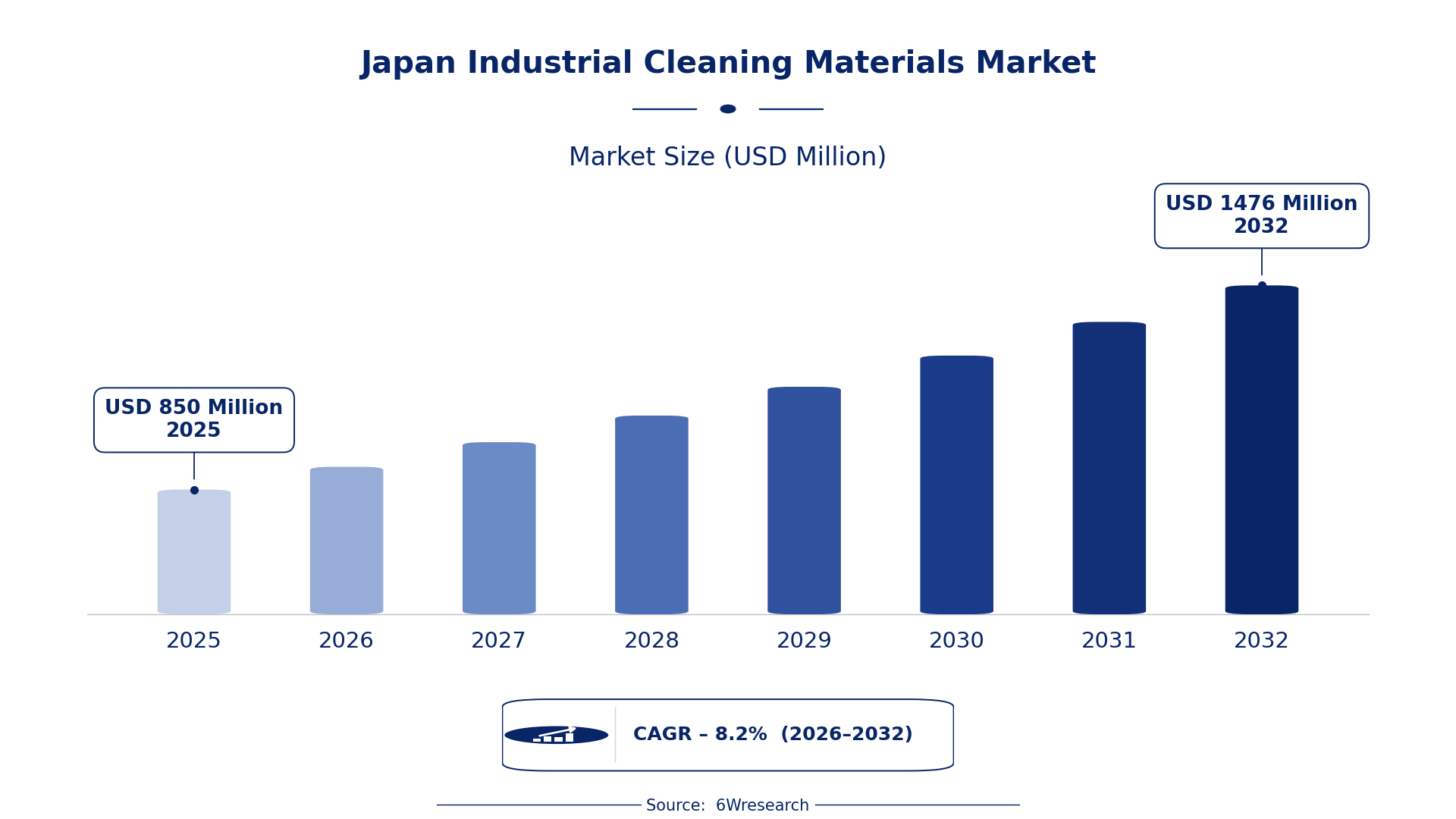
According to 6Wresearch internal database and industry insights, the Japan Industrial Cleaning Materials Market was valued at USD 850 Million in 2025 and is projected to reach USD 1,476 Million by 2032, growing at a CAGR of approximately 8.2% during 2026–2032.
Japan Industrial Cleaning Materials Market Highlights
| Report Metric | Details |
| Report Name | Japan Industrial Cleaning Materials Market (2026-2032) |
| Market Size 2025 | USD 850 Million |
| Market Size 2032 | USD 1,476 Million |
| Absolute Growth 2025–2032 | USD 626 Million |
| CAGR 2026–2032 | 8.2% |
| Peak Annual Growth | 9.2% in 2028 |
| Forecast Period | 2026–2032 |
| Historical Data | 2022–2025 |
| Base Year | 2025 |
| Leading Material Type, 2025 | Degreasers (44% share) |
| Leading Form Factor, 2025 | Liquid/Spray (39% share) |
| Leading Application Area, 2025 | Oil & Machinery Cleaning (46% share) |
| Leading End User, 2025 | Heavy Equipment Workshops (37% share) |
| Fastest-Growing Material Type | Descalers (11.3% CAGR) |
| Fastest-Growing Form Factor | Powder/Liquid (12.0% CAGR) |
| Fastest-Growing Application Area | Boiler & Heat Exchangers (10.3% CAGR) |
| Fastest-Growing End User | Food Industry Plants (10.4% CAGR) |
| Growing Sector | Boiler & Heat Exchangers |
| Key End Users | Oil & Machinery Cleaning, Boiler & Heat Exchangers, Hands & Surfaces, Rust/Scale Removal |
Japan Industrial Cleaning Materials Market Year-wise Growth Rate and Key Drivers (2022–2032)
This graph illustrates the annual growth rates of the market from 2022 to 2032, highlighting a steady upward trajectory and projected market expansion over the forecast period.
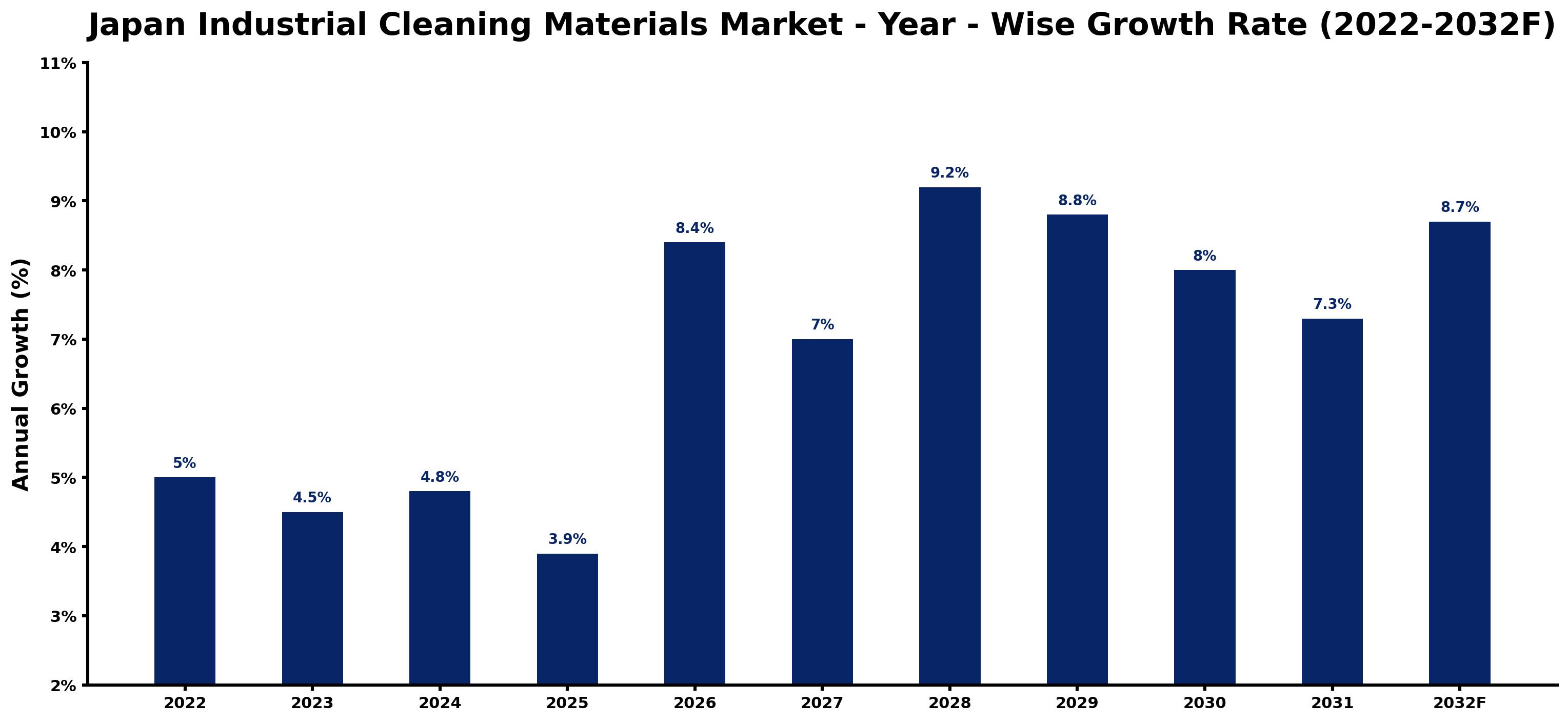
For each year, the table pairs the estimated growth rate with the leading influence on demand, showing how the drivers changed across the period.
| Year | Estimated Annual Growth (%) | Market Rationale |
| 2022 | 5.0 | The market experienced strong demand due to recovery in the manufacturing sector. |
| 2023 | 4.5 | Growth slowed as companies adjusted to rising material costs and inflation. |
| 2024 | 4.8 | Demand increased as manufacturers resumed operations and expanded production capabilities. |
| 2025 | 3.9 | Market growth slowed as businesses faced supply chain disruptions and rising costs. |
| 2026 | 8.4 | A surge in investment in industrial cleaning materials is anticipated to drive demand higher. |
| 2027 | 7.0 | Growth is projected to slow as manufacturers face challenges in sourcing raw materials. |
| 2028 | 9.2 | The market is expected to peak as new eco-friendly cleaning technologies gain popularity. |
| 2029 | 8.8 | Growth is projected to slow as the market stabilises after rapid expansion. |
| 2030 | 8.0 | Demand will continue to rise, supported by increased focus on sustainability in manufacturing. |
| 2031 | 7.3 | Market growth is expected to slow as competition intensifies among cleaning material suppliers. |
| 2032 | 8.7 | A renewed emphasis on hygiene in industrial settings will boost demand. |
Note: Market size estimations and growth projections presented in this report are based on 6Wresearch's proprietary forecasting methodology, utilizing the latest available industry data, government publications, and primary research inputs.
Japan Industrial Cleaning Materials Market Synopsis
Industrial cleaning materials are chemical substances formulated to remove contaminants from surfaces and equipment, produced through chemical synthesis. Key buyer groups include heavy equipment workshops and the food industry, which necessitate strict hygiene standards. The Japan Industrial Cleaning Materials Market is growing due to rising demand from the manufacturing sector, investments in decarbonisation initiatives, and a focus on eco-friendly cleaning solutions, with the food industry employing over 1.5 million people driving substantial purchases.
Market Dynamics Impact Analysis (2026–2032)
| Factor | Type | Impact | Primary Segment Affected |
| Rising demand from the manufacturing sector drives the need for effective cleaning solutions. | Driver | High | Degreasers |
| The automotive sector's growth increases the consumption of industrial cleaning materials. | Driver | High | Industrial Soaps |
| Investment in eco-friendly cleaning technologies presents opportunities for new product development. | Opportunity | Medium | Descalers |
| The push for sustainability in industrial practices opens new markets for cleaning materials. | Opportunity | Medium | Liquid/Spray |
| Stringent regulations on chemical safety limit the types of materials that can be used. | Restraint | High | Degreasers |
| The high cost of raw materials affects pricing and availability of cleaning products. | Restraint | High | Industrial Soaps |
| Compliance with environmental regulations increases operational costs for manufacturers. | Challenge | High | Descalers |
| Limited capacity for production can delay supply to the market. | Challenge | Medium | Liquid/Spray |
Evaluation of Drivers in Japan Industrial Cleaning Materials Market (2026–2032)
Below are the drivers that matter most for revenue growth, with supporting evidence.
| Drivers | Primary Segment Affected | Why It Matters (Evidence) |
| Increased production in the manufacturing sector drives demand for degreasers. | Degreasers | In 2022, Japan's manufacturing sector produced approximately 1.5 trillion JPY worth of goods, leading to higher cleaning material needs. |
| The automotive industry’s expansion boosts the use of industrial soaps. | Industrial Soaps | The automotive sector, as one of the largest consumers, increases purchases of cleaning materials significantly. |
| The food industry’s strict hygiene standards necessitate regular use of descalers. | Descalers | With over 1.5 million employees, the food industry in Japan drives consistent demand for cleaning solutions. |
| Growing environmental awareness encourages the adoption of eco-friendly cleaning products. | Liquid/Spray | The promotion of eco-friendly cleaning materials aligns with Japan's sustainability goals, leading to increased purchases. |
| Technological advancements in cleaning solutions improve product effectiveness. | Liquid/Spray | ISO 9001 standards ensure quality and performance, driving demand for certified cleaning materials. |
The strongest pull on demand comes from the manufacturing sector, which produced approximately 1.5 trillion JPY worth of goods in 2022, resulting in increased purchases of degreasers. The automotive industry, a major consumer of industrial soaps, continues to expand, further driving demand. The food industry employs over 1.5 million people, necessitating regular use of descalers to maintain hygiene standards. Technological improvements in cleaning solutions are enhancing product effectiveness, increasing adoption rates among industrial users.
Evaluation of Restraints in Japan Industrial Cleaning Materials Market
The following restraints limit how fast demand can grow.
| Market Restraint | Primary Segment Affected | Why It Matters (Evidence) |
| Stringent regulations on chemical safety limit available cleaning materials. | Degreasers | Japan has strict regulations under the Chemical Substances Control Law, affecting product formulations. |
| High raw material costs impact the pricing of industrial soaps. | Industrial Soaps | Rising costs of chemical inputs are affecting the affordability and availability of cleaning products. |
| Compliance with environmental regulations increases operational costs for manufacturers. | Descalers | Manufacturers must invest in compliance measures, raising overall production costs. |
| Limited production capacity can delay supply to the market. | Liquid/Spray | Manufacturers face challenges in scaling production to meet increasing demand. |
| Market competition can lead to price wars, affecting profitability. | Liquid/Spray | Intense competition among suppliers can drive down prices, impacting margins. |
Japan Industrial Cleaning Materials Market Challenges
New regulations introduced in 2023 limit harmful substances in cleaning materials, requiring producers to reformulate products, which can delay production timelines by six months. Upgrading technology to comply with these regulations costs producers approximately JPY 10 billion annually, straining budgets. Increased competition from eco-friendly alternatives pressures traditional producers, forcing them to invest in research and development, which can divert funds from other critical areas. Skills shortages in chemical engineering hinder suppliers' ability to innovate, potentially reducing their market share by 15%, impacting their long-term viability.
Trends in the Japan Industrial Cleaning Materials Market
Four trends stand out in the Japan Industrial Cleaning Materials Market.
- Shift towards Eco-Friendly Cleaning Solutions: Since 2023, there has been a noticeable shift towards eco-friendly cleaning materials. Japan targets a 46% cut in greenhouse gas emissions by 2030, promoting sustainable practices in the industrial sector.
- Transition from Traditional to Advanced Cleaning Technologies: The industry is moving from traditional cleaning methods to advanced technologies that improve efficiency. For instance, new descalers have enhanced cleaning effectiveness, increasing adoption rates among heavy equipment workshops.
- Emergence of Sustainable Practices in Manufacturing: Manufacturers are increasingly adopting sustainable cleaning practices to meet regulatory standards. In 2023, over 30% of industrial cleaning materials produced adhered to eco-friendly guidelines, reflecting a significant industry shift.
- Prioritisation of Hygiene Standards in Food Processing: The food industry has heightened its focus on hygiene standards since 2022, necessitating frequent cleaning. This has resulted in increased demand for industrial cleaning materials in food processing plants.
Investment Opportunities in the Japan Industrial Cleaning Materials Market
Several openings in the Japan Industrial Cleaning Materials Market merit attention from investors.
- Supply Eco-Friendly Cleaning Materials: With the growing focus on sustainability, there is an opportunity to supply eco-friendly cleaning materials. The food industry, which employs over 1.5 million people, is increasingly seeking sustainable solutions.
- Invest in Advanced Cleaning Technologies: Investing in advanced cleaning technologies is timely as manufacturers seek efficient solutions. Heavy equipment workshops are looking for innovations that improve cleaning effectiveness and reduce waste.
- Expand Production Capacity: Expanding production capacity is essential now, given the rising demand for industrial cleaning materials. Facilities in industrial hubs like Aichi and Osaka can cater to this growing market.
- Form Partnerships for Compliance Solutions: Forming partnerships with local manufacturers can help navigate compliance with new regulations. Collaborating with industry associations can facilitate access to best practices and standards.
Government Initiatives in the Japan Industrial Cleaning Materials Market
The Chemical Substances Control Law, enacted in 1973, mandates the evaluation and control of chemical substances used in manufacturing and import. This law ensures that producers must adhere to stringent safety and environmental standards, impacting the formulation of industrial cleaning materials. Additionally, the PRTR Law, established in 1999, requires businesses to report the release of designated chemicals, further enforcing compliance and transparency in chemical management practices.
In 2023, the Ministry of the Environment allocated JPY 50 billion to support the transition towards eco-friendly cleaning materials. This funding aims to assist manufacturers in developing sustainable products that meet new regulatory standards. The Japan Cleaning Association plays a crucial role in promoting best practices and ensuring compliance with these environmental initiatives, benefiting both producers and buyers in the industrial cleaning materials market.
Future Insight of the Japan Industrial Cleaning Materials Market
By 2032, advanced cleaning technologies will be adopted in heavy equipment workshops, driven by Japan's decarbonisation goals. The automotive sector will see a shift towards automated cleaning processes, enhancing efficiency. Compliance with ISO 9001 will become stricter, raising quality standards for suppliers. Japan's commitment to a 46% cut in greenhouse-gas emissions by 2030 will encourage the development of sustainable cleaning materials, reshaping the industry.
Market Segmentation Analysis
Japan Industrial Cleaning Materials Market report covers a detailed analysis of the following market segments:
By Material Type – Degreasers Lead, Descalers Expected to Grow Fastest
According to Saurav Kr Singh, Senior Research Analyst at 6Wresearch, Degreasers accounted for 44% of the market by material type in 2025. Degreasers dominate the market due to their essential role in removing oil and grease from machinery surfaces, which is critical for maintaining operational efficiency. The automotive sector, which is one of the largest consumers of these materials, significantly drives this demand. The quickest growth will come from Descalers, forecast to expand at a CAGR of 11.3% between 2026 and 2032. Descalers are experiencing rapid growth as industries increasingly prioritise equipment efficiency and longevity, especially in sectors reliant on mineral-heavy water. The introduction of new regulations limiting harmful substances further elevates the necessity for effective descaling solutions. This trend suggests that suppliers should prioritise the development of descalers to cater to the rising demand across various industrial sectors.
By Form Factor – Liquid/Spray Leads, Powder/Liquid Expected to Grow Fastest
Liquid/Spray took 39% of form factor revenue in 2025, more than any other category. Liquid/Spray forms lead the market due to their ease of application across various settings, making them a preferred choice for users. This format is particularly advantageous in environments where quick and efficient cleaning is essential. Powder/Liquid is set to record the highest CAGR in this split, 12.0% over 2026–2032. Powder/Liquid forms are gaining traction as they cater to specific applications, providing effective solutions where traditional liquids may not suffice. Their adaptability in niche markets contributes to their accelerated growth. Suppliers must consider expanding their product lines to include more powder and liquid options to meet emerging market demands.
By Application Area – Oil & Machinery Cleaning Leads, Boiler & Heat Exchangers Expected to Grow Fastest
In 2025, Oil & Machinery Cleaning led the application area split with a 46% share. Oil & Machinery Cleaning is the largest segment as it is critical for the maintenance of industrial machinery, ensuring operational reliability. The manufacturing sector's substantial output necessitates consistent cleaning practices to uphold equipment performance. Over 2026–2032, Boiler & Heat Exchangers are expected to post the fastest growth, at a CAGR of 10.3%. Boiler & Heat Exchangers are seeing the fastest growth due to the increasing emphasis on equipment efficiency and longevity in industrial operations. As industries expand, the need for effective cleaning solutions in this area becomes more pronounced. Suppliers should focus on developing targeted cleaning solutions for boiler and heat exchanger applications to seize growth opportunities.
By End User – Heavy Equipment Workshops Lead, Food Industry Plants Expected to Grow Fastest
With 37% of end user revenue in 2025, Heavy Equipment Workshops was the largest category. Heavy Equipment Workshops are the primary users of industrial cleaning materials, as they require regular maintenance to ensure machinery operates effectively. Their concentration in industrial regions boosts the demand for these cleaning solutions. Food Industry Plants are projected to grow fastest, at a CAGR of 10.4% during 2026–2032. Food Industry Plants are rapidly increasing their use of cleaning materials due to strict hygiene standards that require frequent cleaning. This growth is propelled by the need to comply with health regulations and ensure product safety. Suppliers should tailor their offerings to meet the stringent hygiene standards of the food industry, capitalising on this expanding market.
Key Attractiveness of the Report
- 10 Years of Market Numbers
- Historical Data Starting from 2022 to 2025
- Base Year 2025
- Forecast Data until 2032
- Key Performance Indicators Impacting the Market
- Major Upcoming Developments and Projects
Key Highlights of the Report:
- Japan Industrial Cleaning Materials Market Outlook
- Market Size of Japan Industrial Cleaning Materials Market, 2025
- Forecast of Japan Industrial Cleaning Materials Market, 2032
- Historical Data and Forecast of Japan Industrial Cleaning Materials Revenues & Volume for the Period 2022-2032F
- Japan Industrial Cleaning Materials Market Trend Evolution
- Japan Industrial Cleaning Materials Market Drivers and Challenges
- Japan Industrial Cleaning Materials Price Trends
- Japan Industrial Cleaning Materials Porter's Five Forces
- Japan Industrial Cleaning Materials Industry Life Cycle
- Historical Data and Forecast of Japan Industrial Cleaning Materials Market Revenues & Volume By Material Type for the Period 2022-2032F
- Historical Data and Forecast of Japan Industrial Cleaning Materials Market Revenues & Volume By Degreasers for the Period 2022-2032F
- Historical Data and Forecast of Japan Industrial Cleaning Materials Market Revenues & Volume By Descalers for the Period 2022-2032F
- Historical Data and Forecast of Japan Industrial Cleaning Materials Market Revenues & Volume By Industrial Soaps for the Period 2022-2032F
- Historical Data and Forecast of Japan Industrial Cleaning Materials Market Revenues & Volume By Abrasive Cleaners for the Period 2022-2032F
- Historical Data and Forecast of Japan Industrial Cleaning Materials Market Revenues & Volume By Form Factor for the Period 2022-2032F
- Historical Data and Forecast of Japan Industrial Cleaning Materials Market Revenues & Volume By Liquid/Spray for the Period 2022-2032F
- Historical Data and Forecast of Japan Industrial Cleaning Materials Market Revenues & Volume By Powder/Liquid for the Period 2022-2032F
- Historical Data and Forecast of Japan Industrial Cleaning Materials Market Revenues & Volume By Solid/Bar/Liquid for the Period 2022-2032F
- Historical Data and Forecast of Japan Industrial Cleaning Materials Market Revenues & Volume By Paste/Granules for the Period 2022-2032F
- Historical Data and Forecast of Japan Industrial Cleaning Materials Market Revenues & Volume By Application Area for the Period 2022-2032F
- Historical Data and Forecast of Japan Industrial Cleaning Materials Market Revenues & Volume By Oil & Machinery Cleaning for the Period 2022-2032F
- Historical Data and Forecast of Japan Industrial Cleaning Materials Market Revenues & Volume By Boiler & Heat Exchangers for the Period 2022-2032F
- Historical Data and Forecast of Japan Industrial Cleaning Materials Market Revenues & Volume By Hands & Surfaces for the Period 2022-2032F
- Historical Data and Forecast of Japan Industrial Cleaning Materials Market Revenues & Volume By Rust/Scale Removal for the Period 2022-2032F
- Historical Data and Forecast of Japan Industrial Cleaning Materials Market Revenues & Volume By End User for the Period 2022-2032F
- Historical Data and Forecast of Japan Industrial Cleaning Materials Market Revenues & Volume By Heavy Equipment Workshops for the Period 2022-2032F
- Historical Data and Forecast of Japan Industrial Cleaning Materials Market Revenues & Volume By Industrial HVAC Systems for the Period 2022-2032F
- Historical Data and Forecast of Japan Industrial Cleaning Materials Market Revenues & Volume By Food Industry Plants for the Period 2022-2032F
- Historical Data and Forecast of Japan Industrial Cleaning Materials Market Revenues & Volume By Automotive Garages for the Period 2022-2032F
- Japan Industrial Cleaning Materials Import Export Trade Statistics
- Market Opportunity Assessment By Material Type
- Market Opportunity Assessment By Form Factor
- Market Opportunity Assessment By Application Area
- Market Opportunity Assessment By End User
- Japan Industrial Cleaning Materials Top Companies Market Share
- Japan Industrial Cleaning Materials Competitive Benchmarking By Technical and Operational Parameters
- Japan Industrial Cleaning Materials Company Profiles
- Japan Industrial Cleaning Materials Key Strategic Recommendations
Market Covered
Segments analysed in this report are listed below.
By Material Type
- Degreasers
- Descalers
- Industrial Soaps
- Abrasive Cleaners
By Form Factor
- Liquid/Spray
- Powder/Liquid
- Solid/Bar/Liquid
- Paste/Granules
By Application Area
- Oil & Machinery Cleaning
- Boiler & Heat Exchangers
- Hands & Surfaces
- Rust/Scale Removal
By End User
- Heavy Equipment Workshops
- Industrial HVAC Systems
- Food Industry Plants
- Automotive Garages































