Japan Industrial Compressor Market Size & Growth Rate
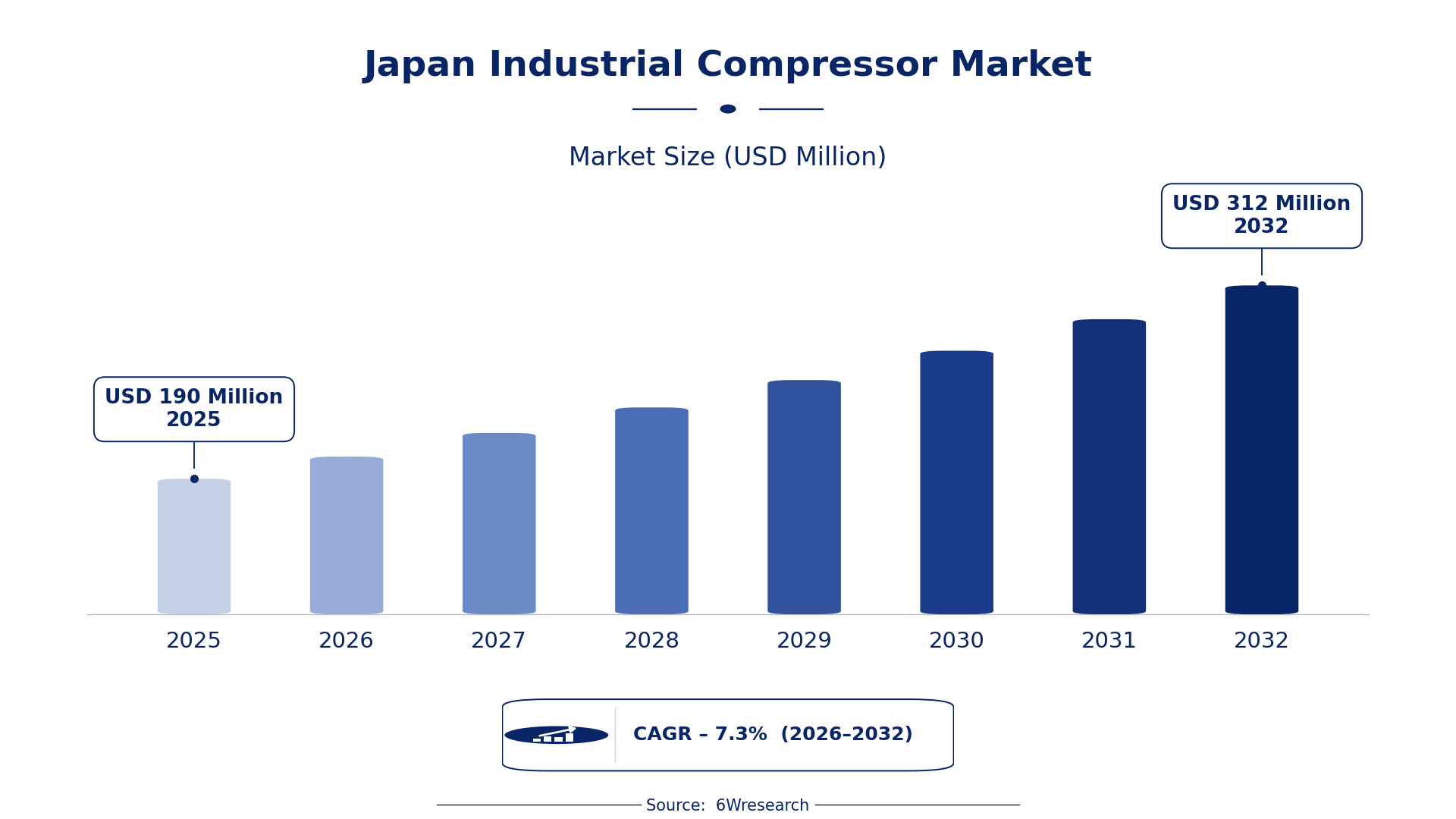
According to 6Wresearch internal database and industry insights, the Japan Industrial Compressor Market was valued at USD 190 Million in 2025 and is projected to reach USD 312 Million by 2032, growing at a CAGR of approximately 7.3% during 2026–2032.
Japan Industrial Compressor Market Highlights
| Report Metric | Details |
| Report Name | Japan Industrial Compressor Market (2026-2032) |
| Market Size 2025 | USD 190 Million |
| Market Size 2032 | USD 312 Million |
| Absolute Growth 2025–2032 | USD 122 Million |
| CAGR 2026–2032 | 7.3% |
| Peak Annual Growth | 8.6% in 2026 |
| Forecast Period | 2026–2032 |
| Historical Data | 2022–2025 |
| Base Year | 2025 |
| Leading Compressor Type, 2025 | Rotary Screw Compressors (48% share) |
| Leading Compression Principle, 2025 | Continuous Rotary Motion (49% share) |
| Leading Lubrication Type, 2025 | Oil-Injected/Dry (48% share) |
| Leading End User, 2025 | General Manufacturing (49% share) |
| Fastest-Growing Compressor Type | Reciprocating Compressors (9.8% CAGR) |
| Fastest-Growing Compression Principle | Piston Driven (9.0% CAGR) |
| Fastest-Growing Lubrication Type | Lubricated (9.9% CAGR) |
| Fastest-Growing End User | Workshop Applications (9.1% CAGR) |
| Growing Sector | Workshop Applications |
| Key End Users | General Manufacturing, Workshop Applications, Petrochemical Plants, HVAC & Refrigeration Firms |
Japan Industrial Compressor Market Year-wise Growth Rate and Key Drivers (2022–2032)
This graph illustrates the annual growth rates of the market from 2022 to 2032, highlighting a steady upward trajectory and projected market expansion over the forecast period.
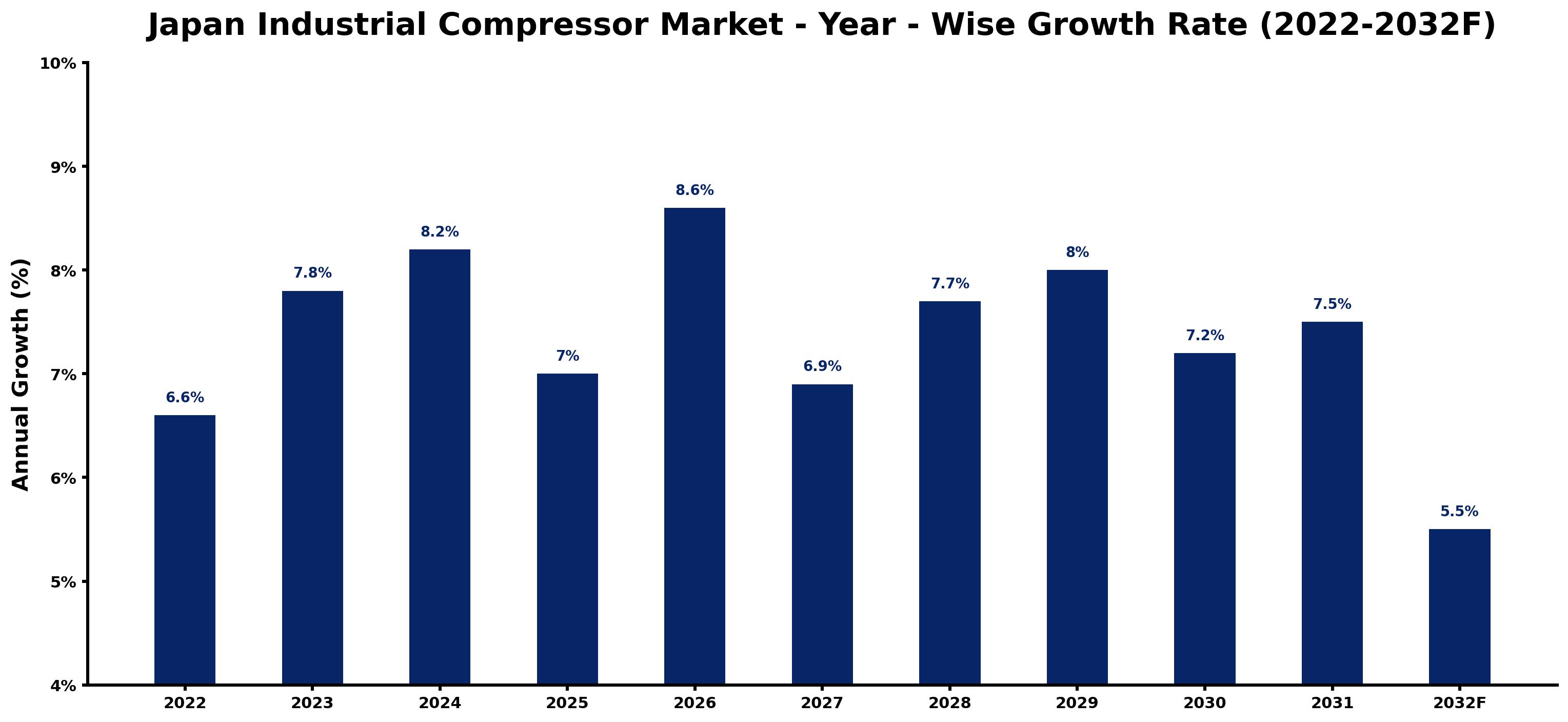
Annual growth estimates for each year appear below with the principal reason behind them, explaining the shifts that set the pace of the market.
| Year | Estimated Annual Growth (%) | Market Rationale |
| 2022 | 6.6 | The market experienced steady growth due to strong industrial activity and demand for compressors. |
| 2023 | 7.8 | Growth accelerated as manufacturers adopted energy-efficient technologies and expanded operations. |
| 2024 | 8.2 | The market saw further expansion driven by increased investments in manufacturing and HVAC sectors. |
| 2025 | 7.0 | Growth slowed slightly as some sectors adjusted to rising energy costs and market saturation. |
| 2026 | 8.6 | The market is expected to rebound with heightened demand from the HVAC sector and ongoing industrial projects. |
| 2027 | 6.9 | A slight slowdown is projected as manufacturers face challenges in sourcing materials and components. |
| 2028 | 7.7 | Growth is expected to resume as new technologies improve compressor efficiency and attract investment. |
| 2029 | 8.0 | Demand is projected to surge as manufacturers ramp up production to meet rising market needs and standards. |
| 2030 | 7.2 | Growth will decelerate due to regulatory adjustments and market corrections in energy consumption. |
| 2031 | 7.5 | The market is expected to regain momentum as companies adapt to new regulations and improve operational efficiencies. |
| 2032 | 5.5 | Growth will continue but at a slower pace as market saturation begins to influence purchasing decisions. |
Note: Market size estimations and growth projections presented in this report are based on 6Wresearch's proprietary forecasting methodology, utilizing the latest available industry data, government publications, and primary research inputs.
Japan Industrial Compressor Market Synopsis
The Japan Industrial Compressor Market is valued at approximately 250 billion yen, driven by demand from the manufacturing and HVAC sectors. The Tokyo region accounts for 30% of total compressor demand, while the HVAC sector is projected to grow, increasing compressor demand by 10% annually. The government's focus on energy efficiency and decarbonisation investments is propelling market growth.
Market Dynamics Impact Analysis (2026–2032)
| Factor | Type | Impact | Primary Segment Affected |
| Rising demand for energy-efficient compressors | Driver | High | Oil-Injected/Dry |
| Increased investment in HVAC and manufacturing sectors | Driver | High | General Manufacturing |
| Growing adoption of oil-free compressors in food processing | Opportunity | High | Oil-Free |
| Expansion of manufacturing facilities in Osaka | Opportunity | Medium | General Manufacturing |
| High initial investment costs for advanced compressors | Restraint | High | Rotary Screw Compressors |
| Regulatory compliance costs associated with safety standards | Restraint | Medium | Reciprocating Compressors |
| Limited availability of skilled technicians for maintenance | Challenge | High | Centrifugal Compressors |
| Fluctuating raw material prices affecting production costs | Challenge | Medium | Scroll Compressors |
Evaluation of Drivers in Japan Industrial Compressor Market (2026–2032)
The main growth drivers and the segments they affect most are set out below.
| Drivers | Primary Segment Affected | Why It Matters (Evidence) |
| Increased focus on energy efficiency in industrial operations | Oil-Injected/Dry | This focus has led to a demand for compressors that reduce energy consumption, with the HVAC sector projected to grow by 10% annually. |
| Expansion of manufacturing facilities in urban areas | General Manufacturing | As new facilities emerge, the need for reliable air supply systems increases, particularly in the Tokyo region, which accounts for 30% of demand. |
| Growing regulations promoting eco-friendly technologies | Oil-Free | These regulations drive food processing industries to adopt oil-free compressors to meet hygiene standards, boosting overall demand. |
| Technological advancements in compressor design | Scroll Compressors | Innovations in design improve efficiency, attracting investments in residential HVAC applications, which are seeing rising adoption rates. |
| Rising industrial activity across various sectors | Reciprocating Compressors | As industrial output increases, the need for high-pressure compressors grows, particularly in petrochemical plants. |
Several shifts outside the market lift sales. The HVAC sector is projected to grow by 10% annually, driving demand for energy-efficient compressors. Urban areas are seeing new manufacturing facilities emerge, which increases the need for reliable air supply systems. As industrial activity rises, particularly in petrochemical plants, the demand for high-pressure compressors is increasing, creating a favourable environment for manufacturers.
Evaluation of Restraints in Japan Industrial Compressor Market
The key brakes on demand, and where they bite hardest, are shown below.
| Market Restraint | Primary Segment Affected | Why It Matters (Evidence) |
| High initial investment costs for advanced compressors | Rotary Screw Compressors | These costs deter smaller manufacturers from upgrading their equipment, limiting market growth potential. |
| Regulatory compliance costs associated with safety standards | Reciprocating Compressors | Compliance with new regulations increases operational costs, affecting profitability for manufacturers. |
| Limited availability of skilled technicians for maintenance | Centrifugal Compressors | A shortage of qualified technicians hampers effective maintenance, leading to operational inefficiencies. |
| Fluctuating raw material prices affecting production costs | Scroll Compressors | Volatility in raw material prices can disrupt production schedules and impact pricing strategies. |
| Market saturation in certain segments | Oil-Injected/Dry | Saturation limits growth opportunities for new entrants and existing players alike. |
Japan Industrial Compressor Market Challenges
Japan's industrial compressor market is valued at approximately 250 billion yen, yet producers encounter fierce competition, which pressures prices and compresses profit margins. Importers face escalating logistics costs, leading to delays that hinder product availability for buyers in key regions like Tokyo, where 30% of total compressor demand is located. Buyers experience difficulties sourcing energy-efficient compressors due to a skills gap in the workforce, resulting in heightened operational expenses for manufacturers. New regulations introduced in 2023 enforce stricter safety standards, compelling producers to allocate resources for compliance, which can delay product launches and increase costs.
Trends in the Japan Industrial Compressor Market
Below are the shifts with the largest effect on the Japan Industrial Compressor Market.
- Expansion of Manufacturing Facilities in Osaka: Osaka is experiencing a surge in manufacturing facilities, creating higher demand for industrial compressors. This growth is reflected in the region's significant portion of Japan's compressor usage.
- Rising Demand for Oil-Free Compressors: The food processing industry is increasingly adopting oil-free compressors to meet stringent hygiene standards. This trend is reflected in the growing market share of oil-free compressors in Japan.
- Technological Advancements in Compressor Design: Innovations in compressor design are improving energy efficiency and performance. Manufacturers are investing in advanced compressor technologies to meet rising market demands.
- Growing Demand for Energy-Efficient Compressors: With Japan's target to cut greenhouse gas emissions by 46% by 2030, there is a strong push for energy-efficient compressors. Manufacturers can invest in technologies that align with this goal.
Investment Opportunities in the Japan Industrial Compressor Market
Where to invest in the Japan Industrial Compressor Market: the main openings are set out below.
- Investment in HVAC Sector Expansion: The HVAC sector's anticipated growth presents opportunities for suppliers to provide advanced compressors. Collaborating with HVAC firms in urban areas can facilitate market entry.
- Rising Adoption of Oil-Free Compressors in Food Processing: The increasing focus on hygiene standards in food processing creates a demand for oil-free compressors. Suppliers can target this sector to meet specific needs.
- Technological Innovations in Compressor Efficiency: Investing in R&D for compressor technologies can yield strong returns. Partnering with research institutions can help develop advanced solutions.
- Growing Demand for Energy-Efficient Compressors: With Japan's target to cut greenhouse gas emissions by 46% by 2030, there is a strong push for energy-efficient compressors. Manufacturers can invest in technologies that align with this goal.
Government Initiatives in the Japan Industrial Compressor Market
The GX Promotion Act (2023) establishes a legal framework for promoting energy-efficient technologies, which directly impacts compressor manufacturers by encouraging compliance with new energy standards. This act aims to facilitate a reduction in greenhouse gas emissions, aligning with Japan's environmental goals. The government has targeted approximately JPY 150 trillion in public and private decarbonisation investment over the next decade, which will benefit the compressor industry.
The Ministry of Economy, Trade and Industry (METI) oversees the implementation of energy efficiency regulations for large energy users. This agency funds initiatives that promote energy-saving technologies, providing financial support to manufacturers adopting compliant compressor systems. In 2023, the government allocated 1 billion yen specifically for energy-saving technologies in the manufacturing sector.
Future Insight of the Japan Industrial Compressor Market
Manufacturers in the industrial sector will see a shift towards energy-efficient compressors by 2032, driven by growing environmental awareness. The government's allocation of 1 billion yen for energy-saving technologies will spur innovation in compressor design. The GX Basic Policy will promote decarbonisation initiatives, creating opportunities for suppliers to introduce advanced solutions. As energy efficiency improves, buyers will benefit from reduced operational costs, enhancing their competitive edge in the market.
Market Segmentation Analysis
Japan Industrial Compressor Market report covers a detailed analysis of the following market segments:
By Compressor Type – Rotary Screw Compressors Lead, Reciprocating Compressors Expected to Grow Fastest
According to Saurav Kr Singh, Senior Research Analyst at 6Wresearch, the largest compressor type category in 2025 was Rotary Screw Compressors, at 48% of revenue. Rotary screw compressors dominate the market due to their reliability in delivering continuous air supply, which is crucial for manufacturing operations. Their prevalence in the Tokyo region highlights their integral role in sustaining industrial productivity. Reciprocating Compressors are projected to grow fastest, at a CAGR of 9.8% during 2026–2032. Reciprocating compressors are witnessing rapid growth as they are increasingly preferred for high-pressure applications, particularly in manufacturing. This trend is fuelled by the need for versatile compressor solutions that can adapt to various operational demands. Suppliers must focus on enhancing the distribution of reciprocating compressors to leverage this upward trend.
By Compression Principle – Continuous Rotary Motion Leads, Piston Driven Expected to Grow Fastest
Continuous Rotary Motion took 49% of compression principle revenue in 2025, more than any other category. Continuous rotary motion is vital for rotary screw compressors, which are extensively used in Japan's manufacturing sector. This principle guarantees a reliable and efficient air supply, making it the preferred choice for many users. Piston Driven is set to record the highest CAGR in this split, 9.0% over 2026–2032. Piston driven compressors are becoming more popular due to their effectiveness in high-pressure applications, appealing to a diverse range of end users. Their versatility in various settings is driving their growth in the market. Buyers may find value in exploring piston driven options to meet specific pressure requirements in their operations.
By Lubrication Type – Oil-Injected/Dry Leads, Lubricated Expected to Grow Fastest
In 2025, Oil-Injected/Dry led the lubrication type split with a 48% share. Oil-injected/dry lubricated compressors are prevalent as they are vital for the performance of rotary screw compressors, widely used in the manufacturing sector. Their ability to maintain operational efficiency contributes to their leading position in the market. Over 2026–2032, Lubricated is expected to post the fastest growth, at a CAGR of 9.9%. Lubricated compressors are seeing increased adoption due to their reliability and performance across various compressor types, particularly in sectors requiring consistent operation. This trend indicates a shift towards solutions that ensure optimal functionality. Suppliers should consider expanding their offerings of lubricated compressors to meet the evolving preferences of buyers.
By End User – General Manufacturing Leads, Workshop Applications Expected to Grow Fastest
General Manufacturing held 49% of the Japan Industrial Compressor Market by end user in 2025. General manufacturing represents the largest end user of industrial compressors, largely due to the sector's diverse and extensive operational needs. The significant volume of compressor usage in this segment underscores its critical role in Japan's industrial landscape. The quickest growth will come from Workshop Applications, forecast to expand at a CAGR of 9.1% between 2026 and 2032. Workshop applications are growing swiftly as small-scale operations seek efficient compressor solutions for diverse tasks. This trend signals a movement towards more flexible and user-friendly compressor technologies in smaller settings. Suppliers should customise their offerings to align with the specific requirements of workshop applications to tap into this burgeoning market.
Key Attractiveness of the Report
- 10 Years of Market Numbers
- Historical Data Starting from 2022 to 2025
- Base Year 2025
- Forecast Data until 2032
- Key Performance Indicators Impacting the Market
- Major Upcoming Developments and Projects
Key Highlights of the Report:
- Japan Industrial Compressor Market Outlook
- Market Size of Japan Industrial Compressor Market, 2025
- Forecast of Japan Industrial Compressor Market, 2032
- Historical Data and Forecast of Japan Industrial Compressor Revenues & Volume for the Period 2022-2032F
- Japan Industrial Compressor Market Trend Evolution
- Japan Industrial Compressor Market Drivers and Challenges
- Japan Industrial Compressor Price Trends
- Japan Industrial Compressor Porter's Five Forces
- Japan Industrial Compressor Industry Life Cycle
- Historical Data and Forecast of Japan Industrial Compressor Market Revenues & Volume By Compressor Type for the Period 2022-2032F
- Historical Data and Forecast of Japan Industrial Compressor Market Revenues & Volume By Rotary Screw Compressors for the Period 2022-2032F
- Historical Data and Forecast of Japan Industrial Compressor Market Revenues & Volume By Reciprocating Compressors for the Period 2022-2032F
- Historical Data and Forecast of Japan Industrial Compressor Market Revenues & Volume By Centrifugal Compressors for the Period 2022-2032F
- Historical Data and Forecast of Japan Industrial Compressor Market Revenues & Volume By Scroll Compressors for the Period 2022-2032F
- Historical Data and Forecast of Japan Industrial Compressor Market Revenues & Volume By Compression Principle for the Period 2022-2032F
- Historical Data and Forecast of Japan Industrial Compressor Market Revenues & Volume By Continuous Rotary Motion for the Period 2022-2032F
- Historical Data and Forecast of Japan Industrial Compressor Market Revenues & Volume By Piston Driven for the Period 2022-2032F
- Historical Data and Forecast of Japan Industrial Compressor Market Revenues & Volume By Dynamic Compression for the Period 2022-2032F
- Historical Data and Forecast of Japan Industrial Compressor Market Revenues & Volume By Orbiting Scroll Design for the Period 2022-2032F
- Historical Data and Forecast of Japan Industrial Compressor Market Revenues & Volume By Lubrication Type for the Period 2022-2032F
- Historical Data and Forecast of Japan Industrial Compressor Market Revenues & Volume By Oil-Injected/Dry for the Period 2022-2032F
- Historical Data and Forecast of Japan Industrial Compressor Market Revenues & Volume By Lubricated for the Period 2022-2032F
- Historical Data and Forecast of Japan Industrial Compressor Market Revenues & Volume By Oil-Free for the Period 2022-2032F
- Historical Data and Forecast of Japan Industrial Compressor Market Revenues & Volume By Dry for the Period 2022-2032F
- Historical Data and Forecast of Japan Industrial Compressor Market Revenues & Volume By End User for the Period 2022-2032F
- Historical Data and Forecast of Japan Industrial Compressor Market Revenues & Volume By General Manufacturing for the Period 2022-2032F
- Historical Data and Forecast of Japan Industrial Compressor Market Revenues & Volume By Workshop Applications for the Period 2022-2032F
- Historical Data and Forecast of Japan Industrial Compressor Market Revenues & Volume By Petrochemical Plants for the Period 2022-2032F
- Historical Data and Forecast of Japan Industrial Compressor Market Revenues & Volume By HVAC & Refrigeration Firms for the Period 2022-2032F
- Japan Industrial Compressor Import Export Trade Statistics
- Market Opportunity Assessment By Compressor Type
- Market Opportunity Assessment By Compression Principle
- Market Opportunity Assessment By Lubrication Type
- Market Opportunity Assessment By End User
- Japan Industrial Compressor Top Companies Market Share
- Japan Industrial Compressor Competitive Benchmarking By Technical and Operational Parameters
- Japan Industrial Compressor Company Profiles
- Japan Industrial Compressor Key Strategic Recommendations
Market Covered
This report examines the market across the segments below.
By Compressor Type
- Rotary Screw Compressors
- Reciprocating Compressors
- Centrifugal Compressors
- Scroll Compressors
By Compression Principle
- Continuous Rotary Motion
- Piston Driven
- Dynamic Compression
- Orbiting Scroll Design
By Lubrication Type
- Oil-Injected/Dry
- Lubricated
- Oil-Free
- Dry
By End User
- General Manufacturing
- Workshop Applications
- Petrochemical Plants
- HVAC & Refrigeration Firms































