Japan Industrial Conductors Market Size & Growth Rate
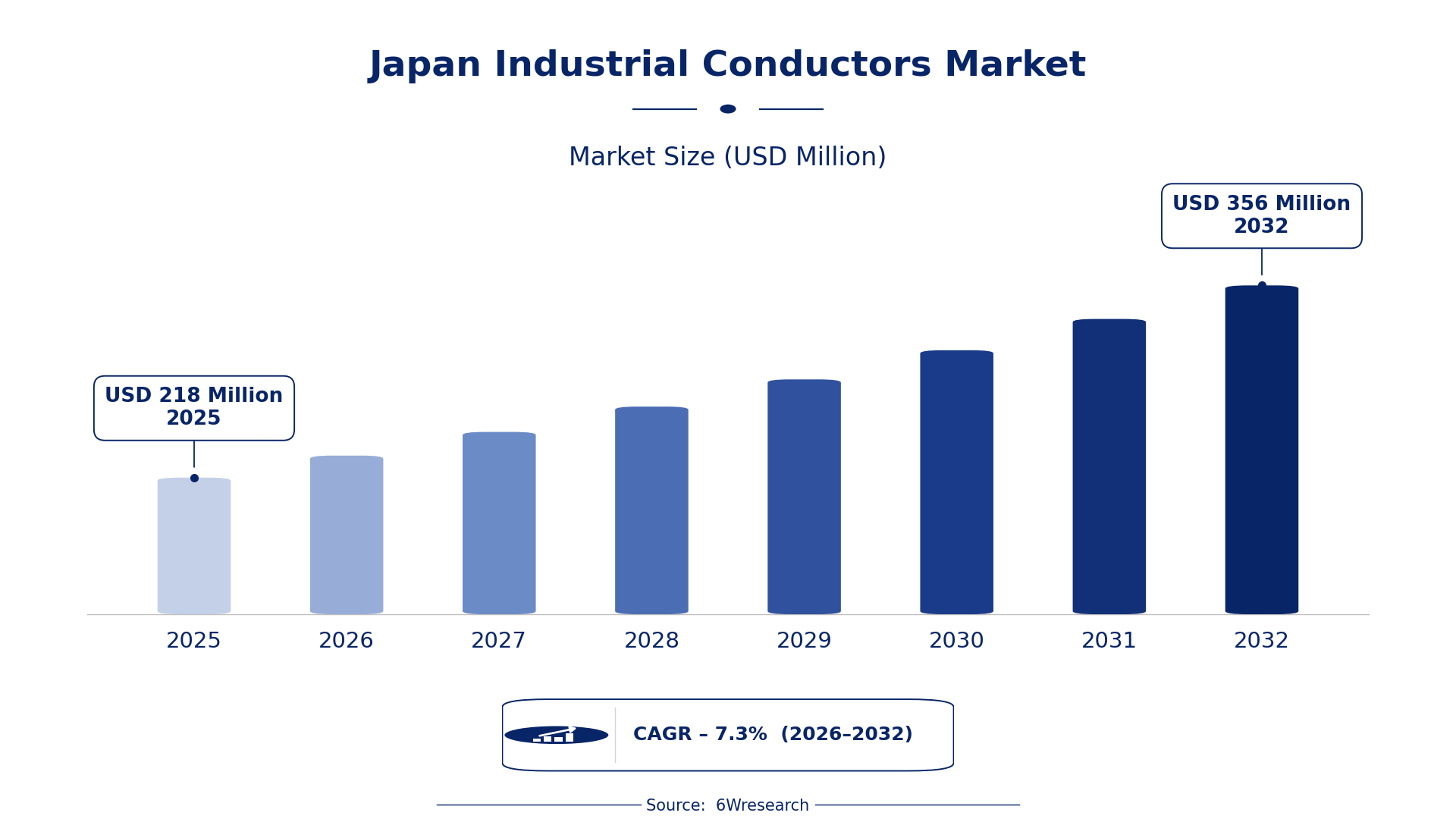
According to 6Wresearch internal database and industry insights, the Japan Industrial Conductors Market was valued at USD 218 Million in 2025 and is projected to reach USD 356 Million by 2032, growing at a CAGR of approximately 7.3% during 2026–2032.
Japan Industrial Conductors Market Highlights
| Report Metric | Details |
| Report Name | Japan Industrial Conductors Market (2026-2032) |
| Market Size 2025 | USD 218 Million |
| Market Size 2032 | USD 356 Million |
| Absolute Growth 2025–2032 | USD 138 Million |
| CAGR 2026–2032 | 7.3% |
| Peak Annual Growth | 8.1% in 2028 |
| Forecast Period | 2026–2032 |
| Historical Data | 2022–2025 |
| Base Year | 2025 |
| Leading Conductor Material, 2025 | Copper Conductors (39% share) |
| Leading Form Factor, 2025 | Wire/Strip (39% share) |
| Leading Usage Segment, 2025 | Electrical Systems (35% share) |
| Leading End User, 2025 | Power Grid & Cabling Firms (37% share) |
| Fastest-Growing Conductor Material | Aluminum Conductors (10.2% CAGR) |
| Fastest-Growing Form Factor | Busbars (10.6% CAGR) |
| Fastest-Growing Usage Segment | Lightweight Wiring (10.0% CAGR) |
| Fastest-Growing End User | Aerospace & Automotive OEMs (10.3% CAGR) |
| Growing Sector | Aerospace & Automotive OEMs |
| Key End Users | Power Grid & Cabling Firms, Aerospace & Automotive OEMs, Utility Installers, Semiconductor Industry |
Japan Industrial Conductors Market Year-wise Growth Rate and Key Drivers (2022–2032)
This graph illustrates the annual growth rates of the market from 2022 to 2032, highlighting a steady upward trajectory and projected market expansion over the forecast period.
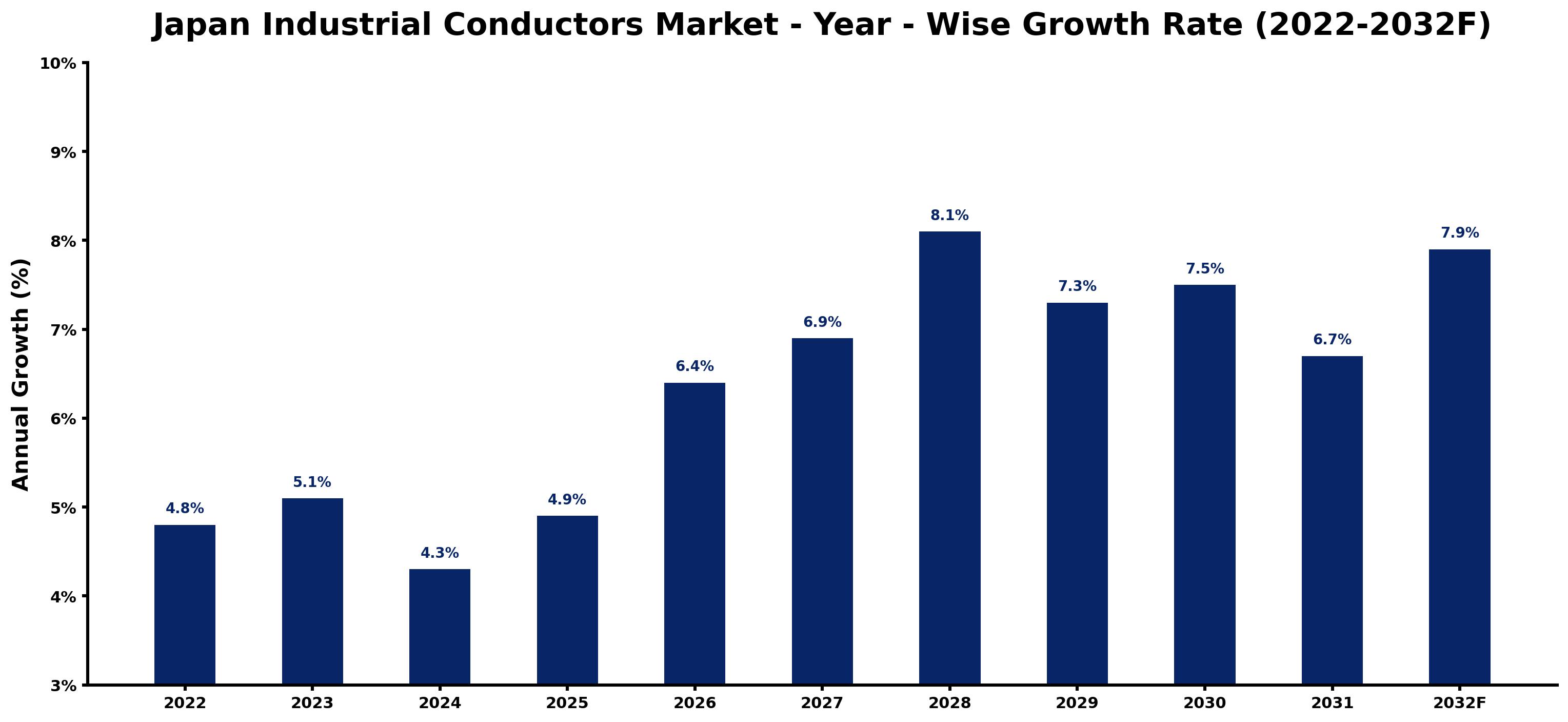
Each row of the following table gives one year's estimated growth and the event or demand shift that explains it.
| Year | Estimated Annual Growth (%) | Market Rationale |
| 2022 | 4.8 | The market experienced steady growth, reflecting ongoing demand from the electrical sector. |
| 2023 | 5.1 | Growth accelerated due to increased infrastructure projects and manufacturing activities. |
| 2024 | 4.3 | A slowdown occurred as market conditions adjusted to previous growth rates. |
| 2025 | 4.9 | Demand improved with rising investments in electrical systems and power grids. |
| 2026 | 6.4 | Growth is expected to rise as energy efficiency initiatives gain traction across industries. |
| 2027 | 6.9 | The market is projected to continue expanding with heightened focus on lightweight wiring solutions. |
| 2028 | 8.1 | Peak growth will be driven by investments in decarbonisation and infrastructure. |
| 2029 | 7.3 | A slowdown in growth is expected as market conditions stabilise after peak levels. |
| 2030 | 7.5 | Demand will increase again as energy consumption reduction targets are pursued. |
| 2031 | 6.7 | Growth is projected to slow slightly, reflecting adjustments in supply chain capacities. |
| 2032 | 7.9 | The market is expected to rebound with new investments in advanced electrical technologies. |
Note: Market size estimations and growth projections presented in this report are based on 6Wresearch's proprietary forecasting methodology, utilizing the latest available industry data, government publications, and primary research inputs.
Japan Industrial Conductors Market Synopsis
Industrial conductors are crucial materials for transmitting electrical current, primarily composed of metals such as copper and aluminium. They play a vital role in power distribution, telecommunications, and electronic applications. The Japan Industrial Conductors Market is growing due to domestic demand from the electrical and electronics sectors, alongside an emphasis on energy efficiency and decarbonisation. Public and private investments, including a target of JPY 150 trillion for decarbonisation initiatives over the next decade, are driving this expansion.
Market Dynamics Impact Analysis (2026–2032)
| Factor | Type | Impact | Primary Segment Affected |
| Increased investments in electrical infrastructure | Driver | High | Electrical Systems |
| Growing demand for lightweight wiring solutions | Driver | High | Lightweight Wiring |
| Rising need for energy-efficient technologies | Opportunity | High | High-Purity Wiring |
| Expansion of the aerospace sector | Opportunity | Medium | Aerospace & Automotive OEMs |
| Market fluctuations in raw material prices | Restraint | High | Copper Conductors |
| Regulatory compliance costs for manufacturers | Restraint | Medium | Aluminum Conductors |
| Supply chain disruptions affecting availability | Challenge | High | Busbars |
| Competition from alternative materials | Challenge | Medium | Copper-Clad Aluminum |
Evaluation of Drivers in Japan Industrial Conductors Market (2026–2032)
Key forces behind demand, with the segment each one moves most, are listed below.
| Drivers | Primary Segment Affected | Why It Matters (Evidence) |
| Increased public and private investment in infrastructure | Electrical Systems | Japan's GX Basic Policy targets JPY 150 trillion in decarbonisation investment, boosting demand for electrical systems. |
| Growing adoption of lightweight materials in various sectors | Lightweight Wiring | The aerospace sector is projected to grow by 10% annually, increasing demand for lightweight wiring solutions. |
| Rising focus on energy efficiency in electrical systems | High-Purity Wiring | The government aims for a 20% reduction in energy consumption by 2030, driving demand for high-purity conductors. |
| Expansion of the semiconductor industry | Sensitive Electronics | Valued at over $40 billion, this sector requires high-purity conductors for manufacturing processes. |
| Increased utility installations across Japan | Utility Installers | With over 1,000 utility installers operating, demand for industrial conductors is consistently high. |
This investment boosts purchases from firms involved in modernising power grids. The aerospace sector, projected to grow by 10% annually, increases the need for lightweight wiring solutions. The semiconductor industry, valued at over $40 billion, requires high-purity conductors for manufacturing processes. Utility installers, numbering over 1,000, consistently demand industrial conductors for various installations, further supporting market growth.
Evaluation of Restraints in Japan Industrial Conductors Market
These are the pressures that could keep growth below its potential.
| Market Restraint | Primary Segment Affected | Why It Matters (Evidence) |
| Fluctuations in copper and aluminum prices | Copper Conductors | Price volatility impacts production costs, affecting pricing strategies for manufacturers. |
| Compliance with JIS standards for quality | Aluminum Conductors | Manufacturers must invest in quality assurance to meet stringent JIS standards, raising operational costs. |
| Supply chain disruptions due to global events | Busbars | Disruptions can delay production schedules, impacting timely delivery to construction projects. |
| Limited availability of skilled labour | Electrical Systems | A shortage of skilled workers can slow down project completions and increase operational costs. |
| High competition from alternative materials | Copper-Clad Aluminum | Alternative materials may offer lower costs, challenging traditional conductor materials in price-sensitive applications. |
Japan Industrial Conductors Market Challenges
A shortage of skilled technicians in Japan's electrical manufacturing sector hampers production, causing delays for producers in meeting market demand. Extended lead times for industrial conductors affect buyers, leading to postponed infrastructure projects that can cost millions in lost revenue. Rising copper prices have increased input costs by approximately 15%, straining budgets for buyers and risking project cancellations. Heightened competition among producers results in aggressive pricing strategies that erode profit margins, particularly impacting smaller manufacturers who struggle to maintain sustainability.
Trends in the Japan Industrial Conductors Market
Several trends are reshaping the Japan Industrial Conductors Market; the most important are set out below.
- Shift towards Lightweight Wiring Solutions: The Kansai region is increasingly adopting lightweight wiring solutions, driven by the need for fuel efficiency. This shift began in 2023, with the aerospace sector projected to grow by 10%, increasing demand for specialized conductors.
- Transition to Energy-Efficient Technologies: Japan is prioritising energy-efficient technologies in electrical systems, following the government's target to reduce energy consumption by 20% by 2030. This trend is reflected in the rising demand for high-purity wiring in semiconductor fabrication facilities.
- Emergence of Decarbonisation Initiatives: Decarbonisation initiatives are gaining momentum, with Japan targeting a 46% cut in greenhouse gas emissions by 2030. This shift is driving investments in electrical infrastructure, particularly in power distribution systems.
- Growing Demand for High-Purity Conductors: The semiconductor industry is increasingly relying on high-purity conductors for manufacturing processes, reflecting the sector's growth. Valued at over $40 billion, this demand is reshaping the conductor market.
Investment Opportunities in the Japan Industrial Conductors Market
The following areas offer the clearest openings for investors and suppliers in the Japan Industrial Conductors Market.
- Investment Gap in Electrical Infrastructure: With a projected investment gap of JPY 150 trillion, there is a significant opportunity for suppliers to provide advanced industrial conductors. Power grid firms in the Tokyo metropolitan area are key buyers, and partnerships with local manufacturers can facilitate market entry.
- Rising Demand for Lightweight Solutions: As the aerospace sector grows, estimated to expand by 10% annually, there is a pressing need for lightweight wiring solutions. Collaborating with aerospace OEMs in the Kansai region can enhance market presence.
- Focus on Energy Efficiency: The government's target to reduce energy consumption by 20% by 2030 creates opportunities for suppliers of high-purity conductors. Engaging with utility installers can facilitate access to this growing market.
- Expansion of Semiconductor Manufacturing: The semiconductor industry, valued at over $40 billion, presents opportunities for high-purity conductor suppliers. Establishing joint ventures with manufacturers in the Tokyo area can drive growth.
Government Initiatives in the Japan Industrial Conductors Market
The GX Promotion Act (2023) serves as the legal foundation for Japan's decarbonisation strategy, obliging producers to align with energy efficiency targets. The act aims for about JPY 150 trillion in public and private investment over the next decade, benefiting industrial conductor manufacturers by increasing demand for energy-efficient products.
The Ministry of Economy, Trade and Industry (METI) oversees the implementation of energy efficiency measures, funding projects that improve electrical systems. METI's initiatives support manufacturers in meeting JIS standards, ensuring product quality and market competitiveness.
Future Insight of the Japan Industrial Conductors Market
Japan's decarbonisation investment pipeline is set to reach JPY 150 trillion over the next decade, creating substantial demand for industrial conductors. By 2032, advancements in energy-efficient technologies will necessitate upgrades in electrical systems, providing opportunities for suppliers. The automotive industry's shift towards lightweight wiring will open new production avenues for manufacturers focused on innovative materials. Growth in the semiconductor sector will further drive demand for high-purity wiring, prompting enhancements in production techniques.
Market Segmentation Analysis
Japan Industrial Conductors Market report covers a detailed analysis of the following market segments:
By Conductor Material – Copper Conductors Lead, Aluminum Conductors Expected to Grow Fastest
According to Saurav Kr Singh, Senior Research Analyst at 6Wresearch, Copper Conductors held 39% of the Japan Industrial Conductors Market by conductor material in 2025. Copper conductors hold the largest market share due to their extensive use in electrical wiring and connections across various industries. Their reliability is exemplified by major users such as the Tokyo Electric Power Company, which relies on copper for efficient power distribution. Over 2026–2032, Aluminum Conductors are expected to post the fastest growth, at a CAGR of 10.2%. Aluminum conductors are experiencing rapid growth, particularly in overhead power lines, because of their lightweight nature. This shift is driven by the increasing demand for efficient and cost-effective solutions in urban power distribution. Suppliers should focus on increasing the production of aluminum conductors to satisfy the rising demand in overhead applications.
By Form Factor – Wire/Strip Leads, Busbars Expected to Grow Fastest
In 2025, Wire/Strip led the form factor split with a 39% share. Wire and strip form factors dominate the market as they are commonly used for electrical connections in a wide array of applications. Their versatility makes them essential for both residential and industrial electrical systems. Busbars are projected to grow fastest, at a CAGR of 10.6% during 2026–2032. Busbars are witnessing the fastest growth, primarily due to their efficiency in power distribution within electrical panels. The increasing complexity of electrical systems in commercial buildings is driving this trend. Manufacturers should invest in busbar technology to capitalise on this expanding segment.
By Usage Segment – Electrical Systems Lead, Lightweight Wiring Expected to Grow Fastest
Electrical Systems took 35% of usage segment revenue in 2025, more than any other category. Electrical systems represent the largest usage segment, serving as core components in Japan's electrical infrastructure. The ongoing development of the country's electrical grid reinforces their dominant market position. The quickest growth will come from Lightweight Wiring, forecast to expand at a CAGR of 10.0% between 2026 and 2032. Lightweight wiring is the fastest-growing segment, particularly in the aerospace and automotive sectors where weight reduction is critical. The anticipated growth in these industries significantly fuels the demand for lightweight wiring solutions. Suppliers must adapt their offerings to include lightweight wiring options to capture this emerging market opportunity.
By End User – Power Grid & Cabling Firms Lead, Aerospace & Automotive OEMs Expected to Grow Fastest
With 37% of end user revenue in 2025, Power Grid & Cabling Firms was the largest category. Power grid and cabling firms are the leading end users of industrial conductors, requiring reliable materials for extensive electrical networks. Their continuous investment in infrastructure development underpins their dominant market position. Aerospace & Automotive OEMs are set to record the highest CAGR in this split, 10.3% over 2026–2032. Aerospace and automotive OEMs are the fastest-growing end users, driven by the increasing demand for lightweight and efficient wiring solutions. The projected growth in vehicle production and aerospace projects significantly propels this demand. Suppliers should prioritise partnerships with aerospace and automotive OEMs to leverage this growth opportunity effectively.
Key Attractiveness of the Report
- 10 Years of Market Numbers
- Historical Data Starting from 2022 to 2025
- Base Year 2025
- Forecast Data until 2032
- Key Performance Indicators Impacting the Market
- Major Upcoming Developments and Projects
Key Highlights of the Report:
- Japan Industrial Conductors Market Outlook
- Market Size of Japan Industrial Conductors Market, 2025
- Forecast of Japan Industrial Conductors Market, 2032
- Historical Data and Forecast of Japan Industrial Conductors Revenues & Volume for the Period 2022-2032F
- Japan Industrial Conductors Market Trend Evolution
- Japan Industrial Conductors Market Drivers and Challenges
- Japan Industrial Conductors Price Trends
- Japan Industrial Conductors Porter's Five Forces
- Japan Industrial Conductors Industry Life Cycle
- Historical Data and Forecast of Japan Industrial Conductors Market Revenues & Volume By Conductor Material for the Period 2022-2032F
- Historical Data and Forecast of Japan Industrial Conductors Market Revenues & Volume By Copper Conductors for the Period 2022-2032F
- Historical Data and Forecast of Japan Industrial Conductors Market Revenues & Volume By Aluminum Conductors for the Period 2022-2032F
- Historical Data and Forecast of Japan Industrial Conductors Market Revenues & Volume By Silver-Plated Conductors for the Period 2022-2032F
- Historical Data and Forecast of Japan Industrial Conductors Market Revenues & Volume By Bimetallic Conductors for the Period 2022-2032F
- Historical Data and Forecast of Japan Industrial Conductors Market Revenues & Volume By Form Factor for the Period 2022-2032F
- Historical Data and Forecast of Japan Industrial Conductors Market Revenues & Volume By Wire/Strip for the Period 2022-2032F
- Historical Data and Forecast of Japan Industrial Conductors Market Revenues & Volume By Busbars, Rods for the Period 2022-2032F
- Historical Data and Forecast of Japan Industrial Conductors Market Revenues & Volume By High-Purity Wiring for the Period 2022-2032F
- Historical Data and Forecast of Japan Industrial Conductors Market Revenues & Volume By Copper-Clad Aluminum for the Period 2022-2032F
- Historical Data and Forecast of Japan Industrial Conductors Market Revenues & Volume By Usage Segment for the Period 2022-2032F
- Historical Data and Forecast of Japan Industrial Conductors Market Revenues & Volume By Electrical Systems for the Period 2022-2032F
- Historical Data and Forecast of Japan Industrial Conductors Market Revenues & Volume By Lightweight Wiring for the Period 2022-2032F
- Historical Data and Forecast of Japan Industrial Conductors Market Revenues & Volume By Sensitive Electronics for the Period 2022-2032F
- Historical Data and Forecast of Japan Industrial Conductors Market Revenues & Volume By Cost-Efficient Cabling for the Period 2022-2032F
- Historical Data and Forecast of Japan Industrial Conductors Market Revenues & Volume By End User for the Period 2022-2032F
- Historical Data and Forecast of Japan Industrial Conductors Market Revenues & Volume By Power Grid & Cabling Firms for the Period 2022-2032F
- Historical Data and Forecast of Japan Industrial Conductors Market Revenues & Volume By Aerospace & Automotive OEMs for the Period 2022-2032F
- Historical Data and Forecast of Japan Industrial Conductors Market Revenues & Volume By Semiconductor Industry for the Period 2022-2032F
- Historical Data and Forecast of Japan Industrial Conductors Market Revenues & Volume By Utility Installers for the Period 2022-2032F
- Japan Industrial Conductors Import Export Trade Statistics
- Market Opportunity Assessment By Conductor Material
- Market Opportunity Assessment By Form Factor
- Market Opportunity Assessment By Usage Segment
- Market Opportunity Assessment By End User
- Japan Industrial Conductors Top Companies Market Share
- Japan Industrial Conductors Competitive Benchmarking By Technical and Operational Parameters
- Japan Industrial Conductors Company Profiles
- Japan Industrial Conductors Key Strategic Recommendations
Market Covered
The following segment groups are covered in the report.
By Conductor Material
- Copper Conductors
- Aluminum Conductors
- Silver-Plated Conductors
- Bimetallic Conductors
By Form Factor
- Wire/Strip
- Busbars
- Rods
- High-Purity Wiring
- Copper-Clad Aluminum
By Usage Segment
- Electrical Systems
- Lightweight Wiring
- Sensitive Electronics
- Cost-Efficient Cabling
By End User
- Power Grid & Cabling Firms
- Aerospace & Automotive OEMs
- Semiconductor Industry
- Utility Installers































