Japan industrial control components Market Size & Growth Rate
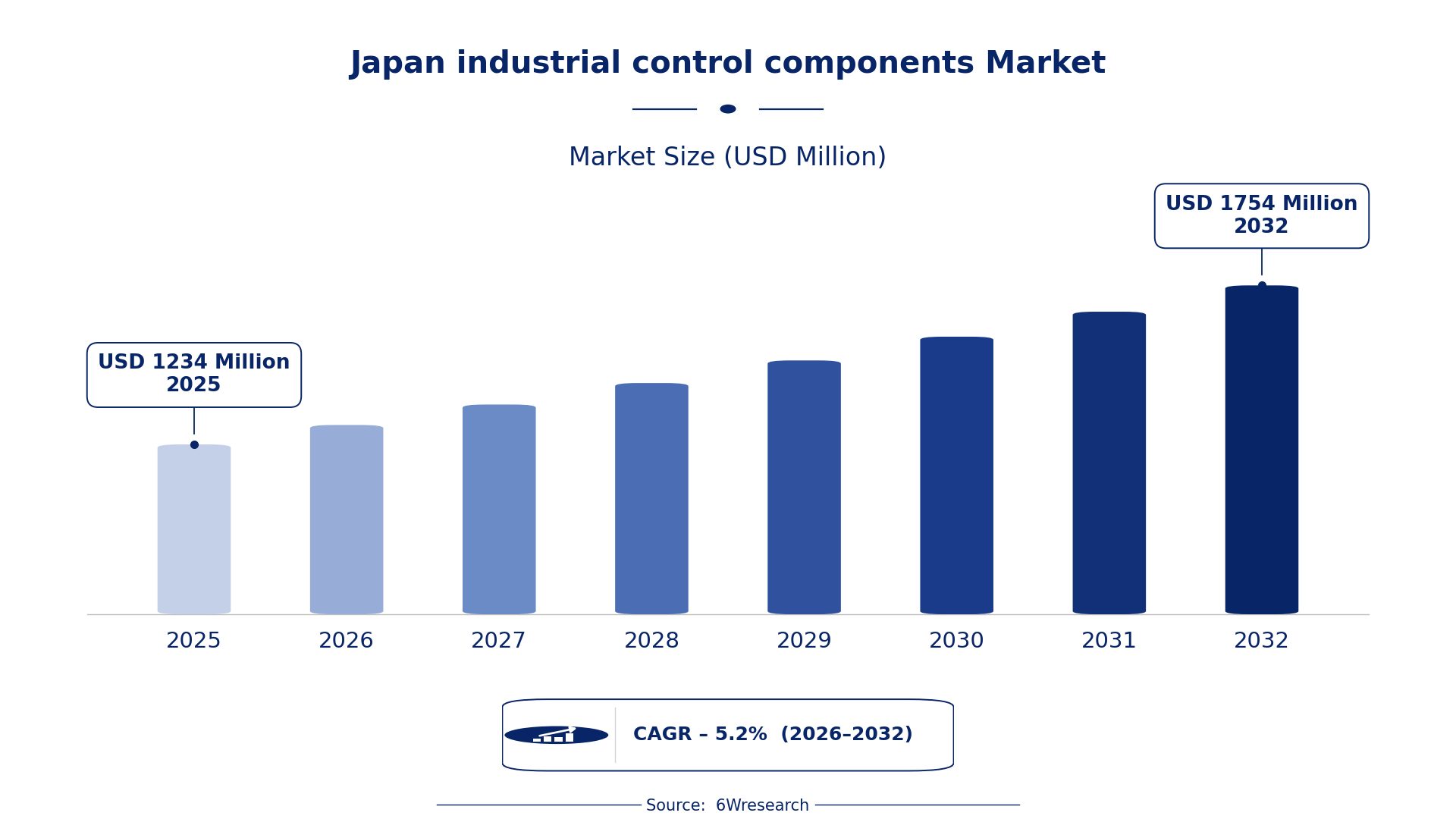
According to 6Wresearch internal database and industry insights, the Japan industrial control components Market was valued at USD 1,234 Million in 2025 and is projected to reach USD 1,754 Million by 2032, growing at a CAGR of approximately 5.2% during 2026–2032.
Japan industrial control components Market Highlights
| Report Metric | Details |
| Report Name | Japan industrial control components Market (2026-2032) |
| Market Size 2025 | USD 1,234 Million |
| Market Size 2032 | USD 1,754 Million |
| Absolute Growth 2025–2032 | USD 520 Million |
| CAGR 2026–2032 | 5.2% |
| Peak Annual Growth | 6.9% in 2032 |
| Forecast Period | 2026–2032 |
| Historical Data | 2022–2025 |
| Base Year | 2025 |
| Leading Component Type, 2025 | Contactors (47% share) |
| Leading Function, 2025 | Protection (40% share) |
| Leading Mounting Method, 2025 | DIN Rail (35% share) |
| Leading End User, 2025 | Automation OEMs (39% share) |
| Fastest-Growing Component Type | Timers (7.3% CAGR) |
| Fastest-Growing Function | Sequential Control (6.8% CAGR) |
| Fastest-Growing End User | Motor Control Centers (7.0% CAGR) |
| Growing Sector | Motor Control Centers |
| Key End Users | Automation OEMs, Panel Builders, Motor Control Centers, Distribution Panels |
Japan industrial control components Market Year-wise Growth Rate and Key Drivers (2022–2032)
This graph illustrates the annual growth rates of the market from 2022 to 2032, highlighting a steady upward trajectory and projected market expansion over the forecast period.
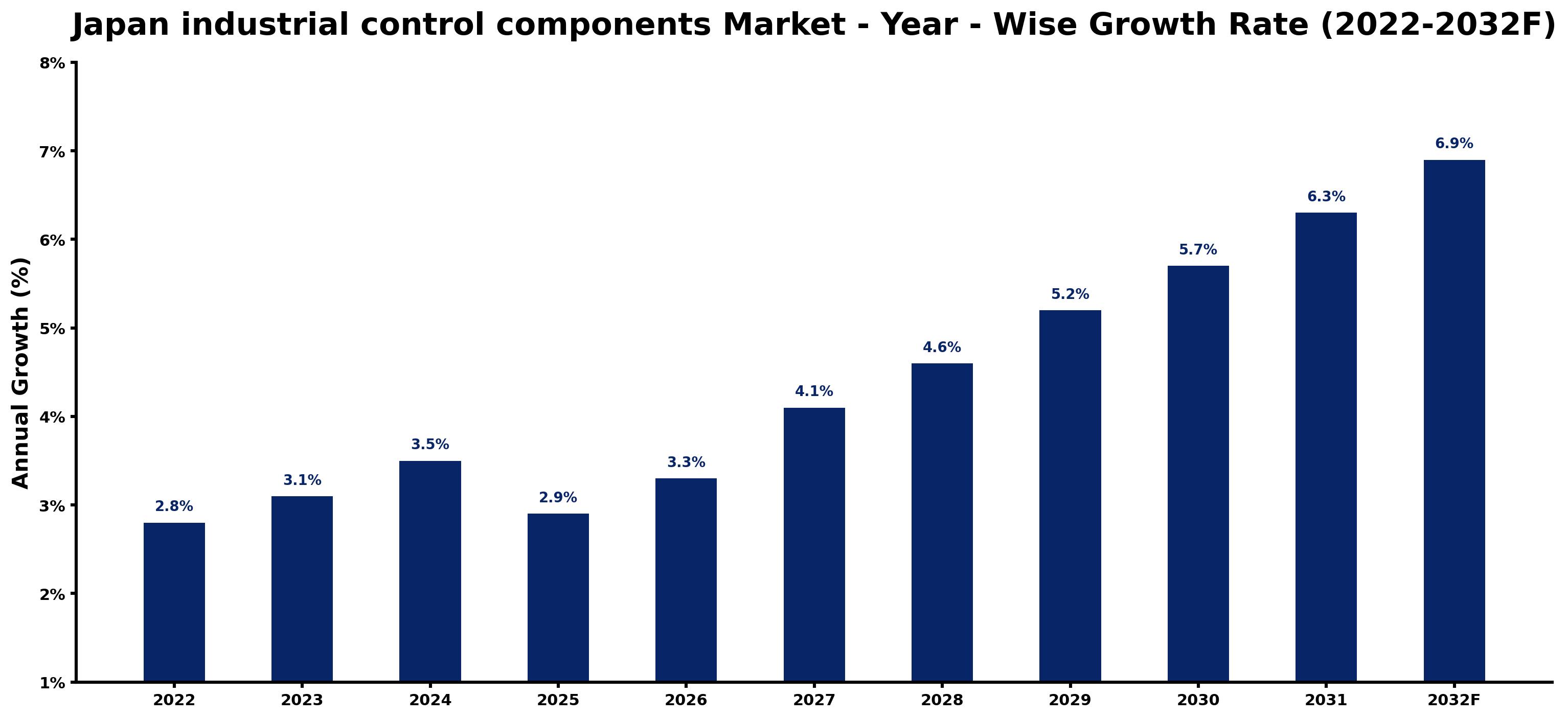
The table below sets out the estimated growth rate for each year and the main factor behind it.
| Year | Estimated Annual Growth (%) | Market Rationale |
| 2022 | 2.8 | The market experienced steady growth with increasing automation in various sectors. |
| 2023 | 3.1 | Demand for industrial control components rose due to advancements in factory automation. |
| 2024 | 3.5 | Growth accelerated as manufacturers upgraded their aging control systems to improve efficiency. |
| 2025 | 2.9 | The growth rate slowed as market saturation began to influence purchasing decisions. |
| 2026 | 3.3 | Growth is expected to resume as investments in automation technologies increase. |
| 2027 | 4.1 | Demand is projected to rise due to a surge in industrial robot installations across various sectors. |
| 2028 | 4.6 | The market is anticipated to expand further with rising energy efficiency initiatives in manufacturing. |
| 2029 | 5.2 | Increased focus on sustainability will drive further demand for control components. |
| 2030 | 5.7 | The growth rate is expected to continue rising as manufacturers aim for energy consumption reductions. |
| 2031 | 6.3 | Demand is projected to surge as the market prepares for the peak in 2032. |
| 2032 | 6.9 | The market is expected to peak as investments in automation reach unprecedented levels. |
Note: Market size estimations and growth projections presented in this report are based on 6Wresearch's proprietary forecasting methodology, utilizing the latest available industry data, government publications, and primary research inputs.
Japan industrial control components Market Synopsis
Industrial control components are vital devices in automation and control systems, manufactured through precision engineering. The Japan industrial control components Market is driven by the thriving manufacturing sector, which accounted for 20% of GDP in 2023. Investments, such as the JPY 150 trillion decarbonisation initiative, fuel demand for these components. The installed base exceeds 10 million units, indicating a strong need for upgrades and new installations, particularly in automation and energy efficiency applications.
Market Dynamics Impact Analysis (2026–2032)
| Factor | Type | Impact | Primary Segment Affected |
| Growing automation in manufacturing processes | Driver | High | Protection |
| Increased investments in energy-efficient technologies | Driver | High | Contactors |
| Rising demand for advanced automation solutions | Opportunity | High | Automation OEMs |
| Need for upgrades in aging control systems | Opportunity | High | Motor Control Centers |
| Market saturation limiting new installations | Restraint | Medium | Relays |
| High initial costs of advanced control components | Restraint | Medium | Circuit Breakers |
| Shortage of skilled workforce in automation | Challenge | High | Panel Builders |
| Increasing competition from international suppliers | Challenge | High | Distribution Panels |
Evaluation of Drivers in Japan industrial control components Market (2026–2032)
The following drivers explain most of the expected growth.
| Drivers | Primary Segment Affected | Why It Matters (Evidence) |
| Increased factory automation | Protection | This trend drives demand as manufacturers seek to enhance safety standards, with the installed base exceeding 10 million units. |
| Investment in energy-efficient technologies | Contactors | As Japan targets a 20% reduction in energy consumption by 2030, manufacturers are purchasing more control components. |
| Growth in industrial robotics | Automation OEMs | The total number of industrial robots reached 500,000 in 2023, increasing the need for control components. |
| Aging control systems needing upgrades | Motor Control Centers | With an average age over 15 years, many systems require modernisation to improve efficiency. |
| Support from industry standards | Relays | The JIS C 8201 standard ensures quality, prompting manufacturers to invest in compliant components. |
Spending rises because the manufacturing sector in Japan is increasingly automating processes, with 20% of GDP attributed to this industry. The average age of control systems exceeds 15 years, necessitating upgrades. Japan's target to reduce energy consumption by 20% by 2030 is prompting manufacturers to invest in energy-efficient technologies. The installed base of industrial control components exceeds 10 million units, driving demand for replacements. Support from industry standards, such as JIS C 8201, ensures quality, prompting manufacturers to invest in compliant components.
Evaluation of Restraints in Japan industrial control components Market
Below are the constraints most often cited by buyers and suppliers, with the segment each affects.
| Market Restraint | Primary Segment Affected | Why It Matters (Evidence) |
| Market saturation limiting new installations | Relays | With many manufacturers already equipped, new installations are becoming less frequent, reducing demand for relays. |
| High initial costs of advanced control components | Circuit Breakers | The expense of implementing advanced systems can deter smaller manufacturers from upgrading their circuit breakers. |
| Shortage of skilled workforce in automation | Panel Builders | A lack of qualified personnel hampers the ability to implement and maintain new systems, impacting panel builders. |
| Increasing competition from international suppliers | Distribution Panels | Domestic manufacturers face pressure from lower-cost foreign alternatives, affecting market share of distribution panels. |
| Regulatory compliance costs | Contactors | Adhering to safety and performance standards can increase operational costs for manufacturers of contactors. |
Japan industrial control components Market Challenges
Buyers in Japan face rising costs as the national minimum wage increases to JPY 1,055 per hour, forcing them to pay more for industrial control components. Competition among producers intensifies as price wars drive down margins, which can delay investments in technology upgrades. Regulatory demands, such as compliance with the JIS C 8201 standard, require manufacturers to allocate up to 15% of their budgets for quality assurance, straining their financial resources. Outdated technology burdens users, with the average age of control systems exceeding 15 years, leading to inefficiencies that can reduce productivity across the manufacturing sector.
Trends in the Japan industrial control components Market
These developments are changing demand patterns in the Japan industrial control components Market.
- Shift from Traditional to Smart Automation: Since 2023, manufacturers are increasingly adopting smart automation technologies, improving operational efficiency. The Automation Industry Association of Japan reported a 30% rise in smart systems, indicating a shift towards more integrated solutions.
- Transition from Mechanical to Electronic Control Systems: In 2024, the demand for electronic control systems surged as manufacturers sought precision and reliability. This change is reflected by the installation of over 100,000 electronic control units in factories across the Kanto region.
- Automation OEMs Prioritising Energy Efficiency: In 2023, Automation OEMs began prioritising energy-efficient components, driven by regulatory targets. This shift has led to a 25% increase in the adoption of energy-saving technologies in manufacturing facilities.
- Rising Demand for Modular Control Solutions: Starting in 2025, there is a growing preference for modular control solutions among manufacturers. This trend is evidenced by a 40% increase in modular component sales in the Tokyo area.
Investment Opportunities in the Japan industrial control components Market
Investors looking at the Japan industrial control components Market should consider the following areas.
- Automation OEMs Seeking Upgrades: Automation OEMs require advanced control components to boost operational efficiency. With over 10 million units in the installed base, suppliers can target this market by forming local partnerships.
- Energy-Efficient Control Components: Manufacturers are focusing on energy-efficient control components to meet regulatory targets. The Kanto region offers opportunities for suppliers to invest in energy-saving technologies, addressing the rising demand for sustainability.
- Modular Control Solutions for Flexibility: Manufacturers show growing interest in modular control solutions for their flexibility. Suppliers can capitalise on this trend by providing tailored modular components to facilities across Japan.
- Investment in Automation Technologies: The current emphasis on automation technologies generates demand for advanced control components. Suppliers can enter this market by collaborating with local manufacturers and adhering to industry standards.
Government Initiatives in the Japan industrial control components Market
The Electrical Appliance and Material Safety Act (1961) governs the safety of electrical appliances and materials sold in Japan, ensuring that industrial control components comply with safety standards. The GX Promotion Act (2023) introduces a framework for promoting decarbonisation, requiring manufacturers to adhere to new energy efficiency regulations.
The Ministry of Economy, Trade and Industry (METI) supervises the approval of safety standards for industrial control components. In 2023, METI allocated ¥5 billion for research and development in automation technologies, supporting sector innovation.
Future Insight of the Japan industrial control components Market
The investment pipeline for decarbonisation, estimated at JPY 150 trillion over the next decade, will stimulate demand for advanced industrial control components. By 2032, the installed base of industrial robots is expected to exceed 600,000 units, driving the need for updated control systems. The government's target to reduce energy consumption in manufacturing will push suppliers to innovate their offerings. Automation initiatives will present buyers with opportunities to improve operational efficiency and reduce costs.
Market Segmentation Analysis
Japan industrial control components Market report covers a detailed analysis of the following market segments:
By Component Type – Contactors Lead, Timers Expected to Grow Fastest
According to Saurav Kr Singh, Senior Research Analyst at 6Wresearch, Contactors accounted for 47% of the market by component type in 2025. Contactors dominate the market because they are essential for high-load switching tasks in various sectors, particularly in manufacturing. Their extensive installed base of over 10 million units reflects their critical role in Japan's industrial operations. Over 2026–2032, Timers are expected to post the fastest growth, at a CAGR of 7.3%. Timers are rapidly growing in popularity as they are increasingly utilised for controlling time-based operations in automated systems. The government's 2023 initiative to enhance factory automation is significantly driving this demand. Suppliers should prioritise the development of timers to capitalise on this expanding market segment.
By Function – Protection Leads, Sequential Control Expected to Grow Fastest
The largest function category in 2025 was Protection, at 40% of revenue. Protection functions are vital for safeguarding electrical systems, making them a key focus for manufacturers in Japan. Adherence to the JIS C 8201 standard ensures that these components meet stringent performance requirements. Sequential Control is set to record the highest CAGR in this split, 6.8% over 2026–2032. Sequential control is gaining traction due to its importance in specific automation processes within Japan's manufacturing sector. The increasing complexity of these systems necessitates more sophisticated control solutions. Buyers should focus on acquiring protection components to ensure system reliability and compliance with industry standards.
By Mounting Method – DIN Rail Leads and Records the Fastest Growth
In 2025, DIN Rail led the mounting method split with a 35% share. DIN rail mounting is the preferred method for industrial components due to its standardisation and ease of installation. This approach is widely accepted across various sectors, ensuring compatibility and efficiency in assembly. DIN Rail is also forecast to expand faster than any other category, at a CAGR of 7.6% over 2026–2032. As DIN rail is both the leading and fastest-growing mounting method, its continued dominance is assured by the ongoing demand for standardised solutions in industrial environments. The ease of integration with existing systems supports its growth trajectory. Suppliers must maintain a comprehensive inventory of DIN rail products to meet the continuous market demand.
By End User – Automation OEMs Lead, Motor Control Centers Expected to Grow Fastest
Automation OEMs held 39% of the Japan industrial control components Market by end user in 2025. Automation OEMs represent the largest market share as they create substantial demand for industrial control components in manufacturing applications. Their crucial role in developing automation solutions underscores their significance in the supply chain. The quickest growth will come from Motor Control Centers, forecast to expand at a CAGR of 7.0% between 2026 and 2032. Motor control centers are experiencing rapid growth due to their essential role in motor control, aligning with the government's focus on energy efficiency in manufacturing. This trend is further amplified by the increasing number of industrial robots requiring effective control solutions. Suppliers should tailor their offerings to meet the specific needs of motor control centers to seize emerging opportunities.
Key Attractiveness of the Report
- 10 Years of Market Numbers
- Historical Data Starting from 2022 to 2025
- Base Year 2025
- Forecast Data until 2032
- Key Performance Indicators Impacting the Market
- Major Upcoming Developments and Projects
Key Highlights of the Report:
- Japan industrial control components Market Outlook
- Market Size of Japan industrial control components Market, 2025
- Forecast of Japan industrial control components Market, 2032
- Historical Data and Forecast of Japan industrial control components Revenues & Volume for the Period 2022-2032F
- Japan industrial control components Market Trend Evolution
- Japan industrial control components Market Drivers and Challenges
- Japan industrial control components Price Trends
- Japan industrial control components Porter's Five Forces
- Japan industrial control components Industry Life Cycle
- Historical Data and Forecast of Japan industrial control components Market Revenues & Volume By Component Type for the Period 2022-2032F
- Historical Data and Forecast of Japan industrial control components Market Revenues & Volume By Relays for the Period 2022-2032F
- Historical Data and Forecast of Japan industrial control components Market Revenues & Volume By Timers for the Period 2022-2032F
- Historical Data and Forecast of Japan industrial control components Market Revenues & Volume By Contactors for the Period 2022-2032F
- Historical Data and Forecast of Japan industrial control components Market Revenues & Volume By Circuit Breakers for the Period 2022-2032F
- Historical Data and Forecast of Japan industrial control components Market Revenues & Volume By Function for the Period 2022-2032F
- Historical Data and Forecast of Japan industrial control components Market Revenues & Volume By Switching for the Period 2022-2032F
- Historical Data and Forecast of Japan industrial control components Market Revenues & Volume By Sequential Control for the Period 2022-2032F
- Historical Data and Forecast of Japan industrial control components Market Revenues & Volume By High Load Switching for the Period 2022-2032F
- Historical Data and Forecast of Japan industrial control components Market Revenues & Volume By Protection for the Period 2022-2032F
- Historical Data and Forecast of Japan industrial control components Market Revenues & Volume By Mounting Method for the Period 2022-2032F
- Historical Data and Forecast of Japan industrial control components Market Revenues & Volume By DIN Rail for the Period 2022-2032F
- Historical Data and Forecast of Japan industrial control components Market Revenues & Volume By PCB/Panel for the Period 2022-2032F
- Historical Data and Forecast of Japan industrial control components Market Revenues & Volume By Screw-Mounted for the Period 2022-2032F
- Historical Data and Forecast of Japan industrial control components Market Revenues & Volume By Enclosed/Standalone for the Period 2022-2032F
- Historical Data and Forecast of Japan industrial control components Market Revenues & Volume By End User for the Period 2022-2032F
- Historical Data and Forecast of Japan industrial control components Market Revenues & Volume By Panel Builders for the Period 2022-2032F
- Historical Data and Forecast of Japan industrial control components Market Revenues & Volume By Automation OEMs for the Period 2022-2032F
- Historical Data and Forecast of Japan industrial control components Market Revenues & Volume By Motor Control Centers for the Period 2022-2032F
- Historical Data and Forecast of Japan industrial control components Market Revenues & Volume By Distribution Panels for the Period 2022-2032F
- Japan industrial control components Import Export Trade Statistics
- Market Opportunity Assessment By Component Type
- Market Opportunity Assessment By Function
- Market Opportunity Assessment By Mounting Method
- Market Opportunity Assessment By End User
- Japan industrial control components Top Companies Market Share
- Japan industrial control components Competitive Benchmarking By Technical and Operational Parameters
- Japan industrial control components Company Profiles
- Japan industrial control components Key Strategic Recommendations
Market Covered
Coverage by segment is as follows.
By Component Type
- Relays
- Timers
- Contactors
- Circuit Breakers
By Function
- Switching
- Sequential Control
- High Load Switching
- Protection
By Mounting Method
- DIN Rail
- PCB/Panel
- Screw-Mounted
- Enclosed/Standalone
By End User
- Panel Builders
- Automation OEMs
- Motor Control Centers
- Distribution Panels































