Japan Industrial Control MCU Market Size & Growth Rate
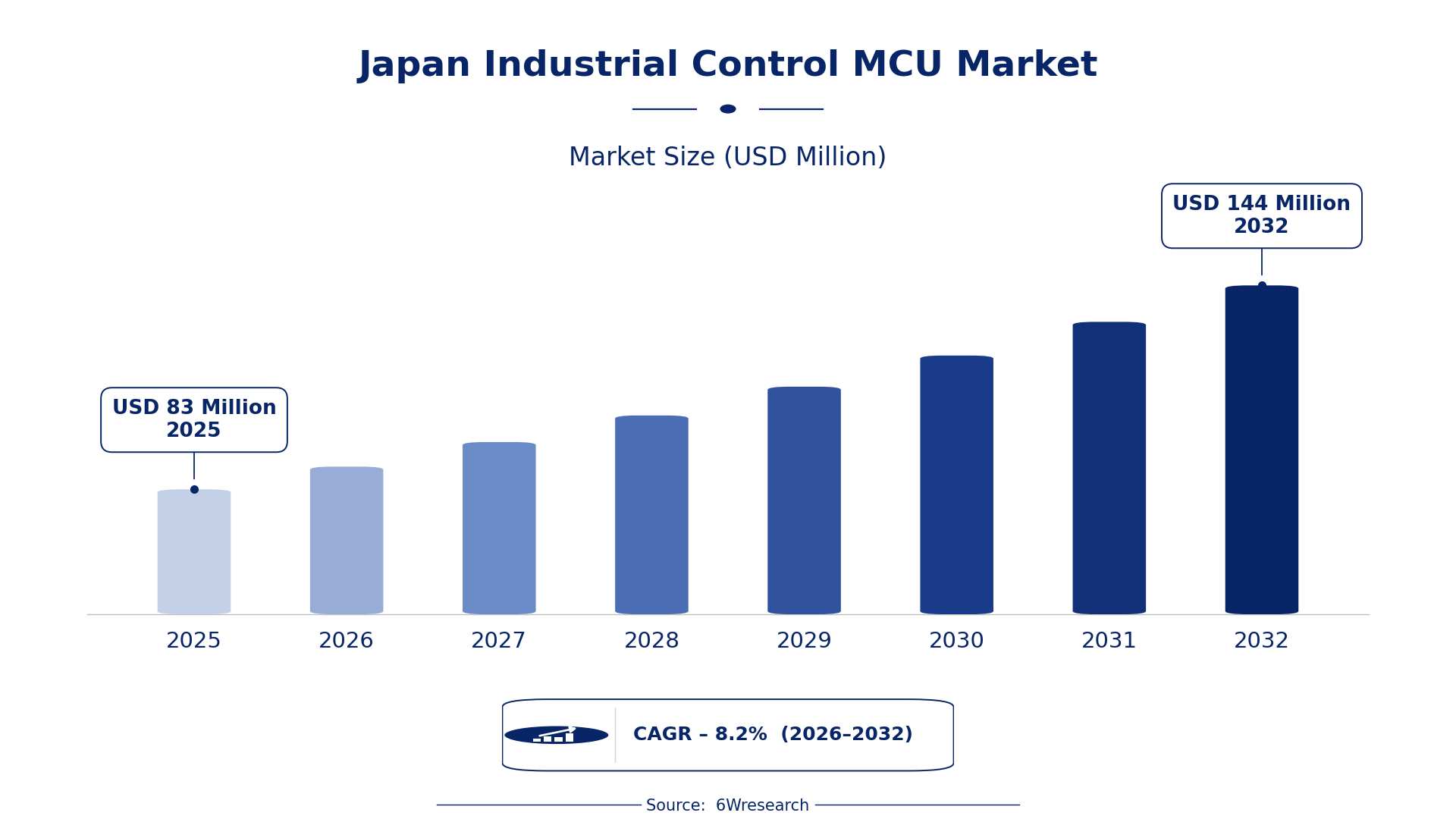
According to 6Wresearch internal database and industry insights, the Japan Industrial Control MCU Market was valued at USD 83 Million in 2025 and is projected to reach USD 144 Million by 2032, growing at a CAGR of approximately 8.2% during 2026–2032.
Japan Industrial Control MCU Market Highlights
| Report Metric | Details |
| Report Name | Japan Industrial Control MCU Market (2026-2032) |
| Market Size 2025 | USD 83 Million |
| Market Size 2032 | USD 144 Million |
| Absolute Growth 2025–2032 | USD 61 Million |
| CAGR 2026–2032 | 8.2% |
| Peak Annual Growth | 9.1% in 2030 |
| Forecast Period | 2026–2032 |
| Historical Data | 2022–2025 |
| Base Year | 2025 |
| Leading MCU Type, 2025 | 8-Bit MCUs (42% share) |
| Leading Architecture, 2025 | Low-Power (37% share) |
| Leading Application Area, 2025 | Simple Control Loops (47% share) |
| Leading End User, 2025 | HVAC Controllers (35% share) |
| Fastest-Growing MCU Type | 16-Bit MCUs (11.3% CAGR) |
| Fastest-Growing Architecture | Mid-Level Control (11.0% CAGR) |
| Fastest-Growing Application Area | Industrial Automation (10.3% CAGR) |
| Fastest-Growing End User | Drives & Motor Systems (10.6% CAGR) |
| Growing Sector | Industrial Automation |
| Key End Users | Manufacturers, Automotive Tier-1 Suppliers, Robotics Developers, HVAC System Integrators |
Japan Industrial Control MCU Market Year-wise Growth Rate and Key Drivers (2022–2032)
This graph illustrates the annual growth rates of the market from 2022 to 2032, highlighting a steady upward trajectory and projected market expansion over the forecast period.
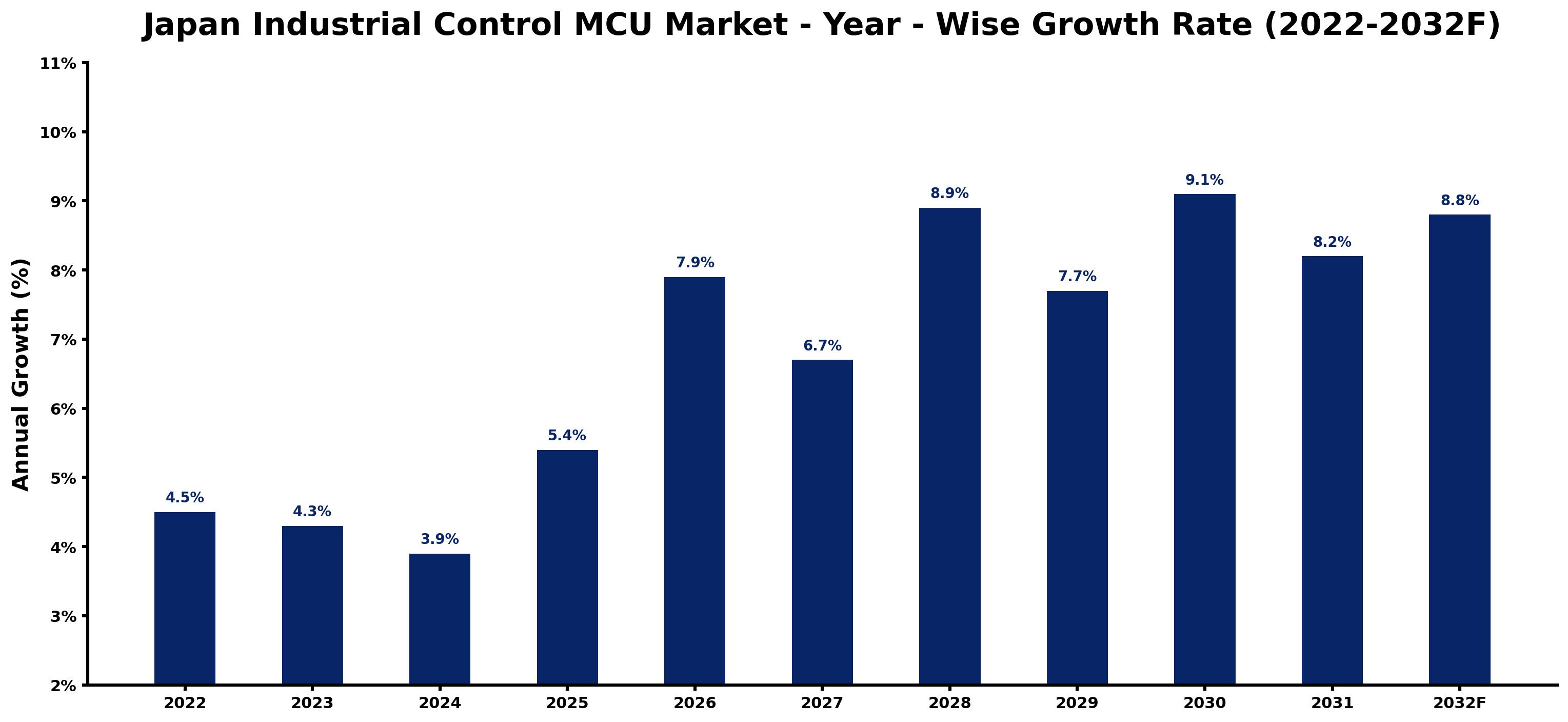
For each year, the table pairs the estimated growth rate with the leading influence on demand, showing how the drivers changed across the period.
| Year | Estimated Annual Growth (%) | Market Rationale |
| 2022 | 4.5 | The market showed steady growth due to ongoing industrial automation efforts. |
| 2023 | 4.3 | Growth slowed as manufacturers adjusted to supply chain disruptions from global events. |
| 2024 | 3.9 | The market continued to slow as companies focused on efficiency improvements. |
| 2025 | 5.4 | Demand surged as automation projects ramped up across various sectors. |
| 2026 | 7.9 | Investment in semiconductor technology is anticipated to increase, driving further demand for MCUs. |
| 2027 | 6.7 | Growth is projected to slow as the market stabilises after the previous surge in demand. |
| 2028 | 8.9 | Rising interest in robotics and AI applications is expected to boost market growth. |
| 2029 | 7.7 | Growth is anticipated to slow as companies consolidate their investments in automation. |
| 2030 | 9.1 | Peak growth is projected as advanced automation technologies gain traction. |
| 2031 | 8.2 | The market is expected to see a slowdown as saturation in certain sectors begins. |
| 2032 | 8.8 | Demand is projected to accelerate again as new applications for MCUs emerge. |
Note: Market size estimations and growth projections presented in this report are based on 6Wresearch's proprietary forecasting methodology, utilizing the latest available industry data, government publications, and primary research inputs.
Japan Industrial Control MCU Market Synopsis
Industrial Control MCUs are semiconductor devices essential for managing and controlling industrial processes, made through complex fabrication techniques. Their primary applications include automation in manufacturing, robotics, and automotive systems. The Japan Industrial Control MCU Market is experiencing growth driven by increasing investments in automation and robotics, with domestic users leading the demand. The Japanese government has initiated various programmes to improve industrial competitiveness, contributing to the projected market growth by 2032.
Market Dynamics Impact Analysis (2026–2032)
| Factor | Type | Impact | Primary Segment Affected |
| Growing investment in automation technologies | Driver | High | Industrial Automation |
| Rising demand for robotics in manufacturing | Driver | High | Robotics & AI |
| Increased need for energy-efficient solutions | Opportunity | Medium | Low-Power |
| Expansion of automotive applications for safety features | Opportunity | Medium | Automotive Grade MCUs |
| Supply chain disruptions affecting semiconductor availability | Restraint | High | 32-Bit MCUs |
| High production costs for advanced MCUs | Restraint | Medium | High-Performance |
| Competition from international semiconductor manufacturers | Challenge | High | 16-Bit MCUs |
| Rapid technological changes requiring constant adaptation | Challenge | Medium | 8-Bit MCUs |
Evaluation of Drivers in Japan Industrial Control MCU Market (2026–2032)
Key forces behind demand, with the segment each one moves most, are listed below.
| Drivers | Primary Segment Affected | Why It Matters (Evidence) |
| Investment in automation projects | Industrial Automation | This investment leads to increased purchases of MCUs for control systems, with over 5 million industrial controllers installed in Japan. |
| Growth in robotics applications | Robotics & AI | The demand for MCUs in robotics is driven by projected needs for over 2 million MCUs by 2025. |
| Focus on energy efficiency | Low-Power | Companies are adopting low-power solutions to meet energy-saving initiatives, aligning with Japan's decarbonisation targets. |
| Expansion of automotive safety features | Automotive Grade MCUs | The automotive industry drives MCU adoption, with substantial usage in vehicle control systems. |
| Rising demand for advanced processing capabilities | High-Performance | Increased automation in manufacturing requires high-performance MCUs for real-time data processing. |
Purchasing is picking up as investment in automation technologies rises, leading to increased demand for control systems. In 2022, Japan produced over 1 million units of 32-Bit MCUs, reflecting the growing need for complex control tasks. Robotics applications are expanding, with projections indicating that more than 2 million MCUs will be required by 2025. The focus on energy efficiency is prompting manufacturers to adopt Low-Power MCUs, essential for meeting decarbonisation goals. The automotive sector's emphasis on safety features is driving the adoption of Automotive Grade MCUs, vital for vehicle control systems.
Evaluation of Restraints in Japan Industrial Control MCU Market
These restraints slow adoption and weigh on supplier margins.
| Market Restraint | Primary Segment Affected | Why It Matters (Evidence) |
| Supply chain disruptions | 32-Bit MCUs | These disruptions have led to delays in MCU availability, impacting production timelines for manufacturers. |
| High production costs | High-Performance | The costs associated with advanced MCU fabrication limit the ability of manufacturers to scale production efficiently. |
| Regulatory compliance challenges | Automotive Grade MCUs | Meeting stringent safety standards like ISO-26262 increases the complexity and cost of MCU development. |
| Limited domestic semiconductor manufacturing capacity | 16-Bit MCUs | This limitation affects the ability to meet rising local demand for mid-range control systems. |
| Market saturation in certain segments | 8-Bit MCUs | As the market matures, growth opportunities in basic control applications are becoming constrained. |
Japan Industrial Control MCU Market Challenges
Japan's limited number of semiconductor suppliers leads to supply chain disruptions, delaying production timelines for manufacturers. Environmental regulations create compliance costs that can raise operational expenses for producers by 15%, complicating financial planning. Rising labour costs, with the national minimum wage at JPY 1,055 per hour, squeeze profit margins for companies in the industrial sector. Buyers face challenges in securing timely deliveries, as the average installed base of industrial controllers is around 5 million units, resulting in production inefficiencies and extended lead times.
Trends in the Japan Industrial Control MCU Market
The trends below show where the Japan Industrial Control MCU Market is heading.
- Launch of Robotics Promotion Programme: In 2023, the Japanese government launched a programme to enhance robotics in manufacturing, aiming to boost productivity. This initiative is projected to drive demand for over 2 million MCUs by 2025.
- Shift towards Low-Power Solutions: The Tokyo region is progressively adopting Low-Power MCUs to align with energy-saving initiatives, mirroring a broader trend towards sustainability in industrial processes.
- Increase in Automotive Safety Standards: The implementation of ISO-26262 is compelling automotive manufacturers to integrate more Automotive Grade MCUs, resulting in substantial growth in MCU adoption for safety features.
- Rising Demand for AI in Robotics: The increasing interest in AI applications is driving a heightened need for High-Performance MCUs in robotics, with forecasts indicating a surge in demand.
Investment Opportunities in the Japan Industrial Control MCU Market
Several openings in the Japan Industrial Control MCU Market merit attention from investors.
- Automotive Tier-1 Suppliers: Automotive Tier-1 suppliers are increasingly adopting MCUs for safety features, with the market gap indicating a need for more than 1 million units by 2025.
- Investment in Energy-Efficient Technologies: With Japan targeting a 46% cut in greenhouse-gas emissions by 2030, there is a strong opportunity for suppliers of Low-Power MCUs to meet this demand.
- Partnerships in Semiconductor Development: Now is the time for local firms to form joint ventures with international semiconductor manufacturers to improve production capabilities and meet rising demand.
- Focus on Industrial Automation: The current trend towards automation in manufacturing creates an opportunity for suppliers to invest in advanced MCU technologies, particularly in the Tokyo region.
Government Initiatives in the Japan Industrial Control MCU Market
The Electrical Appliance and Material Safety Act regulates the safety of electrical appliances, ensuring that Industrial Control MCUs meet stringent safety standards. Compliance with this act is essential for manufacturers to access the market and assure buyers of product safety.
In 2023, the GX Promotion Act allocated JPY 150 trillion for decarbonisation investments over ten years, administered by the Ministry of Economy, Trade and Industry. This funding supports initiatives that improve the competitiveness of semiconductor technologies, benefiting MCU producers.
Future Insight of the Japan Industrial Control MCU Market
By 2032, suppliers will adjust to the growing demand for advanced semiconductor technologies, spurred by government initiatives promoting innovation in automation. Robotics and AI applications will necessitate over 2 million MCUs by 2025, prompting suppliers to improve production capabilities. New standards from industry associations will simplify compliance processes, facilitating market entry for buyers. Investments exceeding $1 billion annually in semiconductor R&D will further accelerate the development of energy-efficient MCUs across various industrial applications.
Market Segmentation Analysis
Japan Industrial Control MCU Market report covers a detailed analysis of the following market segments:
By MCU Type – 8-Bit MCUs Leads, 16-Bit MCUs Expected to Grow Fastest
According to Saurav Kr Singh, Senior Research Analyst at 6Wresearch, 8-Bit MCUs held 42% of the Japan Industrial Control MCU Market by mcu type in 2025. The 8-Bit MCUs hold the largest share as they are widely used in simple control applications like sensors and actuators, crucial for various industrial processes. Their established presence in the Tokyo region ensures a robust installed base that continues to drive demand. Over 2026–2032, 16-Bit MCUs is expected to post the fastest growth, at a CAGR of 11.3%. The 16-Bit MCUs are experiencing rapid growth due to their integration into mid-range industrial control systems, vital for enhancing operational efficiency. The government's promotion of automation in manufacturing is expected to significantly boost the adoption of these MCUs. Suppliers should prioritise expanding their 16-Bit MCU offerings to capitalise on the increasing demand in industrial automation.
By Architecture – Low-Power Leads, Mid-Level Control Expected to Grow Fastest
With 37% of architecture revenue in 2025, Low-Power was the largest category. Low-Power MCUs lead the market as they are ideal for energy-efficient applications in various industrial settings, aligning with Japan's sustainability goals. Their ability to support energy-saving initiatives makes them a preferred choice among manufacturers. Mid-Level Control is projected to grow fastest, at a CAGR of 11.0% during 2026–2032. Mid-Level Control MCUs are growing quickly due to their versatility in various control applications that require moderate processing power, which is increasingly sought after in the industrial sector. The rising complexity of automation tasks is likely to drive further adoption of these MCUs. Buyers should consider investing in Mid-Level Control MCUs to meet the increasing demands for efficiency in automation.
By Application Area – Simple Control Loops Lead, Industrial Automation Expected to Grow Fastest
In 2025, Simple Control Loops led the application area split with a 47% share. Simple Control Loops lead the application area as they are essential for basic automation tasks across various industries, ensuring reliability and efficiency. Their fundamental role in automation processes makes them indispensable in the current market. Industrial Automation is set to record the highest CAGR in this split, 10.3% over 2026–2032. Industrial Automation is the fastest-growing application area, driven by the need for improved efficiency and productivity in manufacturing processes. Government initiatives promoting robotics and automation are likely to further accelerate this growth trajectory. Suppliers must align their strategies with the focus on Industrial Automation to capture emerging market opportunities.
By End User – HVAC Controllers Lead, Drives & Motor Systems Expected to Grow Fastest
HVAC Controllers took 35% of end user revenue in 2025, more than any other category. HVAC Controllers dominate the end user segment as they are extensively utilised for climate control in industrial and commercial buildings, reflecting ongoing demand for efficient temperature management. The average installed base in this sector supports sustained growth and adoption. The quickest growth will come from Drives & Motor Systems, forecast to expand at a CAGR of 10.6% between 2026 and 2032. Drives & Motor Systems are witnessing the fastest growth due to their essential role in controlling electric motors, critical for various industrial applications. The increasing focus on automation and efficiency in manufacturing is driving demand for these systems. Manufacturers should prioritise the development of solutions for Drives & Motor Systems to leverage the expanding market potential.
Key Attractiveness of the Report
- 10 Years of Market Numbers
- Historical Data Starting from 2022 to 2025
- Base Year 2025
- Forecast Data until 2032
- Key Performance Indicators Impacting the Market
- Major Upcoming Developments and Projects
Key Highlights of the Report:
- Japan Industrial Control MCU Market Outlook
- Market Size of Japan Industrial Control MCU Market, 2025
- Forecast of Japan Industrial Control MCU Market, 2032
- Historical Data and Forecast of Japan Industrial Control MCU Revenues & Volume for the Period 2022-2032F
- Japan Industrial Control MCU Market Trend Evolution
- Japan Industrial Control MCU Market Drivers and Challenges
- Japan Industrial Control MCU Price Trends
- Japan Industrial Control MCU Porter's Five Forces
- Japan Industrial Control MCU Industry Life Cycle
- Historical Data and Forecast of Japan Industrial Control MCU Market Revenues & Volume By MCU Type for the Period 2022-2032F
- Historical Data and Forecast of Japan Industrial Control MCU Market Revenues & Volume By 8-Bit MCUs for the Period 2022-2032F
- Historical Data and Forecast of Japan Industrial Control MCU Market Revenues & Volume By 16-Bit MCUs for the Period 2022-2032F
- Historical Data and Forecast of Japan Industrial Control MCU Market Revenues & Volume By 32-Bit MCUs for the Period 2022-2032F
- Historical Data and Forecast of Japan Industrial Control MCU Market Revenues & Volume By Automotive Grade MCUs for the Period 2022-2032F
- Historical Data and Forecast of Japan Industrial Control MCU Market Revenues & Volume By Architecture for the Period 2022-2032F
- Historical Data and Forecast of Japan Industrial Control MCU Market Revenues & Volume By Low-Power for the Period 2022-2032F
- Historical Data and Forecast of Japan Industrial Control MCU Market Revenues & Volume By Mid-Level Control for the Period 2022-2032F
- Historical Data and Forecast of Japan Industrial Control MCU Market Revenues & Volume By High-Performance for the Period 2022-2032F
- Historical Data and Forecast of Japan Industrial Control MCU Market Revenues & Volume By ISO-26262 Compliant for the Period 2022-2032F
- Historical Data and Forecast of Japan Industrial Control MCU Market Revenues & Volume By Application Area for the Period 2022-2032F
- Historical Data and Forecast of Japan Industrial Control MCU Market Revenues & Volume By Simple Control Loops for the Period 2022-2032F
- Historical Data and Forecast of Japan Industrial Control MCU Market Revenues & Volume By Industrial Automation for the Period 2022-2032F
- Historical Data and Forecast of Japan Industrial Control MCU Market Revenues & Volume By Robotics & AI for the Period 2022-2032F
- Historical Data and Forecast of Japan Industrial Control MCU Market Revenues & Volume By Vehicle Control Units for the Period 2022-2032F
- Historical Data and Forecast of Japan Industrial Control MCU Market Revenues & Volume By End User for the Period 2022-2032F
- Historical Data and Forecast of Japan Industrial Control MCU Market Revenues & Volume By HVAC Controllers for the Period 2022-2032F
- Historical Data and Forecast of Japan Industrial Control MCU Market Revenues & Volume By Drives & Motor Systems for the Period 2022-2032F
- Historical Data and Forecast of Japan Industrial Control MCU Market Revenues & Volume By Embedded System Designers for the Period 2022-2032F
- Historical Data and Forecast of Japan Industrial Control MCU Market Revenues & Volume By Automotive Tier-1s for the Period 2022-2032F
- Japan Industrial Control MCU Import Export Trade Statistics
- Market Opportunity Assessment By MCU Type
- Market Opportunity Assessment By Architecture
- Market Opportunity Assessment By Application Area
- Market Opportunity Assessment By End User
- Japan Industrial Control MCU Top Companies Market Share
- Japan Industrial Control MCU Competitive Benchmarking By Technical and Operational Parameters
- Japan Industrial Control MCU Company Profiles
- Japan Industrial Control MCU Key Strategic Recommendations
Market Covered
The study includes the following segmentation.
By MCU Type
- 8-Bit MCUs
- 16-Bit MCUs
- 32-Bit MCUs
- Automotive Grade MCUs
By Architecture
- Low-Power
- Mid-Level Control
- High-Performance
- ISO-26262 Compliant
By Application Area
- Simple Control Loops
- Industrial Automation
- Robotics & AI
- Vehicle Control Units
By End User
- HVAC Controllers
- Drives & Motor Systems
- Embedded System Designers
- Automotive Tier-1s































