Japan industrial control software Market Size & Growth Rate
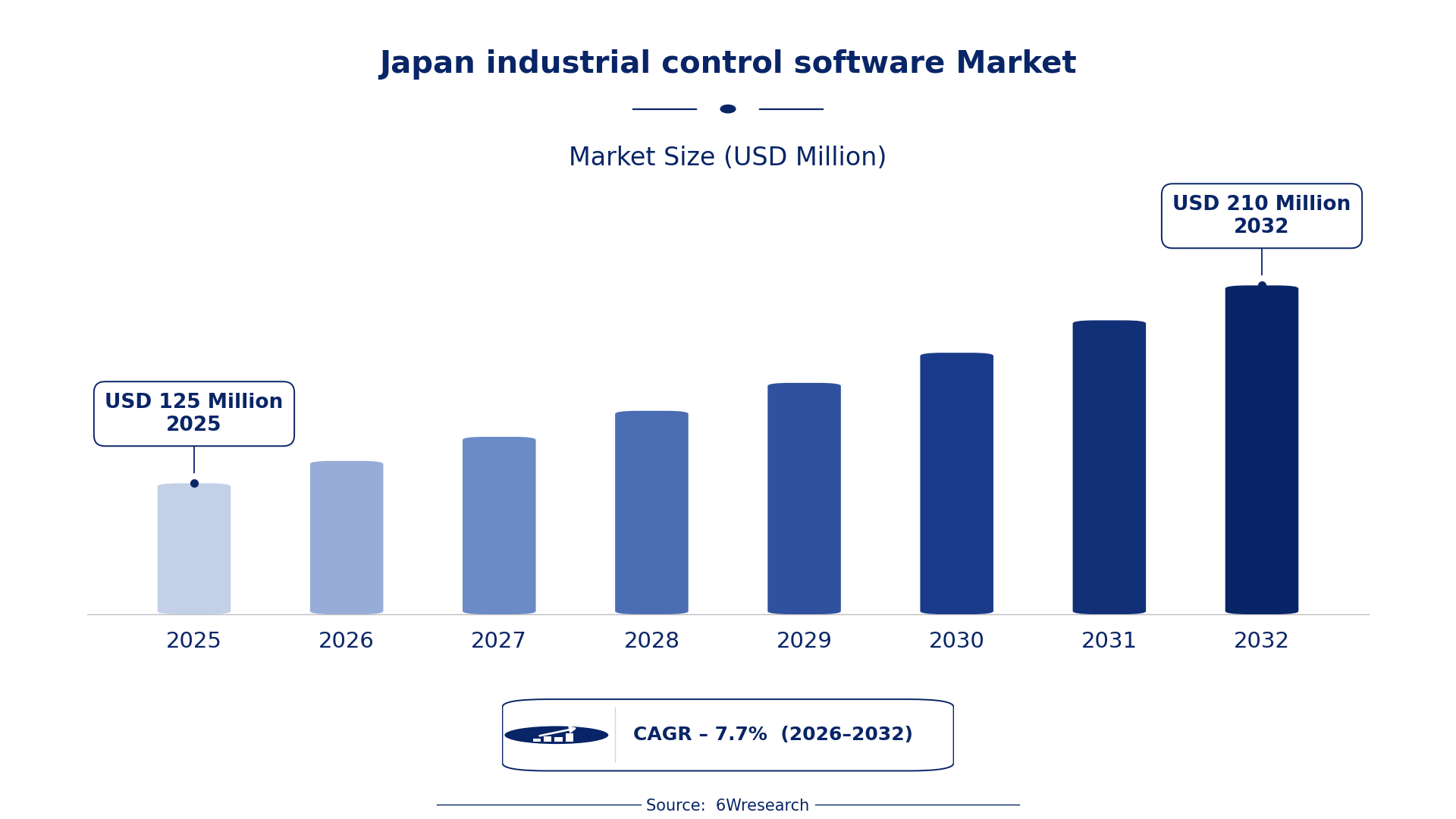
According to 6Wresearch internal database and industry insights, the Japan industrial control software Market was valued at USD 125 Million in 2025 and is projected to reach USD 210 Million by 2032, growing at a CAGR of approximately 7.7% during 2026–2032.
Japan industrial control software Market Highlights
| Report Metric | Details |
| Report Name | Japan industrial control software Market (2026-2032) |
| Market Size 2025 | USD 125 Million |
| Market Size 2032 | USD 210 Million |
| Absolute Growth 2025–2032 | USD 85 Million |
| CAGR 2026–2032 | 7.7% |
| Peak Annual Growth | 8.7% in 2029 |
| Forecast Period | 2026–2032 |
| Historical Data | 2022–2025 |
| Base Year | 2025 |
| Leading Software Type, 2025 | SCADA Software (40% share) |
| Leading Platform Support, 2025 | Windows/Linux (38% share) |
| Leading Feature Set, 2025 | Real-Time Monitoring (36% share) |
| Leading End User, 2025 | Utility & Process Plants (38% share) |
| Fastest-Growing Software Type | HMI Software (10.7% CAGR) |
| Fastest-Growing Platform Support | Cross-Platform (10.6% CAGR) |
| Fastest-Growing End User | Machine Builders (10.3% CAGR) |
| Growing Sector | Utility & Process Plants |
| Key End Users | Utility Plants, Process Plants, Machine Builders, System Integrators |
Japan industrial control software Market Year-wise Growth Rate and Key Drivers (2022–2032)
This graph illustrates the annual growth rates of the market from 2022 to 2032, highlighting a steady upward trajectory and projected market expansion over the forecast period.
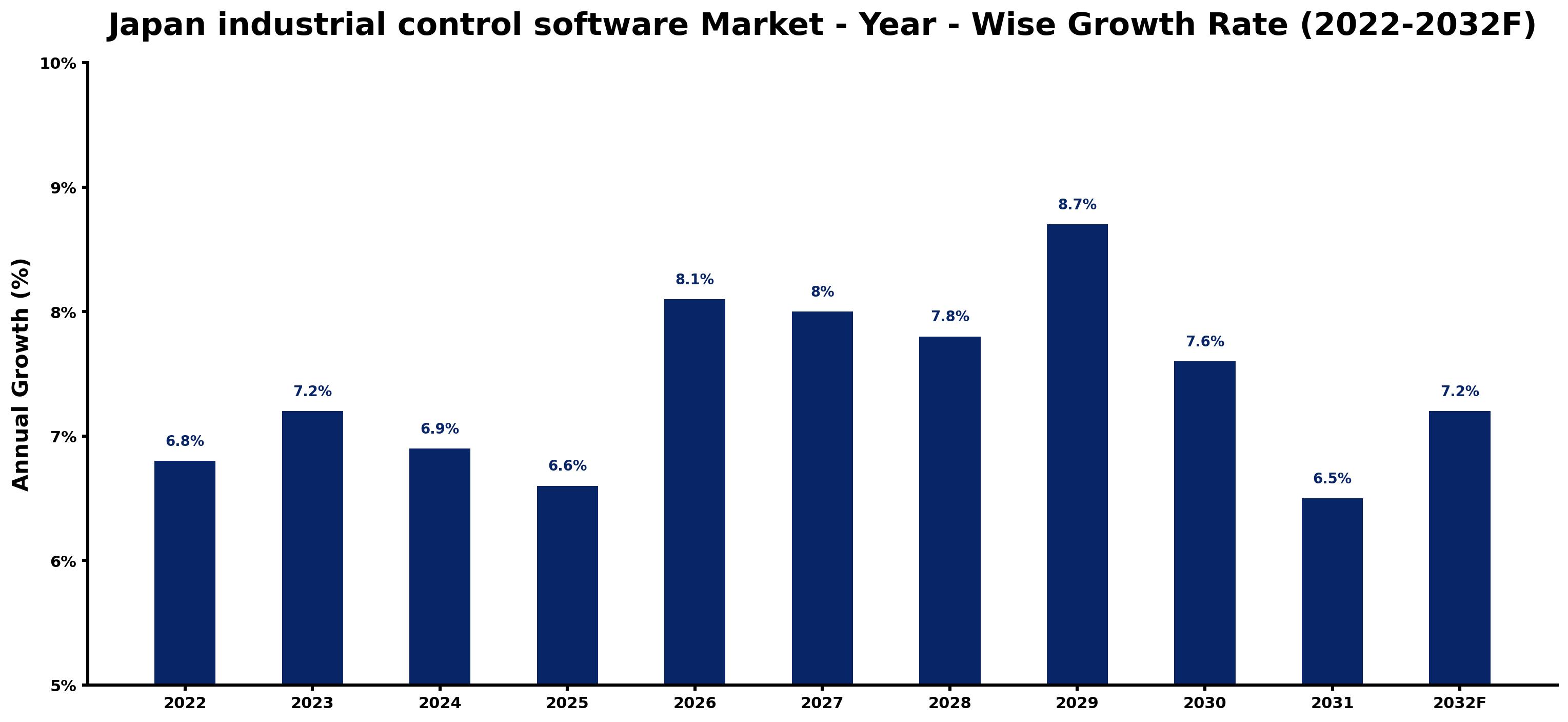
Each row of the following table gives one year's estimated growth and the event or demand shift that explains it.
| Year | Estimated Annual Growth (%) | Market Rationale |
| 2022 | 6.8 | The market experienced steady growth due to ongoing investments in automation technologies. |
| 2023 | 7.2 | Demand for SCADA systems surged across various sectors, accelerating growth. |
| 2024 | 6.9 | A slight slowdown occurred as companies adjusted to new technologies and investments. |
| 2025 | 6.6 | Competition intensified, leading to slower growth despite continued market expansion. |
| 2026 | 8.1 | Demand is expected to surge as investments in HMI software solutions gain momentum. |
| 2027 | 8.0 | Growth will slow slightly as firms focus on integrating advanced features into existing systems. |
| 2028 | 7.8 | Increasing automation needs will maintain market growth as new technologies emerge. |
| 2029 | 8.7 | A peak in growth will be reached as major industrial projects are initiated nationwide. |
| 2030 | 7.6 | Growth is expected to decelerate as the market stabilises following the peak year. |
| 2031 | 6.5 | The market will continue to grow, albeit at a reduced rate as saturation approaches. |
| 2032 | 7.2 | A resurgence in demand is anticipated as new projects are launched across sectors. |
Note: Market size estimations and growth projections presented in this report are based on 6Wresearch's proprietary forecasting methodology, utilizing the latest available industry data, government publications, and primary research inputs.
Japan industrial control software Market Synopsis
Industrial control software includes applications for monitoring and controlling industrial processes, essential for automation, data acquisition, and real-time monitoring in manufacturing and utility sectors. The Japan industrial control software Market is expanding due to rising investments in automation technologies, driven by the need for efficiency and safety. With over 1,000 utility plants and a target of 30% IoT adoption in manufacturing by 2025, the market is set for growth, particularly in HMI software solutions and SCADA systems. This growth is supported by the increasing focus on safety regulations and the expansion of IoT applications in various sectors.
Market Dynamics Impact Analysis (2026–2032)
| Factor | Type | Impact | Primary Segment Affected |
| Increasing investments in automation technologies | Driver | High | SCADA Software |
| Growing demand for real-time monitoring features | Driver | High | HMI Software |
| Rising need for efficient industrial processes | Opportunity | High | PLC Programming Tools |
| Expansion of IoT applications in manufacturing | Opportunity | Medium | Industrial Middleware |
| High implementation costs of SCADA systems | Restraint | High | SCADA Software |
| Competition among software providers leading to price wars | Restraint | Medium | HMI Software |
| Shortage of skilled professionals in automation | Challenge | High | PLC Programming Tools |
| Technological advancements requiring constant updates | Challenge | Medium | Industrial Middleware |
Evaluation of Drivers in Japan industrial control software Market (2026–2032)
Below are the drivers that matter most for revenue growth, with supporting evidence.
| Drivers | Primary Segment Affected | Why It Matters (Evidence) |
| Rising investments in automation technologies | SCADA Software | Japan's GX Basic Policy aims for JPY 150 trillion in decarbonisation investment over 10 years. |
| Growing demand for real-time monitoring features | HMI Software | The average population served by utility plants using industrial control software is around 500,000. |
| Increased focus on safety regulations | PLC Programming Tools | Real-time monitoring features are critical for safety in chemical processing plants. |
| Expansion of IoT applications in manufacturing | Industrial Middleware | The government aims to increase IoT adoption in manufacturing by 30% by 2025. |
| Need for improved operational efficiency | SCADA Software | The installed base of SCADA systems in Japan is estimated at 5,000 units. |
Orders keep climbing as investments in automation technologies rise, with Japan targeting JPY 150 trillion for decarbonisation over ten years. The average population served by utility plants using industrial control software is around 500,000, driving demand for efficient solutions. IoT adoption in manufacturing is expected to rise by 30% by 2025, further boosting demand for industrial middleware. The installed base of SCADA systems, estimated at 5,000 units, highlights the need for operational efficiency.
Evaluation of Restraints in Japan industrial control software Market
Below are the constraints most often cited by buyers and suppliers, with the segment each affects.
| Market Restraint | Primary Segment Affected | Why It Matters (Evidence) |
| High implementation costs of SCADA systems | SCADA Software | The average cost of implementing SCADA systems in Japan is approximately ¥50 million. |
| Competition among software providers leading to price wars | HMI Software | Intense competition has led to price reductions, affecting profit margins for providers. |
| Shortage of skilled professionals in automation | PLC Programming Tools | The total number of system integrators in Japan is estimated to be around 2,500. |
| Technological advancements requiring constant updates | Industrial Middleware | The average lifespan of industrial control software in Japan is around 10 years. |
| Regulatory compliance costs for software development | HMI Software | Compliance with ISO 9001 standards incurs additional costs for software development. |
Japan industrial control software Market Challenges
Regulatory hurdles delay the timely development of industrial control software, as compliance with standards like ISO 9001 can extend project timelines by up to six months for producers. Rising minimum wages, which reached JPY 1,055 per hour in October 2024, increase operational costs, compelling buyers to pay higher prices for software solutions. Limited technology integration, with only 30% of manufacturers expected to adopt IoT by 2025, restricts efficiency improvements for buyers. Skills shortages in programming and system integration contribute to an estimated 20% increase in project timelines for producers, complicating delivery schedules.
Trends in the Japan industrial control software Market
Several trends are reshaping the Japan industrial control software Market; the most important are set out below.
- Shift from Traditional to Real-Time Monitoring: In 2023, the Japan Automation Association reported an increase in demand for real-time monitoring solutions, reflecting a shift towards more responsive industrial processes. This change is critical for improving operational safety and efficiency.
- Growing Adoption of IoT in Manufacturing: The government aims to increase IoT adoption in manufacturing by 30% by 2025, driving demand for industrial control software. This trend is evident in the Tokyo metropolitan area, where automation technologies are rapidly advancing.
- Expansion of Cross-Platform Solutions: Cross-platform software solutions are gaining traction, with a CAGR of 10.6% projected from 2026 to 2032. This trend is particularly strong among machine builders in the Yokohama region, who seek versatile applications.
- Increased Focus on Safety Standards: Real-time monitoring features are becoming critical in industries like chemical processing, where safety is paramount. The average population served by a utility plant using industrial control software is around 500,000, highlighting the need for stringent safety measures.
Investment Opportunities in the Japan industrial control software Market
The openings below show where demand in the Japan industrial control software Market is visible and how suppliers can enter.
- Joint Ventures for Automation Technology: Partnering with local firms for automation technology development is essential now, as Japan allocates ¥10 billion for research in 2024. This presents a chance for system integrators to expand their market presence.
- Investing in HMI Software Solutions: With a projected CAGR of 10.7% for HMI software, the timing is right for investments in this area. Utility & process plants are major buyers, seeking advanced solutions to improve operational efficiency.
- Expanding in the Yokohama Region: The Yokohama region is known for its concentration of machine builders, presenting opportunities for suppliers. The average cost of implementing SCADA systems is approximately ¥50 million, indicating a significant market potential.
- Meeting Regulatory Standards: With ISO 9001 being a key standard, investing in compliance-focused software development is critical now. System integrators can benefit from aligning their solutions with these regulations.
Government Initiatives in the Japan industrial control software Market
The Electrical Appliance and Material Safety Act regulates the safety of electrical appliances and materials sold in Japan, ensuring that industrial control software adheres to strict safety standards. Compliance with this act is essential for producers, as it mandates rigorous testing and certification processes to ensure product safety and reliability.
In 2024, the government allocated a budget of ¥10 billion for automation technology research, administered by the Digital Agency. This funding supports various projects aimed at improving automation capabilities across industries, benefiting both producers and buyers.
Future Insight of the Japan industrial control software Market
A major investment in utility plants will drive growth, targeting JPY 150 trillion in decarbonisation efforts over the next decade. By 2032, the installed base of SCADA systems is projected to rise to approximately 7,000 units, improving monitoring capabilities across the sector. Advances in automation technologies will arise from a ¥10 billion research budget allocated for 2024, benefiting both buyers and suppliers. The Tokyo metropolitan area will remain a central hub for industrial automation, promoting innovation and collaboration among stakeholders.
Market Segmentation Analysis
Japan industrial control software Market report covers a detailed analysis of the following market segments:
By Software Type – SCADA Software Leads, HMI Software Expected to Grow Fastest
According to Saurav Kr Singh, Senior Research Analyst at 6Wresearch, SCADA Software took 40% of software type revenue in 2025, more than any other category. SCADA software holds the largest share as it is essential for monitoring extensive industrial processes, particularly in utility plants where operational efficiency is crucial. The presence of over 5,000 SCADA systems in Japan highlights its indispensable role in managing large-scale operations. HMI Software is set to record the highest CAGR in this split, 10.7% over 2026–2032. The rapid growth of HMI software is fuelled by the increasing demand for intuitive interfaces that allow operators to interact efficiently with machinery, as shown by the heightened interest reported in 2023. This trend will further solidify the dominance of SCADA systems by enhancing user engagement. Suppliers should focus on developing advanced HMI solutions that complement existing SCADA systems to capture emerging opportunities.
By Platform Support – Windows/Linux Leads, Cross-Platform Expected to Grow Fastest
Windows/Linux accounted for 38% of the market by platform support in 2025. Windows and Linux are the predominant operating systems in the market, providing essential compatibility and reliability for industrial applications. Their extensive usage supports a large installed base of industrial control software, ensuring widespread adoption. The quickest growth will come from Cross-Platform, forecast to expand at a CAGR of 10.6% between 2026 and 2032. Cross-platform support is rapidly gaining popularity, allowing industrial control software to operate on various operating systems, thus appealing to a broader user base. This trend is expected to motivate suppliers to offer more cross-platform solutions, expanding their market reach. Buyers may gain access to a wider range of software options compatible with different operating systems.
By Feature Set – Real-Time Monitoring Leads and Records the Fastest Growth
The largest feature set category in 2025 was Real-Time Monitoring, at 36% of revenue. Real-time monitoring is the leading feature set due to its vital role in ensuring operational efficiency and safety across various industrial processes. The critical need for immediate data feedback, especially in chemical processing, reinforces its significance in the market. Its lead should widen, with a projected CAGR of 10.0% during 2026–2032, the highest in this split. As real-time monitoring is already the leading feature, its growth will continue to accelerate due to the increasing emphasis on safety and efficiency in industrial operations. The ongoing demand for enhanced monitoring capabilities will further strengthen its market position. Suppliers should prioritise advancements in real-time monitoring technologies to align with market demands.
By End User – Utility & Process Plants Lead, Machine Builders Expected to Grow Fastest
With 38% of end user revenue in 2025, Utility & Process Plants was the largest category. Utility and process plants are the largest users of industrial control software, relying heavily on these systems for their essential operational functions. Their extensive scale of operations necessitates robust software solutions for effective management and oversight. Over 2026–2032, Machine Builders are expected to post the fastest growth, at a CAGR of 10.3%. Machine builders are witnessing rapid growth as they increasingly integrate industrial control software into their machinery for automation, reflecting a broader trend towards improved manufacturing processes. This integration is expected to drive further demand for tailored software solutions. Suppliers should aim to deliver customised software solutions that enhance automation capabilities for machine builders.
Key Attractiveness of the Report
- 10 Years of Market Numbers
- Historical Data Starting from 2022 to 2025
- Base Year 2025
- Forecast Data until 2032
- Key Performance Indicators Impacting the Market
- Major Upcoming Developments and Projects
Key Highlights of the Report:
- Japan industrial control software Market Outlook
- Market Size of Japan industrial control software Market, 2025
- Forecast of Japan industrial control software Market, 2032
- Historical Data and Forecast of Japan industrial control software Revenues & Volume for the Period 2022-2032F
- Japan industrial control software Market Trend Evolution
- Japan industrial control software Market Drivers and Challenges
- Japan industrial control software Price Trends
- Japan industrial control software Porter's Five Forces
- Japan industrial control software Industry Life Cycle
- Historical Data and Forecast of Japan industrial control software Market Revenues & Volume By Software Type for the Period 2022-2032F
- Historical Data and Forecast of Japan industrial control software Market Revenues & Volume By SCADA Software for the Period 2022-2032F
- Historical Data and Forecast of Japan industrial control software Market Revenues & Volume By HMI Software for the Period 2022-2032F
- Historical Data and Forecast of Japan industrial control software Market Revenues & Volume By PLC Programming Tools for the Period 2022-2032F
- Historical Data and Forecast of Japan industrial control software Market Revenues & Volume By Industrial Middleware for the Period 2022-2032F
- Historical Data and Forecast of Japan industrial control software Market Revenues & Volume By Platform Support for the Period 2022-2032F
- Historical Data and Forecast of Japan industrial control software Market Revenues & Volume By Windows/Linux for the Period 2022-2032F
- Historical Data and Forecast of Japan industrial control software Market Revenues & Volume By Cross-Platform for the Period 2022-2032F
- Historical Data and Forecast of Japan industrial control software Market Revenues & Volume By IEC 61131 Languages for the Period 2022-2032F
- Historical Data and Forecast of Japan industrial control software Market Revenues & Volume By API-Based for the Period 2022-2032F
- Historical Data and Forecast of Japan industrial control software Market Revenues & Volume By Feature Set for the Period 2022-2032F
- Historical Data and Forecast of Japan industrial control software Market Revenues & Volume By Real-Time Monitoring for the Period 2022-2032F
- Historical Data and Forecast of Japan industrial control software Market Revenues & Volume By UI Visualization for the Period 2022-2032F
- Historical Data and Forecast of Japan industrial control software Market Revenues & Volume By Ladder/FBD/C Codes for the Period 2022-2032F
- Historical Data and Forecast of Japan industrial control software Market Revenues & Volume By Device Interfacing for the Period 2022-2032F
- Historical Data and Forecast of Japan industrial control software Market Revenues & Volume By End User for the Period 2022-2032F
- Historical Data and Forecast of Japan industrial control software Market Revenues & Volume By Utility & Process Plants for the Period 2022-2032F
- Historical Data and Forecast of Japan industrial control software Market Revenues & Volume By Machine Builders for the Period 2022-2032F
- Historical Data and Forecast of Japan industrial control software Market Revenues & Volume By System Integrators for the Period 2022-2032F
- Historical Data and Forecast of Japan industrial control software Market Revenues & Volume By IoT Control Systems for the Period 2022-2032F
- Japan industrial control software Import Export Trade Statistics
- Market Opportunity Assessment By Software Type
- Market Opportunity Assessment By Platform Support
- Market Opportunity Assessment By Feature Set
- Market Opportunity Assessment By End User
- Japan industrial control software Top Companies Market Share
- Japan industrial control software Competitive Benchmarking By Technical and Operational Parameters
- Japan industrial control software Company Profiles
- Japan industrial control software Key Strategic Recommendations
Market Covered
This report examines the market across the segments below.
By Software Type
- SCADA Software
- HMI Software
- PLC Programming Tools
- Industrial Middleware
By Platform Support
- Windows/Linux
- Cross-Platform
- IEC 61131 Languages
- API-Based
By Feature Set
- Real-Time Monitoring
- UI Visualization
- Ladder/FBD/C Codes
- Device Interfacing
By End User
- Utility & Process Plants
- Machine Builders
- System Integrators
- IoT Control Systems































