Japan Industrial Conveyance Systems Market Size & Growth Rate
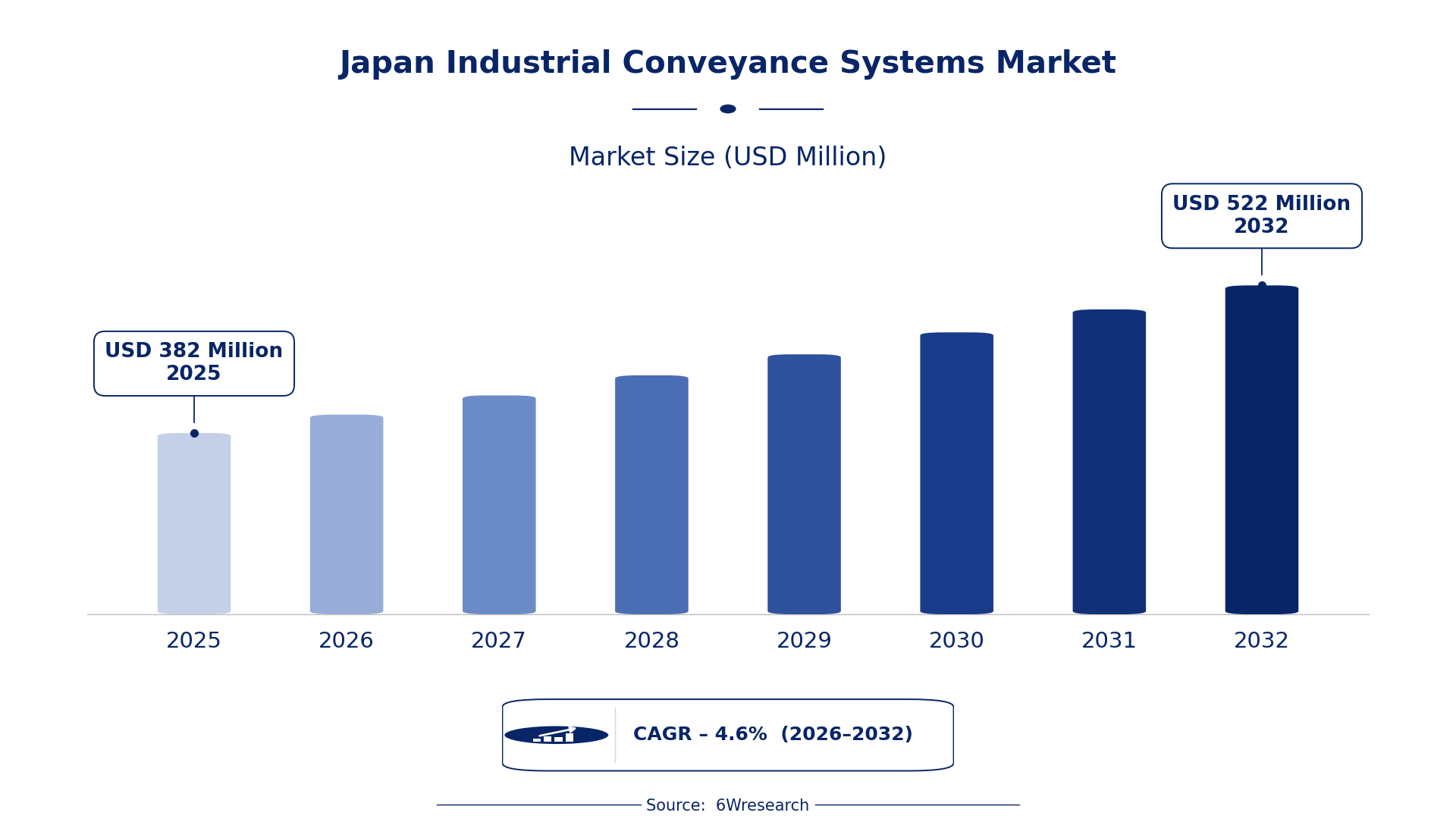
According to 6Wresearch internal database and industry insights, the Japan Industrial Conveyance Systems Market was valued at USD 382 Million in 2025 and is projected to reach USD 522 Million by 2032, growing at a CAGR of approximately 4.6% during 2026–2032.
Japan Industrial Conveyance Systems Market Highlights
| Report Metric | Details |
| Report Name | Japan Industrial Conveyance Systems Market (2026-2032) |
| Market Size 2025 | USD 382 Million |
| Market Size 2032 | USD 522 Million |
| Absolute Growth 2025–2032 | USD 140 Million |
| CAGR 2026–2032 | 4.6% |
| Peak Annual Growth | 6.0% in 2032 |
| Forecast Period | 2026–2032 |
| Historical Data | 2022–2025 |
| Base Year | 2025 |
| Leading System Type, 2025 | Belt Conveyance Systems (39% share) |
| Leading Motion Mechanism, 2025 | Gravity/Motorized (46% share) |
| Leading Application Type, 2025 | Assembly Line (37% share) |
| Leading End User, 2025 | Automotive Plants (45% share) |
| Fastest-Growing System Type | Overhead Conveyors (6.5% CAGR) |
| Fastest-Growing Motion Mechanism | Chain Driven (6.1% CAGR) |
| Fastest-Growing Application Type | Material Sorting (6.2% CAGR) |
| Fastest-Growing End User | Logistics Warehouses (6.0% CAGR) |
| Growing Sector | Automotive |
| Key End Users | Automotive Plants, FMCG Industry, Logistics Warehouses |
Japan Industrial Conveyance Systems Market Year-wise Growth Rate and Key Drivers (2022–2032)
This graph illustrates the annual growth rates of the market from 2022 to 2032, highlighting a steady upward trajectory and projected market expansion over the forecast period.
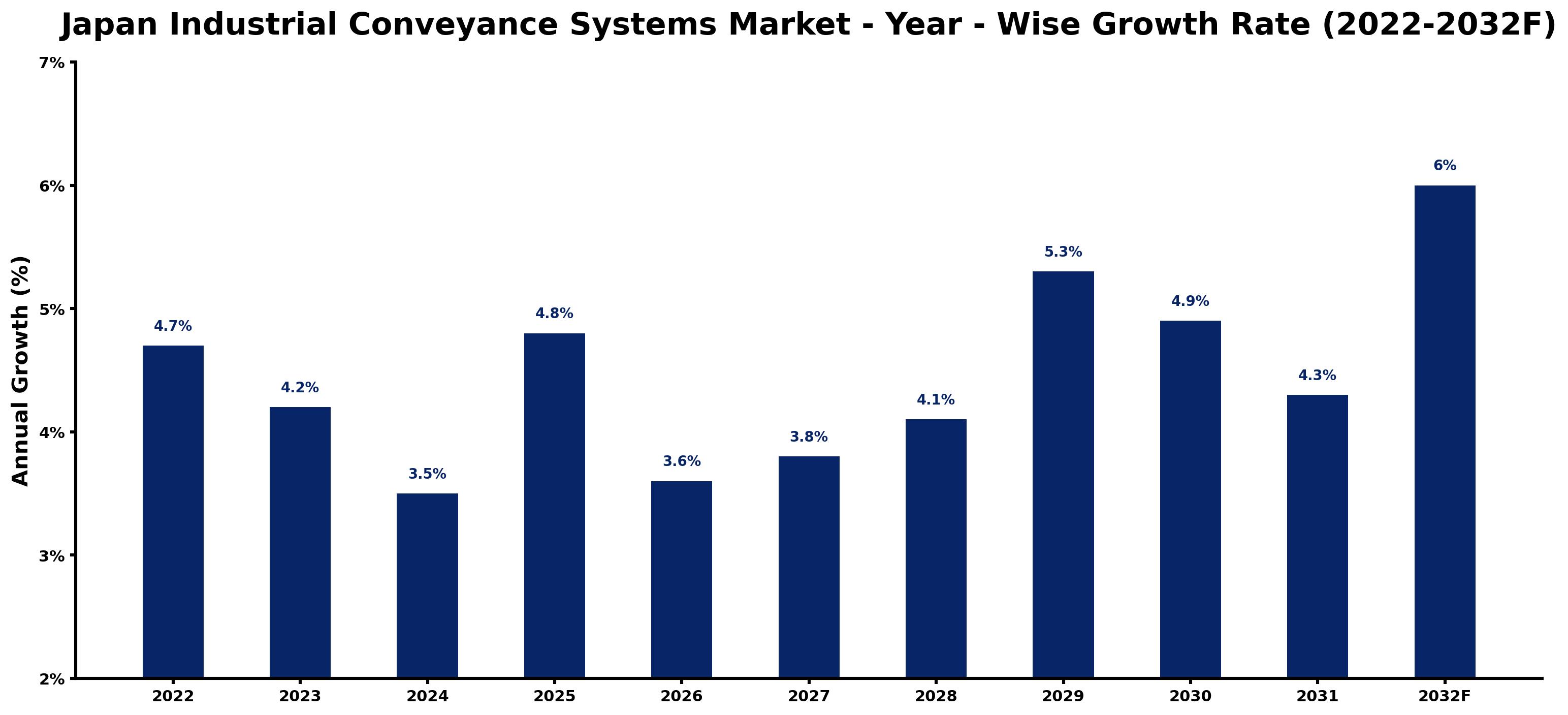
Year by year, the estimates below pair each growth rate with the development that shaped it.
| Year | Estimated Annual Growth (%) | Market Rationale |
| 2022 | 4.7 | The automotive sector produced over 9 million vehicles, driving steady demand for conveyance solutions. |
| 2023 | 4.2 | Demand growth slowed as manufacturers adjusted to supply chain challenges and rising material costs. |
| 2024 | 3.5 | Continued investments in automation technologies led to a further slowdown in growth expectations. |
| 2025 | 4.8 | Increased production in the automotive sector boosted demand for advanced conveyance solutions. |
| 2026 | 3.6 | Growth is expected to slow as manufacturers face challenges in sourcing materials and skilled labour. |
| 2027 | 3.8 | Demand is projected to increase as companies begin upgrading aging manufacturing equipment for efficiency. |
| 2028 | 4.1 | Rising investments in logistics and warehousing will improve demand for conveyance solutions. |
| 2029 | 5.3 | The FMCG sector's expansion is expected to drive higher demand for efficient material handling solutions. |
| 2030 | 4.9 | Growth is projected to slow as companies focus on consolidating existing systems rather than new investments. |
| 2031 | 4.3 | Demand is expected to continue rising as the logistics industry invests in automation technologies. |
| 2032 | 6.0 | A surge in decarbonisation investments is projected to drive growth in conveyance solutions. |
Note: Market size estimations and growth projections presented in this report are based on 6Wresearch's proprietary forecasting methodology, utilizing the latest available industry data, government publications, and primary research inputs.
Japan Industrial Conveyance Systems Market Synopsis
Industrial conveyance systems are mechanical devices designed for transporting materials within facilities, commonly made from metal or plastic. In Japan, these systems are extensively used in the automotive and FMCG sectors, which are critical to the economy. The Japan Industrial Conveyance Systems Market is growing due to rising production levels, particularly in the automotive sector, and substantial investments in logistics efficiency, with a projected JPY 150 trillion allocated for decarbonisation over the next decade.
Market Dynamics Impact Analysis (2026–2032)
| Factor | Type | Impact | Primary Segment Affected |
| Growing production levels in the automotive sector | Driver | High | Belt Conveyance Systems |
| Increased investments in logistics efficiency | Driver | High | Material Sorting |
| Rising demand for automation in manufacturing | Opportunity | High | Gravity/Motorized |
| Expansion of the FMCG sector requiring efficient material handling | Opportunity | High | Packaging |
| Aging manufacturing equipment necessitating upgrades | Restraint | Medium | Belt Conveyance Systems |
| Supply chain disruptions affecting material availability | Restraint | High | Belt Conveyance Systems |
| High costs of advanced automation technologies | Challenge | Medium | Belt Conveyance Systems |
| Limited skilled labour for installation and maintenance | Challenge | High | Belt Conveyance Systems |
Evaluation of Drivers in Japan Industrial Conveyance Systems Market (2026–2032)
Key forces behind demand, with the segment each one moves most, are listed below.
| Drivers | Primary Segment Affected | Why It Matters (Evidence) |
| Increased vehicle production drives demand for efficient conveyance solutions | Belt Conveyance Systems | Japan's automotive sector produced over 9 million vehicles in 2022, necessitating advanced solutions for assembly lines. |
| Growing logistics investments improve material handling efficiency | Material Sorting | Japan's logistics industry is expected to invest over JPY 150 trillion in automation technologies by 2025, boosting demand for sorting solutions. |
| Government support for automation encourages system upgrades | Gravity/Motorized | The Ministry of Economy, Trade and Industry funds automation initiatives, driving demand for efficient conveyance solutions. |
| Rising FMCG sector demands efficient product movement | Packaging | The FMCG industry in Japan is valued at approximately 25 trillion yen, driving the need for advanced packaging solutions. |
| Technological advancements improve system efficiency | Overhead Conveyors | Innovations in overhead conveyor designs are creating space-saving solutions in manufacturing facilities. |
What keeps demand rising is the high production levels in Japan's automotive sector, which produced over 9 million vehicles in 2022, necessitating advanced conveyance solutions for assembly lines. The logistics industry is expected to invest heavily in automation technologies by 2025, boosting demand for material sorting solutions. The FMCG sector, valued at approximately 25 trillion yen, drives the need for efficient packaging solutions. Technological advancements in overhead conveyor designs are improving space-saving capabilities in manufacturing facilities.
Evaluation of Restraints in Japan Industrial Conveyance Systems Market
These restraints slow adoption and weigh on supplier margins.
| Market Restraint | Primary Segment Affected | Why It Matters (Evidence) |
| Aging manufacturing equipment leads to increased upgrade costs | Belt Conveyance Systems | The average age of manufacturing equipment in Japan is around 10 years, prompting costly upgrades. |
| Supply chain disruptions hinder material availability | Belt Conveyance Systems | Manufacturers face challenges in sourcing materials due to ongoing global supply chain issues. |
| High costs associated with advanced automation technologies | Belt Conveyance Systems | Investments in advanced systems can be prohibitively expensive for smaller manufacturers. |
| Limited skilled labour affects installation and maintenance | Belt Conveyance Systems | A shortage of skilled workers impacts the ability to install and maintain advanced conveyance systems. |
| Regulatory compliance adds to operational costs | Belt Conveyance Systems | Compliance with the Industrial Safety and Health Act increases operational expenses for manufacturers. |
Japan Industrial Conveyance Systems Market Challenges
Japan's focus on decarbonisation creates a demand for advanced technology in industrial conveyance systems, yet many producers cannot afford the upgrades, resulting in production delays of up to 20% for manufacturers. A shortage of skilled workers in automation and robotics limits the effective implementation of new technologies, causing operational inefficiencies that can slow down output for factories. Local producers face intense competition from international suppliers, forcing them to cut prices and potentially reducing profit margins by 15%. Supply chain disruptions, intensified by global events, can delay the acquisition of essential components, impacting delivery schedules for end-users.
Trends in the Japan Industrial Conveyance Systems Market
Four trends stand out in the Japan Industrial Conveyance Systems Market.
- Shift in Automotive Manufacturing Practices: Automotive plants are increasingly adopting advanced automation technologies to improve production efficiency, with over 9 million vehicles produced in 2022. This shift drives demand for modern conveyance solutions.
- Increase in Logistics Automation: Japan's logistics industry is projected to invest over JPY 150 trillion in automation technologies by 2025, improving efficiency in material handling operations. This investment is set to enhance operational capabilities across the sector.
- Adoption of Overhead Conveyors in Manufacturing: Overhead conveyors are gaining popularity in manufacturing for their space-saving capabilities, particularly in automotive and electronics sectors. This trend is supported by a projected CAGR of 6.5% for overhead systems.
- Rising Demand for Efficient Packaging Solutions: The FMCG sector's expansion is leading to a greater focus on efficient packaging systems, with the industry valued at approximately 25 trillion yen in Japan. This trend is pushing manufacturers to upgrade their conveyance solutions.
Investment Opportunities in the Japan Industrial Conveyance Systems Market
The following opportunities in the Japan Industrial Conveyance Systems Market pair current demand with a clear way in.
- Automotive Plants Seeking Advanced Solutions: Automotive plants are increasingly looking for advanced conveyance systems to improve production efficiency. With over 9 million vehicles produced in 2022, the demand for effective solutions is substantial.
- FMCG Sector's Growth Creates Demand: The FMCG industry, valued at approximately 25 trillion yen, is expanding rapidly, creating opportunities for suppliers of advanced conveyance systems. Investing in this sector can yield substantial returns.
- Logistics Industry's Push for Automation: Japan's logistics industry is set to invest significantly in automation technologies, with expectations of increased efficiency. Suppliers can enter this market through partnerships with logistics providers.
- Government Support for Decarbonisation Initiatives: With JPY 150 trillion allocated for decarbonisation investments, there is a strong opportunity for suppliers to provide energy-efficient conveyance systems. Collaborating with local manufacturers can facilitate market entry.
Government Initiatives in the Japan Industrial Conveyance Systems Market
The Industrial Safety and Health Act mandates that employers ensure the safety of machinery, including conveyance systems, impacting producers and buyers. Compliance requires regular safety assessments and adherence to design standards, such as JIS B 8801, which governs conveyor design and safety. This act affects operational costs and compliance efforts for manufacturers, ensuring safer working environments.
In 2023, a programme was launched aimed at improving logistics efficiency, with JPY 150 trillion allocated for public and private decarbonisation investments over ten years. The Ministry of Economy, Trade and Industry oversees this initiative, supporting manufacturers in adopting advanced conveyance solutions and improving operational capabilities.
Future Insight of the Japan Industrial Conveyance Systems Market
By 2032, buyers in the automotive sector will increasingly adopt automated conveyance systems, driven by government funding programmes that enhance manufacturing efficiency. The logistics industry plans to invest over JPY 150 trillion in automation technologies, improving operational capabilities across various sectors. Compliance with the JIS B 8801 standard will elevate safety and design quality in new installations. As the aerospace sector grows, there will be a rising demand for specialised conveyance solutions, providing suppliers with opportunities to innovate and meet specific market requirements.
Market Segmentation Analysis
Japan Industrial Conveyance Systems Market report covers a detailed analysis of the following market segments:
By System Type – Belt Conveyance Systems Lead, Overhead Conveyors Expected to Grow Fastest
According to Saurav Kr Singh, Senior Research Analyst at 6Wresearch, with 39% of system type revenue in 2025, Belt Conveyance Systems was the largest category. Belt conveyance systems dominate the market due to their extensive use in continuous material handling across various sectors, particularly in automotive assembly lines. Their reliability and efficiency in transporting materials make them indispensable in maintaining production flow. Overhead Conveyors are projected to grow fastest, at a CAGR of 6.5% during 2026–2032. Overhead conveyors are experiencing rapid growth as they optimise space in manufacturing environments, especially where floor space is limited. This trend is driven by the increasing need for efficient production layouts and streamlined operations. Suppliers should focus on developing overhead solutions to meet the growing demand for space-efficient systems.
By Motion Mechanism – Gravity/Motorized Leads, Chain Driven Expected to Grow Fastest
Gravity/Motorized took 46% of motion mechanism revenue in 2025, more than any other category. Gravity/motorized mechanisms lead the market as they are widely utilised in both manual and automated systems, demonstrating their versatility across various applications. Their consistent performance in settings such as automotive plants reinforces their dominant position. The quickest growth will come from Chain Driven, forecast to expand at a CAGR of 6.1% between 2026 and 2032. Chain driven mechanisms are growing rapidly due to their suitability for heavy-duty applications, which are increasingly required in sectors like automotive manufacturing. The rise in production volumes necessitates robust and reliable motion solutions. Buyers should consider investing in chain driven systems to enhance operational efficiency in challenging environments.
By Application Type – Assembly Line Leads, Material Sorting Expected to Grow Fastest
In 2025, Assembly Line led the application type split with a 37% share. Assembly line applications lead the market as they are essential for the automotive and electronics manufacturing sectors, where efficiency is paramount. The critical role of these systems in streamlining production processes solidifies their dominant position. Material Sorting is set to record the highest CAGR in this split, 6.2% over 2026–2032. Material sorting applications are growing rapidly, driven by the increasing demand for efficient logistics and warehousing solutions. The expansion of e-commerce is further accelerating the need for advanced sorting systems. Suppliers must prioritise the development of advanced sorting technologies to capitalise on the burgeoning logistics sector.
By End User – Automotive Plants Lead, Logistics Warehouses Expected to Grow Fastest
Automotive Plants accounted for 45% of the market by end user in 2025. Automotive plants represent the largest end user of conveyance systems, underscoring their reliance on advanced technologies for efficient production processes. The production of over 9 million vehicles in 2022 highlights the substantial demand for these systems within the automotive sector. Over 2026–2032, Logistics Warehouses are expected to post the fastest growth, at a CAGR of 6.0%. Logistics warehouses are experiencing the fastest growth as they play a vital role in efficient material handling, particularly with the rise of e-commerce. Increased automation investments are driving this trend forward. Suppliers should adapt their offerings to address the unique needs of logistics warehouses to capture emerging market opportunities.
Key Attractiveness of the Report
- 10 Years of Market Numbers
- Historical Data Starting from 2022 to 2025
- Base Year 2025
- Forecast Data until 2032
- Key Performance Indicators Impacting the Market
- Major Upcoming Developments and Projects
Key Highlights of the Report:
- Japan Industrial Conveyance Systems Market Outlook
- Market Size of Japan Industrial Conveyance Systems Market, 2025
- Forecast of Japan Industrial Conveyance Systems Market, 2032
- Historical Data and Forecast of Japan Industrial Conveyance Systems Revenues & Volume for the Period 2022-2032F
- Japan Industrial Conveyance Systems Market Trend Evolution
- Japan Industrial Conveyance Systems Market Drivers and Challenges
- Japan Industrial Conveyance Systems Price Trends
- Japan Industrial Conveyance Systems Porter's Five Forces
- Japan Industrial Conveyance Systems Industry Life Cycle
- Historical Data and Forecast of Japan Industrial Conveyance Systems Market Revenues & Volume By System Type for the Period 2022-2032F
- Historical Data and Forecast of Japan Industrial Conveyance Systems Market Revenues & Volume By Roller Conveyors for the Period 2022-2032F
- Historical Data and Forecast of Japan Industrial Conveyance Systems Market Revenues & Volume By Belt Conveyance Systems for the Period 2022-2032F
- Historical Data and Forecast of Japan Industrial Conveyance Systems Market Revenues & Volume By Overhead Conveyors for the Period 2022-2032F
- Historical Data and Forecast of Japan Industrial Conveyance Systems Market Revenues & Volume By Slat Conveyance Systems for the Period 2022-2032F
- Historical Data and Forecast of Japan Industrial Conveyance Systems Market Revenues & Volume By Motion Mechanism for the Period 2022-2032F
- Historical Data and Forecast of Japan Industrial Conveyance Systems Market Revenues & Volume By Gravity/Motorized for the Period 2022-2032F
- Historical Data and Forecast of Japan Industrial Conveyance Systems Market Revenues & Volume By Friction-Based for the Period 2022-2032F
- Historical Data and Forecast of Japan Industrial Conveyance Systems Market Revenues & Volume By Chain Driven for the Period 2022-2032F
- Historical Data and Forecast of Japan Industrial Conveyance Systems Market Revenues & Volume By Mechanically Interlocked for the Period 2022-2032F
- Historical Data and Forecast of Japan Industrial Conveyance Systems Market Revenues & Volume By Application Type for the Period 2022-2032F
- Historical Data and Forecast of Japan Industrial Conveyance Systems Market Revenues & Volume By Assembly Line for the Period 2022-2032F
- Historical Data and Forecast of Japan Industrial Conveyance Systems Market Revenues & Volume By Packaging for the Period 2022-2032F
- Historical Data and Forecast of Japan Industrial Conveyance Systems Market Revenues & Volume By Paint Shops for the Period 2022-2032F
- Historical Data and Forecast of Japan Industrial Conveyance Systems Market Revenues & Volume By Material Sorting for the Period 2022-2032F
- Historical Data and Forecast of Japan Industrial Conveyance Systems Market Revenues & Volume By End User for the Period 2022-2032F
- Historical Data and Forecast of Japan Industrial Conveyance Systems Market Revenues & Volume By Automotive Plants for the Period 2022-2032F
- Historical Data and Forecast of Japan Industrial Conveyance Systems Market Revenues & Volume By FMCG Industry for the Period 2022-2032F
- Historical Data and Forecast of Japan Industrial Conveyance Systems Market Revenues & Volume By Aerospace Sector for the Period 2022-2032F
- Historical Data and Forecast of Japan Industrial Conveyance Systems Market Revenues & Volume By Logistics Warehouses for the Period 2022-2032F
- Japan Industrial Conveyance Systems Import Export Trade Statistics
- Market Opportunity Assessment By System Type
- Market Opportunity Assessment By Motion Mechanism
- Market Opportunity Assessment By Application Type
- Market Opportunity Assessment By End User
- Japan Industrial Conveyance Systems Top Companies Market Share
- Japan Industrial Conveyance Systems Competitive Benchmarking By Technical and Operational Parameters
- Japan Industrial Conveyance Systems Company Profiles
- Japan Industrial Conveyance Systems Key Strategic Recommendations
Market Covered
This report examines the market across the segments below.
By System Type
- Roller Conveyors
- Belt Conveyance Systems
- Overhead Conveyors
- Slat Conveyance Systems
By Motion Mechanism
- Gravity/Motorized
- Friction-Based
- Chain Driven
- Mechanically Interlocked
By Application Type
- Assembly Line
- Packaging
- Paint Shops
- Material Sorting
By End User
- Automotive Plants
- FMCG Industry
- Aerospace Sector
- Logistics Warehouses































