Japan Industrial Conveyor Systems Market Size & Growth Rate
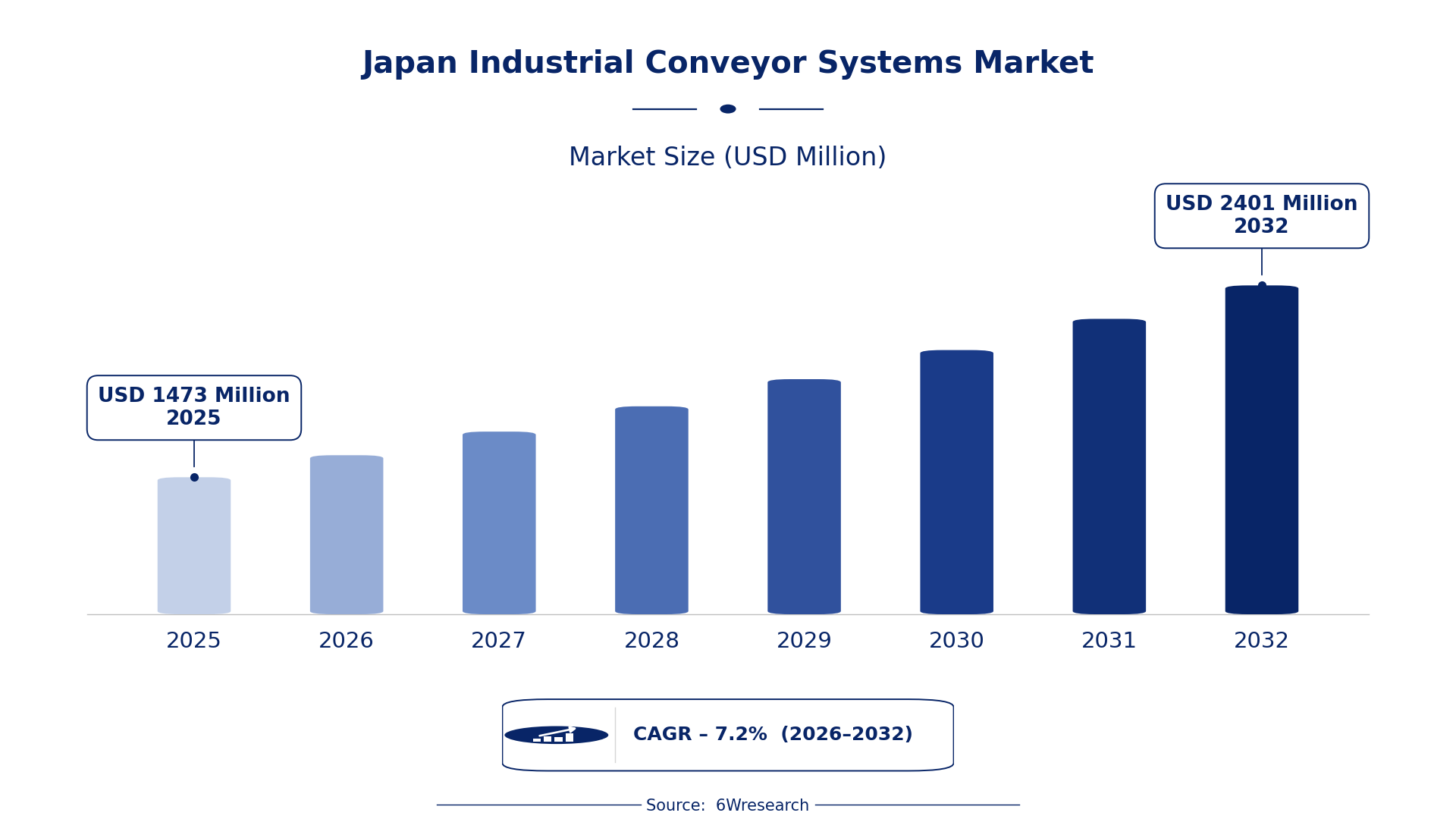
According to 6Wresearch internal database and industry insights, the Japan Industrial Conveyor Systems Market was valued at USD 1,473 Million in 2025 and is projected to reach USD 2,401 Million by 2032, growing at a CAGR of approximately 7.2% during 2026–2032.
Japan Industrial Conveyor Systems Market Highlights
| Report Metric | Details |
| Report Name | Japan Industrial Conveyor Systems Market (2026-2032) |
| Market Size 2025 | USD 1,473 Million |
| Market Size 2032 | USD 2,401 Million |
| Absolute Growth 2025–2032 | USD 928 Million |
| CAGR 2026–2032 | 7.2% |
| Peak Annual Growth | 8.5% in 2030 |
| Forecast Period | 2026–2032 |
| Historical Data | 2022–2025 |
| Base Year | 2025 |
| Leading Conveyor Type, 2025 | Belt Conveyors (38% share) |
| Leading Frame Material, 2025 | Mild Steel / SS (47% share) |
| Leading Drive Type, 2025 | Electric Motor (39% share) |
| Leading End User, 2025 | Food Processing Units (43% share) |
| Fastest-Growing Conveyor Type | Screw Conveyors (9.9% CAGR) |
| Fastest-Growing Frame Material | Stainless Steel (10.1% CAGR) |
| Fastest-Growing End User | Pharmaceutical Plants (9.3% CAGR) |
| Growing Sector | Food Processing |
| Key End Users | Food Processing Units, Pharmaceutical Plants, Chemical Industry, Foundry & Metal Works |
Japan Industrial Conveyor Systems Market Year-wise Growth Rate and Key Drivers (2022–2032)
This graph illustrates the annual growth rates of the market from 2022 to 2032, highlighting a steady upward trajectory and projected market expansion over the forecast period.
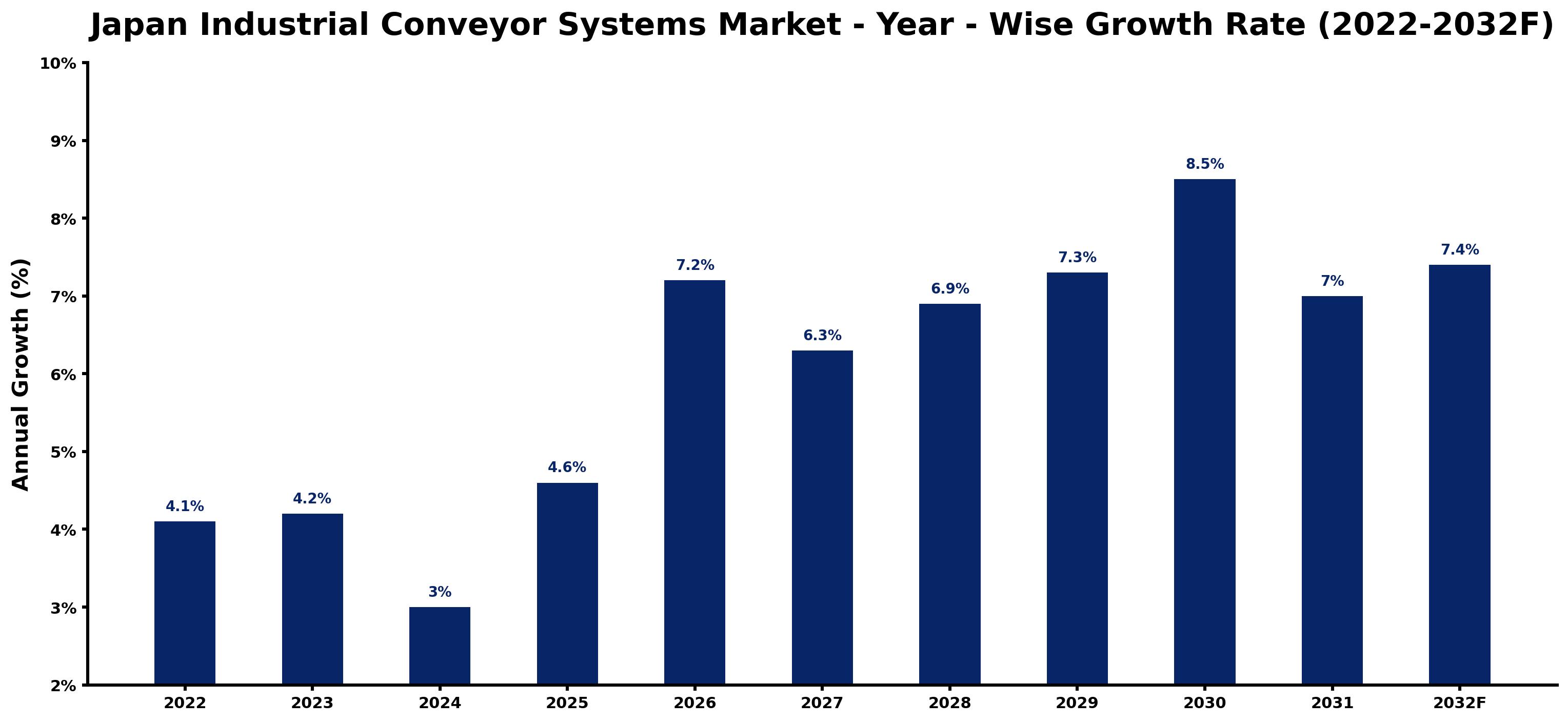
The following figures match every annual growth estimate with the main market development of that year, giving the reasoning behind each rise or slowdown.
| Year | Estimated Annual Growth (%) | Market Rationale |
| 2022 | 4.1 | Demand was steady as industries adapted to changing market conditions. |
| 2023 | 4.2 | Growth accelerated due to heightened investments in automation technologies. |
| 2024 | 3.0 | Growth slowed as certain sectors faced temporary supply chain challenges. |
| 2025 | 4.6 | Demand surged with the food processing sector expanding its operations. |
| 2026 | 7.2 | Growth is expected to accelerate as manufacturers invest in energy-efficient technologies. |
| 2027 | 6.3 | Growth is projected to slow as market saturation begins in some conveyor types. |
| 2028 | 6.9 | Demand is expected to increase with rising automation in manufacturing processes. |
| 2029 | 7.3 | Growth is projected to continue as technological advancements improve operational efficiency. |
| 2030 | 8.5 | Demand is expected to peak as industries aim for higher productivity levels. |
| 2031 | 7.0 | Growth is projected to slow as the market stabilises after peak demand. |
| 2032 | 7.4 | Demand is expected to remain strong as sustainability initiatives drive new investments. |
Note: Market size estimations and growth projections presented in this report are based on 6Wresearch's proprietary forecasting methodology, utilizing the latest available industry data, government publications, and primary research inputs.
Japan Industrial Conveyor Systems Market Synopsis
Industrial conveyor systems are mechanical devices used to transport materials within various facilities. The Japan Industrial Conveyor Systems Market is primarily driven by the food processing sector, which employs over 1.5 million people and is expanding operations. Growth is fuelled by rising automation, increased investments in decarbonisation, and the adoption of energy-efficient systems, with a target of JPY 150 trillion in investments over the next decade.
Market Dynamics Impact Analysis (2026–2032)
| Factor | Type | Impact | Primary Segment Affected |
| Increased automation in manufacturing processes | Driver | High | Belt Conveyors |
| Growing demand from the food processing sector | Driver | High | Food Processing Units |
| Rising need for energy-efficient systems | Opportunity | High | Electric Motor |
| Expansion of the pharmaceutical sector | Opportunity | High | Pharmaceutical Plants |
| High initial investment costs for advanced systems | Restraint | Medium | Screw Conveyors |
| Limited availability of skilled workforce for installation | Restraint | Medium | Chain Conveyors |
| Competition from low-cost imports | Challenge | High | Pneumatic Conveyors |
| Technological advancements requiring constant upgrades | Challenge | High | Stainless Steel |
Evaluation of Drivers in Japan Industrial Conveyor Systems Market (2026–2032)
The main growth drivers and the segments they affect most are set out below.
| Drivers | Primary Segment Affected | Why It Matters (Evidence) |
| Surge in food processing sector employment | Belt Conveyors | The food processing sector employs over 1.5 million people, driving demand for efficient material handling. |
| Investment in automation technologies | Screw Conveyors | Manufacturers are investing in automation to enhance efficiency, increasing demand for reliable systems. |
| Adoption of ISO 9001 certification | Chain Conveyors | Manufacturers seek ISO 9001 certification to ensure quality, driving demand for reliable systems. |
| Expansion of the pharmaceutical sector | Stainless Steel | Pharmaceutical plants require stainless steel conveyors to meet stringent hygiene standards. |
| Government initiatives for decarbonisation | Electric Motor | Japan's decarbonisation strategy encourages investments in energy-efficient conveyor systems. |
A wider customer base explains much of the growth, as demand from the food processing sector has surged, employing over 1.5 million people and driving conveyor purchases. Investments in automation technologies are reshaping manufacturing processes, with notable advancements being made. In 2023, Japan targets JPY 150 trillion in decarbonisation investments, encouraging the adoption of energy-efficient conveyor systems. The pharmaceutical sector's expansion requires stainless steel conveyors to meet hygiene standards, while quality assurance drives demand for chain conveyors. These factors contribute to a vibrant market for industrial conveyor systems.
Evaluation of Restraints in Japan Industrial Conveyor Systems Market
The table below lists the restraints and the evidence behind each.
| Market Restraint | Primary Segment Affected | Why It Matters (Evidence) |
| High initial investment costs for advanced systems | Screw Conveyors | Upfront costs deter some manufacturers from upgrading their conveyor systems. |
| Limited availability of skilled workforce for installation | Chain Conveyors | A shortage of skilled technicians affects timely installation of new systems. |
| Competition from low-cost imports | Pneumatic Conveyors | Importers offer cheaper alternatives, impacting local manufacturers' market share. |
| Technological advancements requiring constant upgrades | Stainless Steel | Rapid changes necessitate frequent updates, increasing operational costs for manufacturers. |
| Regulatory compliance costs for safety standards | Belt Conveyors | Compliance with safety regulations raises operational costs for producers. |
Japan Industrial Conveyor Systems Market Challenges
Increased costs for producers in the food processing sector arise from the need to comply with the JIS B 8801 standard, which can raise manufacturing expenses by up to 15%. Skills shortages in automation technologies hinder producers, particularly in the pharmaceutical industry, delaying production processes by three months. Rising material costs, particularly for stainless steel, inflate prices by 20%, impacting buyers across multiple sectors. Regulatory changes aimed at reducing greenhouse gas emissions will require manufacturers to invest heavily, costing an estimated JPY 150 trillion over ten years, straining budgets and slowing innovation for producers.
Trends in the Japan Industrial Conveyor Systems Market
The trends below show where the Japan Industrial Conveyor Systems Market is heading.
- Launch of GX Basic Policy: In 2023, the Japanese government adopted the GX Basic Policy, targeting a 46% reduction in greenhouse gas emissions by 2030. This initiative is driving investments in energy-efficient conveyor systems, creating opportunities for suppliers.
- Food Processing Units Increasing Automation: Food processing units are increasingly automating their operations to meet rising production demands. This sector employs approximately 1.5 million people, driving substantial investments in advanced conveyor systems.
- Stainless Steel Gaining Popularity: Stainless steel conveyors are becoming more popular in pharmaceutical plants due to stringent hygiene standards. The need for cleanliness in these facilities is driving the demand for high-quality conveyor systems.
- Rising Demand for Energy-Efficient Solutions: The push for energy efficiency is leading to increased investments in electric motor-driven conveyor systems. Japan's decarbonisation strategy targets substantial investments, creating opportunities for suppliers in this segment.
Investment Opportunities in the Japan Industrial Conveyor Systems Market
The opportunities below stand out in the Japan Industrial Conveyor Systems Market for new entrants and existing suppliers.
- Gap in Energy-Efficient Systems: With Japan targeting a 46% cut in greenhouse gas emissions by 2030, there is an opportunity for energy-efficient conveyor systems. Manufacturers in the food processing sector are seeking solutions to meet these targets.
- Pharmaceutical Sector Expansion: The pharmaceutical sector is expanding rapidly, creating a demand for advanced conveyor systems. Suppliers can enter this market by partnering with local manufacturers to meet hygiene standards.
- Growing Need for Automation in Food Processing: As food processing units seek to improve productivity, the demand for automated conveyor systems is rising. Suppliers can benefit by offering innovative solutions tailored to this sector.
- Investment in Lightweight Conveyors: The increasing popularity of aluminum alloy conveyors for lightweight applications presents an opportunity. Suppliers can enter this market by collaborating with regional distributors to reach food processing units.
Government Initiatives in the Japan Industrial Conveyor Systems Market
The Act on the Rational Use of Energy mandates large energy users to enhance efficiency and report energy consumption, impacting conveyor system producers by necessitating investments in energy-efficient technologies. Compliance with this act is essential for manufacturers to remain competitive in the market, ensuring they meet operational efficiency standards.
The Industrial Safety and Health Act establishes employer responsibilities regarding hazardous substances and machinery. This regulation ensures that conveyor system manufacturers adhere to safety standards, benefiting buyers by ensuring safer operational environments.
Future Insight of the Japan Industrial Conveyor Systems Market
Technological advancements will transform demand for conveyor systems by 2032, particularly in the food processing sector, which will implement automation to improve hygiene and efficiency. The introduction of eco-friendly conveyor systems will support Japan's emissions reduction targets, creating new opportunities for suppliers. Investment in decarbonisation initiatives will yield innovative solutions tailored to industry needs. As manufacturing evolves, suppliers must adjust their products to align with the shifting requirements of buyers.
Market Segmentation Analysis
Japan Industrial Conveyor Systems Market report covers a detailed analysis of the following market segments:
By Conveyor Type – Belt Conveyors Lead, Screw Conveyors Expected to Grow Fastest
According to Saurav Kr Singh, Senior Research Analyst at 6Wresearch, Belt Conveyors took 38% of conveyor type revenue in 2025, more than any other category. Belt conveyors dominate the market as they are essential for the continuous transport of bulk materials within various facilities. Their widespread application in logistics and manufacturing, especially in the Tokyo region, underscores their importance in Japan's industrial operations. Over 2026–2032, Screw Conveyors are expected to post the fastest growth, at a CAGR of 9.9%. Screw conveyors are experiencing rapid growth due to their specific use in transporting granular materials across multiple sectors. The chemical industry's significant demand for screw conveyors for bulk material handling plays a crucial role in this upward trend. Suppliers should consider expanding their screw conveyor product lines to capitalise on the increasing demand in relevant industries.
By Frame Material – Mild Steel / SS Leads, Stainless Steel Expected to Grow Fastest
In 2025, Mild Steel / SS led the frame material split with a 47% share. Mild steel and stainless steel are the dominant materials for conveyor frames, valued for their cost-effectiveness and durability. Their extensive application in manufacturing sectors, especially food processing, ensures a solid installed base in Japan. Stainless Steel is projected to grow fastest, at a CAGR of 10.1% during 2026–2032. Stainless steel is experiencing the fastest growth due to its compliance with strict hygiene standards in food and pharmaceutical applications. The heightened focus on cleanliness and safety in these industries is driving the demand for stainless steel conveyors. Buyers in food and pharmaceutical sectors should prioritise stainless steel options to adhere to hygiene regulations.
By Drive Type – Electric Motor Leads and Records the Fastest Growth
Electric Motor held 39% of the Japan Industrial Conveyor Systems Market by drive type in 2025. Electric motors are the primary power source for most conveyor systems, making them the leading drive type in the market. Their reliability and efficiency in powering various conveyor types contribute to their widespread adoption across industries. Electric Motor is also forecast to expand faster than any other category, at a CAGR of 10.2% over 2026–2032. The electric motor segment is also the fastest-growing due to advancements in technology that improve energy efficiency and performance. As automation in manufacturing increases, the demand for electric motor-driven systems will continue to rise. Suppliers should invest in developing more energy-efficient electric motor solutions to meet the rising demand.
By End User – Food Processing Units Lead, Pharmaceutical Plants Expected to Grow Fastest
The largest end user category in 2025 was Food Processing Units, at 43% of revenue. Food processing units are the largest end-users of conveyor systems, driven by the need for hygienic and efficient material handling solutions. With approximately 1.5 million people employed in this sector, the demand for effective conveyor systems remains robust. The quickest growth will come from Pharmaceutical Plants, forecast to expand at a CAGR of 9.3% between 2026 and 2032. Pharmaceutical plants are seeing the fastest growth as they require specialised conveyor systems to maintain sterile environments. The heightened focus on health and safety regulations in the pharmaceutical sector is propelling this demand forward. Suppliers need to tailor their products to comply with the strict standards required by the pharmaceutical industry.
Key Attractiveness of the Report
- 10 Years of Market Numbers
- Historical Data Starting from 2022 to 2025
- Base Year 2025
- Forecast Data until 2032
- Key Performance Indicators Impacting the Market
- Major Upcoming Developments and Projects
Key Highlights of the Report:
- Japan Industrial Conveyor Systems Market Outlook
- Market Size of Japan Industrial Conveyor Systems Market, 2025
- Forecast of Japan Industrial Conveyor Systems Market, 2032
- Historical Data and Forecast of Japan Industrial Conveyor Systems Revenues & Volume for the Period 2022-2032F
- Japan Industrial Conveyor Systems Market Trend Evolution
- Japan Industrial Conveyor Systems Market Drivers and Challenges
- Japan Industrial Conveyor Systems Price Trends
- Japan Industrial Conveyor Systems Porter's Five Forces
- Japan Industrial Conveyor Systems Industry Life Cycle
- Historical Data and Forecast of Japan Industrial Conveyor Systems Market Revenues & Volume By Conveyor Type for the Period 2022-2032F
- Historical Data and Forecast of Japan Industrial Conveyor Systems Market Revenues & Volume By Belt Conveyors for the Period 2022-2032F
- Historical Data and Forecast of Japan Industrial Conveyor Systems Market Revenues & Volume By Chain Conveyors for the Period 2022-2032F
- Historical Data and Forecast of Japan Industrial Conveyor Systems Market Revenues & Volume By Screw Conveyors for the Period 2022-2032F
- Historical Data and Forecast of Japan Industrial Conveyor Systems Market Revenues & Volume By Pneumatic Conveyors for the Period 2022-2032F
- Historical Data and Forecast of Japan Industrial Conveyor Systems Market Revenues & Volume By Frame Material for the Period 2022-2032F
- Historical Data and Forecast of Japan Industrial Conveyor Systems Market Revenues & Volume By Mild Steel / SS for the Period 2022-2032F
- Historical Data and Forecast of Japan Industrial Conveyor Systems Market Revenues & Volume By Galvanized Steel for the Period 2022-2032F
- Historical Data and Forecast of Japan Industrial Conveyor Systems Market Revenues & Volume By Stainless Steel for the Period 2022-2032F
- Historical Data and Forecast of Japan Industrial Conveyor Systems Market Revenues & Volume By Aluminum Alloy for the Period 2022-2032F
- Historical Data and Forecast of Japan Industrial Conveyor Systems Market Revenues & Volume By Drive Type for the Period 2022-2032F
- Historical Data and Forecast of Japan Industrial Conveyor Systems Market Revenues & Volume By Electric Motor for the Period 2022-2032F
- Historical Data and Forecast of Japan Industrial Conveyor Systems Market Revenues & Volume By Hydraulic for the Period 2022-2032F
- Historical Data and Forecast of Japan Industrial Conveyor Systems Market Revenues & Volume By Gearbox Driven for the Period 2022-2032F
- Historical Data and Forecast of Japan Industrial Conveyor Systems Market Revenues & Volume By Compressed Air for the Period 2022-2032F
- Historical Data and Forecast of Japan Industrial Conveyor Systems Market Revenues & Volume By End User for the Period 2022-2032F
- Historical Data and Forecast of Japan Industrial Conveyor Systems Market Revenues & Volume By Food Processing Units for the Period 2022-2032F
- Historical Data and Forecast of Japan Industrial Conveyor Systems Market Revenues & Volume By Foundry & Metal Works for the Period 2022-2032F
- Historical Data and Forecast of Japan Industrial Conveyor Systems Market Revenues & Volume By Chemical Industry for the Period 2022-2032F
- Historical Data and Forecast of Japan Industrial Conveyor Systems Market Revenues & Volume By Pharmaceutical Plants for the Period 2022-2032F
- Japan Industrial Conveyor Systems Import Export Trade Statistics
- Market Opportunity Assessment By Conveyor Type
- Market Opportunity Assessment By Frame Material
- Market Opportunity Assessment By Drive Type
- Market Opportunity Assessment By End User
- Japan Industrial Conveyor Systems Top Companies Market Share
- Japan Industrial Conveyor Systems Competitive Benchmarking By Technical and Operational Parameters
- Japan Industrial Conveyor Systems Company Profiles
- Japan Industrial Conveyor Systems Key Strategic Recommendations
Market Covered
The following segment groups are covered in the report.
By Conveyor Type
- Belt Conveyors
- Chain Conveyors
- Screw Conveyors
- Pneumatic Conveyors
By Frame Material
- Mild Steel / SS
- Galvanized Steel
- Stainless Steel
- Aluminum Alloy
By Drive Type
- Electric Motor
- Hydraulic
- Gearbox Driven
- Compressed Air
By End User
- Food Processing Units
- Foundry & Metal Works
- Chemical Industry
- Pharmaceutical Plants































