Japan Industrial Cooling Fluids Market Size & Growth Rate
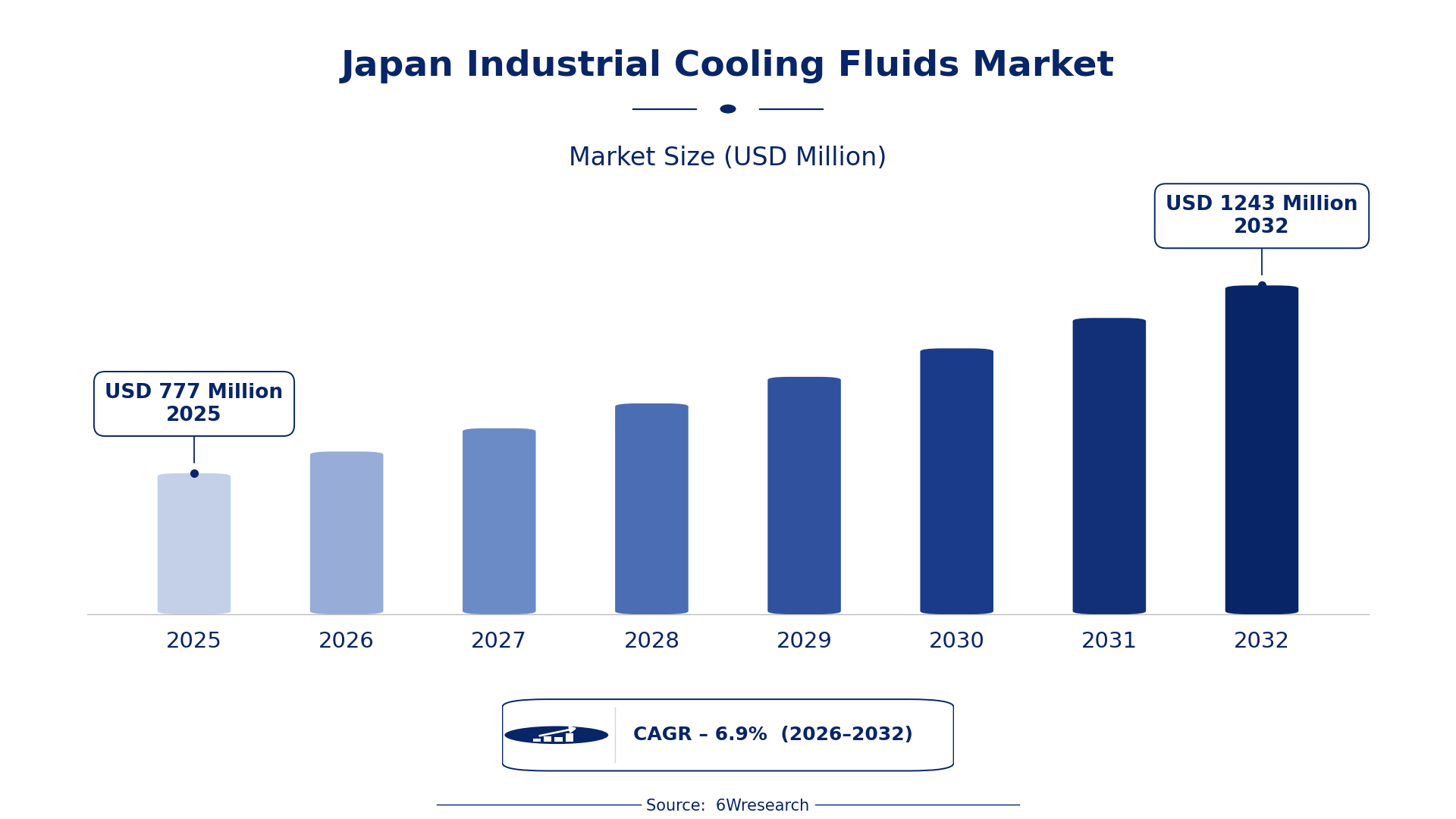
According to 6Wresearch internal database and industry insights, the Japan Industrial Cooling Fluids Market was valued at USD 777 Million in 2025 and is projected to reach USD 1,243 Million by 2032, growing at a CAGR of approximately 6.9% during 2026–2032.
Japan Industrial Cooling Fluids Market Highlights
| Report Metric | Details |
| Report Name | Japan Industrial Cooling Fluids Market (2026-2032) |
| Market Size 2025 | USD 777 Million |
| Market Size 2032 | USD 1,243 Million |
| Absolute Growth 2025–2032 | USD 466 Million |
| CAGR 2026–2032 | 6.9% |
| Peak Annual Growth | 12.2% in 2032 |
| Forecast Period | 2026–2032 |
| Historical Data | 2022–2025 |
| Base Year | 2025 |
| Leading Fluid Type, 2025 | Water-Based Coolants (48% share) |
| Leading Base Material, 2025 | Glycol/Water Blend (37% share) |
| Leading Cooling Application, 2025 | HVAC & Process Cooling (46% share) |
| Leading End User, 2025 | HVAC Systems (42% share) |
| Fastest-Growing Fluid Type | Bio-Based Cooling Fluids (10.2% CAGR) |
| Fastest-Growing Base Material | Vegetable Oil Derivatives (10.4% CAGR) |
| Fastest-Growing Cooling Application | Eco Applications (9.6% CAGR) |
| Fastest-Growing End User | Sustainable Facilities (9.5% CAGR) |
| Growing Sector | HVAC Systems |
| Key End Users | Manufacturers, Electronics Producers, Metalworking Industry, Construction Firms |
Japan Industrial Cooling Fluids Market Year-wise Growth Rate and Key Drivers (2022–2032)
This graph illustrates the annual growth rates of the market from 2022 to 2032, highlighting a steady upward trajectory and projected market expansion over the forecast period.
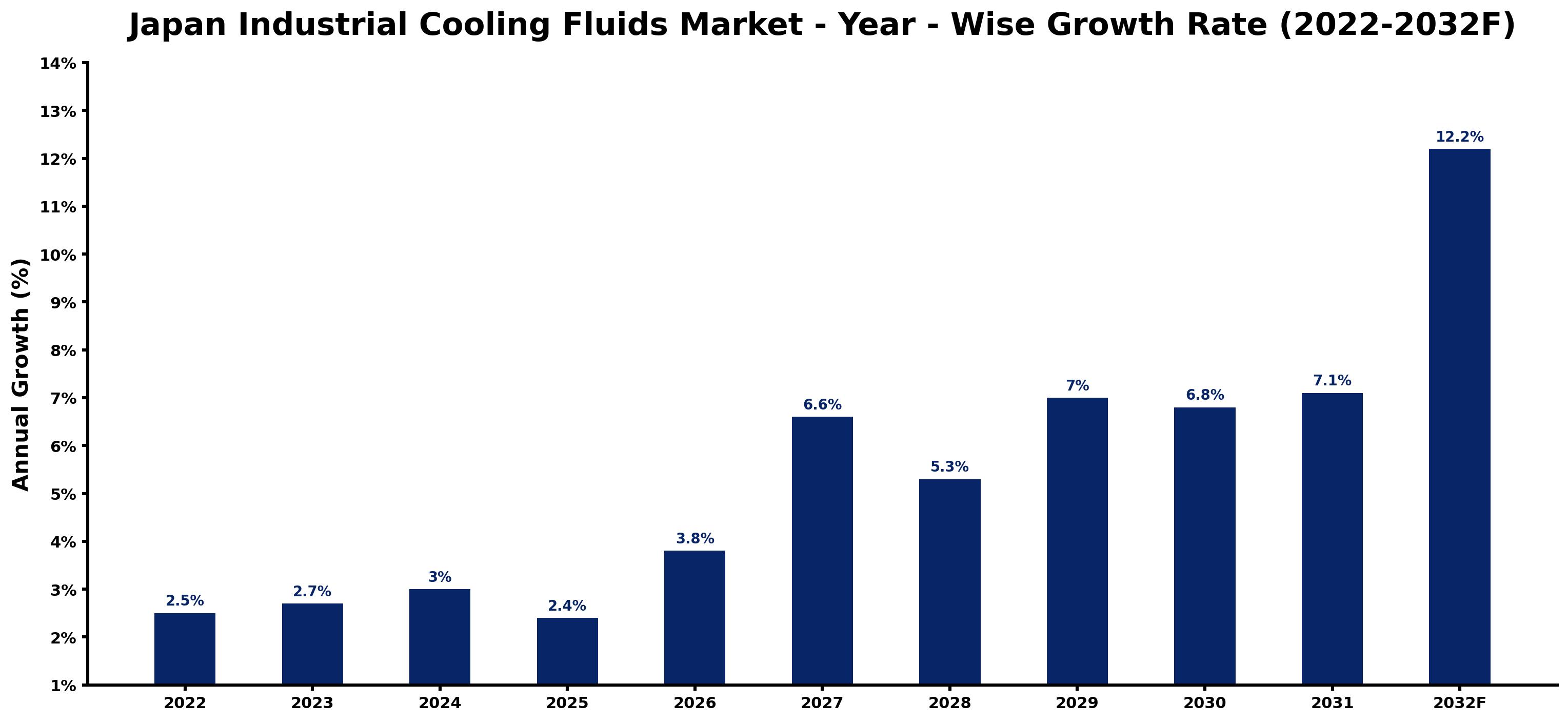
The table below sets out the estimated growth rate for each year and the main factor behind it.
| Year | Estimated Annual Growth (%) | Market Rationale |
| 2022 | 2.5 | The market showed steady growth due to consistent demand from the HVAC sector. |
| 2023 | 2.7 | Growth accelerated as energy efficiency initiatives gained traction among manufacturers. |
| 2024 | 3.0 | Demand increased further with the expansion of semiconductor production in Tokyo. |
| 2025 | 2.4 | Growth slowed slightly as manufacturers adjusted to new environmental regulations. |
| 2026 | 3.8 | The market is expected to grow faster as investments in decarbonisation ramp up. |
| 2027 | 6.6 | Demand is projected to rise significantly with advancements in CNC technology. |
| 2028 | 5.3 | Growth is anticipated to slow as the market adjusts to evolving standards. |
| 2029 | 7.0 | The market will see renewed growth driven by rising demand for eco-friendly solutions. |
| 2030 | 6.8 | Growth is likely to moderate as manufacturers focus on compliance with regulations. |
| 2031 | 7.1 | Demand is expected to rise again as new technologies are adopted in production. |
| 2032 | 12.2 | The market will peak as investments in energy-efficient cooling solutions surge. |
Note: Market size estimations and growth projections presented in this report are based on 6Wresearch's proprietary forecasting methodology, utilizing the latest available industry data, government publications, and primary research inputs.
Japan Industrial Cooling Fluids Market Synopsis
Industrial cooling fluids transfer heat away from machinery and systems, primarily in HVAC systems, metalworking, and electronics. The Japan Industrial Cooling Fluids Market is growing due to rising energy efficiency demands and investments in decarbonisation, with public and private sectors targeting approximately JPY 150 trillion over the next decade. The HVAC market, valued at around 1.5 trillion JPY, contributes to this expansion, alongside the increasing need for sustainable solutions in manufacturing and electronics.
Market Dynamics Impact Analysis (2026–2032)
| Factor | Type | Impact | Primary Segment Affected |
| Growing demand for energy-efficient HVAC systems | Driver | High | HVAC & Process Cooling |
| Rising investments in semiconductor manufacturing | Driver | High | Electronics Cooling |
| Increasing demand for bio-based cooling fluids | Opportunity | Medium | Bio-Based Cooling Fluids |
| Expansion of sustainable facilities in urban areas | Opportunity | Medium | Sustainable Facilities |
| Regulatory compliance costs for hazardous substances | Restraint | High | Oil-Based Cooling Fluids |
| Fluctuating raw material prices affecting production | Restraint | Medium | Synthetic Coolants |
| High costs associated with compliance and testing | Challenge | High | Synthetic Coolants |
| Technological advancements requiring constant updates | Challenge | Medium | Water-Based Coolants |
Evaluation of Drivers in Japan Industrial Cooling Fluids Market (2026–2032)
The following drivers explain most of the expected growth.
| Drivers | Primary Segment Affected | Why It Matters (Evidence) |
| Increased focus on energy efficiency in HVAC systems | HVAC & Process Cooling | Japan's HVAC market, valued at approximately 1.5 trillion JPY, drives demand for cooling fluids. |
| Expansion in semiconductor production capacity | Electronics Cooling | Tokyo accounts for 30% of Japan's semiconductor production, increasing demand for cooling solutions. |
| Rising adoption of bio-based cooling fluids | Bio-Based Cooling Fluids | Environmental regulations are pushing companies to seek sustainable cooling options, enhancing market growth. |
| Growth in the metalworking industry | Oil-Based Cooling Fluids | The metalworking sector employs over 1 million workers, generating significant demand for cooling fluids. |
| Technological advancements in CNC machines | CNC and Machine Tools | The installed base of over 250,000 CNC machines requires effective cooling solutions for optimal performance. |
The strongest pull on demand comes from the increased focus on energy efficiency in HVAC systems, with the market valued at approximately 1.5 trillion JPY. Expansion in semiconductor production capacity in Tokyo, which accounts for 30% of Japan's semiconductor output, drives the need for effective cooling solutions. The metalworking industry, employing over 1 million workers, generates substantial demand for oil-based cooling fluids. Technological advancements in CNC machines, with over 250,000 units installed, further necessitate effective cooling solutions to maintain operational efficiency.
Evaluation of Restraints in Japan Industrial Cooling Fluids Market
The following restraints limit how fast demand can grow.
| Market Restraint | Primary Segment Affected | Why It Matters (Evidence) |
| Regulatory compliance costs for hazardous substances | Oil-Based Cooling Fluids | Compliance with the Industrial Safety and Health Act increases operational costs for producers. |
| Fluctuating raw material prices affecting production | Synthetic Coolants | Volatility in raw material costs can lead to unpredictable pricing for cooling fluids. |
| High costs associated with compliance and testing | Synthetic Coolants | Producers face expenses in meeting safety and environmental standards, impacting profitability. |
| Limited awareness of bio-based options among manufacturers | Bio-Based Cooling Fluids | Many manufacturers are still unfamiliar with the benefits of bio-based cooling fluids, hindering adoption. |
| Technological advancements requiring constant updates | Water-Based Coolants | Producers must continuously invest in R&D to keep up with new technologies, straining budgets. |
Japan Industrial Cooling Fluids Market Challenges
Japan's environmental regulations require a shift to bio-based cooling fluids, raising production costs for manufacturers by approximately 15%. Stricter compliance with ISO 14001 standards necessitates additional investments in quality management, which can delay product launches for producers by up to six months. Rapid technological advancements in energy efficiency compel suppliers to upgrade equipment frequently, straining their budgets. Consequently, buyers face rising prices as manufacturers pass on these costs, leading to an estimated 10% increase in overall operational expenses in the HVAC sector.
Trends in the Japan Industrial Cooling Fluids Market
Several trends are reshaping the Japan Industrial Cooling Fluids Market; the most important are set out below.
- Launch of Energy Efficiency Programme: In 2023, Japan initiated a programme to improve energy efficiency in HVAC systems, aiming to reduce energy consumption by 20%. This initiative encourages manufacturers to invest in advanced cooling technologies, boosting overall market demand.
- Shift Towards Eco-Friendly Cooling Solutions: Manufacturers are increasingly adopting bio-based cooling fluids due to rising environmental regulations. The demand for these fluids is projected to grow by 10.2% annually as sustainability becomes a priority in industrial practices.
- Growth of Sustainable Facilities: The trend towards sustainable facilities is visible in urban areas, with increasing interest in eco-friendly designs. This shift is supported by the Ministry of the Environment's initiatives promoting green building practices, influencing cooling fluid demand.
- Emergence of Advanced CNC Technologies: The metalworking industry is experiencing a shift towards advanced CNC technologies, necessitating improved cooling solutions. This trend is driven by the need for precision in machining processes, increasing demand for effective cooling fluids.
Investment Opportunities in the Japan Industrial Cooling Fluids Market
Where to invest in the Japan Industrial Cooling Fluids Market: the main openings are set out below.
- Gap in Bio-Based Cooling Fluids: With a growing demand for eco-friendly solutions, the market for bio-based cooling fluids is expanding, projected to increase by 10.2% annually. Manufacturers can target this segment by developing new products that meet sustainability standards.
- Investment in Sustainable Facilities: The push for sustainable facilities in urban areas presents opportunities for suppliers of eco-friendly cooling solutions. Collaborating with local construction firms can facilitate market entry and enhance product visibility.
- Expansion of Semiconductor Facilities: Tokyo's semiconductor production is a significant growth area, with demand for advanced cooling solutions increasing. Suppliers can enter this market by partnering with local manufacturers to provide tailored cooling fluids.
- Rising Demand for Energy-Efficient HVAC Systems: The HVAC market's value of approximately 1.5 trillion JPY indicates a substantial opportunity for suppliers of energy-efficient cooling fluids. Engaging with HVAC contractors can enhance market presence and drive sales.
Government Initiatives in the Japan Industrial Cooling Fluids Market
The GX Promotion Act, adopted in 2023, reinforces Japan's commitment to decarbonisation, building on earlier legislation aimed at improving energy efficiency. This new law facilitates investments in energy-efficient technologies, impacting producers and buyers of industrial cooling fluids by promoting compliance with sustainability standards.
The Ministry of Economy, Trade and Industry (METI) oversees the implementation of energy efficiency standards and funds initiatives to promote advanced manufacturing technologies. This agency is responsible for approving projects that improve energy efficiency in industrial processes, directly benefiting industrial cooling fluid producers.
Future Insight of the Japan Industrial Cooling Fluids Market
Investment in decarbonisation will spur demand for advanced cooling fluids by 2032, particularly in the metalworking sector. The ongoing programme to enhance energy efficiency in HVAC systems will motivate suppliers to develop new solutions. Japan's commitment to net-zero emissions will drive the creation of eco-friendly options, aligning with market expectations. As Tokyo remains a semiconductor production hub, the need for reliable cooling fluids will continue to support operational efficiency.
Market Segmentation Analysis
Japan Industrial Cooling Fluids Market report covers a detailed analysis of the following market segments:
By Fluid Type – Water-Based Coolants Lead, Bio-Based Cooling Fluids Expected to Grow Fastest
According to Saurav Kr Singh, Senior Research Analyst at 6Wresearch, Water-Based Coolants held 48% of the Japan Industrial Cooling Fluids Market by fluid type in 2025. Water-based coolants dominate the market primarily due to their extensive use in HVAC systems, essential for regulating temperatures in various industrial applications. The significance of these fluids is underscored by the valuation of Japan's HVAC market at approximately 1.5 trillion JPY. Bio-Based Cooling Fluids are set to record the highest CAGR in this split, 10.2% over 2026–2032. The surge in bio-based cooling fluids is attributed to stringent environmental regulations that encourage the adoption of sustainable practices across industries. This trend is reinforced by Japan's commitment to a 46% reduction in greenhouse gas emissions by 2030, driving demand for eco-friendly alternatives. This trend indicates that suppliers should focus on developing bio-based options to meet the increasing demand for sustainable cooling solutions.
By Base Material – Glycol/Water Blend Leads, Vegetable Oil Derivatives Expected to Grow Fastest
The largest base material category in 2025 was Glycol/Water Blend, at 37% of revenue. The glycol/water blend holds the largest share as it is extensively utilised in HVAC systems for its effectiveness in lowering freezing points, making it ideal for temperature control. This blend is critical in maintaining optimal conditions in various industrial settings across Japan. The quickest growth will come from Vegetable Oil Derivatives, forecast to expand at a CAGR of 10.4% between 2026 and 2032. Vegetable oil derivatives are gaining traction due to the growing emphasis on eco-friendly applications, reflecting a shift towards sustainability in industrial practices. This aligns with the Ministry of the Environment's promotion of environmentally responsible manufacturing processes. Buyers are increasingly prioritising sustainable materials, prompting suppliers to innovate in product development.
By Cooling Application – HVAC & Process Cooling Leads, Eco Applications Expected to Grow Fastest
In 2025, HVAC & Process Cooling led the cooling application split with a 46% share. HVAC and process cooling applications lead the market as they are vital for temperature regulation in buildings and industrial facilities, ensuring operational efficiency. Their importance is underscored by the average temperature maintenance of 22°C in industrial environments. Eco Applications are projected to grow fastest, at a CAGR of 9.6% during 2026–2032. Eco applications are experiencing rapid growth as interest in sustainable cooling solutions rises, driven by consumer and regulatory pressures for greener alternatives. This reflects a broader trend towards sustainability in industrial practices. Suppliers must adapt to the growing preference for eco-friendly cooling solutions to remain competitive.
By End User – HVAC Systems Lead, Sustainable Facilities Expected to Grow Fastest
With 42% of end user revenue in 2025, HVAC Systems was the largest category. HVAC systems represent the largest end user of industrial cooling fluids due to their critical role in maintaining comfortable and safe environments in various buildings. This sector's significance is highlighted by Japan's large population, which drives continuous demand for effective HVAC solutions. Over 2026–2032, Sustainable Facilities are expected to post the fastest growth, at a CAGR of 9.5%. Sustainable facilities are emerging as the fastest-growing end user segment, reflecting a shift towards green building designs that prioritise environmental responsibility. This trend aligns with Japan's ambitious decarbonisation goals and investment in eco-friendly infrastructure. Suppliers should target the sustainable facilities segment to capture emerging opportunities in the market.
Key Attractiveness of the Report
- 10 Years of Market Numbers
- Historical Data Starting from 2022 to 2025
- Base Year 2025
- Forecast Data until 2032
- Key Performance Indicators Impacting the Market
- Major Upcoming Developments and Projects
Key Highlights of the Report:
- Japan Industrial Cooling Fluids Market Outlook
- Market Size of Japan Industrial Cooling Fluids Market, 2025
- Forecast of Japan Industrial Cooling Fluids Market, 2032
- Historical Data and Forecast of Japan Industrial Cooling Fluids Revenues & Volume for the Period 2022-2032F
- Japan Industrial Cooling Fluids Market Trend Evolution
- Japan Industrial Cooling Fluids Market Drivers and Challenges
- Japan Industrial Cooling Fluids Price Trends
- Japan Industrial Cooling Fluids Porter's Five Forces
- Japan Industrial Cooling Fluids Industry Life Cycle
- Historical Data and Forecast of Japan Industrial Cooling Fluids Market Revenues & Volume By Fluid Type for the Period 2022-2032F
- Historical Data and Forecast of Japan Industrial Cooling Fluids Market Revenues & Volume By Water-Based Coolants for the Period 2022-2032F
- Historical Data and Forecast of Japan Industrial Cooling Fluids Market Revenues & Volume By Oil-Based Cooling Fluids for the Period 2022-2032F
- Historical Data and Forecast of Japan Industrial Cooling Fluids Market Revenues & Volume By Synthetic Coolants for the Period 2022-2032F
- Historical Data and Forecast of Japan Industrial Cooling Fluids Market Revenues & Volume By Bio-Based Cooling Fluids for the Period 2022-2032F
- Historical Data and Forecast of Japan Industrial Cooling Fluids Market Revenues & Volume By Base Material for the Period 2022-2032F
- Historical Data and Forecast of Japan Industrial Cooling Fluids Market Revenues & Volume By Glycol/Water Blend for the Period 2022-2032F
- Historical Data and Forecast of Japan Industrial Cooling Fluids Market Revenues & Volume By Mineral/Synthetic Oil for the Period 2022-2032F
- Historical Data and Forecast of Japan Industrial Cooling Fluids Market Revenues & Volume By PAG, Silicates for the Period 2022-2032F
- Historical Data and Forecast of Japan Industrial Cooling Fluids Market Revenues & Volume By Vegetable Oil Derivatives for the Period 2022-2032F
- Historical Data and Forecast of Japan Industrial Cooling Fluids Market Revenues & Volume By Cooling Application for the Period 2022-2032F
- Historical Data and Forecast of Japan Industrial Cooling Fluids Market Revenues & Volume By HVAC & Process Cooling for the Period 2022-2032F
- Historical Data and Forecast of Japan Industrial Cooling Fluids Market Revenues & Volume By CNC and Machine Tools for the Period 2022-2032F
- Historical Data and Forecast of Japan Industrial Cooling Fluids Market Revenues & Volume By Electronics Cooling for the Period 2022-2032F
- Historical Data and Forecast of Japan Industrial Cooling Fluids Market Revenues & Volume By Eco Applications for the Period 2022-2032F
- Historical Data and Forecast of Japan Industrial Cooling Fluids Market Revenues & Volume By End User for the Period 2022-2032F
- Historical Data and Forecast of Japan Industrial Cooling Fluids Market Revenues & Volume By HVAC Systems for the Period 2022-2032F
- Historical Data and Forecast of Japan Industrial Cooling Fluids Market Revenues & Volume By Metalworking Industry for the Period 2022-2032F
- Historical Data and Forecast of Japan Industrial Cooling Fluids Market Revenues & Volume By Semiconductor Industry for the Period 2022-2032F
- Historical Data and Forecast of Japan Industrial Cooling Fluids Market Revenues & Volume By Sustainable Facilities for the Period 2022-2032F
- Japan Industrial Cooling Fluids Import Export Trade Statistics
- Market Opportunity Assessment By Fluid Type
- Market Opportunity Assessment By Base Material
- Market Opportunity Assessment By Cooling Application
- Market Opportunity Assessment By End User
- Japan Industrial Cooling Fluids Top Companies Market Share
- Japan Industrial Cooling Fluids Competitive Benchmarking By Technical and Operational Parameters
- Japan Industrial Cooling Fluids Company Profiles
- Japan Industrial Cooling Fluids Key Strategic Recommendations
Market Covered
The report covers the following segments.
By Fluid Type
- Water-Based Coolants
- Oil-Based Cooling Fluids
- Synthetic Coolants
- Bio-Based Cooling Fluids
By Base Material
- Glycol/Water Blend
- Mineral/Synthetic Oil
- PAG
- Silicates
- Vegetable Oil Derivatives
By Cooling Application
- HVAC & Process Cooling
- CNC and Machine Tools
- Electronics Cooling
- Eco Applications
By End User
- HVAC Systems
- Metalworking Industry
- Semiconductor Industry
- Sustainable Facilities































