Japan Industrial Cooling Solutions Market Size & Growth Rate
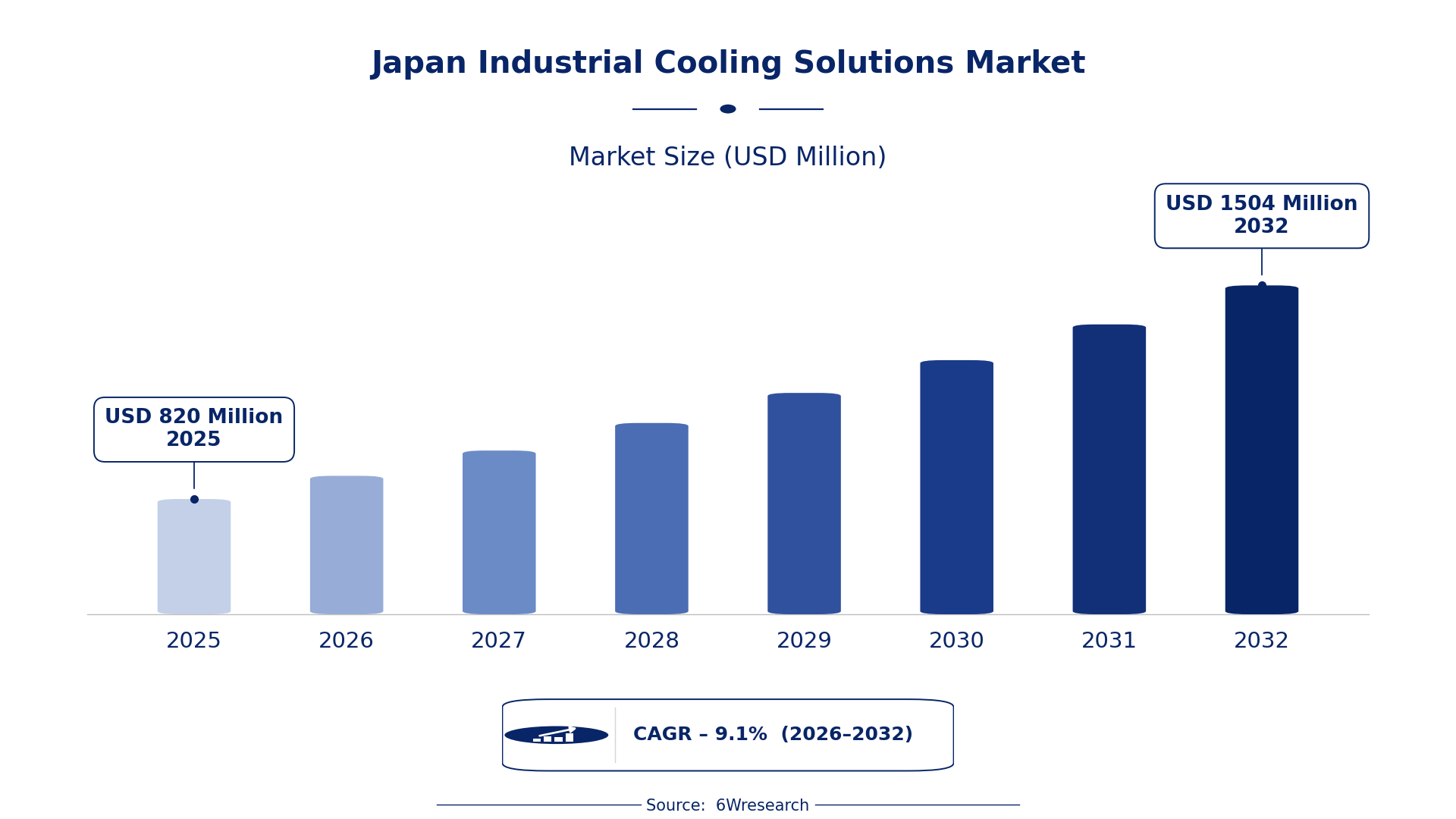
According to 6Wresearch internal database and industry insights, the Japan Industrial Cooling Solutions Market was valued at USD 820 Million in 2025 and is projected to reach USD 1,504 Million by 2032, growing at a CAGR of approximately 9.1% during 2026–2032.
Japan Industrial Cooling Solutions Market Highlights
| Report Metric | Details |
| Report Name | Japan Industrial Cooling Solutions Market (2026-2032) |
| Market Size 2025 | USD 820 Million |
| Market Size 2032 | USD 1,504 Million |
| Absolute Growth 2025–2032 | USD 684 Million |
| CAGR 2026–2032 | 9.1% |
| Peak Annual Growth | 10.7% in 2032 |
| Forecast Period | 2026–2032 |
| Historical Data | 2022–2025 |
| Base Year | 2025 |
| Leading Solution Type, 2025 | Evaporative Cooling (45% share) |
| Leading Cooling Medium, 2025 | Water + Air (45% share) |
| Leading Setup Type, 2025 | Outdoor/Indoor (54% share) |
| Leading End User, 2025 | Power Plants (34% share) |
| Fastest-Growing Solution Type | Chiller Systems (12.8% CAGR) |
| Fastest-Growing Cooling Medium | Refrigerant-Based (11.9% CAGR) |
| Fastest-Growing Setup Type | Modular/Packaged (13.2% CAGR) |
| Fastest-Growing End User | Data Centers (12.1% CAGR) |
| Growing Sector | energy and technology |
| Key End Users | power plants, data centers, oil refineries, manufacturing |
Japan Industrial Cooling Solutions Market Year-wise Growth Rate and Key Drivers (2022–2032)
This graph illustrates the annual growth rates of the market from 2022 to 2032, highlighting a steady upward trajectory and projected market expansion over the forecast period.
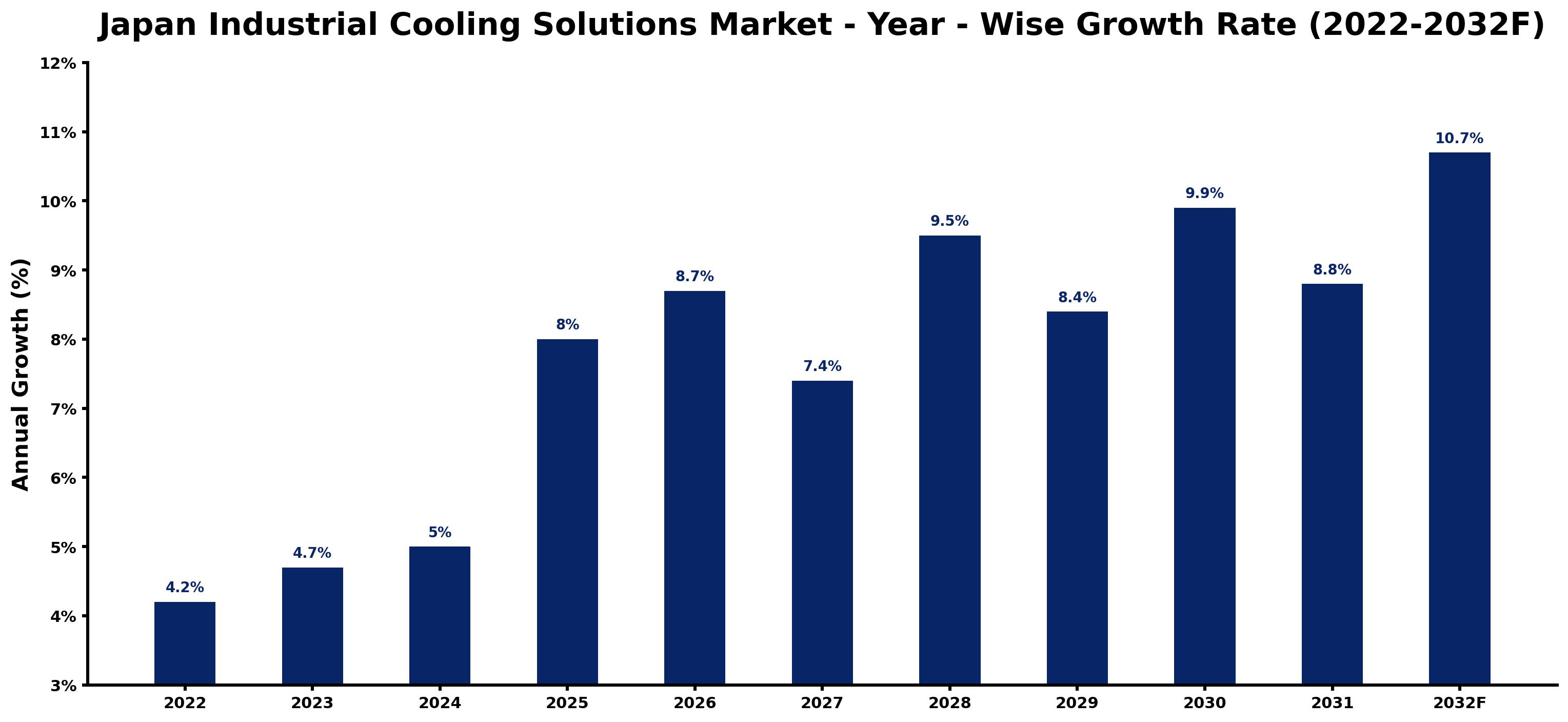
The yearly estimates that follow link every growth rate to its principal driver, so readers can see why the pace changed in each period.
| Year | Estimated Annual Growth (%) | Market Rationale |
| 2022 | 4.2 | The market showed steady growth due to ongoing industrial activities. |
| 2023 | 4.7 | Demand increased as energy efficiency measures gained traction. |
| 2024 | 5.0 | Growth continued with rising temperatures boosting cooling needs. |
| 2025 | 8.0 | The market peaked as investments in cooling technologies surged. |
| 2026 | 8.7 | Demand is expected to remain strong due to ongoing decarbonisation efforts. |
| 2027 | 7.4 | Growth is projected to slow slightly as the market stabilises after rapid expansion. |
| 2028 | 9.5 | Demand is expected to rebound as new projects in manufacturing emerge. |
| 2029 | 8.4 | Growth is projected to decelerate as market adjustments take place post-peak. |
| 2030 | 9.9 | Demand is expected to accelerate with heightened focus on energy efficiency. |
| 2031 | 8.8 | Growth is projected to slow as the market approaches saturation in some segments. |
| 2032 | 10.7 | The market is expected to peak again as advanced cooling solutions gain traction. |
Note: Market size estimations and growth projections presented in this report are based on 6Wresearch's proprietary forecasting methodology, utilizing the latest available industry data, government publications, and primary research inputs.
Japan Industrial Cooling Solutions Market Synopsis
Industrial cooling solutions in Japan encompass technologies designed to manage heat in various industrial processes, particularly in power generation and data centers. The total installed base of these systems exceeds 200,000 units, reflecting strong demand driven by Japan's commitment to reducing greenhouse gas emissions and increasing investments in energy-efficient technologies. The government's GX Basic Policy aims for substantial decarbonisation investment, further propelling market growth.
Market Dynamics Impact Analysis (2026–2032)
| Factor | Type | Impact | Primary Segment Affected |
| Rising temperatures drive demand for efficient cooling solutions. | Driver | High | Evaporative Cooling |
| Investment in energy-efficient technologies supports market expansion. | Driver | High | Chiller Systems |
| Growing data center infrastructure creates new cooling requirements. | Opportunity | High | Closed-Loop Cooling |
| Increased focus on decarbonisation opens avenues for innovative solutions. | Opportunity | High | Refrigerant-Based |
| High initial costs of advanced cooling systems limit adoption. | Restraint | Medium | Integrated |
| Regulatory compliance can be burdensome for manufacturers. | Restraint | Medium | Modular/Packaged |
| Supply chain disruptions affect availability of components. | Challenge | High | Chiller Systems |
| Technological advancements can outpace market readiness. | Challenge | Medium | Evaporative Cooling |
Evaluation of Drivers in Japan Industrial Cooling Solutions Market (2026–2032)
The factors lifting demand, and the evidence behind each, are summarised below.
| Drivers | Primary Segment Affected | Why It Matters (Evidence) |
| Increased energy efficiency initiatives drive demand for cooling solutions. | Evaporative Cooling | Japan's target to reduce energy consumption in industrial cooling by 15% by 2025 encourages investment in efficient systems. |
| Growing industrial activities boost the need for reliable cooling systems. | Chiller Systems | The total installed base of industrial cooling systems indicates a strong market presence. |
| Rising temperatures necessitate advanced cooling technologies. | Closed-Loop Cooling | The average temperature in industrial facilities is maintained at 20-25°C, increasing cooling requirements. |
| The expansion of data centers creates new cooling demands. | Refrigerant-Based | The Tokyo metropolitan area has a high concentration of data centers requiring advanced cooling solutions. |
| Decarbonisation investments drive innovation in cooling technologies. | Integrated | Japan's GX Basic Policy targets about JPY 150 trillion of public and private decarbonisation investment over 10 years. |
The installed base of industrial cooling systems reflects strong demand from sectors like power generation and manufacturing. Rising temperatures necessitate advanced solutions, as the average temperature in industrial facilities is maintained at 20-25°C. The expansion of data centers in the Tokyo metropolitan area further drives demand for reliable systems.
Evaluation of Restraints in Japan Industrial Cooling Solutions Market
The main factors holding the market back are set out below.
| Market Restraint | Primary Segment Affected | Why It Matters (Evidence) |
| High initial costs hinder the adoption of advanced cooling systems. | Integrated | Investments in advanced solutions can be prohibitive for smaller manufacturers. |
| Regulatory compliance can burden manufacturers and suppliers. | Modular/Packaged | The Industrial Safety and Health Act imposes strict requirements on hazardous substances. |
| Supply chain disruptions affect the availability of cooling components. | Chiller Systems | Global supply chain issues have delayed the delivery of essential parts. |
| Technological advancements can outpace market readiness. | Evaporative Cooling | Rapid innovation may lead to a gap in user familiarity with new systems. |
| Limited water resources can restrict evaporative cooling applications. | Dry Cooling Systems | Certain regions face challenges in sourcing adequate water for cooling. |
Japan Industrial Cooling Solutions Market Challenges
High operational costs burden buyers due to a shortage of skilled technicians for industrial cooling systems, stemming from an ageing workforce and inadequate training programmes. Regulatory compliance with standards like JIS B 8616 raises initial investment costs for buyers by approximately 15%, complicating project budgets. Suppliers face increased costs from stringent energy regulations aimed at reducing energy consumption in industrial cooling by 15% by 2025, which can delay project timelines. Competition intensifies as the market shifts towards integrated cooling solutions, leading to price volatility that can fluctuate by 10% annually, impacting buyers' procurement strategies.
Trends in the Japan Industrial Cooling Solutions Market
Buyers and suppliers in the Japan Industrial Cooling Solutions Market are adjusting to the following trends.
- Shift from Traditional to Integrated Cooling Solutions: Since 2023, the adoption of integrated cooling solutions has increased in new industrial projects across Japan. This shift is prompted by the need for synergy in complex systems, with new installations expected to rise significantly.
- Transition from Water-Based to Refrigerant-Based Systems: In 2023, a rise in demand for refrigerant-based cooling systems was reported, reflecting a shift towards more efficient technologies. Approximately 45% of cooling solutions now utilise this medium.
- Emergence of Modular Cooling Systems: The trend towards modular cooling systems began in 2023, with a CAGR of 13.2% projected for the next decade. This flexibility allows for easier installation in diverse industrial environments.
- Prioritisation of Energy Efficiency Standards: The introduction of JIS B 8616 in 2023 has set new standards for evaporative cooling systems. This regulation aims to improve energy efficiency across the industry.
Investment Opportunities in the Japan Industrial Cooling Solutions Market
Several openings in the Japan Industrial Cooling Solutions Market merit attention from investors.
- Investment in Energy-Efficient Technologies: With Japan targeting a 15% reduction in energy consumption by 2025, there is a strong opportunity for suppliers of energy-efficient cooling technologies. Power plants are key buyers in this initiative.
- Expansion of Data Centers: The Tokyo metropolitan area, with its high concentration of data centers, presents a significant opportunity for advanced cooling solutions. This sector is expected to grow rapidly, driven by increasing digital demands.
- Development of Integrated Cooling Systems: The need for synergy in complex industrial processes creates a demand for integrated cooling solutions. Collaborating with manufacturers in the Kansai region can facilitate market entry.
- Focus on Decarbonisation Investments: Japan's GX Basic Policy, targeting JPY 150 trillion in decarbonisation investments, opens avenues for innovative cooling solutions. Engaging with industrial sectors prioritising sustainability will be essential.
Government Initiatives in the Japan Industrial Cooling Solutions Market
The GX Promotion Act, adopted in 2023, strengthens the legal framework for decarbonisation efforts in Japan. It builds on the Act on the Rational Use of Energy, which obliges large energy users to improve efficiency. This newer act enhances reporting requirements and encourages investment in energy-efficient technologies, directly impacting industrial cooling solutions.
The Ministry of the Environment oversees the implementation of energy efficiency standards and funds initiatives promoting advanced cooling technologies. In 2023, the ministry launched a program to promote energy-efficient cooling solutions, targeting a 15% reduction in energy consumption by 2025. This initiative supports both producers and buyers in adopting modern cooling systems.
Future Insight of the Japan Industrial Cooling Solutions Market
Investment in decarbonisation initiatives will create robust demand for advanced cooling technologies by 2032. The implementation of energy-efficient cooling systems will lead to a notable reduction in energy consumption across industrial applications. New standards will streamline operations for suppliers, while the concentration of data centers in the Tokyo metropolitan area will attract further investment to enhance cooling infrastructure. Enhanced focus on sustainability will drive innovation in cooling technologies, providing significant benefits for both buyers and suppliers.
Market Segmentation Analysis
Japan Industrial Cooling Solutions Market report covers a detailed analysis of the following market segments:
By Solution Type – Evaporative Cooling Leads, Chiller Systems Expected to Grow Fastest
According to Saurav Kr Singh, Senior Research Analyst at 6Wresearch, Evaporative Cooling accounted for 45% of the market by solution type in 2025. Evaporative cooling systems dominate the market due to their extensive application in energy-efficient cooling, particularly in power plants. Their ability to effectively manage heat while minimising energy use makes them a preferred choice in industrial settings. Chiller Systems are set to record the highest CAGR in this split, 12.8% over 2026–2032. Chiller systems are growing rapidly as they are essential for maintaining temperature control in various industrial applications, particularly in data centres. The rising demand for reliable cooling solutions in these sectors will continue to drive their adoption. Suppliers should focus on improving the efficiency and reliability of chiller systems to meet the increasing industrial needs.
By Cooling Medium – Water + Air Leads, Refrigerant-Based Expected to Grow Fastest
With 45% of cooling medium revenue in 2025, Water + Air was the largest category. Water and air are the primary cooling mediums, widely utilised in numerous industrial applications due to their availability and effectiveness. This combination is particularly favoured in power generation and manufacturing processes across Japan. The quickest growth will come from Refrigerant-Based, forecast to expand at a CAGR of 11.9% between 2026 and 2032. Refrigerant-based cooling systems are gaining traction as they are commonly used in HVAC systems, which are integral to maintaining comfortable environments in data centers. The rising demand for these systems reflects a shift towards more efficient cooling technologies. Buyers may benefit from exploring refrigerant-based solutions to improve energy efficiency in their operations.
By Setup Type – Outdoor/Indoor Leads, Modular/Packaged Expected to Grow Fastest
Outdoor/Indoor took 54% of setup type revenue in 2025, more than any other category. Outdoor and indoor setups lead the market as they are designed to cater to the specific environmental requirements of diverse applications. This adaptability allows industries to optimise their cooling solutions based on facility design and operational requirements. Modular/Packaged is projected to grow fastest, at a CAGR of 13.2% during 2026–2032. Modular and packaged setups are experiencing the fastest growth due to their ease of installation and flexibility in different industrial environments. This trend is particularly noticeable in new projects where space and efficiency are paramount. Suppliers should consider providing more modular solutions to address the rising demand for flexible installations.
By End User – Power Plants Lead, Data Centers Expected to Grow Fastest
In 2025, Power Plants led the end user split with a 34% share. Power plants are the largest users of industrial cooling solutions due to their necessity for efficient heat management and compliance with environmental regulations. This sector's extensive installed base, particularly in regions like Kanto, underscores its importance in the market. Over 2026–2032, Data Centers are expected to post the fastest growth, at a CAGR of 12.1%. Data centres are witnessing rapid growth as they demand advanced cooling technologies to ensure operational stability amidst rising heat loads from high-density computing. The concentration of data centres in urban areas significantly contributes to this increasing demand. Suppliers should focus on creating specialised cooling solutions for data centres to leverage the growth potential in this segment.
Key Attractiveness of the Report
- 10 Years of Market Numbers
- Historical Data Starting from 2022 to 2025
- Base Year 2025
- Forecast Data until 2032
- Key Performance Indicators Impacting the Market
- Major Upcoming Developments and Projects
Key Highlights of the Report:
- Japan Industrial Cooling Solutions Market Outlook
- Market Size of Japan Industrial Cooling Solutions Market, 2025
- Forecast of Japan Industrial Cooling Solutions Market, 2032
- Historical Data and Forecast of Japan Industrial Cooling Solutions Revenues & Volume for the Period 2022-2032F
- Japan Industrial Cooling Solutions Market Trend Evolution
- Japan Industrial Cooling Solutions Market Drivers and Challenges
- Japan Industrial Cooling Solutions Price Trends
- Japan Industrial Cooling Solutions Porter's Five Forces
- Japan Industrial Cooling Solutions Industry Life Cycle
- Historical Data and Forecast of Japan Industrial Cooling Solutions Market Revenues & Volume By Solution Type for the Period 2022-2032F
- Historical Data and Forecast of Japan Industrial Cooling Solutions Market Revenues & Volume By Evaporative Cooling for the Period 2022-2032F
- Historical Data and Forecast of Japan Industrial Cooling Solutions Market Revenues & Volume By Chiller Systems for the Period 2022-2032F
- Historical Data and Forecast of Japan Industrial Cooling Solutions Market Revenues & Volume By Closed-Loop Cooling for the Period 2022-2032F
- Historical Data and Forecast of Japan Industrial Cooling Solutions Market Revenues & Volume By Dry Cooling Systems for the Period 2022-2032F
- Historical Data and Forecast of Japan Industrial Cooling Solutions Market Revenues & Volume By Cooling Medium for the Period 2022-2032F
- Historical Data and Forecast of Japan Industrial Cooling Solutions Market Revenues & Volume By Water + Air for the Period 2022-2032F
- Historical Data and Forecast of Japan Industrial Cooling Solutions Market Revenues & Volume By Refrigerant-Based for the Period 2022-2032F
- Historical Data and Forecast of Japan Industrial Cooling Solutions Market Revenues & Volume By Coolant Circulation for the Period 2022-2032F
- Historical Data and Forecast of Japan Industrial Cooling Solutions Market Revenues & Volume By Air-Based for the Period 2022-2032F
- Historical Data and Forecast of Japan Industrial Cooling Solutions Market Revenues & Volume By Setup Type for the Period 2022-2032F
- Historical Data and Forecast of Japan Industrial Cooling Solutions Market Revenues & Volume By Outdoor/Indoor for the Period 2022-2032F
- Historical Data and Forecast of Japan Industrial Cooling Solutions Market Revenues & Volume By Modular/Packaged for the Period 2022-2032F
- Historical Data and Forecast of Japan Industrial Cooling Solutions Market Revenues & Volume By Integrated for the Period 2022-2032F
- Historical Data and Forecast of Japan Industrial Cooling Solutions Market Revenues & Volume By Standalone for the Period 2022-2032F
- Historical Data and Forecast of Japan Industrial Cooling Solutions Market Revenues & Volume By End User for the Period 2022-2032F
- Historical Data and Forecast of Japan Industrial Cooling Solutions Market Revenues & Volume By Power Plants for the Period 2022-2032F
- Historical Data and Forecast of Japan Industrial Cooling Solutions Market Revenues & Volume By Data Centers for the Period 2022-2032F
- Historical Data and Forecast of Japan Industrial Cooling Solutions Market Revenues & Volume By Oil Refineries for the Period 2022-2032F
- Historical Data and Forecast of Japan Industrial Cooling Solutions Market Revenues & Volume By Industrial Furnaces for the Period 2022-2032F
- Japan Industrial Cooling Solutions Import Export Trade Statistics
- Market Opportunity Assessment By Solution Type
- Market Opportunity Assessment By Cooling Medium
- Market Opportunity Assessment By Setup Type
- Market Opportunity Assessment By End User
- Japan Industrial Cooling Solutions Top Companies Market Share
- Japan Industrial Cooling Solutions Competitive Benchmarking By Technical and Operational Parameters
- Japan Industrial Cooling Solutions Company Profiles
- Japan Industrial Cooling Solutions Key Strategic Recommendations
Market Covered
The study includes the following segmentation.
By Solution Type
- Evaporative Cooling
- Chiller Systems
- Closed-Loop Cooling
- Dry Cooling Systems
By Cooling Medium
- Water + Air
- Refrigerant-Based
- Coolant Circulation
- Air-Based
By Setup Type
- Outdoor/Indoor
- Modular/Packaged
- Integrated
- Standalone
By End User
- Power Plants
- Data Centers
- Oil Refineries
- Industrial Furnaces































