Japan Industrial Dispensing Systems Market Size & Growth Rate
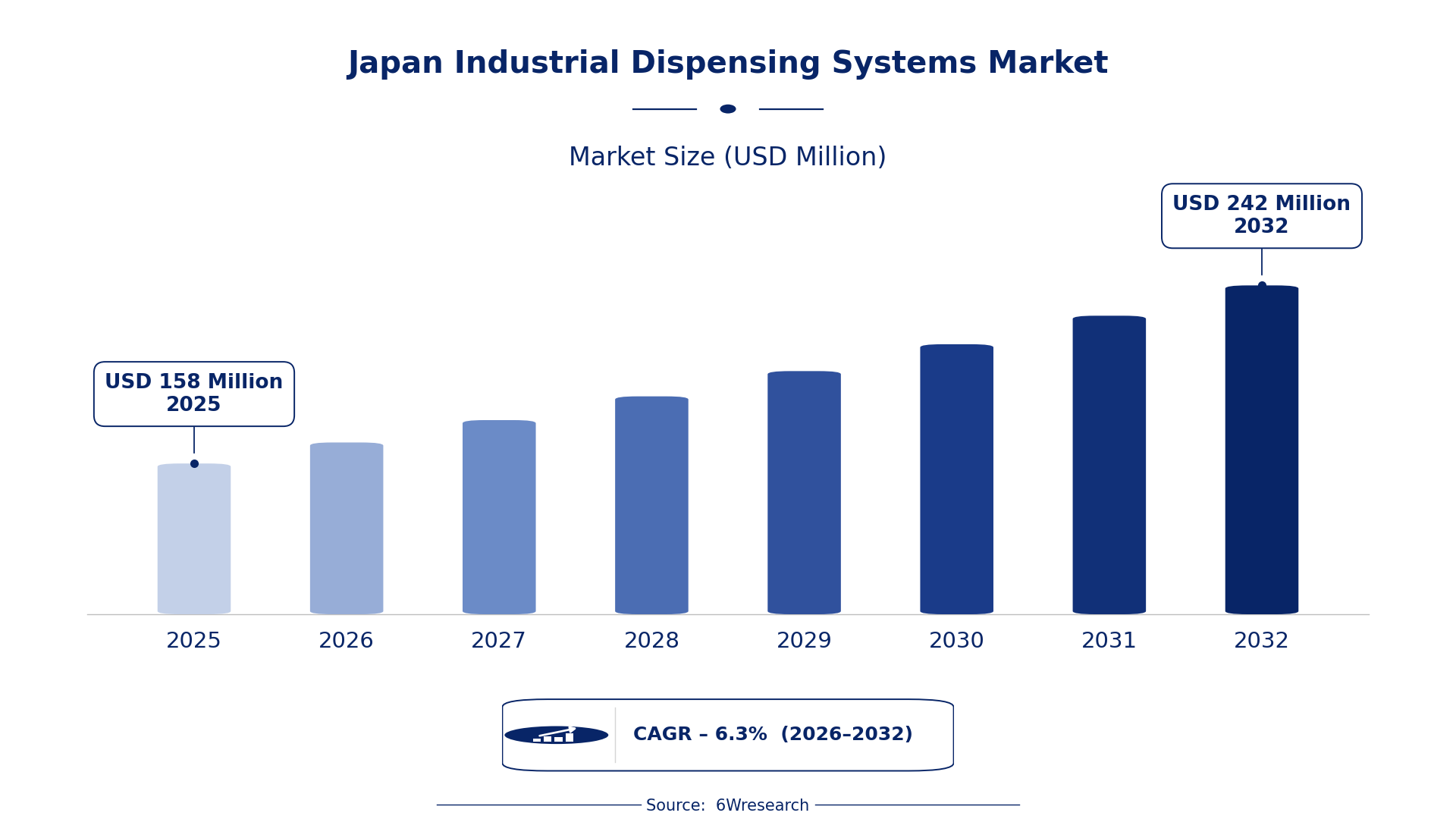
According to 6Wresearch internal database and industry insights, the Japan Industrial Dispensing Systems Market was valued at USD 158 Million in 2025 and is projected to reach USD 242 Million by 2032, growing at a CAGR of approximately 6.3% during 2026–2032.
Japan Industrial Dispensing Systems Market Highlights
| Report Metric | Details |
| Report Name | Japan Industrial Dispensing Systems Market (2026-2032) |
| Market Size 2025 | USD 158 Million |
| Market Size 2032 | USD 242 Million |
| Absolute Growth 2025–2032 | USD 84 Million |
| CAGR 2026–2032 | 6.3% |
| Peak Annual Growth | 7.4% in 2032 |
| Forecast Period | 2026–2032 |
| Historical Data | 2022–2025 |
| Base Year | 2025 |
| Leading Dispensing Method, 2025 | Volumetric Dispensing (52% share) |
| Leading Material Type, 2025 | Adhesives (43% share) |
| Leading Control Mode, 2025 | PLC-Controlled (45% share) |
| Leading End User, 2025 | PCB Assembly Lines (51% share) |
| Fastest-Growing Dispensing Method | Spray Dispensing (8.9% CAGR) |
| Fastest-Growing Material Type | Gels (9.3% CAGR) |
| Fastest-Growing Control Mode | Sensor-Based (8.6% CAGR) |
| Fastest-Growing End User | Automotive Assembly (8.2% CAGR) |
| Growing Sector | Automotive Assembly |
| Key End Users | Electronics OEMs, Automotive Assembly, Aerospace Manufacturing |
Japan Industrial Dispensing Systems Market Year-wise Growth Rate and Key Drivers (2022–2032)
This graph illustrates the annual growth rates of the market from 2022 to 2032, highlighting a steady upward trajectory and projected market expansion over the forecast period.
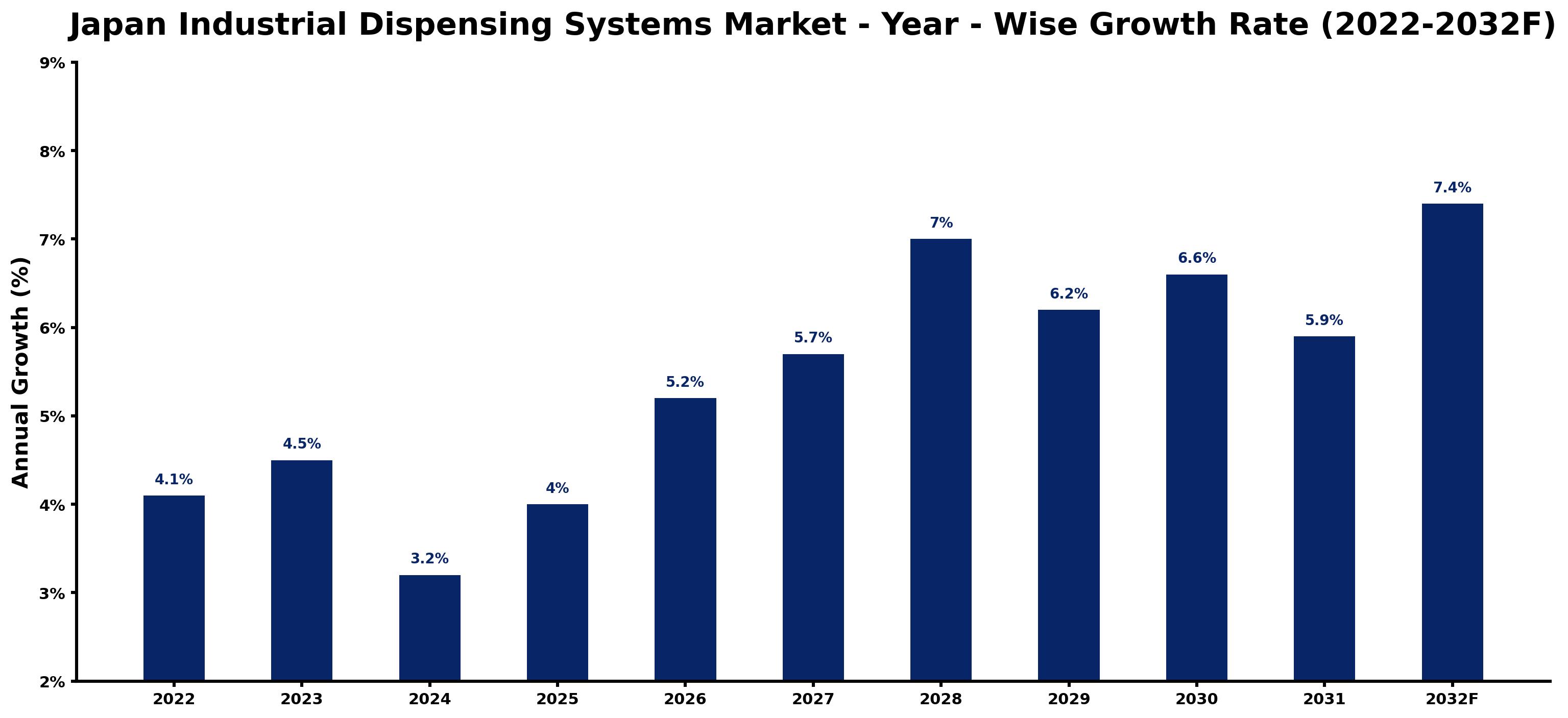
For each year, the table pairs the estimated growth rate with the leading influence on demand, showing how the drivers changed across the period.
| Year | Estimated Annual Growth (%) | Market Rationale |
| 2022 | 4.1 | The market experienced steady growth due to ongoing demand from the electronics sector. |
| 2023 | 4.5 | Growth accelerated as automotive production increased, driving higher demand for dispensing systems. |
| 2024 | 3.2 | The market saw a slowdown as manufacturers adjusted to supply chain challenges. |
| 2025 | 4.0 | Demand rose again with advancements in automation technologies boosting production capacity. |
| 2026 | 5.2 | The introduction of new manufacturing standards is expected to improve efficiency and drive sales. |
| 2027 | 5.7 | Increased investments in robotics are set to further support market growth. |
| 2028 | 7.0 | The market is likely to benefit from rising automotive assembly requirements and innovations. |
| 2029 | 6.2 | A slight slowdown occurs as the market stabilises after rapid growth phases. |
| 2030 | 6.6 | Continued advancements in technology are projected to sustain growth momentum. |
| 2031 | 5.9 | Growth moderates as the market adjusts to new regulatory standards and practices. |
| 2032 | 7.4 | The market peaks as demand from the electronics sector reaches new heights. |
Note: Market size estimations and growth projections presented in this report are based on 6Wresearch's proprietary forecasting methodology, utilizing the latest available industry data, government publications, and primary research inputs.
Japan Industrial Dispensing Systems Market Synopsis
Industrial dispensing systems are advanced technologies used for precise application of materials such as adhesives and coatings, primarily in assembly lines within the electronics and automotive industries. The Japan Industrial Dispensing Systems Market is growing due to increased production in the automotive sector, which produced over 8 million vehicles in 2022, and the electronics sector, expected to consume 40% of dispensing systems by 2025. Government initiatives supporting automation and advanced manufacturing technologies are driving further demand, with a budget of ¥50 billion allocated for these efforts in 2023.
Market Dynamics Impact Analysis (2026–2032)
| Factor | Type | Impact | Primary Segment Affected |
| Rising automotive production increases the need for precise dispensing systems. | Driver | High | Automotive Assembly |
| Growing demand for high-speed applications in electronics drives innovation in dispensing technologies. | Driver | High | Jet Dispensing Systems |
| The push for automation in manufacturing creates opportunities for suppliers of advanced dispensing systems. | Opportunity | High | PLC-Controlled |
| Increased investment in decarbonisation initiatives opens new markets for sustainable dispensing solutions. | Opportunity | Medium | Adhesives |
| Stringent environmental regulations require manufacturers to adapt their processes, potentially increasing costs. | Restraint | High | Volumetric Dispensing |
| Limited availability of skilled workers in advanced manufacturing can hinder production capacity. | Restraint | Medium | Volumetric Dispensing |
| Supply chain disruptions can delay the delivery of essential components, affecting production schedules. | Challenge | High | Volumetric Dispensing |
| Technological advancements require continuous investment, which may strain smaller manufacturers. | Challenge | Medium | Volumetric Dispensing |
Evaluation of Drivers in Japan Industrial Dispensing Systems Market (2026–2032)
These are the developments adding the most demand over the forecast period.
| Drivers | Primary Segment Affected | Why It Matters (Evidence) |
| Increased automotive production drives demand for dispensing systems. | Automotive Assembly | The automotive sector produced over 8 million vehicles in 2022, necessitating efficient assembly processes. |
| Demand for high-speed dispensing solutions is rising in electronics manufacturing. | Jet Dispensing Systems | The electronics sector is projected to consume 40% of dispensing systems by 2025, boosting sales. |
| Advancements in automation technologies enhance production efficiency. | PLC-Controlled | Government programs promoting automation have a budget of ¥50 billion for 2023, encouraging investment. |
| Growing focus on sustainability leads to increased use of eco-friendly materials. | Adhesives | Japan targets a 46% cut in greenhouse-gas emissions by 2030, driving demand for sustainable solutions. |
| Rising standards in manufacturing quality increase the need for precision dispensing. | Coatings | ISO 9001 certification is widely adopted, ensuring high-quality production processes. |
Several shifts outside the market lift sales. The automotive sector's production of over 8 million vehicles in 2022 boosts demand for dispensing systems, particularly in automotive assembly. The electronics sector is expected to consume 40% of these systems by 2025, increasing the need for precision technologies. Japan's commitment to reducing greenhouse gas emissions by 46% by 2030 drives the adoption of eco-friendly materials, increasing demand for sustainable adhesives in manufacturing processes.
Evaluation of Restraints in Japan Industrial Dispensing Systems Market
The key brakes on demand, and where they bite hardest, are shown below.
| Market Restraint | Primary Segment Affected | Why It Matters (Evidence) |
| Stringent environmental regulations increase compliance costs for manufacturers. | Volumetric Dispensing | Japan's strict environmental standards necessitate investments in compliance technologies that can reach millions of yen. |
| Shortage of skilled workers affects the production capacity of dispensing systems. | Volumetric Dispensing | The demand for advanced manufacturing skills outpaces supply, limiting operational efficiency and leading to increased training costs. |
| Supply chain disruptions can lead to delays in obtaining critical components. | Volumetric Dispensing | Recent global supply chain issues have impacted the availability of essential materials, causing project delays of several months. |
| High initial investment costs for advanced dispensing technologies may deter smaller firms. | Volumetric Dispensing | Smaller manufacturers may struggle to afford the latest automation technologies, which can exceed ¥10 million. |
| Rapid technological changes require constant investment in R&D, straining budgets. | Volumetric Dispensing | Manufacturers must continuously innovate to remain competitive, increasing financial pressure that can reach 20% of their budgets. |
Japan Industrial Dispensing Systems Market Challenges
Buyers face challenges with outdated technology in industrial dispensing systems, leading to inefficiencies that can inflate production costs by 20%. This issue arises because many manufacturers hesitate to invest in modern systems, resulting in operational delays. Suppliers encounter high costs due to stringent environmental regulations, which can increase manufacturing expenses by 15%, ultimately affecting pricing for buyers. Regulatory compliance presents additional hurdles, as Japan's strict environmental standards can extend product development timelines by six months for manufacturers, hindering their ability to respond to market demands.
Trends in the Japan Industrial Dispensing Systems Market
Several trends are reshaping the Japan Industrial Dispensing Systems Market; the most important are set out below.
- Automation Adoption in Manufacturing: The manufacturing sector is increasingly embracing automation technologies, driven by the need for efficiency. The Tokyo Metropolitan Government initiated a subsidy program for automation technologies with a budget of ¥50 billion in 2023, encouraging manufacturers to invest in advanced systems.
- Precision Dispensing Technologies: The market is shifting towards precision dispensing technologies, particularly in electronics manufacturing. In 2023, the electronics sector is projected to consume 40% of dispensing systems, underscoring the move towards accuracy and efficiency.
- Sustainable Materials in Dispensing: There is a growing trend towards using sustainable materials in dispensing systems. Japan's target for a 46% reduction in greenhouse gas emissions by 2030 is driving manufacturers to adopt eco-friendly adhesives and coatings.
- Smart Manufacturing Solutions: Smart manufacturing solutions are gaining traction in Japan, with an emphasis on data-driven processes. The GX Basic Policy, adopted in 2023, aims to facilitate public-private investment in advanced technologies, promoting smart manufacturing.
Investment Opportunities in the Japan Industrial Dispensing Systems Market
The following opportunities in the Japan Industrial Dispensing Systems Market pair current demand with a clear way in.
- Kanto Region Manufacturing: The Kanto region, home to major electronics manufacturers, presents opportunities for suppliers of dispensing systems. With a projected market size of USD 158 million by 2025, entering this region through local partnerships can strengthen market presence.
- Eco-Friendly Adhesives Supply: There is a growing demand for eco-friendly adhesives as manufacturers seek sustainable solutions. The automotive sector, aiming for greener production, offers a market for suppliers of environmentally friendly materials.
- Investment in Automation Technologies: Now is the time to invest in automation technologies, as government initiatives support this shift. The ¥50 billion budget for 2023 encourages manufacturers to adopt advanced dispensing systems, creating opportunities for suppliers.
- Expansion in Aerospace Manufacturing: Aerospace manufacturing is increasingly prioritising high-quality standards, creating demand for advanced dispensing systems. Suppliers can target this sector by ensuring compliance with stringent industry regulations.
Government Initiatives in the Japan Industrial Dispensing Systems Market
The GX Promotion Act, enacted in 2023, establishes a legal basis for the GX strategy, which aims to reduce greenhouse gas emissions. This act complements existing laws that require large energy users to improve efficiency, impacting the manufacturing processes of dispensing systems by mandating energy audits and efficiency upgrades. The act is part of a broader effort to achieve Japan's decarbonisation targets, with a projected investment of JPY 150 trillion over ten years.
In 2023, the government allocated ¥50 billion to promote automation technologies in manufacturing, administered by the Ministry of Economy, Trade and Industry (METI). This funding supports projects that improve production efficiency and competitiveness in the industrial dispensing systems market.
Future Insight of the Japan Industrial Dispensing Systems Market
A new automation subsidy program initiated in 2023 will stimulate advancements in manufacturing facilities by 2032, improving efficiency and reducing costs for buyers. Japan's GX Basic Policy aims for JPY 150 trillion in decarbonisation investments, driving the development of eco-friendly dispensing technologies. The electronics sector is projected to consume 40% of dispensing systems by 2025, indicating a shift towards more precise applications. As the installed base of over 100,000 units evolves, suppliers will need to adapt to emerging standards and technologies to meet the increasing demands of domestic manufacturers.
Market Segmentation Analysis
Japan Industrial Dispensing Systems Market report covers a detailed analysis of the following market segments:
By Dispensing Method – Volumetric Dispensing Leads, Spray Dispensing Expected to Grow Fastest
According to Saurav Kr Singh, Senior Research Analyst at 6Wresearch, in 2025, Volumetric Dispensing led the dispensing method split with a 52% share. Volumetric dispensing holds the largest share due to its critical role in ensuring precise measurements, particularly in the automotive sector where accuracy is essential. This method is vital for manufacturers in the Kanto region who require exact application for their production processes. Over 2026–2032, Spray Dispensing is expected to post the fastest growth, at a CAGR of 8.9%. Spray dispensing is witnessing rapid growth as it becomes the preferred choice for coatings, especially in the automotive industry, which produced over 8 million vehicles in 2022. The efficiency of spray methods is driving their increasing adoption among manufacturers. Suppliers should prioritise the development of spray dispensing technologies to meet the rising demand in the automotive sector.
By Material Type – Adhesives Lead, Gels Expected to Grow Fastest
Adhesives held 43% of the Japan Industrial Dispensing Systems Market by material type in 2025. Adhesives dominate the market because of their widespread application in assembly processes across various industries, particularly in electronics and automotive manufacturing. The high demand for reliable bonding solutions significantly contributes to their leading position in the market. The quickest growth will come from Gels, forecast to expand at a CAGR of 9.3% between 2026 and 2032. Gels are experiencing the fastest growth as they are utilised in niche applications requiring specific properties, particularly in specialised electronics. Their unique characteristics are attracting attention from manufacturers seeking tailored solutions. Buyers may benefit from exploring gel options for specialised applications to enhance their manufacturing processes.
By Control Mode – PLC-Controlled Leads, Sensor-Based Expected to Grow Fastest
The largest control mode category in 2025 was PLC-Controlled, at 45% of revenue. PLC-controlled systems are the most prevalent in the market, serving as a standard control method for automation across diverse manufacturing processes. Their reliability and ease of integration make them a preferred choice among manufacturers. Sensor-Based is projected to grow fastest, at a CAGR of 8.6% during 2026–2032. Sensor-based control is rapidly gaining traction due to its ability to enhance precision in dispensing applications, especially within high-tech industries. As manufacturers pursue greater accuracy, the demand for sensor-based systems is expected to rise significantly. Suppliers should concentrate on advancing sensor-based technologies to satisfy the growing need for precision in manufacturing.
By End User – PCB Assembly Lines Lead, Automotive Assembly Expected to Grow Fastest
PCB Assembly Lines took 51% of end user revenue in 2025, more than any other category. PCB assembly lines represent the largest end user segment, requiring precise dispensing systems for the assembly of electronic components. The concentration of electronics manufacturers in Japan significantly drives this demand. Automotive Assembly is set to record the highest CAGR in this split, 8.2% over 2026–2032. Automotive assembly is the fastest-growing segment, with the production of over 8 million vehicles in 2022 creating a substantial need for efficient dispensing solutions. This trend is likely to continue as the automotive sector expands its operations. Manufacturers should focus on automotive assembly to capitalise on the increasing demand for dispensing systems.
Key Attractiveness of the Report
- 10 Years of Market Numbers
- Historical Data Starting from 2022 to 2025
- Base Year 2025
- Forecast Data until 2032
- Key Performance Indicators Impacting the Market
- Major Upcoming Developments and Projects
Key Highlights of the Report:
- Japan Industrial Dispensing Systems Market Outlook
- Market Size of Japan Industrial Dispensing Systems Market, 2025
- Forecast of Japan Industrial Dispensing Systems Market, 2032
- Historical Data and Forecast of Japan Industrial Dispensing Systems Revenues & Volume for the Period 2022-2032F
- Japan Industrial Dispensing Systems Market Trend Evolution
- Japan Industrial Dispensing Systems Market Drivers and Challenges
- Japan Industrial Dispensing Systems Price Trends
- Japan Industrial Dispensing Systems Porter's Five Forces
- Japan Industrial Dispensing Systems Industry Life Cycle
- Historical Data and Forecast of Japan Industrial Dispensing Systems Market Revenues & Volume By Dispensing Method for the Period 2022-2032F
- Historical Data and Forecast of Japan Industrial Dispensing Systems Market Revenues & Volume By Volumetric Dispensing for the Period 2022-2032F
- Historical Data and Forecast of Japan Industrial Dispensing Systems Market Revenues & Volume By Spray Dispensing for the Period 2022-2032F
- Historical Data and Forecast of Japan Industrial Dispensing Systems Market Revenues & Volume By Jet Dispensing Systems for the Period 2022-2032F
- Historical Data and Forecast of Japan Industrial Dispensing Systems Market Revenues & Volume By Meter Mix Dispensing for the Period 2022-2032F
- Historical Data and Forecast of Japan Industrial Dispensing Systems Market Revenues & Volume By Material Type for the Period 2022-2032F
- Historical Data and Forecast of Japan Industrial Dispensing Systems Market Revenues & Volume By Adhesives, Gels for the Period 2022-2032F
- Historical Data and Forecast of Japan Industrial Dispensing Systems Market Revenues & Volume By Lubricants, Coatings for the Period 2022-2032F
- Historical Data and Forecast of Japan Industrial Dispensing Systems Market Revenues & Volume By Inks, Pastes for the Period 2022-2032F
- Historical Data and Forecast of Japan Industrial Dispensing Systems Market Revenues & Volume By Two-Part Resins for the Period 2022-2032F
- Historical Data and Forecast of Japan Industrial Dispensing Systems Market Revenues & Volume By Control Mode for the Period 2022-2032F
- Historical Data and Forecast of Japan Industrial Dispensing Systems Market Revenues & Volume By PLC-Controlled for the Period 2022-2032F
- Historical Data and Forecast of Japan Industrial Dispensing Systems Market Revenues & Volume By Sensor-Based for the Period 2022-2032F
- Historical Data and Forecast of Japan Industrial Dispensing Systems Market Revenues & Volume By Software-Controlled for the Period 2022-2032F
- Historical Data and Forecast of Japan Industrial Dispensing Systems Market Revenues & Volume By Servo-Driven for the Period 2022-2032F
- Historical Data and Forecast of Japan Industrial Dispensing Systems Market Revenues & Volume By End User for the Period 2022-2032F
- Historical Data and Forecast of Japan Industrial Dispensing Systems Market Revenues & Volume By PCB Assembly Lines for the Period 2022-2032F
- Historical Data and Forecast of Japan Industrial Dispensing Systems Market Revenues & Volume By Automotive Assembly for the Period 2022-2032F
- Historical Data and Forecast of Japan Industrial Dispensing Systems Market Revenues & Volume By Electronics OEMs for the Period 2022-2032F
- Historical Data and Forecast of Japan Industrial Dispensing Systems Market Revenues & Volume By Aerospace Manufacturing for the Period 2022-2032F
- Japan Industrial Dispensing Systems Import Export Trade Statistics
- Market Opportunity Assessment By Dispensing Method
- Market Opportunity Assessment By Material Type
- Market Opportunity Assessment By Control Mode
- Market Opportunity Assessment By End User
- Japan Industrial Dispensing Systems Top Companies Market Share
- Japan Industrial Dispensing Systems Competitive Benchmarking By Technical and Operational Parameters
- Japan Industrial Dispensing Systems Company Profiles
- Japan Industrial Dispensing Systems Key Strategic Recommendations
Market Covered
The study includes the following segmentation.
By Dispensing Method
- Volumetric Dispensing
- Spray Dispensing
- Jet Dispensing Systems
- Meter Mix Dispensing
By Material Type
- Adhesives
- Gels
- Lubricants
- Coatings
- Inks
- Pastes
- Two-Part Resins
By Control Mode
- PLC-Controlled
- Sensor-Based
- Software-Controlled
- Servo-Driven
By End User
- PCB Assembly Lines
- Automotive Assembly
- Electronics OEMs
- Aerospace Manufacturing































