Japan Industrial Drives Market Size & Growth Rate
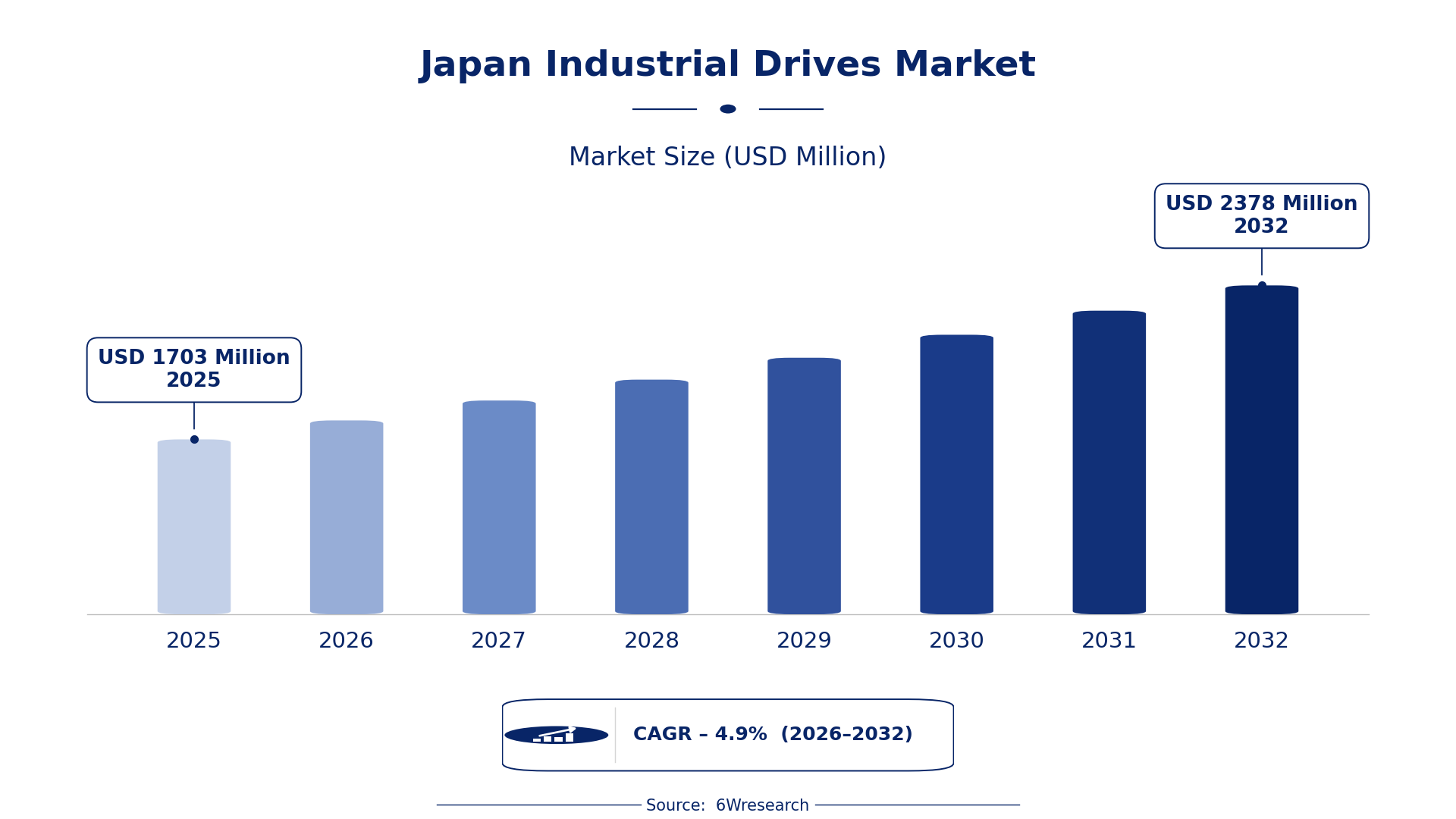
According to 6Wresearch internal database and industry insights, the Japan Industrial Drives Market was valued at USD 1,703 Million in 2025 and is projected to reach USD 2,378 Million by 2032, growing at a CAGR of approximately 4.9% during 2026–2032.
Japan Industrial Drives Market Highlights
| Report Metric | Details |
| Report Name | Japan Industrial Drives Market (2026-2032) |
| Market Size 2025 | USD 1,703 Million |
| Market Size 2032 | USD 2,378 Million |
| Absolute Growth 2025–2032 | USD 675 Million |
| CAGR 2026–2032 | 4.9% |
| Peak Annual Growth | 5.5% in 2032 |
| Forecast Period | 2026–2032 |
| Historical Data | 2022–2025 |
| Base Year | 2025 |
| Leading Drive Type, 2025 | Variable Frequency Drives (44% share) |
| Leading Motor Control, 2025 | Speed Regulation (50% share) |
| Leading Voltage Rating, 2025 | Low/Medium Voltage (49% share) |
| Leading End User, 2025 | Conveyor Systems (53% share) |
| Fastest-Growing Drive Type | Servo Drives (6.8% CAGR) |
| Fastest-Growing Motor Control | Precision Control (6.5% CAGR) |
| Fastest-Growing Voltage Rating | Multi-Axis Capability (6.4% CAGR) |
| Fastest-Growing End User | Robotics Equipment (6.6% CAGR) |
| Growing Sector | Robotics |
| Key End Users | Manufacturers, logistics providers, automotive sector, construction companies |
Japan Industrial Drives Market Year-wise Growth Rate and Key Drivers (2022–2032)
This graph illustrates the annual growth rates of the market from 2022 to 2032, highlighting a steady upward trajectory and projected market expansion over the forecast period.
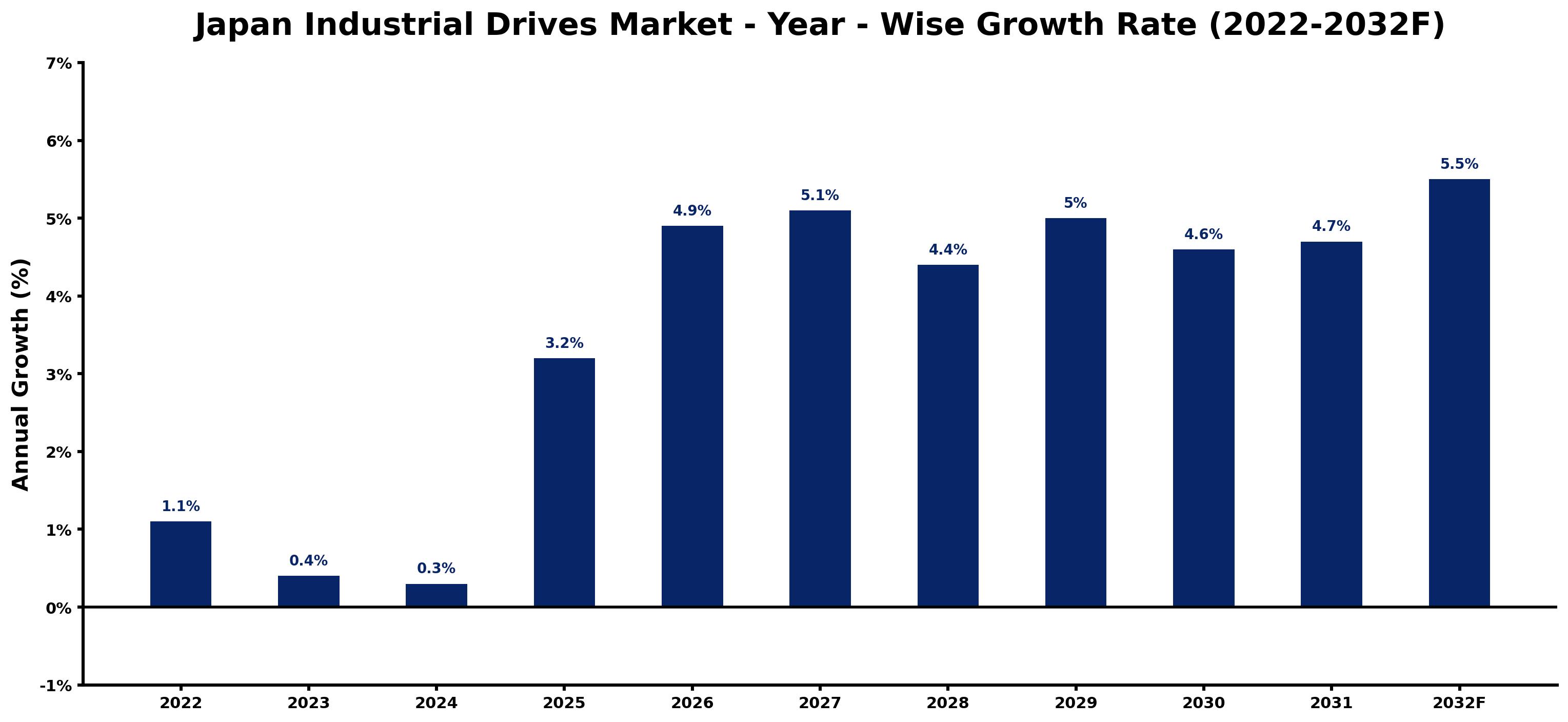
Annual growth estimates for each year appear below with the principal reason behind them, explaining the shifts that set the pace of the market.
| Year | Estimated Annual Growth (%) | Market Rationale |
| 2022 | 1.1 | The market experienced moderate growth, reflecting ongoing demand from various industries. |
| 2023 | 0.4 | Growth slowed due to economic uncertainties affecting investment in automation technologies. |
| 2024 | 0.3 | The market continued to grow slowly as companies focused on maintaining existing equipment. |
| 2025 | 3.2 | Demand increased as manufacturers upgraded aging systems for efficiency. |
| 2026 | 4.9 | Growth is anticipated to rise as investments in automation technologies gain traction. |
| 2027 | 5.1 | The market is projected to expand further, driven by increasing demand for precision control in robotics. |
| 2028 | 4.4 | Growth is expected to slow slightly as companies adjust to market conditions and demand. |
| 2029 | 5.0 | Demand is projected to surge again as new projects in automation and robotics emerge. |
| 2030 | 4.6 | Growth will moderate as companies reassess their investment strategies amid changing market conditions. |
| 2031 | 4.7 | Demand is expected to pick up again as industries continue to invest in advanced technologies. |
| 2032 | 5.5 | The market is projected to peak with strong growth driven by decarbonisation efforts and automation. |
Note: Market size estimations and growth projections presented in this report are based on 6Wresearch's proprietary forecasting methodology, utilizing the latest available industry data, government publications, and primary research inputs.
Japan Industrial Drives Market Synopsis
Industrial drives are electromechanical devices that control motor speed, torque, and position, essential for automation in manufacturing and robotics. The Japan Industrial Drives Market is expanding due to investments in automation, particularly in the robotics sector, projected to grow by 10% annually through 2025. The Kanto region serves as a key industrial hub, driving demand for efficient systems. Japan's commitment to reducing greenhouse gas emissions is pushing industries to adopt energy-efficient drive systems, creating further growth opportunities.
Market Dynamics Impact Analysis (2026–2032)
| Factor | Type | Impact | Primary Segment Affected |
| Growing demand for automation in manufacturing processes | Driver | High | Variable Frequency Drives |
| Increased investments in robotics and precision control systems | Driver | High | Servo Drives |
| Emerging opportunities in energy-efficient drive systems | Opportunity | High | Soft Starters |
| Expansion in the robotics sector driving increased demand | Opportunity | Medium | Robotics Equipment |
| High initial costs of advanced drive systems | Restraint | High | Servo Drives |
| Limited awareness of energy-efficient technologies among smaller firms | Restraint | Medium | Variable Frequency Drives |
| Challenges in integrating new technologies with existing systems | Challenge | High | Soft Starters |
| Competition from alternative technologies in automation | Challenge | Medium | Servo Drives |
Evaluation of Drivers in Japan Industrial Drives Market (2026–2032)
Demand rests on the following drivers, each shown with the segment it touches most.
| Drivers | Primary Segment Affected | Why It Matters (Evidence) |
| Increased automation in manufacturing | Variable Frequency Drives | This trend drives demand as manufacturers seek to optimise processes, with 40% of the market attributed to these drives. |
| Growth in robotics applications | Servo Drives | The robotics sector is expected to grow by 10% annually, increasing demand for precision control systems. |
| Investment in energy efficiency initiatives | Soft Starters | The 2023 subsidy program for energy-efficient systems encourages adoption across various industries. |
| Rising need for operational efficiency | Speed Regulation | With the average age of industrial equipment over 15 years, upgrades are essential for maintaining efficiency. |
| Expansion of manufacturing facilities | Conveyor Systems | The total number of manufacturing facilities exceeds 40,000, driving demand for efficient material handling systems. |
Buyers are adding capacity as they transition from traditional systems to advanced automation solutions. The robotics sector, projected to grow by 10% annually through 2025, is driving demand for servo drives, vital for precision control. The average age of industrial equipment in Japan exceeds 15 years, necessitating upgrades to improve efficiency.
Evaluation of Restraints in Japan Industrial Drives Market
These are the pressures that could keep growth below its potential.
| Market Restraint | Primary Segment Affected | Why It Matters (Evidence) |
| High initial costs of advanced drive systems | Servo Drives | The high costs deter smaller manufacturers from upgrading, limiting market growth opportunities. |
| Limited awareness of energy-efficient technologies among smaller firms | Variable Frequency Drives | Many small manufacturers lack knowledge about the benefits of energy-efficient drives, hindering adoption. |
| Integration challenges with legacy systems | Soft Starters | Existing systems often require extensive modifications, delaying the adoption of new technologies. |
| Competition from emerging technologies | Servo Drives | Alternative technologies may offer lower-cost solutions, affecting demand for traditional servo drives. |
| Fluctuating raw material prices | Variable Frequency Drives | Rising costs of semiconductor materials can impact pricing and availability of drives. |
Japan Industrial Drives Market Challenges
Buyers face rising costs as Japan's JPY 150 trillion decarbonisation investment is expected to increase industrial drive prices by 15%. Producers encounter supply chain disruptions because the installed base of industrial drives has reached 1.5 million units, complicating maintenance logistics and extending downtime. Distributors struggle with regulatory compliance as the Ministry of Economy, Trade and Industry enforces energy efficiency standards, which can inflate production costs by up to 10% for manufacturers. Buyers experience heightened competition from the rapidly growing robotics sector, projected to expand by 10% annually, compelling them to invest in advanced automation technologies to maintain market relevance.
Trends in the Japan Industrial Drives Market
The trends below show where the Japan Industrial Drives Market is heading.
- Shift towards Energy-Efficient Technologies: Japan's manufacturing sector is increasingly adopting energy-efficient technologies, driven by the GX Basic Policy aiming for a 46% reduction in greenhouse gas emissions by 2030. This transition is prompting industries to upgrade their systems.
- Growing Adoption of Robotics in Manufacturing: The robotics sector is experiencing rapid growth, with a projected annual increase of 10% through 2025. This trend is reflected in the rising demand for servo drives, essential for precision control in automated processes.
- Increased Focus on Automation in Logistics: The logistics sector is prioritising automation to enhance efficiency, particularly in conveyor systems. With over 40,000 manufacturing facilities in Japan, the need for advanced material handling solutions is driving this trend.
- Integration of Voltage Limiting Technologies: Voltage limiting technologies are being integrated into new drive systems to improve safety. This trend is gaining traction as manufacturers seek to comply with safety standards and reduce operational risks.
Investment Opportunities in the Japan Industrial Drives Market
Investors looking at the Japan Industrial Drives Market should consider the following areas.
- Partnerships for Energy-Efficient Solutions: With Japan targeting a 46% cut in greenhouse gas emissions by 2030, there is a growing opportunity for partnerships in energy-efficient drive systems. Collaborating with local manufacturers can facilitate market entry.
- Focus on Robotics Equipment Supply: The robotics equipment sector is expanding rapidly, creating opportunities for suppliers of servo drives. Engaging with manufacturers in the Kanto region can strengthen market presence.
- Investment in Automation Technologies: The annual investment in automation technology exceeds 1 trillion yen, indicating a gap for suppliers of advanced drive systems. Targeting the automotive sector can yield substantial returns.
- Expansion into the Soft Starters Market: The demand for soft starters is rising in pump and fan systems across various industries. Suppliers can enter this market by collaborating with local distributors to broaden their reach.
Government Initiatives in the Japan Industrial Drives Market
The GX Promotion Act, enacted in 2023, strengthens the legal framework for decarbonisation efforts, building on the Industrial Safety and Health Act of 1972. This new law mandates stricter energy efficiency measures, compelling manufacturers to invest in advanced drive systems that meet these standards. The government aims to reduce energy consumption in industrial sectors by 20% by 2030, benefiting buyers of industrial drives.
In 2023, Japan allocated JPY 150 trillion for public and private decarbonisation investments, overseen by the Ministry of Economy, Trade and Industry (METI). This funding supports initiatives aimed at improving energy efficiency in manufacturing, benefiting buyers of industrial drives.
Future Insight of the Japan Industrial Drives Market
By 2032, buyers will benefit from improved performance in industrial drives due to the implementation of advanced semiconductor technologies. The introduction of new subsidy programmes for energy-efficient systems will likely lower operational costs, creating a more competitive environment. Integration of safety technologies will attract various industries, making drive systems more versatile. As Japan aims for a 46% reduction in greenhouse gas emissions, demand for eco-friendly drive solutions will surge, prompting suppliers to innovate and align with sustainability objectives.
Market Segmentation Analysis
Japan Industrial Drives Market report covers a detailed analysis of the following market segments:
By Drive Type – Variable Frequency Drives Lead, Servo Drives Expected to Grow Fastest
According to Saurav Kr Singh, Senior Research Analyst at 6Wresearch, with 44% of drive type revenue in 2025, Variable Frequency Drives was the largest category. Variable frequency drives are extensively employed for speed control in manufacturing and automation applications, showcasing their importance in the industrial landscape. Their dominance is underscored by their substantial share of the market, reflecting widespread adoption across various sectors. Over 2026–2032, Servo Drives are expected to post the fastest growth, at a CAGR of 6.8%. The surge in servo drives is propelled by the increasing demand for precision control in robotics, which is anticipated to grow at a rate of 10% annually through 2025. This trend highlights the critical role of servo drives in the ongoing automation efforts, ensuring their continued prominence in the market. Suppliers should focus on enhancing servo drive offerings to cater to the rising automation demands in various industries.
By Motor Control – Speed Regulation Leads, Precision Control Expected to Grow Fastest
Speed Regulation took 50% of motor control revenue in 2025, more than any other category. Speed regulation is essential for maintaining operational efficiency in numerous industries, making it a fundamental aspect of industrial drives. Its critical role is evident in the extensive installed base of drives that rely on this functionality for optimal performance. The quickest growth will come from Precision Control, forecast to expand at a CAGR of 6.5% between 2026 and 2032. Precision control is becoming increasingly vital for applications that require exact positioning, particularly in robotics and automation sectors. As these industries expand, the demand for precision control solutions is expected to accelerate, driving growth in this area. Buyers should prioritise solutions that offer advanced precision control features to meet the evolving demands of automation.
By Voltage Rating – Low/Medium Voltage Leads, Multi-Axis Capability Expected to Grow Fastest
Low/Medium Voltage accounted for 49% of the market by voltage rating in 2025. Low/medium voltage drives are the standard choice for most industrial applications, providing reliable performance across various sectors. Their established presence in the market ensures a strong installed base that supports ongoing demand. Multi-Axis Capability is set to record the highest CAGR in this split, 6.4% over 2026–2032. The multi-axis capability segment is gaining traction due to its application in specialized fields, which are becoming more prevalent as industries seek advanced automation solutions. This niche growth suggests a shift towards more complex drive systems. Suppliers should consider developing multi-axis solutions to address the needs of specialised applications in the market.
By End User – Conveyor Systems Lead, Robotics Equipment Expected to Grow Fastest
In 2025, Conveyor Systems led the end user split with a 53% share. Conveyor systems are widely utilised in logistics and manufacturing, establishing them as a key end user of industrial drives in Japan. Their essential role in improving operational efficiency ensures a steady demand for drive solutions across various applications. Robotics Equipment is projected to grow fastest, at a CAGR of 6.6% during 2026–2032. Robotics equipment is experiencing rapid growth as automation becomes more integrated into manufacturing processes, leading to increased demand for advanced drive systems. This trend indicates that suppliers should focus on this segment to capitalise on emerging opportunities. Buyers should invest in drive systems tailored for robotics to stay competitive in the advancing automation environment.
Key Attractiveness of the Report
- 10 Years of Market Numbers
- Historical Data Starting from 2022 to 2025
- Base Year 2025
- Forecast Data until 2032
- Key Performance Indicators Impacting the Market
- Major Upcoming Developments and Projects
Key Highlights of the Report:
- Japan Industrial Drives Market Outlook
- Market Size of Japan Industrial Drives Market, 2025
- Forecast of Japan Industrial Drives Market, 2032
- Historical Data and Forecast of Japan Industrial Drives Revenues & Volume for the Period 2022-2032F
- Japan Industrial Drives Market Trend Evolution
- Japan Industrial Drives Market Drivers and Challenges
- Japan Industrial Drives Price Trends
- Japan Industrial Drives Porter's Five Forces
- Japan Industrial Drives Industry Life Cycle
- Historical Data and Forecast of Japan Industrial Drives Market Revenues & Volume By Drive Type for the Period 2022-2032F
- Historical Data and Forecast of Japan Industrial Drives Market Revenues & Volume By Variable Frequency Drives for the Period 2022-2032F
- Historical Data and Forecast of Japan Industrial Drives Market Revenues & Volume By Servo Drives for the Period 2022-2032F
- Historical Data and Forecast of Japan Industrial Drives Market Revenues & Volume By DC Drives for the Period 2022-2032F
- Historical Data and Forecast of Japan Industrial Drives Market Revenues & Volume By Soft Starters for the Period 2022-2032F
- Historical Data and Forecast of Japan Industrial Drives Market Revenues & Volume By Motor Control for the Period 2022-2032F
- Historical Data and Forecast of Japan Industrial Drives Market Revenues & Volume By Speed Regulation for the Period 2022-2032F
- Historical Data and Forecast of Japan Industrial Drives Market Revenues & Volume By Precision Control for the Period 2022-2032F
- Historical Data and Forecast of Japan Industrial Drives Market Revenues & Volume By Torque Control for the Period 2022-2032F
- Historical Data and Forecast of Japan Industrial Drives Market Revenues & Volume By Reduced Inrush Current for the Period 2022-2032F
- Historical Data and Forecast of Japan Industrial Drives Market Revenues & Volume By Voltage Rating for the Period 2022-2032F
- Historical Data and Forecast of Japan Industrial Drives Market Revenues & Volume By Low/Medium Voltage for the Period 2022-2032F
- Historical Data and Forecast of Japan Industrial Drives Market Revenues & Volume By Multi-Axis Capability for the Period 2022-2032F
- Historical Data and Forecast of Japan Industrial Drives Market Revenues & Volume By High Torque for the Period 2022-2032F
- Historical Data and Forecast of Japan Industrial Drives Market Revenues & Volume By Voltage Limiting for the Period 2022-2032F
- Historical Data and Forecast of Japan Industrial Drives Market Revenues & Volume By End User for the Period 2022-2032F
- Historical Data and Forecast of Japan Industrial Drives Market Revenues & Volume By Conveyor Systems for the Period 2022-2032F
- Historical Data and Forecast of Japan Industrial Drives Market Revenues & Volume By Robotics Equipment for the Period 2022-2032F
- Historical Data and Forecast of Japan Industrial Drives Market Revenues & Volume By Printing & Textile for the Period 2022-2032F
- Historical Data and Forecast of Japan Industrial Drives Market Revenues & Volume By Pump & Fan Systems for the Period 2022-2032F
- Japan Industrial Drives Import Export Trade Statistics
- Market Opportunity Assessment By Drive Type
- Market Opportunity Assessment By Motor Control
- Market Opportunity Assessment By Voltage Rating
- Market Opportunity Assessment By End User
- Japan Industrial Drives Top Companies Market Share
- Japan Industrial Drives Competitive Benchmarking By Technical and Operational Parameters
- Japan Industrial Drives Company Profiles
- Japan Industrial Drives Key Strategic Recommendations
Market Covered
The report covers the following segments.
By Drive Type
- Variable Frequency Drives
- Servo Drives
- DC Drives
- Soft Starters
By Motor Control
- Speed Regulation
- Precision Control
- Torque Control
- Reduced Inrush Current
By Voltage Rating
- Low/Medium Voltage
- Multi-Axis Capability
- High Torque
- Voltage Limiting
By End User
- Conveyor Systems
- Robotics Equipment
- Printing & Textile
- Pump & Fan Systems































