Japan Industrial Drying Equipment Market Size & Growth Rate
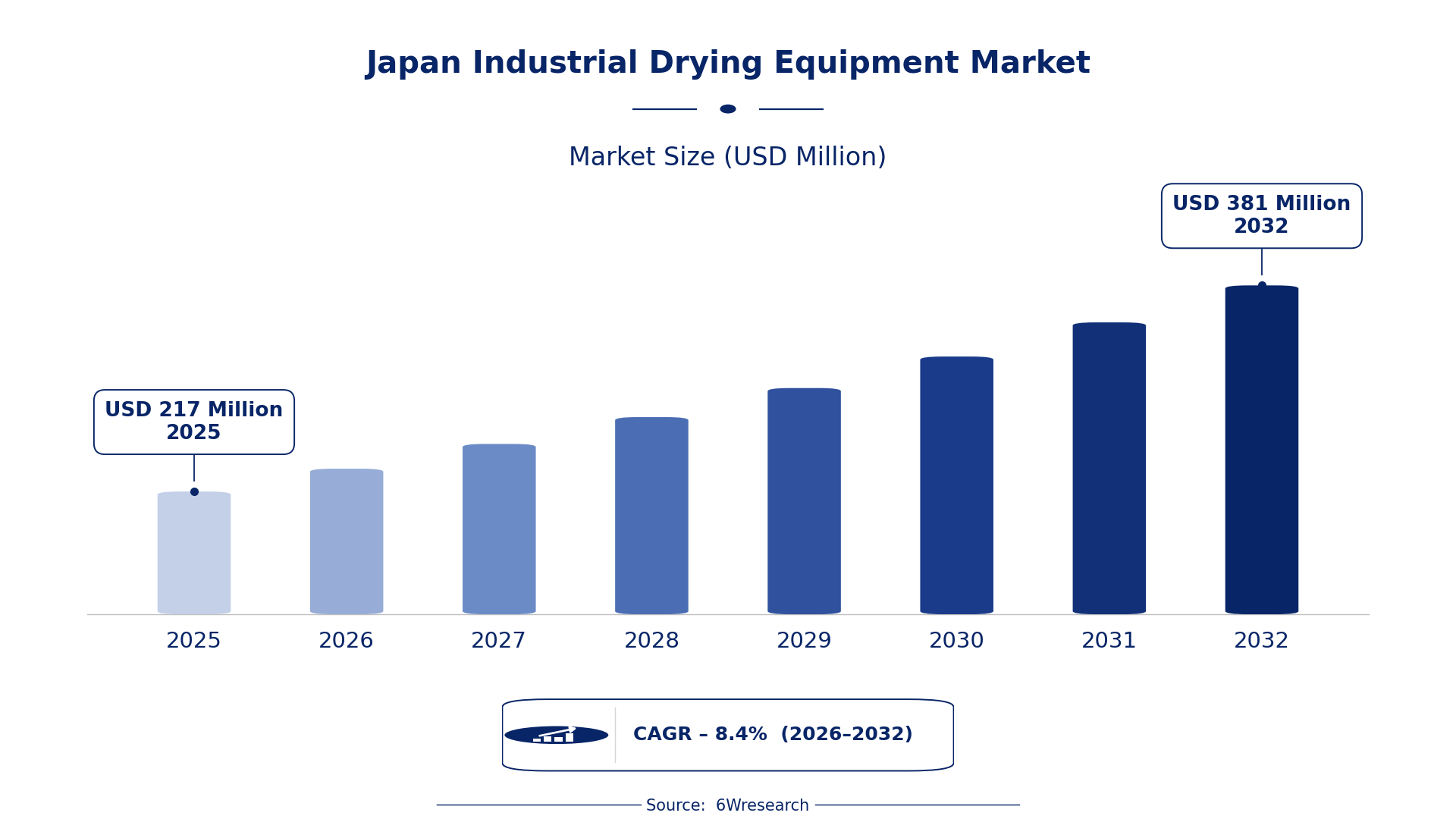
According to 6Wresearch internal database and industry insights, the Japan Industrial Drying Equipment Market was valued at USD 217 Million in 2025 and is projected to reach USD 381 Million by 2032, growing at a CAGR of approximately 8.4% during 2026–2032.
Japan Industrial Drying Equipment Market Highlights
| Report Metric | Details |
| Report Name | Japan Industrial Drying Equipment Market (2026-2032) |
| Market Size 2025 | USD 217 Million |
| Market Size 2032 | USD 381 Million |
| Absolute Growth 2025–2032 | USD 164 Million |
| CAGR 2026–2032 | 8.4% |
| Peak Annual Growth | 9.4% in 2026 |
| Forecast Period | 2026–2032 |
| Historical Data | 2022–2025 |
| Base Year | 2025 |
| Leading Equipment Type, 2025 | Rotary Dryers (45% share) |
| Leading Heating Source, 2025 | Steam/Gas (35% share) |
| Leading Operation Mode, 2025 | Continuous (48% share) |
| Leading End User, 2025 | Cement Industry (41% share) |
| Fastest-Growing Equipment Type | Spray Dryers (11.5% CAGR) |
| Fastest-Growing Heating Source | Hot Air (11.7% CAGR) |
| Fastest-Growing Operation Mode | Rapid Drying (11.0% CAGR) |
| Fastest-Growing End User | Food & Dairy Firms (10.8% CAGR) |
| Growing Sector | Food Processing |
| Key End Users | Cement Industry, Food & Dairy Firms, Pharmaceutical Manufacturers, Chemical Plants |
Japan Industrial Drying Equipment Market Year-wise Growth Rate and Key Drivers (2022–2032)
This graph illustrates the annual growth rates of the market from 2022 to 2032, highlighting a steady upward trajectory and projected market expansion over the forecast period.
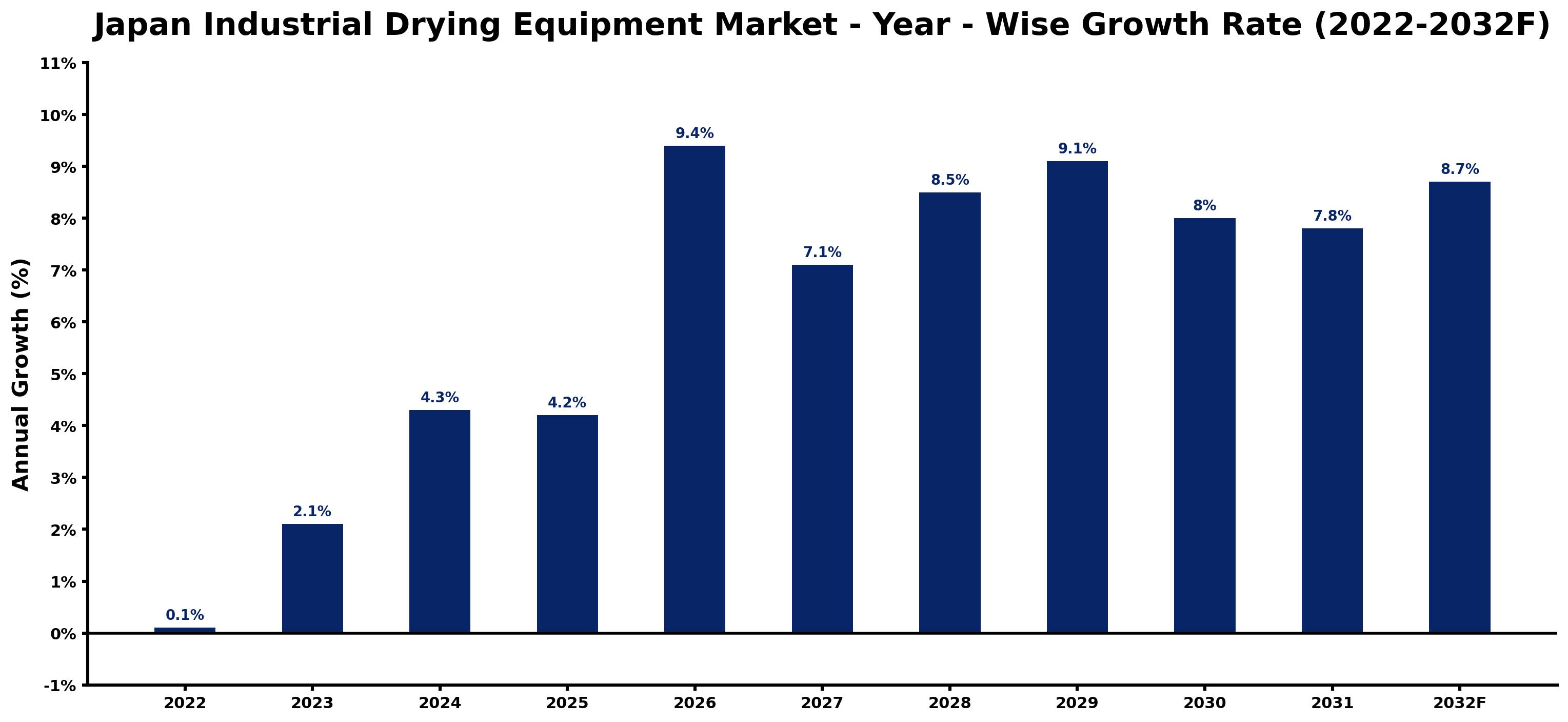
Annual growth estimates for each year appear below with the principal reason behind them, explaining the shifts that set the pace of the market.
| Year | Estimated Annual Growth (%) | Market Rationale |
| 2022 | 0.1 | The market experienced minimal growth due to ongoing adjustments in industrial operations. |
| 2023 | 2.1 | Growth accelerated as the food processing sector increased its demand for drying technologies. |
| 2024 | 4.3 | The market continued to expand, driven by rising production capacities in the cement industry. |
| 2025 | 4.2 | Growth slowed slightly as the market adjusted to new operational efficiencies. |
| 2026 | 9.4 | Demand is expected to surge as the cement industry ramps up production, driving equipment purchases. |
| 2027 | 7.1 | Growth will decelerate as the market stabilises after rapid expansion in the previous year. |
| 2028 | 8.5 | The market is projected to rebound with increased investments in food and dairy processing facilities. |
| 2029 | 9.1 | Growth is anticipated to pick up as pharmaceutical manufacturers adopt advanced drying technologies. |
| 2030 | 8.0 | The market's growth rate is expected to slow as competition intensifies among equipment suppliers. |
| 2031 | 7.8 | A further slowdown will occur as buyers focus on efficiency improvements and cost management. |
| 2032 | 8.7 | Demand is projected to rise again as new projects in food processing come online. |
Note: Market size estimations and growth projections presented in this report are based on 6Wresearch's proprietary forecasting methodology, utilizing the latest available industry data, government publications, and primary research inputs.
Japan Industrial Drying Equipment Market Synopsis
Industrial drying equipment is essential for removing moisture from various materials through methods such as heat and airflow. Key applications include drying food products, chemicals, and pharmaceuticals. The Japan Industrial Drying Equipment Market is growing due to increased investments in food processing, valued at approximately ¥5 trillion. The cement industry, with an annual production capacity of about 50 million tons, also contributes to this demand. Advancements in drying technologies are driving market growth, particularly in the pharmaceutical sector, valued at ¥10 trillion.
Market Dynamics Impact Analysis (2026–2032)
| Factor | Type | Impact | Primary Segment Affected |
| Increased demand from the food processing sector | Driver | High | Spray Dryers |
| Rising production capacities in the cement industry | Driver | High | Rotary Dryers |
| Growing investment in modernization of industrial equipment | Opportunity | High | Fluid Bed Dryers |
| Expansion of pharmaceutical manufacturing capabilities | Opportunity | Medium | Flash Dryers |
| High operational costs for energy-intensive drying processes | Restraint | High | Steam/Gas |
| Competition from alternative drying technologies | Restraint | Medium | Hot Air |
| Rising costs of raw materials impacting production | Challenge | High | Continuous |
| Technological advancements requiring constant upgrades | Challenge | Medium | Rapid Drying |
Evaluation of Drivers in Japan Industrial Drying Equipment Market (2026–2032)
The table below links each growth driver to the segment it affects and the evidence for it.
| Drivers | Primary Segment Affected | Why It Matters (Evidence) |
| Growing food processing industry | Spray Dryers | The food processing industry, valued at approximately ¥5 trillion, drives demand for efficient drying solutions. |
| Increased cement production | Rotary Dryers | With an annual production capacity of about 50 million tons, the cement industry heavily relies on drying equipment. |
| Modernization of industrial equipment | Fluid Bed Dryers | A government program allocated ¥1 billion for modernization, encouraging upgrades in drying technologies. |
| Pharmaceutical sector expansion | Flash Dryers | The pharmaceutical market, valued at ¥10 trillion, necessitates advanced drying techniques for product quality. |
| Adoption of energy-efficient technologies | Hot Air | High-velocity air drying is increasingly used in food processing for its efficiency and reduced energy costs. |
Most of the extra volume comes from the food processing industry, valued at approximately ¥5 trillion, which drives demand for efficient drying solutions. Increased cement production, with an annual capacity of about 50 million tons, boosts the need for drying equipment. The pharmaceutical market, valued at ¥10 trillion, necessitates advanced drying techniques, leading to increased purchases of flash dryers. The adoption of high-velocity air drying in food processing improves efficiency and reduces energy costs.
Evaluation of Restraints in Japan Industrial Drying Equipment Market
The following restraints limit how fast demand can grow.
| Market Restraint | Primary Segment Affected | Why It Matters (Evidence) |
| High operational costs for energy-intensive drying processes | Steam/Gas | Rising energy prices have led to increased operational costs, impacting profitability for users of steam and gas heating. |
| Competition from alternative drying technologies | Hot Air | Emerging technologies may offer more cost-effective solutions, challenging traditional hot air drying methods. |
| Supply chain disruptions affecting raw material availability | Continuous | Rising costs and shortages of essential materials have delayed production schedules for continuous drying equipment. |
| Technological advancements requiring constant upgrades | Rapid Drying | The need for ongoing investment in new technologies can strain budgets for manufacturers and buyers. |
| Regulatory compliance costs for safety and efficiency standards | Fluid Bed Dryers | Compliance with safety regulations increases operational costs for fluid bed dryer users. |
Japan Industrial Drying Equipment Market Challenges
Japan's food processing industry, valued at approximately ¥5 trillion, contends with fierce competition that compels producers to lower prices, squeezing profit margins. Importers face challenges due to rapid advancements in drying technology, necessitating costly equipment upgrades that can postpone operations by six months. Compliance with the JIS Z 8801 standard adds further expenses for producers, potentially increasing costs by 15%. A shortage of skilled workers in advanced drying techniques hampers productivity, causing project delays for buyers in the pharmaceutical sector.
Trends in the Japan Industrial Drying Equipment Market
The following changes are redrawing the Japan Industrial Drying Equipment Market.
- Shift from Conventional to Advanced Drying Technologies: Since 2023, the industry has seen a transition towards advanced drying technologies, such as high-velocity air drying, which improves efficiency. Adoption rates are increasing in the food processing sector, where efficiency is paramount.
- Transition from Batch to Continuous Drying Processes: The movement towards continuous drying processes began in 2023, driven by the need for higher efficiency in production. The cement industry is increasingly adopting continuous drying methods to improve productivity and reduce energy consumption.
- Emergence of Energy-Efficient Drying Solutions: In 2024, energy-efficient drying solutions gained prominence as industries sought to reduce operational costs. The food processing sector has reported a 30% reduction in energy use with the adoption of these technologies.
- Prioritisation of Compliance with Environmental Standards: In 2023, compliance with environmental standards became a priority, particularly in the cement industry. Companies are investing in technologies that align with Japan's target of a 46% cut in greenhouse-gas emissions by 2030.
Investment Opportunities in the Japan Industrial Drying Equipment Market
Investors looking at the Japan Industrial Drying Equipment Market should consider the following areas.
- Partnerships for Equipment Modernization: Collaborating with local manufacturers for equipment modernization offers a promising opportunity, particularly in the food processing sector, valued at ¥5 trillion.
- Investment in Energy-Efficient Drying Technologies: Investing in energy-efficient drying technologies is timely, as companies strive to reduce operational costs. The cement industry, with its annual production capacity of about 50 million tons, stands out as a prime candidate for such investments.
- Expansion of Pharmaceutical Manufacturing Facilities: With Japan's pharmaceutical market valued at ¥10 trillion, there is a growing opportunity to provide advanced drying solutions to new manufacturing facilities.
- Entry into the Food Processing Sector: Now is an opportune moment to penetrate the food processing sector, which is increasingly investing in drying technologies. Forming partnerships with local firms can facilitate market entry.
Government Initiatives in the Japan Industrial Drying Equipment Market
The Industrial Safety and Health Act of 1972 mandates employer responsibilities regarding hazardous substances and machinery, ensuring safety standards for industrial drying equipment. The Act on the Rational Use of Energy, enacted in 1979, requires large energy users to improve energy efficiency and report their energy consumption, impacting drying equipment operations.
The GX Promotion Act of 2023 serves as the legal foundation for Japan's decarbonisation strategy, promoting investments in energy-efficient technologies. The Ministry of Economy, Trade and Industry oversees compliance with these regulations, ensuring that buyers of industrial drying equipment adhere to energy efficiency standards.
Future Insight of the Japan Industrial Drying Equipment Market
New industrial drying facilities will emerge by 2032, focusing on government programmes for equipment modernization. The anticipated ¥150 trillion in decarbonisation investment will encourage suppliers to adopt advanced technologies. Stricter standards are likely to be implemented, ensuring improved quality and safety in drying equipment. The increasing adoption of air drying methods in food processing will boost efficiency, benefiting both buyers and suppliers.
Market Segmentation Analysis
Japan Industrial Drying Equipment Market report covers a detailed analysis of the following market segments:
By Equipment Type – Rotary Dryers Lead, Spray Dryers Expected to Grow Fastest
According to Saurav Kr Singh, Senior Research Analyst at 6Wresearch, in 2025, Rotary Dryers led the equipment type split with a 45% share. Rotary dryers hold the largest share in Japan due to their effectiveness in processing bulk materials, particularly in industries such as cement and food processing. Their widespread adoption in facilities across the country, including those in the Tokyo region, underscores their importance in the market. The quickest growth will come from Spray Dryers, forecast to expand at a CAGR of 11.5% between 2026 and 2032. Spray dryers are experiencing rapid growth owing to their essential role in producing powdered food and dairy products, which are increasingly sought after by consumers. The shift towards convenience foods, with a notable increase in demand, is propelling this segment's expansion. This indicates that suppliers must focus on enhancing spray dryer technology to meet the rising needs of the food processing industry.
By Heating Source – Steam/Gas Lead, Hot Air Expected to Grow Fastest
With 35% of heating source revenue in 2025, Steam/Gas was the largest category. Steam and gas serve as the primary heating sources in many drying processes, particularly in the cement and food industries where consistent heat is essential. Their extensive application across these sectors solidifies their leading market share in Japan. Over 2026–2032, Hot Air is expected to post the fastest growth, at a CAGR of 11.7%. Hot air is rapidly becoming the preferred choice due to its efficiency in food and chemical drying, driven by the industry's shift towards energy-efficient solutions. This trend indicates a growing alignment with environmental regulations and sustainability goals. Buyers should consider adopting hot air systems to achieve energy efficiency while meeting production needs.
By Operation Mode – Continuous Leads, Rapid Drying Expected to Grow Fastest
Continuous held 48% of the Japan Industrial Drying Equipment Market by operation mode in 2025. Continuous operation mode is critical for large-scale production processes, especially in industries like cement where maintaining efficiency is essential. Its capacity for steady output is a key factor in its leading market position. Rapid Drying is set to record the highest CAGR in this split, 11.0% over 2026–2032. Rapid drying is increasingly vital for time-sensitive applications, particularly in food processing where speed directly affects product quality. This growing emphasis on quick drying solutions highlights the industry's demand for advanced technologies. Suppliers must invest in rapid drying technologies to cater to the needs of fast-paced production environments.
By End User – Cement Industry Leads, Food & Dairy Firms Expected to Grow Fastest
Cement Industry accounted for 41% of the market by end user in 2025. The cement industry is the major user of drying equipment for processing raw materials, reflecting its substantial production capacity in Japan. This sector's ongoing operations ensure a strong demand for drying solutions. Food & Dairy Firms are projected to grow fastest, at a CAGR of 10.8% during 2026–2032. Food and dairy firms are experiencing the fastest growth as they increasingly rely on drying technologies for processing and preservation. The rising consumer demand for processed food products is a key factor behind this trend. Suppliers should tailor their offerings to meet the specific needs of food and dairy firms to capitalise on this growth opportunity.
Key Attractiveness of the Report
- 10 Years of Market Numbers
- Historical Data Starting from 2022 to 2025
- Base Year 2025
- Forecast Data until 2032
- Key Performance Indicators Impacting the Market
- Major Upcoming Developments and Projects
Key Highlights of the Report:
- Japan Industrial Drying Equipment Market Outlook
- Market Size of Japan Industrial Drying Equipment Market, 2025
- Forecast of Japan Industrial Drying Equipment Market, 2032
- Historical Data and Forecast of Japan Industrial Drying Equipment Revenues & Volume for the Period 2022-2032F
- Japan Industrial Drying Equipment Market Trend Evolution
- Japan Industrial Drying Equipment Market Drivers and Challenges
- Japan Industrial Drying Equipment Price Trends
- Japan Industrial Drying Equipment Porter's Five Forces
- Japan Industrial Drying Equipment Industry Life Cycle
- Historical Data and Forecast of Japan Industrial Drying Equipment Market Revenues & Volume By Equipment Type for the Period 2022-2032F
- Historical Data and Forecast of Japan Industrial Drying Equipment Market Revenues & Volume By Rotary Dryers for the Period 2022-2032F
- Historical Data and Forecast of Japan Industrial Drying Equipment Market Revenues & Volume By Spray Dryers for the Period 2022-2032F
- Historical Data and Forecast of Japan Industrial Drying Equipment Market Revenues & Volume By Flash Dryers for the Period 2022-2032F
- Historical Data and Forecast of Japan Industrial Drying Equipment Market Revenues & Volume By Fluid Bed Dryers for the Period 2022-2032F
- Historical Data and Forecast of Japan Industrial Drying Equipment Market Revenues & Volume By Heating Source for the Period 2022-2032F
- Historical Data and Forecast of Japan Industrial Drying Equipment Market Revenues & Volume By Steam/Gas for the Period 2022-2032F
- Historical Data and Forecast of Japan Industrial Drying Equipment Market Revenues & Volume By Hot Air for the Period 2022-2032F
- Historical Data and Forecast of Japan Industrial Drying Equipment Market Revenues & Volume By High-Velocity Air for the Period 2022-2032F
- Historical Data and Forecast of Japan Industrial Drying Equipment Market Revenues & Volume By Uniform Airflow for the Period 2022-2032F
- Historical Data and Forecast of Japan Industrial Drying Equipment Market Revenues & Volume By Operation Mode for the Period 2022-2032F
- Historical Data and Forecast of Japan Industrial Drying Equipment Market Revenues & Volume By Continuous for the Period 2022-2032F
- Historical Data and Forecast of Japan Industrial Drying Equipment Market Revenues & Volume By Rapid Drying for the Period 2022-2032F
- Historical Data and Forecast of Japan Industrial Drying Equipment Market Revenues & Volume By High-Speed Evaporation for the Period 2022-2032F
- Historical Data and Forecast of Japan Industrial Drying Equipment Market Revenues & Volume By Controlled Drying for the Period 2022-2032F
- Historical Data and Forecast of Japan Industrial Drying Equipment Market Revenues & Volume By End User for the Period 2022-2032F
- Historical Data and Forecast of Japan Industrial Drying Equipment Market Revenues & Volume By Cement Industry for the Period 2022-2032F
- Historical Data and Forecast of Japan Industrial Drying Equipment Market Revenues & Volume By Food & Dairy Firms for the Period 2022-2032F
- Historical Data and Forecast of Japan Industrial Drying Equipment Market Revenues & Volume By Chemical Plants for the Period 2022-2032F
- Historical Data and Forecast of Japan Industrial Drying Equipment Market Revenues & Volume By Pharma Manufacturing for the Period 2022-2032F
- Japan Industrial Drying Equipment Import Export Trade Statistics
- Market Opportunity Assessment By Equipment Type
- Market Opportunity Assessment By Heating Source
- Market Opportunity Assessment By Operation Mode
- Market Opportunity Assessment By End User
- Japan Industrial Drying Equipment Top Companies Market Share
- Japan Industrial Drying Equipment Competitive Benchmarking By Technical and Operational Parameters
- Japan Industrial Drying Equipment Company Profiles
- Japan Industrial Drying Equipment Key Strategic Recommendations
Market Covered
Coverage by segment is as follows.
By Equipment Type
- Rotary Dryers
- Spray Dryers
- Flash Dryers
- Fluid Bed Dryers
By Heating Source
- Steam/Gas
- Hot Air
- High-Velocity Air
- Uniform Airflow
By Operation Mode
- Continuous
- Rapid Drying
- High-Speed Evaporation
- Controlled Drying
By End User
- Cement Industry
- Food & Dairy Firms
- Chemical Plants
- Pharma Manufacturing































