Japan Industrial Electronics Market Size & Growth Rate
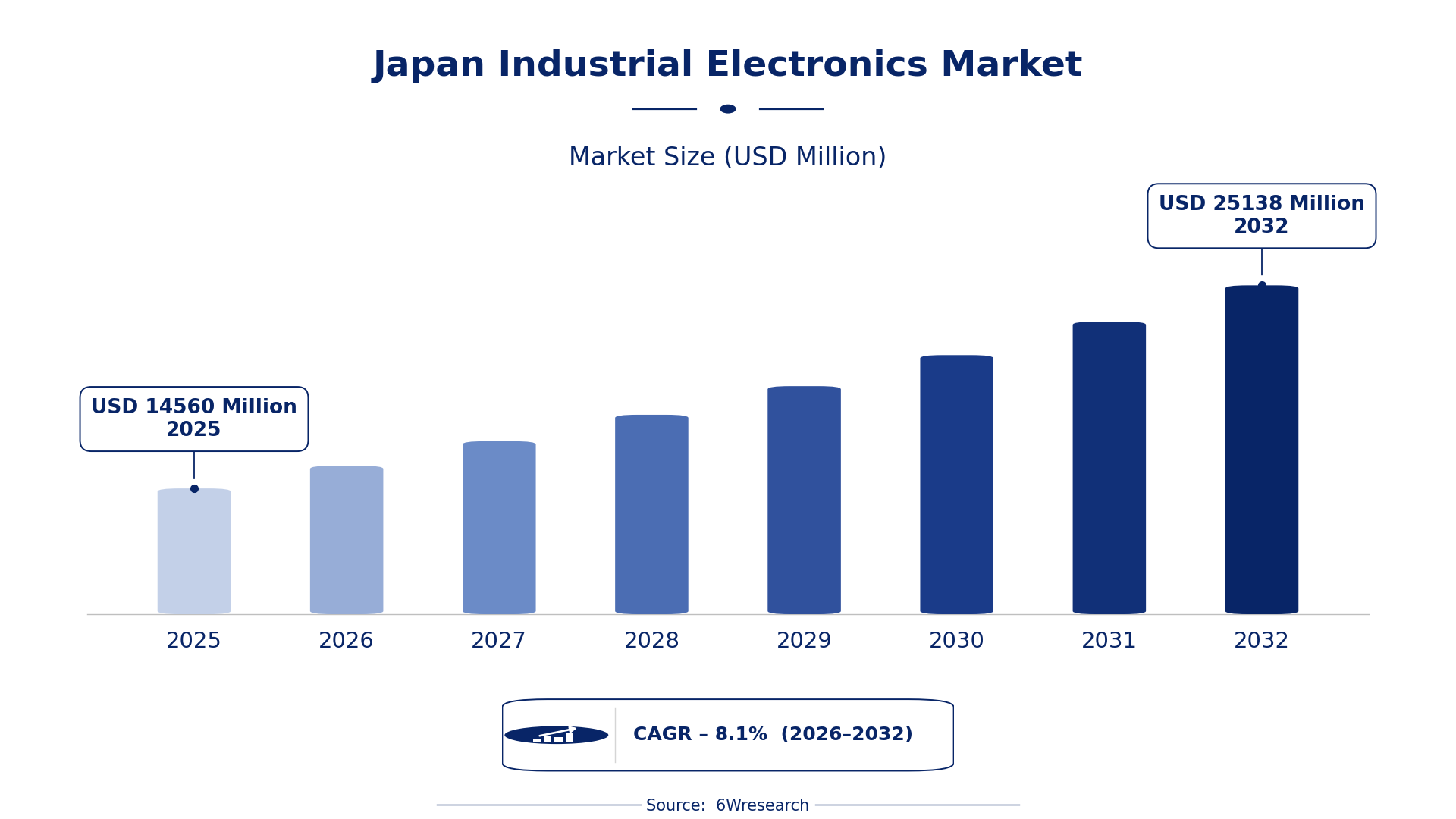
According to 6Wresearch internal database and industry insights, the Japan Industrial Electronics Market was valued at USD 14,560 Million in 2025 and is projected to reach USD 25,138 Million by 2032, growing at a CAGR of approximately 8.1% during 2026–2032.
Japan Industrial Electronics Market Highlights
| Report Metric | Details |
| Report Name | Japan Industrial Electronics Market (2026-2032) |
| Market Size 2025 | USD 14,560 Million |
| Market Size 2032 | USD 25,138 Million |
| Absolute Growth 2025–2032 | USD 10,578 Million |
| CAGR 2026–2032 | 8.1% |
| Peak Annual Growth | 9.0% in 2026 |
| Forecast Period | 2026–2032 |
| Historical Data | 2022–2025 |
| Base Year | 2025 |
| Leading Product Category, 2025 | Power Electronics (35% share) |
| Leading Functionality, 2025 | Process Control (50% share) |
| Leading Integration Use, 2025 | PLCs (46% share) |
| Leading End User, 2025 | Industrial Automation (47% share) |
| Fastest-Growing Product Category | Embedded Controllers (11.5% CAGR) |
| Fastest-Growing Functionality | Input Detection (11.2% CAGR) |
| Fastest-Growing Integration Use | Field Devices (11.0% CAGR) |
| Fastest-Growing End User | Smart Factories (10.6% CAGR) |
| Growing Sector | Smart Factories |
| Key End Users | Industrial Automation, Smart Factories, Control Room Equipment, OEM Assemblers |
Japan Industrial Electronics Market Year-wise Growth Rate and Key Drivers (2022–2032)
This graph illustrates the annual growth rates of the market from 2022 to 2032, highlighting a steady upward trajectory and projected market expansion over the forecast period.
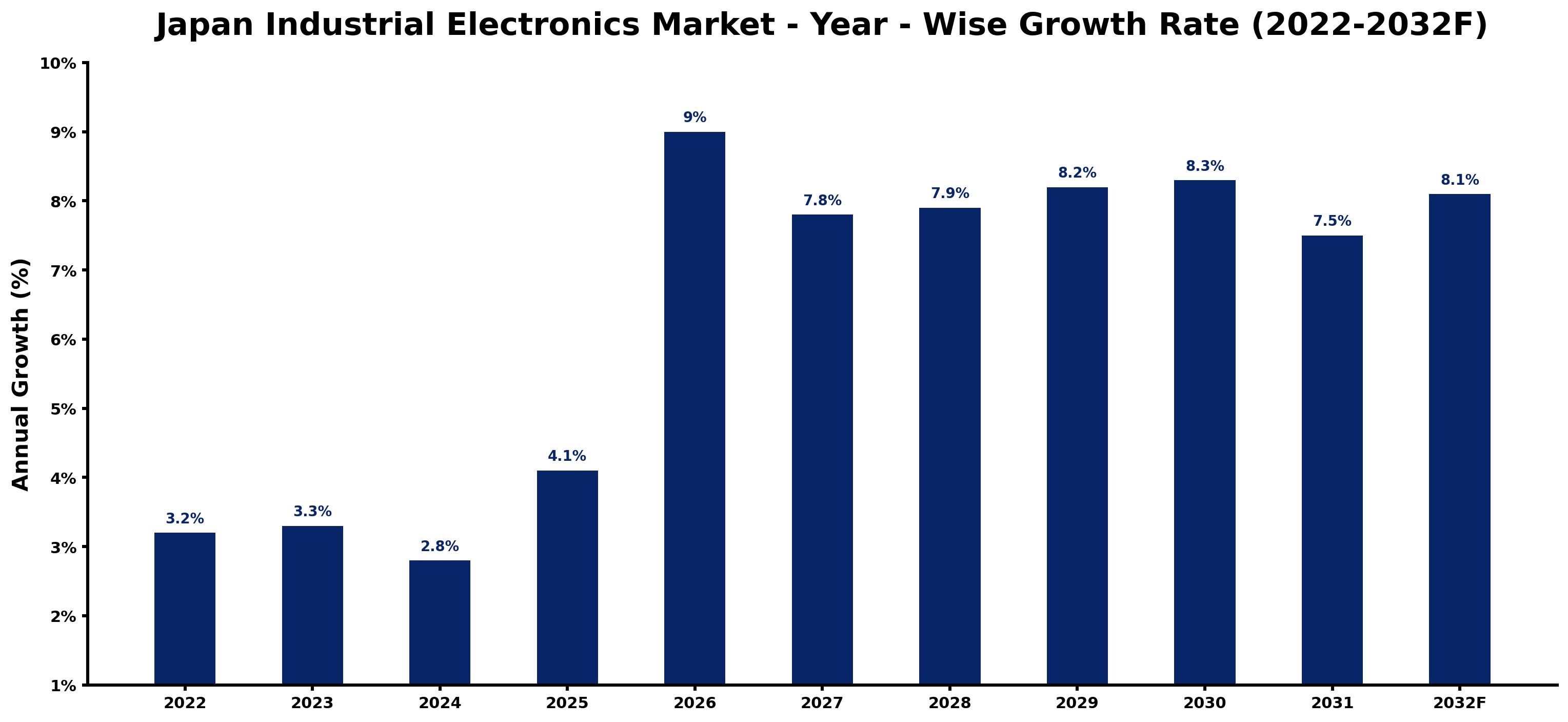
Year by year, the estimates below pair each growth rate with the development that shaped it.
| Year | Estimated Annual Growth (%) | Market Rationale |
| 2022 | 3.2 | The market was stable, with moderate demand from key sectors like automotive and electronics. |
| 2023 | 3.3 | Demand grew slightly due to increased automation initiatives in manufacturing. |
| 2024 | 2.8 | Growth slowed as manufacturers adjusted to rising costs and supply chain issues. |
| 2025 | 4.1 | A surge in investments in smart factories led to faster growth in the market. |
| 2026 | 9.0 | The market is expected to peak as Industry 4.0 technologies gain widespread adoption. |
| 2027 | 7.8 | Growth will slow as the market stabilises after the peak in investment. |
| 2028 | 7.9 | Demand is projected to increase again as manufacturers seek to improve operational efficiency. |
| 2029 | 8.2 | Continued investment in automation technologies is anticipated to support market growth. |
| 2030 | 8.3 | The market will maintain momentum as energy efficiency initiatives gain priority. |
| 2031 | 7.5 | Growth is expected to slow as market conditions normalise after several years of rapid expansion. |
| 2032 | 8.1 | The market is projected to grow steadily as new technologies emerge. |
Note: Market size estimations and growth projections presented in this report are based on 6Wresearch's proprietary forecasting methodology, utilizing the latest available industry data, government publications, and primary research inputs.
Japan Industrial Electronics Market Synopsis
Industrial electronics encompass devices and systems crucial for monitoring and controlling industrial processes, utilising semiconductor technology and sensors. Their main applications lie in automation and control within manufacturing sectors, particularly automotive and machinery. The Japan Industrial Electronics Market is expanding due to increased investments in Industry 4.0 technologies, with around JPY 150 trillion earmarked for decarbonisation initiatives over the next decade. The government's commitment to smart factory initiatives is propelling demand for automation and control systems, supported by substantial funding for this transition.
Market Dynamics Impact Analysis (2026–2032)
| Factor | Type | Impact | Primary Segment Affected |
| Rising investments in automation technologies | Driver | High | Industrial Automation |
| Increased adoption of Industry 4.0 | Driver | High | Embedded Controllers |
| Growing demand for energy-efficient solutions | Opportunity | High | Power Electronics |
| Expansion of smart factories in key regions | Opportunity | High | Smart Factories |
| Supply chain disruptions affecting component availability | Restraint | High | Industrial Sensors |
| High costs of advanced technologies limiting access | Restraint | Medium | Embedded Controllers |
| Competition from international manufacturers | Challenge | High | Industrial Automation |
| Shortage of skilled workforce in automation | Challenge | Medium | Control Room Equipment |
Evaluation of Drivers in Japan Industrial Electronics Market (2026–2032)
Demand rests on the following drivers, each shown with the segment it touches most.
| Drivers | Primary Segment Affected | Why It Matters (Evidence) |
| Increased automation in manufacturing processes | Embedded Controllers | This drives demand for embedded systems, with over 70% adoption in automotive electronics, enhancing production efficiency. |
| Growing focus on energy efficiency | Power Electronics | The annual demand for power electronics is projected to exceed 500 billion yen by 2025, as industries seek to reduce energy consumption. |
| Expansion of smart factories | Industrial Automation | The Smart Manufacturing Strategy 2023 aims to enhance automation, attracting investments in industrial electronics. |
| Rising installed base of industrial sensors | Industrial Sensors | With over 10 million units installed, the need for monitoring solutions is increasing across various sectors. |
| Government support for robotics development | Control Room Equipment | A budget of 100 billion yen for 2023 boosts innovation in robotics, leading to higher demand for control systems. |
Spending rises because of the increasing automation in manufacturing processes, with over 70% adoption of embedded controllers in automotive electronics driving efficiency. The annual demand for power electronics is projected to exceed 500 billion yen by 2025, as industries focus on energy efficiency. The installed base of industrial sensors exceeds 10 million units, increasing the need for monitoring solutions in manufacturing. Continued investments in smart factories are attracting funding for industrial electronics, particularly in regions like Tokyo where industrial growth is strong. Support for robotics development further boosts demand for control systems, with a significant budget allocated for innovation in this area.
Evaluation of Restraints in Japan Industrial Electronics Market
Several factors work against faster growth; the main ones are summarised below.
| Market Restraint | Primary Segment Affected | Why It Matters (Evidence) |
| Supply chain disruptions affecting component availability | Industrial Sensors | Delays in component delivery have impacted production timelines for manufacturers reliant on sensors. |
| High costs of advanced technologies limiting access | Embedded Controllers | The expense associated with implementing advanced embedded systems restricts adoption among smaller manufacturers. |
| Intense competition from international manufacturers | Industrial Automation | Local manufacturers face pressure from foreign competitors, which can lead to reduced market share and pricing power. |
| Shortage of skilled workforce in automation | Control Room Equipment | A lack of qualified personnel in automation technologies hampers the ability to implement advanced control systems. |
| Regulatory compliance costs impacting profitability | Power Electronics | Meeting stringent regulations increases operational costs for manufacturers, affecting overall profitability. |
Japan Industrial Electronics Market Challenges
Producers are grappling with rising costs stemming from stringent environmental regulations, which necessitate substantial investments in cleaner technologies and may delay product launches. Compliance with these regulations requires extensive documentation, lengthening lead times for suppliers and limiting their ability to meet buyer demands. Local suppliers face challenges from international manufacturers with lower operational costs, compelling them to reduce prices and potentially compromise quality. Rapid technological advancements demand continuous innovation, leading to increased R&D expenses for producers, which ultimately raises prices for buyers seeking the latest industrial electronics.
Trends in the Japan Industrial Electronics Market
The trends below show where the Japan Industrial Electronics Market is heading.
- Shift towards Smart Factories: The transition towards smart factories began in 2023, driven by government initiatives. This shift is expected to increase demand for industrial electronics, with investments projected to rise as manufacturers adopt advanced automation technologies.
- Increase in Energy Efficiency Standards: Since 2023, Japan has prioritised energy efficiency, with the GX Promotion Act setting ambitious targets. This shift encourages manufacturers to adopt energy-efficient technologies, boosting the demand for power electronics and related systems.
- Adoption of Industry 4.0 Technologies: The adoption of Industry 4.0 technologies has accelerated since 2023, with manufacturers integrating IoT and AI into operations. This trend has led to a notable increase in demand for embedded controllers and industrial sensors.
- Focus on Robotics Integration: In 2023, there has been a notable increase in robotics integration within manufacturing. The government's budget for robotics development supports this trend, driving demand for control systems and automation technologies.
Investment Opportunities in the Japan Industrial Electronics Market
The following opportunities in the Japan Industrial Electronics Market pair current demand with a clear way in.
- Manufacturers seeking automation solutions: With the rise of smart factories, there is a growing need for advanced industrial electronics. Investing in automation technologies can meet the demands of manufacturers in regions like Tokyo, where industrial growth is strong.
- Supply of energy-efficient technologies: As energy efficiency becomes a priority, supplying advanced power electronics can meet the needs of manufacturers aiming to reduce consumption. The automotive sector is a key buyer group for these technologies.
- Investment in smart factory initiatives: The current push for smart factories presents an opportunity to supply integrated automation systems. Collaborating with local manufacturers in Aichi can facilitate market entry and growth.
- Development of IoT-enabled devices: The increasing integration of IoT in industrial processes creates demand for smart devices. Focusing on field devices can attract buyers in Japan's expanding industrial automation sector.
Government Initiatives in the Japan Industrial Electronics Market
The Semiconductor and Digital Industry Strategy, introduced by METI in June 2021, seeks to secure domestic semiconductor manufacturing and support the growth of the industrial electronics sector. This initiative builds on previous measures that require large energy users to enhance efficiency and report their energy consumption, thereby improving overall industry standards.
The Japan Electrical Manufacturers' Association (JEMA) supervises the execution of various initiatives, including funding for smart factory projects and robotics development. In 2023, a budget of 100 billion yen was designated to support innovation in these areas, benefiting manufacturers and reinforcing the industrial electronics market.
Future Insight of the Japan Industrial Electronics Market
By 2032, suppliers will witness a surge in the adoption of Industry 4.0 technologies, driven by government backing for smart factory initiatives. The installed base of industrial sensors will surpass 10 million units, improving data collection capabilities for manufacturers. Ongoing investment in robotics will enhance automation, enabling suppliers to streamline operations and cut costs. As energy consumption regulations tighten, factories will increasingly adopt automation to achieve efficiency targets, allowing buyers to optimise their production processes and reduce waste.
Market Segmentation Analysis
Japan Industrial Electronics Market report covers a detailed analysis of the following market segments:
By Product Category – Power Electronics Leads, Embedded Controllers Expected to Grow Fastest
According to Saurav Kr Singh, Senior Research Analyst at 6Wresearch, Power Electronics accounted for 35% of the market by product category in 2025. Power electronics dominate the market as they are essential for controlling power in various industrial applications, particularly in automotive manufacturing. Their critical role in managing energy consumption aligns with Japan's target of reducing energy usage by 30% by 2030. Over 2026–2032, Embedded Controllers are expected to post the fastest growth, at a CAGR of 11.5%. Embedded controllers are experiencing rapid growth due to their integral role in automation and control tasks, especially with the increasing adoption of Industry 4.0 technologies. The substantial budget allocated for robotics development further accelerates this segment's expansion. Suppliers should enhance their embedded controller offerings to meet the rising demand for automation solutions.
By Functionality – Process Control Leads, Input Detection Expected to Grow Fastest
The largest functionality category in 2025 was Process Control, at 50% of revenue. Process control is the leading functionality as it is fundamental for maintaining operational efficiency in manufacturing processes. With over 60% of Japan's manufacturing reliant on effective process control systems, their importance in production optimisation is clear. Input Detection is set to record the highest CAGR in this split, 11.2% over 2026–2032. Input detection is the fastest-growing functionality, driven by the rising need for user interaction and automation in modern manufacturing environments. As smart technologies become more prevalent, demand for input detection systems is expected to increase significantly. Buyers must prioritise investments in input detection technologies to stay competitive in the evolving industrial landscape.
By Integration Use – PLCs Lead, Field Devices Expected to Grow Fastest
PLCs took 46% of integration use revenue in 2025, more than any other category. PLCs are the leading integration use segment, being central to industrial automation systems that enable seamless control and monitoring of manufacturing processes. Their adoption rate exceeding 70% in manufacturing illustrates their vital role in operational success. Field Devices are projected to grow fastest, at a CAGR of 11.0% during 2026–2032. Field devices are rapidly gaining importance as they are essential for data collection and control, particularly in IoT applications within the industrial sector. This growth is driven by the increasing integration of field devices into smart factory initiatives, enhancing operational capabilities. Suppliers need to improve their field device offerings to meet the growing demand for data-driven solutions in industrial applications.
By End User – Industrial Automation Leads, Smart Factories Expected to Grow Fastest
Industrial Automation held 47% of the Japan Industrial Electronics Market by end user in 2025. Industrial automation is the largest end user segment, serving as the primary application area for all industrial electronics products. The presence of approximately 40,000 factories in Japan highlights the extensive reliance on automation technologies across various industries. The quickest growth will come from Smart Factories, forecast to expand at a CAGR of 10.6% between 2026 and 2032. Smart factories represent the fastest-growing end user segment, reflecting a shift towards more advanced and automated manufacturing environments. This trend is propelled by Japan's Smart Manufacturing Strategy 2023, which promotes enhanced automation and efficiency. Buyers should consider investing in smart factory solutions to fully leverage the advantages of advanced automation technologies.
Key Attractiveness of the Report
- 10 Years of Market Numbers
- Historical Data Starting from 2022 to 2025
- Base Year 2025
- Forecast Data until 2032
- Key Performance Indicators Impacting the Market
- Major Upcoming Developments and Projects
Key Highlights of the Report:
- Japan Industrial Electronics Market Outlook
- Market Size of Japan Industrial Electronics Market, 2025
- Forecast of Japan Industrial Electronics Market, 2032
- Historical Data and Forecast of Japan Industrial Electronics Revenues & Volume for the Period 2022-2032F
- Japan Industrial Electronics Market Trend Evolution
- Japan Industrial Electronics Market Drivers and Challenges
- Japan Industrial Electronics Price Trends
- Japan Industrial Electronics Porter's Five Forces
- Japan Industrial Electronics Industry Life Cycle
- Historical Data and Forecast of Japan Industrial Electronics Market Revenues & Volume By Product Category for the Period 2022-2032F
- Historical Data and Forecast of Japan Industrial Electronics Market Revenues & Volume By Power Electronics for the Period 2022-2032F
- Historical Data and Forecast of Japan Industrial Electronics Market Revenues & Volume By Embedded Controllers for the Period 2022-2032F
- Historical Data and Forecast of Japan Industrial Electronics Market Revenues & Volume By Industrial Sensors for the Period 2022-2032F
- Historical Data and Forecast of Japan Industrial Electronics Market Revenues & Volume By Signal Conditioners for the Period 2022-2032F
- Historical Data and Forecast of Japan Industrial Electronics Market Revenues & Volume By Functionality for the Period 2022-2032F
- Historical Data and Forecast of Japan Industrial Electronics Market Revenues & Volume By Conversion/Control for the Period 2022-2032F
- Historical Data and Forecast of Japan Industrial Electronics Market Revenues & Volume By Process Control for the Period 2022-2032F
- Historical Data and Forecast of Japan Industrial Electronics Market Revenues & Volume By Input Detection for the Period 2022-2032F
- Historical Data and Forecast of Japan Industrial Electronics Market Revenues & Volume By Analog/Digital Input for the Period 2022-2032F
- Historical Data and Forecast of Japan Industrial Electronics Market Revenues & Volume By Integration Use for the Period 2022-2032F
- Historical Data and Forecast of Japan Industrial Electronics Market Revenues & Volume By Drives, Inverters for the Period 2022-2032F
- Historical Data and Forecast of Japan Industrial Electronics Market Revenues & Volume By Robotics, PLCs for the Period 2022-2032F
- Historical Data and Forecast of Japan Industrial Electronics Market Revenues & Volume By Motion/Temp/Proximity for the Period 2022-2032F
- Historical Data and Forecast of Japan Industrial Electronics Market Revenues & Volume By Field Devices for the Period 2022-2032F
- Historical Data and Forecast of Japan Industrial Electronics Market Revenues & Volume By End User for the Period 2022-2032F
- Historical Data and Forecast of Japan Industrial Electronics Market Revenues & Volume By Industrial Automation for the Period 2022-2032F
- Historical Data and Forecast of Japan Industrial Electronics Market Revenues & Volume By OEM Assemblers for the Period 2022-2032F
- Historical Data and Forecast of Japan Industrial Electronics Market Revenues & Volume By Smart Factories for the Period 2022-2032F
- Historical Data and Forecast of Japan Industrial Electronics Market Revenues & Volume By Control Room Equipment for the Period 2022-2032F
- Japan Industrial Electronics Import Export Trade Statistics
- Market Opportunity Assessment By Product Category
- Market Opportunity Assessment By Functionality
- Market Opportunity Assessment By Integration Use
- Market Opportunity Assessment By End User
- Japan Industrial Electronics Top Companies Market Share
- Japan Industrial Electronics Competitive Benchmarking By Technical and Operational Parameters
- Japan Industrial Electronics Company Profiles
- Japan Industrial Electronics Key Strategic Recommendations
Market Covered
Segments analysed in this report are listed below.
By Product Category
- Power Electronics
- Embedded Controllers
- Industrial Sensors
- Signal Conditioners
By Functionality
- Conversion/Control
- Process Control
- Input Detection
- Analog/Digital Input
By Integration Use
- Drives
- Inverters
- Robotics
- PLCs
- Motion/Temp/Proximity
- Field Devices
By End User
- Industrial Automation
- OEM Assemblers
- Smart Factories
- Control Room Equipment































