Japan Industrial Emission Monitoring Market Size & Growth Rate
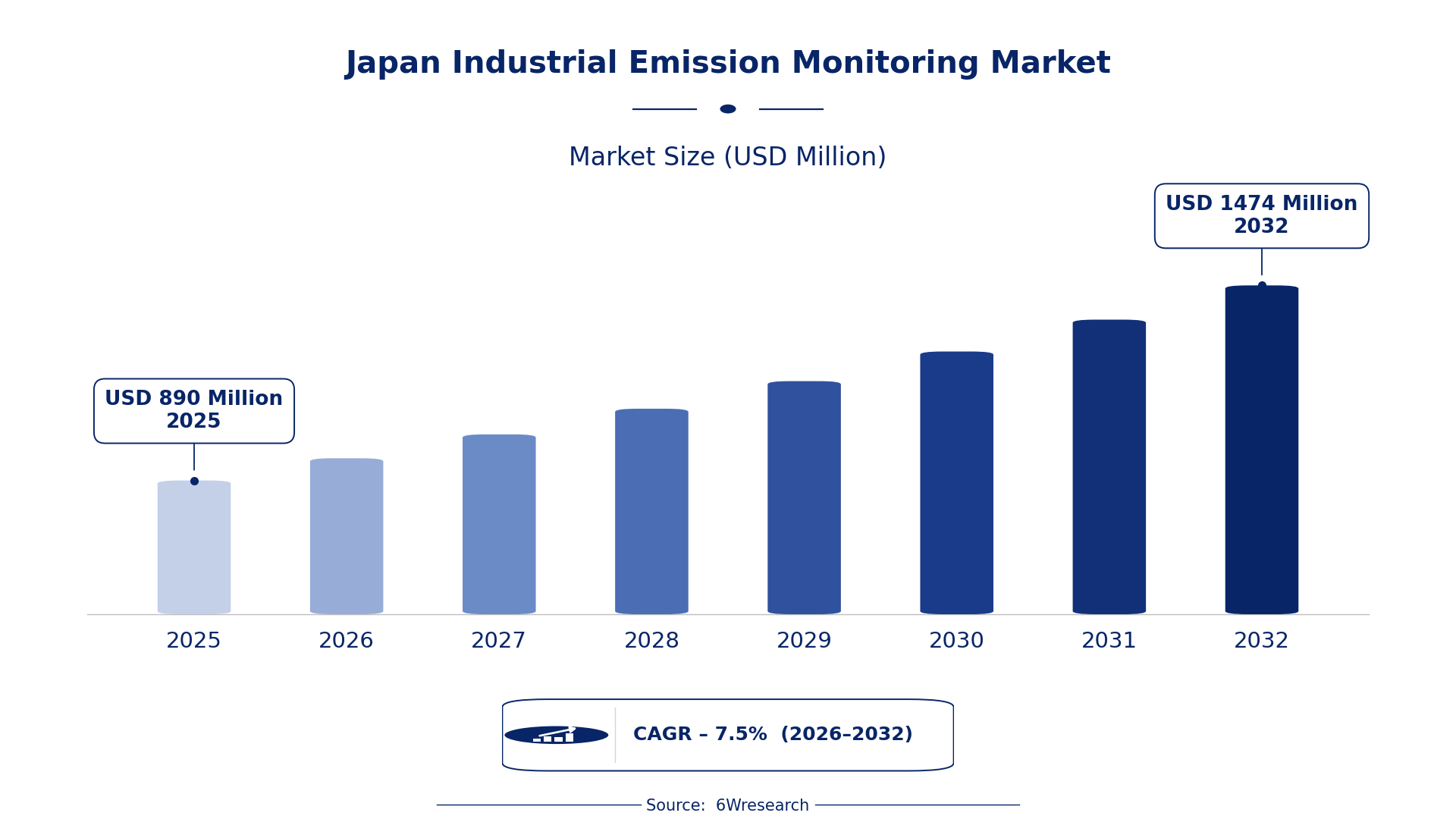
According to 6Wresearch internal database and industry insights, the Japan Industrial Emission Monitoring Market was valued at USD 890 Million in 2025 and is projected to reach USD 1,474 Million by 2032, growing at a CAGR of approximately 7.5% during 2026–2032.
Japan Industrial Emission Monitoring Market Highlights
| Report Metric | Details |
| Report Name | Japan Industrial Emission Monitoring Market (2026-2032) |
| Market Size 2025 | USD 890 Million |
| Market Size 2032 | USD 1,474 Million |
| Absolute Growth 2025–2032 | USD 584 Million |
| CAGR 2026–2032 | 7.5% |
| Peak Annual Growth | 8.8% in 2032 |
| Forecast Period | 2026–2032 |
| Historical Data | 2022–2025 |
| Base Year | 2025 |
| Leading Monitoring System Type, 2025 | CEMS (Continuous) (49% share) |
| Leading Sensor Technology, 2025 | NDIR/FTIR Sensors (37% share) |
| Leading Data Output Format, 2025 | Real-Time Dashboard (42% share) |
| Leading End User, 2025 | Industrial Boilers (40% share) |
| Fastest-Growing Monitoring System Type | Portable Emission Monitors (10.6% CAGR) |
| Fastest-Growing Sensor Technology | Laser-Based Detection (10.7% CAGR) |
| Fastest-Growing End User | On-Site Inspectors (9.5% CAGR) |
| Growing Sector | Industrial Boilers |
| Key End Users | Manufacturers, Energy Producers, Environmental Inspectors, Regulatory Agencies |
Japan Industrial Emission Monitoring Market Year-wise Growth Rate and Key Drivers (2022–2032)
This graph illustrates the annual growth rates of the market from 2022 to 2032, highlighting a steady upward trajectory and projected market expansion over the forecast period.
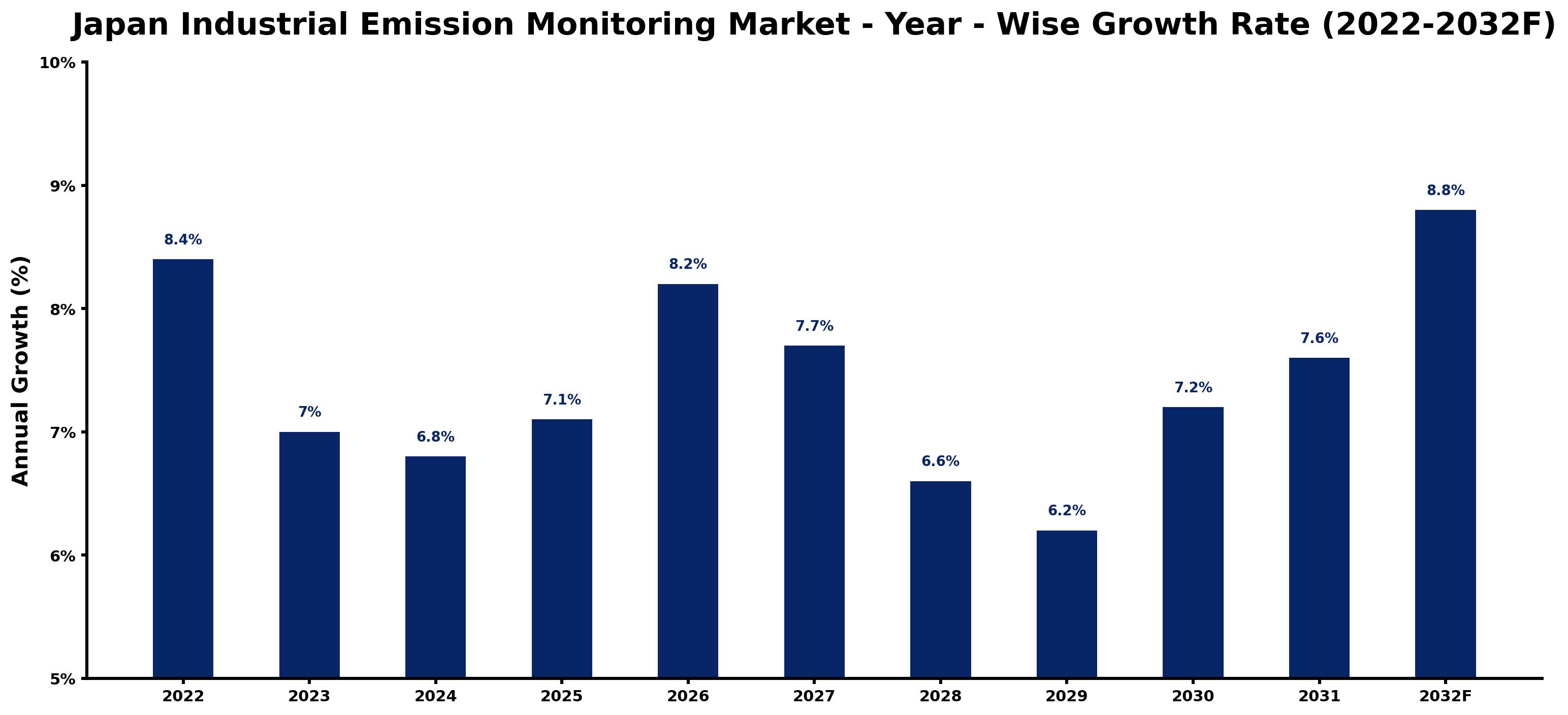
Below, each year's estimated growth is shown next to the factor that most influenced it.
| Year | Estimated Annual Growth (%) | Market Rationale |
| 2022 | 8.4 | The market experienced strong demand driven by regulatory compliance and environmental awareness. |
| 2023 | 7.0 | Growth slowed due to market saturation and increased competition among monitoring technologies. |
| 2024 | 6.8 | The market continued to grow as industries adapted to stricter emission regulations. |
| 2025 | 7.1 | Demand rose as companies invested in advanced monitoring systems for compliance. |
| 2026 | 8.2 | Growth accelerated with the introduction of new technologies enhancing monitoring capabilities. |
| 2027 | 7.7 | The market saw a slowdown as some sectors faced budget constraints. |
| 2028 | 6.6 | Growth decelerated as companies focused on optimizing existing systems instead of new purchases. |
| 2029 | 6.2 | The market continued to grow as regulatory pressures remained strong across industries. |
| 2030 | 7.2 | Demand increased as companies sought to meet ambitious emission reduction targets. |
| 2031 | 7.6 | Growth picked up as new monitoring technologies gained traction in various sectors. |
| 2032 | 8.8 | The market peaked with significant investments in emission monitoring technologies. |
Note: Market size estimations and growth projections presented in this report are based on 6Wresearch's proprietary forecasting methodology, utilizing the latest available industry data, government publications, and primary research inputs.
Japan Industrial Emission Monitoring Market Synopsis
Industrial emission monitoring utilises advanced technologies to measure pollutants from industrial processes, ensuring compliance with environmental regulations and improving air quality. The Japan Industrial Emission Monitoring Market is expanding due to rising regulatory requirements and investments in cleaner technologies. Japan's GX Basic Policy aims for JPY 150 trillion in decarbonisation investments over the next decade, driving demand from sectors such as manufacturing and energy production.
Market Dynamics Impact Analysis (2026–2032)
| Factor | Type | Impact | Primary Segment Affected |
| Increasing regulatory compliance requirements drive demand for monitoring systems. | Driver | High | CEMS (Continuous) |
| Growing investment in cleaner technologies enhances monitoring capabilities. | Driver | High | Portable Emission Monitors |
| Emerging demand for real-time data analytics creates opportunities for advanced monitoring solutions. | Opportunity | High | Real-Time Dashboard |
| Rising awareness of air quality issues among the public boosts demand for monitoring systems. | Opportunity | Medium | In-Situ Monitors |
| High initial investment costs can deter smaller companies from adopting new technologies. | Restraint | High | Extractive Monitors |
| Limited availability of skilled personnel for system installation and maintenance hinders growth. | Restraint | Medium | NDIR/FTIR Sensors |
| Technological advancements may outpace regulatory updates, creating compliance challenges. | Challenge | High | CEMS (Continuous) |
| Competition among monitoring technology providers can lead to price wars, impacting margins. | Challenge | Medium | Portable Emission Monitors |
Evaluation of Drivers in Japan Industrial Emission Monitoring Market (2026–2032)
These are the developments adding the most demand over the forecast period.
| Drivers | Primary Segment Affected | Why It Matters (Evidence) |
| Stricter emission regulations require continuous monitoring systems for compliance. | CEMS (Continuous) | CEMS are mandated for all large industrial sources, ensuring regulatory adherence and improving air quality. |
| Investment in cleaner technologies drives demand for portable monitoring solutions. | Portable Emission Monitors | Over 1,500 on-site inspectors use portable monitors annually for compliance checks, increasing demand for these devices. |
| Real-time data analytics improve operational efficiency and compliance. | Real-Time Dashboard | Used in over 60% of large industrial plants, these dashboards provide critical insights for decision-making. |
| Increased public awareness of air quality issues prompts industries to invest in monitoring. | In-Situ Monitors | The average population exposure to emissions in urban areas is a growing concern, driving demand for effective monitoring. |
| Technological advancements improve the accuracy and reliability of monitoring systems. | NDIR/FTIR Sensors | These sensors are widely adopted for detecting specific gas concentrations in emissions, enhancing monitoring capabilities. |
In 2022, over 2,000 continuous monitoring systems were installed, reflecting the need for compliance in large industrial sources. The average population exposure to industrial emissions in urban areas drives demand for better monitoring solutions. Public awareness of air quality issues is prompting sectors like manufacturing to adopt advanced technologies for improved compliance and health outcomes. The integration of AI in monitoring solutions is improving data analysis, enabling faster decision-making and better air quality management.
Evaluation of Restraints in Japan Industrial Emission Monitoring Market
The following restraints limit how fast demand can grow.
| Market Restraint | Primary Segment Affected | Why It Matters (Evidence) |
| High initial costs deter smaller companies from investing in advanced monitoring systems. | Extractive Monitors | The investment required can limit adoption among smaller industrial players, with costs reaching several million yen. |
| Limited skilled workforce for installation and maintenance hampers system effectiveness. | NDIR/FTIR Sensors | A shortage of qualified personnel affects the operational efficiency of monitoring systems, leading to compliance delays. |
| Technological advancements may outpace regulatory updates, complicating compliance. | CEMS (Continuous) | Rapid changes in technology can lead to outdated compliance standards, creating challenges for industries. |
| Competition among providers leads to price wars, impacting profitability. | Portable Emission Monitors | Intense competition can drive down prices, affecting margins for manufacturers and suppliers. |
| Market saturation in certain sectors slows growth as companies optimise existing systems. | In-Situ Monitors | Many industries focus on improving current systems rather than investing in new ones, limiting market expansion. |
Japan Industrial Emission Monitoring Market Challenges
Producers encounter fierce competition from advanced emission monitoring technologies that threaten their market position. A shortage of skilled professionals in data analysis hampers producers' efficiency, leading to compliance delays that may result in penalties of up to ¥1 million per violation. Many smaller firms struggle to obtain funding for essential monitoring equipment, risking non-compliance fines and operational setbacks. Cost pressures from stringent regulations compel buyers to allocate substantial budgets for compliance, restricting their financial flexibility for other operational needs.
Trends in the Japan Industrial Emission Monitoring Market
The trends below show where the Japan Industrial Emission Monitoring Market is heading.
- Shift Towards Real-Time Monitoring: In 2022, real-time data dashboards became essential in over 60% of large industrial plants, improving compliance and operational efficiency. This trend indicates a growing preference for immediate data access among industries, resulting in increased investments in monitoring technologies.
- Rise of Portable Emission Monitoring: Since 2022, the use of portable emission monitors has surged among on-site inspectors, with over 1,500 inspectors relying on these tools for compliance checks. This shift reflects the need for flexibility and immediate data collection in various industrial settings.
- Increased Adoption of Advanced Sensors: As of 2023, NDIR/FTIR sensors accounted for 37% of the market, driven by their effectiveness in detecting specific gas concentrations. This trend highlights the growing demand for precision in emission monitoring technologies.
- Focus on Decarbonisation Investments: Japan's GX Basic Policy, targeting JPY 150 trillion in decarbonisation investments over the next decade, has spurred demand for emission monitoring technologies. This initiative aims to reduce industrial emissions significantly by 2030.
Investment Opportunities in the Japan Industrial Emission Monitoring Market
The opportunities below stand out in the Japan Industrial Emission Monitoring Market for new entrants and existing suppliers.
- Industrial Boilers Seeking Compliance Solutions: Industrial boilers represent a major source of emissions, creating a demand for monitoring solutions. With regulations tightening, investment in emission monitoring technologies is essential for compliance and operational efficiency.
- Growing Need for Real-Time Data Solutions: With over 60% of large plants adopting real-time dashboards, the demand for advanced monitoring solutions is increasing. Suppliers can enter this market by partnering with local manufacturers to provide tailored solutions.
- On-Site Inspectors Requiring Portable Solutions: The increasing reliance on portable monitors by over 1,500 on-site inspectors indicates a strong market need. Suppliers can meet this demand by investing in innovative portable monitoring technologies.
- Cement Kilns Under Pressure for Emission Reductions: Cement kilns contribute about 10% of total industrial emissions, creating a pressing need for effective monitoring solutions. Suppliers can engage with manufacturers to develop compliant monitoring systems.
Government Initiatives in the Japan Industrial Emission Monitoring Market
The GX Promotion Act, enacted in 2023, establishes a legal framework for Japan's decarbonisation strategy, complementing existing laws such as the PRTR Law of 1999. This act mandates stricter emission reporting and encourages investment in cleaner technologies, improving compliance for industrial operators by ensuring they meet updated standards.
The Ministry of the Environment oversees the implementation of emission monitoring regulations, ensuring businesses adhere to the PRTR Law. By facilitating funding for environmental monitoring technologies, the ministry supports industries in effectively meeting compliance standards, with an allocation of ¥10 billion in 2023 to enhance monitoring capabilities.
Future Insight of the Japan Industrial Emission Monitoring Market
Real-time data dashboards will transform emission monitoring by 2032, allowing for immediate responses to pollution levels. Japan's ¥10 billion investment in environmental monitoring technologies will stimulate demand for sophisticated systems, benefiting both buyers and suppliers. Continuous emissions monitoring will become standard across all industrial sectors, improving compliance and operational efficiency. The integration of AI in monitoring technologies will enable faster data analysis, promoting quicker decision-making and better air quality management.
Market Segmentation Analysis
Japan Industrial Emission Monitoring Market report covers a detailed analysis of the following market segments:
By Monitoring System Type – CEMS (Continuous) Leads, Portable Emission Monitors Expected to Grow Fastest
According to Saurav Kr Singh, Senior Research Analyst at 6Wresearch, with 49% of monitoring system type revenue in 2025, CEMS (Continuous) was the largest category. CEMS are essential for large industrial sources in Japan, ensuring compliance with stringent regulations. The installed base of 2,000 continuous monitoring systems highlights their reliability and critical role in providing real-time emissions data. The quickest growth will come from Portable Emission Monitors, forecast to expand at a CAGR of 10.6% between 2026 and 2032. The increasing emphasis on on-site compliance checks is driving the demand for portable emission monitors, with over 1,500 inspectors utilising them each year. This trend indicates a growing preference for flexible monitoring solutions to meet regulatory demands. Suppliers should prioritise the development of portable monitoring technologies to cater to the rising needs of inspectors.
By Sensor Technology – NDIR/FTIR Sensors Lead, Laser-Based Detection Expected to Grow Fastest
The largest sensor technology category in 2025 was NDIR/FTIR Sensors, at 37% of revenue. NDIR/FTIR sensors are widely employed in Japan due to their effectiveness in detecting specific gas concentrations, making them crucial for compliance monitoring. Their established market presence underscores their importance in emissions measurement. Laser-Based Detection is set to record the highest CAGR in this split, 10.7% over 2026–2032. The heightened emphasis on precision in emissions measurement is accelerating the adoption of laser-based detection technologies. As industries aim for enhanced accuracy, this segment is expected to witness significant growth. Investing in laser-based detection technologies may provide suppliers with a competitive edge in the market.
By Data Output Format – Real-Time Dashboard Leads and Records the Fastest Growth
Real-Time Dashboard held 42% of the Japan Industrial Emission Monitoring Market by data output format in 2025. Real-time dashboards are used in over 60% of large industrial plants, offering immediate insights into emissions data. Their ability to visualise complex information is vital for operational efficiency and regulatory compliance. Real-Time Dashboard is also forecast to expand faster than any other category, at a CAGR of 11.1% over 2026–2032. As industries increasingly prioritise immediate access to data, the demand for real-time dashboards is set to grow. This trend reinforces the leading position of this format in data output solutions. Suppliers should enhance the functionalities of dashboards to meet the escalating demand for real-time data visualisation.
By End User – Industrial Boilers Lead, On-Site Inspectors Expected to Grow Fastest
Industrial Boilers took 40% of end user revenue in 2025, more than any other category. Industrial boilers represent a major source of emissions in Japan, necessitating stringent monitoring to adhere to regulations. Their significant role in the industrial sector ensures a substantial share of the market for monitoring solutions. On-Site Inspectors are projected to grow fastest, at a CAGR of 9.5% during 2026–2032. The reliance of on-site inspectors on accurate monitoring data for compliance assessments propels the rapid growth of this user segment. As regulatory scrutiny intensifies, their demand for monitoring solutions is anticipated to increase. Suppliers should tailor their offerings to meet the specific requirements of on-site inspectors for compliance monitoring.
Key Attractiveness of the Report
- 10 Years of Market Numbers
- Historical Data Starting from 2022 to 2025
- Base Year 2025
- Forecast Data until 2032
- Key Performance Indicators Impacting the Market
- Major Upcoming Developments and Projects
Key Highlights of the Report:
- Japan Industrial Emission Monitoring Market Outlook
- Market Size of Japan Industrial Emission Monitoring Market, 2025
- Forecast of Japan Industrial Emission Monitoring Market, 2032
- Historical Data and Forecast of Japan Industrial Emission Monitoring Revenues & Volume for the Period 2022-2032F
- Japan Industrial Emission Monitoring Market Trend Evolution
- Japan Industrial Emission Monitoring Market Drivers and Challenges
- Japan Industrial Emission Monitoring Price Trends
- Japan Industrial Emission Monitoring Porter's Five Forces
- Japan Industrial Emission Monitoring Industry Life Cycle
- Historical Data and Forecast of Japan Industrial Emission Monitoring Market Revenues & Volume By Monitoring System Type for the Period 2022-2032F
- Historical Data and Forecast of Japan Industrial Emission Monitoring Market Revenues & Volume By CEMS (Continuous) for the Period 2022-2032F
- Historical Data and Forecast of Japan Industrial Emission Monitoring Market Revenues & Volume By Portable Emission Monitors for the Period 2022-2032F
- Historical Data and Forecast of Japan Industrial Emission Monitoring Market Revenues & Volume By In-Situ Monitors for the Period 2022-2032F
- Historical Data and Forecast of Japan Industrial Emission Monitoring Market Revenues & Volume By Extractive Monitors for the Period 2022-2032F
- Historical Data and Forecast of Japan Industrial Emission Monitoring Market Revenues & Volume By Sensor Technology for the Period 2022-2032F
- Historical Data and Forecast of Japan Industrial Emission Monitoring Market Revenues & Volume By NDIR/FTIR Sensors for the Period 2022-2032F
- Historical Data and Forecast of Japan Industrial Emission Monitoring Market Revenues & Volume By Electrochemical for the Period 2022-2032F
- Historical Data and Forecast of Japan Industrial Emission Monitoring Market Revenues & Volume By Laser-Based Detection for the Period 2022-2032F
- Historical Data and Forecast of Japan Industrial Emission Monitoring Market Revenues & Volume By Sample Line Monitoring for the Period 2022-2032F
- Historical Data and Forecast of Japan Industrial Emission Monitoring Market Revenues & Volume By Data Output Format for the Period 2022-2032F
- Historical Data and Forecast of Japan Industrial Emission Monitoring Market Revenues & Volume By Real-Time Dashboard for the Period 2022-2032F
- Historical Data and Forecast of Japan Industrial Emission Monitoring Market Revenues & Volume By USB/Cloud Sync for the Period 2022-2032F
- Historical Data and Forecast of Japan Industrial Emission Monitoring Market Revenues & Volume By Analog/Digital for the Period 2022-2032F
- Historical Data and Forecast of Japan Industrial Emission Monitoring Market Revenues & Volume By SCADA-Linked for the Period 2022-2032F
- Historical Data and Forecast of Japan Industrial Emission Monitoring Market Revenues & Volume By End User for the Period 2022-2032F
- Historical Data and Forecast of Japan Industrial Emission Monitoring Market Revenues & Volume By Industrial Boilers for the Period 2022-2032F
- Historical Data and Forecast of Japan Industrial Emission Monitoring Market Revenues & Volume By On-Site Inspectors for the Period 2022-2032F
- Historical Data and Forecast of Japan Industrial Emission Monitoring Market Revenues & Volume By Cement Kilns for the Period 2022-2032F
- Historical Data and Forecast of Japan Industrial Emission Monitoring Market Revenues & Volume By Refineries for the Period 2022-2032F
- Japan Industrial Emission Monitoring Import Export Trade Statistics
- Market Opportunity Assessment By Monitoring System Type
- Market Opportunity Assessment By Sensor Technology
- Market Opportunity Assessment By Data Output Format
- Market Opportunity Assessment By End User
- Japan Industrial Emission Monitoring Top Companies Market Share
- Japan Industrial Emission Monitoring Competitive Benchmarking By Technical and Operational Parameters
- Japan Industrial Emission Monitoring Company Profiles
- Japan Industrial Emission Monitoring Key Strategic Recommendations
Market Covered
This report examines the market across the segments below.
By Monitoring System Type
- CEMS (Continuous)
- Portable Emission Monitors
- In-Situ Monitors
- Extractive Monitors
By Sensor Technology
- NDIR/FTIR Sensors
- Electrochemical
- Laser-Based Detection
- Sample Line Monitoring
By Data Output Format
- Real-Time Dashboard
- USB/Cloud Sync
- Analog/Digital
- SCADA-Linked
By End User
- Industrial Boilers
- On-Site Inspectors
- Cement Kilns
- Refineries































