Japan Industrial Equipment Leasing Market Size & Growth Rate
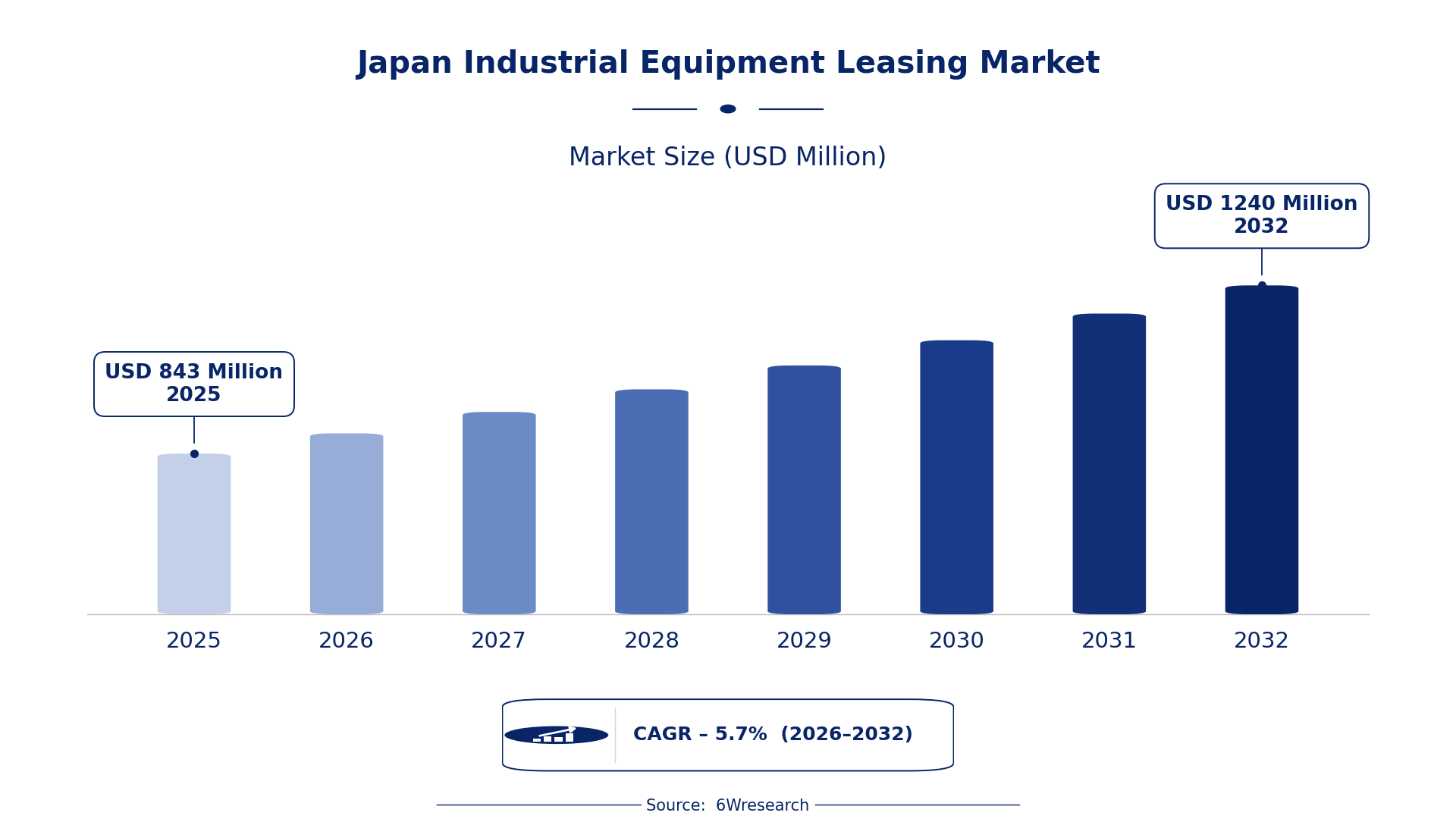
According to 6Wresearch internal database and industry insights, the Japan Industrial Equipment Leasing Market was valued at USD 843 Million in 2025 and is projected to reach USD 1,240 Million by 2032, growing at a CAGR of approximately 5.7% during 2026–2032.
Japan Industrial Equipment Leasing Market Highlights
| Report Metric | Details |
| Report Name | Japan Industrial Equipment Leasing Market (2026-2032) |
| Market Size 2025 | USD 843 Million |
| Market Size 2032 | USD 1,240 Million |
| Absolute Growth 2025–2032 | USD 397 Million |
| CAGR 2026–2032 | 5.7% |
| Peak Annual Growth | 6.9% in 2032 |
| Forecast Period | 2026–2032 |
| Historical Data | 2022–2025 |
| Base Year | 2025 |
| Leading Equipment Type, 2025 | Construction Equipment (46% share) |
| Leading Lease Duration, 2025 | Short/Long-Term (40% share) |
| Leading Ownership Type, 2025 | Operating Lease (48% share) |
| Leading End User, 2025 | Contractors (51% share) |
| Fastest-Growing Equipment Type | Manufacturing Machinery (8.4% CAGR) |
| Fastest-Growing Lease Duration | Monthly/Annual (7.7% CAGR) |
| Fastest-Growing Ownership Type | Finance Lease (7.4% CAGR) |
| Fastest-Growing End User | SMEs (7.5% CAGR) |
| Growing Sector | construction |
| Key End Users | contractors, SMEs, logistics providers, manufacturers |
Japan Industrial Equipment Leasing Market Year-wise Growth Rate and Key Drivers (2022–2032)
This graph illustrates the annual growth rates of the market from 2022 to 2032, highlighting a steady upward trajectory and projected market expansion over the forecast period.
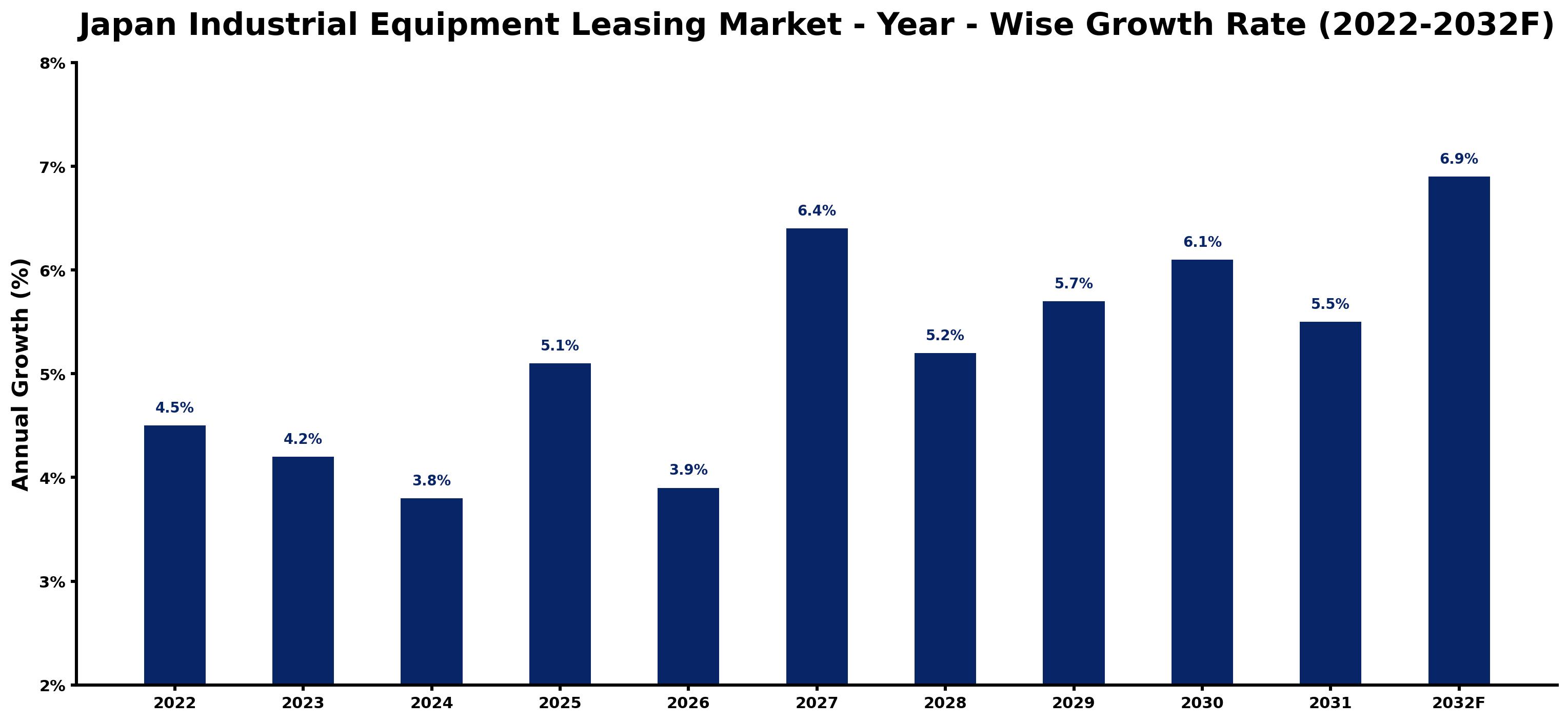
Below, each year's estimated growth is shown next to the factor that most influenced it.
| Year | Estimated Annual Growth (%) | Market Rationale |
| 2022 | 4.5 | The market experienced steady growth, supported by ongoing construction projects. |
| 2023 | 4.2 | Growth slowed due to a temporary dip in manufacturing activity and equipment demand. |
| 2024 | 3.8 | Demand continued to slow as businesses adjusted to economic uncertainties and budget constraints. |
| 2025 | 5.1 | Growth accelerated as contractors increased equipment leasing for large-scale projects. |
| 2026 | 3.9 | A slowdown is expected as leasing rates stabilise and businesses become more cautious. |
| 2027 | 6.4 | Demand is projected to rise due to increased investments in infrastructure and construction. |
| 2028 | 5.2 | Growth is anticipated to slow as the market adjusts to previous high demand levels and competition increases. |
| 2029 | 5.7 | Demand is expected to increase as SMEs seek flexible leasing options for machinery acquisition. |
| 2030 | 6.1 | Growth will continue as contractors expand projects, requiring more leased equipment. |
| 2031 | 5.5 | The market is projected to see a slowdown as leasing demand normalises after previous peaks. |
| 2032 | 6.9 | Demand is expected to surge as green equipment leasing initiatives gain traction among businesses. |
Note: Market size estimations and growth projections presented in this report are based on 6Wresearch's proprietary forecasting methodology, utilizing the latest available industry data, government publications, and primary research inputs.
Japan Industrial Equipment Leasing Market Synopsis
Industrial Equipment Leasing involves the rental of machinery and equipment for various industries through financial agreements, allowing businesses to use essential tools without outright purchase. The Japan Industrial Equipment Leasing Market was valued at approximately 1 trillion yen in 2022, driven by strong demand from contractors and SMEs. Increased investments in infrastructure, a growing focus on sustainability, and the rising adoption of flexible leasing options are propelling market growth, with annual investments projected to exceed 500 billion yen by 2025.
Market Dynamics Impact Analysis (2026–2032)
| Factor | Type | Impact | Primary Segment Affected |
| Rising investments in infrastructure projects | Driver | High | Construction Equipment |
| Growing adoption of flexible leasing options by SMEs | Driver | High | Manufacturing Machinery |
| Increasing demand for green equipment leasing | Opportunity | High | Power Generators |
| Expansion of project-based leasing among contractors | Opportunity | High | Transport Equipment |
| High competition among leasing companies | Restraint | Medium | Short/Long-Term |
| Budget constraints affecting SMEs' leasing decisions | Restraint | Medium | Operating Lease |
| High initial costs of green equipment | Challenge | High | Finance Lease |
| Regulatory compliance costs for leasing companies | Challenge | Medium | Full-Service Lease |
Evaluation of Drivers in Japan Industrial Equipment Leasing Market (2026–2032)
The table below links each growth driver to the segment it affects and the evidence for it.
| Drivers | Primary Segment Affected | Why It Matters (Evidence) |
| Increased infrastructure spending | Construction Equipment | Japan's government allocated JPY 150 trillion for infrastructure projects, leading to higher leasing demand from contractors. |
| Flexible leasing options for SMEs | Manufacturing Machinery | Approximately 60% of SMEs utilise leasing, allowing them to acquire necessary machinery without upfront costs. |
| Focus on sustainability initiatives | Power Generators | The GX Basic Policy aims for JPY 150 trillion in decarbonisation investments, increasing demand for green equipment leasing. |
| Growth in project-based leasing | Transport Equipment | Contractors are increasingly opting for project-based leasing to manage large-scale construction efficiently. |
| Rising demand for short-term leases | Short/Long-Term | The average lease duration for construction equipment is 24 months, reflecting a preference for flexible arrangements. |
Behind the steady rise in orders sits Japan's commitment to infrastructure development, with substantial funding allocated to projects. The average lease duration for construction equipment remains around 24 months, indicating a strong preference for flexible arrangements among businesses. Demand for green equipment leasing is increasing as companies aim to meet sustainability targets, driven by investments in eco-friendly machinery. Approximately 60% of SMEs are utilising leasing for machinery acquisition, allowing them to manage costs effectively and adapt to changing market conditions.
Evaluation of Restraints in Japan Industrial Equipment Leasing Market
The main factors holding the market back are set out below.
| Market Restraint | Primary Segment Affected | Why It Matters (Evidence) |
| Intense competition among leasing companies | Short/Long-Term | With numerous players in the market, pricing pressures can limit profitability for leasing firms. |
| Budget constraints for SMEs | Operating Lease | Many SMEs face financial limitations, impacting their ability to commit to long-term leasing agreements. |
| High costs associated with green equipment | Finance Lease | The initial investment for green equipment can deter companies from opting for sustainable leasing options. |
| Regulatory compliance costs | Full-Service Lease | Leasing companies must invest in compliance measures, which can increase operational costs. |
| Market saturation in urban areas | Transport Equipment | High competition in urban regions can limit growth opportunities for leasing companies. |
Japan Industrial Equipment Leasing Market Challenges
Japan's construction equipment leasing market faced a valuation of approximately 1 trillion yen in 2022, indicating high costs that burden buyers. This expense arises from rising operational costs, forcing buyers to allocate more budget for leasing agreements. Regulatory pressures mount, as ISO 9001 certification is a common requirement, causing procurement delays for leasing companies. Skills shortages persist in the logistics sector, where the demand for trained personnel outpaces supply, resulting in project delays that can extend timelines by up to six months for contractors.
Trends in the Japan Industrial Equipment Leasing Market
Buyers and suppliers in the Japan Industrial Equipment Leasing Market are adjusting to the following trends.
- Shift towards Green Equipment Leasing: In 2023, the government launched a program promoting green equipment leasing, aligning with sustainability goals. This initiative is expected to increase demand for eco-friendly machinery, with investments anticipated to reach JPY 150 trillion over ten years.
- Growing Popularity of Project-Based Leasing: Contractors are increasingly adopting project-based leasing for large-scale projects, improving efficiency and flexibility. This trend is seen as project-based leasing options have gained traction, particularly in the construction sector.
- Rising Demand for Short-Term Leases: The trend towards short-term leasing is clear as businesses seek flexibility in equipment acquisition. The average lease duration for construction equipment remains around 24 months, reflecting this shift.
- Expansion of Leasing Options for SMEs: SMEs are increasingly utilising leasing options to manage equipment costs effectively. Approximately 60% of SMEs in Japan are now using leasing for machinery acquisition, highlighting this growing trend.
Investment Opportunities in the Japan Industrial Equipment Leasing Market
The following opportunities in the Japan Industrial Equipment Leasing Market pair current demand with a clear way in.
- Contractors Seeking Flexible Leasing Solutions: Contractors are increasingly looking for flexible leasing options to manage project costs effectively. The construction sector is expected to see growth, with investments exceeding 500 billion yen by 2025.
- Aichi Prefecture's Manufacturing Sector Growth: The Aichi Prefecture is experiencing a surge in manufacturing activities, creating demand for machinery leasing. Companies can enter this market by partnering with local firms to offer tailored leasing solutions.
- Entry through Joint Ventures: Establishing joint ventures with local leasing companies can facilitate market entry. This strategy is particularly relevant for companies looking to provide innovative leasing options in Japan.
- Supply of Green Equipment: There is a growing need for green equipment leasing options as companies aim to meet sustainability targets. The GX Basic Policy encourages investments in eco-friendly machinery, creating opportunities for suppliers.
Government Initiatives in the Japan Industrial Equipment Leasing Market
The GX Promotion Act, introduced in 2023, establishes a legal framework for promoting green equipment leasing, enhancing previous regulations. This act aims to facilitate investments in sustainable technologies and equipment, aligning with Japan's decarbonisation goals. The act is expected to support the leasing industry by encouraging companies to adopt eco-friendly practices and technologies, ultimately benefiting buyers seeking sustainable solutions.
The Ministry of Economy, Trade and Industry oversees funding programs that support leasing initiatives. These programs aim to assist companies in acquiring equipment while promoting energy efficiency and sustainability, benefiting contractors and SMEs. By providing financial support, the ministry helps reduce the burden of initial costs associated with leasing, making it easier for buyers to access necessary machinery.
Future Insight of the Japan Industrial Equipment Leasing Market
By 2032, SMEs will increasingly adopt leasing for machinery acquisition as the government promotes green equipment initiatives. Annual investment in industrial equipment leasing is projected to exceed 500 billion yen by 2025, driven by a focus on sustainable technologies. The logistics sector will continue to stimulate demand for modernised fleets, as companies seek to enhance operational efficiency. New standards and best practices introduced by the Japan Leasing Association will streamline processes for suppliers and improve service delivery.
Market Segmentation Analysis
Japan Industrial Equipment Leasing Market report covers a detailed analysis of the following market segments:
By Equipment Type – Construction Equipment Leads, Manufacturing Machinery Expected to Grow Fastest
According to Saurav Kr Singh, Senior Research Analyst at 6Wresearch, Construction Equipment accounted for 46% of the market by equipment type in 2025. Construction equipment commands the largest market share due to its essential role in various construction projects across Japan. The robust activity in the Tokyo region, accounting for 30% of leasing activities, underscores the high demand for this equipment. Over 2026–2032, Manufacturing Machinery is expected to post the fastest growth, at a CAGR of 8.4%. Manufacturing machinery is experiencing rapid growth as industries strive to enhance production efficiency. The steady demand observed in Aichi Prefecture highlights the increasing reliance on leased machinery for manufacturing operations. Suppliers should focus on expanding their manufacturing machinery offerings to take advantage of this growing segment.
By Lease Duration – Short/Long-Term Leads, Monthly/Annual Expected to Grow Fastest
The largest lease duration category in 2025 was Short/Long-Term, at 40% of revenue. Short/long-term leases dominate the market as they provide businesses with the flexibility needed to adapt to fluctuating project demands. This flexibility is crucial for companies managing varying workloads and financial constraints. The quickest growth will come from Monthly/Annual, forecast to expand at a CAGR of 7.7% between 2026 and 2032. Monthly/annual leases are gaining traction as they align well with the budgeting cycles of many organisations. This shift indicates a preference for shorter commitments that simplify financial management. Buyers may increasingly favour monthly/annual leases to improve their financial agility in operations.
By Ownership Type – Operating Lease Leads, Finance Lease Expected to Grow Fastest
In 2025, Operating Lease led the ownership type split with a 48% share. Operating leases are preferred by businesses seeking short-term solutions without the burden of ownership. This model is particularly appealing for companies that need equipment for specific projects without long-term commitments. Finance Lease is set to record the highest CAGR in this split, 7.4% over 2026–2032. Finance leases are gaining popularity as they cater to businesses looking for longer-term equipment solutions while retaining some ownership benefits. This trend reflects a growing need for stability in equipment financing. Suppliers should consider offering more flexible finance lease options to meet the evolving preferences of their clients.
By End User – Contractors Lead, SMEs Expected to Grow Fastest
Contractors took 51% of end user revenue in 2025, more than any other category. Contractors represent the largest segment of end users for leased equipment, primarily due to their reliance on such resources for large-scale construction projects. Their significant presence in the market emphasises the importance of leasing within the construction sector. SMEs are projected to grow fastest, at a CAGR of 7.5% during 2026–2032. SMEs are rapidly adopting leasing solutions as they provide flexible options that cater to their operational needs. This trend reflects a growing preference among smaller businesses for leased equipment to boost efficiency. Suppliers should tailor their marketing strategies to address the specific needs of SMEs within the leasing market.
Key Attractiveness of the Report
- 10 Years of Market Numbers
- Historical Data Starting from 2022 to 2025
- Base Year 2025
- Forecast Data until 2032
- Key Performance Indicators Impacting the Market
- Major Upcoming Developments and Projects
Key Highlights of the Report:
- Japan Industrial Equipment Leasing Market Outlook
- Market Size of Japan Industrial Equipment Leasing Market, 2025
- Forecast of Japan Industrial Equipment Leasing Market, 2032
- Historical Data and Forecast of Japan Industrial Equipment Leasing Revenues & Volume for the Period 2022-2032F
- Japan Industrial Equipment Leasing Market Trend Evolution
- Japan Industrial Equipment Leasing Market Drivers and Challenges
- Japan Industrial Equipment Leasing Price Trends
- Japan Industrial Equipment Leasing Porter's Five Forces
- Japan Industrial Equipment Leasing Industry Life Cycle
- Historical Data and Forecast of Japan Industrial Equipment Leasing Market Revenues & Volume By Equipment Type for the Period 2022-2032F
- Historical Data and Forecast of Japan Industrial Equipment Leasing Market Revenues & Volume By Construction Equipment for the Period 2022-2032F
- Historical Data and Forecast of Japan Industrial Equipment Leasing Market Revenues & Volume By Manufacturing Machinery for the Period 2022-2032F
- Historical Data and Forecast of Japan Industrial Equipment Leasing Market Revenues & Volume By Power Generators for the Period 2022-2032F
- Historical Data and Forecast of Japan Industrial Equipment Leasing Market Revenues & Volume By Transport Equipment for the Period 2022-2032F
- Historical Data and Forecast of Japan Industrial Equipment Leasing Market Revenues & Volume By Lease Duration for the Period 2022-2032F
- Historical Data and Forecast of Japan Industrial Equipment Leasing Market Revenues & Volume By Short/Long-Term for the Period 2022-2032F
- Historical Data and Forecast of Japan Industrial Equipment Leasing Market Revenues & Volume By Monthly/Annual for the Period 2022-2032F
- Historical Data and Forecast of Japan Industrial Equipment Leasing Market Revenues & Volume By Project-Based for the Period 2022-2032F
- Historical Data and Forecast of Japan Industrial Equipment Leasing Market Revenues & Volume By Full-Service Lease for the Period 2022-2032F
- Historical Data and Forecast of Japan Industrial Equipment Leasing Market Revenues & Volume By Ownership Type for the Period 2022-2032F
- Historical Data and Forecast of Japan Industrial Equipment Leasing Market Revenues & Volume By Operating Lease for the Period 2022-2032F
- Historical Data and Forecast of Japan Industrial Equipment Leasing Market Revenues & Volume By Finance Lease for the Period 2022-2032F
- Historical Data and Forecast of Japan Industrial Equipment Leasing Market Revenues & Volume By Rental/Leaseback for the Period 2022-2032F
- Historical Data and Forecast of Japan Industrial Equipment Leasing Market Revenues & Volume By Fleet Management Model for the Period 2022-2032F
- Historical Data and Forecast of Japan Industrial Equipment Leasing Market Revenues & Volume By End User for the Period 2022-2032F
- Historical Data and Forecast of Japan Industrial Equipment Leasing Market Revenues & Volume By Contractors for the Period 2022-2032F
- Historical Data and Forecast of Japan Industrial Equipment Leasing Market Revenues & Volume By SMEs for the Period 2022-2032F
- Historical Data and Forecast of Japan Industrial Equipment Leasing Market Revenues & Volume By Remote Sites for the Period 2022-2032F
- Historical Data and Forecast of Japan Industrial Equipment Leasing Market Revenues & Volume By Logistics Providers for the Period 2022-2032F
- Japan Industrial Equipment Leasing Import Export Trade Statistics
- Market Opportunity Assessment By Equipment Type
- Market Opportunity Assessment By Lease Duration
- Market Opportunity Assessment By Ownership Type
- Market Opportunity Assessment By End User
- Japan Industrial Equipment Leasing Top Companies Market Share
- Japan Industrial Equipment Leasing Competitive Benchmarking By Technical and Operational Parameters
- Japan Industrial Equipment Leasing Company Profiles
- Japan Industrial Equipment Leasing Key Strategic Recommendations
Market Covered
The following segment groups are covered in the report.
By Equipment Type
- Construction Equipment
- Manufacturing Machinery
- Power Generators
- Transport Equipment
By Lease Duration
- Short/Long-Term
- Monthly/Annual
- Project-Based
- Full-Service Lease
By Ownership Type
- Operating Lease
- Finance Lease
- Rental/Leaseback
- Fleet Management Model
By End User
- Contractors
- SMEs
- Remote Sites
- Logistics Providers































