Japan Industrial Explosives Market Size & Growth Rate
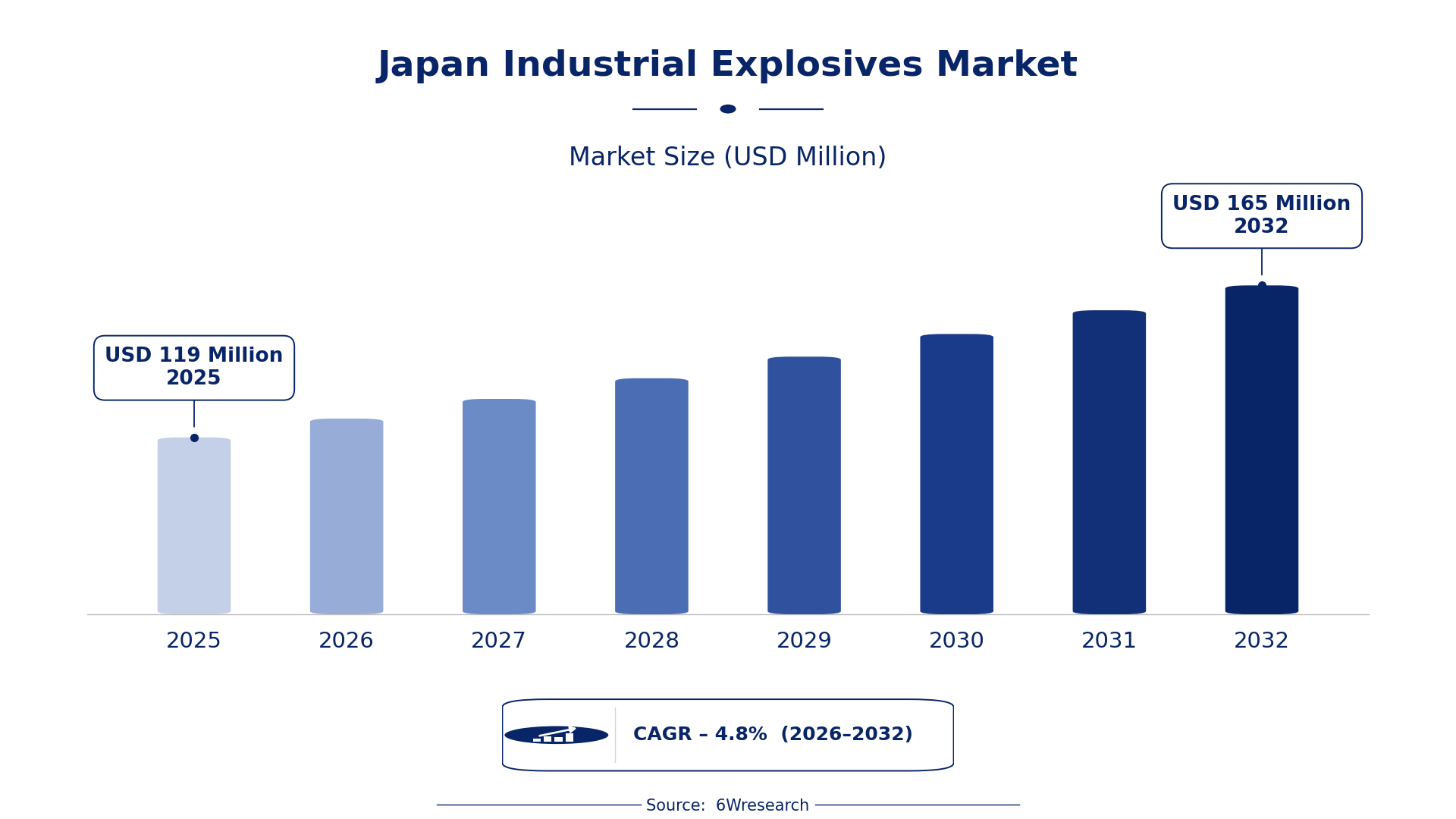
According to 6Wresearch internal database and industry insights, the Japan Industrial Explosives Market was valued at USD 119 Million in 2025 and is projected to reach USD 165 Million by 2032, growing at a CAGR of approximately 4.8% during 2026–2032.
Japan Industrial Explosives Market Highlights
| Report Metric | Details |
| Report Name | Japan Industrial Explosives Market (2026-2032) |
| Market Size 2025 | USD 119 Million |
| Market Size 2032 | USD 165 Million |
| Absolute Growth 2025–2032 | USD 46 Million |
| CAGR 2026–2032 | 4.8% |
| Peak Annual Growth | 6.0% in 2027 |
| Forecast Period | 2026–2032 |
| Historical Data | 2022–2025 |
| Base Year | 2025 |
| Leading Type, 2025 | High Explosives (66% share) |
| Leading End-use Industry, 2025 | Metal Mining (36% share) |
| Fastest-Growing Type | Blasting Agents (6.3% CAGR) |
| Fastest-Growing End-use Industry | Non-Metal Mining (6.0% CAGR) |
| Growing Sector | Metal Mining |
| Key End Users | Construction companies, mining operators, quarrying firms, demolition contractors |
Japan Industrial Explosives Market Year-wise Growth Rate and Key Drivers (2022–2032)
This graph illustrates the annual growth rates of the market from 2022 to 2032, highlighting a steady upward trajectory and projected market expansion over the forecast period.
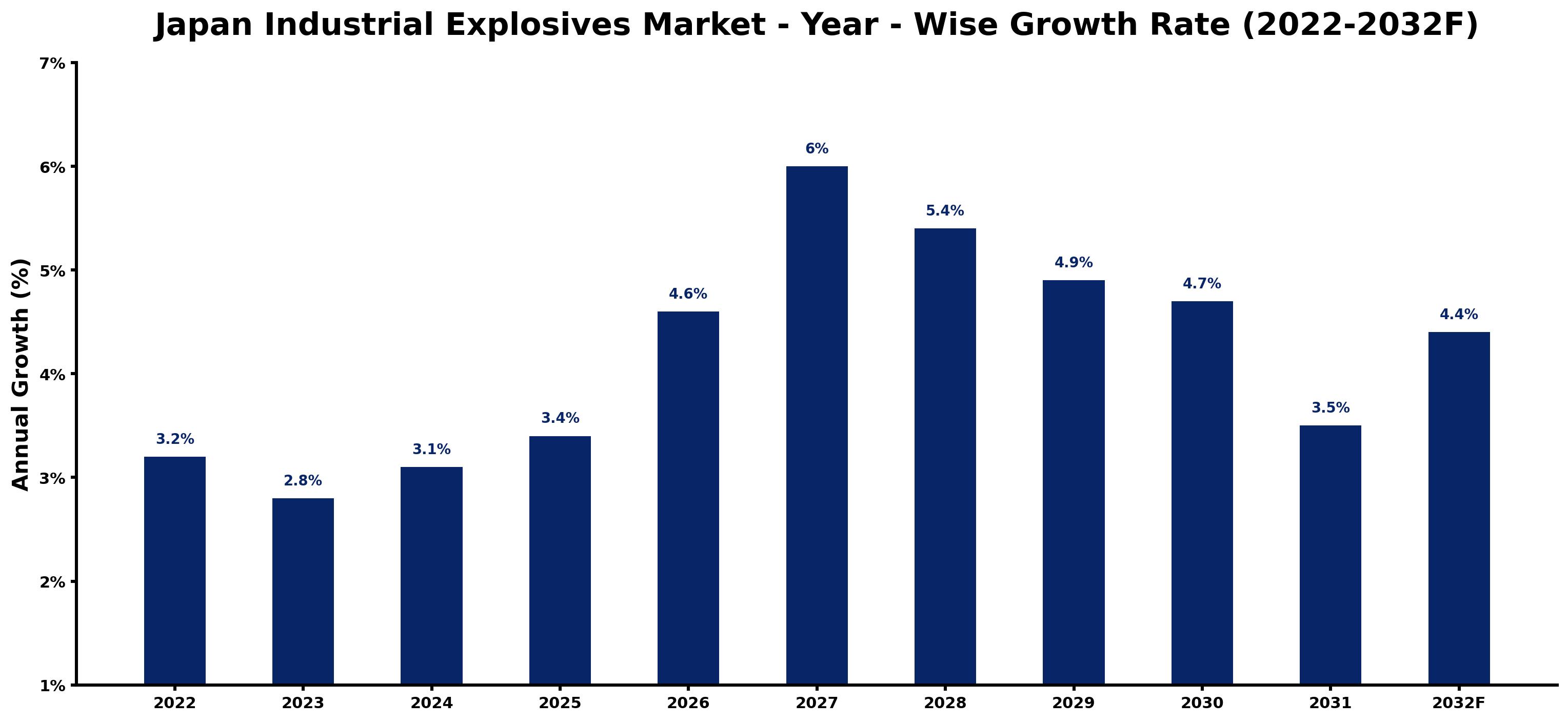
Below, each year's estimated growth is shown next to the factor that most influenced it.
| Year | Estimated Annual Growth (%) | Market Rationale |
| 2022 | 3.2 | The market showed steady growth, reflecting strong demand from the construction sector. |
| 2023 | 2.8 | Demand growth slowed due to rising raw material costs impacting project budgets. |
| 2024 | 3.1 | Increased infrastructure projects boosted the demand for explosives in mining and construction. |
| 2025 | 3.4 | The construction sector's expansion led to higher demand for industrial explosives. |
| 2026 | 4.6 | Demand is expected to rise as non-metal mining activities increase across the country. |
| 2027 | 6.0 | The market will peak as infrastructure investments drive explosive orders to new heights. |
| 2028 | 5.4 | Growth will slow as market demand stabilises after reaching peak levels. |
| 2029 | 4.9 | A slight slowdown in growth will occur as competition intensifies in the sector. |
| 2030 | 4.7 | Demand growth will continue to decelerate as the market adjusts to new standards. |
| 2031 | 3.5 | The market will see further moderation in growth as suppliers adapt to changing conditions. |
| 2032 | 4.4 | Demand is projected to rise again as safety measures and innovations take effect. |
Note: Market size estimations and growth projections presented in this report are based on 6Wresearch's proprietary forecasting methodology, utilizing the latest available industry data, government publications, and primary research inputs.
Japan Industrial Explosives Market Synopsis
Industrial explosives are chemical compounds used to create explosions for applications such as mining and construction. In Japan, the annual demand for industrial explosives is around 300,000 tons, driven by ongoing infrastructure projects and a robust metal mining sector. The construction industry, valued at approximately 5 trillion JPY, plays a crucial role in this demand, alongside the metal mining sector, which employs over 100,000 workers and relies on explosives for mineral extraction.
Market Dynamics Impact Analysis (2026–2032)
| Factor | Type | Impact | Primary Segment Affected |
| Increasing investments in infrastructure projects | Driver | High | Construction |
| Rising demand for minerals in domestic markets | Driver | High | Metal Mining |
| Growing need for efficient blasting solutions | Opportunity | High | Blasting Agents |
| Expansion of quarrying activities in Kanto and Kansai regions | Opportunity | Medium | Quarrying |
| Stringent safety regulations affecting production | Restraint | High | High Explosives |
| Limited availability of raw materials impacting supply | Restraint | Medium | Blasting Agents |
| High operational costs for mining companies | Challenge | High | Metal Mining |
| Regulatory compliance costs for manufacturers | Challenge | Medium | Construction |
Evaluation of Drivers in Japan Industrial Explosives Market (2026–2032)
The following drivers explain most of the expected growth.
| Drivers | Primary Segment Affected | Why It Matters (Evidence) |
| Demand from construction projects | Construction | The construction sector's value of approximately 5 trillion JPY drives the need for explosives in demolition and excavation. |
| Increased mineral extraction activities | Metal Mining | Metal mining employs over 100,000 workers, creating a consistent demand for explosives. |
| Growth in non-metal mining due to infrastructure projects | Non-Metal Mining | Infrastructure projects have led to a rise in demand for non-metallic minerals, boosting explosives usage. |
| Regulatory compliance driving safety improvements | High Explosives | The adoption of the ISO 9001 standard in explosives manufacturing improves safety and quality, increasing demand. |
| Rising quarrying activities in Kanto and Kansai | Quarrying | The concentration of quarrying in these regions drives demand for explosives in rock breaking. |
Behind the steady rise in orders sits the construction sector, valued at approximately 5 trillion JPY, which fuels demand for explosives used in demolition and excavation. The metal mining sector employs over 100,000 workers, driving consistent orders for high explosives. Non-metal mining has seen increased demand due to infrastructure projects, which boosts the need for blasting agents. The adoption of the ISO 9001 standard in explosives manufacturing improves safety, leading to more purchases. Quarrying activities in the Kanto and Kansai regions contribute to the growing need for explosives.
Evaluation of Restraints in Japan Industrial Explosives Market
Below are the constraints most often cited by buyers and suppliers, with the segment each affects.
| Market Restraint | Primary Segment Affected | Why It Matters (Evidence) |
| Strict safety regulations increasing operational costs | High Explosives | Compliance with the Industrial Safety and Health Act raises costs for manufacturers, impacting pricing. |
| Supply chain disruptions affecting raw material availability | Blasting Agents | Limited access to essential materials like ammonium nitrate can delay production and inflate costs. |
| High operational costs for mining companies | Metal Mining | Rising energy prices and maintenance costs reduce profitability, affecting explosive purchases. |
| Regulatory compliance costs for manufacturers | Construction | Manufacturers face increased costs to meet safety and quality standards, limiting profit margins. |
| Market saturation leading to competitive pricing pressures | Non-Metal Mining | An oversupply of explosives can result in price reductions, impacting profitability for producers. |
Japan Industrial Explosives Market Challenges
Annual demand for industrial explosives in Japan is around 300,000 tons, but rising costs of raw materials like ammonium nitrate can inflate prices for buyers, increasing project budgets by up to 15%. Stringent regulations from the Japan Explosives Association create supply chain disruptions, delaying deliveries and impacting timelines for construction firms. High capital requirements hinder suppliers from adopting new technologies, limiting their ability to compete effectively. Competition from alternative materials in non-metal mining sectors pressures traditional explosive producers, potentially reducing their market share by 10%.
Trends in the Japan Industrial Explosives Market
Several trends are reshaping the Japan Industrial Explosives Market; the most important are set out below.
- Shift from Traditional to Advanced Blasting Techniques: The industry is moving towards advanced blasting techniques to improve efficiency and safety. The introduction of automated blasting systems in mining operations has led to a 20% increase in productivity.
- Transition from High to Blasting Agents: Blasting agents are increasingly preferred for large-scale mining operations due to their cost-effectiveness. In 2022, blasting agents accounted for 40% of explosives used in mining, reflecting this trend.
- Emergence of Safety Standards in Explosives Manufacturing: The adoption of the ISO 9001 standard has become prevalent, ensuring higher safety and quality in explosives production. This standard is now widely implemented across the industry, improving consumer confidence.
- Growing Focus on Environmental Sustainability: The GX Basic Policy adopted in 2023 aims for substantial decarbonisation investments, influencing the explosives sector to adopt greener practices. Japan targets JPY 150 trillion in investments over the next decade.
Investment Opportunities in the Japan Industrial Explosives Market
The openings below show where demand in the Japan Industrial Explosives Market is visible and how suppliers can enter.
- Tokyo Metropolitan Area Construction Projects: With ongoing construction in the Tokyo metropolitan area, there is a demand for high-quality explosives. The annual demand is around 300,000 tons, presenting a strong opportunity for suppliers.
- Investment in Non-Metal Mining: Now is an opportune time to invest in non-metal mining, which has seen rising demand due to infrastructure projects. This sector is expanding rapidly, creating opportunities for new suppliers.
- Supply of Advanced Blasting Agents: There is a growing need for advanced blasting agents that improve efficiency. Suppliers can target mining companies in various regions, where demand is increasing.
- Expansion of Quarrying Operations: With quarrying activities on the rise, suppliers should focus on providing explosives tailored for these operations. The market gap presents a valuable opportunity.
Government Initiatives in the Japan Industrial Explosives Market
The Industrial Safety and Health Act, enacted in 1972, sets forth employer responsibilities regarding hazardous substances, ensuring safety in explosives manufacturing. This law mandates rigorous testing and reporting, impacting how producers operate. The GX Promotion Act of 2023 further supports the sector by promoting decarbonisation initiatives, with a target of JPY 150 trillion in public-private investment over the next decade.
The Japan Explosives Association oversees the implementation of safety standards and energy efficiency regulations. This agency approves projects that improve safety measures in mining operations, ensuring compliance with the Industrial Safety and Health Act. It plays a key role in funding initiatives that promote safer practices in the explosives sector.
Future Insight of the Japan Industrial Explosives Market
By 2032, construction firms will increasingly implement advanced safety technologies as Japan enhances safety measures in mining operations. The JIS B 8601 standard will gain prominence, ensuring rigorous testing of explosive products. As Japan invests approximately JPY 150 trillion in decarbonisation, suppliers will need to innovate to meet environmental standards. The growth of non-metal mining will create opportunities for buyers seeking diverse explosive solutions, encouraging suppliers to broaden their product offerings.
Market Segmentation Analysis
Japan Industrial Explosives Market report covers a detailed analysis of the following market segments:
By Type – High Explosives Lead, Blasting Agents Expected to Grow Fastest
According to Summon Dutta, Assistant Manager at 6Wresearch, High Explosives held 66% of the Japan Industrial Explosives Market by type in 2025. High explosives are essential for precise blasting in mining and construction, which are key contributors to Japan's economy. Their widespread use in major infrastructure projects, particularly in the Tokyo metropolitan area, solidifies their dominant position in the market. Blasting Agents are projected to grow fastest, at a CAGR of 6.3% during 2026–2032. Blasting agents are favoured for large-scale operations due to their efficiency and effectiveness in achieving optimal results. With annual demand for industrial explosives at approximately 300,000 tons, the shift towards blasting agents is expected to accelerate as project sizes increase. Suppliers should focus on ensuring the availability and safety of blasting agents to meet the growing demand.
By End-use Industry – Metal Mining Leads, Non-Metal Mining Expected to Grow Fastest
With 36% of end-use industry revenue in 2025, Metal Mining was the largest category. Metal mining is a cornerstone of Japan's resource extraction efforts, employing over 100,000 workers and driving substantial demand for explosives. The industry's reliance on high explosives for mineral extraction underpins its leading market share. Non-Metal Mining is set to record the highest CAGR in this split, 6.0% over 2026–2032. Non-metal mining is experiencing growth due to increased infrastructure projects that require non-metallic minerals. This surge indicates a shift in focus that will likely continue as Japan invests in decarbonisation and sustainable practices. Buyers in the non-metal mining sector should prepare for increased competition and supply chain adjustments as demand rises.
Key Attractiveness of the Report
- 10 Years of Market Numbers
- Historical Data Starting from 2022 to 2025
- Base Year 2025
- Forecast Data until 2032
- Key Performance Indicators Impacting the Market
- Major Upcoming Developments and Projects
Key Highlights of the Report:
- Japan Industrial Explosives Market Outlook
- Market Size of Japan Industrial Explosives Market, 2025
- Forecast of Japan Industrial Explosives Market, 2032
- Historical Data and Forecast of Japan Industrial Explosives Revenues & Volume for the Period 2022-2032
- Japan Industrial Explosives Market Trend Evolution
- Japan Industrial Explosives Market Drivers and Challenges
- Japan Industrial Explosives Price Trends
- Japan Industrial Explosives Porter's Five Forces
- Japan Industrial Explosives Industry Life Cycle
- Historical Data and Forecast of Japan Industrial Explosives Market Revenues & Volume By Type for the Period 2022-2032
- Historical Data and Forecast of Japan Industrial Explosives Market Revenues & Volume By High Explosives for the Period 2022-2032
- Historical Data and Forecast of Japan Industrial Explosives Market Revenues & Volume By Blasting Agents for the Period 2022-2032
- Historical Data and Forecast of Japan Industrial Explosives Market Revenues & Volume By End-use Industry for the Period 2022-2032
- Historical Data and Forecast of Japan Industrial Explosives Market Revenues & Volume By Metal Mining for the Period 2022-2032
- Historical Data and Forecast of Japan Industrial Explosives Market Revenues & Volume By Non-Metal Mining for the Period 2022-2032
- Historical Data and Forecast of Japan Industrial Explosives Market Revenues & Volume By Quarrying for the Period 2022-2032
- Historical Data and Forecast of Japan Industrial Explosives Market Revenues & Volume By Construction for the Period 2022-2032
- Historical Data and Forecast of Japan Industrial Explosives Market Revenues & Volume By Others for the Period 2022-2032
- Japan Industrial Explosives Import Export Trade Statistics
- Market Opportunity Assessment By Type
- Market Opportunity Assessment By End-use Industry
- Japan Industrial Explosives Top Companies Market Share
- Japan Industrial Explosives Competitive Benchmarking By Technical and Operational Parameters
- Japan Industrial Explosives Company Profiles
- Japan Industrial Explosives Key Strategic Recommendations
Market Covered
The following segment groups are covered in the report.
By Type
- High Explosives
- Blasting Agents
By End-use Industry
- Metal Mining
- Non-Metal Mining
- Quarrying
- Construction
- Others































