Japan Industrial Fat Market Size & Growth Rate
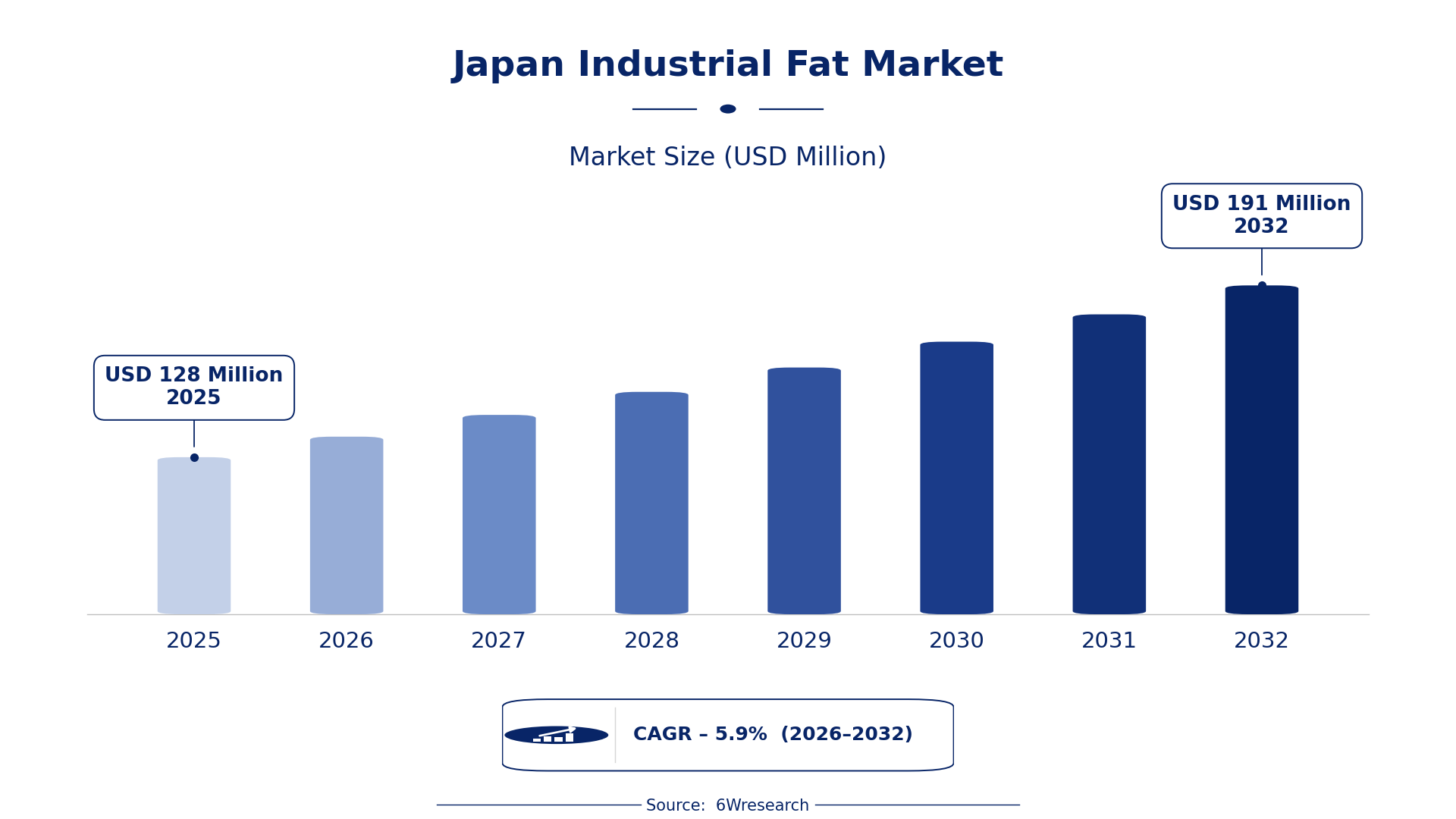
According to 6Wresearch internal database and industry insights, the Japan Industrial Fat Market was valued at USD 128 Million in 2025 and is projected to reach USD 191 Million by 2032, growing at a CAGR of approximately 5.9% during 2026–2032.
Japan Industrial Fat Market Highlights
| Report Metric | Details |
| Report Name | Japan Industrial Fat Market (2026-2032) |
| Market Size 2025 | USD 128 Million |
| Market Size 2032 | USD 191 Million |
| Absolute Growth 2025–2032 | USD 63 Million |
| CAGR 2026–2032 | 5.9% |
| Peak Annual Growth | 7.2% in 2026 |
| Forecast Period | 2026–2032 |
| Historical Data | 2022–2025 |
| Base Year | 2025 |
| Leading Fat Type, 2025 | Hydrogenated Fats (50% share) |
| Leading Source Type, 2025 | Animal-Based (36% share) |
| Leading Usage/Application, 2025 | Baking & Frying (38% share) |
| Leading End User, 2025 | Food Processing Units (46% share) |
| Fastest-Growing Fat Type | Specialty Industrial Fats (8.4% CAGR) |
| Fastest-Growing Source Type | Vegetable-Based (8.1% CAGR) |
| Fastest-Growing Usage/Application | Snacks/Frozen Foods (8.0% CAGR) |
| Fastest-Growing End User | Ready-to-Eat Manufacturers (7.3% CAGR) |
| Growing Sector | food processing |
| Key End Users | food processing units, commercial bakeries, ready-to-eat manufacturers, personal care industry |
Japan Industrial Fat Market Year-wise Growth Rate and Key Drivers (2022–2032)
This graph illustrates the annual growth rates of the market from 2022 to 2032, highlighting a steady upward trajectory and projected market expansion over the forecast period.
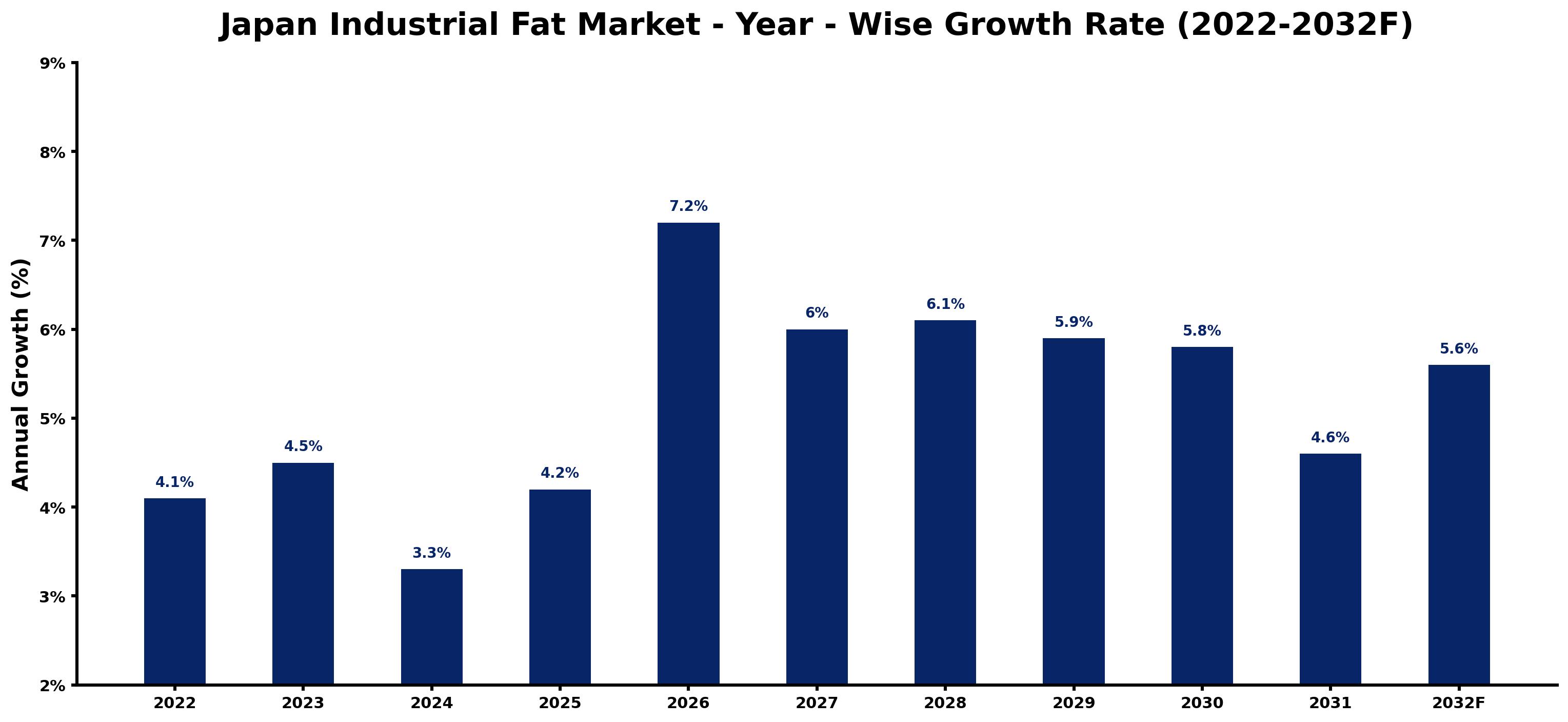
Below, each year's estimated growth is shown next to the factor that most influenced it.
| Year | Estimated Annual Growth (%) | Market Rationale |
| 2022 | 4.1 | The market showed solid growth due to steady demand from food processing units. |
| 2023 | 4.5 | Growth accelerated as the food processing sector expanded, particularly in confectionery. |
| 2024 | 3.3 | A slowdown occurred as some sectors adjusted to changing consumer preferences. |
| 2025 | 4.2 | Demand increased again, driven by commercial bakeries ramping up production. |
| 2026 | 7.2 | The market is expected to peak as investments in food processing technologies surge. |
| 2027 | 6.0 | Growth will slow slightly as market conditions stabilise after the peak. |
| 2028 | 6.1 | Demand is projected to rise again, supported by a growing preference for vegetable-based fats. |
| 2029 | 5.9 | A slight slowdown will occur as buyers adjust to market saturation. |
| 2030 | 5.8 | Growth is expected to slow further as competition intensifies within the food processing sector. |
| 2031 | 4.6 | The market will continue to grow, albeit at a slower pace due to market maturity. |
| 2032 | 5.6 | Demand is projected to increase again as innovation in food products revitalises interest. |
Note: Market size estimations and growth projections presented in this report are based on 6Wresearch's proprietary forecasting methodology, utilizing the latest available industry data, government publications, and primary research inputs.
Japan Industrial Fat Market Synopsis
Industrial fat encompasses fats and oils derived from both animal and vegetable sources, primarily used in food processing, baking, and personal care products. The Japan Industrial Fat Market is growing due to rising demand from the food processing sector, valued at approximately 20 trillion yen, alongside a growing preference for vegetable-based fats driven by health trends. Advances in food processing technologies, such as those promoted by the Japan Food Industry Association, are also contributing to new demand, particularly in the confectionery and snack sectors.
Market Dynamics Impact Analysis (2026–2032)
| Factor | Type | Impact | Primary Segment Affected |
| Rising health consciousness among consumers leads to increased demand for vegetable-based fats. | Driver | High | Vegetable-Based |
| The food processing sector's expansion, particularly in confectionery, boosts demand for industrial fats. | Driver | High | Hydrogenated Fats |
| Growing demand for specialty fats in personal care products presents new market opportunities. | Opportunity | Medium | Specialty Industrial Fats |
| Increasing exports of processed foods create additional demand for industrial fats. | Opportunity | High | Baking & Frying |
| Fluctuations in raw material prices can impact production costs for industrial fat manufacturers. | Restraint | High | Tallow |
| Regulatory compliance related to food safety standards can constrain market growth. | Restraint | Medium | Shortening |
| Competition from alternative fat sources poses challenges for traditional fat producers. | Challenge | High | Animal-Based |
| Technological advancements in food processing may outpace some manufacturers' capabilities. | Challenge | Medium | Hydrogenated Fats |
Evaluation of Drivers in Japan Industrial Fat Market (2026–2032)
The main growth drivers and the segments they affect most are set out below.
| Drivers | Primary Segment Affected | Why It Matters (Evidence) |
| Increased investment in food processing technologies boosts production efficiency. | Hydrogenated Fats | The food processing sector's value of approximately 20 trillion yen drives higher purchases of industrial fats. |
| Growing consumer preference for healthier options raises demand for vegetable-based fats. | Vegetable-Based | Health trends are prompting buyers to seek alternatives, leading to increased sales. |
| Expansion of the confectionery sector generates higher demand for industrial fats. | Shortening | The projected growth of the confectionery market to 3 trillion yen by 2025 increases purchases. |
| Rising production in commercial bakeries leads to higher consumption of industrial fats. | Baking & Frying | Commercial bakeries in Japan produce over 1 million tons of baked goods annually, driving demand. |
| Innovation in food products encourages the use of specialty fats in various applications. | Specialty Industrial Fats | The personal care industry is increasingly adopting specialty fats, expanding market opportunities. |
Orders keep climbing as investments in food processing technologies boost production capabilities. The food processing sector, valued at approximately 20 trillion yen, is driving demand for industrial fats. Health trends are prompting buyers to seek vegetable-based alternatives, which is increasing sales. The confectionery market, projected to reach 3 trillion yen by 2025, generates higher demand for industrial fats. Commercial bakeries producing over 1 million tons of baked goods annually are increasing consumption of baking and frying fats.
Evaluation of Restraints in Japan Industrial Fat Market
The main factors holding the market back are set out below.
| Market Restraint | Primary Segment Affected | Why It Matters (Evidence) |
| Fluctuations in raw material prices can lead to increased production costs. | Tallow | Rising prices for animal and vegetable sources can squeeze margins for producers. |
| Compliance with food safety standards can limit production flexibility. | Shortening | Manufacturers must adhere to stringent regulations, which can slow down innovation. |
| Competition from alternative fat sources may reduce market share for traditional fats. | Animal-Based | Changing consumer preferences are leading to declining demand for traditional fat producers. |
| Technological advancements may outpace some manufacturers' capabilities, limiting growth. | Hydrogenated Fats | Firms lagging in technology adoption may struggle to compete effectively. |
| Market saturation in certain segments can hinder new growth opportunities. | Specialty Industrial Fats | As the market matures, finding new applications becomes increasingly challenging. |
Japan Industrial Fat Market Challenges
Producers in the food processing sector face escalating costs due to stringent regulations on fat sourcing, which can increase production expenses by 15%. Suppliers experience rising operational costs as they adapt to environmental standards, leading to a 20% reduction in profit margins. Disruptions in the supply chain for vegetable-based fats result in a 10% decrease in delivery reliability for producers. Buyers struggle with shifting consumer preferences towards healthier options, which can extend the time-to-market for new products by six months.
Trends in the Japan Industrial Fat Market
Several trends are reshaping the Japan Industrial Fat Market; the most important are set out below.
- Shift from Animal-Based to Vegetable-Based Fats: Tokyo is experiencing a shift towards vegetable-based fats, reflecting health trends. In 2023, the preference for these fats has increased, with a notable rise in demand among food processors, particularly in the region.
- Transition to Healthier Food Products: The confectionery market is evolving towards healthier options, with projected growth reaching 3 trillion yen by 2025. This shift encourages manufacturers to reformulate products using industrial fats, particularly in Osaka.
- Emergence of Specialty Fats in Personal Care: The personal care industry is increasingly adopting specialty fats, with demand rising due to changing consumer preferences. In 2023, this segment has seen a notable increase in usage, particularly in urban areas.
- Growing Demand for Convenience Foods: Ready-to-eat manufacturers are expanding their offerings, driving demand for industrial fats. In 2023, the market for convenience foods has grown, influencing fat usage across the country.
Investment Opportunities in the Japan Industrial Fat Market
Where to invest in the Japan Industrial Fat Market: the main openings are set out below.
- Invest in Vegetable-Based Fats: The growing preference for vegetable-based fats presents an opportunity for suppliers. With health trends driving demand, food processing units are increasingly seeking these alternatives, particularly in urban centres.
- Supply Specialty Fats for Personal Care: There is a rising demand for specialty fats in the personal care industry. By partnering with manufacturers in Tokyo, suppliers can tap into this growing market, which is expanding rapidly.
- Expand Offerings for Ready-to-Eat Manufacturers: The convenience food sector is expanding, creating opportunities for suppliers of industrial fats. With the ready-to-eat market projected to grow, entering this space is timely for suppliers.
- Focus on Innovations in Food Processing: Investments in food processing technologies are increasing. Suppliers can benefit by collaborating with the Japan Food Industry Association to improve their product offerings and meet evolving market needs.
Government Initiatives in the Japan Industrial Fat Market
The Industrial Safety and Health Act (1972) establishes employer responsibilities regarding hazardous substances in food production. The GX Promotion Act (2023) aims to facilitate decarbonisation efforts within the industry, promoting sustainable practices among producers and ensuring compliance with environmental standards.
The Japan Food Safety Commission oversees the approval of sustainable fat sourcing initiatives. They fund projects that align with the GX Basic Policy, which targets JPY 150 trillion of decarbonisation investment over 10 years, benefiting producers and promoting sustainability in the sector.
Future Insight of the Japan Industrial Fat Market
By 2032, personal care producers will increasingly adopt specialty fats to cater to health-conscious consumers. The food processing sector will benefit from advanced processing technologies that improve production efficiency. Japan's commitment to a JPY 150 trillion decarbonisation investment will drive suppliers to implement sustainable sourcing practices. The confectionery market is projected to expand significantly, prompting buyers to innovate and diversify their product offerings.
Market Segmentation Analysis
Japan Industrial Fat Market report covers a detailed analysis of the following market segments:
By Fat Type – Hydrogenated Fats Lead, Specialty Industrial Fats Expected to Grow Fastest
According to Saurav Kr Singh, Senior Research Analyst at 6Wresearch, Hydrogenated Fats held 50% of the Japan Industrial Fat Market by fat type in 2025. Hydrogenated fats dominate the market due to their extensive use in baking and frying applications, which are vital for many food products. This sub-segment benefits from a well-established supply chain and a high installed base in food processing facilities across Japan. Specialty Industrial Fats are set to record the highest CAGR in this split, 8.4% over 2026–2032. Specialty industrial fats are experiencing rapid growth as they cater to niche applications, particularly in the personal care sector. The rising demand for unique formulations in specialty products is propelling this segment forward. Suppliers should focus on expanding their specialty fat offerings to capture the growing demand in niche markets.
By Source Type – Animal-Based Leads, Vegetable-Based Expected to Grow Fastest
Animal-Based took 36% of source type revenue in 2025, more than any other category. Animal-based fats hold the largest share as they are essential for traditional food products, which remain highly sought after by consumers in Japan. Their established presence in culinary applications guarantees ongoing demand from food processing units. The quickest growth will come from Vegetable-Based, forecast to expand at a CAGR of 8.1% between 2026 and 2032. Vegetable-based fats are experiencing rapid growth due to an increasing consumer preference for healthier alternatives. This trend is evidenced by the rising incorporation of these fats in various food products as health awareness continues to rise. Buyers may need to adjust their sourcing strategies to include more vegetable-based options to align with consumer health preferences.
By Usage/Application – Baking & Frying Leads, Snacks/Frozen Foods Expected to Grow Fastest
With 38% of usage/application revenue in 2025, Baking & Frying was the largest category. Baking and frying applications dominate the market as they are vital for food production, especially in commercial environments. The extensive reliance on these processes in food manufacturing secures a strong demand for fats in these categories. Snacks/Frozen Foods are projected to grow fastest, at a CAGR of 8.0% during 2026–2032. Snacks and frozen foods are growing quickly due to the rising consumer demand for convenience foods. This shift is propelled by increasingly busy lifestyles that favour ready-to-eat options, thereby elevating the need for appropriate fats. Suppliers should adapt their product lines to meet the increasing demand for fats in the snacks and frozen foods sector.
By End User – Food Processing Units Lead, Ready-to-Eat Manufacturers Expected to Grow Fastest
The largest end user category in 2025 was Food Processing Units, at 46% of revenue. Food processing units represent the largest end-user segment, reflecting the significant volume of fats needed for a wide range of food products. Their essential role in the supply chain guarantees consistent demand for industrial fats across multiple applications, particularly in regions like Tokyo and Osaka. Over 2026–2032, Ready-to-Eat Manufacturers are expected to post the fastest growth, at a CAGR of 7.3%. Ready-to-eat manufacturers are experiencing rapid growth as consumer preferences increasingly favour convenience foods. This shift is resulting in heightened production levels and a growing need for fats that meet the specific requirements of ready-to-eat products. Suppliers should focus on creating tailored solutions for ready-to-eat manufacturers to capitalise on this expanding market.
Key Attractiveness of the Report
- 10 Years of Market Numbers
- Historical Data Starting from 2022 to 2025
- Base Year 2025
- Forecast Data until 2032
- Key Performance Indicators Impacting the Market
- Major Upcoming Developments and Projects
Key Highlights of the Report:
- Japan Industrial Fat Market Outlook
- Market Size of Japan Industrial Fat Market, 2025
- Forecast of Japan Industrial Fat Market, 2032
- Historical Data and Forecast of Japan Industrial Fat Revenues & Volume for the Period 2022-2032F
- Japan Industrial Fat Market Trend Evolution
- Japan Industrial Fat Market Drivers and Challenges
- Japan Industrial Fat Price Trends
- Japan Industrial Fat Porter's Five Forces
- Japan Industrial Fat Industry Life Cycle
- Historical Data and Forecast of Japan Industrial Fat Market Revenues & Volume By Fat Type for the Period 2022-2032F
- Historical Data and Forecast of Japan Industrial Fat Market Revenues & Volume By Hydrogenated Fats for the Period 2022-2032F
- Historical Data and Forecast of Japan Industrial Fat Market Revenues & Volume By Tallow for the Period 2022-2032F
- Historical Data and Forecast of Japan Industrial Fat Market Revenues & Volume By Shortening for the Period 2022-2032F
- Historical Data and Forecast of Japan Industrial Fat Market Revenues & Volume By Specialty Industrial Fats for the Period 2022-2032F
- Historical Data and Forecast of Japan Industrial Fat Market Revenues & Volume By Source Type for the Period 2022-2032F
- Historical Data and Forecast of Japan Industrial Fat Market Revenues & Volume By Animal/Vegetable Sources for the Period 2022-2032F
- Historical Data and Forecast of Japan Industrial Fat Market Revenues & Volume By Animal-Based for the Period 2022-2032F
- Historical Data and Forecast of Japan Industrial Fat Market Revenues & Volume By Vegetable-Based for the Period 2022-2032F
- Historical Data and Forecast of Japan Industrial Fat Market Revenues & Volume By Tailored Blends for the Period 2022-2032F
- Historical Data and Forecast of Japan Industrial Fat Market Revenues & Volume By Usage/Application for the Period 2022-2032F
- Historical Data and Forecast of Japan Industrial Fat Market Revenues & Volume By Baking & Frying for the Period 2022-2032F
- Historical Data and Forecast of Japan Industrial Fat Market Revenues & Volume By Soap & Detergent for the Period 2022-2032F
- Historical Data and Forecast of Japan Industrial Fat Market Revenues & Volume By Confectionery for the Period 2022-2032F
- Historical Data and Forecast of Japan Industrial Fat Market Revenues & Volume By Snacks/Frozen Foods for the Period 2022-2032F
- Historical Data and Forecast of Japan Industrial Fat Market Revenues & Volume By End User for the Period 2022-2032F
- Historical Data and Forecast of Japan Industrial Fat Market Revenues & Volume By Food Processing Units for the Period 2022-2032F
- Historical Data and Forecast of Japan Industrial Fat Market Revenues & Volume By Personal Care Industry for the Period 2022-2032F
- Historical Data and Forecast of Japan Industrial Fat Market Revenues & Volume By Commercial Bakeries for the Period 2022-2032F
- Historical Data and Forecast of Japan Industrial Fat Market Revenues & Volume By Ready-to-Eat Manufacturers for the Period 2022-2032F
- Japan Industrial Fat Import Export Trade Statistics
- Market Opportunity Assessment By Fat Type
- Market Opportunity Assessment By Source Type
- Market Opportunity Assessment By Usage/Application
- Market Opportunity Assessment By End User
- Japan Industrial Fat Top Companies Market Share
- Japan Industrial Fat Competitive Benchmarking By Technical and Operational Parameters
- Japan Industrial Fat Company Profiles
- Japan Industrial Fat Key Strategic Recommendations
Market Covered
This report examines the market across the segments below.
By Fat Type
- Hydrogenated Fats
- Tallow
- Shortening
- Specialty Industrial Fats
By Source Type
- Animal/Vegetable Sources
- Animal-Based
- Vegetable-Based
- Tailored Blends
By Usage/Application
- Baking & Frying
- Soap & Detergent
- Confectionery
- Snacks/Frozen Foods
By End User
- Food Processing Units
- Personal Care Industry
- Commercial Bakeries
- Ready-to-Eat Manufacturers































