Japan Industrial Fillers Market Size & Growth Rate

According to 6Wresearch internal database and industry insights, the Japan Industrial Fillers Market was valued at USD 116 Million in 2025 and is projected to reach USD 162 Million by 2032, growing at a CAGR of approximately 4.9% during 2026–2032.
Japan Industrial Fillers Market Highlights
| Report Metric | Details |
| Report Name | Japan Industrial Fillers Market (2026-2032) |
| Market Size 2025 | USD 116 Million |
| Market Size 2032 | USD 162 Million |
| Absolute Growth 2025–2032 | USD 46 Million |
| CAGR 2026–2032 | 4.9% |
| Peak Annual Growth | 5.8% in 2030 |
| Forecast Period | 2026–2032 |
| Historical Data | 2022–2025 |
| Base Year | 2025 |
| Leading Filler Type, 2025 | Calcium Carbonate (47% share) |
| Leading Base Material, 2025 | Mineral-Based (48% share) |
| Leading Functionality, 2025 | Volume Enhancement (47% share) |
| Leading End User, 2025 | Paint & Plastics Industry (40% share) |
| Fastest-Growing Filler Type | Silica Fillers (6.9% CAGR) |
| Fastest-Growing Base Material | Synthetic/Natural (7.1% CAGR) |
| Fastest-Growing Functionality | Rheology Control (6.5% CAGR) |
| Fastest-Growing End User | Adhesives & Sealants (6.6% CAGR) |
| Growing Sector | Adhesives & Sealants |
| Key End Users | Paint manufacturers, Plastic producers, Rubber manufacturers, Electronics industry |
Japan Industrial Fillers Market Year-wise Growth Rate and Key Drivers (2022–2032)
This graph illustrates the annual growth rates of the market from 2022 to 2032, highlighting a steady upward trajectory and projected market expansion over the forecast period.
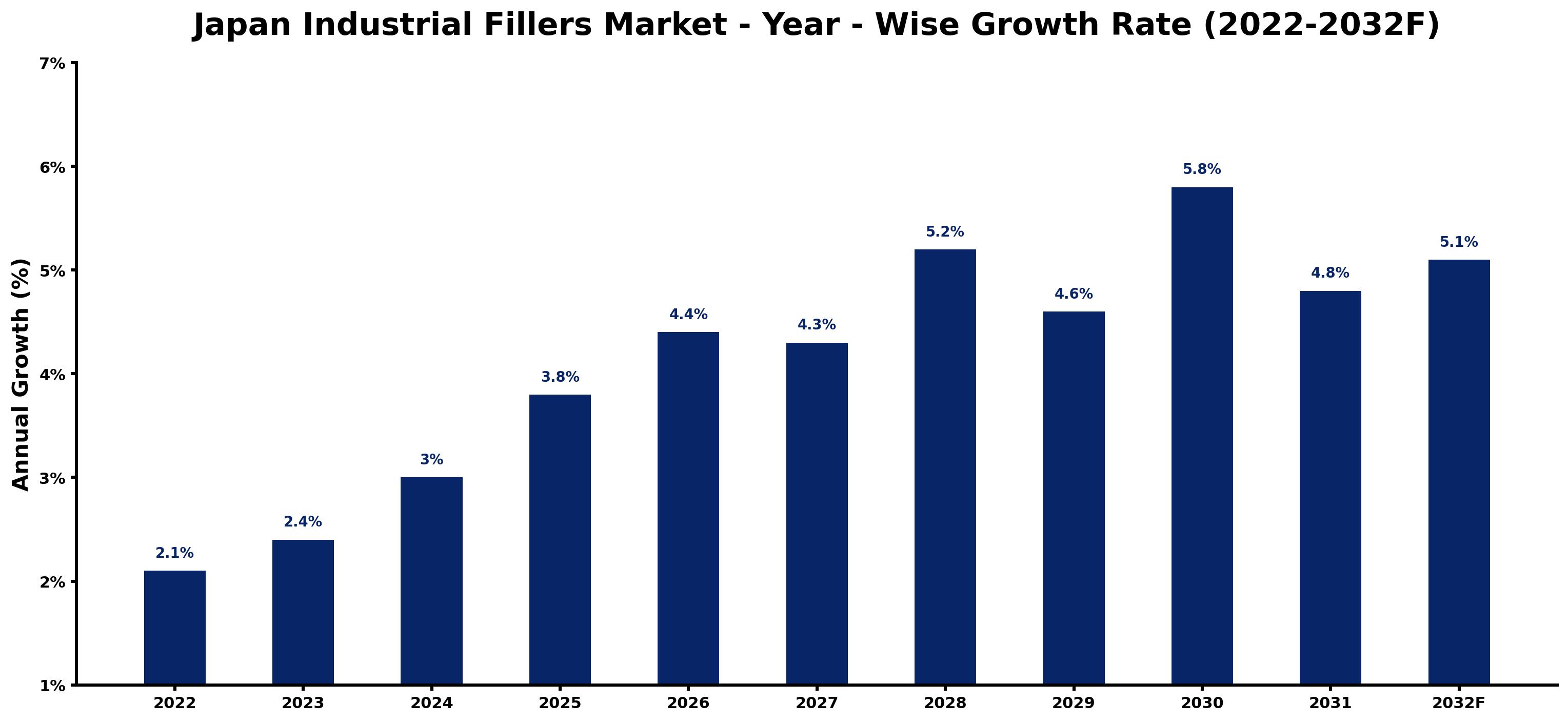
The table below sets out the estimated growth rate for each year and the main factor behind it.
| Year | Estimated Annual Growth (%) | Market Rationale |
| 2022 | 2.1 | The market experienced steady growth as demand from the paint industry remained strong. |
| 2023 | 2.4 | Growth accelerated due to increased investments in the rubber manufacturing sector. |
| 2024 | 3.0 | The market continued to expand as production levels in the plastics industry improved. |
| 2025 | 3.8 | The paint and plastics industries drove higher demand for industrial fillers. |
| 2026 | 4.4 | Investment in sustainable materials is expected to create new opportunities for growth. |
| 2027 | 4.3 | A slight slowdown is projected as demand stabilises after a peak in 2025. |
| 2028 | 5.2 | The market is expected to see renewed growth as the adhesives sector expands. |
| 2029 | 4.6 | Growth is anticipated to slow as the market adjusts to previous rapid increases in demand. |
| 2030 | 5.8 | A surge in demand for eco-friendly fillers will propel market growth to its peak. |
| 2031 | 4.8 | Growth is projected to slow as the market begins to stabilise after reaching peak levels. |
| 2032 | 5.1 | Demand is expected to rise again as technological advancements in fillers emerge. |
Note: Market size estimations and growth projections presented in this report are based on 6Wresearch's proprietary forecasting methodology, utilizing the latest available industry data, government publications, and primary research inputs.
Japan Industrial Fillers Market Synopsis
Industrial fillers are materials added to products to improve properties such as strength, durability, and cost-effectiveness. In Japan, they are primarily used in the paint, plastics, and rubber manufacturing sectors. The Japan Industrial Fillers Market is growing due to rising investments in sustainable materials, particularly in the rubber and adhesives industries. The paint industry, valued at approximately 1 trillion yen, remains a key driver, alongside increasing demand for eco-friendly solutions and advancements in filler technology.
Market Dynamics Impact Analysis (2026–2032)
| Factor | Type | Impact | Primary Segment Affected |
| Increased investment in sustainable materials | Driver | High | Silica Fillers |
| Rising demand from the paint and plastics industries | Driver | High | Calcium Carbonate |
| Growing market for eco-friendly fillers | Opportunity | High | Synthetic/Natural |
| Expansion of the adhesives market | Opportunity | Medium | Adhesives & Sealants |
| Regulatory challenges regarding hazardous substances | Restraint | High | Carbon Black |
| Competition from alternative materials | Restraint | Medium | Mineral-Based |
| High production costs for eco-friendly fillers | Challenge | High | Silica Fillers |
| Limited applications of certain filler types | Challenge | Medium | Talc-Based Fillers |
Evaluation of Drivers in Japan Industrial Fillers Market (2026–2032)
Demand rests on the following drivers, each shown with the segment it touches most.
| Drivers | Primary Segment Affected | Why It Matters (Evidence) |
| Rising investments in sustainable materials | Silica Fillers | Japan's GX Basic Policy targets JPY 150 trillion in decarbonisation investment, boosting demand for eco-friendly fillers. |
| Increased production in the paint industry | Calcium Carbonate | The paint industry in Japan is valued at approximately 1 trillion yen, driving higher filler usage. |
| Growth in the adhesives market | Adhesives & Sealants | The adhesives market is projected to reach 300 billion yen by 2025, increasing demand for fillers. |
| Technological advancements in filler formulations | Synthetic/Natural | Innovations in filler technology are improving performance, leading to increased adoption in various industries. |
| Demand for conductive fillers in electronics | Carbon Black | The electronics industry is a major consumer of conductive fillers, driving market growth. |
Most of the extra volume comes from rising investments in sustainable materials, with Japan targeting JPY 150 trillion for decarbonisation over the next decade. The paint industry, valued at approximately 1 trillion yen, drives demand for calcium carbonate fillers as production increases. Innovations in filler formulations are improving performance, while the electronics sector's demand for conductive fillers continues to grow, propelling overall market expansion.
Evaluation of Restraints in Japan Industrial Fillers Market
Several factors work against faster growth; the main ones are summarised below.
| Market Restraint | Primary Segment Affected | Why It Matters (Evidence) |
| Regulatory challenges regarding hazardous substances | Carbon Black | The Industrial Safety and Health Act imposes strict regulations on hazardous substances, impacting production costs. |
| Competition from alternative materials | Mineral-Based | The rise of alternative materials in various applications poses a threat to traditional fillers. |
| High production costs for eco-friendly fillers | Silica Fillers | Investments in sustainable production methods increase costs, affecting pricing strategies. |
| Limited applications of certain filler types | Talc-Based Fillers | Talc-based fillers are primarily used in cosmetics, limiting their market potential. |
| Market volatility due to fluctuating raw material prices | Calcium Carbonate | Price fluctuations in raw materials can disrupt supply chains and affect profitability. |
Japan Industrial Fillers Market Challenges
In Tokyo, multiple manufacturers compete for a limited supply of silica fillers, raising prices and increasing costs for paint producers who depend on these materials. Stringent regulations around environmental standards, such as those outlined in the GX Basic Policy, impose compliance costs on filler producers, delaying product launches and affecting supply chains. A lack of skilled workers in the industrial fillers sector hampers production efficiency, resulting in longer lead times for suppliers and higher operational costs. Disruptions in sourcing talc-based fillers for cosmetics can cause production delays for manufacturers, impacting their ability to fulfil market demand.
Trends in the Japan Industrial Fillers Market
The shifts below are changing how Japan Industrial Fillers Market products are bought and supplied.
- Shift towards Eco-Friendly Fillers: Japan's industrial fillers market is increasingly embracing eco-friendly materials, supported by the GX Basic Policy. In 2023, the government launched a program promoting sustainable filler materials, aligning with the target of JPY 150 trillion in decarbonisation investments.
- Rising Demand for Conductive Fillers: The electronics industry in Japan is increasingly adopting conductive fillers, essential for product performance. This sector's demand is set to grow, with carbon black fillers being a key component in electronic applications.
- Expansion of Adhesives Market: The adhesives market is on track to reach 300 billion yen by 2025, creating new opportunities for filler suppliers. This growth is driven by increasing applications in construction and automotive industries.
- Technological Advancements in Filler Formulations: Innovations in filler formulations are improving performance and expanding applications. For instance, advanced silica fillers are enhancing rheology control in coatings, leading to higher product quality.
Investment Opportunities in the Japan Industrial Fillers Market
Investors looking at the Japan Industrial Fillers Market should consider the following areas.
- Supply of Eco-Friendly Fillers: With Japan targeting a 46% cut in greenhouse-gas emissions by 2030, there is a growing demand for eco-friendly fillers. Suppliers can partner with local manufacturers to meet this need.
- Investment in Adhesives Market: The adhesives market, projected to reach 300 billion yen by 2025, presents opportunities for suppliers of industrial fillers. Collaborating with adhesive manufacturers can facilitate market entry.
- Development of Conductive Fillers: The electronics sector's demand for conductive fillers is increasing, driven by technological advancements. Suppliers can focus on developing high-performance conductive fillers to capture this market.
- Expansion into Sustainable Material Production: The government’s push for sustainable materials creates opportunities for investment in production facilities. Collaborating with local partners can streamline entry into this growing market.
Government Initiatives in the Japan Industrial Fillers Market
The GX Promotion Act, adopted in 2023, establishes a framework for promoting sustainable practices among producers of industrial fillers. This law aims to support the transition to eco-friendly materials, aligning with Japan's target of JPY 150 trillion in decarbonisation investment over the next decade. Compliance with this act is essential for manufacturers to remain competitive in the evolving market.
The Ministry of Health, Labour and Welfare oversees the Industrial Safety and Health Act, which mandates that manufacturers ensure the safety of hazardous substances used in fillers. This regulation impacts how producers handle materials and ensures they meet safety standards, ultimately influencing buyer confidence in the products they purchase.
Future Insight of the Japan Industrial Fillers Market
Innovations in biodegradable fillers will drive demand by 2032, aligning with Japan's net zero emissions target by 2050. The government's decarbonisation investment of JPY 150 trillion will stimulate innovation in filler production, benefiting suppliers who embrace these changes. JIS Z 8801 standards will gain importance, ensuring quality and safety in filler applications, which will build buyer trust. As the annual demand for silica fillers reaches around 500,000 tons, suppliers must refine their product lines to cater to evolving industry requirements.
Market Segmentation Analysis
Japan Industrial Fillers Market report covers a detailed analysis of the following market segments:
By Filler Type – Calcium Carbonate Leads, Silica Fillers Expected to Grow Fastest
According to Saurav Kr Singh, Senior Research Analyst at 6Wresearch, Calcium Carbonate accounted for 47% of the market by filler type in 2025. Calcium carbonate holds the largest share in Japan due to its extensive use in volume enhancement for essential sectors like plastics and paints. The production of 4 million tons in 2022 illustrates its widespread application and importance in these industries. The quickest growth will come from Silica Fillers, forecast to expand at a CAGR of 6.9% between 2026 and 2032. Silica fillers are experiencing rapid growth as they are increasingly employed for rheology control in coatings and adhesives, reflecting the rising demand for high-performance materials. The annual demand for silica fillers, estimated at around 500,000 tons, indicates a strong upward trend in this segment. Suppliers should enhance their silica filler offerings to leverage the growing demand in the coatings and adhesives sectors.
By Base Material – Mineral-Based Leads, Synthetic/Natural Expected to Grow Fastest
With 48% of base material revenue in 2025, Mineral-Based was the largest category. Mineral-based fillers dominate the market due to their common use across various industrial applications, making them a staple in the production processes. Their established presence in sectors such as paint and plastics solidifies their leading position. Synthetic/Natural is projected to grow fastest, at a CAGR of 7.1% during 2026–2032. Synthetic/natural fillers are gaining traction in niche applications, propelled by the increasing demand for specialised materials that meet specific performance criteria. This shift indicates a growing trend towards more tailored solutions in the filler market. Buyers may benefit from exploring synthetic and natural fillers to meet specific application needs and improve product performance.
By Functionality – Volume Enhancement Leads, Rheology Control Expected to Grow Fastest
Volume Enhancement took 47% of functionality revenue in 2025, more than any other category. Volume enhancement is the leading functionality due to its critical role in reducing production costs, making it a priority for manufacturers across various sectors. This focus on cost efficiency drives the widespread adoption of fillers that provide volume enhancement benefits. Rheology Control is set to record the highest CAGR in this split, 6.5% over 2026–2032. Rheology control is the fastest-growing functionality, essential for ensuring product consistency in coatings and adhesives. The increasing emphasis on product quality in these sectors fuels the demand for fillers that deliver superior rheological properties. Suppliers should prioritise the development of fillers that provide rheology control to align with the rising quality standards in the coatings and adhesives industries.
By End User – Paint & Plastics Industry Leads, Adhesives & Sealants Expected to Grow Fastest
The largest end user category in 2025 was Paint & Plastics Industry, at 40% of revenue. The paint and plastics industry is the largest consumer of fillers, supported by a substantial market value of approximately 1 trillion yen. This sector's ongoing demand for fillers across various applications solidifies its leading position in the market. Over 2026–2032, Adhesives & Sealants are expected to post the fastest growth, at a CAGR of 6.6%. Adhesives and sealants represent the fastest-growing end user segment, significantly enhancing product properties across multiple applications. The projected growth of the adhesives market to 300 billion yen by 2025 highlights this significant trend. Suppliers must consider expanding their offerings to cater to the adhesive and sealant markets to capture emerging growth opportunities.
Key Attractiveness of the Report
- 10 Years of Market Numbers
- Historical Data Starting from 2022 to 2025
- Base Year 2025
- Forecast Data until 2032
- Key Performance Indicators Impacting the Market
- Major Upcoming Developments and Projects
Key Highlights of the Report:
- Japan Industrial Fillers Market Outlook
- Market Size of Japan Industrial Fillers Market, 2025
- Forecast of Japan Industrial Fillers Market, 2032
- Historical Data and Forecast of Japan Industrial Fillers Revenues & Volume for the Period 2022-2032F
- Japan Industrial Fillers Market Trend Evolution
- Japan Industrial Fillers Market Drivers and Challenges
- Japan Industrial Fillers Price Trends
- Japan Industrial Fillers Porter's Five Forces
- Japan Industrial Fillers Industry Life Cycle
- Historical Data and Forecast of Japan Industrial Fillers Market Revenues & Volume By Filler Type for the Period 2022-2032F
- Historical Data and Forecast of Japan Industrial Fillers Market Revenues & Volume By Calcium Carbonate for the Period 2022-2032F
- Historical Data and Forecast of Japan Industrial Fillers Market Revenues & Volume By Silica Fillers for the Period 2022-2032F
- Historical Data and Forecast of Japan Industrial Fillers Market Revenues & Volume By Talc-Based Fillers for the Period 2022-2032F
- Historical Data and Forecast of Japan Industrial Fillers Market Revenues & Volume By Carbon Black for the Period 2022-2032F
- Historical Data and Forecast of Japan Industrial Fillers Market Revenues & Volume By Base Material for the Period 2022-2032F
- Historical Data and Forecast of Japan Industrial Fillers Market Revenues & Volume By Mineral-Based for the Period 2022-2032F
- Historical Data and Forecast of Japan Industrial Fillers Market Revenues & Volume By Synthetic/Natural for the Period 2022-2032F
- Historical Data and Forecast of Japan Industrial Fillers Market Revenues & Volume By Magnesium Silicate for the Period 2022-2032F
- Historical Data and Forecast of Japan Industrial Fillers Market Revenues & Volume By Carbonaceous for the Period 2022-2032F
- Historical Data and Forecast of Japan Industrial Fillers Market Revenues & Volume By Functionality for the Period 2022-2032F
- Historical Data and Forecast of Japan Industrial Fillers Market Revenues & Volume By Volume Enhancement for the Period 2022-2032F
- Historical Data and Forecast of Japan Industrial Fillers Market Revenues & Volume By Rheology Control for the Period 2022-2032F
- Historical Data and Forecast of Japan Industrial Fillers Market Revenues & Volume By Opacity & Texture for the Period 2022-2032F
- Historical Data and Forecast of Japan Industrial Fillers Market Revenues & Volume By Conductivity for the Period 2022-2032F
- Historical Data and Forecast of Japan Industrial Fillers Market Revenues & Volume By End User for the Period 2022-2032F
- Historical Data and Forecast of Japan Industrial Fillers Market Revenues & Volume By Paint & Plastics Industry for the Period 2022-2032F
- Historical Data and Forecast of Japan Industrial Fillers Market Revenues & Volume By Adhesives & Sealants for the Period 2022-2032F
- Historical Data and Forecast of Japan Industrial Fillers Market Revenues & Volume By Rubber Manufacturing for the Period 2022-2032F
- Historical Data and Forecast of Japan Industrial Fillers Market Revenues & Volume By Tire & Electronics Industry for the Period 2022-2032F
- Japan Industrial Fillers Import Export Trade Statistics
- Market Opportunity Assessment By Filler Type
- Market Opportunity Assessment By Base Material
- Market Opportunity Assessment By Functionality
- Market Opportunity Assessment By End User
- Japan Industrial Fillers Top Companies Market Share
- Japan Industrial Fillers Competitive Benchmarking By Technical and Operational Parameters
- Japan Industrial Fillers Company Profiles
- Japan Industrial Fillers Key Strategic Recommendations
Market Covered
The following segment groups are covered in the report.
By Filler Type
- Calcium Carbonate
- Silica Fillers
- Talc-Based Fillers
- Carbon Black
By Base Material
- Mineral-Based
- Synthetic/Natural
- Magnesium Silicate
- Carbonaceous
By Functionality
- Volume Enhancement
- Rheology Control
- Opacity & Texture
- Conductivity
By End User
- Paint & Plastics Industry
- Adhesives & Sealants
- Rubber Manufacturing
- Tire & Electronics Industry































