Japan Industrial Non-Ferrous Metals Market Size & Growth Rate
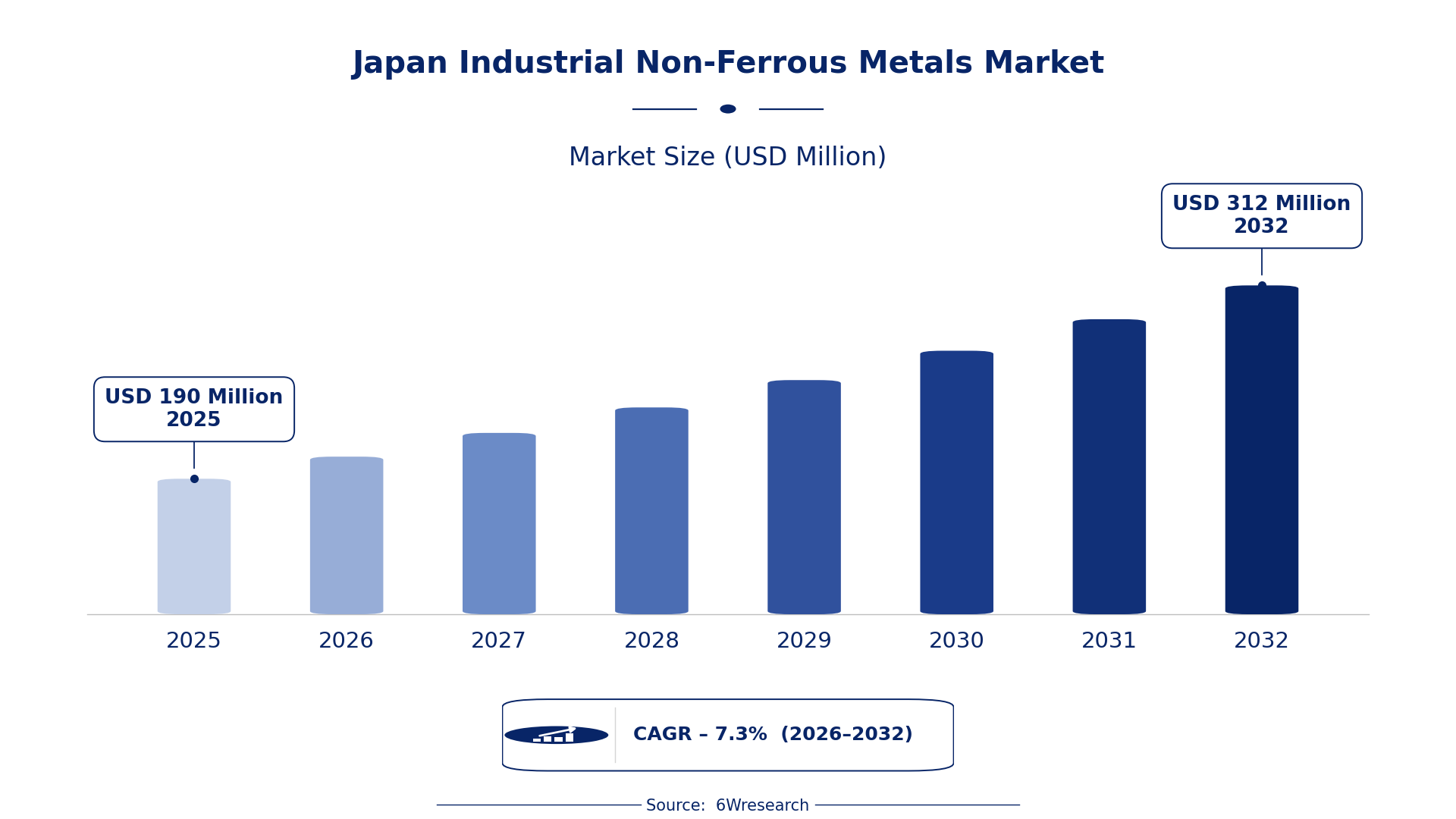
According to 6Wresearch internal database and industry insights, the Japan Industrial Non-Ferrous Metals Market was valued at USD 190 Million in 2025 and is projected to reach USD 312 Million by 2032, growing at a CAGR of approximately 7.3% during 2026–2032.
Japan Industrial Non-Ferrous Metals Market Highlights
| Report Metric | Details |
| Report Name | Japan Industrial Non-Ferrous Metals Market (2026-2032) |
| Market Size 2025 | USD 190 Million |
| Market Size 2032 | USD 312 Million |
| Absolute Growth 2025–2032 | USD 122 Million |
| CAGR 2026–2032 | 7.3% |
| Peak Annual Growth | 8.1% in 2030 |
| Forecast Period | 2026–2032 |
| Historical Data | 2022–2025 |
| Base Year | 2025 |
| Leading Metal Type, 2025 | Aluminum (53% share) |
| Leading Form, 2025 | Rolled Sheets (42% share) |
| Leading Processing Technique, 2025 | Extrusion (49% share) |
| Leading Application Area, 2025 | Structural Components (39% share) |
| Leading End User Industry, 2025 | Automotive (31% share) |
| Fastest-Growing Metal Type | Copper (10.0% CAGR) |
| Fastest-Growing Form | Rods & Wires (10.1% CAGR) |
| Fastest-Growing Processing Technique | Drawing (10.4% CAGR) |
| Fastest-Growing Application Area | Electrical Conduction (8.8% CAGR) |
| Fastest-Growing End User Industry | Power (9.6% CAGR) |
| Growing Sector | Construction Industry |
| Key End Users | Automotive, Electronics, Construction Industry, Power |
Japan Industrial Non-Ferrous Metals Market Year-wise Growth Rate and Key Drivers (2022–2032)
This graph illustrates the annual growth rates of the market from 2022 to 2032, highlighting a steady upward trajectory and projected market expansion over the forecast period.
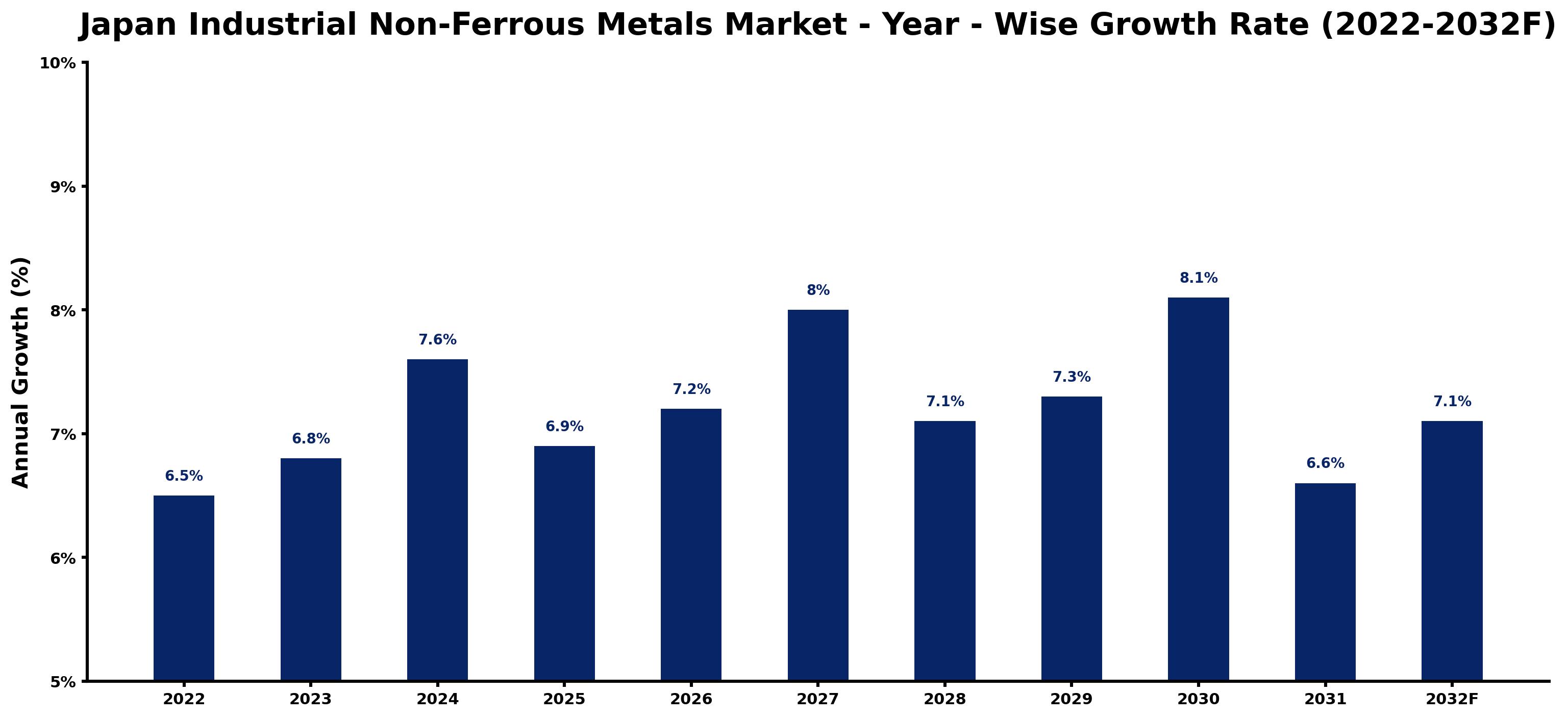
Annual growth estimates for each year appear below with the principal reason behind them, explaining the shifts that set the pace of the market.
| Year | Estimated Annual Growth (%) | Market Rationale |
| 2022 | 6.5 | The market experienced steady growth due to ongoing demand from the construction sector. |
| 2023 | 6.8 | Increased automotive production contributed to faster growth compared to the previous year. |
| 2024 | 7.6 | The demand for copper in electronics and automotive applications drove higher growth rates. |
| 2025 | 6.9 | Growth slowed slightly as the market adjusted to previous peaks in demand. |
| 2026 | 7.2 | Rising investments in infrastructure projects will lead to an uptick in market growth. |
| 2027 | 8.0 | The recovery in the automotive sector will boost demand for non-ferrous metals. |
| 2028 | 7.1 | Growth will moderate as supply chain issues begin to affect production rates. |
| 2029 | 7.3 | Increased focus on sustainable materials in construction will spur demand. |
| 2030 | 8.1 | The peak growth rate will be driven by heightened investments in decarbonisation initiatives. |
| 2031 | 6.6 | Growth will slow as the market stabilises after reaching its peak. |
| 2032 | 7.1 | Continued demand from the power sector will support a return to higher growth. |
Note: Market size estimations and growth projections presented in this report are based on 6Wresearch's proprietary forecasting methodology, utilizing the latest available industry data, government publications, and primary research inputs.
Japan Industrial Non-Ferrous Metals Market Synopsis
Industrial non-ferrous metals, including aluminum, copper, zinc, and lead, are essential materials produced through mining and refining processes. Their main applications include automotive, construction, and electronics industries. The Japan Industrial Non-Ferrous Metals Market is expanding due to strong demand from the automotive sector, which consumed approximately 40% of copper production in 2022, and ongoing investments in infrastructure, projected to reach JPY 150 trillion over the next decade, driving further purchases.
Market Dynamics Impact Analysis (2026–2032)
| Factor | Type | Impact | Primary Segment Affected |
| Strong demand from the automotive sector drives purchases of aluminum and copper. | Driver | High | Aluminum |
| Growing investments in infrastructure projects increase the need for non-ferrous metals. | Driver | High | Copper |
| The rising demand for battery manufacturing components presents investment opportunities. | Opportunity | High | Battery Manufacturing |
| Sustainable construction practices create a need for eco-friendly materials. | Opportunity | Medium | Construction Industry |
| Supply chain disruptions can delay production schedules for manufacturers. | Restraint | High | Rods & Wires |
| Strict regulations on lead usage in battery manufacturing limit market growth. | Restraint | Medium | Lead |
| High costs associated with compliance to environmental regulations affect profitability. | Challenge | High | Aluminum |
| Technological advancements require continuous investment to stay competitive. | Challenge | Medium | Copper |
Evaluation of Drivers in Japan Industrial Non-Ferrous Metals Market (2026–2032)
These are the developments adding the most demand over the forecast period.
| Drivers | Primary Segment Affected | Why It Matters (Evidence) |
| Increased automotive production requires more aluminum for lightweight structures. | Aluminum | Japan produced 1.2 million tons of aluminum in 2022, boosting demand from automakers. |
| Growing electronics industry drives demand for copper wiring and components. | Copper | The electronics sector in Japan is valued at over $100 billion, increasing copper purchases. |
| Rising construction activities lead to higher consumption of non-ferrous metals. | Rods & Wires | The construction industry is projected to grow by 3% annually, increasing metal demand. |
| Investment in battery manufacturing is rising due to electric vehicle growth. | Battery Manufacturing | The demand for battery components is expected to rise significantly by 2025. |
| Sustainability initiatives in construction promote the use of non-ferrous metals. | Structural Components | Tokyo's government promotes sustainable materials, encouraging more eco-friendly metal usage. |
Several shifts outside the market lift sales. The construction industry is projected to grow by 3% annually, increasing the need for non-ferrous metals. The electronics sector, valued at over $100 billion, drives demand for copper wiring. Investment in battery manufacturing components is rising as electric vehicles become more prevalent. Sustainability efforts in construction are encouraging the use of eco-friendly non-ferrous metals, further boosting demand.
Evaluation of Restraints in Japan Industrial Non-Ferrous Metals Market
These are the pressures that could keep growth below its potential.
| Market Restraint | Primary Segment Affected | Why It Matters (Evidence) |
| Supply chain disruptions can lead to delays in production schedules. | Rods & Wires | Manufacturers reported longer lead times due to global supply chain issues affecting raw materials. |
| Strict regulations on lead usage limit its market potential. | Lead | Lead is primarily used in battery manufacturing, which faces stringent compliance requirements. |
| High compliance costs for environmental regulations affect profitability. | Aluminum | Producers must invest in meeting standards set by the PRTR Law. |
| Limited recycling capabilities for certain non-ferrous metals restrict supply. | Copper | The Ministry of Economy, Trade and Industry promotes recycling, but infrastructure is still developing. |
| Technological advancements require ongoing investment to remain competitive. | Copper | Companies must invest in new technologies to maintain production efficiency and reduce costs. |
Japan Industrial Non-Ferrous Metals Market Challenges
Japan produced 1.2 million tons of aluminum in 2022, yet skills shortages impede the workforce's ability to meet production demands, resulting in delays for manufacturers. Many facilities still depend on outdated technology, which raises operational costs for suppliers and diminishes their competitiveness in the market. Escalating raw material prices, influenced by global trends, are squeezing profit margins for producers, compelling them to increase prices for buyers. Stringent regulations on lead in battery manufacturing impose lengthy approval processes, disrupting supply chains for clinics and hospitals.
Trends in the Japan Industrial Non-Ferrous Metals Market
These developments are changing demand patterns in the Japan Industrial Non-Ferrous Metals Market.
- Shift towards Sustainable Construction Materials: Tokyo is increasingly embracing sustainable materials in construction, with approximately 30% of new projects now featuring eco-friendly non-ferrous metals. This reflects a growing trend towards sustainability in the industry.
- Emergence of Electric Vehicle Battery Manufacturing: The demand for battery manufacturing components has surged, with projections indicating a 25% increase in production capacity by 2025. This underscores the growing importance of non-ferrous metals in the automotive sector.
- Growing Use of Aluminum in Packaging: Aluminum rolled sheets are gaining popularity in packaging applications, with a 15% increase in usage reported in 2023. This trend is driven by the demand for lightweight and recyclable materials.
- Increased Focus on Recycling Non-Ferrous Metals: The Tokyo Metropolitan Government's initiatives to promote recycling have led to a 20% increase in recycled non-ferrous metals in 2023. This shift is reshaping the supply chain and encouraging manufacturers to adopt more sustainable practices.
Investment Opportunities in the Japan Industrial Non-Ferrous Metals Market
The following areas offer the clearest openings for investors and suppliers in the Japan Industrial Non-Ferrous Metals Market.
- Investment in Battery Manufacturing Facilities: Tokyo is experiencing a surge in investments in battery manufacturing facilities, with an expected increase of 25% by 2025. This creates opportunities for suppliers of non-ferrous metals to satisfy rising demand.
- Expansion of Construction Projects: The construction industry is projected to grow by 3% annually, generating a demand for non-ferrous metals. Suppliers can penetrate this market by collaborating with local construction firms.
- Development of Eco-Friendly Metal Products: With Japan's emphasis on sustainability, there is an opportunity to provide eco-friendly non-ferrous metals. The construction industry is actively seeking sustainable materials to comply with regulatory requirements.
- Improvement of Recycling Capabilities: The need for enhanced recycling capabilities presents an opportunity to invest in new technologies. The Ministry of Economy, Trade and Industry supports projects aimed at developing recycling infrastructure.
Government Initiatives in the Japan Industrial Non-Ferrous Metals Market
The Economic Security Promotion Act, enacted in 2022, supports supply-chain resilience for critical products, including non-ferrous metals. This act encourages manufacturers to invest in local production capabilities, ensuring a stable supply of essential materials. The Green Growth Strategy aims for carbon neutrality by 2050, promoting sustainable practices among producers and establishing targets for emissions reduction in the manufacturing sector.
The Japan Non-Ferrous Metals Association utilises the PRTR Law to ensure compliance among its members. This law mandates businesses to report the release of designated chemical substances, ensuring that producers adhere to environmental standards. The association collaborates with the Ministry of Economy, Trade and Industry to promote recycling initiatives, facilitating access to sustainable materials for buyers.
Future Insight of the Japan Industrial Non-Ferrous Metals Market
Japan targets JPY 150 trillion in decarbonisation investment over the next decade, generating demand for sustainable materials in construction and manufacturing. By 2032, advanced recycling technologies will improve resource efficiency for suppliers, while growth in the utility sector will escalate demand for non-ferrous metals. The construction sector is projected to expand by 3% annually, creating opportunities for buyers in infrastructure projects. An increase in components for battery manufacturing will reshape supply dynamics, necessitating adjustments from producers.
Market Segmentation Analysis
Japan Industrial Non-Ferrous Metals Market report covers a detailed analysis of the following market segments:
By Metal Type – Aluminum Leads, Copper Expected to Grow Fastest
According to Saurav Kr Singh, Senior Research Analyst at 6Wresearch, Aluminum took 53% of metal type revenue in 2025, more than any other category. Aluminum commands the largest share owing to its widespread use in the automotive and construction sectors, where lightweight materials are crucial for efficiency. The production of 1.2 million tons in 2022 underscores its essential role in these industries. Copper is projected to grow fastest, at a CAGR of 10.0% during 2026–2032. Copper is experiencing rapid growth due to its critical role in electrical applications and wiring, especially as Japan's electronics sector is valued at over $100 billion. This heightened demand for copper in various applications will likely sustain its market expansion. Suppliers should prioritise their copper offerings to address the increasing demand in electrical applications.
By Form – Rolled Sheets Lead, Rods & Wires Expected to Grow Fastest
In 2025, Rolled Sheets led the form split with a 42% share. Rolled sheets dominate the market as they are widely used in construction and manufacturing, providing essential material for various applications. Their versatility makes them a preferred choice among manufacturers in Japan. The quickest growth will come from Rods & Wires, forecast to expand at a CAGR of 10.1% between 2026 and 2032. Rods and wires are expected to grow quickly due to their critical role in electrical applications, which are increasingly vital as Japan's infrastructure modernises. This trend indicates a strong future demand for these forms. Buyers should consider securing long-term contracts for rods and wires to ensure supply stability amid growing demand.
By Processing Technique – Extrusion Leads, Drawing Expected to Grow Fastest
The largest processing technique category in 2025 was Extrusion, at 49% of revenue. Extrusion is the leading processing technique as it plays a vital role in shaping aluminum and other metals, making it essential in various manufacturing processes. Its efficiency in producing complex shapes solidifies its dominant position in the market. Over 2026–2032, Drawing is expected to post the fastest growth, at a CAGR of 10.4%. Drawing is witnessing the fastest growth because it is crucial for producing wires and rods, which are necessary for electrical applications. The rising demand for these products across multiple sectors will likely drive further advancements in drawing techniques. Suppliers may need to invest in advanced drawing technologies to meet the growing market requirements.
By Application Area – Structural Components Lead, Electrical Conduction Expected to Grow Fastest
Structural Components held 39% of the Japan Industrial Non-Ferrous Metals Market by application area in 2025. Structural components represent the largest application area, vital for the construction and automotive industries where strength and durability are paramount. Their widespread use ensures a consistent demand for non-ferrous metals. Electrical Conduction is set to record the highest CAGR in this split, 8.8% over 2026–2032. Electrical conduction is the fastest-growing application area, driven by the need for reliable power distribution and advancements in electronics. As the electronics sector expands, so will the demand for materials used in electrical conduction. Buyers in the electrical sector should anticipate increased competition for materials as demand for electrical conduction rises.
By End User Industry – Automotive Leads, Power Expected to Grow Fastest
Automotive accounted for 31% of the market by end user industry in 2025. The automotive sector is the largest end user of non-ferrous metals, consuming significant amounts for vehicle manufacturing and components. This industry's strong demand highlights its key role in propelling the overall market for non-ferrous metals. Power is projected to grow fastest, at a CAGR of 9.6% during 2026–2032. The power sector is projected to grow rapidly as it requires non-ferrous metals for infrastructure modernisation, reflecting Japan's commitment to enhancing its energy systems. This growth signals a shift towards more sustainable energy solutions and increased investment in power infrastructure. Suppliers should align their strategies to cater to the rising needs of the power sector as it expands.
Key Attractiveness of the Report
- 10 Years of Market Numbers
- Historical Data Starting from 2022 to 2025
- Base Year 2025
- Forecast Data until 2032
- Key Performance Indicators Impacting the Market
- Major Upcoming Developments and Projects
Key Highlights of the Report:
- Japan Industrial Non-Ferrous Metals Market Outlook
- Market Size of Japan Industrial Non-Ferrous Metals Market, 2025
- Forecast of Japan Industrial Non-Ferrous Metals Market, 2032
- Historical Data and Forecast of Japan Industrial Non-Ferrous Metals Revenues & Volume for the Period 2022-2032F
- Japan Industrial Non-Ferrous Metals Market Trend Evolution
- Japan Industrial Non-Ferrous Metals Market Drivers and Challenges
- Japan Industrial Non-Ferrous Metals Price Trends
- Japan Industrial Non-Ferrous Metals Porter's Five Forces
- Japan Industrial Non-Ferrous Metals Industry Life Cycle
- Historical Data and Forecast of Japan Industrial Non-Ferrous Metals Market Revenues & Volume By Metal Type for the Period 2022-2032F
- Historical Data and Forecast of Japan Industrial Non-Ferrous Metals Market Revenues & Volume By Aluminum for the Period 2022-2032F
- Historical Data and Forecast of Japan Industrial Non-Ferrous Metals Market Revenues & Volume By Copper for the Period 2022-2032F
- Historical Data and Forecast of Japan Industrial Non-Ferrous Metals Market Revenues & Volume By Zinc for the Period 2022-2032F
- Historical Data and Forecast of Japan Industrial Non-Ferrous Metals Market Revenues & Volume By Lead for the Period 2022-2032F
- Historical Data and Forecast of Japan Industrial Non-Ferrous Metals Market Revenues & Volume By Form for the Period 2022-2032F
- Historical Data and Forecast of Japan Industrial Non-Ferrous Metals Market Revenues & Volume By Rolled Sheets for the Period 2022-2032F
- Historical Data and Forecast of Japan Industrial Non-Ferrous Metals Market Revenues & Volume By Rods & Wires for the Period 2022-2032F
- Historical Data and Forecast of Japan Industrial Non-Ferrous Metals Market Revenues & Volume By Ingots for the Period 2022-2032F
- Historical Data and Forecast of Japan Industrial Non-Ferrous Metals Market Revenues & Volume By Blocks for the Period 2022-2032F
- Historical Data and Forecast of Japan Industrial Non-Ferrous Metals Market Revenues & Volume By Processing Technique for the Period 2022-2032F
- Historical Data and Forecast of Japan Industrial Non-Ferrous Metals Market Revenues & Volume By Extrusion for the Period 2022-2032F
- Historical Data and Forecast of Japan Industrial Non-Ferrous Metals Market Revenues & Volume By Drawing for the Period 2022-2032F
- Historical Data and Forecast of Japan Industrial Non-Ferrous Metals Market Revenues & Volume By Casting for the Period 2022-2032F
- Historical Data and Forecast of Japan Industrial Non-Ferrous Metals Market Revenues & Volume By Smelting for the Period 2022-2032F
- Historical Data and Forecast of Japan Industrial Non-Ferrous Metals Market Revenues & Volume By Application Area for the Period 2022-2032F
- Historical Data and Forecast of Japan Industrial Non-Ferrous Metals Market Revenues & Volume By Structural Components for the Period 2022-2032F
- Historical Data and Forecast of Japan Industrial Non-Ferrous Metals Market Revenues & Volume By Electrical Conduction for the Period 2022-2032F
- Historical Data and Forecast of Japan Industrial Non-Ferrous Metals Market Revenues & Volume By Anti-Corrosion Coatings for the Period 2022-2032F
- Historical Data and Forecast of Japan Industrial Non-Ferrous Metals Market Revenues & Volume By Battery Manufacturing for the Period 2022-2032F
- Historical Data and Forecast of Japan Industrial Non-Ferrous Metals Market Revenues & Volume By End User Industry for the Period 2022-2032F
- Historical Data and Forecast of Japan Industrial Non-Ferrous Metals Market Revenues & Volume By Automotive for the Period 2022-2032F
- Historical Data and Forecast of Japan Industrial Non-Ferrous Metals Market Revenues & Volume By Power, Utility and Oil & Gas for the Period 2022-2032F
- Historical Data and Forecast of Japan Industrial Non-Ferrous Metals Market Revenues & Volume By Construction Industry for the Period 2022-2032F
- Historical Data and Forecast of Japan Industrial Non-Ferrous Metals Market Revenues & Volume By Electronics for the Period 2022-2032F
- Japan Industrial Non-Ferrous Metals Import Export Trade Statistics
- Market Opportunity Assessment By Metal Type
- Market Opportunity Assessment By Form
- Market Opportunity Assessment By Processing Technique
- Market Opportunity Assessment By Application Area
- Market Opportunity Assessment By End User Industry
- Japan Industrial Non-Ferrous Metals Top Companies Market Share
- Japan Industrial Non-Ferrous Metals Competitive Benchmarking By Technical and Operational Parameters
- Japan Industrial Non-Ferrous Metals Company Profiles
- Japan Industrial Non-Ferrous Metals Key Strategic Recommendations
Market Covered
Coverage by segment is as follows.
By Metal Type
- Aluminum
- Copper
- Zinc
- Lead
By Form
- Rolled Sheets
- Rods & Wires
- Ingots
- Blocks
By Processing Technique
- Extrusion
- Drawing
- Casting
- Smelting
By Application Area
- Structural Components
- Electrical Conduction
- Anti-Corrosion Coatings
- Battery Manufacturing
By End User Industry
- Automotive
- Power
- Utility and Oil & Gas
- Construction Industry
- Electronics































